Office
Elevate your workspace with expert commercial carpentry. From custom-built ergonomic workstations to sleek boardroom features, we design and install high-quality office interiors that blend professional aesthetics with everyday functionality.
Retail Shops
First impressions are everything in retail. Our commercial carpentry team specializes in bespoke shelving, high-end display units, and unique storefront fixtures designed to showcase your products and enhance the customer shopping experience.
Restaurants and Cafes
Create an inviting atmosphere for your guests with custom-crafted woodwork. We provide durable commercial carpentry solutions, including booth seating, custom bars, and decorative timber accents that stand up to the rigors of a busy hospitality environment.
Partitions and Panels
Optimize your layout with precision-engineered partitions and wall panels. Our commercial carpentry services provide versatile room dividers and acoustic paneling that offer both privacy and structural beauty to any commercial floor plan.
Transform Your Dining Space with Expert Carpentry That Brings People Together
For 35 years, we've crafted dining areas where UAE families gather, business deals close, and memories form around tables built to last generations.
Your dining area does more than serve meals. It hosts Ramadan iftars with extended family, Friday brunches that stretch into afternoons, business dinners where partnerships form, and quiet Tuesday evenings when your teenager finally opens up over dessert. Since 1988, Karnak Carpentry has understood that dining room carpentry in Dubai demands more than attractive furniture—it requires pieces engineered for the climate, sized for genuine hospitality, and built to anchor your most important moments.
Dubai’s coastal humidity can warp inferior dining tables within eighteen months. Summer temperatures that spike above 45°C test every joint and finish. We’ve solved these challenges across 10,000+ UAE projects, from Arabian Ranches family homes where tables seat sixteen during celebrations to DIFC restaurants serving 200 covers nightly. Our workshop teams know which hardwoods tolerate Emirates Hills microclimates and which premium alternatives outlast solid wood in Jumeirah’s salt air.
We don’t manufacture cookie-cutter furniture. Every dining table, storage unit, and built-in element emerges from conversations about how you actually live—whether that’s accommodating wheelchair access for an elderly parent, creating homework space that converts to formal dining, or engineering a restaurant server station that survives five years of heavy commercial use without a single repair call.
Understanding Dining Room Carpentry for UAE Homes and Businesses
Dining spaces in the UAE present unique challenges that distinguish them from carpentry work in temperate climates. The combination of extreme outdoor heat, aggressive air conditioning, fluctuating humidity levels, and generous cultural hospitality standards creates specific requirements that impact every design decision.
Dubai families regularly host gatherings of twenty to thirty guests. Abu Dhabi villas often dedicate entire wings to formal dining separated from casual eating areas. Sharjah townhouses maximize limited square footage by integrating dining with majlis spaces. Commercial restaurants in Dubai Marina face salt air corrosion while maintaining aesthetic standards that justify premium pricing. Each context demands carpentry solutions engineered for the specific environmental and functional pressures.
Climate-Responsive Material Selection
Wood movement remains the primary enemy of dining furniture longevity in UAE conditions. When your air conditioning cycles off during a weekend away, interior humidity can jump from 35% to 68% within hours. Return home and drop it back to 40% overnight. Solid wood expands and contracts with each cycle, creating the gaps, cracks, and joint failures we repair in competitor installations.
We engineer stability through strategic material choices. Quarter-sawn white oak demonstrates minimal movement across grain. Engineered cores wrapped in premium veneers eliminate seasonal expansion entirely while delivering visual richness indistinguishable from solid construction. For coastal properties in Palm Jumeirah or JBR where salt air penetrates even well-sealed buildings, we specify marine-grade adhesives and multi-coat finishing systems originally developed for yacht interiors.
The dining tables we installed in Emirates Towers’ executive dining rooms in 2006 still sit perfectly flat. Conference tables in Abu Dhabi’s Etihad Towers have hosted thousands of business meals without a single service call. This longevity comes from understanding that UAE dining carpentry is fundamentally an engineering challenge wrapped in aesthetic considerations.
Space Planning for Cultural Requirements
Emirati and Gulf Arab hospitality traditions influence dining space design differently than Western conventions. The expectation of serving unexpected guests, accommodating extended family during religious celebrations, and maintaining separation between family and guest dining areas creates specific spatial requirements.
We routinely design dining tables that comfortably seat eight for daily use but expand to accommodate sixteen during Ramadan or Eid celebrations. This requires more than drop-in leaves. The expansion mechanism must operate smoothly enough for household staff or family members to manage alone, lock securely enough to support heavy serving platters without flex, and store leaves in humidity-controlled conditions that prevent warping.
For villas in Arabian Ranches, The Springs, and similar communities, we often create dual dining solutions—a formal majlis dining area for guests and a casual family dining space in kitchen zones. Each serves different functions but maintains design continuity. The formal space emphasizes grandeur and cultural identity with carved details or mashrabiya-inspired screens. The family area prioritizes durability and easy maintenance for daily meals with children.
Integration with Modern UAE Interiors
Contemporary UAE interior design has evolved beyond pure traditional or modern categories into sophisticated fusion approaches. We craft dining elements that honor cultural heritage while embracing minimalist aesthetics, incorporate smart home technology discreetly, and balance statement luxury with livable comfort.
Recent projects demonstrate this evolution. A Downtown Dubai penthouse received a floating walnut dining table with integrated wireless charging and ambient LED lighting, paired with a floor-to-ceiling climate-controlled wine display. A Sharjah heritage home renovation included a traditional Arabic dining setup with floor seating cushions and low tables crafted from reclaimed teak, fitted with hidden storage for linens and serving pieces. An Abu Dhabi villa’s open-plan living area features a live-edge dining table milled from a single African mahogany slab, suspended from ceiling cables for a gravity-defying appearance.
Each installation required solving specific technical challenges—structural support for suspended weight, electrical integration that meets UAE safety codes, humidity control for wine storage, ergonomic comfort for floor dining despite modern heights expectations. This is where decades of UAE-specific experience proves invaluable.
Custom Dining Tables Engineered for UAE Conditions
The dining table anchors every meal, conversation, and gathering. We approach table design as engineering first, aesthetics second, because beauty means nothing when your table develops a permanent bow after two Dubai summers or when joints loosen under the stress of daily temperature cycling.
Structural Engineering for Large-Format Tables
UAE dining tables tend toward generous proportions. A typical family wants seating for ten minimum, with many requesting twelve to sixteen-person capacity. Creating structural stability at these spans requires understanding load distribution, material stress limits, and joint technologies that maintain integrity under climate pressure.
Solid wood tables exceeding 2.4 meters develop sag issues unless properly engineered. We address this through multiple approaches depending on aesthetic goals. Traditional trestle bases concentrate support at strategic points, allowing top spans of 3.6 meters without center leg interference. Modern pedestal designs employ internal steel reinforcement hidden within wood casings, providing cantilever support for dramatic overhangs. For ultimate stability in commercial applications, we build hollow-core engineered tops that weigh 40% less than solid wood equivalents while actually exceeding rigidity specifications.
The 4.8-meter dining table we installed in a Palm Jumeirah villa’s beachfront dining room exemplifies this engineering. The client wanted uninterrupted seating for eighteen guests with ocean views through floor-to-ceiling glass. We constructed a torsion-box core from marine plywood, wrapped it in bookmatched walnut veneer, and supported it on dual steel I-beams clad in matching wood. Three years later, that table maintains perfect flatness despite facing daily 15°C temperature swings and humidity variations from sea breezes.
Expansion Mechanisms and Versatile Sizing
Flexibility defines practical UAE dining. You need eight-person capacity Tuesday through Thursday, then sixteen seats for weekend gatherings. Traditional drop-leaf extensions often fail in our climate because stored leaves warp when isolated from the main table’s climate control.
We engineer integrated expansion systems where leaves remain connected to the main structure even when contracted. Sliding rail mechanisms allow tables to extend from 2.4 to 3.6 meters in seconds, with leaves that stay perfectly aligned because they experience identical environmental conditions. Self-storing butterfly leaf systems hide extra surface area within the table body itself, eliminating separate storage concerns entirely.
For commercial applications like Dubai Marina restaurants that need rapid table reconfiguration, we’ve developed modular systems. Individual tables for two-person dining lock together mechanically to form configurations seating four, six, eight, or twelve. Each module maintains independent stability while connection points provide structural continuity when joined. A single server can reconfigure dining arrangements in under two minutes without tools.
The technology extends to height adjustment as well. We’ve installed dining tables in Business Bay offices that convert to standing-height conference tables via synchronized electric actuators, all controlled through wall switches integrated with the building management system. The mechanism lives entirely within the table base, invisible until needed.
Surface Finishes That Survive UAE Use
Dining table surfaces endure more abuse than any other furniture element. Hot serving dishes placed directly on wood, condensation from chilled beverages, acidic foods and beverages, repeated cleaning with harsh chemicals, and the cumulative impact of thousands of meals over decades. UAE conditions intensify these challenges through humidity-driven finish deterioration and dust abrasion.
We specify multi-stage finishing systems engineered for durability. Premium conversion varnishes create cross-linked polymer networks that resist both water penetration and chemical damage. Catalyzed lacquers with UV inhibitors prevent the yellowing that ruins light wood species under Dubai’s intense sunlight. For commercial installations, we apply commercial-grade polyurethane systems identical to those used in luxury yacht salons—proven to survive harsh marine environments while maintaining visual clarity.
The finish is only as good as the preparation beneath it. We sand progressively through six grit stages up to 320-grit, raise grain through controlled moisture application, and sand again before sealing. Each finish coat receives light sanding before the next application. The process consumes three weeks for a single table. Competitors skip these steps, which is why their tables show finish failure within two years while ours maintain showroom appearance after twenty.
Built-In Dining Storage and Display Solutions
Dining rooms accumulate specific items—serving pieces, table linens, glassware, ceramics, seasonal decorations. Freestanding furniture rarely integrates seamlessly with architectural elements or maximizes available space. We design built-in solutions that expand storage capacity while enhancing room aesthetics through custom integration.
Floor-to-Ceiling Buffet and Display Units
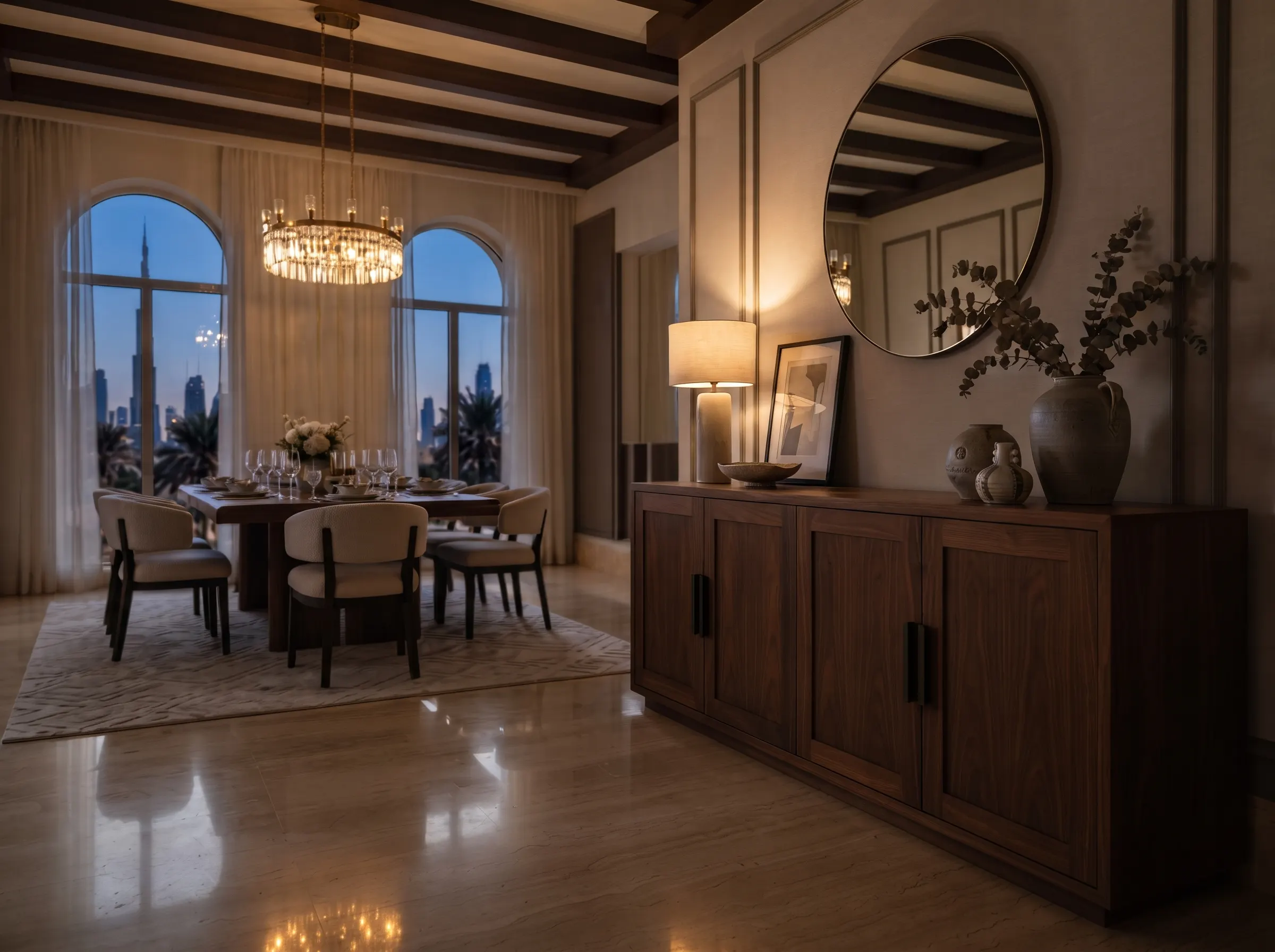
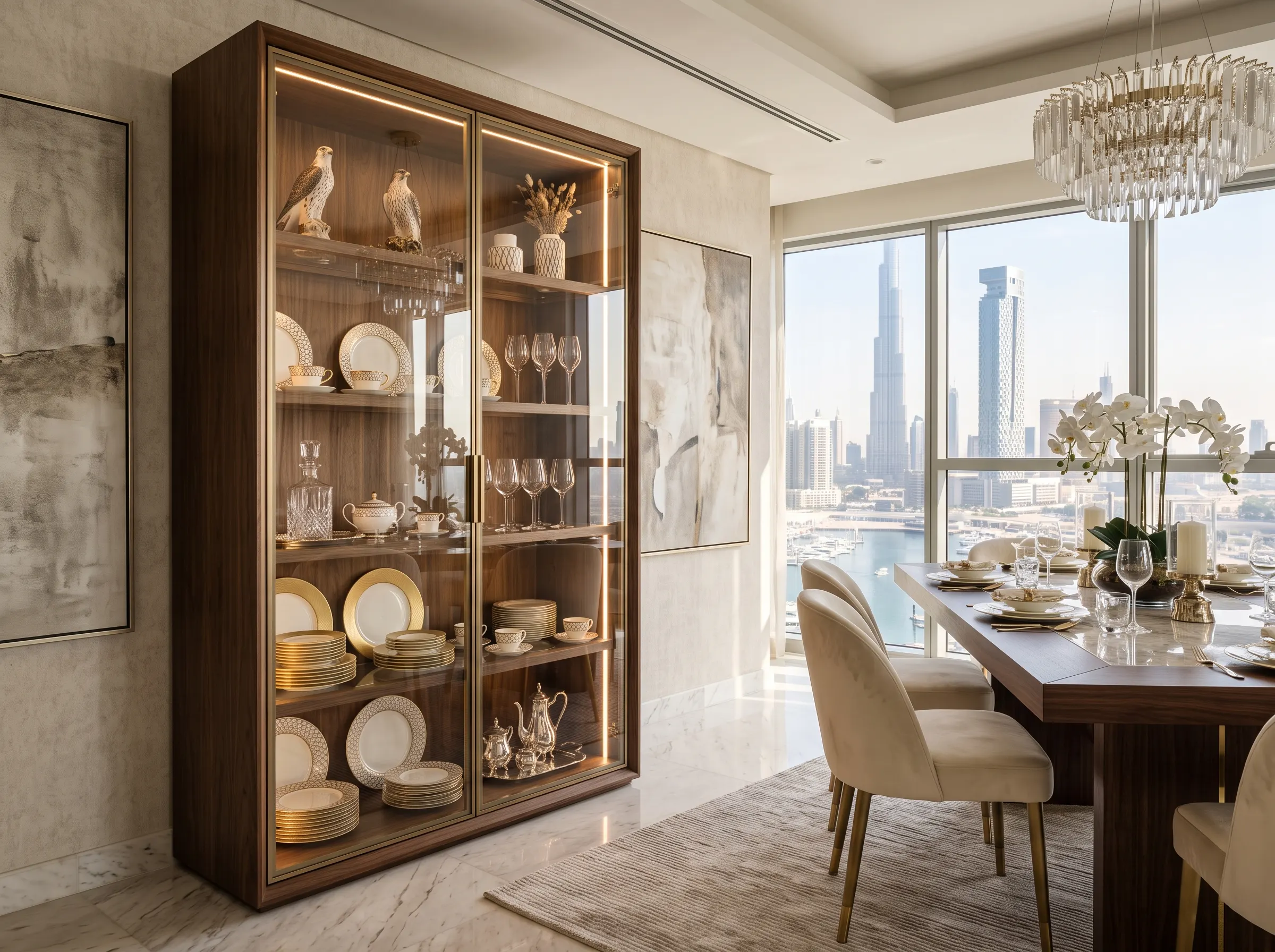
The wall behind or adjacent to your dining table presents opportunity for dramatic built-in storage that serves multiple functions. We create comprehensive systems incorporating closed storage for items you’d rather hide, glass-fronted display for pieces worth showcasing, wine storage with climate control, integrated lighting that enhances ambiance, and serving surfaces at optimal heights for meal presentation.
A recent Business Bay apartment project demonstrates the approach. The dining area shared space with the living room in an open plan configuration. We designed a 4.2-meter floor-to-ceiling unit only 45cm deep that defined the dining zone without blocking light. Lower cabinets with soft-close mechanisms stored table linens and serving dishes. The middle section featured backlit glass shelves displaying the client’s ceramic collection. Upper cabinets with touch-latch doors held seasonal items. A pull-out serving shelf at 90cm height appeared when needed, then disappeared flush with the unit face.
The entire installation incorporated LED strip lighting with dimming control, integrated power outlets for serving equipment, and touch-activated interior lighting within glass display sections. Material choices included white lacquered MDF for the main carcass to maximize light reflection, walnut accents matching the dining table, and bronze-tinted glass shelves for visual warmth.
Banquette Seating with Integrated Storage
Space efficiency matters enormously in Dubai apartments where square meter costs reach astronomical levels. Banquette seating built along windows or walls delivers dual benefits—comfortable seating that doesn’t require circulation space behind chairs, plus substantial storage capacity beneath the seating surface.
We construct banquettes with lift-up seat cushions revealing storage compartments sized for specific items. Deep compartments accommodate bulky serving platters and seasonal decorations. Shallow pull-out drawers organized with custom dividers store flatware and table linens. The seat depth, back angle, and cushion firmness receive as much engineering attention as structural elements because uncomfortable seating defeats the purpose entirely.
For a Jumeirah villa with young children, we built an L-shaped banquette wrapping two walls of their breakfast area. Storage underneath holds toys, art supplies, and outdoor play equipment—items that otherwise scattered throughout the home. The cushions feature removable, washable covers in performance fabric that repels stains. Solid backrests provide proper support while creating a cozy enclosure that children naturally gravitate toward for homework and projects.
Commercial applications take different forms. A café in Dubai Design District wanted European bistro atmosphere with practical UAE requirements. We installed banquette seating along perimeter walls with storage compartments accessed through side panels rather than lifting seats—allowing uninterrupted service during operating hours. Storage holds backup menus, service items, and cleaning supplies. The banquettes accommodate 40% more guests than individual chair arrangements while reducing furniture procurement costs and floor space requirements.
Wine Storage and Display Integration
Serious wine collectors in the UAE face considerable challenges. Improper storage in hot climates ruins expensive bottles rapidly. Our built-in wine storage solutions integrate climate control, proper racking, and display elements that showcase collections while maintaining optimal storage conditions.
We design wine storage as complete environmental systems. Insulated compartments separate wine zones from ambient room conditions. Self-contained cooling units maintain precise temperature and humidity levels regardless of external conditions. Vibration-dampening mounting prevents compressor interference with wine aging. UV-filtering glass doors protect bottles while allowing display visibility.
The capacity ranges from 50-bottle units for casual enthusiasts to 500-bottle walls for serious collectors. A Downtown Dubai penthouse installation included a 12-meter wall of climate-controlled wine storage holding 800 bottles, with sections at different temperatures for reds, whites, and champagnes. Glass doors showcased the collection as living art. Integrated LED lighting with adjustable color temperature allowed the owner to emphasize different bottles for dinner party conversations.
For commercial applications like fine dining restaurants in DIFC, we create accessible wine walls where servers retrieve bottles without entering back-of-house areas. The display becomes theater—guests watch their selection being pulled from the climate-controlled wall, building anticipation and justifying premium pricing. These installations require meeting Dubai Municipality requirements for commercial refrigeration while maintaining visual elegance.
Restaurant and Commercial Dining Carpentry
Commercial dining environments demand carpentry that survives intensive use while maintaining aesthetics that justify pricing and create memorable dining experiences. We’ve completed over 2,400 restaurant and commercial dining projects across the UAE, from quick-service concepts in Dubai malls to Michelin-aspirational fine dining in Abu Dhabi hotels.
High-Volume Restaurant Furniture Engineering
A restaurant table in Dubai Marina serves twelve to fifteen times daily. It supports heavy plates, withstands impacts from dropped items, tolerates cleaning chemicals applied by staff under time pressure, and must look fresh after six months of this treatment. This demands entirely different engineering than residential furniture.
We construct commercial tables with solid hardwood frames joined through mortise-and-tenon joinery reinforced with marine epoxy. Tops use high-pressure laminate over MDF cores when durability trumps aesthetics, or thick veneer over engineered substrates for upscale applications. Every joint receives mechanical fastening plus adhesive bonding because relying on glue alone in commercial stress conditions guarantees failures.
The finish systems employ catalyzed conversion varnishes rated for commercial use, applied in multiple coats with intermediate sanding. These finishes self-heal minor scratches and resist both water and alcohol penetration—critical when servers place cocktails directly on wood surfaces hundreds of times per shift. We recommend refinishing commercial tables every eighteen to twenty-four months to maintain appearance standards, and engineer the pieces for rapid refinishing without full disassembly.
Booth seating presents additional challenges. We build commercial booths with kiln-dried hardwood frames, high-density foam that resists compression, and commercial upholstery that meets UAE fire safety codes while surviving daily cleaning. The wood elements use waterproof finishes because cleaning staff often spray entire booths with sanitizing solutions. Attachment to floor and wall structures must be secure enough to prevent movement when guests lean or push, yet allow removal for annual deep cleaning or reconfiguration.
Café and Quick-Service Environments
Coffee shops and quick-service restaurants face different challenges than full-service dining. Furniture takes harder abuse from higher turnover, requires easier cleaning for rapid table resets, and often needs reconfiguration for different day parts or special events.
We design café furniture with durability-first priorities. Compact tables on single pedestal bases allow easy floor cleaning underneath and quick rearrangement. Solid wood or metal edge banding protects laminate tops from the edge impacts that cause delamination. We avoid stretchers and lower crossbars where customers place feet—these collect dirt and create cleaning difficulties for staff.
The communal tables increasingly popular in Dubai cafés require specific engineering. A 3.6-meter table serving twelve strangers needs adequate leg room, comfortable personal space for laptop work, integrated power access, and acoustic properties that allow conversation without forcing intimacy. We’ve developed modular systems where individual work stations with power and USB access combine into communal arrangements, then separate for private meeting configurations.
A recent project for a specialty coffee chain opening eight Dubai locations demonstrates our systematic approach to café carpentry. We created a complete furniture system—three table sizes that share identical base designs, two seating options optimized for different postures, a modular bar system adaptable to different location layouts, and storage units for retail coffee bags and merchandise. Every component was engineered for flat-pack shipping and tool-free assembly by location staff, yet maintains the sophisticated appearance demanded by their premium positioning.
Server Stations and Back-of-House Integration
Restaurant service quality depends partly on well-designed support areas hidden from guest view. We create server stations, expo areas, and storage solutions that streamline operations while meeting Dubai Municipality health and safety requirements.
Server stations require specific elements—point-of-sale system integration, storage for clean napkins and flatware, trash collection with separate compartments for recycling, and surfaces at appropriate heights for different tasks. We build these as complete units that integrate with restaurant millwork rather than freestanding furniture that creates gaps collecting dirt and pests.
The POS integration matters especially in Dubai where restaurant technology requirements include VAT-compliant billing, multiple payment options, and frequently changing promotional pricing. We create recessed monitor mounting that protects screens from impacts while maintaining visibility. Cable management systems hide power and network connections. Lockable compartments secure cash drawers and backup equipment.
Back-of-house storage for glassware, china, and serving pieces demands different approaches than residential storage. We design for rapid access during service rush periods, easy inventory monitoring for management, and cleaning procedures that meet health code requirements. Commercial-grade drawer slides rated for 50,000 cycles survive years of intensive use. Full-extension slides allow complete visibility into deep drawers. Soft-close mechanisms reduce noise pollution and prevent damage from staff working under pressure.
The Karnak Process for Dining Room Projects
Our systematic approach transforms abstract ideas about dining spaces into completed installations that exceed expectations. This process has evolved across 35 years to address every challenge we’ve encountered, from initial concept development through post-installation support.
Step 1: Comprehensive Space Assessment and Requirements Discovery
We begin every dining project with detailed consultation that goes far beyond measurements and material preferences. Our team needs to understand how you actually use dining spaces, who uses them, what frustrates you about current arrangements, what occasions matter most, and what constraints exist.
For residential clients, we discuss typical guest counts, frequency of entertaining, formality levels you prefer, interaction with other home areas, storage needs for dining-related items, and future changes you anticipate. A young family’s needs differ dramatically from empty nesters planning retirement, which differs from multigenerational households where grandparents live in. These use patterns dictate fundamental design decisions.
We examine existing spaces in detail, documenting exact dimensions, ceiling heights, window and door locations, electrical and data access points, HVAC register positions, structural elements, and lighting conditions throughout the day. We photograph extensively and often create measured drawings on-site using laser measurement tools that ensure accuracy within 2mm. This precision matters because a built-in unit that doesn’t fit perfectly looks amateurish regardless of craftsmanship quality.
For commercial projects, we add operational analysis. We observe service flows during peak periods, interview staff about operational bottlenecks, review customer feedback about seating comfort and space layout, analyze table turnover data, and understand cleaning and maintenance procedures. A restaurant owner might love a particular aesthetic, but if the design creates operational inefficiencies, it undermines business success.
Step 2: Design Development with UAE-Specific Solutions
Design development translates requirements into specific carpentry solutions that address your functional needs while responding to UAE environmental realities and aesthetic preferences. We create detailed drawings, material samples, and often three-dimensional renderings that allow you to visualize completed spaces.
Our design team presents multiple concepts rather than single solutions. Each option addresses core requirements differently, offering trade-offs between cost, aesthetics, functionality, and maintenance requirements. We explain these trade-offs clearly so you make informed decisions rather than choosing blindly based on appearance alone.
The UAE-specific adaptation happens throughout design development. We identify which wood species suit your location’s microclimate. Coastal properties face different challenges than inland locations. Properties with aggressive air conditioning need different humidity buffering than those with moderate systems. We specify finishes rated for Dubai’s UV intensity. We incorporate ventilation behind built-in units to prevent moisture accumulation in humid months.
For a Palm Jumeirah villa project, this meant specifying quarter-sawn white oak rather than the client’s preferred flat-sawn ash because our climate data for that specific location showed humidity swings that would cause unacceptable movement in ash. We created sample boards showing both options with honest assessment of long-term performance expectations. The client appreciated the expertise and selected oak, which has performed flawlessly for four years while ash installations we’ve repaired for competitors in similar locations consistently fail.
Step 3: Material Procurement and Quality Verification
Once design approval occurs, we procure materials through supply relationships developed over three decades. We don’t purchase from general wholesalers or accept whatever arrives from overseas container shipments. Every material receives inspection and verification before acceptance into our workshop.
Hardwood lumber gets evaluated for grain quality, moisture content, defects, and color consistency. We reject boards with excessive knots in visible areas, sapwood intrusion in species where this creates appearance issues, checking or splitting that indicates improper drying, or moisture content outside our 8-12% specification range. This selectivity means we might inspect 100 board feet to find the 60 board feet meeting standards for your project.
Sheet goods like plywood and MDF receive equally rigorous inspection. We verify thickness accuracy because variance creates assembly problems. We check for delamination at edges and cores. We ensure formaldehyde emissions meet E1 or better standards because UAE building regulations increasingly emphasize indoor air quality. For commercial projects requiring fire-rated materials, we verify certification documentation.
Hardware, mechanisms, and finishes come from manufacturers with UAE representation for warranty support. We’ve learned that saving money on imported no-name drawer slides creates service problems when failures occur and no parts availability exists. We specify Blum, Hettich, and Grass mechanisms with local service networks. Finishes come from suppliers who understand UAE climate requirements and can provide technical support for application troubleshooting.
The material selection directly impacts project timeline. Premium figured woods require longer procurement periods than standard grades. Custom hardware might need eight weeks for manufacturing and shipping. We communicate these timelines clearly during design approval so clients can plan accordingly rather than facing surprise delays.
Step 4: Precision Workshop Fabrication
Our 5,000 square meter climate-controlled workshop in Dubai handles complete fabrication using CNC precision for repeatable accuracy and traditional hand skills for details that machines cannot achieve. The combination delivers quality impossible from either approach alone.
Computer-controlled equipment cuts components with accuracy measured in tenths of millimeters. This precision ensures that doors fit perfectly within cases, drawer boxes assemble square without forcing, and joinery components align exactly. We program cutting sequences that optimize material usage, reducing waste that would otherwise increase costs.
Hand skills matter for details that define quality. We hand-select and match wood grain for visual continuity across large surfaces. We hand-cut and fit dovetail joints for drawer construction that will survive decades of use. We hand-sand contoured elements and moldings where machine sanding creates inconsistent results. We hand-apply certain finish techniques like French polishing for clients seeking traditional appearance qualities.
Quality control occurs throughout fabrication rather than as final inspection. Components receive dimensional verification after cutting. Assemblies are checked for square and proper fit before gluing. Finishes are evaluated after each coat application. This continuous verification catches errors when correction remains simple rather than after complete assembly when fixing problems requires disassembly or rebuilding.
Step 5: On-Site Installation and Integration
Installation transforms workshop-fabricated components into integrated dining environments. Our installation teams include carpenters with minimum eight years experience who understand that precision installation matters as much as precision fabrication.
We protect your property extensively during installation. Floor protection goes down before any equipment enters. Dust barriers seal off work areas from occupied spaces. We use dust-extracting power tools that capture 98% of airborne particles. Commercial projects often occur overnight or during closed periods to avoid disrupting operations.
Built-in elements require precise fitting to architectural conditions that never match plans exactly. Walls tilt slightly, floors slope, ceilings vary in height. Our installers measure actual conditions, scribe components to fit perfectly, and use shimming techniques that maintain level and plumb while creating seamless integration with walls and ceilings.
Freestanding furniture like dining tables undergoes final preparation on-site. We level table bases to compensate for floor variations, adjust expansion mechanisms for smooth operation, and apply final polish to surfaces that might have developed minor scuffs during transport. We position furniture exactly where you want it, verify stability on your flooring type, and ensure chairs or other seating elements complement table heights properly.
For complex projects involving electrical integration, lighting, or mechanical elements like motorized components, we coordinate with other trades to ensure proper function. We test all mechanisms repeatedly, verify that lighting creates desired effects, and confirm that control systems operate as specified.
Step 6: Final Inspection and Client Walkthrough
Before considering any project complete, we conduct thorough inspection with clients to verify that every element meets specifications and expectations. This isn’t perfunctory—we genuinely want to identify any concerns while our team remains on-site with tools and materials to address issues immediately.
We demonstrate operation of all mechanisms—drawer slides, door hinges, expansion systems, integrated lighting, or any other functional elements. We explain proper use to prevent damage from incorrect operation. We provide maintenance guidance specific to your installation, covering cleaning products to use and avoid, when to expect service needs, and how environmental changes might affect wood elements.
For commercial installations, we train staff on proper use and care. Restaurant servers learn how to operate expanding tables without damaging mechanisms. Café staff understand how to clean laminate surfaces without damaging edge banding. This training reduces service calls and extends furniture life substantially.
We document completed installations photographically for warranty purposes and our project archives. These images capture condition at installation, providing reference for any future warranty claims or insurance needs. For commercial projects, documentation includes operation and maintenance manuals covering every component and system.
Step 7: Warranty Support and Long-Term Relationship
Our relationship with clients extends far beyond installation completion. We provide comprehensive warranty coverage—five years on structural elements, three years on mechanisms and hardware, two years on finishes. This coverage reflects confidence in our work quality and materials selection.
Warranty service occurs promptly when needed. We maintain service teams separate from production teams specifically for warranty and maintenance work. A service request receives response within 48 hours for assessment, with most issues resolved within one week. Emergency service for commercial clients—like a restaurant with broken table mechanism affecting revenue—occurs within 24 hours.
Beyond warranty periods, we remain available for maintenance, refinishing, and modification services. Dining furniture that receives proper periodic maintenance lasts exponentially longer than neglected pieces. We offer annual maintenance programs for commercial clients and periodic inspection services for residential clients who want professional assessment of their furniture condition.
The long-term relationship often leads to additional projects. Residential clients who initially engaged us for dining room carpentry return for bedroom wardrobes, kitchen renovations, or home office installations. Commercial clients expand to additional locations or upgrade existing installations. These ongoing relationships validate our commitment to quality and service because satisfied clients return repeatedly and refer others regularly.
Why UAE Homeowners and Restaurateurs Choose Karnak for Dining Carpentry
Selecting a carpentry partner for dining spaces involves considerable investment and trust. You’re making decisions that affect daily life or business operations for years or decades. Understanding why clients consistently choose Karnak helps clarify what differentiates genuinely expert carpentry from superficially attractive alternatives.
Three and a Half Decades of UAE-Specific Problem-Solving
We’ve been solving dining carpentry challenges in the UAE since 1988, accumulating knowledge that simply cannot be acquired quickly. We know which imported furniture lines fail within two years in Emirates Hills because we’ve repaired them. We understand which restaurant table configurations maximize revenue in Dubai Marina’s rectangular retail spaces because we’ve tested alternatives. We’ve learned which wood finishing systems survive commercial kitchen environments through trial, error, and refinement over hundreds of installations.
This experience manifests in countless small decisions that collectively determine project success. We know to specify marine adhesives for coastal villa carpentry not from reading product literature but from tracking performance of different adhesives across 847 coastal installations. We recommend specific drawer slide models for humid environments because we’ve analyzed failure patterns across 3,200+ projects. We can accurately predict installation timelines in occupied commercial spaces because we’ve completed 2,400+ restaurant projects and understand exactly how long each operation requires.
When unusual challenges arise—like a client wanting a single-slab dining table exceeding five meters, or a restaurant requiring ada-compliant banquette seating that also maximizes capacity—we draw on archived projects with similar challenges rather than experimenting at your expense. This accumulated knowledge base represents genuine competitive advantage that newer companies cannot replicate regardless of talent or intentions.
Climate-Engineered Solutions That Actually Last
The UAE environment destroys inadequately engineered woodwork with predictable reliability. Furniture that performs perfectly in Europe or North America fails here within months unless specifically adapted. We’ve seen competitors’ installations warp, crack, delaminate, and fall apart because they applied temperate-climate construction methods to tropical-desert conditions.
Our engineering responds specifically to UAE challenges. We account for the 30°C temperature differential between air-conditioned interiors and outdoor loading docks. We understand that coastal humidity varies by neighborhood in Dubai—Palm Jumeirah differs from Emirates Hills which differs from Arabian Ranches. We know that buildings with aggressive air conditioning create different challenges than those with moderate systems.
Material selection reflects this climate knowledge. We specify quarter-sawn lumber that minimizes wood movement. We use moisture-barrier films between wood and wall surfaces. We detail air gaps behind built-in units that prevent moisture accumulation. We recommend climate-controlled wine storage sized appropriately for ambient temperature loads. These specifications come from understanding what fails and why.
The proof appears in performance over time. Dining tables we installed in 1995 still serve families daily. Built-in buffets from 2003 operate smoothly with original hardware. Restaurant furniture from 2008 continues revenue service without structural repairs. This longevity didn’t happen accidentally—it resulted from disciplined engineering based on climate realities rather than optimistic assumptions.
Complete In-House Control From Design Through Installation
We maintain complete control over every project phase through in-house capabilities rather than outsourcing to subcontractors. Design happens in our offices with staff designers. Fabrication occurs in our workshop with our employees using our equipment. Installation uses our installation teams with our vehicles and tools. This vertical integration ensures quality, accountability, and consistency impossible when coordinating multiple independent contractors.
The integration eliminates common failure points. Designers understand workshop capabilities and design accordingly rather than specifying impossible details. Workshop teams understand installation realities and build components that install efficiently. Installation teams provide feedback to designers about site conditions affecting future projects. This continuous improvement cycle operates internally rather than across company boundaries with misaligned incentives.
Quality control becomes straightforward when we control everything. A defect traced to workshop error gets corrected by the same employees who created it, under supervision of managers who trained them and verified their work. Contrast this with outsourced fabrication where identifying responsibility involves contract disputes and finger-pointing between companies with opposed interests.
The business continuity this creates matters for long-term client relationships. When you need service ten years from now, we still exist with access to original project documentation, understanding of what we installed, and ability to fabricate replacement components if necessary. Competitors who outsource fabrication cannot make similar commitments because they depend on subcontractors who might not exist years later.
Portfolio Demonstrating Range and Versatility
Our completed project portfolio spans every dining application—intimate apartment dining nooks, palatial villa formal dining rooms, quick-service cafés, fine dining restaurants, corporate dining facilities, hotel banquet spaces, and everything between. This breadth demonstrates capabilities that extend beyond single specializations.
Residential work includes a Marina apartment where we designed a convertible coffee-to-dining table for a 32 square meter studio, a Jumeirah villa where the dining room accommodates 24 guests with integrated serving and storage walls, and an Arabian Ranches home where dining flows seamlessly into an open kitchen and family area through integrated cabinetry that defines spaces without walls.
Our commercial portfolio includes quick-service concepts like the coffee chain we’ve furnished across eight locations, mid-range restaurants where we’ve created complete environments including furniture and millwork, and upscale fine dining where we’ve crafted individual showpiece tables from rare wood species. We’ve completed hotel banquet furniture for properties across the UAE, understanding the specific durability and configuration requirements these applications demand.
This versatility proves valuable when clients have unusual requirements. Whether you want traditional Arabic dining elements, cutting-edge contemporary design, rustic farmhouse aesthetics, or sophisticated fusion approaches, we’ve executed similar projects successfully and can demonstrate our capabilities through portfolio examples rather than asking you to take chances on unfamiliar territory.
Transparent Processes and Realistic Timelines
We provide clear project timelines with honest assessments of what’s achievable rather than promising unrealistic completion dates to win contracts. A custom dining table requires minimum six weeks for proper execution—three weeks for material procurement and acclimatization, two weeks for fabrication including finishing time, one week for installation coordination and final details. Promising faster delivery requires cutting corners that compromise quality.
Built-in dining carpentry for room renovations typically spans eight to twelve weeks depending on complexity. This includes design development, material procurement, workshop fabrication, installation, and finishing. We break these timelines into specific phases with milestone dates so you understand progress and can plan around construction activities.
For commercial projects, we coordinate with your operational requirements. Restaurants cannot close for months of renovation. We sequence work into phases that minimize disruption, often working during weekdays when homes are less occupied or during restaurant closed periods for commercial work. A full restaurant renovation might occur over six weeks of calendar time but only two weeks of actual closure if properly phased.
We communicate proactively about any delays, explaining causes and providing revised timelines immediately rather than waiting for you to inquire about status. If material procurement extends beyond expected timeframes, you know within days of us discovering this, not weeks later. This transparency allows proper planning and maintains trust even when circumstances beyond our control create delays.
Pricing That Reflects Value Rather Than Minimizing Investment
Quality carpentry costs more than budget alternatives. Premium materials cost more than economy options. Skilled craftspeople command higher wages than unskilled workers. Climate-controlled workshop facilities, advanced equipment, and comprehensive insurance create overhead that competitors operating from industrial yards don’t face. We price our work to sustain quality rather than win contracts through low bidding.
Clients choosing us understand this value equation. They’ve often obtained lower quotes from competitors but recognized that the lower price came with compromises they weren’t willing to accept—inferior materials, rushed timelines, uncertain results, no warranty support, or outright risk of project failure.
Our pricing includes comprehensive services that budget providers charge extra for or ignore entirely. Project includes design development with unlimited revision cycles until you’re satisfied. Materials include full inspection and quality verification. Installation includes site protection, cleanup, and final positioning. Warranty covers materials, labor, and mechanisms comprehensively.
We provide detailed quotations breaking costs into understandable categories—materials, labor, finishing, hardware, installation, project management. This transparency allows informed decisions about where to invest more or accept alternatives rather than facing a single number with no understanding of composition. If budget constraints exist, we can discuss specific modifications that reduce costs while minimizing impact on quality or functionality.
Relationships with UAE’s Design and Construction Communities
We’ve collaborated with virtually every significant architecture and interior design firm operating in the UAE. These relationships create efficiencies when designers specify our work because they understand our capabilities, trust our execution, and communicate in shared technical language that prevents misunderstandings.
For clients working with designers or architects, our existing relationships streamline coordination. We speak the same technical language, understand design intent from drawings and specifications, and know how to collaborate constructively when site conditions require modifications to original plans. We provide detailed shop drawings that meet design firm standards for clarity and completeness.
We also maintain relationships with other trades—contractors, electricians, plumbers, HVAC technicians, painters, stone fabricators, glass suppliers. These relationships facilitate coordination on complex projects where multiple trades interact. When our built-in buffet requires electrical outlets integrated seamlessly, we coordinate with electricians we’ve worked with previously who understand our standards and expectations.
The construction community recognizes quality work. General contractors often recommend us to clients seeking carpentry expertise because they know we’ll execute properly, coordinate professionally, and resolve issues constructively rather than creating problems for overall project completion. This reputation enhances your project’s quality regardless of who else participates.
Recent Dining Room and Restaurant Projects Across UAE
Our project portfolio demonstrates the range, quality, and versatility clients can expect when engaging Karnak Carpentry. Each project presented unique challenges that required specific solutions informed by client requirements, site conditions, and our accumulated expertise.
Emirates Hills Villa – Family Dining for 18 A multigenerational family needed formal dining space for regular Friday gatherings averaging fourteen to eighteen family members. We created a 4.2-meter solid walnut table with integrated butterfly leaves expanding to 5.4 meters. The table sits on a bronze-finished steel trestle base providing uninterrupted leg room. Matching buffet storage spans the north wall with climate-controlled wine storage for 120 bottles, serving counter at optimal height, and display lighting showcasing family heirlooms. Timeline: eleven weeks from design to installation. The family has hosted over 200 Friday gatherings since installation in 2019 without any service requirements.
DIFC Fine Dining Restaurant – 65 Covers An upscale Italian concept required furniture supporting their premium positioning while surviving intensive service. We created forty custom tables in five sizes allowing flexible configurations from two-tops to parties of ten. Each table features book-matched oak veneer over engineered cores, commercial-grade polyurethane finish system, and bases designed for stability on the restaurant’s polished concrete floor. Banquette seating along perimeter walls accommodates twenty-six additional covers with integrated storage accessed through side panels. Timeline: sixteen weeks from contract to opening night. After two years and approximately 85,000 served guests, furniture maintains showroom condition with only scheduled refinishing.
Business Bay Apartment – Convertible Dining Solution A young professional in a 65 square meter apartment needed dining for six when entertaining but didn’t want a permanent table dominating limited space. We engineered a console table normally positioned against the wall that extends and unfolds into a proper dining table seating eight. Storage within the console base holds leaves, extra chairs fold flat in the bedroom closet we also designed. The mechanism operates smoothly enough for solo deployment in under ninety seconds. Materials include white oak with matte lacquer finish. Timeline: seven weeks. Client reports using the dining configuration two to three times monthly with storage configuration serving daily.
The Springs Villa – Open-Plan Dining Integration A family renovating their villa wanted contemporary open-plan living but needed visual definition between dining and family areas without walls. We designed a floor-to-ceiling shelving unit positioned between spaces, creating separation while maintaining visual connection. The unit features open shelving on the family room side displaying books and decorative items, closed storage on the dining side holding table linens and serving pieces. The dining table spans 3 meters in sustainable teak with oil finish emphasizing natural grain. Six matching chairs in leather seats provide comfort for extended meals. Timeline: thirteen weeks for complete installation including coordination with villa renovation contractor.
Jumeirah Beach Residence – Coastal Dining for Salt Air Environment A beachfront apartment required dining furniture that could withstand salt air penetration and humidity extremes from the direct coastal location. We specified quarter-sawn white oak for maximum stability, marine-grade finishing systems with UV inhibitors, and stainless steel hardware throughout. The dining table seats eight with expansion to ten, engineered specifically for the 1.5 meter cantilever over the pedestal base the client wanted for unobstructed views. Built-in storage along the entry wall uses moisture-barrier backing and internal ventilation channels preventing humidity accumulation. Timeline: nine weeks. After four years in this challenging environment, the installation shows zero salt damage, warping, or finish deterioration.
Arabian Ranches – Transitional Dining with Mashrabiya Details Clients wanted contemporary functionality with Arabic design elements honoring cultural heritage. We created a dining ensemble featuring a 3.6-meter table in dark walnut, a buffet wall incorporating mashrabiya-inspired geometric screen panels that conceal storage while creating visual interest, and custom seating with upholstered backs featuring traditional textile patterns in contemporary colors. LED lighting behind the mashrabiya screens creates dramatic shadows on the wall behind. The fusion approach delivers cultural authenticity without pastiche. Timeline: fourteen weeks including custom metalwork for screen elements.
Dubai Marina Café – Quick-Service Furniture System A specialty coffee shop needed furniture that looked residential for ambiance but survived commercial use and allowed rapid reconfiguration for private events. We developed modular tables—individual units for one person, two-person tables, and four-person squares. Each features integrated power outlets and USB ports for laptop users. Bases use weighted pedestals for stability without floor attachment. Tops combine wood veneer aesthetic with commercial laminate durability. The complete system furnishes the 95 square meter café with flexibility to arrange as communal seating, individual work stations, or cleared space for evening events. Timeline: twelve weeks for design, fabrication, and installation across two locations simultaneously.
Downtown Dubai Penthouse – Sculptural Dining Table An art collector wanted a dining table that functioned as sculpture while serving meals for eight to ten guests. We sourced a 4.1-meter African mahogany slab with dramatic live edges and figured grain. The tree fell naturally in a storm—we verified sustainability documentation. We stabilized the slab through controlled drying over nine months, filled natural voids with color-matched epoxy, and crafted a bronze base that appears to float the 180kg slab effortlessly. The installation required crane access to the penthouse balcony because the completed table couldn’t fit through doorways. Timeline: seven months from slab selection to installation. The table has been featured in two design publications and creates conversation at every dinner party.
Abu Dhabi Hotel – Banquet Hall Modular System A five-star hotel needed banquet furniture serving groups from twenty to 400 guests in various configurations. We created a modular system with round tables seating eight or ten, rectangular tables for head table configurations, and specialized units that combine into buffet serving stations. Every component includes leveling feet for stability on carpeted floors, edge protection preventing textile damage, and finish systems surviving intensive use and commercial cleaning chemicals. Storage carts we designed allow banquet staff to reconfigure rooms rapidly. Timeline: twenty-two weeks for complete system across three banquet spaces. The hotel has processed over 1,200 events since installation with only routine maintenance required.
Sharjah Villa – Traditional Arabic Floor Dining A family maintaining cultural dining traditions needed a contemporary interpretation of traditional floor seating. We created a low platform with integrated cushion storage, low tables in traditional proportions crafted from carved dark wood, and atmospheric lighting creating intimate ambiance. The space converts to standard modern function for visitors unfamiliar with floor dining through tables that lower into the platform and chairs that deploy from adjacent storage. The dual functionality preserves tradition while accommodating diverse guests. Timeline: ten weeks. The family reports using traditional configuration for family meals and modern setup for international guests.
Dining Room Carpentry Questions - Expert Answers
Quality dining tables incorporate engineering principles addressing structural stability, material behavior in climate conditions, joinery integrity, and finish durability that budget alternatives ignore. The differences appear most clearly over time rather than at initial purchase. Structural engineering determines whether a table remains flat and stable over years or develops sag, twist, and joint failures. Quality tables use properly dried hardwood lumber, engineered cores that eliminate seasonal movement, and joinery techniques creating mechanical strength beyond adhesive bonding alone. Budget tables often use inadequately dried wood that continues shrinking after assembly, particleboard cores that sag under sustained loads, and simple butt joints relying entirely on glue that fails when moisture or movement creates stress.
Material selection for UAE conditions specifically determines performance. Quality tables specify wood species and construction methods proven in our climate through decades of installation history. We know which species tolerate humidity swings, which finishes survive UV exposure, which adhesives maintain bonds in temperature extremes. Budget manufacturers typically import designs and construction methods optimized for temperate climates without adaptation, leading to predictable failures in UAE environments.
Finish systems represent another critical distinction. Quality finishing involves multiple preparation steps, premium finish materials, proper curing times, and protective top coats creating durable surfaces. Budget finishing rushes through fewer steps with economy materials, creating surfaces that scratch easily, absorb moisture, and deteriorate rapidly. The visual difference appears subtle initially but becomes dramatic within months of normal use.
The joinery techniques connecting table tops to bases, leaves to main surfaces, and structural elements to each other determines long-term integrity. Quality joinery uses mortise-and-tenon joints, dovetails, pocket screws, and mechanical fasteners creating connections stronger than the wood itself. Budget joinery relies on simple butt joints with staples or brads that pull out when wood movement or use stress occurs.
Realistic timelines for custom dining carpentry typically span eight to sixteen weeks from initial consultation through final installation, varying based on project complexity, material procurement requirements, and workshop schedule. Understanding these timelines helps plan effectively rather than facing frustration from unrealistic expectations.
Initial design development usually requires two to three weeks. This includes our initial consultation and space assessment, developing preliminary design concepts, reviewing options with you, refining the selected approach, and finalizing specifications and quotations. Clients who make decisions quickly can compress this phase; those who need time considering options or coordinating with other household members or designers might extend it. We don't rush these decisions because mistakes here create expensive problems later.
Material procurement adds two to four weeks depending on specifications. Standard hardwood species in common dimensions ship from our regular suppliers within days. Figured or exotic woods might require four to six weeks for sourcing and delivery. If you select specific slabs that need additional drying to reach optimal moisture content, add two to three months. Hardware and mechanisms typically arrive within two weeks unless you specify specialized items requiring custom manufacturing.
Workshop fabrication spans three to five weeks for typical dining projects. A straightforward dining table requires minimum three weeks—one week for cutting, assembly, and initial finishing steps, one week for finish curing and additional coats, one week for final finishing, quality control, and preparation for delivery. Complex built-in projects with multiple components, integrated lighting, or specialized features might extend to six or eight weeks.
Installation scheduling depends on project complexity and your availability. Simple furniture delivery and positioning occurs in hours. Comprehensive built-in installations might require three to five days including preparation, installation, finishing touches, and cleanup. We schedule installations to minimize disruption, often working during weekdays when homes are less occupied or during restaurant closed periods for commercial work.
For projects requiring coordination with other trades or construction activities, add coordination time. If electrical work must occur before our installation, or painting must follow our work, these interdependencies extend overall timelines. We manage these schedules proactively but cannot eliminate time required for proper sequencing.
We regularly match existing furniture or adapt our work to specific design directions, though success requires understanding both possibilities and limitations of matching efforts. Perfect matches require access to original pieces for detailed analysis, while design integration demands clarity about aesthetic goals and flexibility within stylistic parameters.
Matching existing furniture precisely means replicating wood species, grain patterns, color tones, finish sheens, construction details, and hardware styles. We can achieve close matches when we can examine existing pieces directly, take samples for analysis, and when the original used standard materials still available. If your existing furniture uses discontinued wood species, obsolete hardware, or finishing techniques no longer practiced, perfect matching becomes impossible and we'll explain limitations honestly during consultation.
Wood species matching presents different challenges depending on what you're trying to match. Common species like oak, walnut, or maple allow excellent matches. Exotic or rare species might require substitutions with similar appearance characteristics. We maintain extensive wood sample libraries showing various species and cuts, allowing you to assess matching potential before committing to projects.
Color matching requires understanding that wood color varies naturally within species and changes over time with light exposure. The walnut furniture you purchased ten years ago has darkened and developed patina that new walnut won't replicate immediately. We can stain new pieces to approximate aged color, though perfect matches remain elusive. We recommend accepting close coordination rather than demanding perfect matches that might require extensive finishing manipulation looking artificial.
Design style integration works differently than matching specific pieces. If you want contemporary, traditional, transitional, rustic, minimalist, or fusion aesthetics, we adapt our work to those directions while incorporating our engineering standards and material selection appropriate for UAE conditions. We've executed successful projects in virtually every design style, drawing on portfolio examples to demonstrate capabilities.
For projects involving collaboration with interior designers or architects, we work from their specifications and drawings, translating design intent into buildable carpentry while maintaining our quality standards. We provide feedback when designs present construction challenges or performance concerns, proposing alternatives that preserve aesthetic intent while ensuring successful long-term results.
Pricing for custom dining carpentry reflects multiple factors including material costs, labor complexity, hardware and mechanism specifications, finishing requirements, project timeline, and installation complexity. Understanding these components helps evaluate quotations intelligently rather than selecting based solely on total numbers.
Material costs vary dramatically based on species selection and quality grades. Sustainable teak costs three to four times more than oak. Figured or book-matched veneers cost five times more than plain-sawn alternatives. Exotic species with limited availability command premium pricing. Sheet goods range from economy particleboard to premium plywood to specialized marine substrates, each with appropriate applications and cost implications.
Labor complexity determines fabrication time and therefore cost. A simple rectangular table with straight edges requires perhaps forty hours of workshop labor. A table with curved edges, integrated extension mechanisms, complex base designs, or specialized joinery might require 80 to 120 hours. Built-in projects with extensive storage, integrated lighting, or custom features can exceed 200 labor hours. We estimate labor based on project drawings and specifications, explaining how complexity drives cost.
Hardware and mechanisms represent substantial cost components often underestimated. Premium drawer slides cost AED 150 to 400 per drawer depending on size and weight rating. Soft-close door hinges run AED 80 to 150 per door. Table extension mechanisms range from AED 800 for basic systems to AED 4,000 for commercial-grade mechanisms supporting heavy tops. We specify quality hardware that justifies cost through reliability and longevity rather than economy alternatives that create service problems.
Finishing requirements significantly impact pricing. Basic stain and clear coat finishing might add 15% to base costs. Hand-rubbed oil finishes requiring multiple applications and extensive labor might add 30%. Specialized finishes like French polishing or automotive-grade catalyzed systems can add 40% to 50%. Commercial finishing systems rated for restaurant use cost more than residential alternatives but deliver durability justifying premium pricing.
Installation complexity varies from simple furniture delivery to comprehensive built-in projects requiring electrical coordination, structural attachment, and finish carpentry. Simple delivery and positioning might cost AED 500 to 1,000. Complex installations requiring multiple days, specialized equipment, or coordination with other trades might run AED 5,000 to 15,000. We quote installation separately from fabrication so you understand complete project costs.
Project timeline affects pricing through workshop scheduling efficiency. Projects allowing flexible timelines we can slot into optimal workshop scheduling cost less than rush projects requiring overtime labor or schedule disruption. We're transparent about rush charges and timeline flexibility, allowing you to make informed decisions about whether accelerated completion justifies additional cost.
Our warranty coverage reflects confidence in our work quality and provides meaningful protection should issues occur. We offer five-year warranty on structural elements, three-year warranty on mechanisms and hardware, and two-year warranty on finishes, with specific coverage details documented at project completion.
Structural warranty covers the fundamental integrity of tables, cabinets, and built-in elements. If a table top develops sag, a cabinet frame develops twist, or joinery fails under normal use conditions, we repair or replace affected components at no charge. This warranty excludes damage from abuse, modifications by others, or exposure to conditions beyond normal residential or commercial use. For commercial installations, we define "normal use" specifically for each application—restaurant furniture receives higher use rating than residential pieces.
Mechanism and hardware warranty covers drawer slides, door hinges, extension mechanisms, and similar functional components. These items have finite operating life—drawer slides rated for 50,000 cycles will eventually wear out. Our warranty covers failures within rated specifications during the warranty period. We use premium mechanisms from manufacturers with UAE service support, ensuring parts availability if warranty service requires component replacement.
Finish warranty covers delamination, excessive wear under normal use, and manufacturing defects in finish application. This warranty excludes damage from harsh chemicals, heat exposure beyond specified limits, or physical abuse. For commercial installations subject to intensive use, we recommend scheduled refinishing every 18 to 24 months as maintenance rather than warranty work.
Service response occurs promptly when warranty claims arise. Contact our service department through phone, email, or website. We respond within 48 hours to assess claims, usually requesting photos documenting concerns. For issues clearly covered under warranty, we schedule service within one week for residential projects, within 24 to 48 hours for commercial projects where downtime affects revenue.
Warranty service might involve on-site repair, workshop repair requiring component removal, or complete replacement depending on issue nature and severity. We cover all costs for warranty work including labor, materials, and transportation. For issues requiring workshop repair, we often provide temporary solutions minimizing inconvenience during repair periods.
Beyond warranty periods, we remain available for service, maintenance, refinishing, and modification work. Many clients appreciate having reliable service access rather than searching for qualified technicians unfamiliar with their installations. We maintain project documentation indefinitely, allowing us to reference original specifications and construction details years after installation.
Annual maintenance programs available for commercial clients include scheduled inspection, adjustment, cleaning, and minor repair work maintaining optimal appearance and function. These programs often prevent major problems by catching minor issues early. Restaurants and hotels appreciate the operational reliability this preventive maintenance provides.
UAE climate challenges include extreme heat, aggressive air conditioning creating rapid temperature swings, humidity fluctuations particularly in coastal areas, intense ultraviolet radiation, and dust infiltration. Tables engineered for these conditions use specific material selections, construction techniques, and finishing systems addressing each challenge systematically.
Wood movement from humidity fluctuations represents the primary climate challenge. Wood expands when humidity increases, contracts when it decreases. UAE buildings cycle air conditioning aggressively, creating rapid humidity changes that stress wood severely. Tables using solid wood tops without proper engineering develop cracks along grain lines, gaps at joints, and cupping across width.
We address movement through several approaches depending on design requirements. Quarter-sawn lumber exhibits minimal movement compared to flat-sawn alternatives because growth ring orientation affects expansion direction. Engineered cores eliminate movement entirely—plywood or MDF substrates wrapped in premium veneers deliver solid wood appearance with dimensional stability. For solid wood tops, we orient grain direction carefully, allow controlled expansion room at joints, and use specialized fastening allowing movement without joint failure.
Heat exposure affects both wood and finishes. Direct sunlight through windows can heat table surfaces to 50°C or higher. Wood itself tolerates this, but finishes can soften, discolor, or craze under sustained heat. We specify finishes with UV inhibitors preventing yellowing and high heat resistance maintaining integrity under temperature extremes. For tables positioned where direct sunlight hits regularly, we recommend heat-resistant finishes originally developed for outdoor furniture or marine applications.
Humidity control in coastal locations requires additional measures. Salt air penetrates even well-sealed buildings in areas like Palm Jumeirah, JBR, or Dubai Marina. We specify marine-grade adhesives that resist moisture better than standard wood glues. We apply moisture barrier films on surfaces facing walls or other elements where airflow is restricted. We detail air gaps allowing ventilation behind built-in elements preventing moisture accumulation.
Finish systems designed for UAE conditions use multiple coats with proper curing times between applications. We start with sealers preventing moisture penetration into wood substrate. We apply build coats creating smooth, filled surfaces. We finish with protective top coats providing hardness and chemical resistance. Each coat requires specific environmental conditions and curing time—rushing finishing guarantees problems.
Dust infiltration affects appearance and function of moving parts. Drawer slides collect dust creating grinding sounds and operating resistance. We specify sealed drawer slide mechanisms when budget allows, or design dust shields protecting slides in standard installations. We detail cabinets and built-ins with proper sealing at edges and backs preventing dust accumulation in internal cavities.
The combination of these engineering details creates tables that maintain structural integrity, appearance, and function through years or decades in UAE environments. Skipping any element creates vulnerability that climate will exploit predictably.
Space constraints challenge functionality more than our fabrication capabilities. We've created successful dining solutions for Dubai studio apartments under 40 square meters, awkwardly shaped alcoves in converted heritage properties, and commercial spaces with structural columns interrupting ideal layouts. Success requires creative problem-solving focused on your specific spatial limitations and functional requirements.
Convertible furniture solves common small-space challenges. We design console tables that extend into full dining tables, coffee tables that elevate to dining height, and wall-mounted drop-leaf tables that fold completely flat when not in use. These solutions preserve space for non-dining activities while providing proper dining functionality when needed. The mechanisms must operate smoothly enough for regular use, store compactly, and lock securely when deployed.
A Marina apartment project exemplifies this approach. The client had a 55 square meter studio with an awkward alcove too small for permanent dining furniture but too prominent to waste. We created a wall-mounted table that folded flat showing only 12cm depth. When deployed for dining, it extended to seat six people with a solid support structure preventing wobble or flex. Storage in the adjacent cabinet held folding chairs. The client uses dining configuration two to three times weekly for entertaining, storage configuration the remainder of time.
Custom sizing optimizes space usage that standard furniture cannot. If your dining area measures 2.8 meters wide, standard tables either waste space or don't fit properly. We build tables to precise dimensions maximizing your space. Similarly, built-in banquettes fit exact wall lengths, turn corners efficiently, and utilize spaces too small or awkwardly shaped for freestanding furniture.
Multi-functional design addresses small-space realities. We've created dining tables with storage drawers for items normally requiring separate furniture. We've built kitchen islands with dining extensions saving space compared to separate elements. We've designed home office desks that convert to dining tables when guests visit. Each solution addresses specific client requirements rather than applying generic space-saving ideas.
Awkward architectural elements like columns, soffits, or angled walls create challenges and opportunities simultaneously. Columns might define zones between dining and adjacent spaces. Soffits can incorporate lighting illuminating dining areas. Angled walls might accommodate custom-shaped built-ins maximizing storage. We analyze your specific architectural conditions identifying opportunities rather than simply accepting constraints.
Visual techniques can make small spaces feel larger while maintaining functionality. Light-colored woods and finishes reflect light making spaces feel open. Glass table tops create transparency that freestanding solid tops cannot. Pedestal bases provide visual openness compared to four-leg alternatives. We apply these principles strategically based on your priorities between visual spaciousness and practical considerations.
We collaborate regularly with design professionals, having worked with virtually every significant architecture and interior design firm operating in the UAE over our 35-year history. These collaborations benefit projects through complementary expertise—designers define aesthetic vision and spatial planning, we provide technical expertise and fabrication execution.
Our collaboration process typically begins when designers specify custom carpentry in project plans. We receive drawings, specifications, and material selections developed during design phases. We review these documents for buildability, providing feedback about potential construction challenges, alternative approaches achieving similar aesthetic results with better performance, and cost implications of specific design decisions.
We prepare detailed shop drawings translating design intent into fabrication-ready specifications. These drawings show precise dimensions, construction details, hardware specifications, finish systems, and installation methods. Design firms review shop drawings to verify alignment with design intent before we proceed to fabrication. This review process prevents misunderstandings that create expensive corrections during installation.
For complex projects involving coordination with multiple trades, we participate in coordination meetings ensuring our work integrates properly with electrical, mechanical, architectural, and other elements. We identify potential conflicts early when resolution remains straightforward rather than discovering problems during installation when fixes become expensive and disruptive.
We maintain direct communication with designers throughout fabrication and installation, providing progress updates and addressing questions or issues promptly. We document any field conditions requiring design modifications, obtain approval before proceeding, and track changes systematically preventing later confusion about what was actually built.
When clients approach us without designer involvement, we provide design services as part of our complete project execution. Our staff designers develop concepts, create renderings, specify materials, and detail construction methods. For clients who value our technical expertise but want aesthetic guidance from specialized designers, we recommend design professionals from our extensive network of collaborators.
The designer relationship extends beyond individual projects. We maintain ongoing communication with design firms we work with regularly, sharing information about new capabilities, material options, and technical developments. Designers appreciate knowing our capabilities when developing concepts, allowing them to specify solutions confidently knowing we can execute them successfully.
Climate-controlled wine storage represents specialized carpentry requiring integration of refrigeration systems, precise humidity control, vibration dampening, UV protection, and proper insulation—all engineered to maintain optimal wine storage conditions regardless of extreme UAE ambient temperatures.
Wine storage demands specific environmental parameters—temperature between 12-14°C for long-term storage, humidity around 70% preventing cork drying, darkness or UV-filtered light preventing light damage, and vibration-free conditions allowing proper aging. UAE ambient conditions violate every parameter—temperatures exceeding 45°C outdoors and 22-24°C in air-conditioned interiors, humidity swinging from 20% to 80%, intense sunlight, and HVAC vibration throughout buildings.
We design wine storage as complete environmental isolation systems. The storage cabinet or room receives insulation separating it from surrounding conditions. We specify minimum R-15 insulation values for walls and doors, ensuring internal conditions maintain stability regardless of external temperature fluctuations. Proper insulation also improves energy efficiency, reducing the cooling load required to maintain target temperatures.
Self-contained refrigeration units specifically designed for wine storage provide cooling and humidity control. These units differ from standard refrigeration—they cycle less frequently to minimize temperature swings, incorporate humidity control preventing the excessive drying common in standard refrigerators, and use vibration-dampened compressors that don't disturb wine during aging. We size cooling units based on storage volume, ambient conditions, door opening frequency, and insulation values.
Racking systems organize bottles while protecting them from vibration and light exposure. We build racks from hardwoods or metal with proper spacing allowing air circulation around bottles. Individual bottle storage in diamond or rectangular configurations suits varied collection sizes. Bulk storage for cases works differently, requiring shelf depths accommodating standard case dimensions. Display storage incorporates glass fronts with UV filtering allowing visibility while protecting contents.
Lighting within wine storage uses LED systems producing minimal heat and incorporating UV filters. We design lighting with multiple zones allowing illumination of specific sections rather than the entire storage area, minimizing light exposure to bottles not being viewed. Control systems integrate dimming and timing functions preventing excessive light exposure.
For serious collectors wanting walk-in wine cellars, we design complete rooms with vapor barriers preventing moisture intrusion, proper door sealing maintaining environmental separation, and multiple cooling units for redundancy. These installations might maintain 500 to 2,000 bottle collections with separate temperature zones for reds, whites, and champagnes.
Commercial restaurant wine walls serve different purposes than residential storage. They must display wine attractively while maintaining storage conditions, allow easy server access during service, and meet Dubai Municipality commercial refrigeration requirements. We create solutions balancing aesthetic display with functional storage and regulatory compliance.
The investment in properly engineered wine storage protects valuable collections and provides proper aging conditions allowing wines to develop as intended. Inadequate storage in UAE conditions can destroy expensive bottles within months through heat damage, cork drying, or light exposure.
Proper maintenance extends furniture life dramatically while preserving appearance and function. We provide specific maintenance guidance for each installation based on materials, finishes, mechanisms, and use patterns, though general principles apply across most dining carpentry.
Daily maintenance involves basic cleaning removing food debris, spills, and dust before they cause damage. We recommend soft cloths dampened with water for routine cleaning, avoiding harsh chemicals that damage finishes. Spills should be wiped immediately preventing moisture penetration or staining. Avoid placing hot items directly on wood surfaces unless specifically designed for heat resistance—use trivets or protective pads.
For finished wood surfaces, periodic application of furniture polish or wax maintains finish luster and provides additional protection. We recommend products specifically formulated for the finish type on your furniture—products for oil finishes differ from those for polyurethane or lacquer finishes. Application frequency depends on use intensity—residential dining tables might need polishing monthly, commercial tables might benefit from weekly treatment.
Moving parts like drawer slides and door hinges benefit from periodic lubrication maintaining smooth operation. We use dry lubricants or silicone-based products avoiding oils that attract dust. Application once or twice yearly for residential furniture, quarterly for commercial installations provides adequate maintenance. During lubrication, we check for loose screws or mounting hardware, tightening as necessary.
Wood furniture in UAE conditions requires monitoring for signs of movement or stress. Check for gaps appearing at joints, surfaces developing slight bowing or cupping, or drawers becoming difficult to operate. These signs might indicate humidity-related movement requiring professional assessment. Early intervention prevents minor issues from becoming major problems requiring extensive repair.
Built-in units benefit from annual inspection of attachment points ensuring secure connection to walls and floors. Check for signs of water intrusion behind units, particularly in kitchen or coastal locations. Verify that internal lighting operates properly and hasn't developed flickering or other problems indicating electrical issues requiring attention.
Refinishing extends furniture life when surfaces show wear beyond what normal cleaning addresses. Dining tables in residential use typically need refinishing every eight to twelve years depending on use intensity and care. Commercial restaurant tables might need refinishing every eighteen to thirty months. We offer refinishing services that can restore severely worn surfaces to like-new condition, often for 20-30% of replacement cost.
For commercial installations, we recommend annual professional maintenance inspection and service. Our technicians assess condition, perform adjustments and repairs, provide cleaning and polishing, and identify potential problems before they affect operations. This preventive maintenance approach costs far less than emergency repairs or premature replacement.
We provide detailed maintenance instructions specific to each installation at project completion, covering recommended cleaning products, procedures for moving or adjusting elements, lubrication requirements, and signs indicating professional service needs. Following these guidelines preserves your investment and maintains optimal appearance and function.
We regularly create contemporary interpretations of traditional Arabic dining elements, from floor-level majlis dining setups to carved screens incorporating geometric or calligraphic patterns to furniture featuring traditional joinery and decorative techniques. Success requires balancing cultural authenticity with modern functionality and comfort.
Traditional Arabic floor dining creates specific challenges adapting to contemporary lifestyles. Historic practice used low platforms with cushions for seating and low tables for food service. Modern interpretations must accommodate users accustomed to chair-height seating while preserving traditional aesthetics for those who prefer authentic experience. We design convertible systems where traditional elements lower into recessed platforms revealing standard dining configurations when needed, or create side-by-side zones offering both options.
Carved decorative screens incorporating mashrabiya geometric patterns or Arabic calligraphy add cultural identity while serving functional purposes—dividing spaces, controlling light, creating privacy, or simply providing visual interest. We execute these elements through traditional hand-carving for ultimate authenticity when budgets allow, or through CNC precision cutting delivering excellent results at lower cost. The choice depends on visibility distance and client priorities between absolute authenticity versus practical considerations.
Traditional Arabic furniture often featured specific wood species—walnut, cedar, teak—and incorporated inlay work, carved details, and specific joinery techniques. We recreate these characteristics using historically appropriate methods when replication serves project goals. For heritage restoration projects or clients prioritizing cultural authenticity, we invest in traditional techniques. For projects seeking traditional aesthetics with modern performance, we adapt traditional appearance to contemporary engineering standards.
Color palettes, finish techniques, and decorative hardware contribute to traditional character. We source or custom-fabricate hardware matching historic styles when standard modern hardware would compromise authenticity. We apply traditional oil finishes or French polishing techniques when these deliver desired appearance, or use modern finish systems mimicking traditional appearance while providing superior durability.
Integration of traditional elements with contemporary design requires nuanced understanding of both aesthetics. A room mixing traditional Arabic carved screens with minimalist contemporary furniture can achieve sophisticated fusion or awkward confusion depending on execution quality. We provide design guidance helping clients achieve coherent results honoring cultural heritage while embracing modern lifestyle requirements.
For heritage properties or historically sensitive renovations, we coordinate with conservation authorities ensuring our work meets preservation standards. We document existing conditions, propose interventions matching historical construction methods and materials, and execute work under supervision when required by heritage regulations.
Sustainable dining furniture addresses environmental impact through material sourcing, manufacturing processes, longevity design, and end-of-life considerations. We offer multiple approaches to sustainability based on client priorities and project requirements.
FSC-certified wood comes from forests managed according to environmental and social standards verified through chain-of-custody documentation. We source FSC-certified lumber for clients prioritizing sustainable forestry, accepting the premium cost FSC certification adds. Availability varies by species—common species like oak readily available with FSC certification, exotic species sometimes limited. We maintain relationships with suppliers providing certified materials and documentation.
Reclaimed wood salvaged from demolished buildings, old boats, or fallen trees provides material with zero forest impact while offering character impossible in new lumber. We've created dining tables from teak salvaged from abandoned fishing vessels, oak from demolished European barns transported to UAE, and local acacia from storm-damaged trees. Reclaimed material requires extensive preparation removing hardware, cleaning, milling to usable dimensions, and addressing defects, adding cost compared to new lumber while delivering unique character and sustainability benefits.
Locally sourced materials reduce transportation environmental impact though UAE local species options remain limited. We identify opportunities for regional sourcing when project requirements allow—stone elements from UAE quarries, metal fabrication from local suppliers, hardware from regional distributors. Complete local sourcing remains impossible for hardwood carpentry given UAE's limited forest resources, but we minimize transportation impact where feasible.
Low-VOC finishes reduce indoor air quality impact and manufacturing emissions. We specify water-based finishes and natural oil finishes for clients prioritizing air quality, explaining performance trade-offs compared to catalyzed systems. Technology improvements have narrowed performance gaps, though catalyzed systems still excel for commercial applications requiring maximum durability.
Longevity represents perhaps the most significant sustainability contribution. Furniture lasting fifty years has far lower environmental impact per year of use than pieces requiring replacement every five years. Our engineering for UAE climate, quality materials selection, and superior construction creates furniture that lasts generations rather than years. This durability exceeds any sustainability benefit from material choices in shorter-lived alternatives.
End-of-life considerations increasingly matter for sustainability-conscious clients. We design furniture for eventual disassembly and material recovery rather than permanent assembly creating disposal challenges. Mechanical fasteners allow disassembly; adhesives prevent it. We document construction methods and materials facilitating responsible disposal or repurposing decades in the future.
For commercial clients with corporate sustainability commitments, we provide documentation supporting LEED or other green building certifications. This includes material source documentation, VOC compliance certificates, and recycled content percentages. We adapt our standard processes to meet specific certification requirements when projects demand this.
The sustainability conversation extends beyond materials to manufacturing efficiency. Our CNC equipment optimizes material yield reducing waste. We repurpose cutoffs and scraps for smaller projects rather than disposal. We invest in dust collection and finishing booth filtration protecting worker health and reducing environmental emissions.
Commercial projects and certain residential renovations require approvals from Dubai Municipality, civil defense authorities, or building management. We manage these regulatory requirements systematically, drawing on 35 years experience navigating UAE building regulations across thousands of commercial and residential projects.
Dubai Municipality approval requirements vary by project scope and property type. Restaurant fit-outs require trade license verification, civil defense safety compliance, and DM building department approval for structural or mechanical modifications. Retail installations in malls require mall management approval in addition to DM requirements. Residential renovations in freehold properties sometimes require building management approval but typically avoid DM involvement unless structural modifications occur.
We begin regulatory analysis during initial consultation, identifying which approvals your project requires based on scope, location, and property type. This early identification allows realistic timeline planning because approval processes add weeks or months to project schedules. Surprises discovered during fabrication create expensive delays.
Drawing preparation follows regulatory standards we've learned through thousands of approved projects. We prepare detailed plans showing existing conditions, proposed modifications, structural details, fire safety provisions, mechanical and electrical integration, and compliance with specific code requirements. These drawings meet submission standards saving revision cycles that delay approvals.
For projects requiring engineering sign-off, we coordinate with structural or MEP engineers providing sealed drawings for regulatory submissions. We maintain relationships with engineering firms experienced in UAE regulatory requirements, facilitating efficient coordination. We compile complete submission packages including our carpentry drawings, engineering documentation, product specifications, and required forms.
Submission and follow-up require understanding regulatory office procedures and expectations. We submit applications through proper channels, track their progress through review processes, respond promptly to questions or revision requests, and coordinate inspection scheduling. This process management allows you to focus on business operations rather than navigating regulatory bureaucracy.
Civil defense requirements affect commercial installations particularly in restaurant and hospitality applications. Fire-rated materials might be required for certain elements. Exit path dimensions require verification. Fire suppression integration needs coordination. We specify compliant materials and incorporate safety requirements into designs rather than attempting compliance through retrofits.
Building management approval in residential communities or commercial buildings adds another layer though typically simpler than government approvals. We provide building management with project details, work schedules, site protection methods, and contractor insurance documentation. We coordinate access, loading dock usage, and noise restriction compliance.
Timeline impact varies by approval complexity. Simple residential projects might add one to two weeks. Complex commercial projects could require six to eight weeks for complete approval processes. We communicate these timelines clearly during project planning, allowing you to schedule accordingly.
Our experience identifying which modifications require approvals and which don't helps avoid unnecessary regulatory involvement. Some projects can be executed without triggering approval requirements if properly scoped. We provide honest assessment helping you understand regulatory obligations without over-requiring approvals where not necessary.
Dining Room Carpentry Coverage Throughout UAE
Our dining carpentry teams serve all seven emirates with identical expertise, quality standards, and customer service regardless of location. We complete projects from Fujairah’s eastern coast to Abu Dhabi’s western developments, from Ras Al Khaimah’s northern mountains to Dubai’s urban core, maintaining consistent excellence across every emirate.
Dubai: We’ve completed over 6,000 dining projects across every Dubai community—Business Bay penthouses, DIFC restaurants, Dubai Marina apartments, JBR coastal properties, Downtown Dubai luxury developments, Palm Jumeirah beachfront villas, Arabian Ranches family homes, Emirates Hills estates, The Springs townhouses, The Meadows neighborhoods, Jumeirah traditional villas, Mirdif family communities, Dubai Silicon Oasis modern apartments, and throughout older neighborhoods like Karama and Deira. Dubai projects range from compact studio dining solutions to palatial villa installations seating thirty guests, from quick-service café furniture to Michelin-aspirational fine dining environments. Our Dubai project history spans 35 years, tracking the city’s transformation from modest trading port to global metropolis.
Abu Dhabi: Our Abu Dhabi portfolio includes over 2,500 dining installations across Corniche apartments, Al Reem Island developments, Saadiyat Island cultural district, Yas Island residential communities, Al Raha Beach properties, Khalifa City family homes, Mohammed Bin Zayed City neighborhoods, and traditional areas throughout the capital. We’ve furnished dining rooms in presidential palaces, created restaurant environments in five-star hotels, and installed banquet systems serving government functions and diplomatic events. Abu Dhabi’s emphasis on cultural heritage and contemporary luxury aligns perfectly with our capabilities executing both traditional Arabic dining elements and cutting-edge modern designs.
Sharjah: We serve Sharjah’s diverse communities including Al Majaz waterfront, Al Khan coastal areas, Muweilah family neighborhoods, University City student housing, Al Nahda mixed-use developments, and heritage districts where restoration projects require traditional craftsmanship respecting architectural history. Sharjah projects often emphasize cultural authenticity and family-oriented design reflecting the emirate’s conservative values and emphasis on heritage preservation. We’ve completed over 800 Sharjah dining projects ranging from affordable apartment solutions to luxury villa installations.
Ajman, Ras Al Khaimah, Fujairah, and Umm Al Quwain: We regularly serve all northern emirates, completing hundreds of projects across various scales and budgets. Ajman’s compact residential developments, RAK’s coastal and mountain properties, Fujairah’s eastern coast communities, and UAQ’s traditional neighborhoods each present unique opportunities and challenges. Response times to northern emirates typically require same-day travel from our Dubai workshop, though we accommodate this routinely through efficient scheduling. Project complexity determines whether we complete installation during single trips or through multiple visits.
Start Your Dining Room Transformation
Exceptional dining spaces don’t happen accidentally. They result from expertise applied to your specific requirements, climate-appropriate engineering, quality materials properly fabricated, and installation executed with precision. Whether you’re envisioning family gatherings around a custom table, restaurant environments supporting your business vision, or built-in storage solutions maximizing your space, we transform concepts into completed installations that exceed expectations and last generations.
IF YOU HAVE ANY QUESTION? WE ARE GLAD TO
CONSULT YOU AS SOON AS POSSIBLE
Get Started
Immediate assistance from our team regarding your project details.
Form Submitted!
Thank you for contacting us. Our team will get back to you within 24 to 48 hours regarding your query.
Contact us on WhatsApp for Quick Response