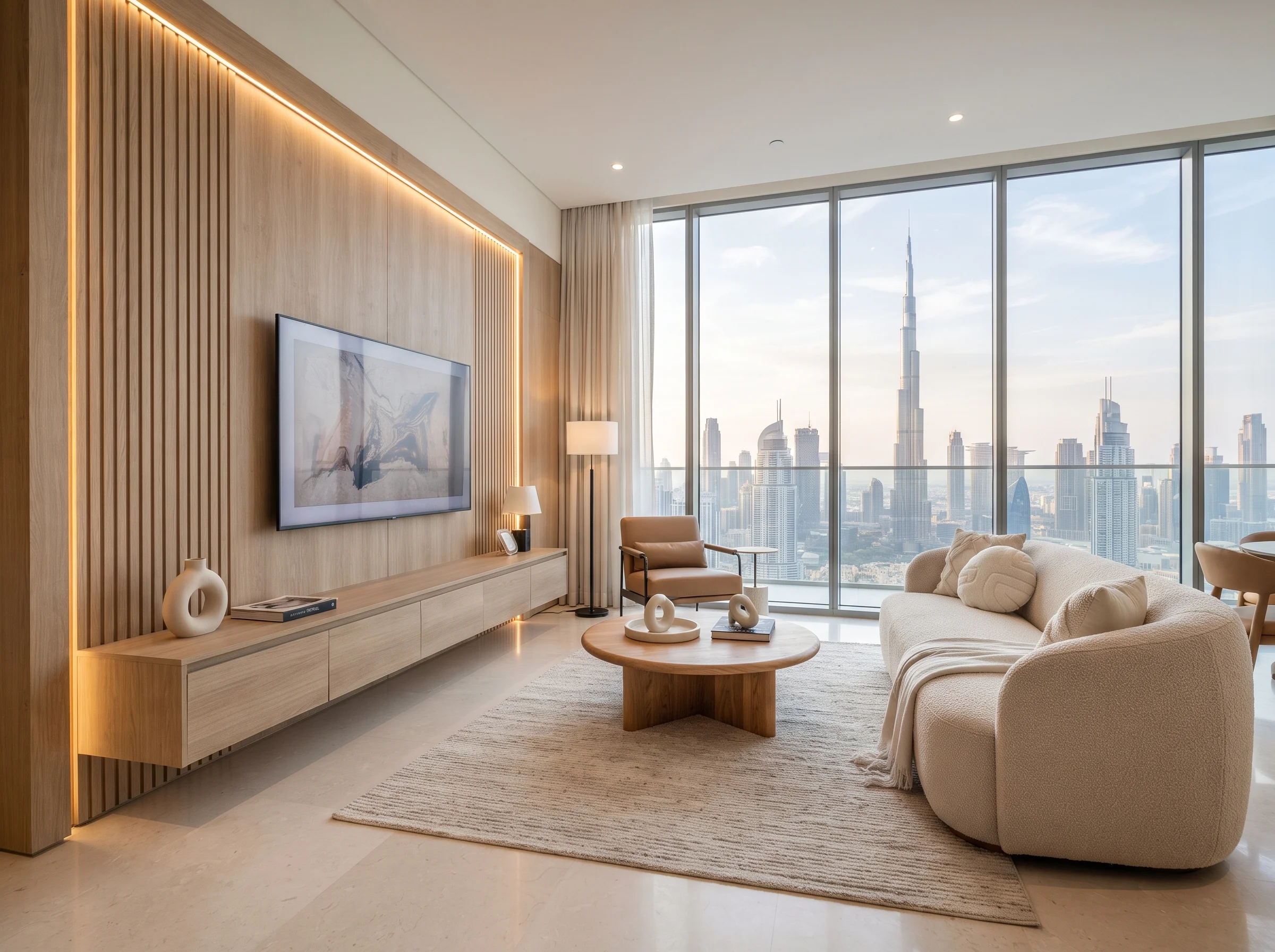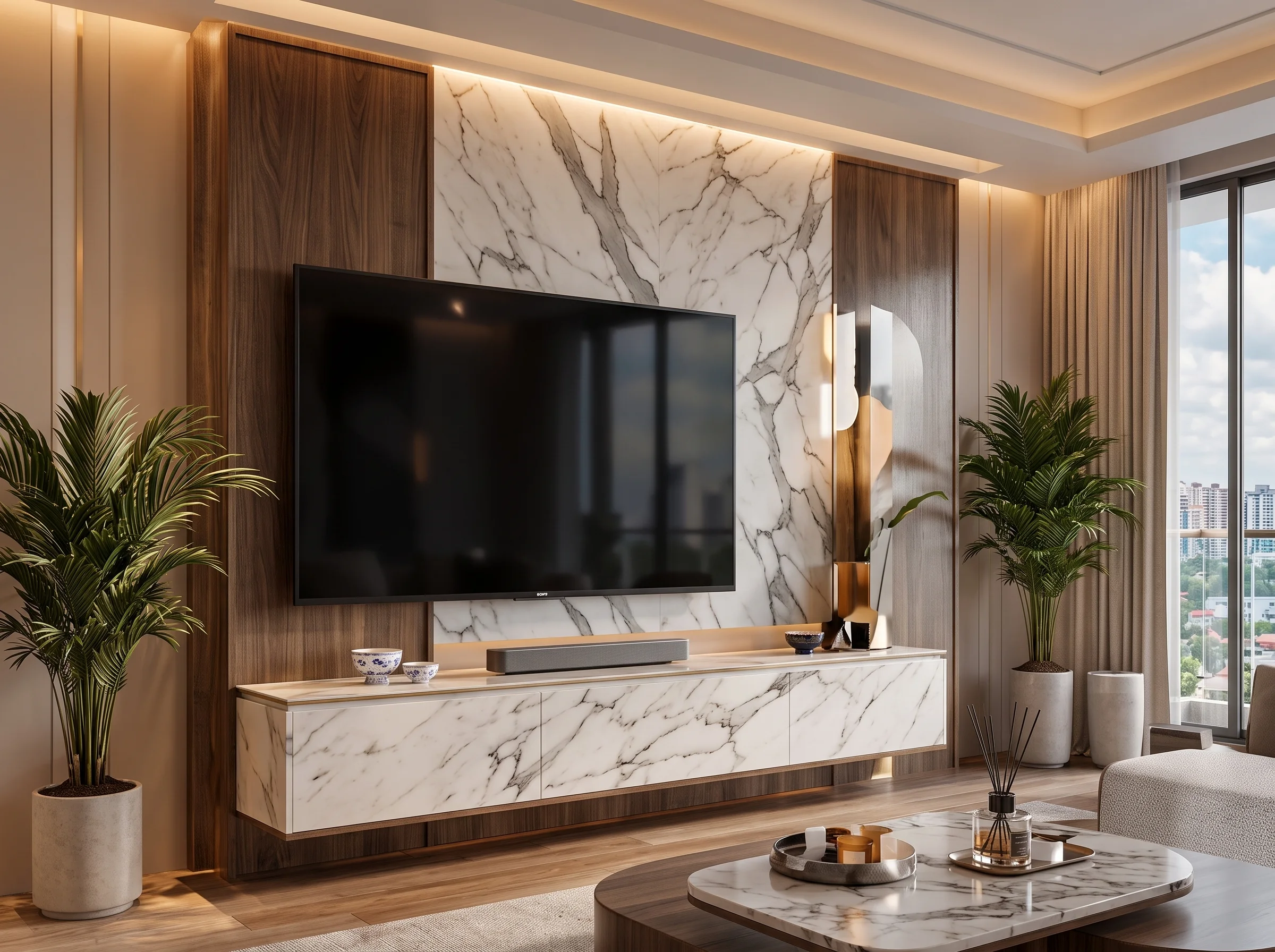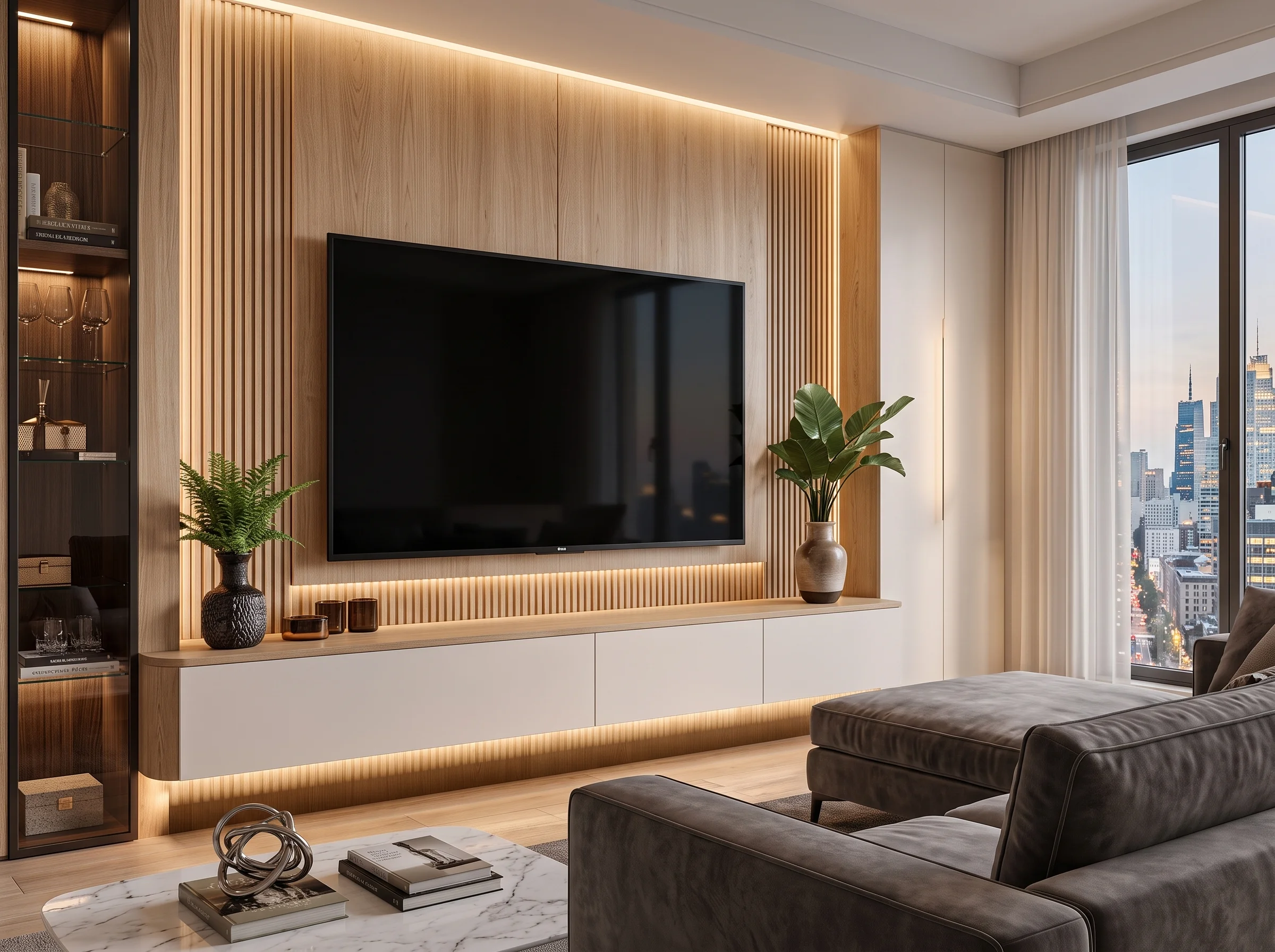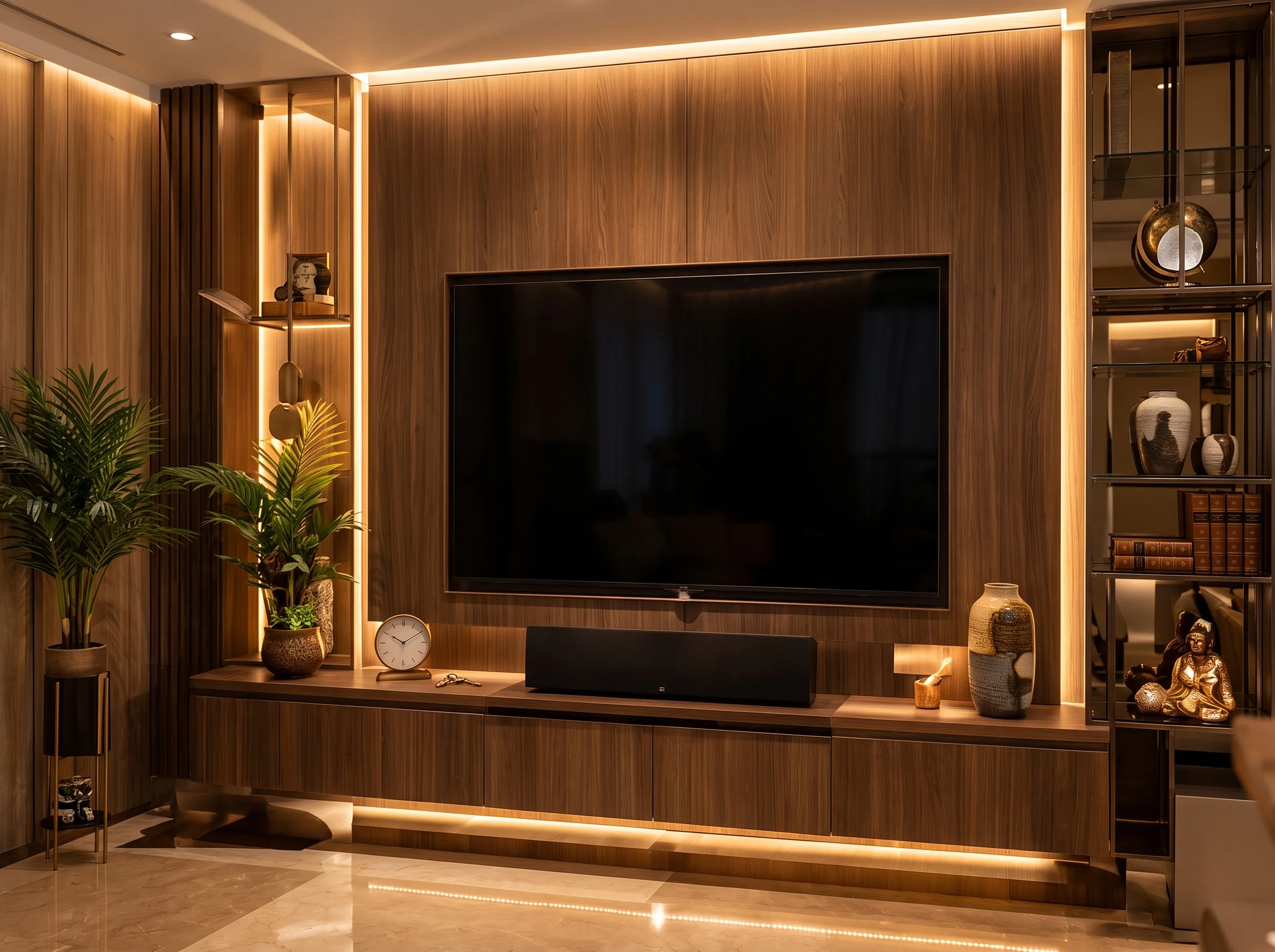
Custom TV Units and Media Walls That Transform Dubai Living Spaces
Your entertainment center deserves the same craftsmanship as your kitchen. For 35 years, we've built TV units and media walls that blend flawless function with striking design across every UAE emirate
When you’re investing in a Dubai property where living rooms command premium square meter rates, your TV units Dubai installation becomes more than furniture. It’s architectural joinery that defines how your family experiences the space daily. Since 1988, we’ve designed and installed over 2,400 custom media walls and entertainment centers across the UAE, from compact JBR apartments where every centimeter counts to sprawling Emirates Hills villas with dedicated home cinema rooms.
The Gulf climate presents challenges that standard furniture retailers don’t address. We’ve seen imported TV units warp within eight months from humidity exposure. We’ve replaced media centers where cable heat buildup caused veneer delamination. Our workshop builds every piece understanding that Dubai’s temperature swings and coastal moisture demand engineering precision alongside aesthetic appeal.
Karnak’s carpentry teams complete TV unit installations in residential towers, commercial offices, hotel suites, and yacht interiors throughout all seven emirates. Each project receives the same detailed process we’ve refined across 10,000+ UAE installations.
Understanding Media Wall Design for UAE Homes
The entertainment wall in your living room serves multiple functions simultaneously. It displays your television while concealing equipment, manages dozens of cables, provides storage for media and personal items, enhances room acoustics, and establishes the visual anchor for your entire space. Getting this wrong means living with frustration daily. Getting it right transforms how your home functions.
Space Planning and Proportions
Your TV size dictates media wall dimensions, but room proportions determine what actually works. In a typical Dubai apartment living room measuring 4.5 by 6 meters, a 65-inch television sits comfortably within a media wall spanning 3.2 to 3.8 meters wide. We measure your viewing distance first, then design backward from optimal screen size to determine unit scale. This prevents the common mistake of overwhelming smaller spaces or creating underwhelming installations in larger rooms.
Wall depth matters more than most homeowners realize. A shallow floating TV unit extends just 180-220mm from the wall, perfect for apartments where floor space is precious. Full built-in media walls might project 450-600mm, creating storage capacity equal to a large wardrobe while integrating the television seamlessly. We calculate these depths based on your equipment needs, cable routing requirements, and how the room flows around furniture placement.
Material Selection for Gulf Climate Performance
Dubai’s coastal humidity ranges from 50% to 90% depending on season and proximity to water. Solid wood expands and contracts with these fluctuations. We engineer TV units using moisture-stable materials that perform reliably year-round. High-pressure laminate over moisture-resistant MDF forms our base for most contemporary designs. The laminate seals against humidity while offering unlimited color and texture options.
When clients request natural wood aesthetics, we use engineered wood veneers over stable substrates rather than solid timber. A walnut-veneered media wall maintains its appearance because the veneer layer is thin enough to move with substrate expansion without visible gaps or warping. We’ve installed units in Palm Jumeirah apartments facing the Gulf where salt air accelerates deterioration. Five years later, the engineered construction shows no degradation while neighboring solid wood furniture shows stress cracks.
For ultra-contemporary designs, we incorporate glass, metal, and stone elements. Tempered glass shelves add visual lightness while supporting equipment weight. Powder-coated aluminum frames provide structure without bulk. Natural stone accent panels introduce texture and luxury. Each material gets selected for both aesthetic contribution and environmental stability.
Integrated Lighting Design
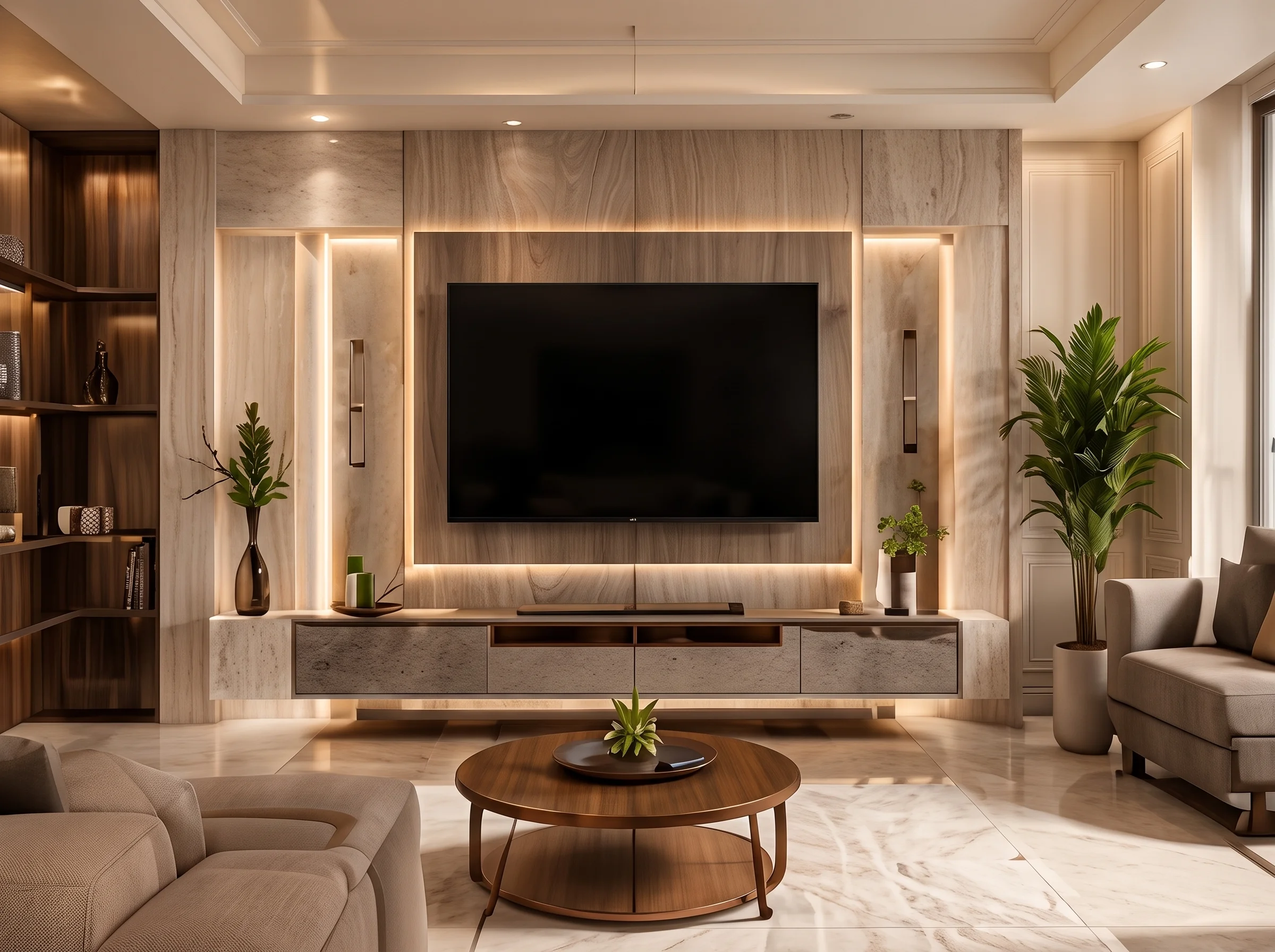
LED lighting transforms TV units from functional furniture into architectural features. We install three lighting types in most media walls. Backlit panels behind the television create the popular floating effect while reducing eye strain during viewing. Under-cabinet lighting illuminates lower storage areas and creates ambient glow. Internal cabinet lighting activates when doors open, making content visible without overhead room lights.
The technical challenge involves heat management. LED strips generate minimal heat, but power supplies and drivers can become warm. We position these components in ventilated sections away from heat-sensitive finishes. Dimming controls let you adjust intensity from bright task lighting to subtle accent glow. Color temperature selection matters too. We typically install 3000K warm white LEDs that complement wood tones and create inviting atmosphere, though some contemporary designs use tunable white systems that shift from 2700K to 5000K.
Comprehensive TV Unit Solutions We Design and Build
Every media wall we create starts with understanding how you actually use the space. The retired couple in Arabian Ranches needs different solutions than the young family in Dubai Marina or the executive with a downtown penthouse. Our design process identifies your specific requirements, then builds a custom solution that addresses each one.
Floating Entertainment Centers
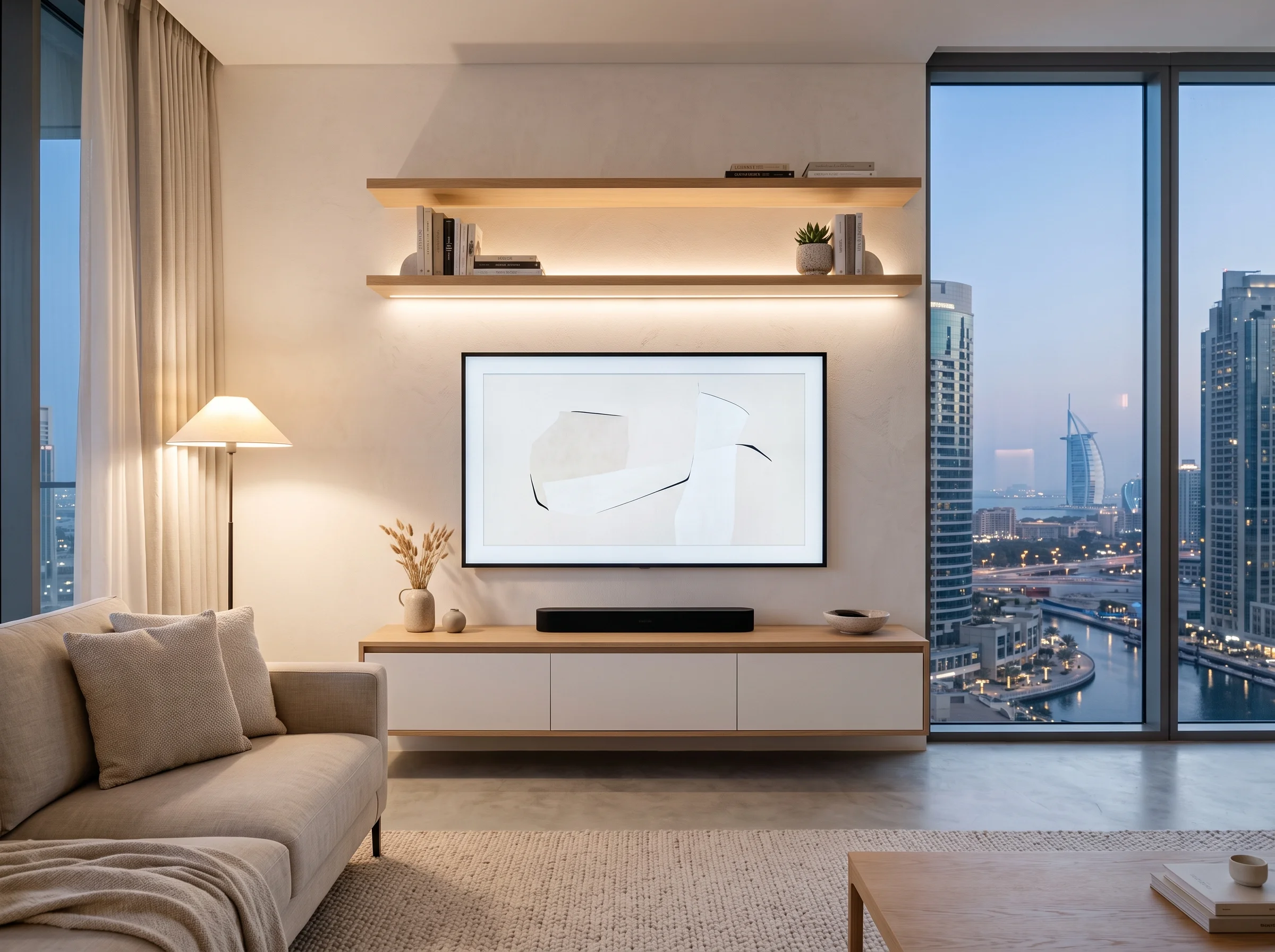
The floating TV unit remains Dubai’s most popular choice for contemporary apartments. The television mounts to a wall-hung cabinet that appears to hover, creating clean lines and making floor cleaning effortless. Behind this simple appearance sits complex engineering. Wall-mounting brackets must anchor into concrete or block, never just plaster. We use heavy-duty European hardware rated for 100kg or more, even though the actual unit weighs 35-50kg. This safety margin accounts for dynamic loading when cabinet doors open and close.
What This Includes:
A complete floating entertainment center encompasses the wall-mounted TV cabinet with soft-close doors and drawers, integrated cable management channels concealed behind panels, mounting hardware engineered for UAE construction standards, and equipment ventilation designed for enclosed spaces. We incorporate wire routing from wall outlets to each device position, LED accent lighting with dimming controls, and seamless alignment with your ceiling height and room proportions. The installation includes wall preparation, precise leveling across spans up to 3.5 meters, and connection of all electrical components by licensed technicians meeting Dubai Municipality requirements.
Climate considerations influence construction significantly. We seal all MDF edges and back panels because even floating units experience humidity exposure where they meet the wall. The gap between unit and wall allows air circulation, but we install moisture barriers on the wall surface before mounting. In coastal areas, we use marine-grade plywood for the unit frame structure instead of standard particleboard. These specifications come from replacing early installations where we learned that standard European construction methods needed adaptation for Gulf conditions.
Installation timing matters in Dubai construction schedules. We prefer mounting floating units after final painting but before furniture delivery. This gives us clear wall access while protecting finished surfaces. The installation itself takes 4-6 hours for a standard 3-meter unit, though complex designs with extensive wiring might require a full day. We coordinate with building management for any drilling requirements and ensure complete cleanup before departing.
Floor-to-Ceiling Media Walls
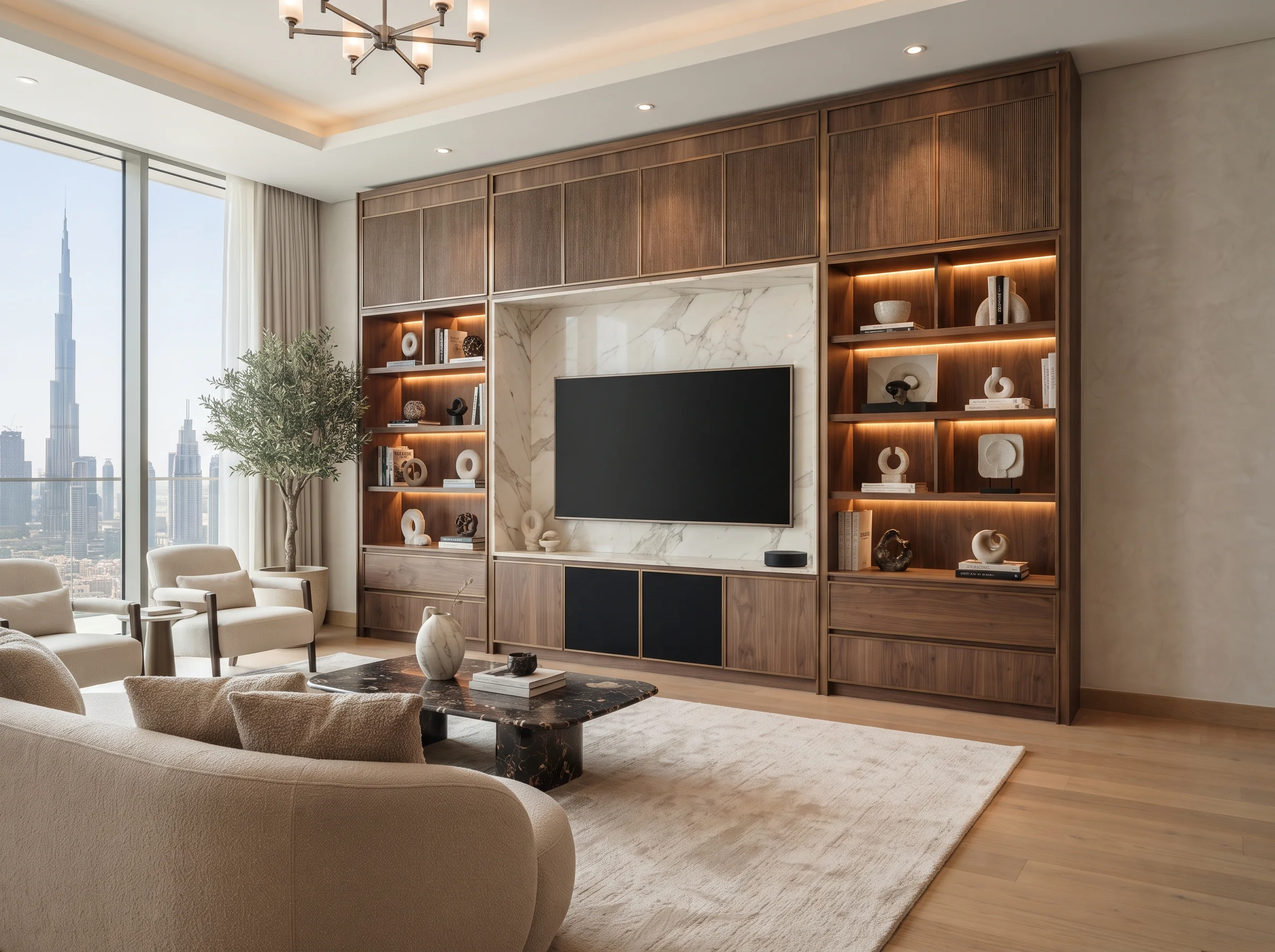
When storage needs expand beyond basic equipment housing, floor-to-ceiling media walls deliver comprehensive solutions. These installations span entire walls, integrating television display with book storage, decorative object display, concealed cabinets for belongings, and sometimes even workspace or bar elements. We’ve built media walls reaching 5.4 meters wide and 3.2 meters tall in Emirates Hills villas where the entertainment room functions as the home’s social center.
The structural approach differs from floating units because floor-to-ceiling installations often become semi-permanent room features. We might build a full framework attached to floor, ceiling, and walls, then apply finish panels. This creates exceptional stability and allows us to incorporate features impossible in furniture-grade construction. Hidden compartments behind sliding panels, motorized TV lifts that raise screens from credenzas, pull-out equipment racks on heavy-duty slides, and integrated sound systems with in-wall speakers all become possible.
Design complexity increases with scale. A successful floor-to-ceiling media wall balances visual weight across its entire surface. We avoid creating a massive dark monolith by incorporating varied depths, open and closed storage combinations, contrasting materials, and strategic lighting. A media wall might feature darker wood lower cabinets providing visual grounding, lighter open shelving at eye level creating breathing room, and the TV positioned slightly off-center within a feature panel using accent materials like textured stone or metallic finishes.
Modular Entertainment Systems
Modular systems offer flexibility for clients who might relocate or redesign. We build individual components that connect into cohesive units but can be reconfigured or separated later. A typical modular system includes a central TV cabinet, matching side towers for storage, floating shelves that mount independently, and optional bridge units that connect towers above the television. Each piece functions standalone but aligns perfectly when grouped.
This approach suits Dubai’s transient population. Professionals on three-year assignments want quality furniture that can move with them. We design modular units to fit standard shipping crates and reassemble in new locations. The engineering ensures components align precisely even after disassembly and reinstallation. We’ve had clients move our modular systems from Dubai Marina apartments to Abu Dhabi villas, then later to compounds in Saudi Arabia.
The construction requires exceptional precision. If tower units are even 2mm different in depth, the assembled system shows visible gaps. We use computer-controlled cutting equipment in our workshop that maintains tolerances within 0.5mm. Each component gets individually inspected against technical drawings before finishing. This attention to detail costs more in production time but eliminates the service calls that plague less carefully manufactured furniture.
Built-In Media Alcoves
Some architectural layouts include recessed alcoves perfect for built-in media centers. We custom-fit these spaces with joinery that appears original to the building. The challenge involves working within fixed dimensions while maximizing functionality. An alcove measuring 2.4 meters wide by 2.8 meters tall might receive a complete entertainment system with the TV at optimal viewing height, equipment storage below, display shelving above, and ambient lighting throughout.
Built-in installations require detailed site measurement because alcoves are rarely perfectly square or plumb. We create templates of the actual space, accounting for out-of-square conditions that might vary by 15-20mm across a span. Back in our workshop, we build components slightly undersized, then use scribing techniques and site-cut infill pieces to achieve seamless wall-to-unit transitions. The finished installation looks like precision factory work but actually involves significant hand-fitting.
Material selection for built-ins emphasizes the permanent nature of installation. We use higher-grade substrates and joinery techniques than in freestanding furniture because removal would likely mean destruction. Finish quality matches or exceeds surrounding architectural millwork. If your apartment features American oak doors and trim, the media alcove receives matching oak veneers and similar stain treatment. This integration makes the unit feel like part of the original construction rather than added furniture.
Home Theater Carpentry Packages
Dedicated home theater rooms require specialized carpentry beyond standard TV units. We’ve completed over 180 home cinema installations across UAE, from compact media rooms in townhouses to elaborate screening rooms in private compounds. These projects involve acoustic treatments, tiered seating platforms, equipment racks, motorized screen housings, and decorative elements that create the cinema experience.
The carpentry scope typically includes wall paneling with integrated acoustic absorption, custom seating risers built to exact dimensions for your chosen theater chairs, equipment closets or racks with extensive ventilation, concealed cable pathways throughout the room, and architectural features like coffered ceilings or column details. We coordinate with audio-visual specialists to ensure our carpentry supports their technical requirements. Screen walls need precise depth for in-wall speakers. Equipment locations require specific ventilation patterns. Cable pathways must accommodate hundreds of individual wires.
One recent Jumeirah villa project illustrates the complexity. The 6.5 by 4.8 meter theater room received fabric-wrapped acoustic panels covering 70% of wall surface, a raised seating platform with two rows of dedicated theater recliners, a rear equipment closet with active cooling, and a coffered ceiling hiding four subwoofers. The carpentry portion alone involved three weeks of workshop fabrication and two weeks of site installation. The result is a space that rivals commercial cinemas for audio-visual performance while maintaining luxury residential aesthetics.
Office and Commercial Media Solutions
Our commercial carpentry expertise extends to office reception areas, boardrooms, hotel lobbies, retail displays, and restaurant spaces requiring media walls. Commercial installations face different demands than residential. They need higher durability for constant use, easier access for maintenance and upgrades, professional cable management for complex AV systems, and aesthetics that reinforce brand identity.
A typical office boardroom media wall might integrate dual screens for presentations, video conferencing equipment, wireless connectivity infrastructure, and storage for presentation materials. We build these using commercial-grade materials that withstand daily use by multiple people. Locking mechanisms secure expensive equipment. Cable access panels allow IT staff to service connections without dismantling cabinetry. Finishes match corporate interior standards while providing years of service life.
Hotel and hospitality projects present unique challenges. Each installation must align with property design standards while meeting technical requirements. We’ve completed media walls for hotel suites where 500 identical units needed manufacture with perfect consistency. We’ve built restaurant feature walls incorporating multiple displays for sports viewing with invisible cable routing despite open ceiling design. These commercial projects require manufacturing efficiency and quality control processes that translate to better results for all our clients.
The Karnak Process for Media Wall Creation
Understanding how we work helps you know what to expect. Our process has evolved over 35 years to minimize surprises while maximizing quality outcomes. Each step builds on the previous, creating a logical progression from initial contact to final installation.
Step 1: Consultation and Space Assessment
Every project begins with conversation. We visit your property to see the space, measure existing conditions, discuss your requirements, and explore design possibilities. This initial consultation typically takes 60-90 minutes and costs nothing. We photograph the space, measure wall dimensions, check electrical outlet locations, assess load-bearing capacity for heavy installations, and document any architectural features that influence design.
During this visit, we ask detailed questions about your usage patterns. How many devices need connection? Do you prefer visible or concealed storage? Will this unit hold books, decorative objects, or just media equipment? Do you entertain frequently, requiring accessible storage for glasses and bottles? These specifics shape design decisions. A family with young children needs different solutions than empty nesters or young professionals.
We also identify potential complications during site assessment. If your desired media wall location has plumbing lines in the wall, we discover this before designing a recessed installation. If floor-to-ceiling units would block HVAC vents, we plan alternatives. If building regulations restrict wall penetrations in your tower, we adjust mounting strategies. Finding these issues early prevents redesign delays later.
Step 2: Custom Design Development
Based on consultation findings, our design team creates detailed drawings of your media wall. We produce elevation views showing how the unit appears from the front, section drawings illustrating internal construction and depth dimensions, and sometimes 3D renderings for complex projects. These drawings specify every dimension, material, finish, hardware, and technical detail.
The design phase involves collaboration. We send initial concepts for your review, discuss any adjustments you want, refine the design incorporating your feedback, and finalize drawings only when you’re completely satisfied. Most projects go through 2-3 design iterations. We’d rather invest time refining the design than build something you’ll tolerate rather than love.
Material specifications happen during design. We provide samples of proposed wood species, laminate finishes, paint colors, metal accents, and glass types. You see and feel actual materials, not just photos. This prevents the disappointment of expecting one appearance and receiving another. We maintain a sample library with hundreds of options, though we can source specific materials if you have particular requirements.
Step 3: Detailed Quotation and Approval
Once design finalizes, we prepare comprehensive quotation documents. The quote itemizes materials, labor, hardware, electrical work, transportation, installation, and any special requirements like after-hours access or crane lifts for high-rise deliveries. We specify payment terms, timeline expectations, warranty coverage, and exactly what the price includes. No hidden costs appear later.
Our quotes remain valid for 30 days because material costs fluctuate. Complex projects might include value engineering options showing how design changes affect pricing. You might see quotes for option A using natural wood veneer at one price, option B using high-quality laminate at lower cost, and option C using exotic wood at premium price. This transparency helps you make informed decisions balancing budget and preferences.
Approval requires signed quotation acceptance and deposit payment. We ask for 40% deposit to commence work, 50% upon delivery to site, and final 10% upon completion and your approval. This payment structure protects both parties while ensuring we have necessary funds to purchase materials and allocate production resources.
Step 4: Workshop Fabrication
Manufacturing happens in our Dubai workshop equipped with industrial woodworking machinery. We begin by cutting all components from sheet materials using computer-controlled panel saws and CNC routers that ensure precision. Edge banding machines apply finished edges to every visible surface. Components receive sanding progression through increasingly fine grits until surfaces feel glass-smooth.
Assembly uses traditional joinery techniques where appropriate and modern hardware where it improves performance. Drawer boxes might use dovetail joints for strength and appearance, while adjustable shelves mount on heavy-duty European hardware. We finish each piece completely in the workshop because on-site finishing produces inferior results and creates dust and fume issues in occupied properties.
Quality control happens at multiple stages. Supervisors inspect raw materials upon delivery, check dimensions after cutting, verify assembly before finishing, and examine completed pieces before packing. We catch and correct issues in our workshop where we have proper tools and lighting. This reduces site installation problems and ensures what arrives matches approved drawings exactly.
Step 5: Site Preparation and Coordination
Before installation day, we coordinate logistics carefully. For apartment installations, we book service elevators, confirm access times with building management, arrange parking for our vehicles, and verify that site conditions match our survey measurements. Changes between measurement and installation sometimes occur. A client might have painted or installed flooring. We check these details to avoid surprises.
We also prepare the installation area. Wall-mounted units require solid backing. If your wall is plasterboard over metal studs, we locate studs precisely and might install additional backing plates. Heavy floor-to-ceiling units need level floors. If your floor tiles create slope or irregularity, we plan shimming and scribing procedures. Electrical work must be completed before we arrive. We coordinate with electricians regarding outlet locations and any lighting controls.
Material delivery typically happens the day before installation or early morning same day. We unpack everything in our vehicle or a staging area to verify all components arrived undamaged and complete. Finding a missing drawer front before starting installation prevents delays. Everything then moves to the work area in proper sequence for efficient assembly.
Step 6: Professional Installation
Installation teams consist of experienced carpenters who’ve completed hundreds of similar projects. They arrive at scheduled time with all necessary tools, hardware, and safety equipment. The installation sequence follows a logical progression: wall preparation and mounting bracket installation first, then base units positioned and secured, followed by upper sections or towers, and finally finishing touches like drawer installation and hardware attachment.
We protect your property carefully throughout installation. Drop cloths cover flooring in work areas and traffic paths. Furniture gets moved carefully and returned to original positions. We vacuum and clean continuously, not just at project end. Drilling uses dust collection systems that capture most debris. We respect that you’re living in or using the space during our work.
Installation duration varies by project complexity. A simple floating TV unit might install in half a day. A full floor-to-ceiling media wall across an entire room might require two or three days. We provide realistic time estimates and update you if conditions change. Once installation completes, we perform detailed quality checks, test all mechanical elements like drawers and doors, connect and verify all lighting, and demonstrate operation of any special features.
Step 7: Final Inspection and Handover
Before we consider a project complete, we walk through everything with you. We open every door and drawer, show you how hardware operates, explain care and maintenance requirements, and verify you’re satisfied with all aspects. If any detail needs adjustment, we address it immediately. Our teams don’t leave until you’re completely happy.
We provide documentation at handover including warranty information covering materials and workmanship, care and cleaning instructions specific to your finish materials, contact information for service or questions, and sometimes spare hardware in case you lose a shelf pin or handle. We also photograph the completed installation for our records and your reference.
The relationship doesn’t end at installation. We follow up by phone after two weeks to ensure everything functions as expected. After three months, we might visit to check that drawers still glide smoothly and doors remain properly aligned. Wood installations sometimes require minor adjustments as materials fully acclimate to your space. We handle these service calls without charge during the warranty period.
Why UAE Homeowners Choose Karnak for Entertainment Carpentry
Dozens of companies offer TV units in Dubai. Many import ready-made furniture that almost fits your space. Some provide semi-custom solutions with limited material choices. A few deliver truly custom carpentry. Understanding what differentiates Karnak helps you make informed decisions about your investment.
Three Decades of UAE-Specific Expertise
Since 1988, we’ve completed over 10,000 UAE projects, with approximately 2,400 focusing specifically on entertainment centers and media walls. This means we’ve solved the humidity warping issue in coastal Dubai apartments 380 times. We’ve navigated Dubai Municipality approval processes for commercial installations in 290+ buildings. We know which wood species survive Emirates Hills’ microclimate and which fail within two years.
Experience reveals patterns that newer companies haven’t encountered. We recognize that certain tower buildings have inconsistent wall construction where plaster thickness varies by 40mm across a single wall span. This affects floating unit installation significantly. We’ve learned that specific imported laminate brands degrade faster under UAE sun exposure near windows. We know which DEWA electrical standards apply to built-in lighting and which inspectors in which areas focus on particular details.
Our long establishment also means we’ve installed media walls in properties across their entire lifecycle. We’ve returned to apartments we first worked on in 1995 to update media walls for current owners. We’ve seen which construction methods and materials age gracefully and which deteriorate. This longitudinal knowledge informs current recommendations. When we specify marine-grade plywood for coastal installations, it’s because we’ve replaced units where we used standard materials in 2008 and moisture damage occurred by 2012.
Complete In-House Manufacturing Control
We operate our own 2,400 square meter workshop in Dubai rather than outsourcing production to third parties. This matters because quality control happens directly under our supervision. If a component needs revision, we handle it immediately rather than negotiating with subcontractors. If your project requires custom solutions beyond standard construction, our workshop teams collaborate to engineer answers.
The workshop employs craftsmen who’ve worked with Karnak for 8-15 years on average. They understand our quality standards implicitly. They know that drawer boxes get built using dovetail joinery even though simpler methods cost less. They verify that grain patterns flow naturally across visible surfaces even when it requires rearranging sheets. They take pride in their work because they’ve built long-term careers with us.
Equipment investment distinguishes professional operations from improvised shops. We maintain computer-controlled cutting equipment that achieves precision impossible by hand, edge banding machines that create invisible joints between surface materials and substrates, industrial spray finishing booths that deliver showroom-quality paint and lacquer results, and complete tooling for both traditional joinery and modern hardware installation. This equipment represents substantial capital investment that proves worthwhile through consistent quality outcomes.
Design Expertise Beyond Standard Solutions
Our design team includes professionals trained in interior architecture who understand how entertainment centers integrate with broader room design. They consider proportion, scale, material harmony with existing finishes, lighting effects, and how the installation affects room flow. This produces media walls that feel intentionally designed for their specific location rather than generic furniture inserted into space.
We regularly collaborate with interior designers, architects, and consultants on high-end projects. This exposes our team to advanced design concepts and demanding quality standards. The knowledge gained from luxury villa projects in Emirates Hills filters down to improve all our work. A technique we developed for a challenging architectural installation becomes standard practice for subsequent projects.
Design flexibility extends to problem-solving unusual conditions. We’ve built media walls for rooms with curved walls where standard rectangular units wouldn’t work. We’ve created installations spanning support columns that couldn’t be removed. We’ve integrated media centers into rooms with complex ceiling soffits, unusual window placements, and architectural features that constrained conventional approaches. These challenging projects develop skills that benefit straightforward installations.
Materials Sourcing and Specification Excellence
We maintain relationships with suppliers across Europe, Asia, and the Middle East, giving access to materials unavailable through retail channels. If you want a specific Italian laminate seen in a hospitality project, we can source it. If you prefer reclaimed teak with documented provenance, we have suppliers. If you need fire-rated materials for commercial installations, we stock certifications.
Material knowledge prevents costly mistakes. We know that certain laminates appear identical in samples but perform differently under heat exposure. We understand which wood species match aesthetically but differ significantly in stability. We can explain why one glass type costs three times another and whether that premium delivers value for your application. This expertise helps you spend budget on differences that matter while avoiding premium pricing for irrelevant specifications.
We also maintain strategic inventory of commonly used materials, allowing faster project commencement. Rather than waiting 8-12 weeks for European material orders, we might begin your project within days using existing stock. For custom colors or special finishes, lead times apply, but we communicate these clearly during planning.
Comprehensive Project Management
From initial measurement through final installation, one project manager coordinates your media wall creation. This person becomes your primary contact for questions, updates, schedule coordination, and any issues requiring attention. They manage workshop scheduling, coordinate with installation teams, handle supplier communications, and ensure your project progresses smoothly.
Project management particularly benefits complex installations involving multiple trades. If your media wall requires electrical work, network cabling, and audio-visual integration alongside carpentry, our project manager coordinates timing and responsibilities. They ensure the electrician completes outlet installation before our installation, that cable pathways align with AV equipment requirements, and that all trades work efficiently without delays or conflicts.
Communication happens proactively. You receive updates at key milestones without needing to chase status. If delays occur due to material issues or site conditions, you know immediately along with revised timelines. We’ve found that transparency about challenges maintains trust better than hiding problems until they become crises.
Post-Installation Support and Service
Our warranty covers both materials and workmanship for periods ranging from one to five years depending on component type. Natural wood carries shorter warranty than engineered materials because wood is a living material that continues responding to environment. Hardware failures get addressed regardless of warranty status if they result from manufacturing defects.
Service requests receive prompt response. We maintain dedicated service teams separate from installation crews. If you call with a drawer that’s sticking or a door that’s come out of alignment, we schedule service within 48-72 hours typically. Most service visits complete in under an hour. We carry common replacement parts in service vehicles to avoid return trips.
We also support modifications and updates. Perhaps you initially installed a media wall for a 55-inch TV and now want to accommodate a 75-inch screen. We assess whether existing structure can support the change or what modifications would be required. Maybe you’re adding equipment and need another shelf. We build matching components that integrate seamlessly with original installation. This ongoing support means your investment adapts to changing needs rather than becoming obsolete.
Transparent Pricing and Honest Recommendations
We price projects based on actual costs plus fair margins, not what we think the market will bear. Quotes itemize expenses so you understand where money goes. If particular specifications drive costs significantly, we explain why and offer alternatives. If reducing scope saves money without compromising quality, we suggest it even though it reduces our revenue.
This honesty extends to recommendations. If your space would function better with a simple floating unit rather than a full media wall, we say so. If the premium wood species you’re considering won’t be visible in the planned design, we suggest saving money with a more practical choice. We’ve turned down projects where clients wanted installations we believed wouldn’t meet their needs, recommending alternative approaches instead.
The construction industry includes companies that maximize profit through change orders and surprise costs. We find this approach short-sighted. Satisfied clients refer friends, hire us for future projects, and provide positive reviews that attract business. The client we treat fairly today becomes the source of three future clients. This long-term thinking shapes how we operate.
Licensed, Insured, and Compliant Operations
Karnak operates with full business licensing through Dubai Economic Department, maintains comprehensive liability insurance covering property damage and worker injury, and ensures all staff hold appropriate trade licenses and labor permits. This legal compliance protects you from risks associated with unlicensed contractors.
Our installations comply with Dubai Municipality building codes, DEWA electrical standards when incorporating lighting, Dubai Civil Defence fire safety regulations for commercial installations, and any specific building management requirements for tower properties. We understand permit requirements and handle applications where necessary.
Compliance goes beyond minimum legal standards to industry best practices. We follow manufacturer installation instructions for hardware. We use specified fastener types and spacing for wall-mounting applications. We don’t take shortcuts that might save minutes during installation but create risks over the installation’s lifespan. Our insurance provider audits our practices periodically, and we maintain approval through proper procedures.
Recent Media Wall Projects Across UAE
Our portfolio demonstrates range across residential and commercial applications, from compact apartment installations to elaborate villa projects. These examples show both design diversity and our ability to execute complex requirements.
Contemporary Marina Apartment: 3.2-Meter Floating Unit
A Dubai Marina couple wanted a minimalist media wall for their 65-inch TV that wouldn’t overwhelm their 42 square meter living room. We designed a floating unit in high-gloss white lacquer spanning 3.2 meters with the TV centered, flanked by open shelving on brushed gold metal frames. The unit depth stays at just 220mm to preserve floor space, but internal cable management accommodates soundbar, streaming devices, and gaming console. LED backlighting creates the floating effect. Installation took six hours, scheduled for a Friday to minimize disruption. The result looks custom architectural rather than furniture, exactly what they wanted.
Emirates Hills Villa: Floor-to-Ceiling Entertainment Wall
An Emirates Hills family converted a 7.2 by 5.4 meter room into a dedicated entertainment space. The feature wall spans the full 7.2 meter width with walnut wood lower cabinets, an off-center TV position within a marble accent panel, and open shelving in varying depths creating visual interest. We integrated a concealed bar within side cabinets, display lighting for art glass collection, and acoustic fabric panels behind decorative grilles. The installation required three weeks of workshop fabrication for 14 individual components, followed by one week on-site assembly and installation. Total project value exceeded AED 185,000 reflecting custom stone work, premium hardware, and complex lighting integration.
Palm Jumeirah Penthouse: Curved Media Wall
A penthouse living room featured a curved wall facing the main seating area. We template-measured the 4.8-meter curved span, then built a media wall following that curve using laminate bending techniques. The finished installation in high-gloss gray appears as one continuous piece despite being assembled from seven sections. The curve required custom mounting hardware and specialized installation procedures. We cantilevered the TV mounting plate from the wall structure behind the curve, allowing the screen to sit within the curved surface rather than projecting forward awkwardly. This project took 11 days in workshop for the complex curved components plus three days installation.
Downtown Dubai Office: Dual-Screen Boardroom Wall
A financial services firm needed a boardroom media wall accommodating two 65-inch displays for presentations while maintaining professional aesthetics when screens are off. We designed a symmetrical wall unit in dark oak with the two TVs positioned at equal spacing, all AV equipment concealed in ventilated central cabinet, and wire management allowing connection from any position at the conference table. Motorized sliding panels cover the screens when not in use, transforming the wall into wood paneling. The integration required coordination with the IT contractor and AV installer. Our carpentry installation took two days, followed by one day of collaborative work with other trades.
Arabian Ranches Townhouse: Compact Family Solution
A growing family in Arabian Ranches needed maximum storage in a compact TV wall space. The 2.8-meter installation includes the TV position, deep lower cabinets for toys and games, upper cabinets for books and decorative items, and five drawers for media accessories. We used a two-tone design with white upper sections creating visual lightness and gray lower cabinets hiding wear from children’s use. Soft-close hardware on everything prevents slamming. Push-to-open doors eliminate handle injury risks with active young children. The practical design delivers serious storage capacity while maintaining clean contemporary appearance. Project completion from order to installation took four weeks.
Jumeirah Beach Residence: Weatherproof Balcony Installation
A JBR apartment owner wanted outdoor entertainment capability on their covered balcony overlooking the beach. We built a weatherproof media console using marine-grade materials with stainless steel hardware, outdoor-rated laminate surfaces, and sealed construction preventing moisture intrusion. The unit houses an outdoor-rated TV, weatherproof speakers, and storage for pool and beach items. Special attention went to ventilation because sealed cabinets in outdoor heat would cook electronics. We incorporated vented back panels and spacing to allow airflow. After two years of Gulf coastal exposure, the unit shows no deterioration. This specialized application required different materials and techniques than standard interior installations.
Business Bay Office Lobby: 4.5-Meter Feature Wall
A technology company wanted their office lobby to make an impact on visitors. We designed a 4.5-meter media wall combining natural walnut, white quartz stone, and bronze-tinted glass. The TV integrates into the stone panel, appearing to float within the surface. LED lighting highlights the walnut wood grain and creates a warm glow in the otherwise contemporary space. The installation serves both functional needs for the reception area and brand expression showing innovation and quality. Coordination with the office interior designer ensured the media wall integrated with broader design intent. Workshop fabrication took three weeks for the complex multi-material construction, with installation completed over a weekend to avoid business disruption.
The Springs Villa: Home Theater Conversion
A family in The Springs converted an unused bedroom into a dedicated cinema. We provided complete carpentry including acoustic wall panels in fabric-wrapped frames covering 85% of wall surface, a raised rear seating platform for second row of theater chairs, equipment cabinet with active ventilation system, and a decorative coffered ceiling concealing surround sound speakers. The carpentry coordinated with audio-visual installation performed by specialists. Our work created the room structure and aesthetics while supporting their technical requirements. The transformation took five weeks total with three weeks workshop time building components and two weeks on-site for installation and coordination with other trades.
Mirdif Apartment: Budget-Conscious Smart Design
A young professional in Mirdif wanted a quality media wall on a realistic budget. We designed a simple floating unit using high-quality laminate in concrete texture rather than real wood veneer, reducing material costs significantly. The 2.6-meter unit includes two soft-close drawers and two push-open cabinets with LED lighting throughout. By focusing budget on quality hardware and construction while using practical materials, we delivered a piece that looks and functions beautifully at 40% less cost than comparable wood designs. This project demonstrates that excellent results don’t always require premium materials when design and construction execution are right.
Festival City Commercial: Multi-Unit Retail Display
A furniture showroom in Festival City commissioned 12 identical media wall displays for their floor. Manufacturing efficiency became critical. We created detailed jigs and templates allowing our workshop to produce consistent components across all units. Each display measures 3.4 meters and showcases different finish options available to customers. The production run took six weeks with installation phased over two weeks as the showroom prepared sections. This commercial project volume helped us refine manufacturing processes and quality control systems that improve all our work.
Entertainment Center Questions - Expert Answers
Your media wall should extend 20-40cm beyond the TV on each side for balanced proportions. A 65-inch TV has a screen width of approximately 145cm, so the media wall should span 185-225cm for proper visual balance. This creates enough presence that the wall anchors the room without the TV looking lost in too much surrounding furniture. If you go narrower, the TV dominates and the media wall feels like an afterthought. If you go much wider, proportions become unbalanced unless you're intentionally creating a full wall feature with additional functions beyond just TV housing.
Height considerations differ based on mounting approach. Wall-mounted TVs typically sit at eye level when seated, placing the screen center about 100-110cm above floor level. Your media wall might extend from floor to 180-240cm high, creating proportional height. Floor-to-ceiling walls work when you're incorporating significant storage or making an architectural statement, but they need careful proportion planning to avoid overwhelming the space.
We measure your viewing distance and use that to determine optimal TV size, then design the media wall around those dimensions. Proper planning ensures everything feels intentionally sized rather than arbitrary. The three-meter rule helps: if your sofa sits three meters from the TV wall, you want approximately a 55-65 inch screen, and the media wall spanning 2.4-2.8 meters creates appropriate presence for that room scale.
Professional cable management separates exceptional installations from adequate ones. We route every cable through concealed channels rather than letting them hang visibly behind units. The back panel of most media walls includes cutouts positioned behind each device location, allowing cables to pass through the cabinet structure into a central routing channel that runs down to floor level where power and data connections exist.
Inside the unit, cables follow organized pathways using hook-and-loop ties rather than plastic zip ties that can damage cable insulation. We group cables by type - power cables separate from HDMI and network cables to prevent interference. Service loops at both ends allow you to disconnect and reconnect devices without fighting tight cable runs. Everything remains accessible for future changes without dismantling the entire installation.
Wall-mounted floating units require additional planning because cable pathways to the wall surface must be concealed. We often install cable raceways during construction or coordinate with electricians to fish cables through walls from outlet locations to the mounting position. The gap between floating unit and wall surface needs to accommodate cable volume without pushing the unit away from the wall visibly. For particularly cable-intensive installations with multiple devices, we might build a deeper equipment section that houses everything in one ventilated compartment rather than having devices scattered across the unit.
Heat management matters alongside cable routing. AV equipment generates heat that needs to escape. We space devices vertically allowing air circulation, incorporate ventilated back panels rather than solid surfaces, and sometimes add active cooling for equipment-dense installations. The Dubai climate means room temperatures can hit 35°C+ during summer power outages. Equipment compartments need to dissipate heat effectively or devices fail prematurely.
Dubai's combination of humidity and temperature fluctuation challenges some materials while others perform excellently. Engineered wood products - MDF and plywood with laminate or veneer surfaces - provide the best stability for most applications. These materials are dimensionally stable across humidity ranges from 40% to 90%, meaning your media wall won't develop gaps or warping as seasons change.
High-pressure laminate surfacing over moisture-resistant MDF core creates our most reliable construction for contemporary designs. The laminate completely seals the MDF against humidity penetration while offering unlimited color, texture, and pattern options. Modern laminates can replicate wood grain convincingly or provide solid colors with various sheen levels from matte to high-gloss. Quality laminates resist scratching, heat marking, and UV fading better than many natural materials.
For natural wood aesthetics, we use engineered veneers over stable substrates. A 0.6mm walnut veneer over moisture-resistant MDF gives you genuine wood appearance and feel while the engineered substrate prevents movement. We avoid solid wood construction for large panels or door components because solid wood expands and contracts with humidity changes. In coastal Dubai locations near water, that movement can be dramatic enough to cause joint failure and visible gaps.
Glass, metal, and stone elements all perform excellently in UAE climate. Tempered glass shelving provides strength and stability. Powder-coated aluminum frames resist corrosion even in high humidity. Natural stone accent panels are completely impervious to climate effects. We often combine materials, using laminate or wood for structural components while incorporating these elements as accents. The material combination creates visual interest while ensuring long-term performance.
Paint and lacquer finishes require quality application for durability. We use automotive-grade spray finishes applied in our workshop climate-controlled booth. This achieves smooth, durable surface coating that hand brushing or rolling cannot match. Proper preparation and finish coats make enormous difference in how painted surfaces age. Cheap paint application shows wear, discoloration, and damage within two years. Professional finishing lasts a decade or more with basic care.
Sound system integration transforms media walls from furniture into complete entertainment environments. We regularly incorporate soundbars, in-wall speakers, subwoofers, and full surround systems into our installations. The approach depends on your audio equipment and performance expectations.
Soundbar integration is simplest. We create a dedicated shelf or recess below the TV at precise height for optimal sound projection. The shelf includes cable routing directly to the TV and concealed power connection. Some designs use motorized lifts that raise the soundbar when needed and lower it flush when not in use, maintaining clean appearance.
In-wall speaker integration requires coordination with audio installers. We build the media wall with speaker cutouts positioned for optimal audio performance. The speakers mount flush with the wall surface, covered by acoustically transparent grilles that match the media wall finish. This creates invisible speaker installation where sound appears to come directly from the screen. We've completed installations with 5.1, 7.1, and even 9.2 surround configurations integrated into media walls and surrounding room architecture.
Subwoofer placement presents challenges because these components are large and need specific positioning for bass performance. We sometimes build dedicated compartments with ventilated access, allowing the subwoofer to function acoustically while remaining hidden visually. Other designs locate subwoofers elsewhere in the room based on acoustic analysis, but we ensure cable routing from media wall to subwoofer position looks intentional rather than like an afterthought.
Equipment amplifiers and processors usually hide in ventilated cabinets within the media wall. These components generate heat and need air circulation. We might install quiet cooling fans on thermostat controls that activate when internal temperature exceeds safe thresholds. Professional AV installers specify ventilation requirements and we design cabinetry meeting those needs.
Timeline depends on project complexity, material availability, and our current workshop schedule. A straightforward floating unit in standard materials typically completes in 3-4 weeks from approved design and deposit to final installation. This includes one week design finalization and quotation, two weeks workshop fabrication, and 1-2 days for installation and final touches.
Complex installations requiring special materials, intricate construction, or extensive coordination extend this timeline. A floor-to-ceiling media wall with custom finishes might take 6-8 weeks. Projects incorporating stone, specialized glass, or imported materials add lead time for those elements to arrive. If electrical work must be completed before our installation, we coordinate timing with your electrician or building schedules.
Our workshop typically operates on 2-3 week production schedules for standard projects. During busy periods around holidays or the traditional September-December construction season, scheduling might extend by a week or two. We communicate realistic timelines during quotation rather than promising faster completion to win the project and then disappointing you with delays.
Expedited timelines are sometimes possible for urgent requirements. If you're completing apartment renovation for tenant occupancy or preparing commercial space for business opening, we can prioritize production and installation. This usually requires premium pricing because we're disrupting efficient workshop scheduling to fast-track your project, but the capability exists when truly needed.
Installation day scheduling coordinates with your availability and any building restrictions. We work weekdays typically but can schedule weekend installation in occupied residences if that's more convenient. High-rise apartments often restrict service elevator access to specific hours, so we align our scheduling with those requirements. Commercial installations sometimes happen after business hours to avoid disrupting operations.
Our standard warranty covers materials and workmanship for two years from installation completion. This includes any manufacturing defects in components we built, hardware failures resulting from product defects rather than misuse, finish degradation beyond normal wear, and structural issues like drawer box failure or cabinet panel delamination. We repair or replace defective components at no charge during the warranty period.
Hardware carries separate warranty terms based on manufacturer coverage. European soft-close hinges and drawer slides typically include lifetime manufacturer warranty against mechanical failure. We handle warranty claims directly rather than making you deal with hardware suppliers. If a drawer slide fails in year three, we source the replacement and install it, charging only for the service call since the component itself is covered by manufacturer warranty.
The warranty doesn't cover damage from misuse, accidents, or normal wear. If you overload shelves beyond weight ratings we specify, that's not warranty coverage. If cleaning with harsh chemicals damages finish, that's not covered. If moving furniture scratches the unit, we'll repair it but as paid service rather than warranty claim. Dubai's unique challenge involves humidity damage from leaving windows open during humid periods or air conditioning failure during vacation. Environmental damage beyond reasonable climate exposure isn't covered.
We provide clear care and maintenance instructions at installation that specify what keeps warranty valid. Following those guidelines ensures your installation performs well and warranty remains honored if issues occur. Common sense applies: if you treat the media wall reasonably as designed, warranty covers any legitimate problems that arise.
Service response during warranty period targets 48-72 hour scheduling for non-emergency issues. If a door is misaligned or a drawer sticks, that's an inconvenience but not urgent. If an electrical component fails creating safety concern, we respond same-day or next-day. After warranty expires, we continue providing service but on paid basis with reasonable rates for labor and materials.
We collaborate extensively with design professionals on both residential and commercial projects. Roughly 40% of our media wall installations come through designer or architect specification. We understand professional design processes, communicate in appropriate technical language, and deliver quality that meets demanding standards.
Our working relationship with designers typically involves their providing design intent, material specifications, and dimensional requirements. We interpret those into buildable technical drawings, suggest refinements based on structural or practical considerations, and quote the project professionally. We attend site meetings as needed and coordinate our installation with broader project schedules.
We're comfortable working from detailed drawings or from conceptual sketches that we develop into construction documentation. Some designers have specific vision and detailed specifications. Others prefer indicating general direction and letting us propose detailed solutions based on our manufacturing expertise. Both approaches work fine.
For architects coordinating full renovation or construction projects, we integrate into the trade scheduling. We provide shop drawings for approval, coordinate with other trades for timing and spatial conflicts, and meet the quality standards that architectural projects demand. Our installation teams understand that working on architect-led projects requires extra care with protection, cleanliness, and coordination because we're one trade among many in valuable properties.
We don't require designers to use our name when presenting designs to clients if they prefer maintaining project control. Some designers specify Karnak directly because our reputation adds credibility. Others prefer sourcing anonymity until contract award. We adapt to however design professionals prefer working. What matters is delivering excellent results that make designers look good and want to work with us repeatedly.
Modern media walls often serve multiple purposes because living spaces - especially in Dubai apartments - need furniture to work harder. We regularly incorporate home office functions, bar and beverage service, display for collections or décor, storage for items unrelated to entertainment, and sometimes even folding tables or desks that deploy when needed.
A media wall spanning a full room width provides ample space for functional zones. The TV might occupy the center 2.5 meters. One side includes cabinets and drawers for general storage. The other side features a workspace with a fold-down desk surface, charging stations for devices, and storage for office supplies. When working, you unfold the desk. When entertaining, it folds flush and disappears into the media wall design.
Bar integration works beautifully in media walls. We build dedicated sections with glass storage, bottle display with lighting, drawer space for bar tools and accessories, and sometimes small refrigeration for wine or beverages. The bar section might include contrasting finishes differentiating it visually from entertainment sections. Watching sports while having drinks with friends becomes seamless when everything integrates into one furniture piece.
Display capabilities let you show collections, artwork, photographs, or decorative objects alongside the TV and storage functions. We design shelving with proper proportions for your specific items - whether that's books, pottery, sculpture, or family photos. Integrated lighting highlights displayed items. The visual variety created by mixing display, entertainment, and storage makes media walls more interesting than units solely focused on the television.
The key is thoughtful planning during design phase. We need to understand all functions you want the media wall to serve, then create zones and features supporting each one. A media wall trying to do everything often succeeds at nothing. But a well-designed multifunctional installation creates a true room centerpiece that solves multiple needs elegantly.
Finish possibilities are essentially unlimited because we source materials globally and work with multiple suppliers. We'll categorize common options while noting that custom finishes are always possible if you have specific vision.
Wood finishes include natural wood veneers in dozens of species from light maple and ash through medium walnut and teak to dark wenge and ebony, stained wood veneers where we modify color while retaining visible grain, high-quality wood-look laminates that convincingly replicate natural wood at lower cost, and reclaimed or character-grade woods with natural imperfections that add authenticity. Wood finishes can be matte, satin, or high-gloss depending on your preference.
Painted finishes offer any color imaginable, with popular choices including white in various warmth tones, grays from light dove to charcoal, rich accent colors like navy, emerald, or burgundy for dramatic effect, and two-tone combinations using different colors for upper and lower sections. Paint sheens range from matte with minimal reflection through satin and semi-gloss to high-gloss lacquer creating mirror-like surfaces. High-gloss finishes require impeccable substrate preparation because they highlight any surface imperfection.
Laminate finishes provide the broadest design range including solid colors in matte, textured, or gloss sheens, convincing wood grain patterns, concrete and stone textures, metallic finishes in brushed or polished effects, and specialty patterns like fabric textures or abstract designs. Quality laminates have improved dramatically over past decade. Current high-end laminates are virtually indistinguishable from actual wood or stone at normal viewing distances.
Glass elements introduce reflective and translucent qualities. We use clear glass for shelving and door panels, back-painted glass in any color for opaque surfaces with depth, frosted or textured glass for diffused transparency, and sometimes artistic glass with embedded patterns or textures. Glass always gets tempered for safety, and we edge-polish exposed edges for refined appearance.
Metal accents in powder-coated aluminum, stainless steel, brass, or bronze add contemporary or industrial character. These might be structural frames, decorative trim, handle elements, or leg components. Metal finishes can be brushed for texture, polished for reflection, or powder-coated in colors coordinating with other finish elements.
Stone and solid surface materials work for accent panels or specialty applications. Natural marble, granite, or quartzite create luxury statements. Engineered quartz provides consistency and broader color range than natural stone. These materials add significant cost and weight but deliver undeniable visual impact when used strategically.
TV mounting requires understanding wall construction and using appropriate hardware for your specific wall type. Dubai construction includes concrete block, concrete poured walls, concrete columns with infill blocks, metal stud framing with cement board or plasterboard, and sometimes wood framing in older villas. Each needs different mounting approach.
Concrete walls provide excellent mounting strength. We use concrete anchors appropriate for load and wall thickness. Heavy-duty drop-in anchors or sleeve anchors rated for 100kg+ each ensure safe installation even for large TVs. We typically install mounting brackets with four to six anchor points, distributing load across the wall surface. Concrete anchoring requires precise drilling and anchor installation, but results in completely secure mounting capable of supporting any residential TV size.
Block walls need anchors positioned to hit the solid block material rather than mortar joints where holding power is minimal. We locate blocks by tapping the wall or using detection equipment, then position mounting brackets accordingly. If your desired TV position falls on mortar joints, we install backing plates spanning multiple blocks, anchoring to solid material on each side, then mounting the TV bracket to that plate. This distributes load across stable wall structure.
Metal stud walls with plasterboard require special considerations because the plasterboard itself supports minimal weight. We locate metal studs and anchor brackets directly to stud members using appropriate fasteners. For larger TVs exceeding stud strength, we sometimes open the wall, install blocking between studs at the mounting height, then close and repair the wall before mounting. This creates solid backing for brackets. Alternatively, if opening walls isn't possible, we might recommend our floating unit solution where the TV mounts to our furniture structure rather than the wall.
Villa wood stud walls work similarly to metal stud approaches but use different fasteners. We anchor to wood studs using lag bolts that provide excellent holding power in wood. These walls typically support heavy loads without special backing unless the TV is exceptionally large.
Before installation, we assess wall construction and recommend appropriate mounting method. If wall structure won't safely support the TV you want, we explain limitations and alternative approaches. Safety is non-negotiable - we won't mount TVs in ways that might fail later.
Equipment ventilation prevents heat buildup that degrades electronics and shortens lifespan. Most AV equipment specifies operating temperature ranges, typically maximum 35-40°C. Inside closed cabinets in Dubai summer conditions, temperatures can exceed these limits without proper ventilation design.
Our standard approach includes ventilated back panels with large holes or slotted patterns allowing air circulation behind equipment. We space shelves adequately so each device has air volume around it - typically 80-100mm clearance above each component. Cabinet backs might be open frameworks rather than solid panels, hidden behind the installed unit but allowing complete air circulation.
For equipment-intensive installations with multiple components in enclosed spaces, we might install active ventilation. Small, quiet fans mounted in cabinet bases or tops create air movement, drawing cool air from bottom and exhausting warm air from top. These fans run on 12V power and are essentially silent in operation. Temperature-activated controls turn fans on only when needed rather than running continuously.
Glass doors create display visibility but trap heat. We specify tempered glass doors only with extensive ventilation or for components that generate minimal heat. If you want glass doors on equipment cabinets, we might recommend perforated metal grilles in door tops and cabinet bottoms allowing air circulation while maintaining refined appearance.
Cable holes also serve ventilation. The large openings we create for cable routing allow significant air movement. We position these thoughtfully to create thermal chimney effects where warm air rises and escapes through upper openings while cool air enters through lower gaps.
Some equipment generates more heat than others. Gaming consoles, AV receivers, and cable boxes can become very warm during operation. We identify high-heat components during planning and ensure those receive particular ventilation attention. Streaming devices and similar compact electronics generate minimal heat and need less ventilation consideration.
Matching existing elements requires careful color matching, finish matching, and sometimes construction technique matching to achieve visual cohesion. We're experienced at integrating new carpentry with established environments, whether that's matching furniture you're keeping or coordinating with architectural millwork already installed.
For finish matching, we start with samples. You provide a small sample of the existing finish if possible, or we visit to examine it in person. We then source materials that match as closely as possible. Perfect matching across different material types is sometimes impossible - matching high-gloss lacquered furniture with laminate, for example, won't be exact because the materials have different light reflection properties. But we can get very close with proper material selection.
Wood species and grain patterns require particular attention. If your existing furniture is walnut, we source walnut veneers. But walnut varies significantly in color and grain pattern depending on growth origin and cut orientation. We show you veneer samples that match the overall tone and grain scale of your existing pieces. Sometimes we need to stain wood slightly to adjust color while retaining grain visibility.
Architectural elements like door trim, window casings, or built-in shelving establish room finish standards. If your apartment has white-painted woodwork with subtle warm undertone, we match that specific white rather than using generic white that might read too cool or too stark. Paint matching services can analyze existing finishes and create matching formulations, though slight variation between paint and laminate or between different manufacturers is normal.
Hardware and handle selection also affects integration. If existing furniture uses brushed nickel handles in particular style, we source similar hardware for the media wall. This creates visual continuity suggesting everything was planned together. Some clients prefer contrast instead of matching, which is equally valid but a different design approach requiring careful consideration.
We communicate realistic expectations about matching. Identical matching across different materials or different manufacturers is rarely achievable. Close, complementary matching that creates visual harmony is the practical goal. We show samples for approval before proceeding so you see actual appearance rather than being surprised at installation.
Good media wall design anticipates future changes. We plan installations with flexibility allowing equipment upgrades without major modifications. This involves several strategies implemented during original construction.
TV mounting typically uses VESA standard mounting patterns that remain consistent across TV generations. Your mounting bracket accommodates different TV sizes within reason. If you currently have a 55-inch TV but might upgrade to 65-inch, we design the media wall dimensions for the larger size and use a mounting bracket compatible with both. The smaller TV installs fine now, with space for the larger upgrade later.
Equipment shelving and storage gets designed with adjustable components where practical. We use adjustable shelf pins in pre-drilled holes, allowing you to reconfigure shelf heights as equipment changes. If devices become larger or you add components, you adjust shelving to accommodate. Fixed shelving works fine when dimensions are generous enough for foreseeable equipment sizes.
Cable routing with service loops and accessible pathways lets you swap equipment without carpentry modifications. You can disconnect old equipment, remove it, install new devices, and reconnect cables using existing infrastructure. If new equipment needs additional cables, properly designed cable channels allow adding them.
Major changes might require modifications. If you want to go from a single 55-inch TV to a dual 75-inch TV installation, the media wall might need significant revision or replacement. We discuss these possibilities during design so you understand limitations and opportunities. Sometimes designing for maximum future flexibility makes sense even if it costs slightly more initially. Other times, designing for current requirements with acceptance that major future changes mean new furniture is the practical approach.
We maintain records of original installations including drawings and specifications. If you contact us five years later wanting modifications, we can review what was built and recommend approaches. We've added sections to existing media walls, rebuilt portions while keeping other sections, and provided complete replacements when changes were too extensive for modification. Having original construction knowledge makes these future projects much easier than if you're working with someone unfamiliar with the existing installation.
Working in occupied properties requires minimizing disruption while maintaining quality results. We've refined procedures over thousands of installations in homes where people are living and businesses that remain operational during our work.
Communication starts before installation day. We confirm timing, discuss any special requirements or concerns, explain what to expect regarding noise and dust, and coordinate with you on access and logistics. We ask that the work area be cleared of furniture and personal items if possible, though we can work around items if necessary. We identify parking for our vehicles and service elevator access for apartments.
Protection measures begin immediately upon arrival. We lay drop cloths along traffic paths from entry to work area. We cover flooring in the immediate work zone. Adjacent furniture receives protective covering. We create containment reducing dust spread to other rooms. For drilling or cutting work, we use tools with dust collection where possible and vacuum continuously.
Work proceeds systematically. We unpack and inventory all components in staging area first, verifying nothing is damaged or missing. Then we begin installation following logical sequence - wall mounting first if applicable, base units next, upper sections after that, and finishing details last. We clean as we go, not just at day's end. This keeps the space manageable throughout the process.
For businesses, we often schedule installation outside operating hours. Weekends and evenings allow us to work without disrupting customer flow or employee productivity. We've installed media walls in operating restaurants between closing and opening, in offices on Fridays when staff is minimal, and in retail spaces overnight. This requires flexible scheduling from our teams but delivers value for clients who cannot afford business disruption.
Noise management matters in occupied properties. We inform you when loud work like drilling will occur. In apartment buildings, we observe community quiet hours. For extended projects, we schedule noisiest work for mid-day when neighbors are more tolerant. We use appropriate tools - concrete drilling with hammer function is loud but necessary and relatively brief, while assembly work is generally quiet.
Our installation teams understand they're guests in your property or business. They're respectful, professional, and considerate. They use restroom facilities appropriately, avoid disrupting your routine unnecessarily, and treat your space as they'd want theirs treated. This attitude converts installation from something to endure into a professional service experience.
Pricing varies significantly based on size, materials, complexity, and features. Providing specific numbers without seeing your requirements would be misleading because every project differs. We can outline factors affecting cost and typical ranges for different installation types to help you budget appropriately.
Basic floating units measuring 2.5-3.0 meters using laminate finishes with standard hardware typically start around AED 8,000-12,000 including design, fabrication, materials, and installation. These are quality installations using good materials and construction but without extensive customization or premium finishes.
Mid-range media walls expanding to floor-to-ceiling designs, natural wood veneers, integrated lighting, and more complex storage configurations typically range AED 18,000-35,000 depending on size and specifications. These projects deliver custom solutions with premium materials and sophisticated features.
High-end installations incorporating exotic woods, stone or glass elements, extensive custom features, complex lighting design, and large scale can range AED 40,000-100,000+. These are showpiece installations where budget allows pursuing exceptional design without significant compromise.
Several factors significantly influence pricing within these ranges. Material selection affects cost substantially - high-gloss lacquer costs more than standard laminate, natural wood veneer costs more than wood-look laminate, and exotic woods cost more than common species. Size drives costs linearly - a 4-meter media wall costs more than a 3-meter wall assuming similar construction because it uses more materials and labor. Complexity adds cost through design time, manufacturing difficulty, and installation challenges.
Special features like motorized components, extensive custom lighting, integrated sound systems, or unique construction requirements add to base pricing. Geographic location matters slightly - ground floor villa installations are simpler than high-rise apartment deliveries requiring elevator coordination and multiple carries.
We provide detailed quotations itemizing costs so you understand exactly what you're paying for. We also offer value engineering options showing how specification changes affect pricing, letting you make informed decisions balancing budget and preferences. The goal is delivering maximum value for your investment, whether that's AED 10,000 or AED 100,000.
For most projects, we provide detailed technical drawings showing dimensions, configurations, and specifications. These two-dimensional drawings accurately communicate what we'll build and work well for clients who read technical documents comfortably or who have experience with construction plans.
We can produce 3D renderings for projects where visualization helps decision-making. Photorealistic renderings show your media wall in your specific space with your chosen finishes, helping you confirm design before we begin fabrication. This particularly benefits clients who struggle visualizing from technical drawings or for complex designs where spatial relationships are difficult to communicate two-dimensionally.
The rendering process adds time and cost to projects. Our design team models the installation in 3D software, applies accurate materials and finishes, and produces views from multiple angles. For straightforward projects, this might add 3-5 days to design timeline and AED 1,500-3,000 to project cost. For complex installations requiring extensive modeling, costs increase accordingly.
Most clients find technical drawings with material samples sufficient for confident approval. We show you exactly what materials will look like through physical samples. The drawings communicate dimensions and configurations accurately. Together, these provide clear understanding of the final result.
We recommend 3D renderings when designs are particularly complex, when you're uncertain about how design choices will appear, or when the project budget comfortably accommodates the additional service. We don't push renderings as mandatory because they're not necessary for most successful projects, but they're available when valuable.
Some clients bring renderings created by their interior designers. We're happy to work from those, interpreting design intent into buildable specifications and confirming that what looks beautiful in renderings is structurally and functionally sound in reality.
TV Unit Coverage Throughout UAE
Our media wall installation teams serve all seven emirates with consistent quality and expertise. Whether you’re in downtown Dubai or a villa in Ras Al Khaimah, you receive the same craftsmanship and professional service that built our reputation over 35 years.
Dubai: We complete TV units and media wall projects across Business Bay, DIFC, Dubai Marina, JBR, Downtown Dubai, Palm Jumeirah, Arabian Ranches, Emirates Hills, The Springs, The Meadows, Jumeirah, Mirdif, Dubai Silicon Oasis, The Greens, The Lakes, Discovery Gardens, Sports City, Motor City, JLT, and all other communities. Our Dubai workshop location enables efficient delivery and installation scheduling throughout the emirate. We understand building management procedures across Dubai’s major towers and communities, streamlining access and installation coordination.
Abu Dhabi: Significant project experience spans Al Reem Island, Saadiyat Island, Yas Island, Al Reef, Khalifa City, Mohammed bin Zayed City, Masdar City, Corniche area, and Abu Dhabi city center. We schedule Abu Dhabi installations to maximize efficiency, often grouping multiple projects to reduce travel time and installation costs for clients in the capital.
Sharjah: We regularly install media walls in Al Majaz, Al Nahda, Al Khan, Muwailih, University City, and throughout Sharjah’s residential and commercial areas. Sharjah’s building codes and approval processes align closely with Dubai’s standards, allowing smooth project execution.
Ajman, UAQ, RAK, Fujairah: Northern emirates receive the same expertise and service quality as Dubai and Abu Dhabi. Installation scheduling coordinates to group northern emirate projects when possible, though we’ll travel for single installations when projects warrant. Many northern emirate clients specifically seek our services because local carpentry options are more limited and our UAE-wide reputation provides confidence.
Start Your Custom Media Wall Project
Your living room deserves entertainment furniture that works as hard as it looks beautiful. We’ve spent 35 years refining our processes, developing supplier relationships, and training craftsmen so that your project benefits from everything we’ve learned. The consultation costs nothing and obligates nothing, but it gives you clear understanding of possibilities and confident direction for your space.
IF YOU HAVE ANY QUESTION? WE ARE GLAD TO
CONSULT YOU AS SOON AS POSSIBLE
Get Started
Immediate assistance from our team regarding your project details.
Form Submitted!
Thank you for contacting us. Our team will get back to you within 24 to 48 hours regarding your query.
Contact us on WhatsApp for Quick Response