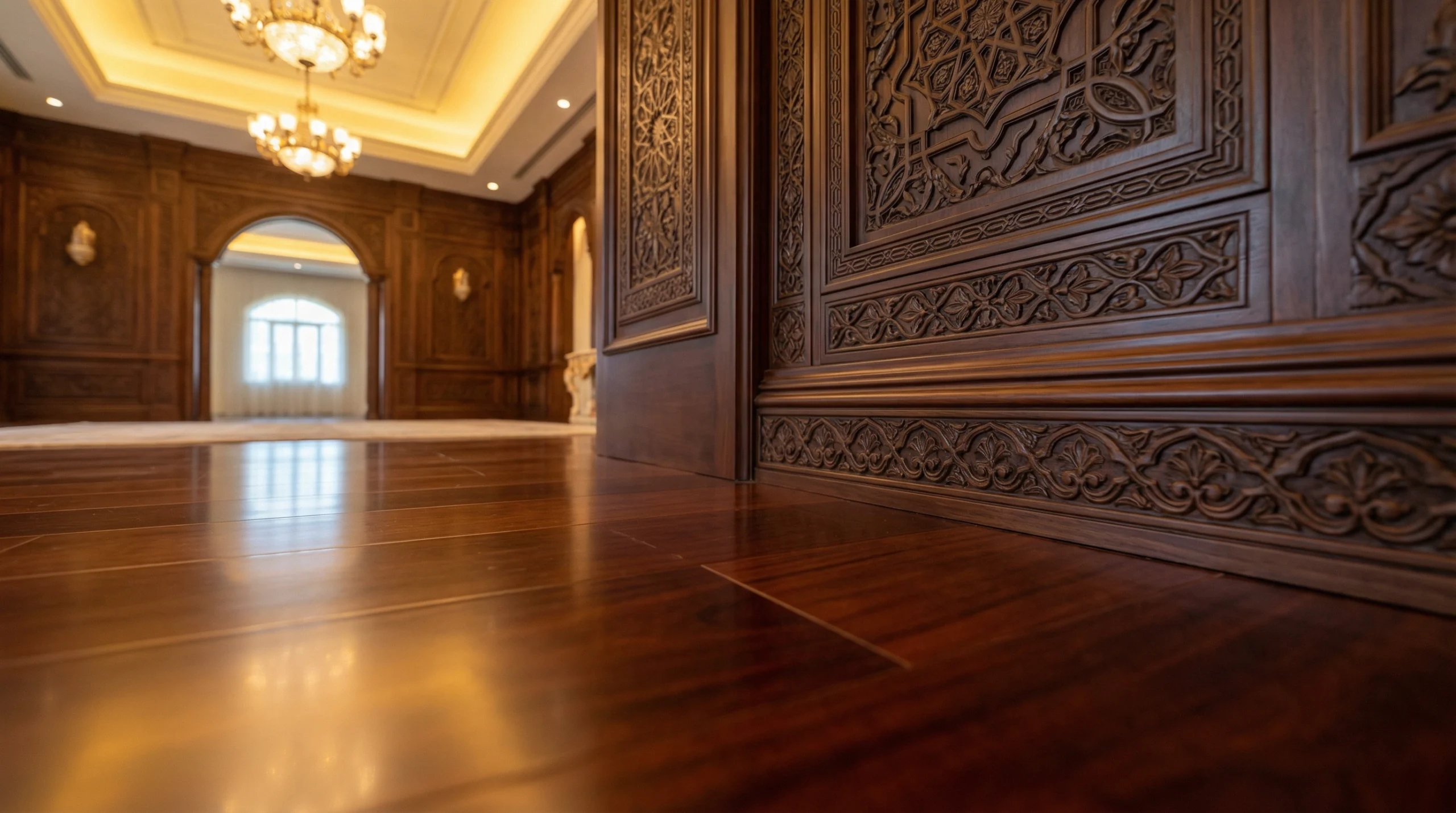
Transform Your Space with Premium Laminate Flooring in Dubai and Across UAE
Durable, beautiful, and perfectly engineered for Gulf climate conditions—backed by 35 years of flooring expertise.
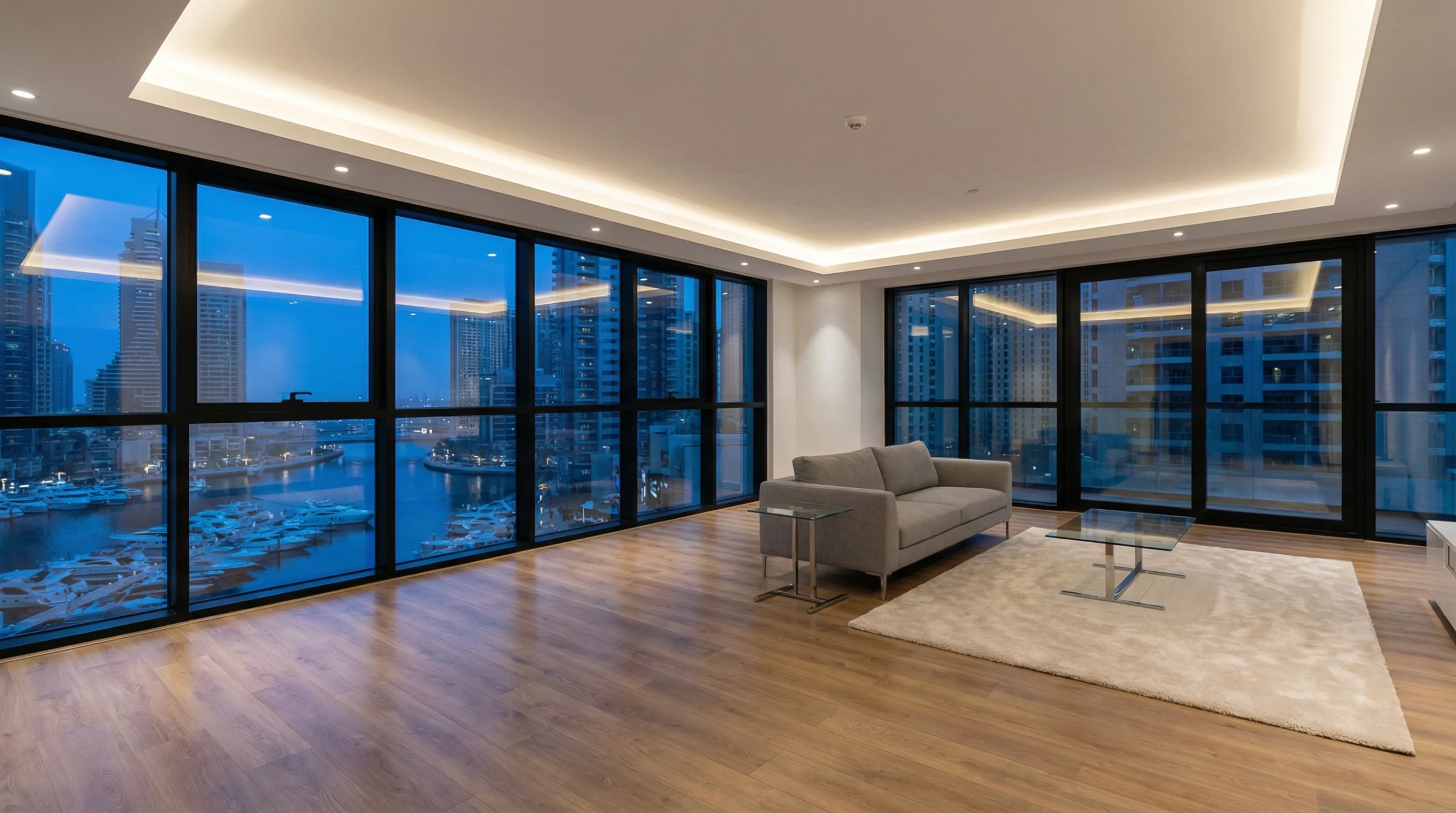
Since 1988, Karnak Carpentry has installed laminate flooring in over 2,400 properties across the UAE, from high-rise apartments in Dubai Marina to sprawling villas in Emirates Hills and commercial spaces throughout all seven emirates. Our laminate flooring Dubai solutions combine European manufacturing quality with installation techniques refined through three decades of working in Gulf conditions.
The UAE market demands flooring that withstands intense heat, dramatic temperature fluctuations between air-conditioned interiors and scorching exteriors, and humidity that spikes during certain months. We’ve watched laminate technology evolve from basic reproductions to today’s advanced HDF cores with integrated moisture barriers, realistic embossed textures synchronized with grain patterns, and AC ratings that exceed most hardwood durability. Our team knows exactly which specifications matter in Dubai’s climate and which marketing claims don’t translate to real-world performance.
We’ve completed installations in every type of UAE property: DIFC offices that needed 72-hour weekend turnarounds, Jumeirah Beach Residence apartments requiring perfect transitions across 15 rooms, restaurant chains needing commercial-grade laminate across multiple locations, and family homes in Arabian Ranches where parents wanted the warmth of wood without maintenance headaches. This experience means we solve problems before they arise.
Understanding Laminate Flooring Technology for UAE Conditions
Laminate flooring has transformed from a budget hardwood alternative into a sophisticated flooring solution that often outperforms solid wood in the UAE’s challenging environment. The technology centers on a high-density fiberboard core sandwiched between protective layers, with photographic imagery creating wood, stone, or tile appearances that even flooring professionals sometimes can’t distinguish from natural materials at first glance.
The Five-Layer Construction System
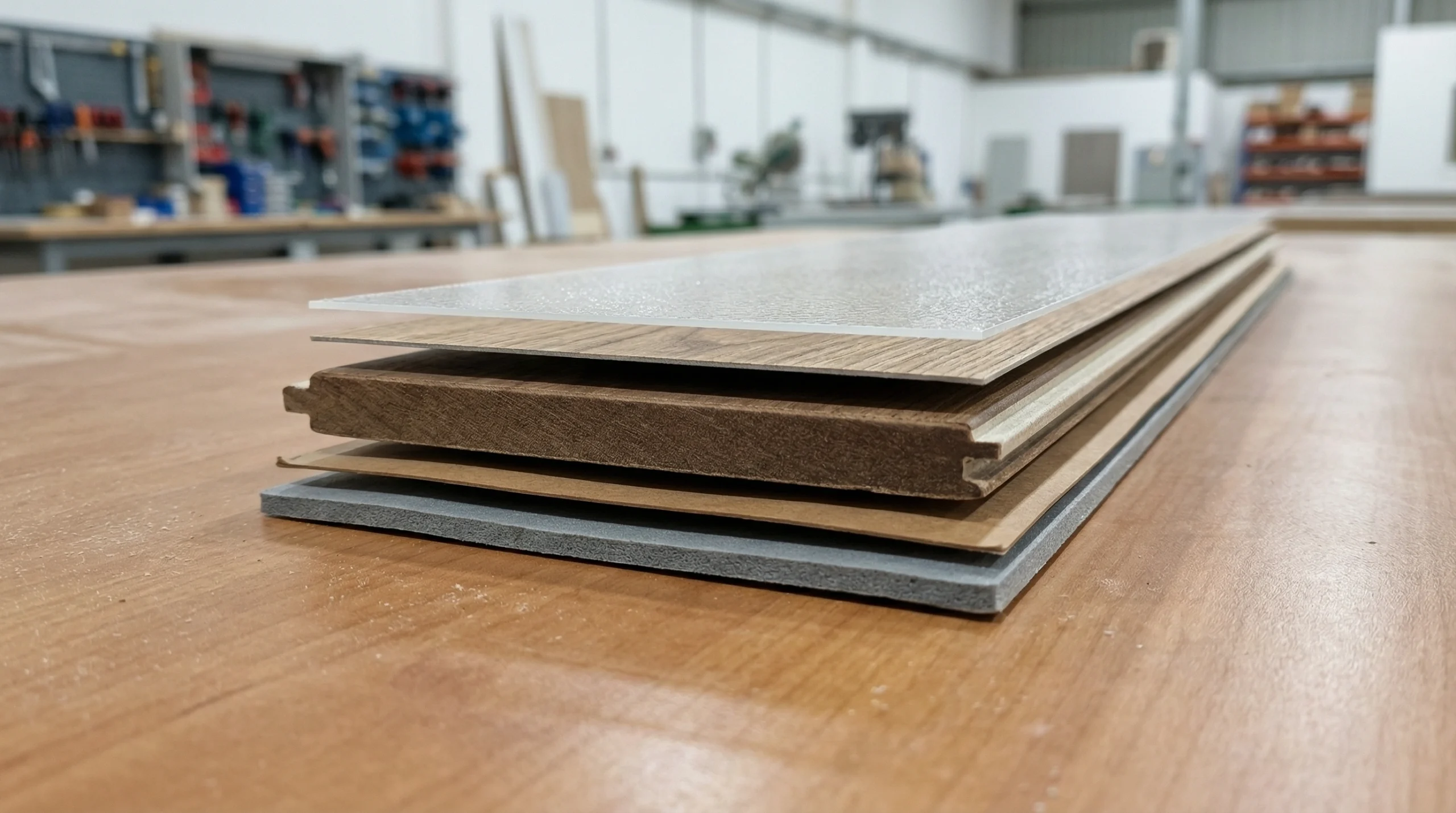
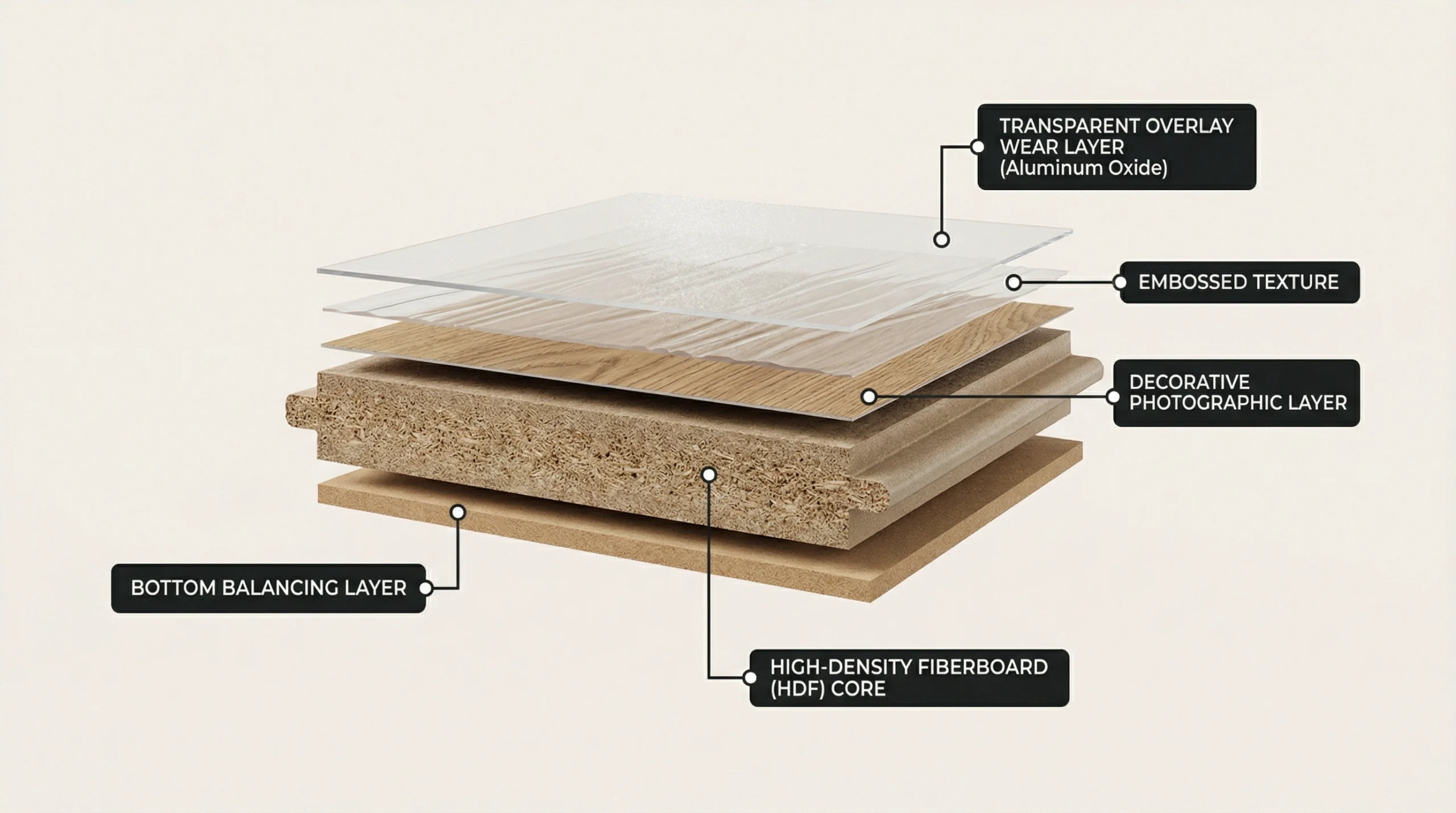
Modern laminate flooring uses a precisely engineered five-layer construction, and understanding each layer explains why quality laminate performs exceptionally well in Dubai’s climate. The bottom balancing layer prevents moisture absorption from below and counteracts the top layer’s forces to keep planks perfectly flat. Above this sits the high-density fiberboard core—the structural foundation—where density directly correlates with durability, dimensional stability, and nail-holding strength for installations requiring fixed attachments.
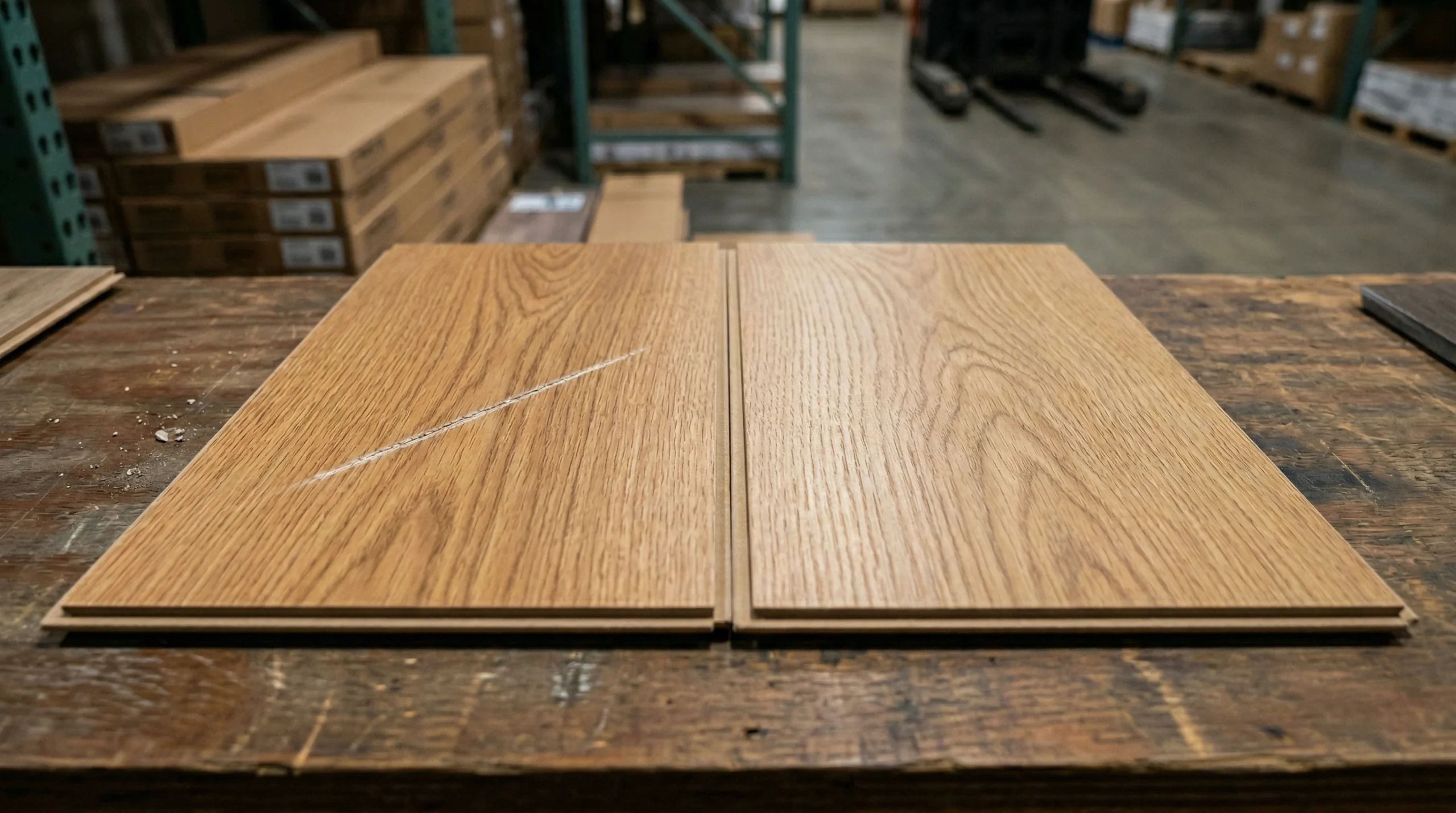
The core’s moisture resistance determines how well your floor survives the humidity spikes during UAE’s occasional winter condensation or summer transitions when air conditioning cycles. We’ve seen cheap laminate with standard HDF cores swell at seams within 18 months in coastal Dubai apartments, while premium moisture-resistant cores in identical conditions show zero swelling after five years. The decorative layer is where the magic happens—high-resolution photography captures every knot, grain variation, and color subtlety of real wood, stone, or creative designs. This layer undergoes advanced printing that synchronizes with the embossed texture above it, so when you run your hand across the surface, you feel grain where you see grain.
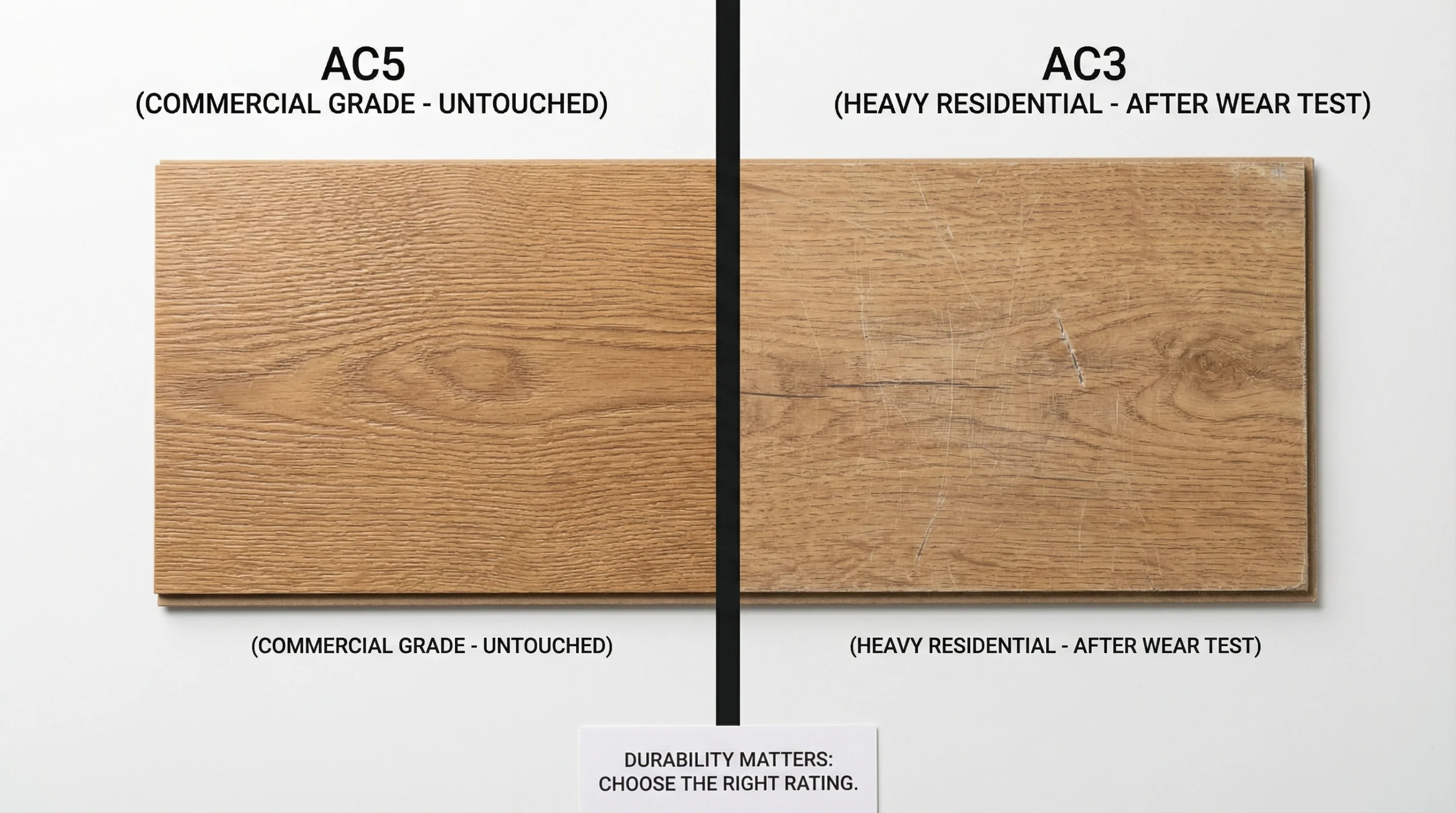
The overlay wear layer is transparent aluminum oxide that determines scratch resistance, stain resistance, and longevity. AC ratings from AC1 (light residential) through AC6 (heavy commercial) measure this layer’s toughness. For Dubai homes, we recommend minimum AC4, which handles active families, pets, and furniture movement. Commercial spaces need AC5 or AC6. The final top layer provides additional moisture resistance and makes cleaning effortless—crucial in dusty UAE conditions where floors need frequent maintenance.
How Climate Affects Laminate Performance
Dubai’s unique climate creates specific challenges that inferior laminate handles poorly. Temperature differentials between 48°C exterior heat and 20°C air-conditioned interiors cause expansion and contraction cycles that stress every construction material. Laminate’s HDF core expands and contracts with temperature and humidity changes, which is why proper installation with expansion gaps is non-negotiable in the UAE.
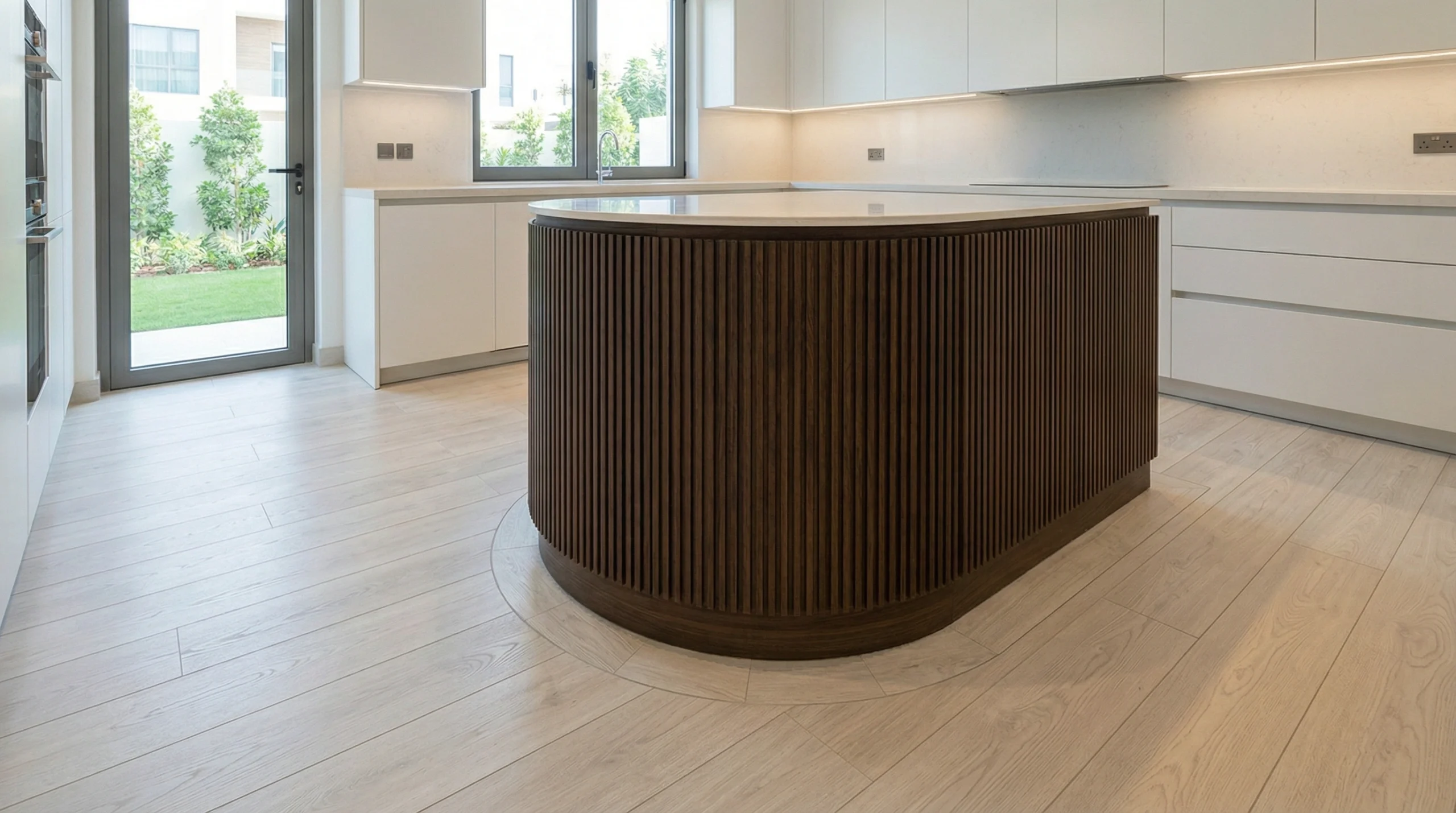
We’ve documented cases where installers from non-Gulf regions installed laminate tight against walls without proper expansion allowance, assuming European climate standards. Within three months during summer, the floor buckled in the center of rooms as planks expanded but had nowhere to go. Our installation protocol includes 10-12mm expansion gaps around all room perimeters, 15mm gaps around heavy fixed objects like kitchen islands, and expansion joints in rooms exceeding 12 meters in any direction. These gaps accommodate the thermal movement without compromising appearance because we conceal them with carefully matched skirting and transition strips.
Humidity presents another consideration. Coastal areas like Dubai Marina, JBR, and Palm Jumeirah experience higher ambient humidity, especially during winter months when cooler air increases relative humidity indoors. Standard laminate can absorb moisture through edges and seams, leading to edge swelling and visible seam separation. We specify waterproof laminate with fully sealed edges and water-resistant core technology for these locations. This costs 25-30% more than standard moisture-resistant laminate but eliminates future replacement costs.
AC Rating Selection for Different UAE Applications
The Abrasion Criteria rating system quantifies how much wear laminate flooring withstands before showing damage. This matters enormously for long-term satisfaction because replacing flooring is disruptive and expensive. AC ratings derive from standardized tests measuring resistance to abrasion, impact, staining, cigarette burns, swelling, and castor chair movement.
For Dubai residential applications, we’ve developed clear guidelines through observing thousands of installations over decades. AC3 laminate works adequately for bedrooms and guest rooms with light traffic, lasting 8-12 years before showing noticeable wear in UAE conditions. Living rooms, dining rooms, and hallways need minimum AC4, which handles 12-18 years of family use including children, pets, and regular furniture rearrangement. Kitchens benefit from AC5 commercial-grade laminate because the combination of dropped utensils, appliance movement, spills, and constant foot traffic degrades lower ratings within 5-7 years.
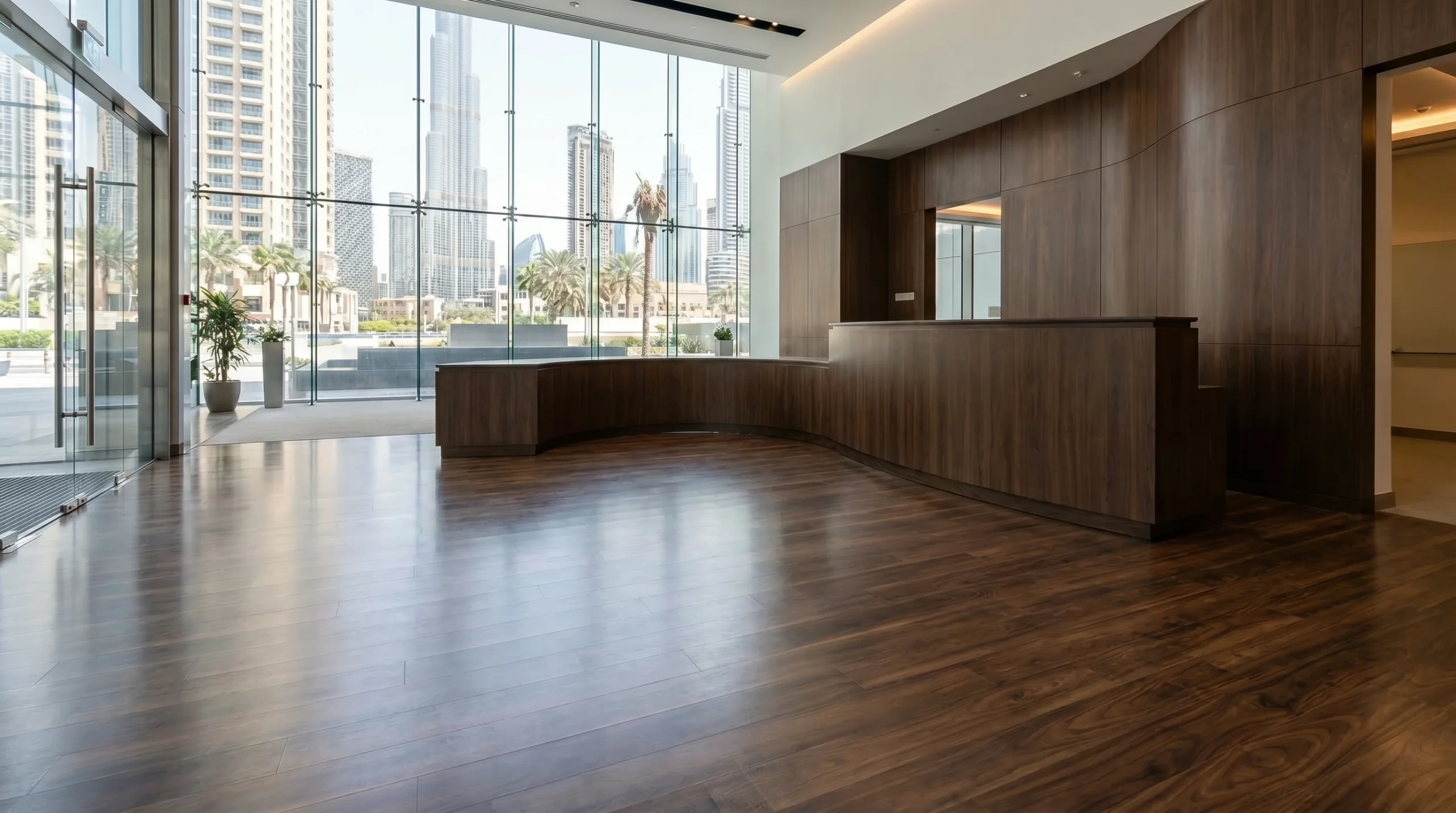
Commercial laminate flooring Dubai projects require AC5 minimum for retail shops, offices, and restaurants with moderate traffic. High-traffic retail environments, hotel lobbies, and busy restaurants need AC6 heavy commercial laminate that costs significantly more but handles punishment that would destroy AC4 within months. We installed AC6 laminate in a Dubai Mall retail location that sees 2,000+ daily visitors—after four years, the floor shows less wear than AC4 laminate in a typical home after two years.
The wear layer thickness directly correlates with AC rating. AC4 typically uses 0.3-0.4mm wear layers, while AC6 employs 0.6-0.8mm layers. Those extra tenths of a millimeter represent millions more abrasion cycles before the decorative layer becomes visible through the wear layer. We always explain this cost-benefit relationship to clients: spending 40% more on AC5 instead of AC3 often doubles or triples floor lifespan, making the actual cost per year of use significantly lower.
Laminate Flooring Styles and Design Options
Laminate manufacturers now offer design sophistication that rivals or exceeds natural material options. The photographic and embossing technology has reached the point where texture, visual depth, and grain realism create convincing wood, stone, or tile reproductions at a fraction of the cost and with superior performance characteristics for UAE installation.
Wood-Look Laminate Options
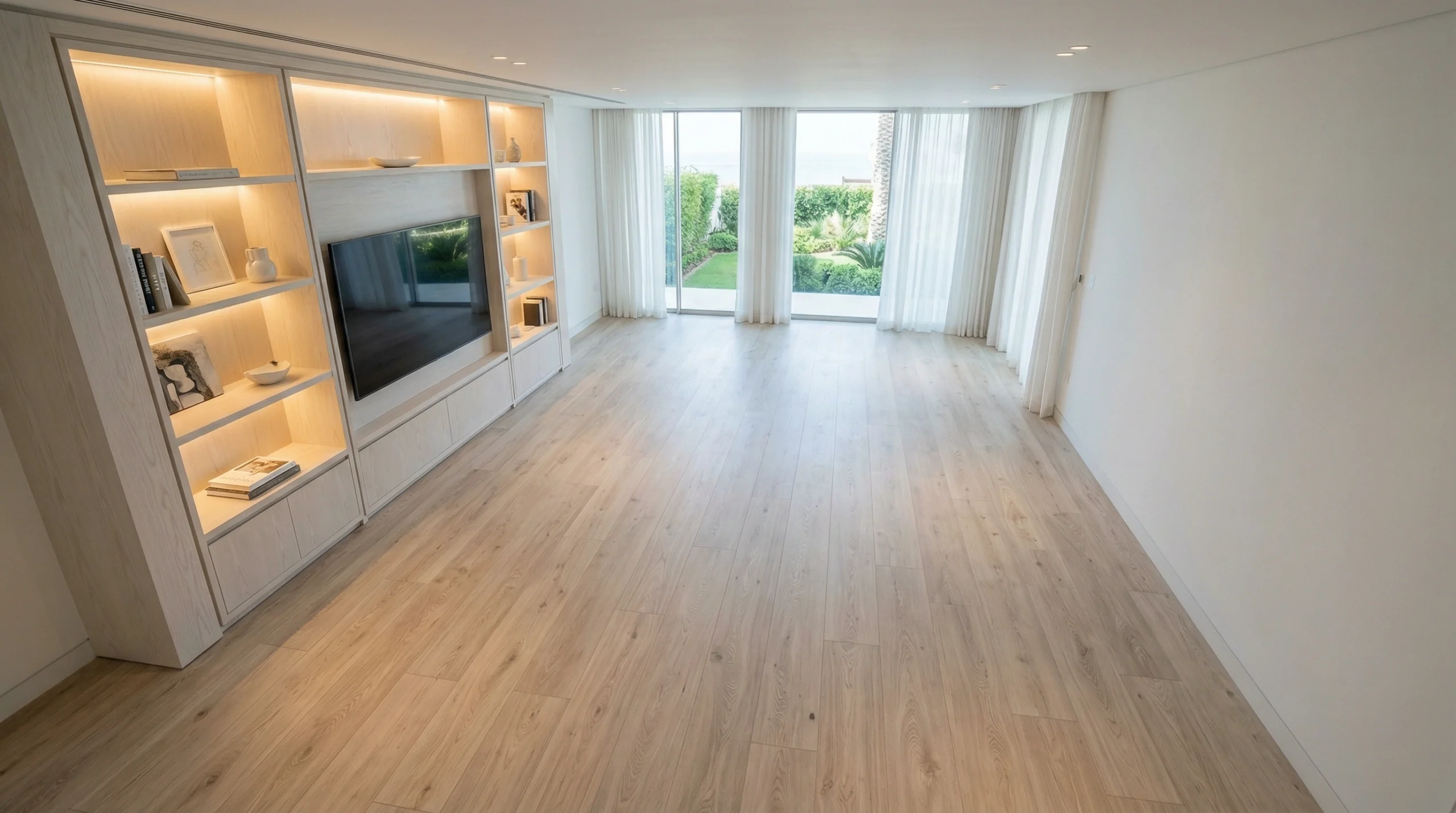
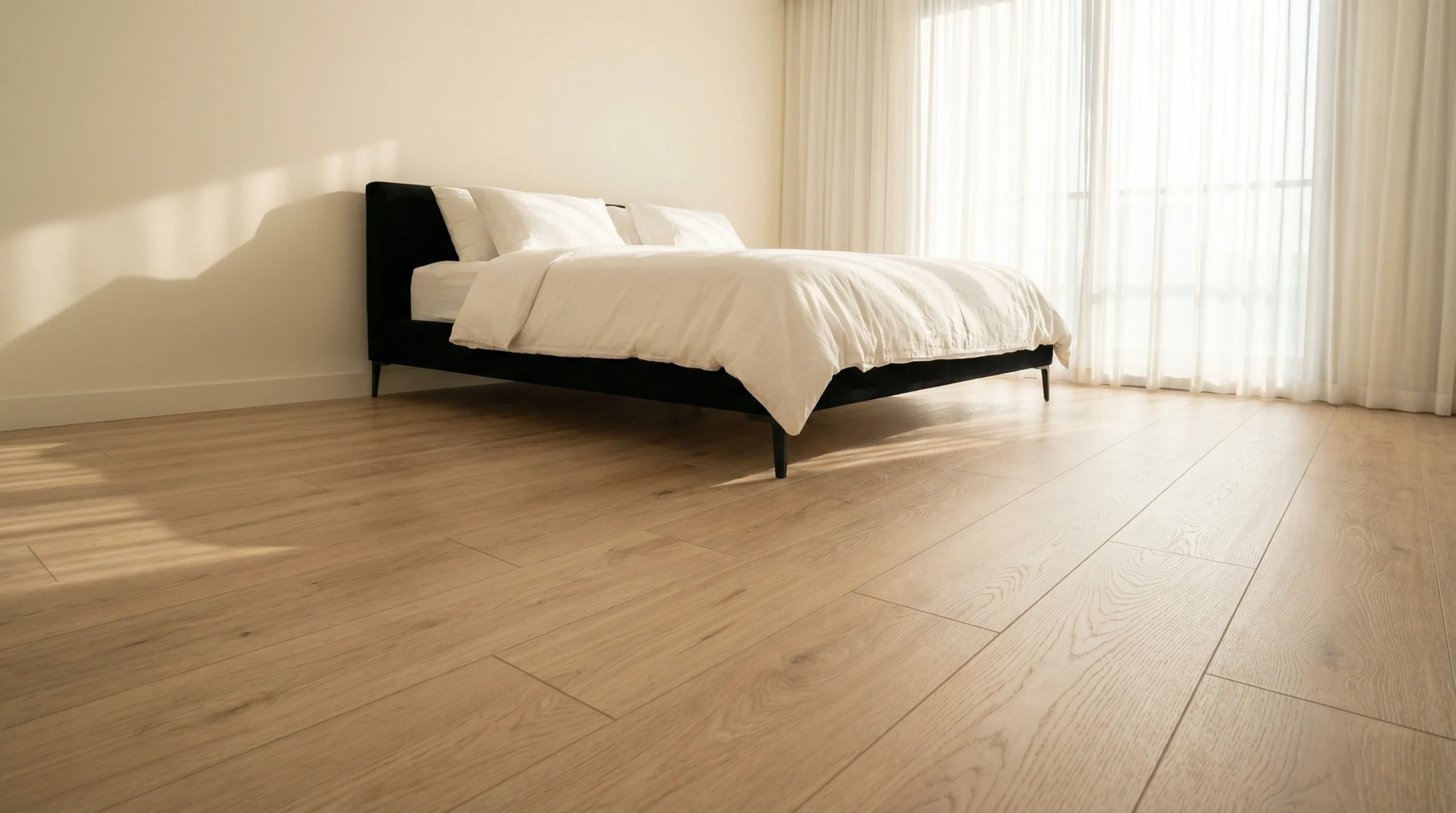
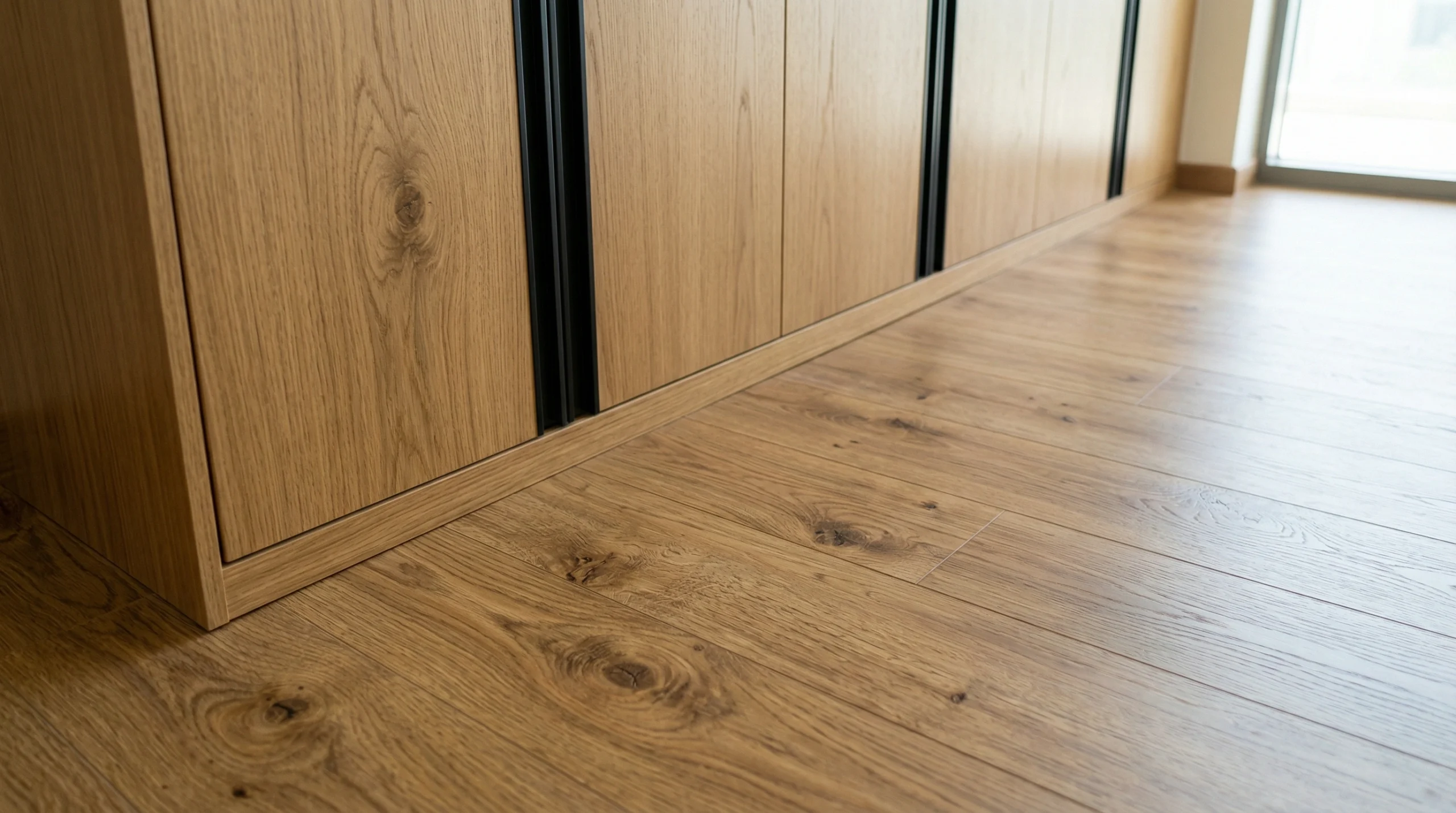
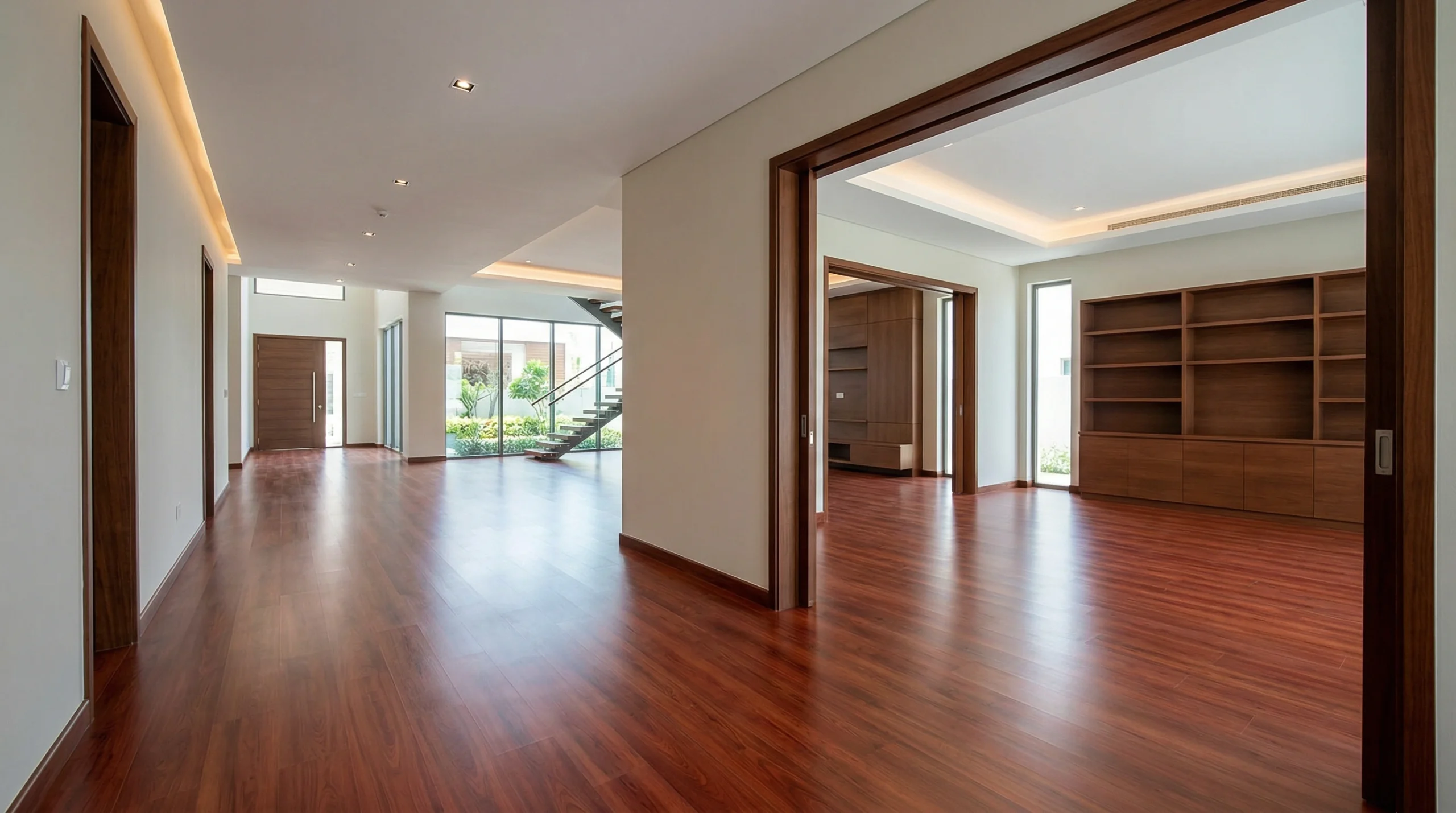
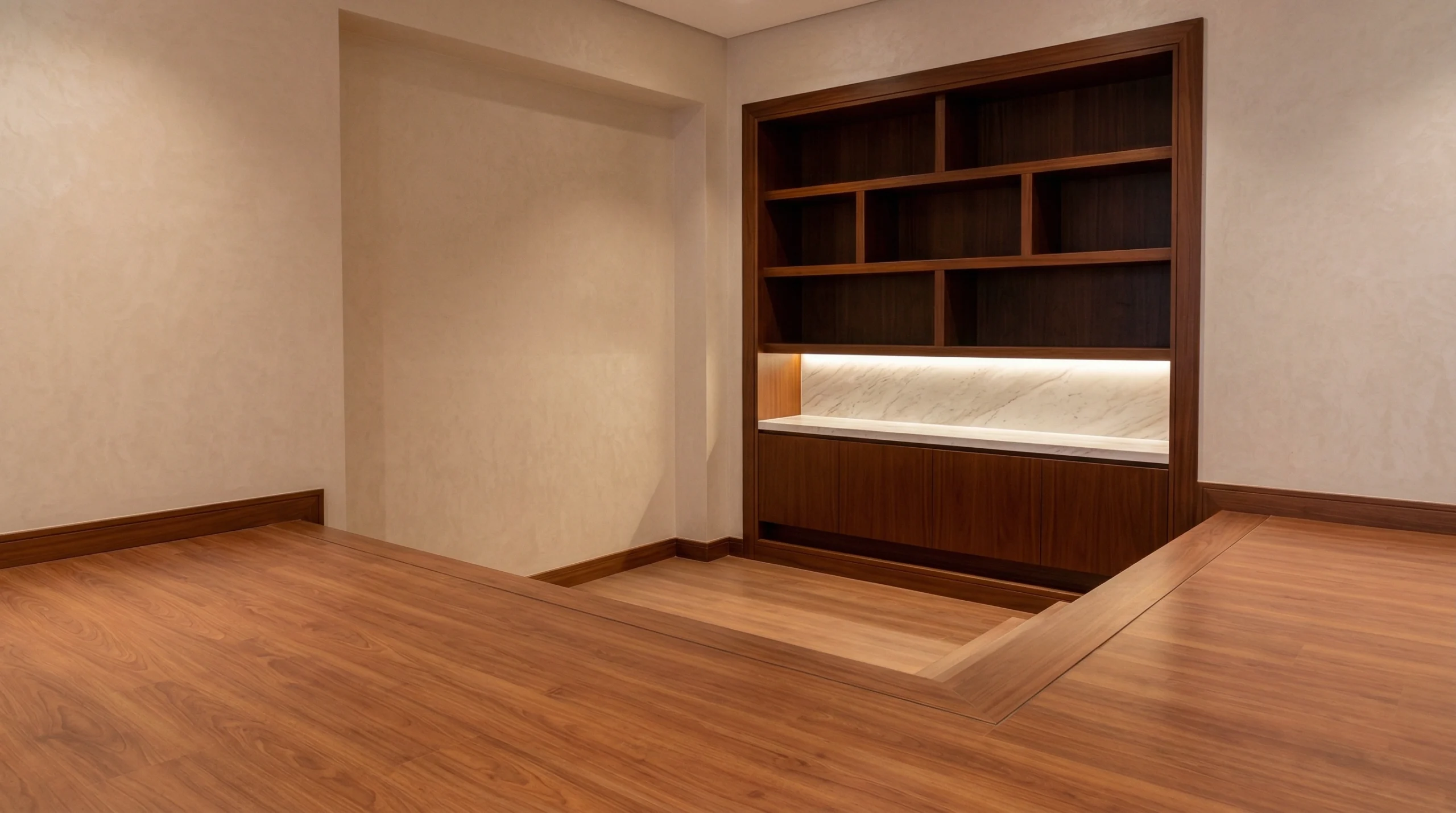
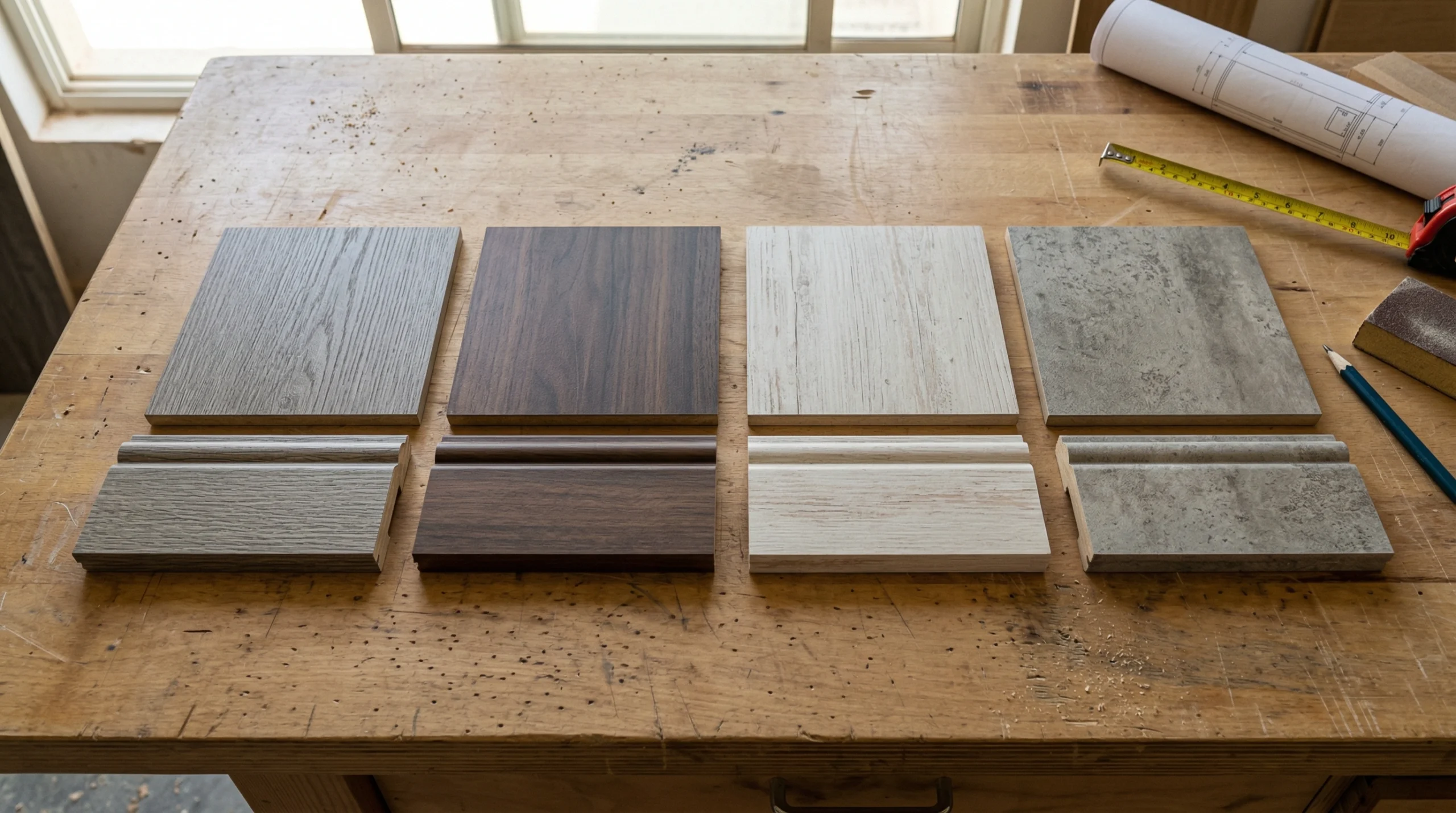
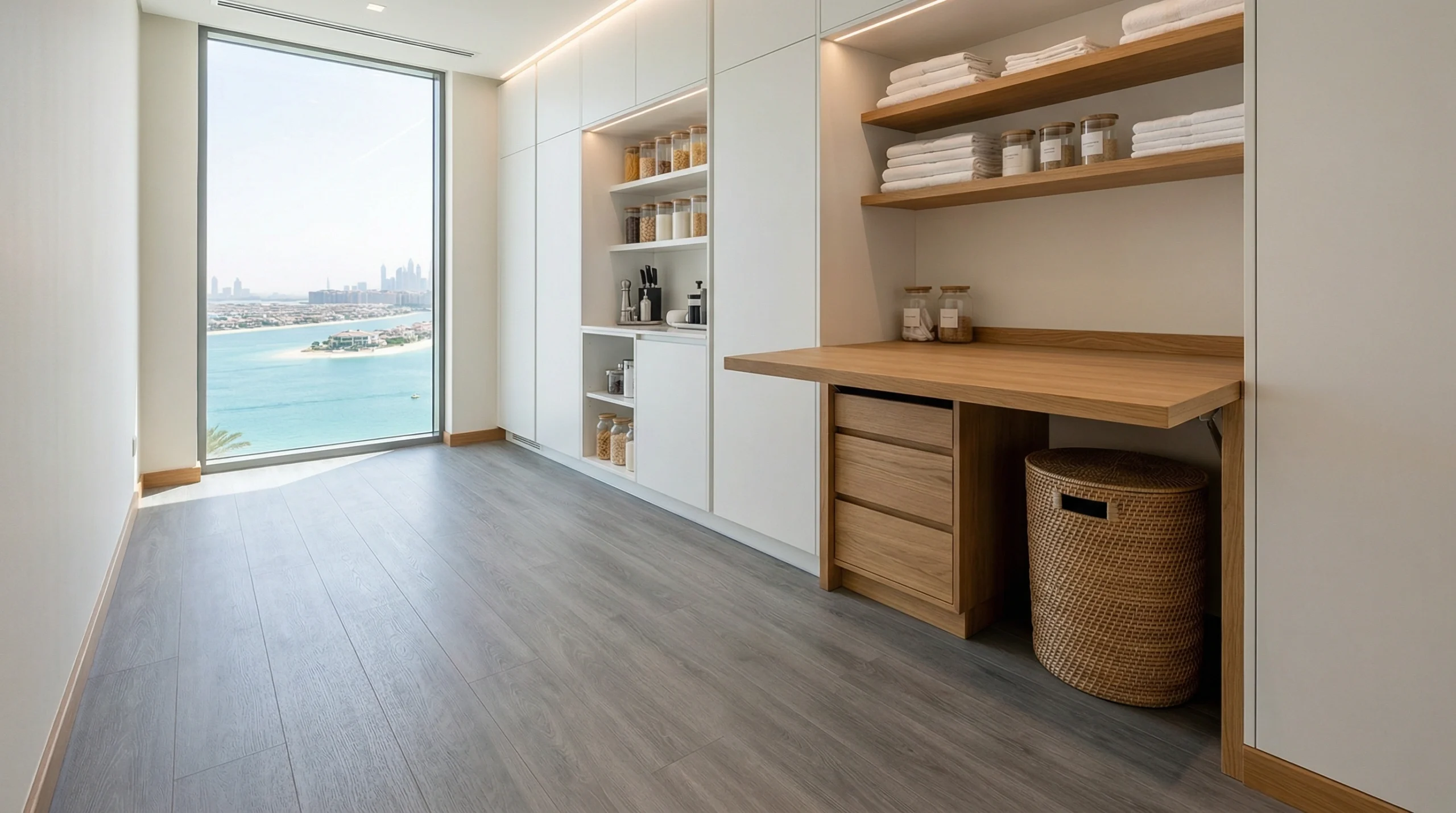
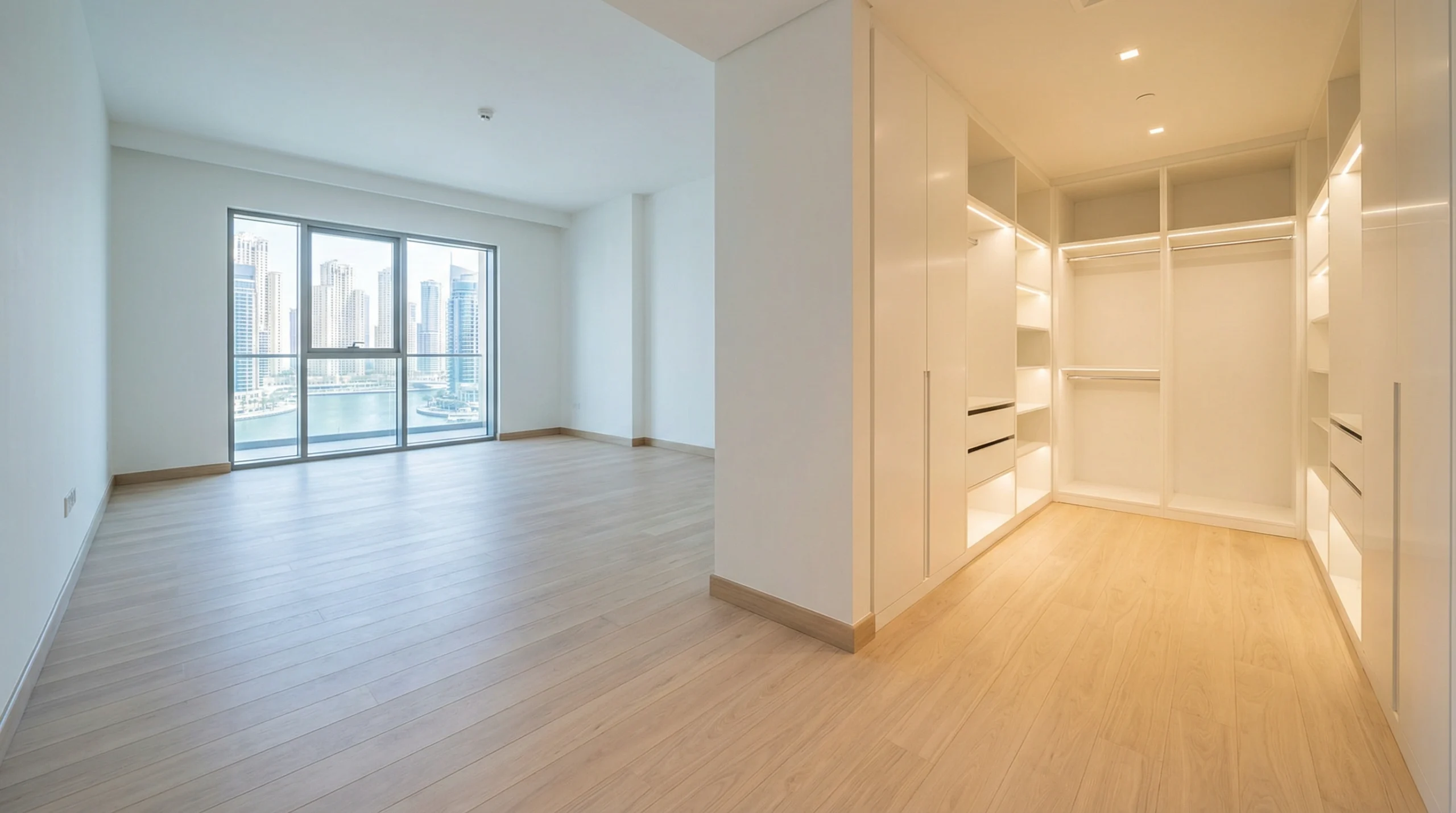
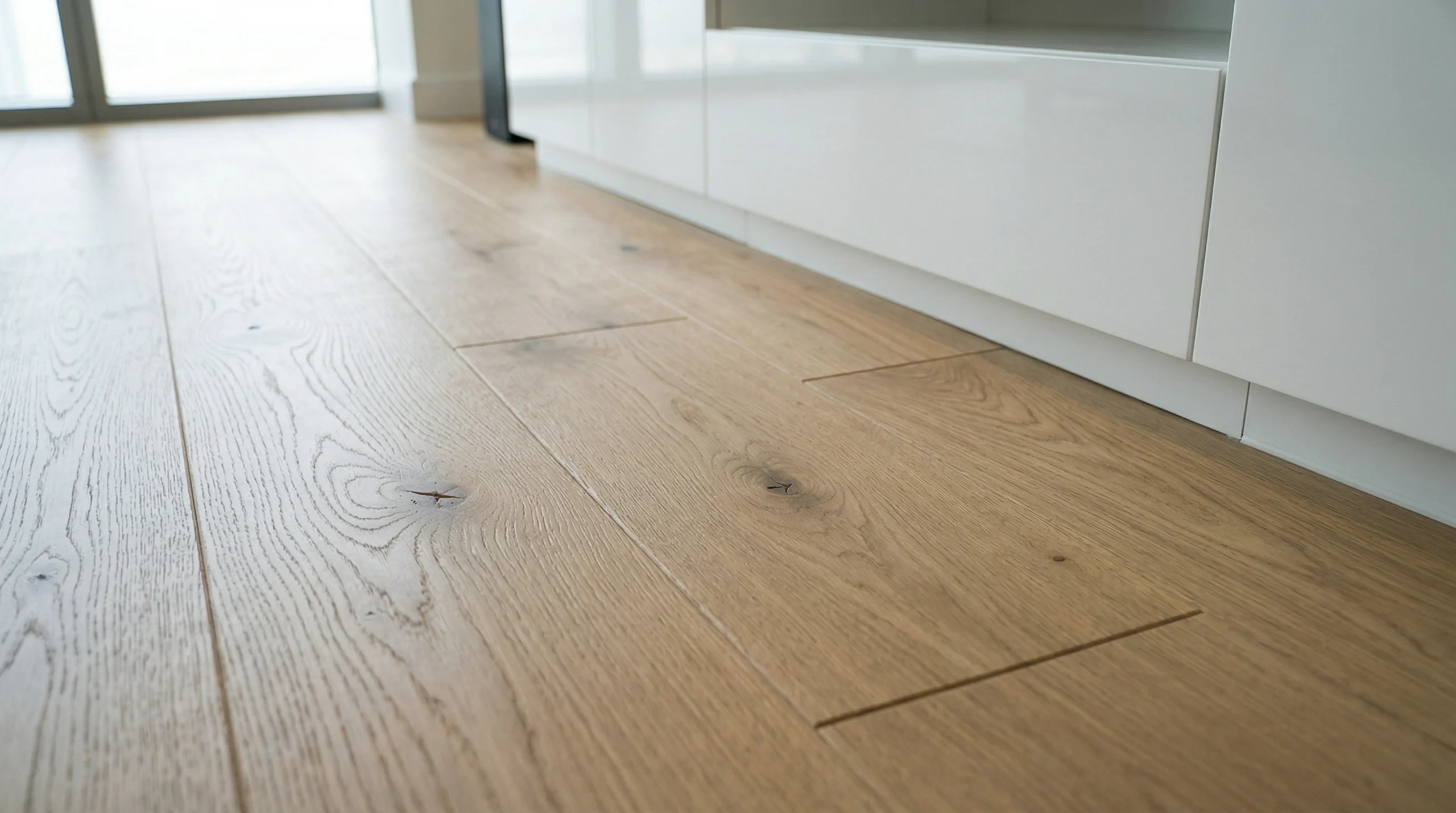
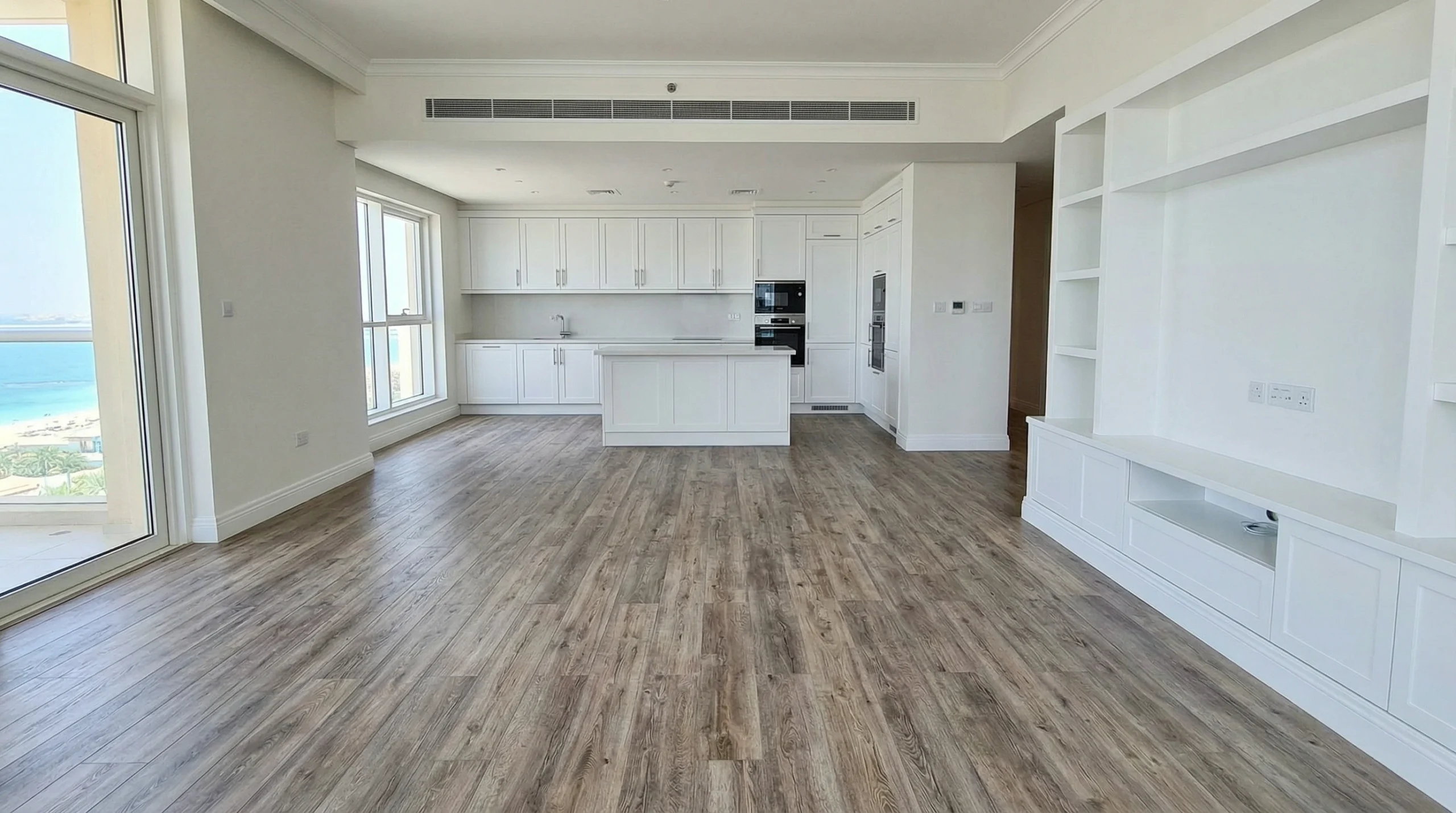
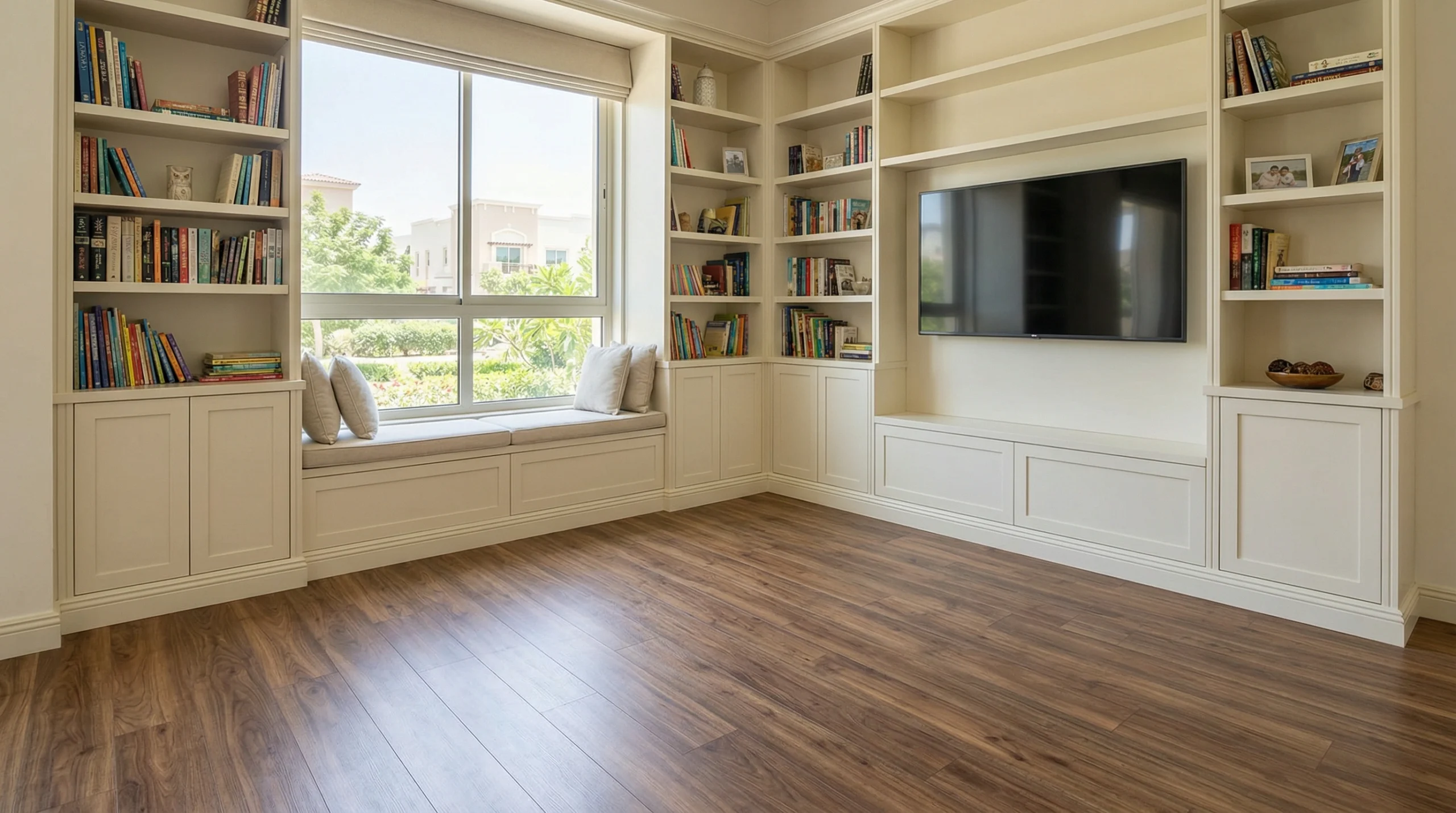
Oak laminate flooring dominates our Dubai installations, representing roughly 60% of residential projects. The appeal spans from light Nordic oak that brightens spaces and creates contemporary Scandinavian aesthetics to rich chocolate and espresso oaks that add warmth and traditional elegance. We source oak laminate from German and Belgian manufacturers whose photographic libraries include hundreds of real oak planks, meaning your floor won’t show the same grain pattern repeating every third plank like cheaper alternatives.
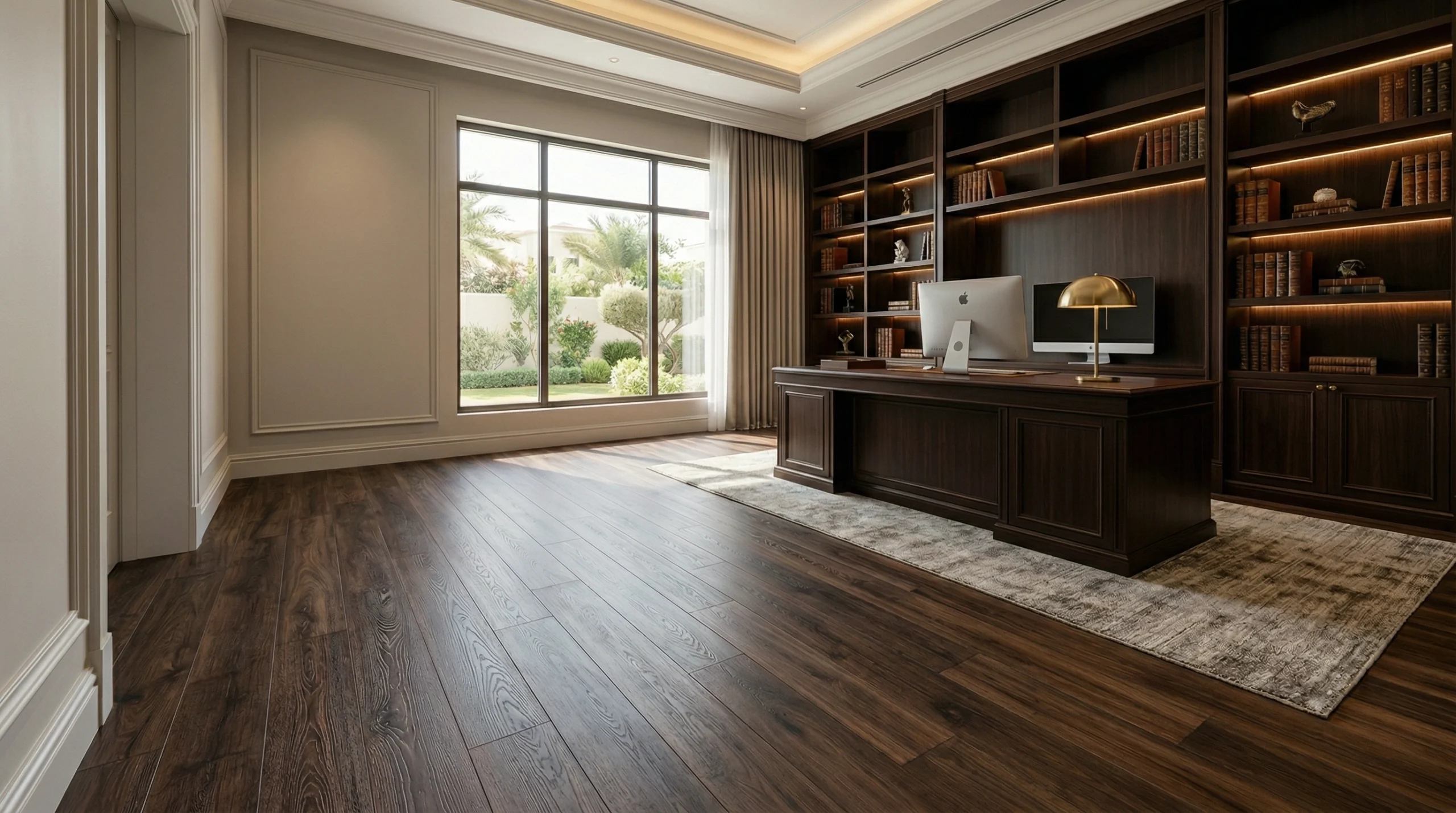
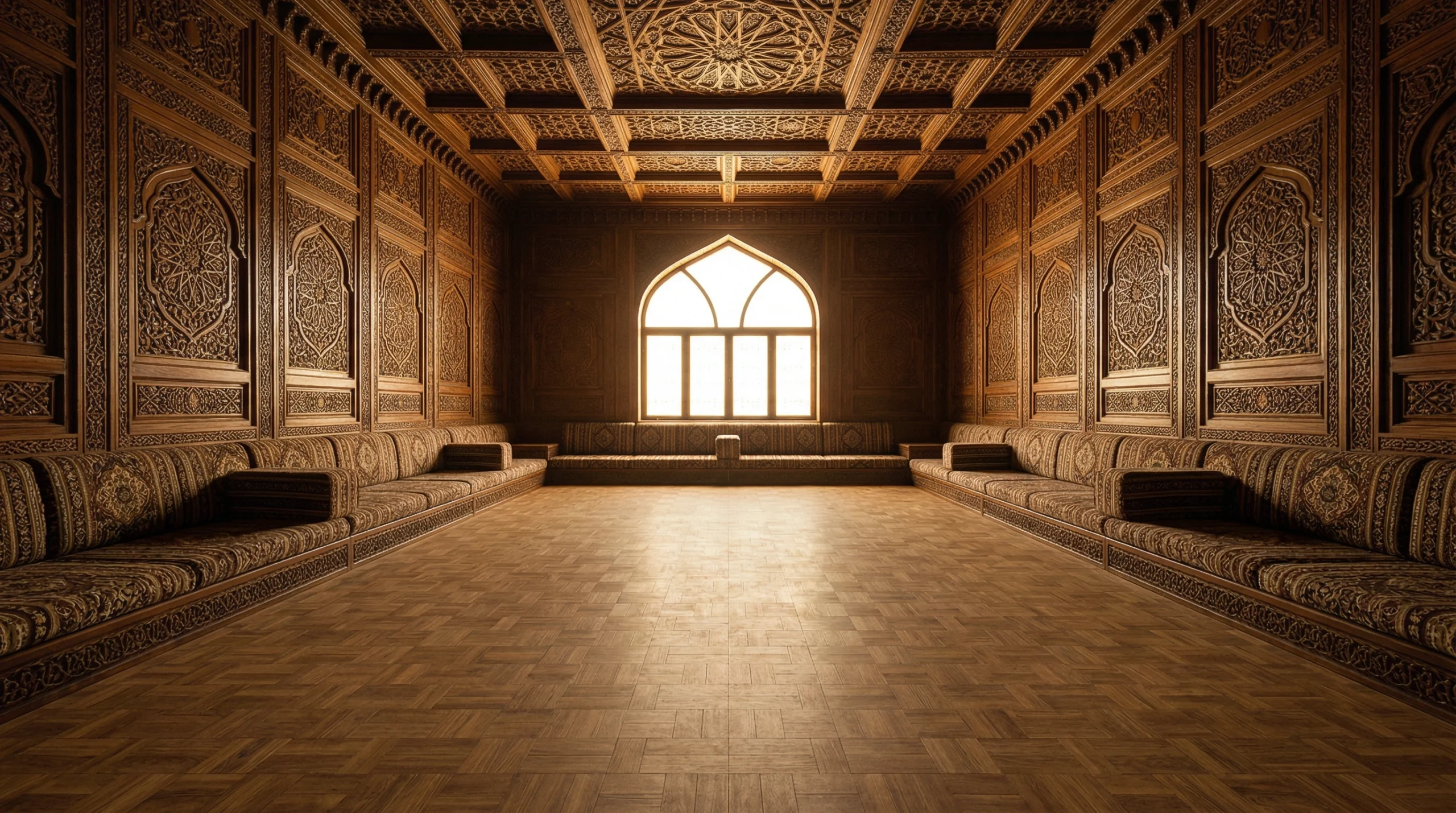
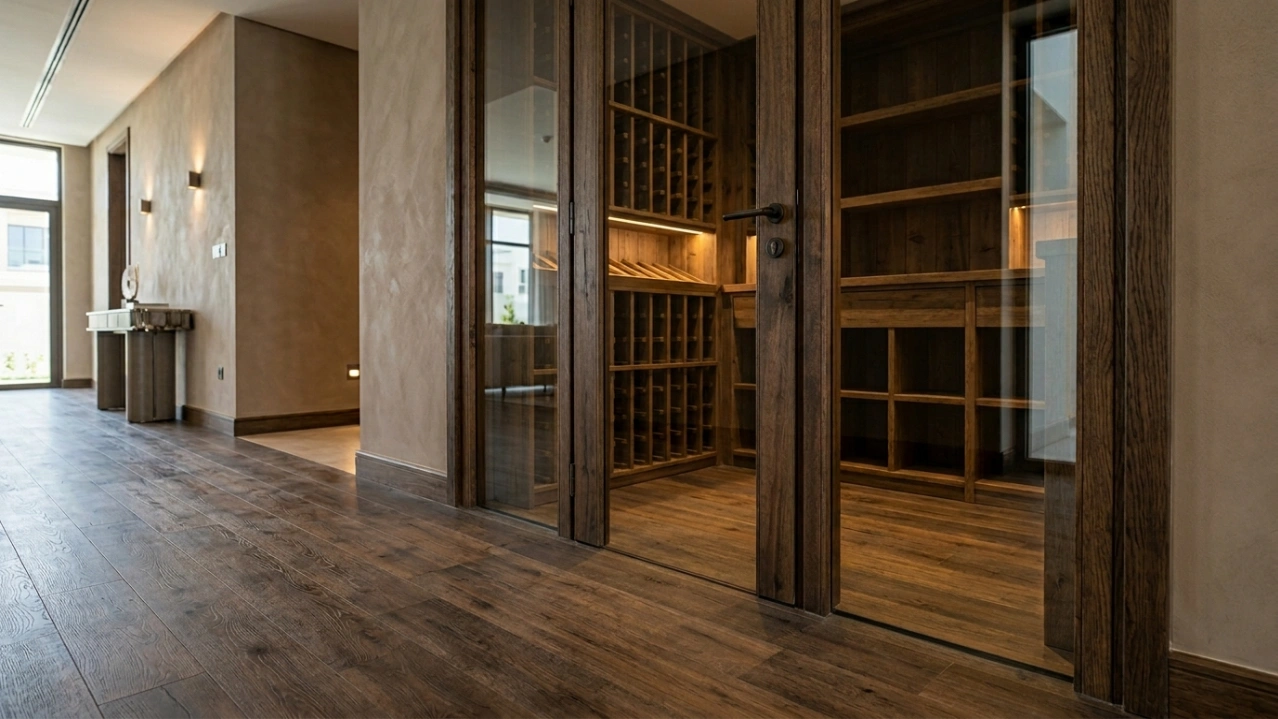
Walnut, hickory, and acacia reproductions suit clients wanting more distinctive character. The darker walnut tones complement traditional Arabic design elements while maintaining contemporary edge. We installed wide-plank walnut laminate throughout a Palm Jumeirah villa where the owners wanted sophistication without solid walnut’s $180-per-square-meter cost and maintenance requirements. The laminate delivered visual impact at $45 per square meter installed, and unlike real walnut, it doesn’t fade in Dubai’s intense sunlight.
Exotic wood reproductions—Brazilian cherry, teak, bamboo, ebony—let homeowners achieve specific aesthetics without environmental concerns or import complications. Hand-scraped and distressed finishes add texture variation that some clients prefer over perfectly uniform surfaces. These work exceptionally well in villas with rustic or Mediterranean design themes.
Plank width significantly affects visual perception. Standard 120-150mm planks suit smaller spaces and create traditional flooring aesthetics. Wide planks of 180-240mm make spaces feel larger and more contemporary, though they cost 15-25% more due to manufacturing complexity and higher defect rates during production. Extra-long planks extending 1800-2200mm reduce the number of end joints and create cleaner sightlines, particularly effective in open-plan layouts common in modern Dubai apartments.
Stone and Tile-Look Laminate
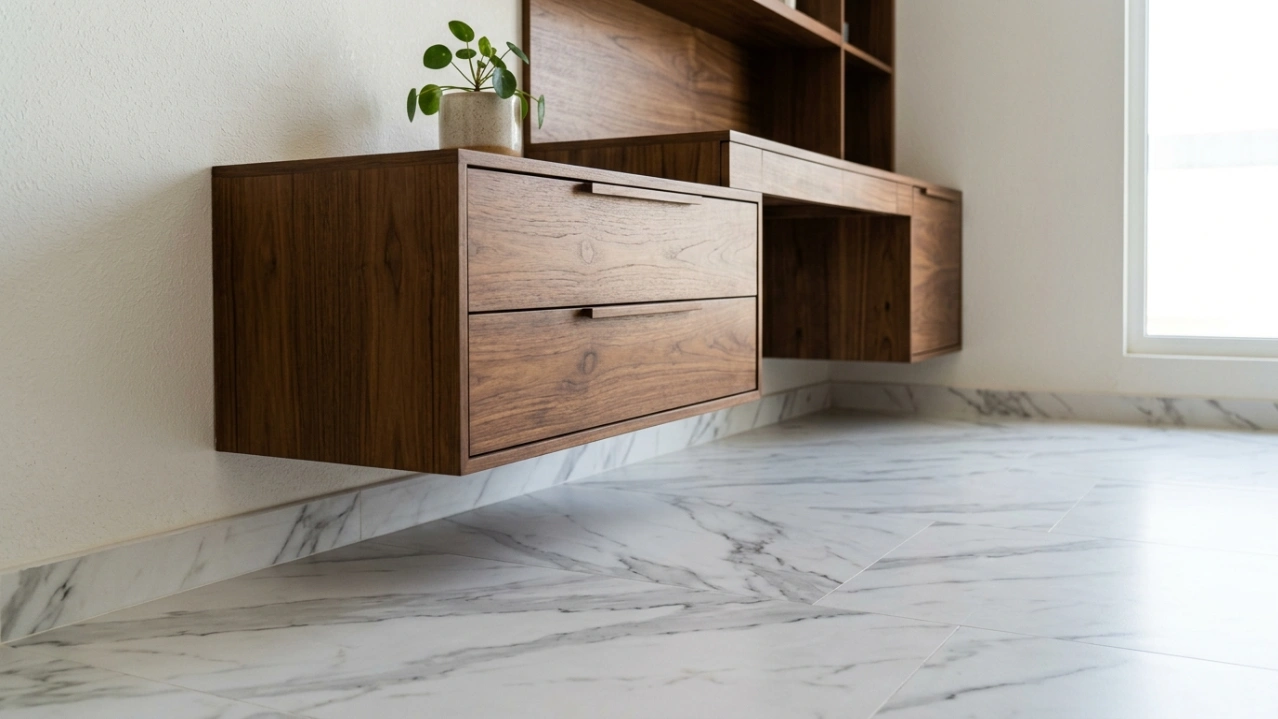
Stone-effect laminate provides the sophisticated appearance of marble, travertine, or slate without cold surfaces that make bare feet uncomfortable in air-conditioned UAE homes. We’ve installed marble-look laminate in bathrooms, kitchens, and entryways where clients wanted elegant stone aesthetics but needed warmer underfoot comfort and faster installation than actual stone.
The technology has advanced to include realistic variations in veining, color gradation, and surface texture that mirror natural stone’s irregularities. Twelve-millimeter-thick laminate with deep embossing creates tactile authenticity—when you close your eyes and touch the surface, your fingers report stone texture. This works particularly well in contemporary minimalist designs where large-format stone-look planks (600x300mm or larger) create seamless modern aesthetics.
Tile-look laminate suits kitchens, bathrooms, and commercial spaces where traditional tile would be the default choice. The advantages over ceramic tile are substantial for UAE installation: faster installation with less mess and disruption, warmer surface temperature, quieter underfoot (tile creates echoing impact sounds in large rooms), and significantly easier replacement if damage occurs. We completed a 400-square-meter restaurant installation in Business Bay using porcelain-look laminate—the project took four days compared to three weeks for tile, allowing the owner to open on schedule.
Contemporary and Creative Designs
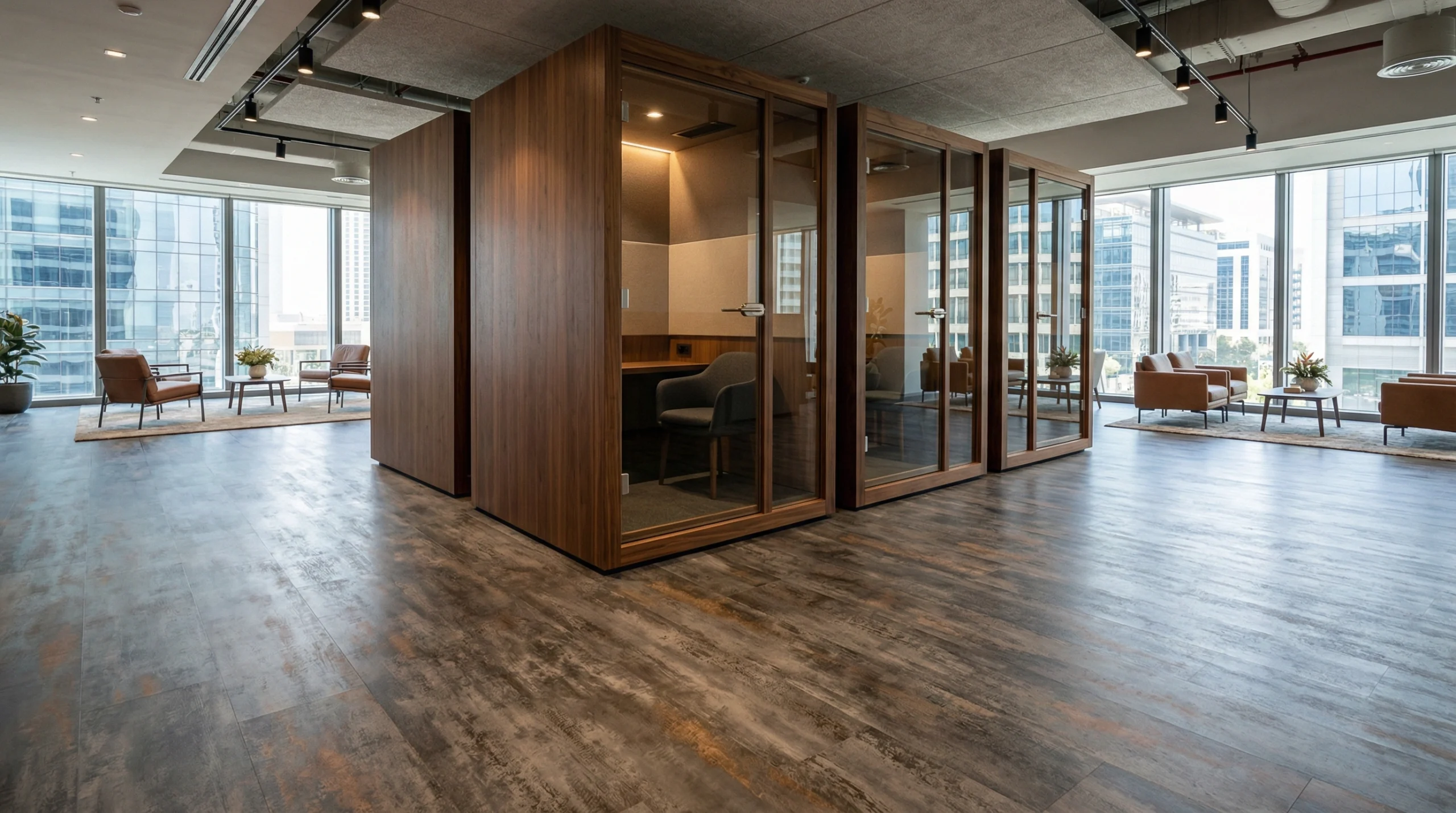
Beyond wood and stone reproductions, laminate now offers concrete effects, industrial metal looks, fabric textures, and abstract geometric patterns. These suit commercial offices, retail environments, and residential clients wanting bold design statements. We installed concrete-effect laminate throughout a DIFC creative agency’s office—the industrial aesthetic matched their brand while the laminate’s acoustic properties (quieter than polished concrete) improved workplace comfort.
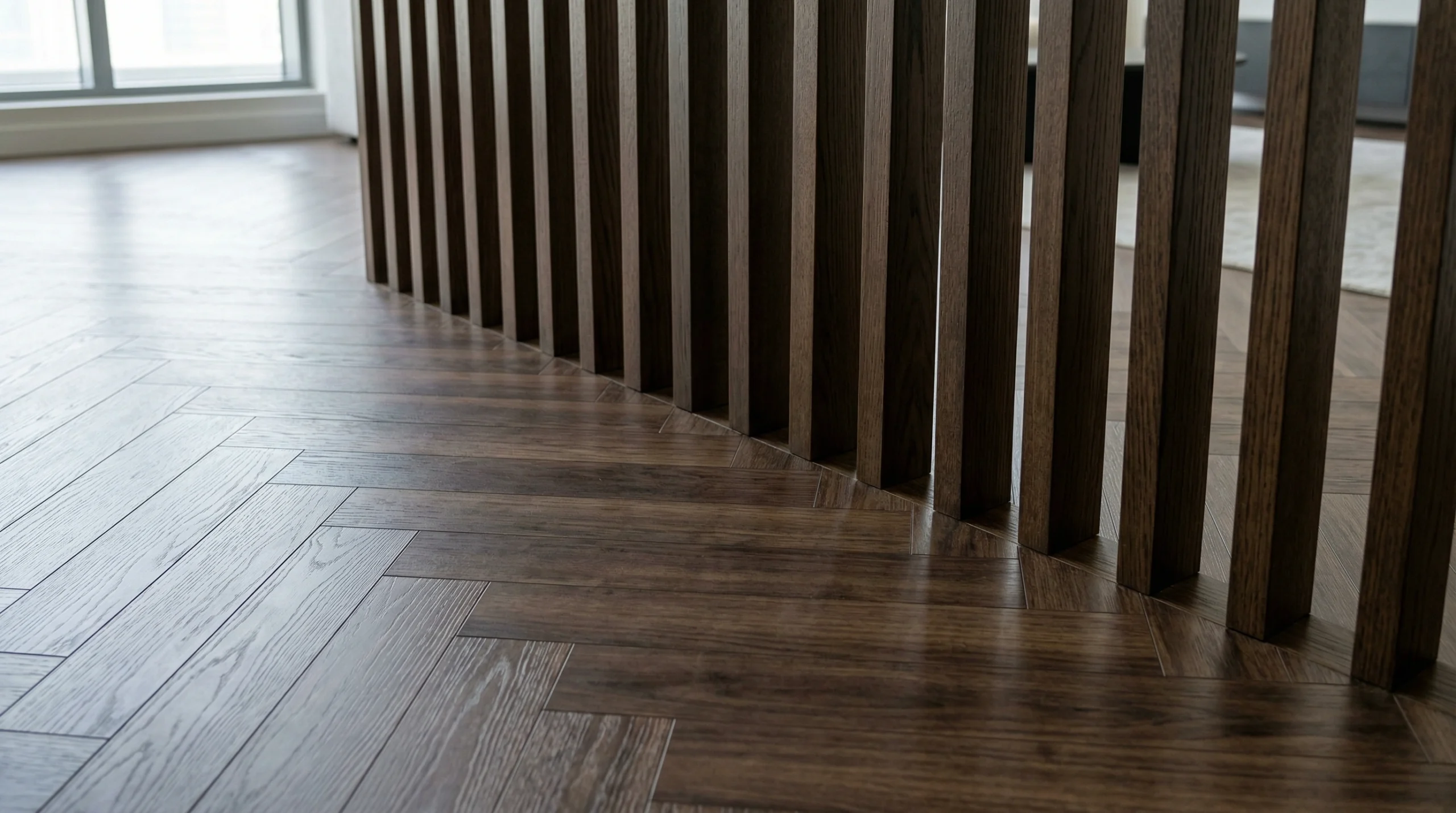
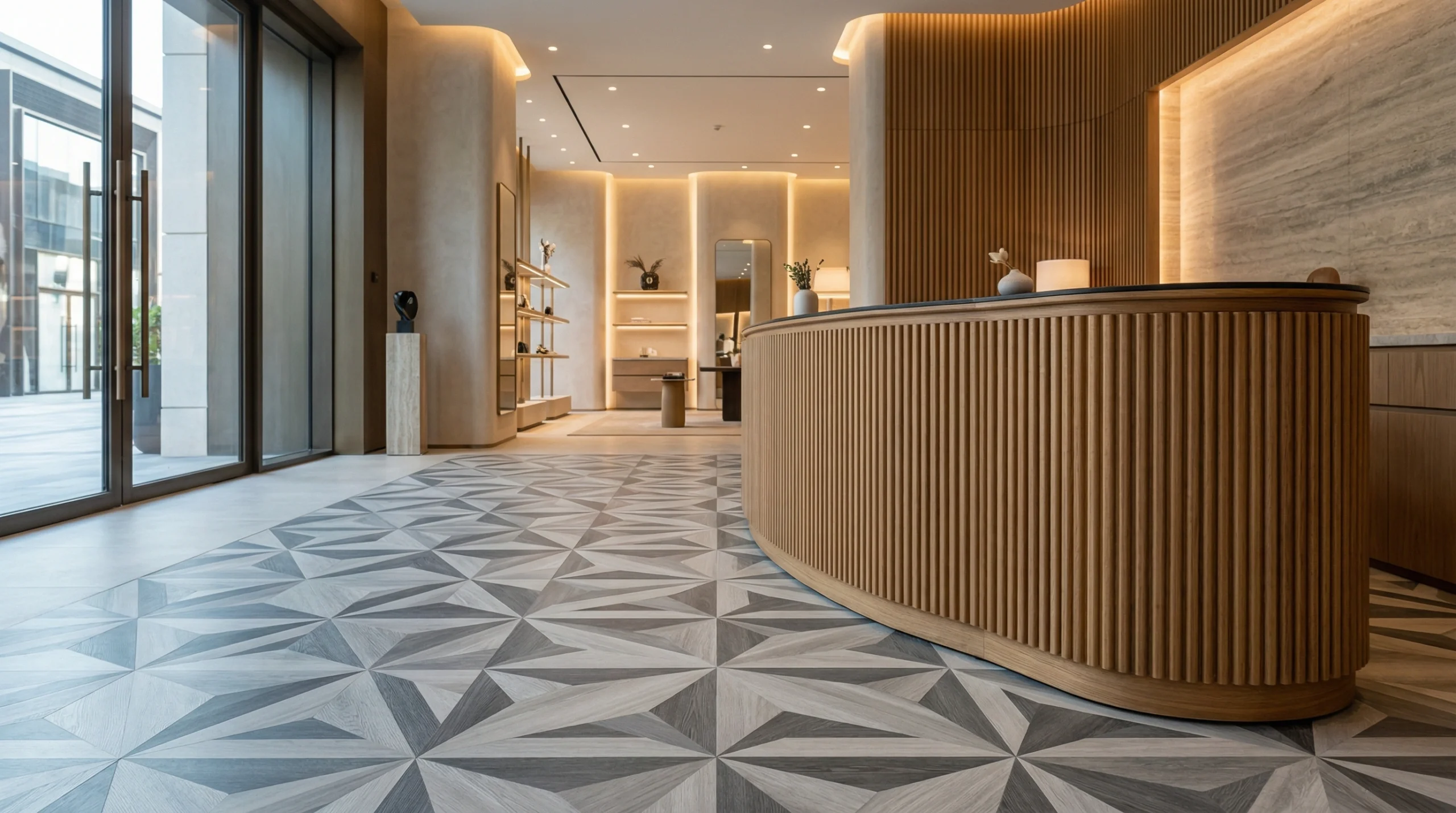
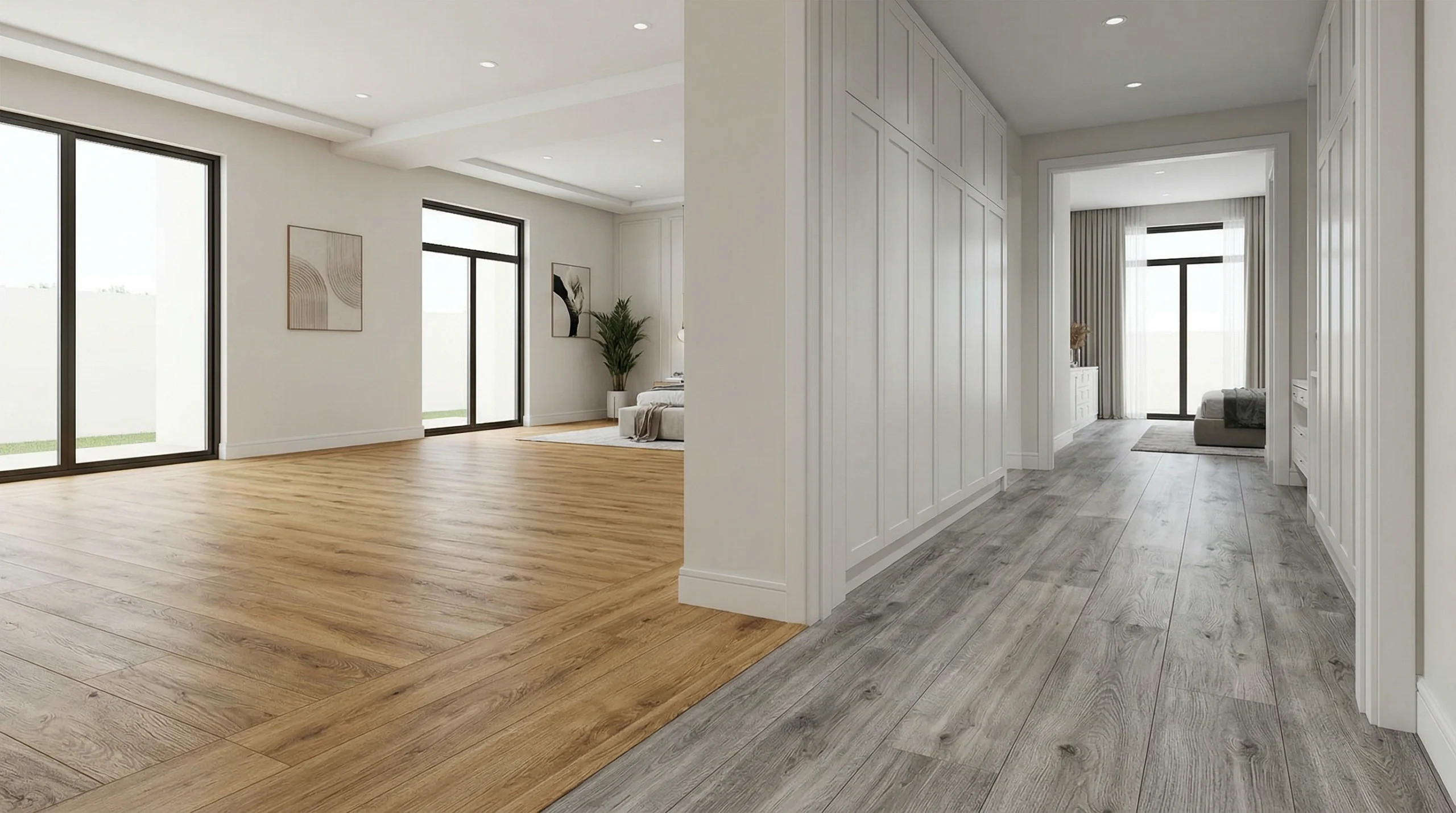
Chevron and herringbone patterns create visual interest and work exceptionally well in entryways, dining rooms, and feature areas. These require more complex installation and generate more waste, typically adding 30-40% to material and labor costs, but the visual impact justifies the investment for many clients. We’ve found that herringbone oak laminate in Dubai Marina apartments creates perceived value that exceeds the actual cost increase.
Waterproof Laminate Flooring Technology
Traditional laminate’s Achilles heel was water vulnerability—spills penetrating seams caused core swelling and permanent damage. Waterproof laminate engineering has solved this limitation through multiple innovations that make the flooring genuinely suitable for UAE bathrooms, laundry rooms, kitchens, and even limited outdoor applications under covered areas.
Water-Resistant vs. Waterproof: Critical Differences
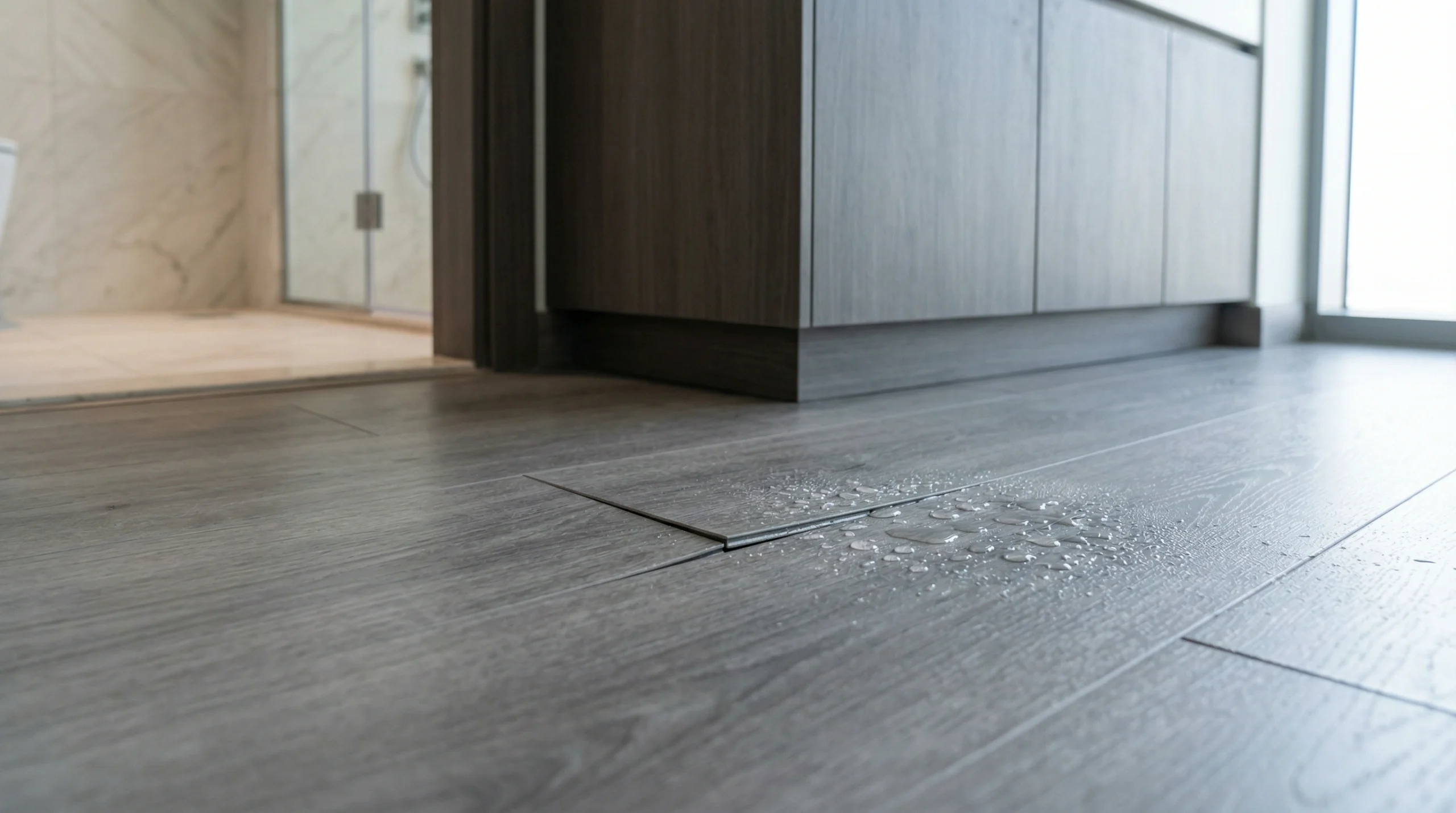
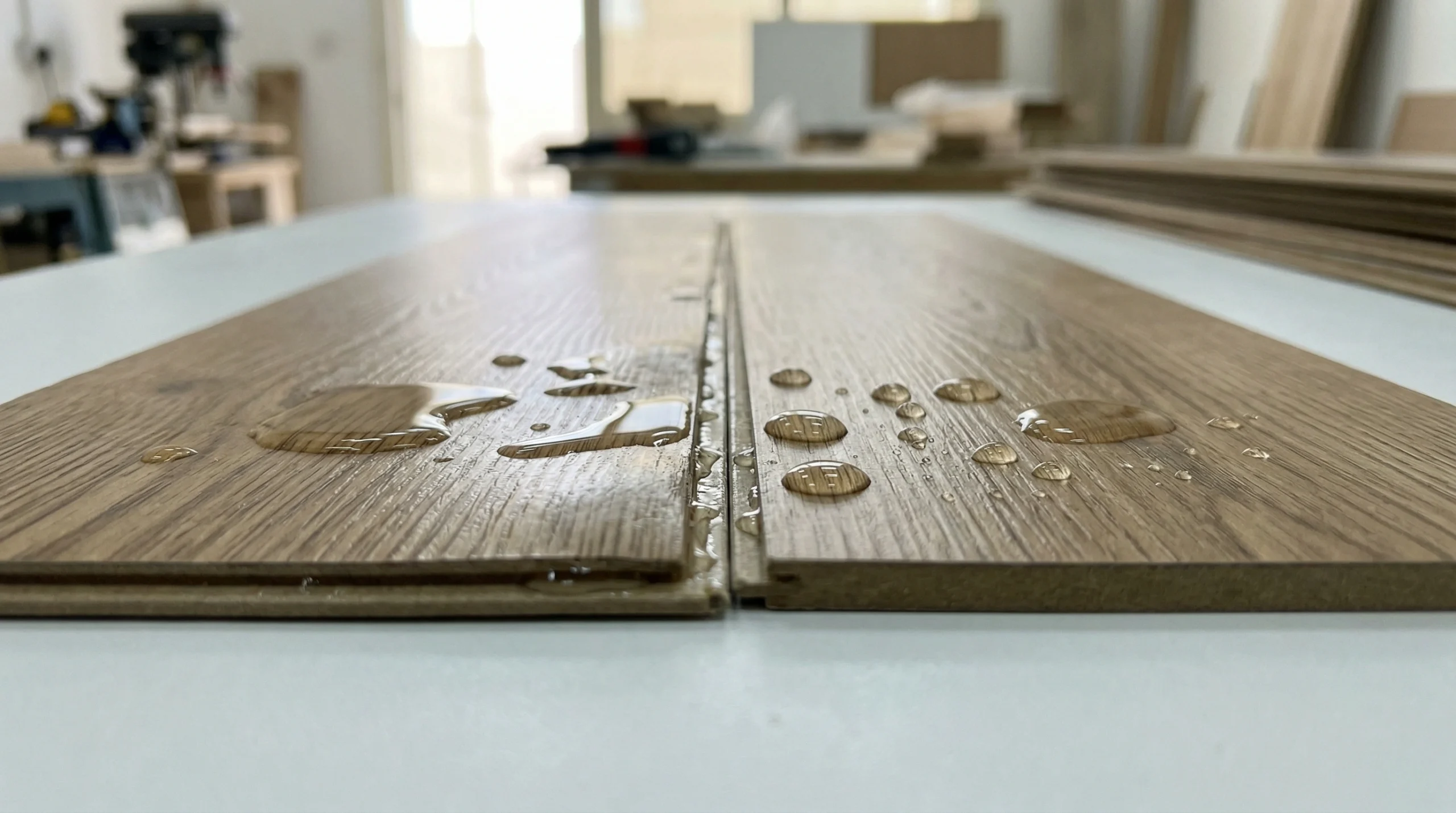
The terminology confusion causes problems. Water-resistant laminate has moisture-resistant core materials and tight-fitting joints that resist water penetration for limited periods—typically 2-4 hours before swelling begins. This suffices for living areas where spills get wiped quickly but fails in wet areas. We’ve replaced water-resistant laminate in Dubai kitchens where dishwasher leaks went unnoticed overnight, causing irreversible damage.
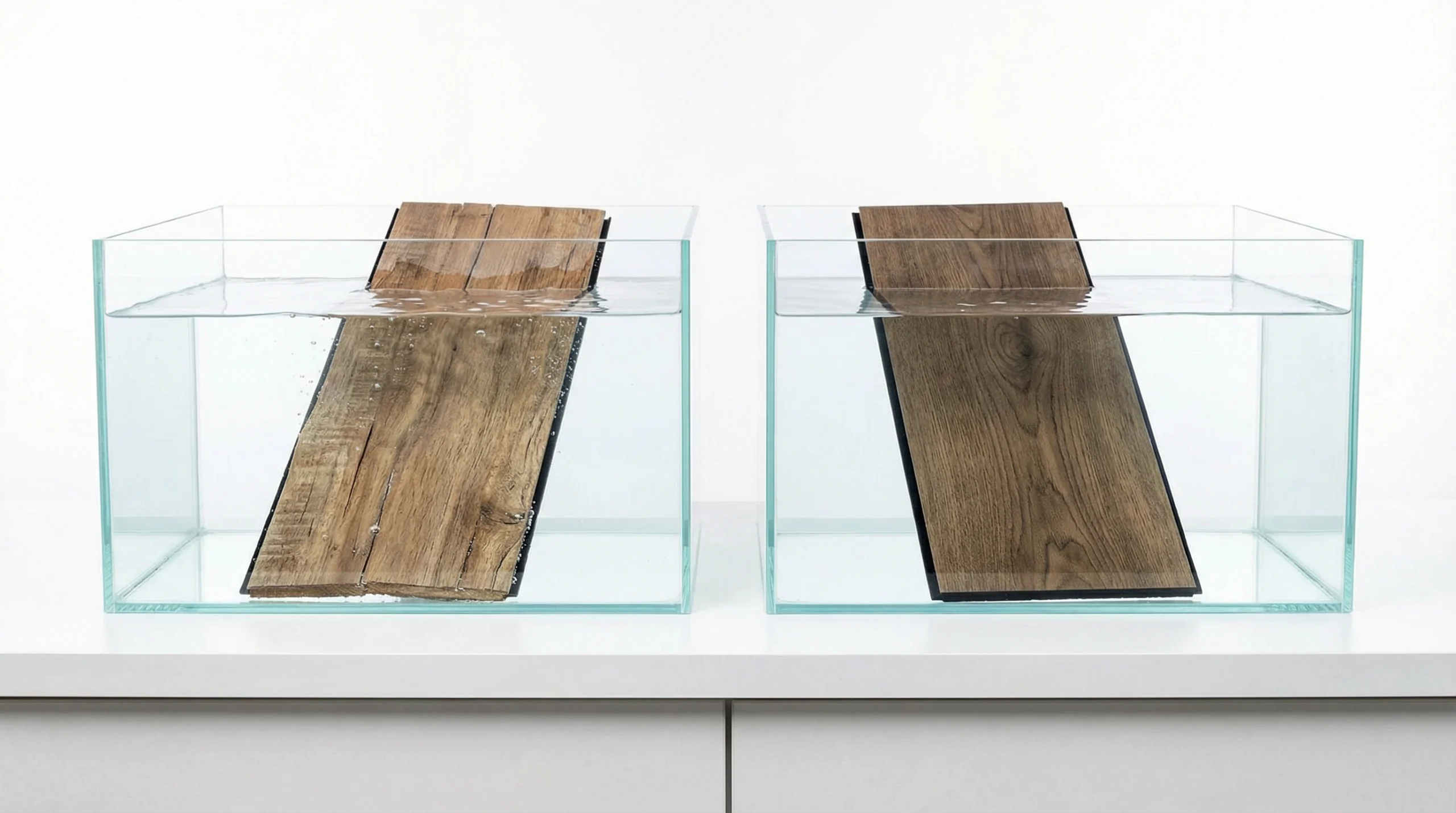
Waterproof laminate uses fundamentally different construction. The core material is rigid polymer composite rather than wood fiber, making it impervious to water absorption. Edges include integrated waterproof barriers or wax coatings that seal seams. The locking mechanism creates compression seals that prevent surface water from penetrating joints. These floors can sit in standing water for 24-72 hours without damage—we’ve tested this claim repeatedly in real-world conditions.
For Dubai homes, we recommend waterproof laminate in kitchens, all bathrooms, laundry rooms, children’s play areas, and any space opening to pools or outdoor areas. The 35-45% cost premium over standard laminate becomes insignificant when avoiding future replacement. A 15-square-meter kitchen floor costs approximately AED 2,800 for quality standard laminate or AED 3,900 for waterproof—the AED 1,100 difference is less than the labor cost alone to replace damaged flooring in three years.
Installation Considerations for Wet Areas
Even waterproof laminate requires proper installation protocols in moisture-prone areas. The subfloor must be completely level and dry before installation—we use moisture meters to verify concrete slabs below 4% moisture content and wood subfloors below 12%. Any higher readings require moisture barrier installation or additional drying time.
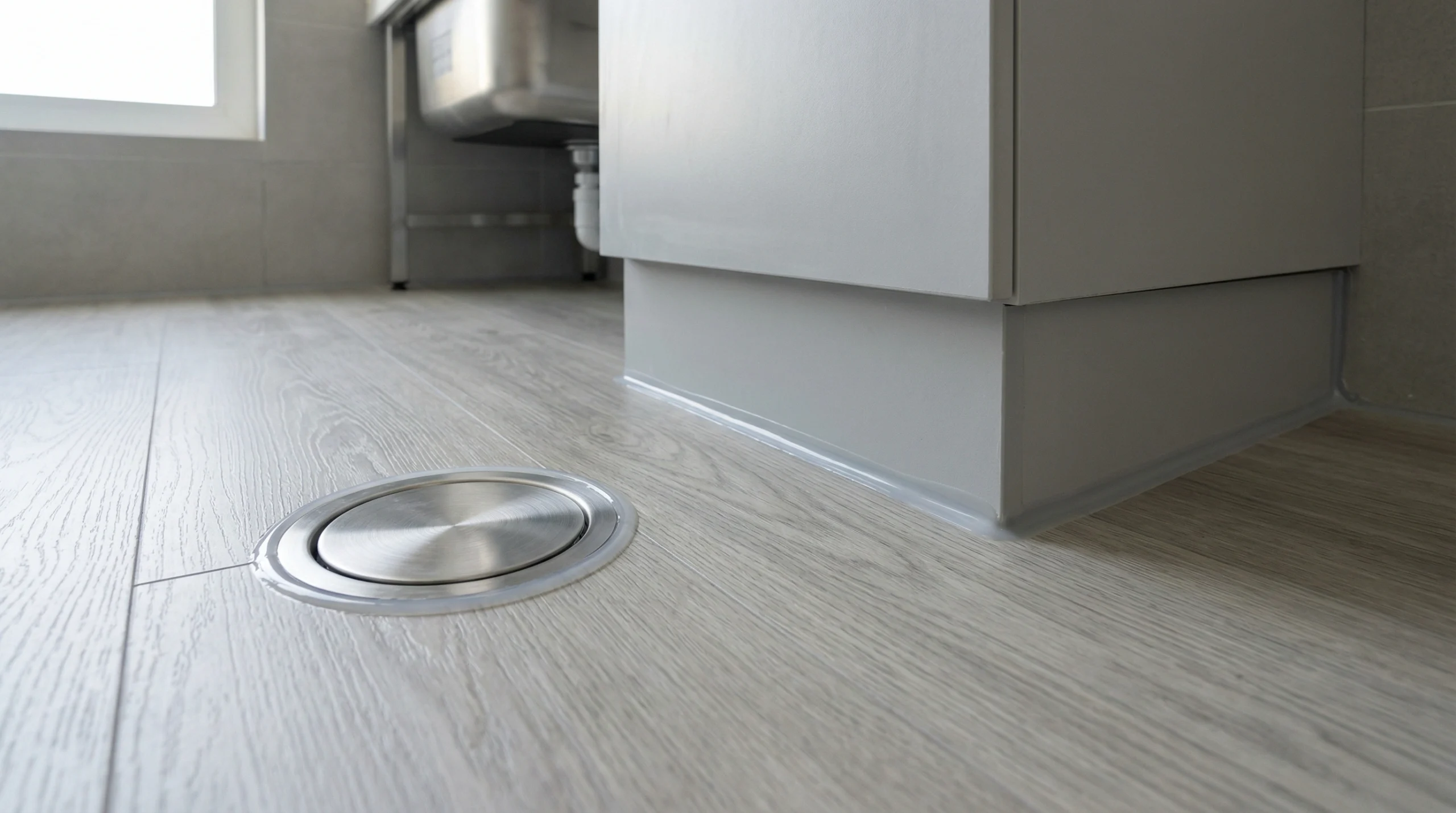
Perimeter sealing around bathtubs, showers, sinks, and toilets uses specialized silicone that bonds to both laminate and fixtures, creating continuous moisture barriers. Standard expansion gaps remain necessary for thermal movement, but we seal these gaps with flexible sealant in bathrooms and kitchens rather than leaving them open beneath skirting boards. This prevents water from running under the floor during cleaning or spills.
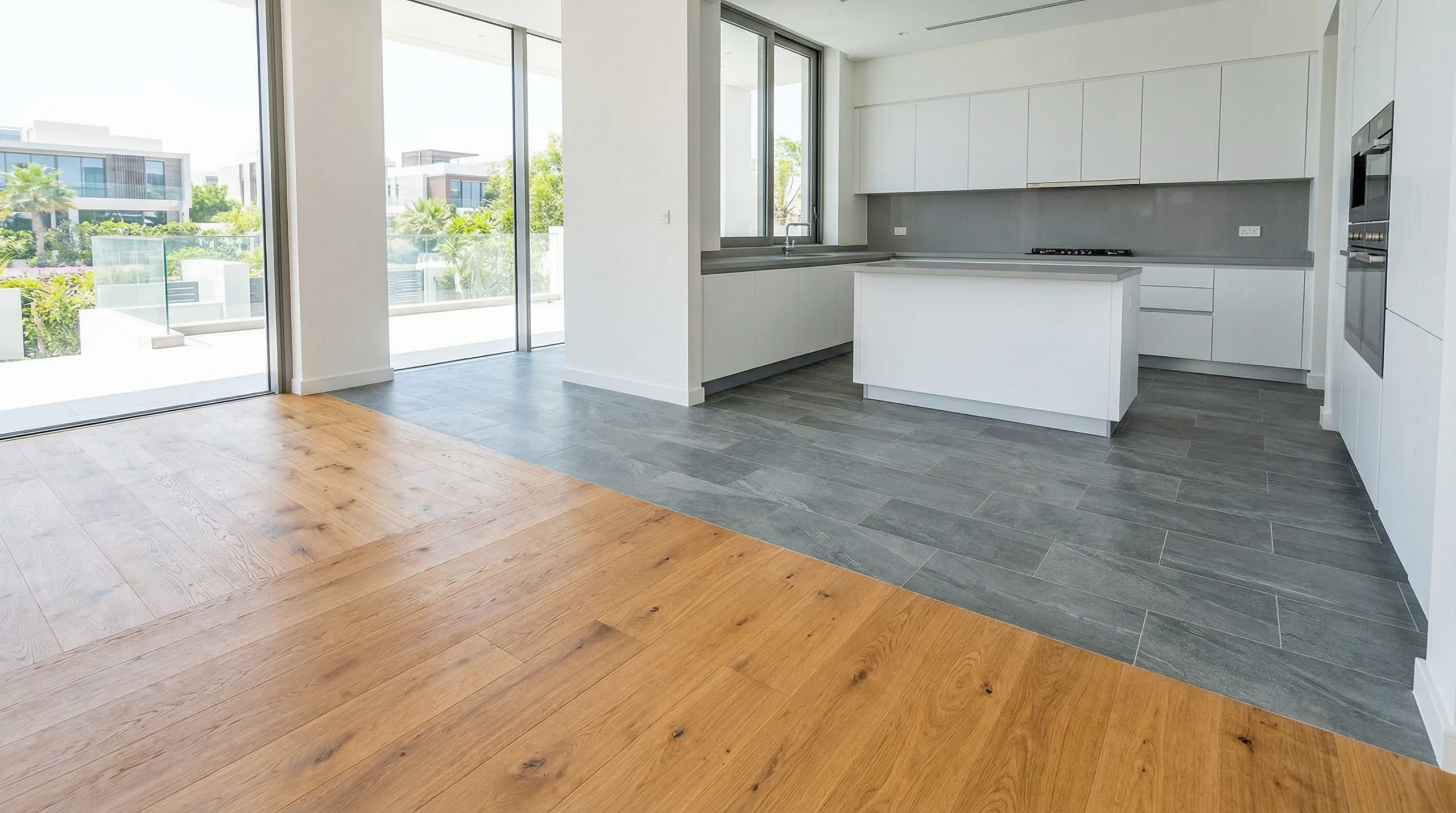
Transitions between waterproof laminate and other flooring materials need extra attention. We install metal or vinyl transition strips with integrated moisture barriers and seal beneath them. Doorways between wet and dry areas get raised transitions that create physical water barriers—you’ll sometimes feel a slight height difference walking from bathroom to hallway, which is intentional and prevents bathroom water from migrating under bedroom flooring.
Limitations and Honest Expectations
Waterproof laminate is not outdoor flooring suitable for uncovered terraces or balconies. Direct sunlight causes surface fading and UV degradation within months. Heavy rain and standing water exceed even waterproof laminate’s capabilities when exposure lasts days or weeks. We’ve seen clients disappointed after installing waterproof laminate on covered balconies where wind-blown rain and occasional flooding caused problems—vinyl plank flooring handles these conditions better.
The polymer core in waterproof laminate creates slightly different acoustic properties than HDF laminate. Some installations sound slightly more hollow underfoot, though quality underlay minimizes this. The core material also makes waterproof laminate less suitable for installations requiring nailed or stapled attachment—the polymer doesn’t hold fasteners as reliably as dense wood fiber, limiting floating installation to the only recommended method.
Complete Laminate Flooring Installation Services
Our laminate flooring installation service covers every detail from initial assessment through final inspection and follow-up support. The installation quality determines how well even premium laminate performs and how long it lasts, which is why we employ only experienced flooring specialists who’ve completed hundreds of Dubai installations and understand UAE-specific requirements.
Pre-Installation Assessment and Planning
Every project begins with detailed site assessment. Our technician visits the property to measure all spaces, photograph existing flooring and subfloor conditions, identify potential complications like uneven concrete or moisture issues, and discuss design preferences. This visit typically takes 45-90 minutes depending on property size and determines whether your timeline is realistic.
We measure existing floor levels relative to adjacent rooms, doorways, and fixed features like kitchen cabinets or bathroom vanities. Laminate adds 10-15mm height depending on product and underlay selection, which can create transition issues. In some Dubai apartments built 15-20 years ago, we’ve found existing floor heights vary by 20mm between rooms—this requires leveling work before laminate installation proceeds. Discovering this during planning rather than mid-installation prevents costly delays and client frustration.
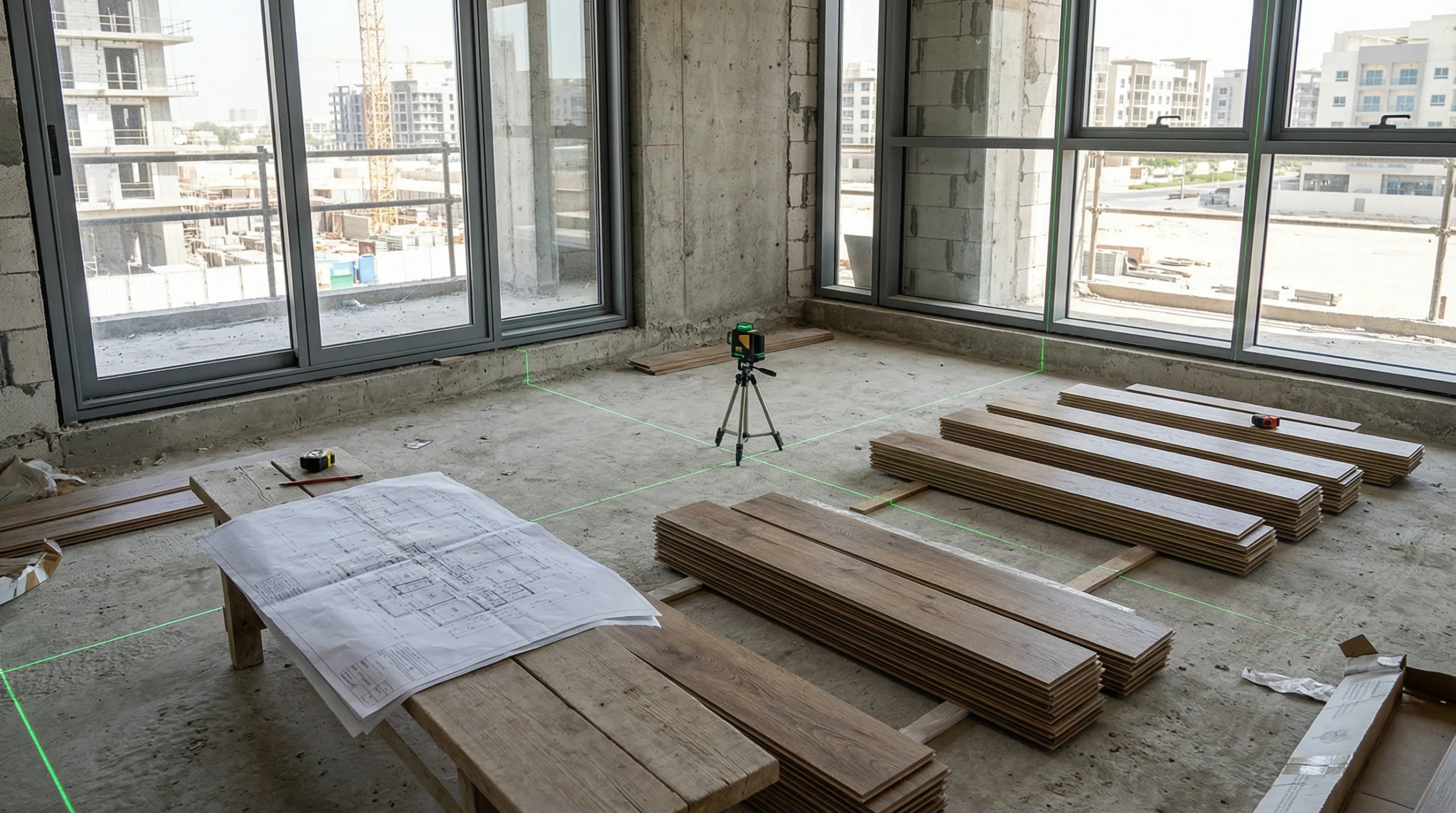
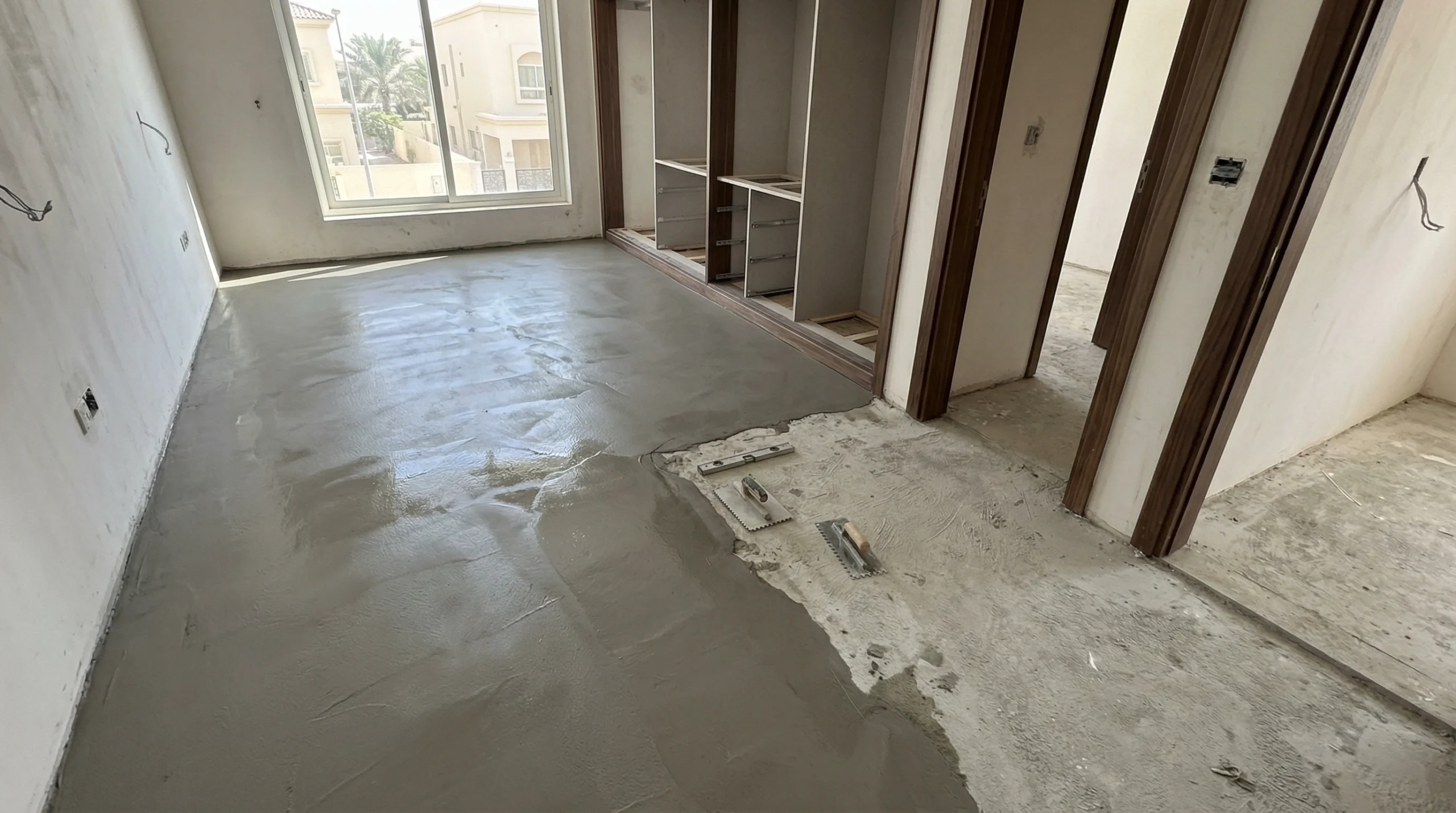
Subfloor evaluation is critical. Concrete slabs must be flat within 3mm over any 3-meter span—greater irregularities telegraph through laminate and create squeaking, movement, and premature wear. We use precision leveling equipment to map the floor and identify high spots requiring grinding or low areas needing filling compound. Wood subfloors get checked for loose boards, rot, termite damage, and adequate support. Discovering compromised subfloors early means we can address them properly rather than installing beautiful flooring over problematic foundations.
Moisture testing on concrete floors uses calibrated meters that measure internal slab moisture. New concrete in UAE construction often contains higher moisture than specifications allow because contractors rush schedules. Installing laminate over wet concrete guarantees failure within months as moisture attacks the core from below. We’ve refused installation on new villas where testing showed 8-9% moisture content—disappointing clients who wanted immediate move-in but saving them from flooring replacement costs six months later.
Subfloor Preparation and Leveling
Proper subfloor preparation separates professional installations from amateur work. Concrete floors get thoroughly cleaned to remove all dust, debris, oil, paint, and adhesive residue—any contamination compromises underlay adhesion and can create squeaking or movement. We use industrial vacuums followed by tack cloths for final cleaning.
High spots get ground using diamond grinding equipment until meeting flatness specifications. This is loud, dusty work that we schedule when properties are empty when possible. Low areas and cracks get filled with self-leveling compound that cures to create perfectly flat surfaces. In severe cases, we install new plywood underlayment over concrete to create ideal laminate installation surfaces—this adds cost but guarantees long-term performance.
Wood subfloors require different preparation. Loose boards get refastened with ring-shank nails or screws. Squeaking areas get identified and repaired. Damaged sections get cut out and replaced. Uneven areas get sanded or planed flat. Gaps between boards get filled. We install additional blocking or supports under areas that feel bouncy or flexible—laminate needs solid, rigid foundations to perform well.
After mechanical preparation, we install vapor barriers over concrete subfloors. UAE construction sometimes allows ground moisture to migrate up through concrete slabs, particularly in ground-floor apartments and villas. Polyethylene sheeting with sealed seams and turned-up edges creates impermeable barriers that protect laminate from below. This step costs minimal money but prevents expensive problems.
Underlay Selection and Installation
Underlay serves multiple functions: cushioning that makes walking more comfortable, sound dampening that reduces impact noise transmission to rooms below, minor subfloor irregularity smoothing, and additional moisture protection. The underlay type and quality significantly affect how your floor feels, sounds, and performs.
Foam underlay is the most economical option, typically 2-3mm thick polyethylene or polystyrene foam that provides basic cushioning and minimal sound control. We use this for budget installations or areas with minimal requirements, but it’s our least recommended option because the performance and comfort improvements from better underlay justify the relatively small cost increase.
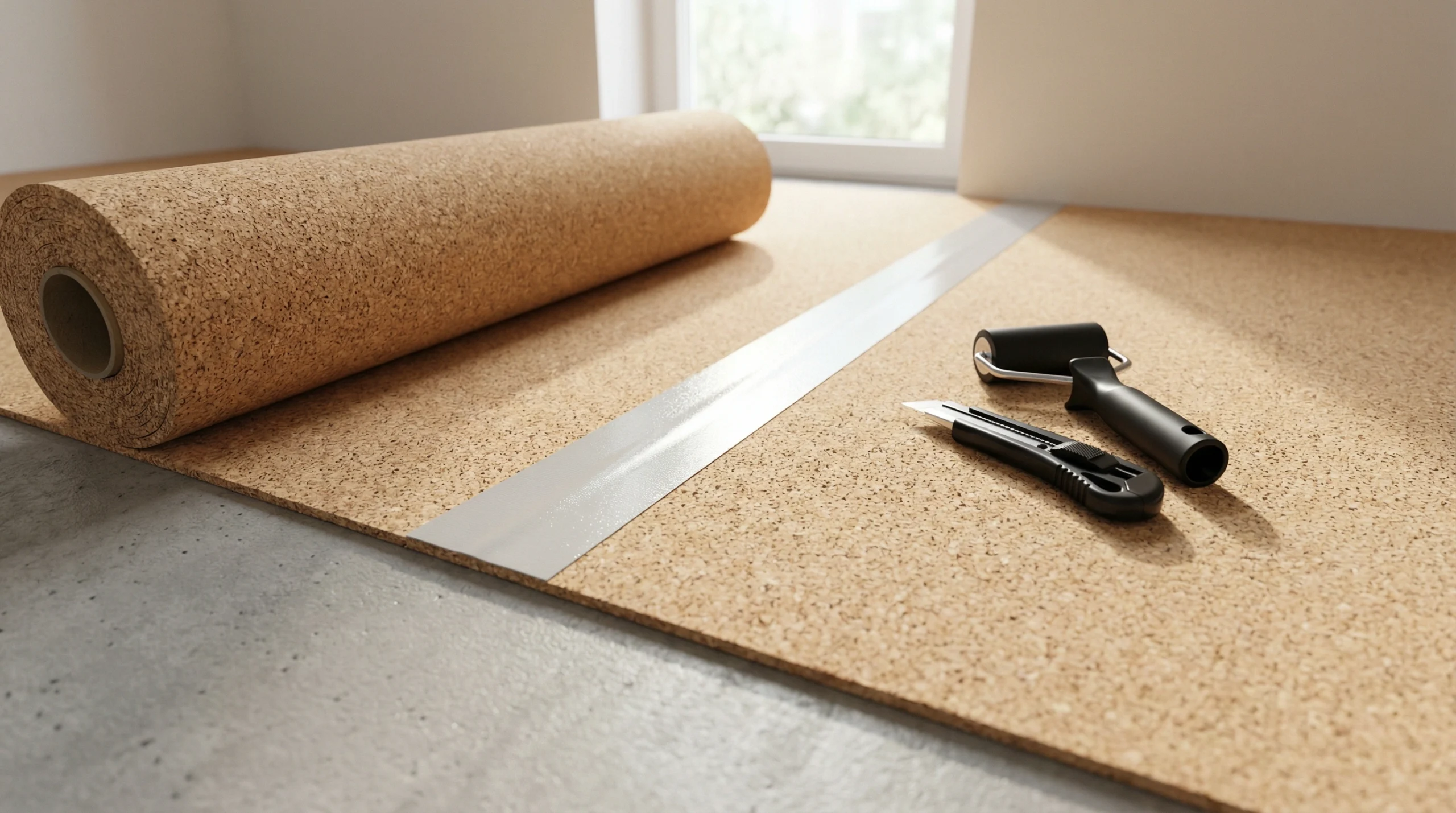
Cork underlay provides superior sound dampening and warmth underfoot, making it our standard recommendation for Dubai apartments where downstairs neighbors appreciate noise reduction. The natural material compresses slightly under heavy furniture but recovers well. The 3-4mm thickness adds noticeable comfort without excessive softness that might compromise laminate stability. Cork costs approximately 40% more than basic foam but creates notably better installations.
Combination underlay integrates multiple layers—typically dense foam bonded to moisture barrier film and sometimes including cork or rubber elements. These products handle multiple functions in single installation steps and work particularly well over concrete slabs. We install combination underlay in most Dubai projects because the integrated moisture barrier eliminates separate vapor barrier steps while providing excellent sound and comfort performance.
Acoustic underlay uses specialized dense rubber or foam formulations engineered specifically for sound control. These work best in high-rise apartments or commercial buildings where impact noise transmission is a serious concern. The product costs 2-3 times more than standard underlay but can reduce impact noise by 40-50%, creating peaceful environments for neighbors and building goodwill in shared residential buildings.
Underlay installation requires precision. Seams must align tightly and get sealed with specialized tape to prevent gaps where moisture could penetrate. The material should extend to room edges without gaps but not overlap or create thickness variations. We trim underlay carefully around pipes, doorframes, and other obstacles to maintain continuous coverage while allowing laminate expansion gaps around perimeter obstacles.
Laminate Plank Installation Methods
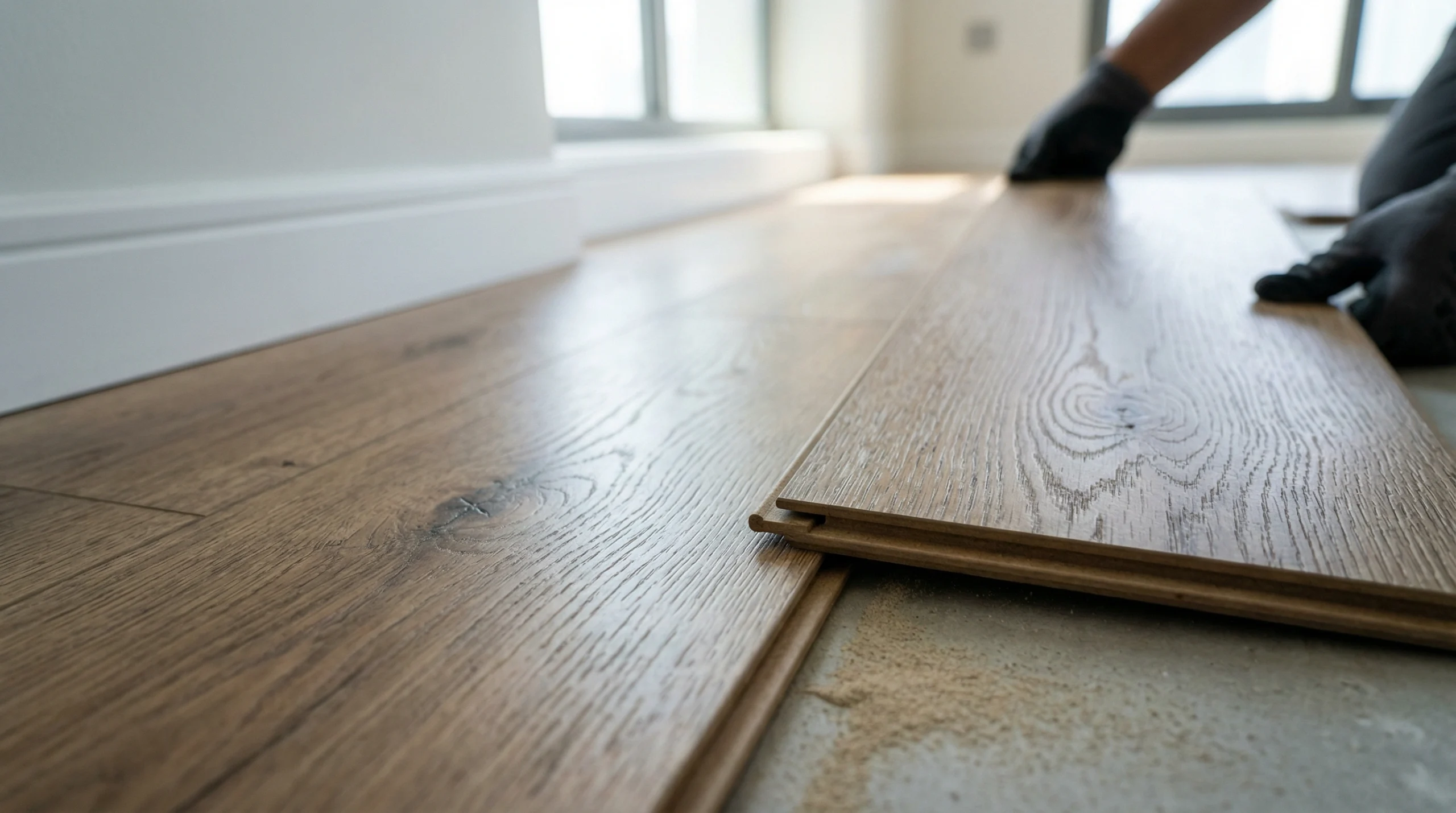
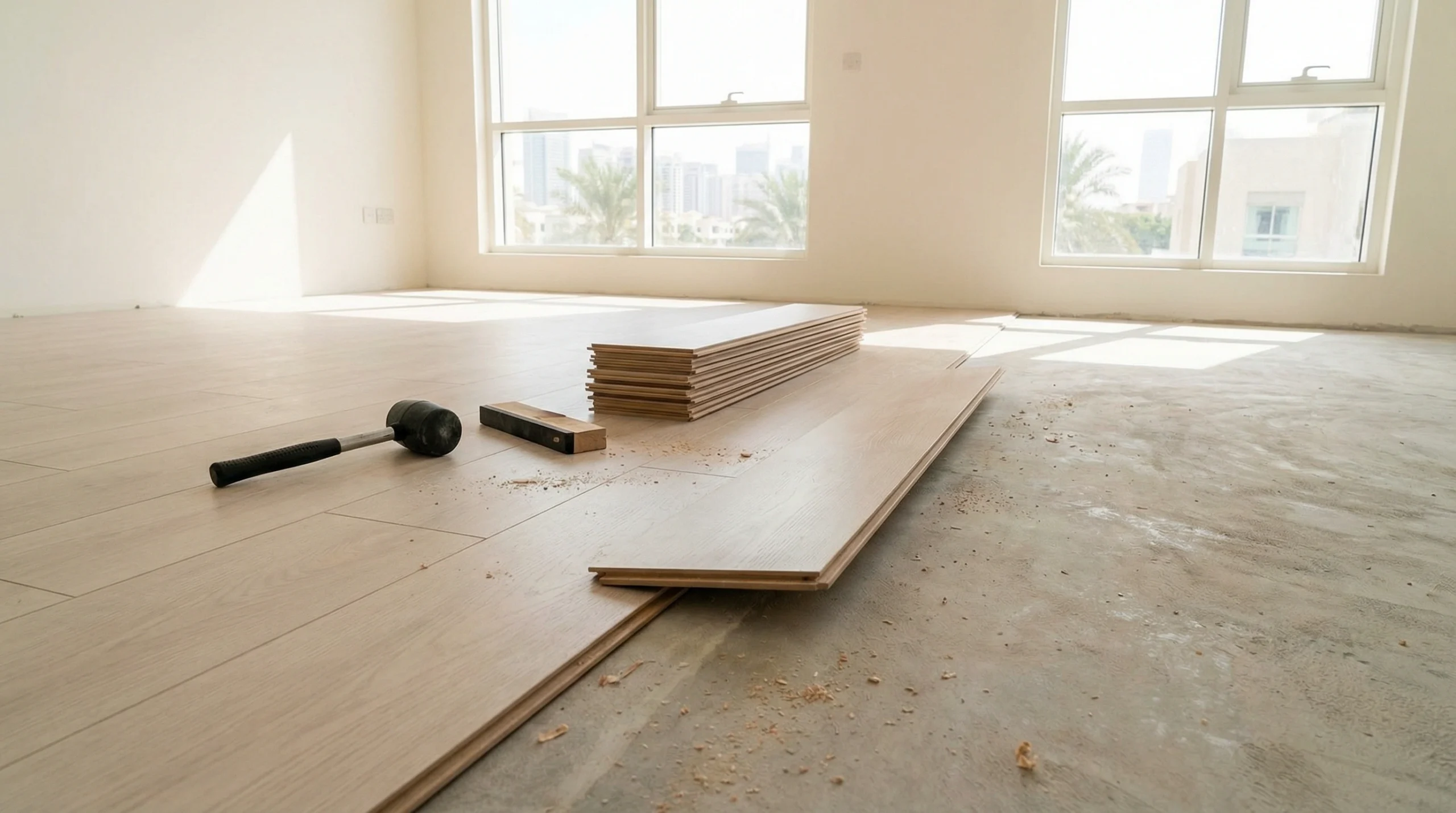
We use floating installation for virtually all laminate projects. This method uses the planks’ integrated click-lock systems to join boards together without adhesive or mechanical fasteners to the subfloor. The entire floor “floats” over underlay, allowing natural expansion and contraction with temperature and humidity changes. This flexibility prevents buckling and maintains integrity through UAE climate variations.
Installation begins against the longest straight wall after accounting for expansion gaps. We use specialized spacers to maintain consistent 10-12mm gaps between flooring and walls throughout installation. The first row establishes alignment that affects the entire floor—any angle error in this row magnifies across the room, potentially creating visible alignment problems at the far wall. We check and recheck first-row alignment using laser levels and measuring to opposite walls before proceeding.
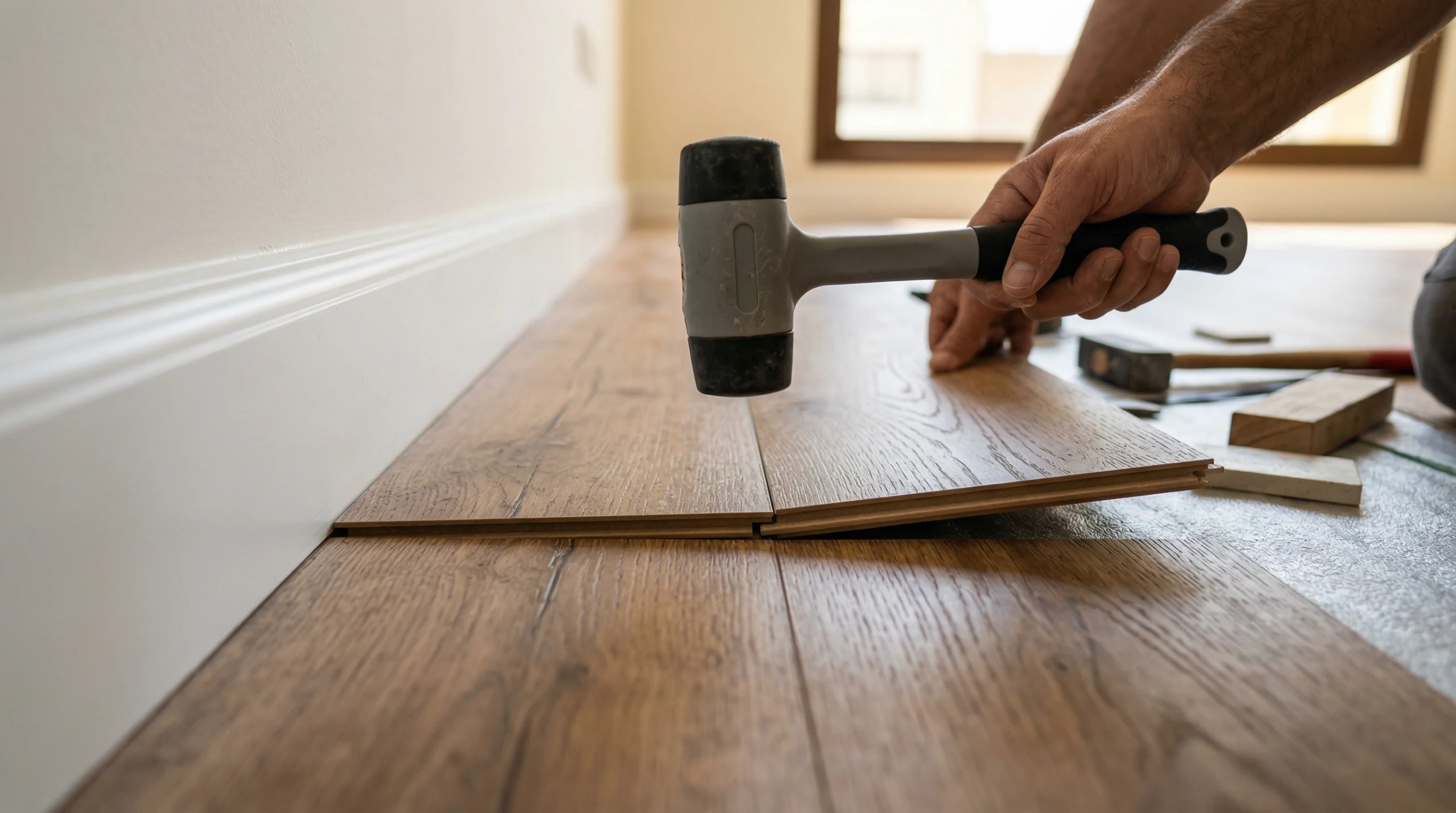
Each subsequent row connects through clicking planks at angles and pressing down or tapping with specialized blocks to engage locking mechanisms. The clicking sound confirms proper engagement—planks that don’t fully click indicate defects or improper technique. We inspect every single connection because one partially connected plank can create failures that spread over time as the floor experiences use and stress.
Plank layout planning prevents installation defects that compromise appearance. End joints in adjacent rows should offset by at least 300mm to prevent visible linear patterns and maintain structural integrity. This sometimes requires cutting initial planks in rows to achieve proper offset patterns. We also avoid narrow plank cuts at room edges—edge planks narrower than 50mm look unprofessional and can pop apart under stress. Careful planning ensures attractive, structurally sound layouts.
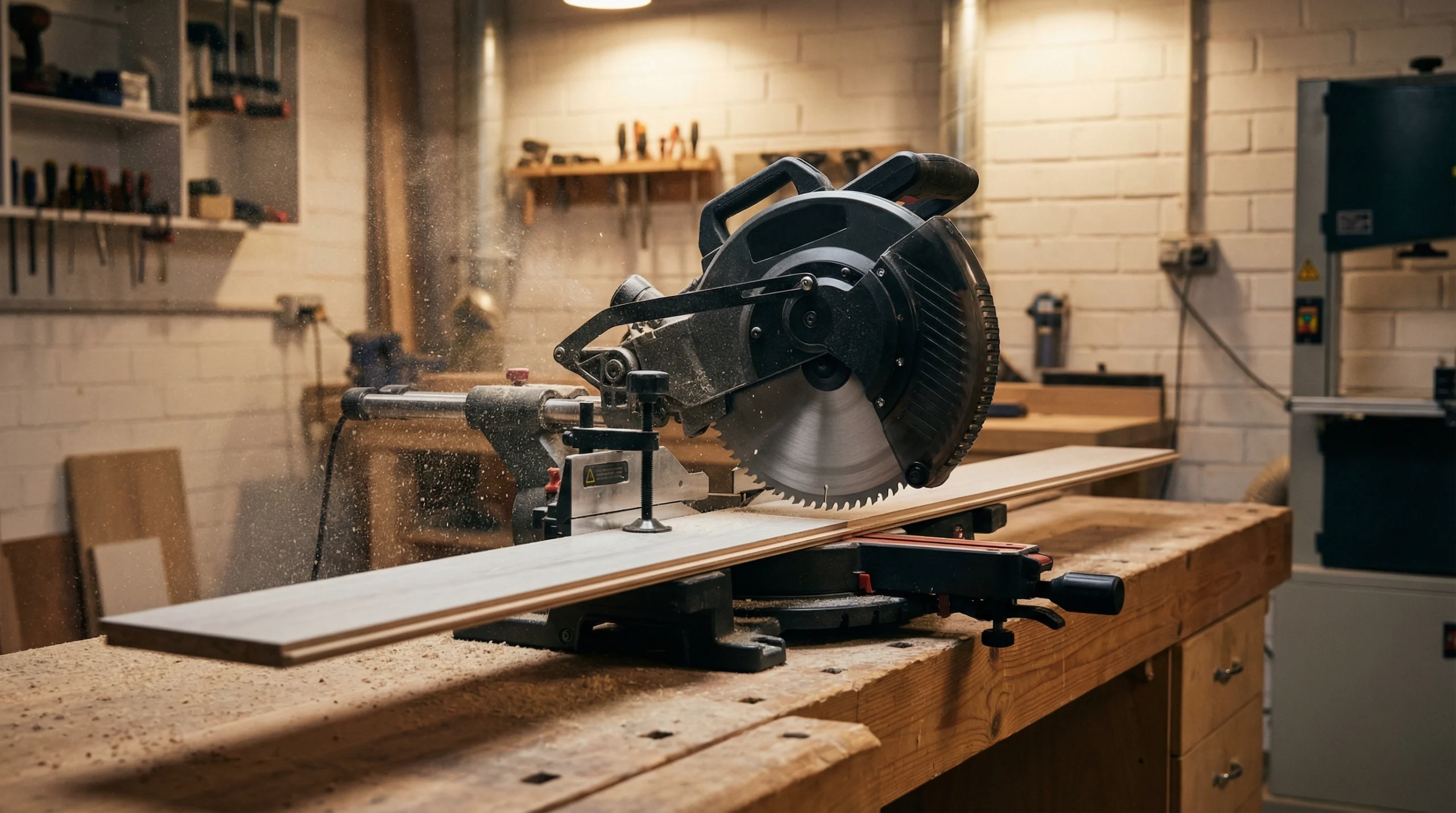
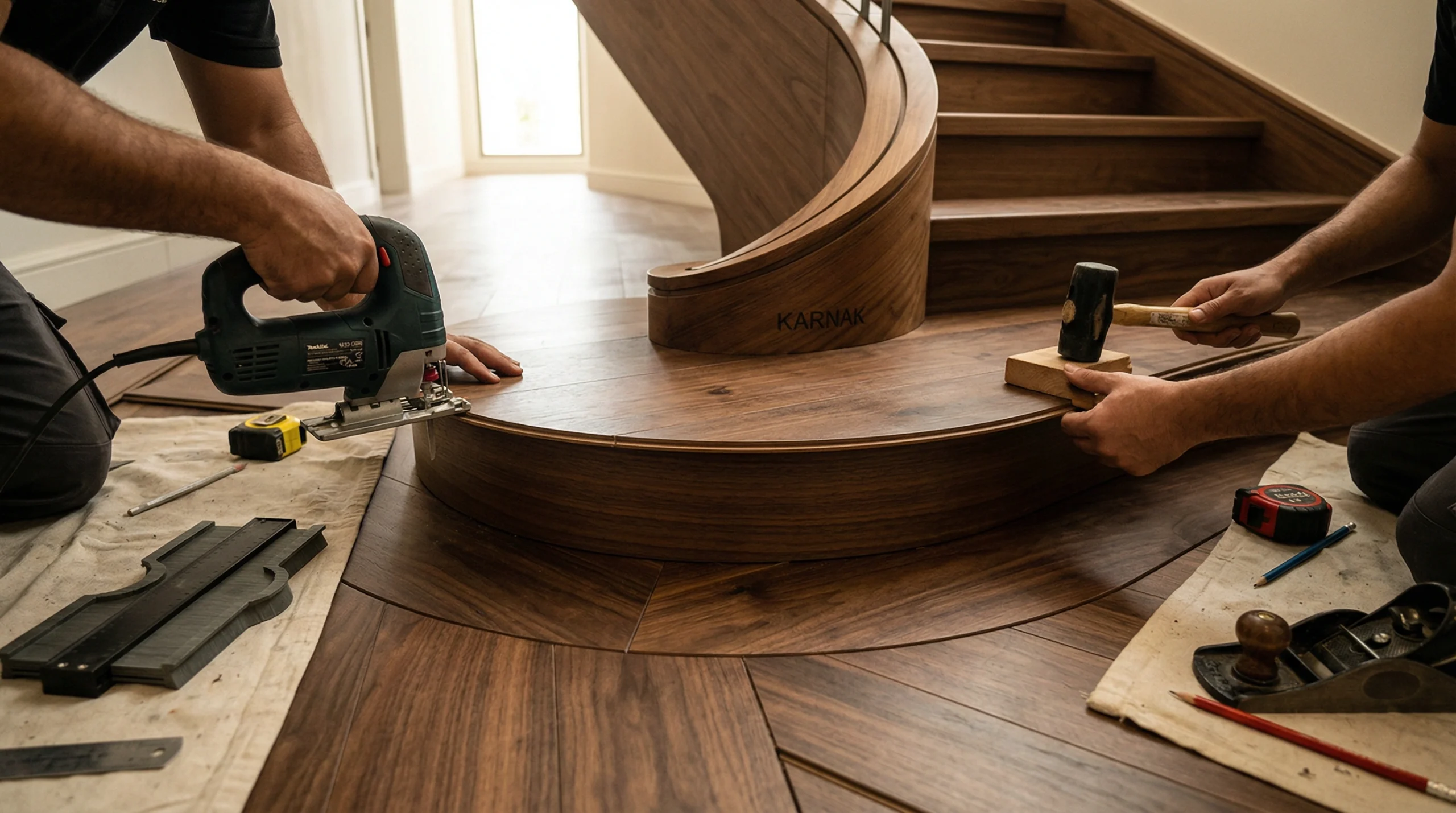
Cutting laminate requires specialized blade systems that minimize chipping and create clean edges. Crosscuts use miter saws with fine-tooth blades. Rip cuts use table saws or circular saws with laminate-specific blades. Intricate cuts around door casings, pipes, or irregular walls use jigsaws with down-cutting blades that prevent top-surface chipping. Every cut gets carefully measured—we follow the carpenter’s rule of measuring twice and cutting once because mistakes waste expensive material.
Doorway and transition installations require particular expertise. Undercutting door casings allows laminate to slide beneath trim for clean, professional transitions. We use oscillating multi-tools to cut casings at precise heights matching laminate and underlay thickness. The alternative—cutting laminate to fit around casings—creates visible gaps and looks amateur.
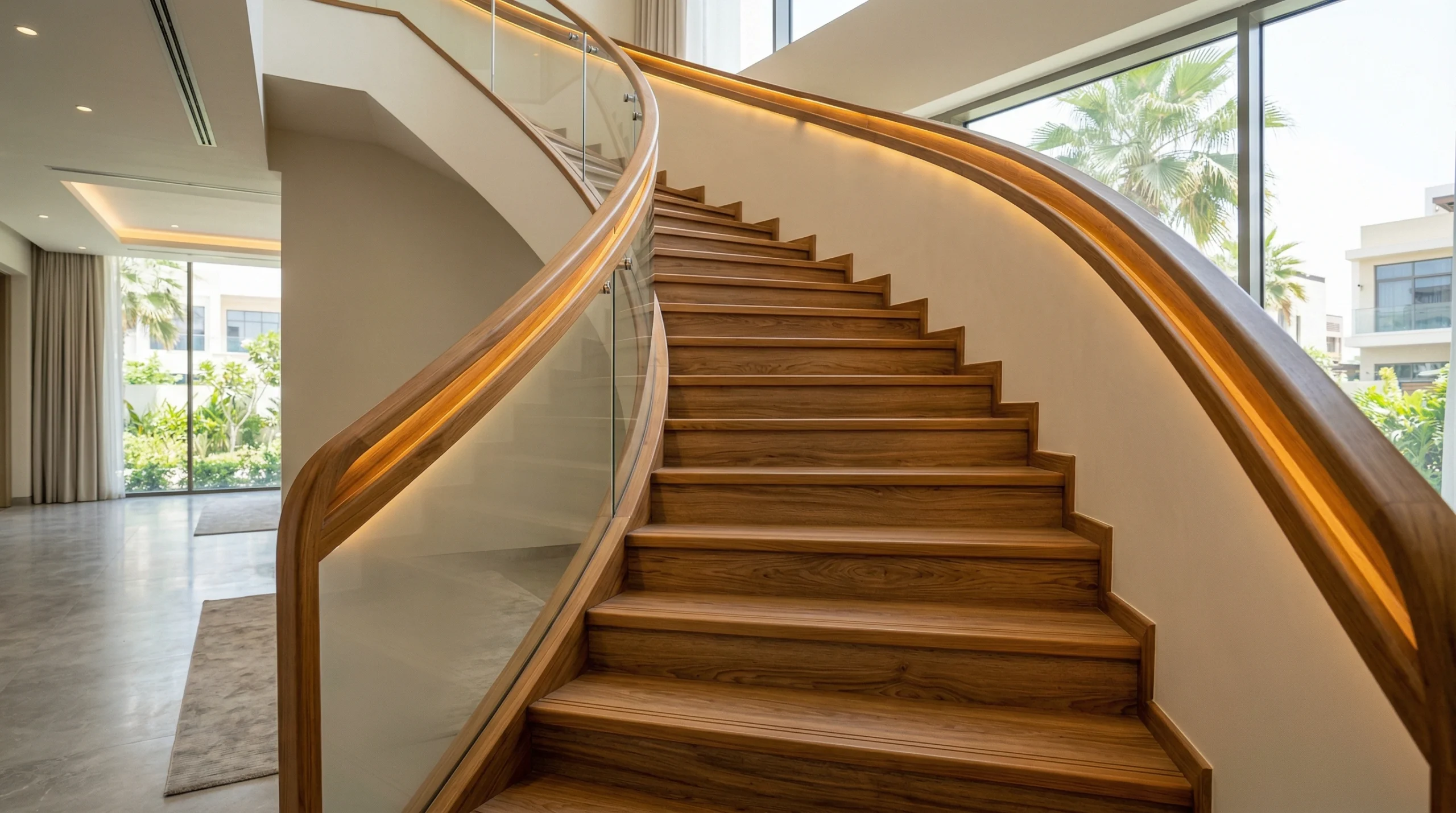
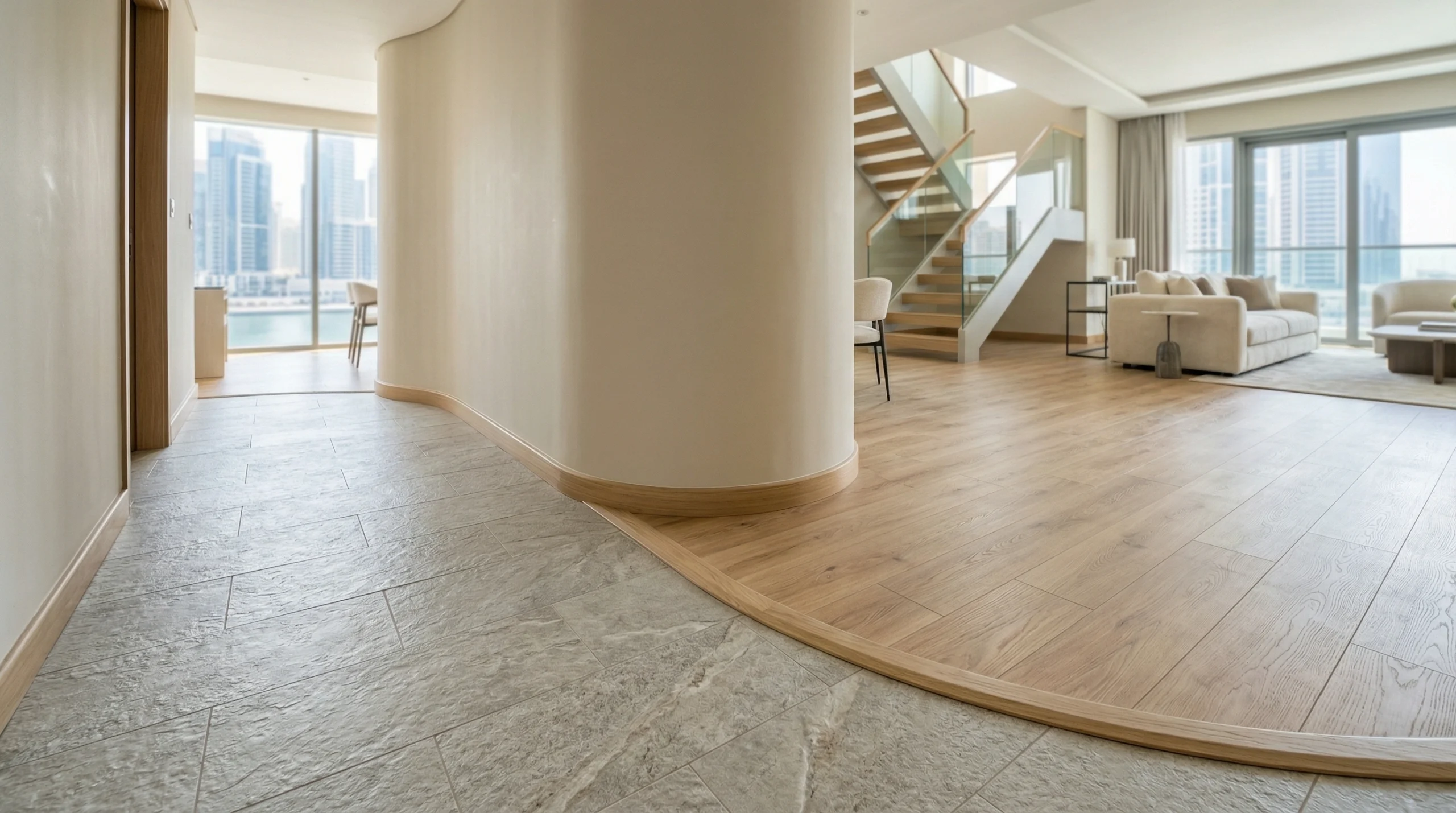
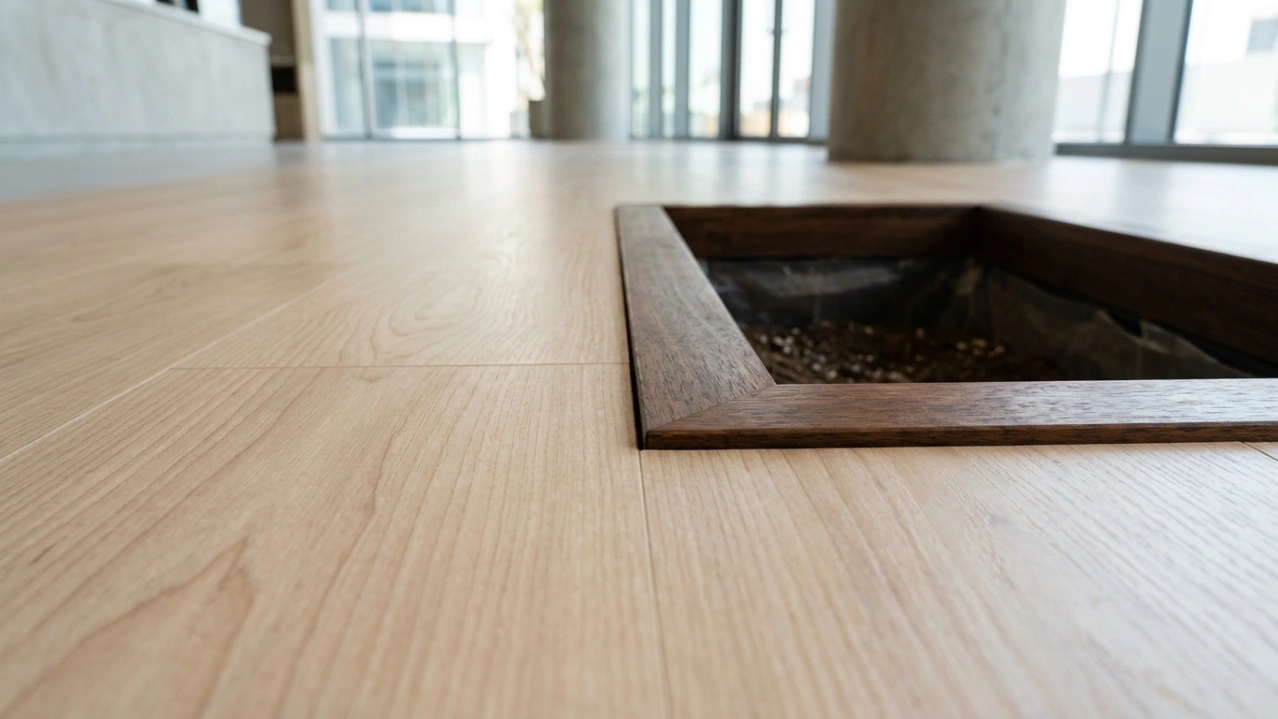
Transition strips between rooms or flooring types must accommodate expansion gaps while creating smooth, safe transitions. T-molding covers gaps between laminate sections in doorways. Reducers transition from higher laminate surfaces to lower adjacent flooring. End molding creates finished edges where laminate meets carpeting or exposed edges. Stair nosing protects laminate edges on stair treads. Each transition type installs differently, and improper installation creates trip hazards or allows moisture penetration.
Final Finishing and Quality Control
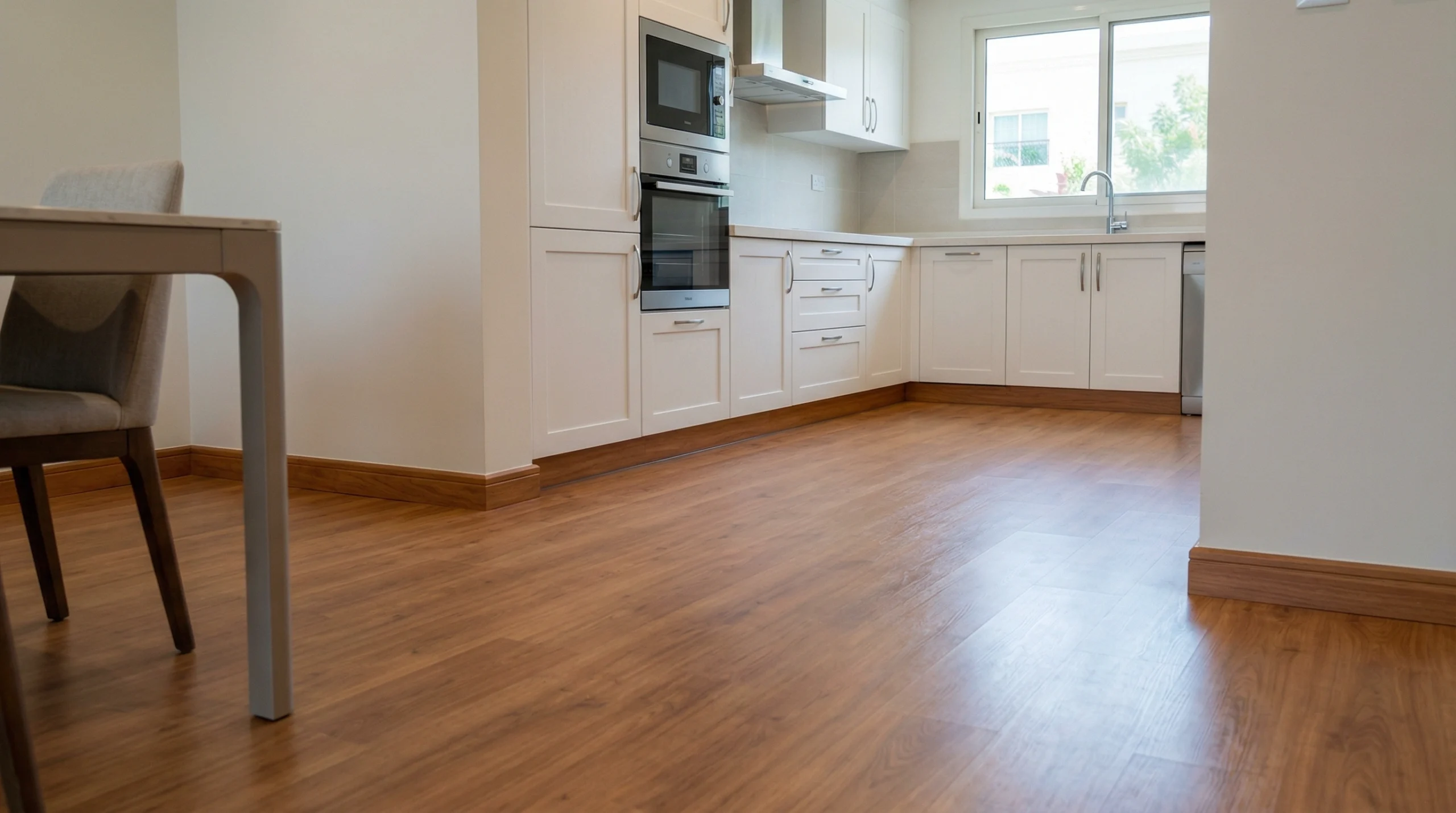
After complete installation, we remove all spacers and vacuum thoroughly to remove sawdust and debris. Skirting boards or baseboards install over expansion gaps, concealing them completely while allowing the floor to move freely beneath. We use color-matched or complementary skirting that enhances overall aesthetics—sometimes matching the laminate for seamless appearance, sometimes contrasting for visual interest.
Final inspection checks every visible seam for proper engagement, runs hands over the entire surface feeling for height differences or loose areas, tests all transition strips for secure attachment, and verifies expansion gaps exist but remain hidden beneath trim. We walk the floor listening for squeaks or hollow sounds that indicate installation defects. Any issues discovered get corrected immediately before considering the project complete.
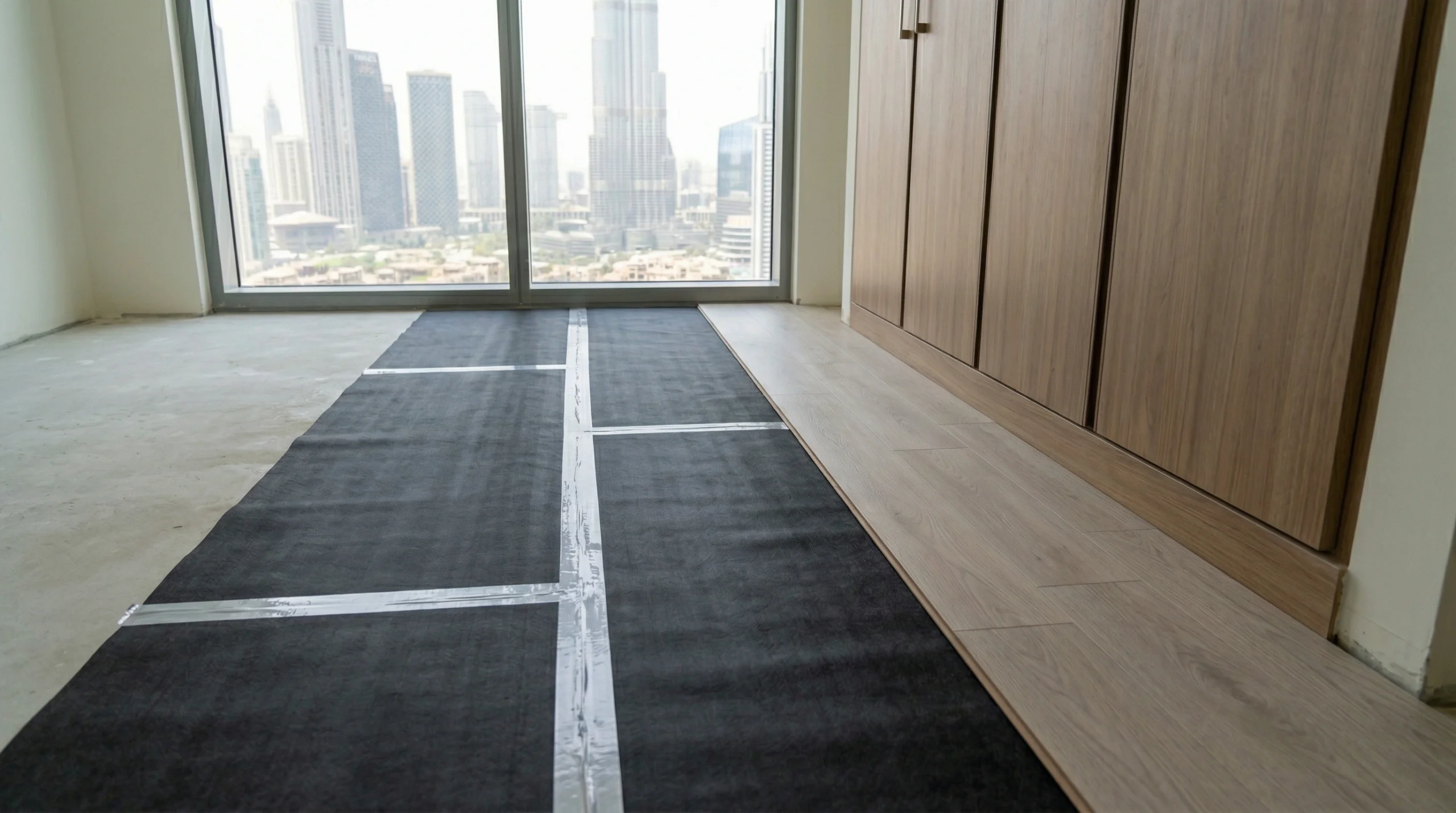
The completed installation gets protected during any remaining construction or move-in activity. We cover floors with specialized laminate protection materials that prevent scratches and damage while allowing the floor to breathe and complete acclimation. Heavy furniture moving uses furniture pads or plywood pathways to prevent denting or scratching from weight and dragging.
The Karnak Process for Laminate Flooring Projects
Our systematic approach ensures every installation meets exacting quality standards while respecting client timelines, budgets, and daily routines. This process has developed over 35 years and thousands of flooring projects across every emirate.
Step 1: Initial Consultation and Requirements Gathering
First contact happens through phone, email, or our website form. We discuss project scope: which rooms, approximate area, desired timeline, budget range, and any special requirements or concerns. This conversation takes 10-20 minutes and establishes whether our services align with the client’s needs and expectations.
For projects within our scope, we schedule on-site consultation at times convenient for clients—including evenings and weekends for working professionals. The site visit is comprehensive, never rushed. Our flooring specialist measures all areas, photographs current conditions, discusses design preferences while showing physical samples of recommended products, explains installation processes and timelines, and identifies any complications that might affect cost or schedule.
We listen carefully to how clients use their spaces. Families with young children need different laminate specifications than retired couples or young professionals. Commercial clients have unique requirements around business hour restrictions, noise limitations, and appearance standards. Understanding these nuances allows us to recommend appropriate solutions rather than one-size-fits-all products.
The consultation concludes with estimated pricing ranges based on preliminary measurements and discussed product options. We explain cost factors: material quality and specifications, subfloor preparation requirements, removal and disposal of existing flooring, furniture moving needs, and timeline constraints. Clients receive this information verbally and receive written quotations within 24 hours.
Step 2: Detailed Quotation and Product Selection
Our quotation documents include precise measurements broken down by room, itemized material costs showing specific product brands and models, labor costs for each installation phase, additional costs for preparation work or disposal, and total project cost with payment terms clearly stated. We include product specification sheets for recommended laminate options so clients understand exactly what they’re purchasing.
The quotation validity period is 30 days because flooring product pricing can change with currency fluctuations and manufacturer price adjustments. We honor quoted prices for this period regardless of market changes. Clients who need more decision time simply request quotation updates if choosing to proceed beyond 30 days.
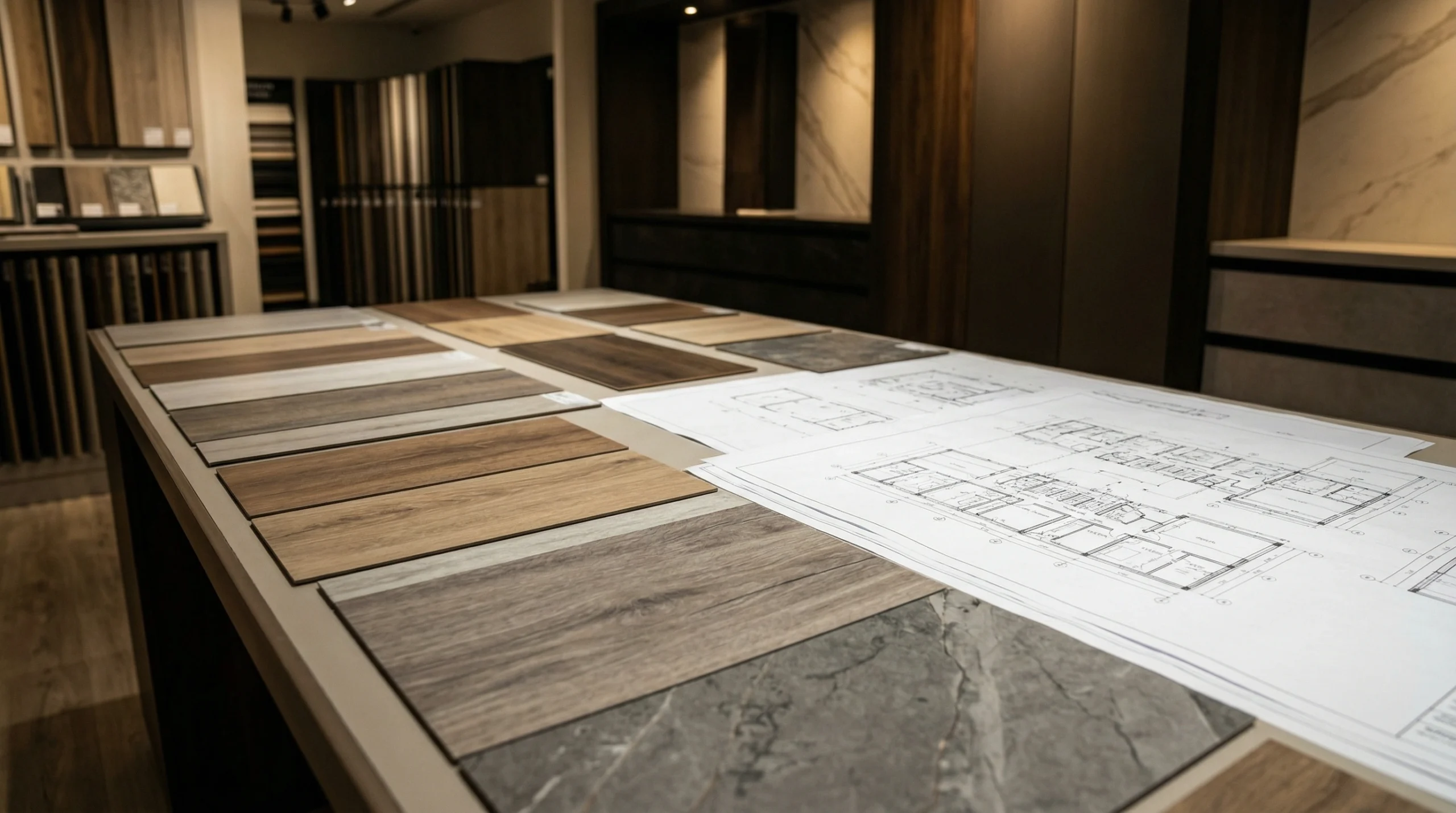
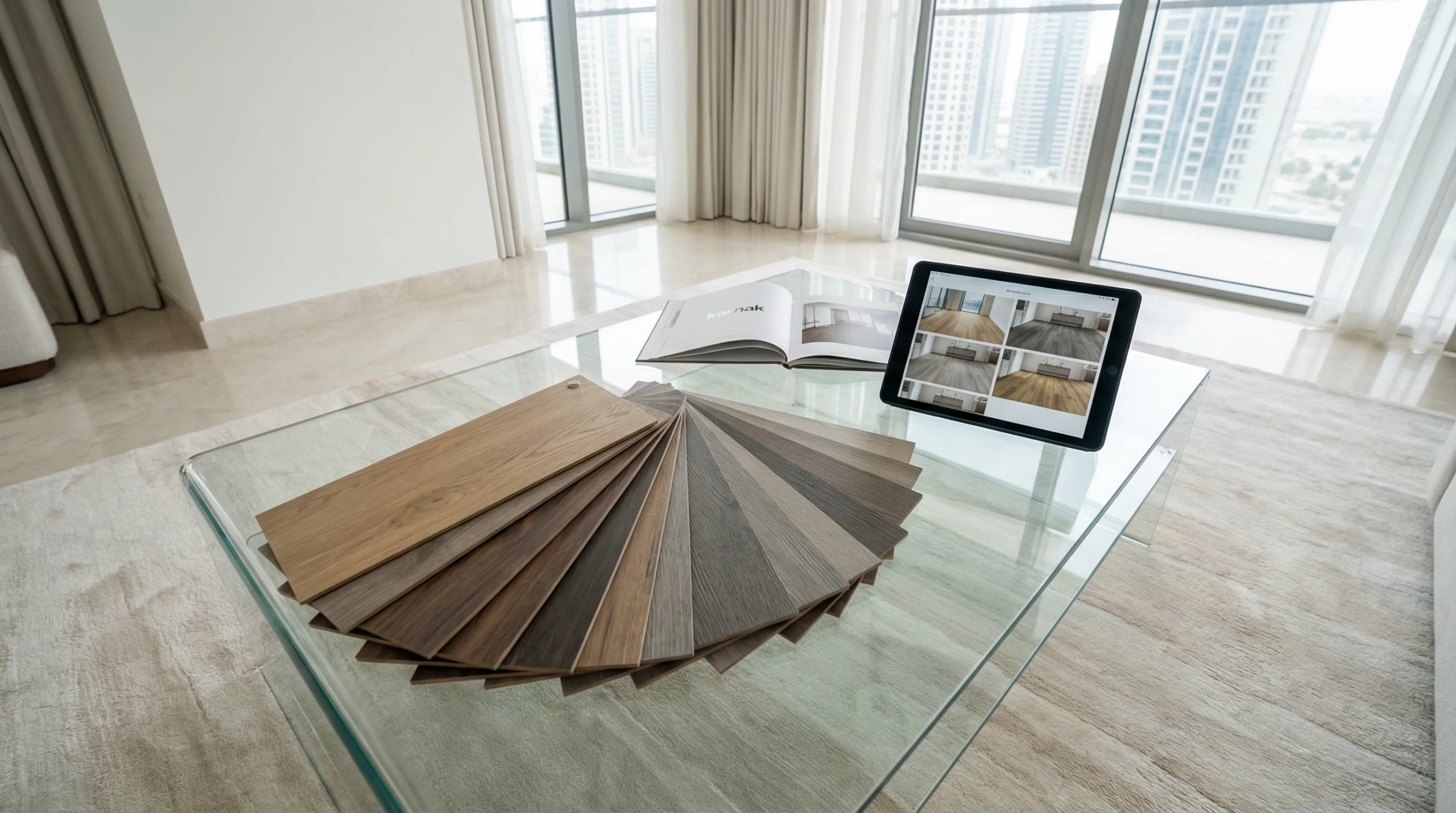
Product selection assistance continues through this phase. Many clients want to see larger samples in their actual spaces under natural lighting conditions. We provide 300x300mm sample tiles for overnight or weekend evaluation at home. Seeing samples against existing furniture, wall colors, and room lighting helps clients make confident choices rather than selecting from small swatches in our showroom.
We discuss care and maintenance requirements for different product options. Some clients prioritize appearance and accept higher maintenance; others want minimum maintenance even if appearance is slightly less dramatic. These honest conversations prevent future dissatisfaction when clients discover their beautiful high-gloss laminate shows every footprint and requires constant cleaning.
Step 3: Project Scheduling and Preparation Guidance
Upon quotation acceptance and deposit payment, we schedule installation dates based on material lead times and our production calendar. Standard in-stock products typically allow installation within 1-2 weeks. Special order items from European manufacturers might require 3-6 weeks for shipping. We provide realistic timelines and update clients immediately if any supply chain issues arise.
Pre-installation preparation guidance helps clients ready their properties. We provide checklists covering room clearance requirements, utility access needs, parking arrangements for work vehicles, and any building management notifications required in managed communities. For occupied homes, we discuss strategies to minimize disruption—sometimes installing in phases allows families to maintain living space functionality throughout the project.
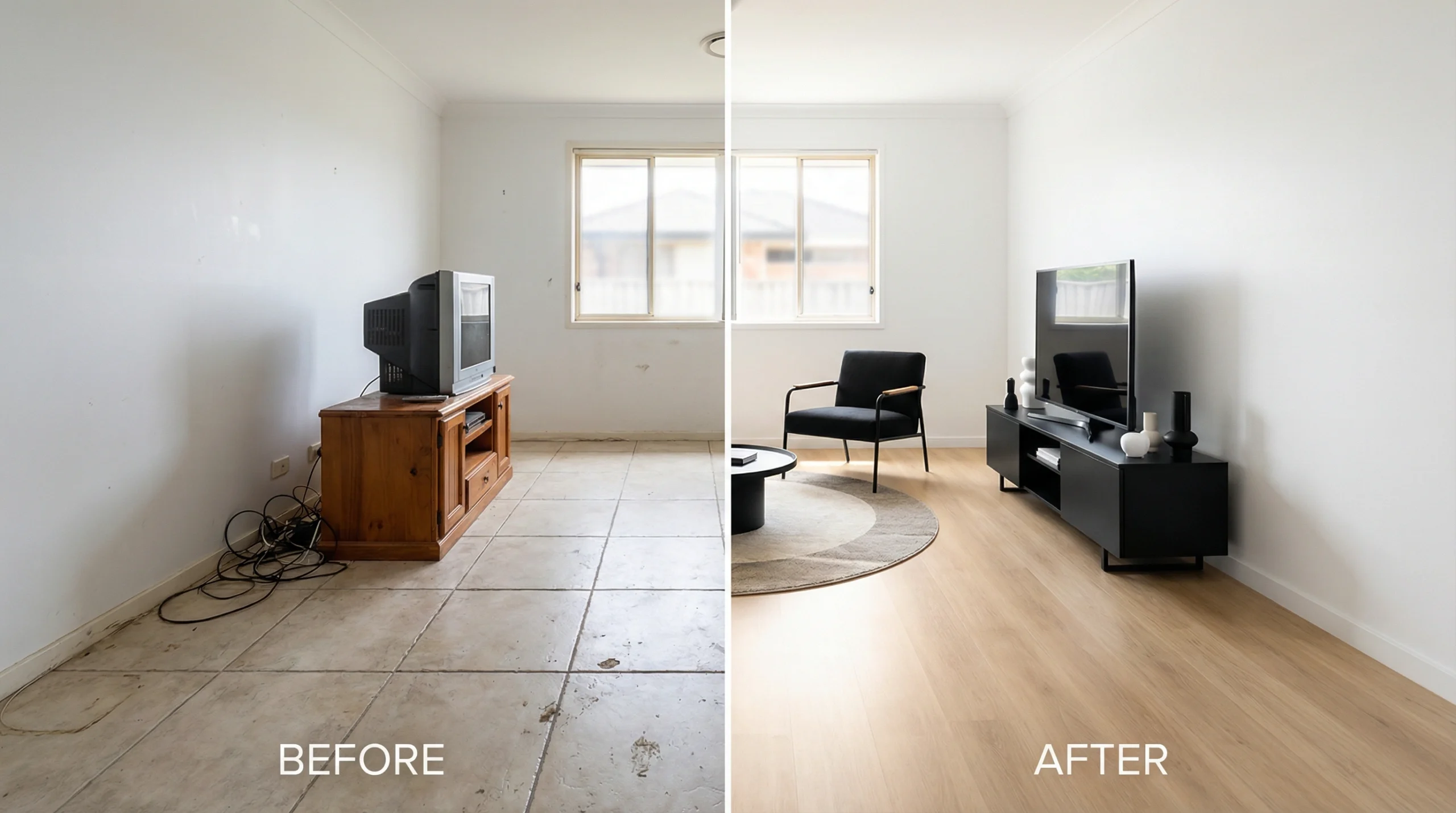
Existing flooring removal gets scheduled if we’re handling this service. Tile removal is messy, loud work requiring 1-2 days depending on area. Carpet removal is faster and cleaner. Clients sometimes choose to remove existing flooring themselves to reduce costs—we provide guidance on proper removal techniques and warn about situations where DIY removal might damage subfloors and create bigger problems.
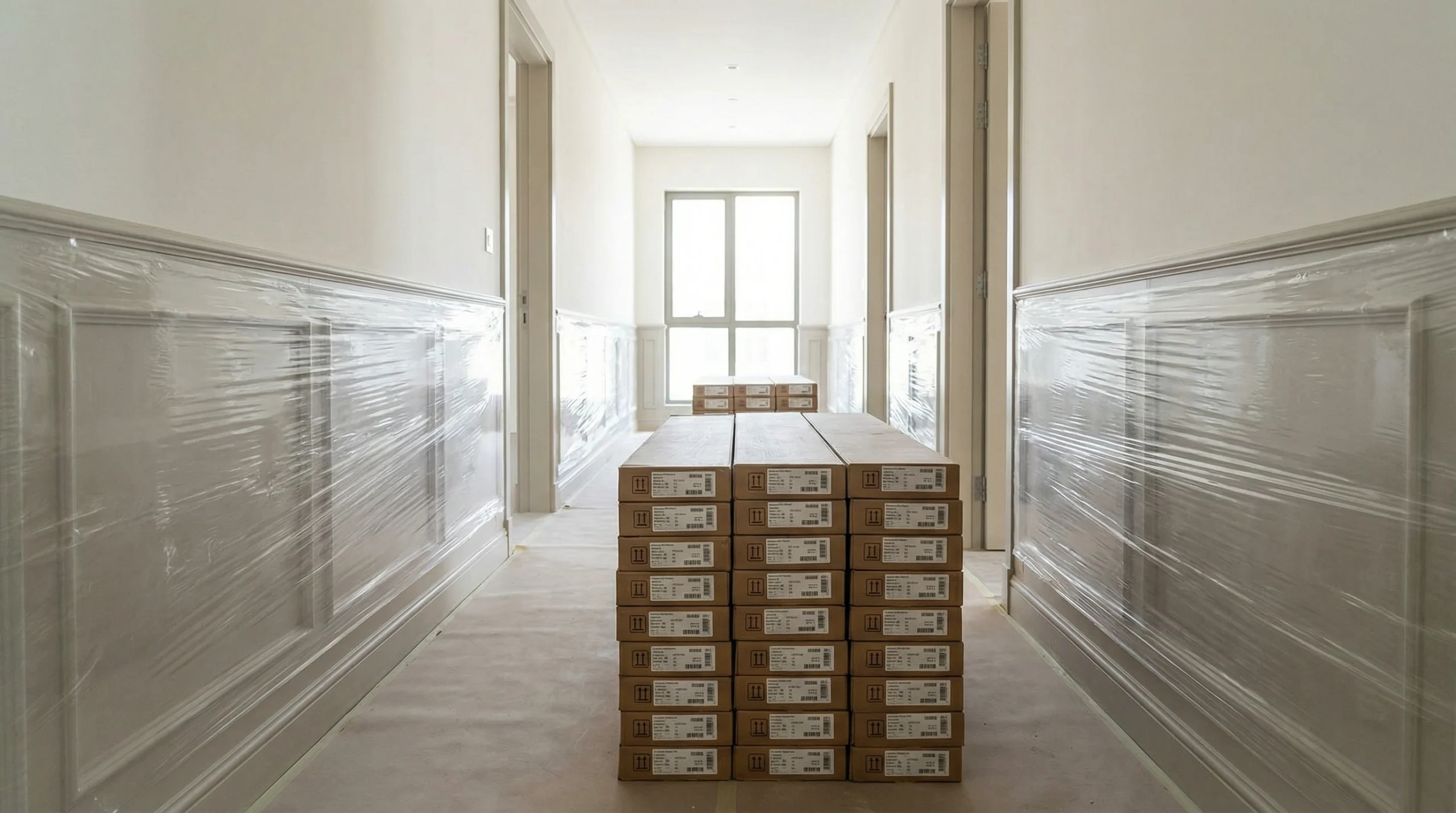
Material delivery happens 24-48 hours before installation begins when possible. Laminate needs acclimation to the installation environment’s temperature and humidity—typically 48-72 hours of storage in the installation space with packages opened allows the material to stabilize. Skipping acclimation can cause post-installation problems as the flooring adjusts to room conditions and expands or contracts more than expected.
Step 4: Installation Execution
Installation day begins with site protection. We lay drop cloths to protect walking paths from our vehicles to installation areas. Doorways and corners get edge protection to prevent damage from material delivery and equipment movement. We maintain tidy work areas and clean up continuously rather than leaving mess until project completion.
The installation team typically consists of 2-4 specialists depending on project scope. A 100-square-meter apartment might require two installers working two days. Larger villas or commercial spaces need more personnel to maintain reasonable timelines. We provide arrival time windows and communicate proactively if any delays occur.
Work proceeds systematically through spaces in logical sequence. We often complete bedrooms first so furniture can return to these spaces while we work on common areas. Open-plan areas get installed continuously to avoid visible seam lines in the middle of expansive spaces. Transitions and detail work happen as installation progresses rather than leaving all trim work until the end.
Quality control checkpoints occur throughout installation. Supervisors visit projects during installation to verify work meets our standards. Any issues discovered during installation get addressed immediately. We maintain direct communication with clients throughout installation days, providing progress updates and promptly answering questions or concerns.
Noise and disruption vary depending on required work. Subfloor preparation can be loud. Laminate cutting generates noise but happens intermittently rather than constantly. Installation itself is relatively quiet. We work within community noise restriction timeframes—particularly important in apartment buildings where neighbors might complain about construction noise during restricted hours.
Step 5: Completion Inspection and Client Walkthrough
Upon installation completion, we conduct internal inspection before inviting client review. This catches any defects or oversights while our team is on-site with tools and materials to correct them. We verify seam integrity, check transitions and skirting for proper installation and appearance, ensure expansion gaps exist appropriately, and test floor for squeaks or movement.
Client walkthrough happens once we’ve confirmed everything meets our standards. We walk through every space together, pointing out installation details and answering questions. Clients inspect as carefully as they wish—we encourage thorough examination because catching any concerns before final payment and team departure is far easier than addressing them later.
Care and maintenance guidance concludes the walkthrough. We explain cleaning procedures, show appropriate cleaning products, warn about practices that can damage laminate, and provide written care instructions for future reference. Understanding how to maintain their new floor helps clients protect their investment and maintain beauty for years.
Final payment happens after client approval and completion of any last-minute adjustments. We provide warranty documentation covering materials and installation work, maintain project records for future reference, and schedule a 30-day follow-up call to ensure continued satisfaction and address any questions that have arisen during the floor’s first month of use.
Step 6: Warranty Support and Long-Term Service
Our relationship continues beyond installation completion. The manufacturer’s warranty covers material defects—typically 15-25 years for residential laminate and 5-15 years for commercial products. Our installation warranty covers workmanship issues for 2 years. Any problems within warranty periods get evaluated and addressed according to warranty terms.
Clients contact us directly for warranty claims rather than dealing with manufacturers. We handle assessment, documentation, and coordination with manufacturers when material defects occur. Our established relationships with suppliers often expedite warranty resolutions that might take homeowners months to navigate independently.
Beyond warranty periods, we remain available for consultation, repairs, expansion projects, or maintenance guidance. Many clients who installed residential carpentry services with us in their first homes return for new projects when they move to larger properties or upgrade. We’ve worked with some families across three different homes over 20 years.
Why UAE Clients Choose Karnak for Laminate Flooring
Selecting a flooring contractor affects your living or working environment for a decade or more. The decision merits careful consideration because installation quality determines how well even premium products perform long-term.
Three and a Half Decades of UAE Flooring Expertise
Since 1988, we’ve installed laminate flooring throughout the UAE’s evolution from scattered developments to the sophisticated metropolis it is today. We’ve worked through every phase of laminate technology advancement—from early products that failed regularly in Gulf conditions to today’s advanced materials that often outperform natural alternatives.
This accumulated experience means we’ve solved every laminate installation challenge multiple times. We know which product specifications matter and which marketing claims are meaningless. We’ve seen how different brands perform in Dubai Marina’s humidity versus Emirates Hills’ microclimate versus Sharjah’s temperature extremes. We understand which installation techniques prevent problems and which create them.
Our project portfolio includes over 2,400 laminate installations: high-rise apartments from studio units to penthouses, standalone villas from Arabian Ranches to Palm Jumeirah, commercial offices throughout DIFC and Business Bay, retail spaces in major malls, restaurants and cafes across all emirates, educational facilities, and healthcare environments. This diversity means we bring relevant experience to virtually any laminate flooring project.
We’ve established relationships with every major laminate manufacturer and distributor serving the UAE market. This provides several client benefits: priority access to new products and limited inventory items, volume purchasing power that allows competitive pricing, technical support and warranty assistance from manufacturers, and inside knowledge about which brands maintain consistent quality versus those with batch-to-batch variations.
Genuine Material Quality Without Shortcuts
We’ve watched competitors compromise material quality when clients push for lowest-possible pricing. The temptation to source cheap laminate from unknown manufacturers saves money initially but costs far more through premature failure and replacement requirements. Our material standards prioritize long-term value over short-term savings.
Every laminate product we install meets minimum specifications: AC4 rating for residential applications (AC3 only for bedrooms upon client request), 8mm minimum thickness for residential (10-12mm preferred), German or Belgian manufacturing for quality consistency (we’ve tested Asian alternatives and consistently found them inferior for UAE conditions), and integrated moisture resistance as standard (waterproof specifications for wet areas).
We maintain direct accounts with Kronotex, Egger, Pergo, Quick-Step, and other established European manufacturers. These companies invest heavily in research, quality control, and product development. Their consistency means a specific product ordered today performs identically to the same product ordered six months ago—critical for renovation additions or future repairs.
Material authenticity verification prevents counterfeit product infiltration. The UAE market unfortunately includes suppliers offering fake branded laminate at suspiciously low prices. We source exclusively through authorized distributors, maintain chain-of-custody documentation, and verify product authenticity codes when manufacturers provide them. Clients receive genuine branded products that perform as manufacturers specify.
Installation Precision and Technical Expertise
The finest laminate performs poorly if installation doesn’t meet technical requirements. Our installation teams undergo continuous training on new products, updated techniques, and emerging best practices. Every installer working on Karnak projects has completed minimum 500 square meters of supervised installation and passed our quality evaluation before working independently.
We invest in specialized tools that enable proper installation: precision laser levels for subfloor flatness verification, moisture meters calibrated for accurate concrete and wood readings, professional-grade cutting equipment that minimizes waste and creates clean edges, tapping blocks and pull bars designed specifically for laminate installation, and spacers and measuring tools that ensure precise gap allowances throughout installations.
Technical knowledge extends beyond mechanical skills to understanding building science. We recognize how UAE construction methods affect flooring: concrete slab moisture content in buildings of different ages, how central air conditioning creates temperature and humidity zones in large villas, where thermal bridges in external walls create condensation risks, and how building orientation affects sun exposure intensity on different rooms.
This knowledge prevents problems that less experienced installers might create unknowingly. We’ve refused installation in new construction where testing revealed problems (excessive concrete moisture, uneven slabs beyond reasonable correction). Disappointing clients in the short term protects them from guaranteed failures that would cost thousands to repair.
Comprehensive Project Management and Communication
Flooring installation disrupts normal routines whether residential or commercial. Our project management focuses on minimizing this disruption through realistic scheduling, clear communication, and systematic coordination with all involved parties.
Pre-project communication establishes clear expectations. We provide detailed timelines showing when each phase occurs, what disruption clients should expect each day, when they can return furniture to completed areas, and what final completion looks like. Surprises during projects create stress—thorough upfront communication prevents most surprises.
On-site project supervision ensures work proceeds according to plans and our quality standards. Larger projects have dedicated site supervisors who remain present throughout installation. Smaller projects receive multiple supervisory visits at critical phases. This supervision catches and corrects issues immediately rather than discovering problems after teams have moved to other projects.
Client communication happens proactively. We send reminders before scheduled work, notify clients immediately if any schedule changes occur, provide progress updates during multi-day projects, and maintain responsiveness to questions or concerns. Project managers provide direct mobile numbers so clients reach decision-makers rather than going through multiple contact layers.
For commercial projects, we coordinate with building management, security, cleaning teams, and other contractors sharing the workspace. Proper coordination prevents conflicts and delays. We’ve completed numerous Dubai mall retail installations during restricted overnight hours, requiring precise coordination to complete work before morning opening times.
Fair Transparent Pricing
Our quotations itemize all costs: materials with specific product identification, labor separated by task (removal, preparation, installation, finishing), disposal fees for removed materials, and any additional services requested. This transparency allows clients to understand exactly what they’re paying for and make informed decisions about optional elements.
We never surprise clients with hidden costs during or after projects. If unexpected conditions appear during installation that genuinely require additional work, we stop and discuss these with clients before proceeding. We explain what we’ve found, why additional work is necessary, what it costs, and what happens if we don’t address it. Clients then decide how to proceed with complete information.
Value pricing rather than cheap pricing defines our philosophy. We’re rarely the lowest quote clients receive. We’re frequently the best value when clients compare material quality specifications, installation thoroughness, warranty coverage, and company stability. Saving AED 2,000 on a 100-square-meter installation means nothing if the floor fails in three years and requires complete replacement.
Payment terms align with project milestones. Deposits secure scheduling and material ordering. Progress payments during large projects align with completion stages. Final payment happens after client approval and completion of any last adjustments. We never demand full payment before beginning work—our pay-as-progress approach protects clients while ensuring we maintain cash flow to operate efficiently.
Proven Track Record Across All Property Types
Our project diversity demonstrates capability to handle any laminate installation regardless of size, complexity, or timeline constraints. High-rise apartments require different logistics than ground-floor villas. Commercial retail needs different specifications than residential bedrooms. Government projects demand different documentation than private homes.
We’ve completed successful installations in every context: occupied homes where families continued living during installation, vacant investment properties requiring accelerated schedules, commercial spaces operating during installation with noise restrictions and work-hour limitations, new construction coordination with other trades, and renovation projects managing hazardous material abatement and demolition.
Specific project examples demonstrate this versatility. We installed 2,400 square meters of commercial-grade waterproof laminate throughout a Business Bay office tower’s common areas and amenity floors—completed over six weekends to avoid disrupting weekday business operations. A Palm Jumeirah villa received 850 square meters of premium wide-plank oak laminate throughout all ground and first-floor living areas—we completed installation in six days to meet the owner’s return from extended travel. A Dubai Healthcare City clinic needed hygienic laminate installation meeting UAE health authority specifications—we coordinated inspections and obtained all required approvals.
Recent Laminate Flooring Projects Across UAE
Our portfolio demonstrates the breadth of laminate solutions we deliver across residential, commercial, and specialized applications throughout all seven emirates.
Emirates Hills Villa – 720 SQM Complete Flooring Renovation
A family relocating from Europe wanted warm wood flooring throughout their 6-bedroom villa but needed durability for three children and two large dogs. We installed German-manufactured AC5 oak laminate in medium-tone finish across all living areas, bedrooms, hallways, and the family’s home office. The waterproof variant in the ground floor kitchen, family bathroom, and utility room provided perfect protection against the inevitable spills and splash from active family life. Project completed in nine days including furniture removal and replacement. The family particularly appreciates how the laminate maintains its appearance despite high traffic and pet activity—something their previous solid wood floors could never achieve.
DIFC Office Suite – 340 SQM Commercial Installation
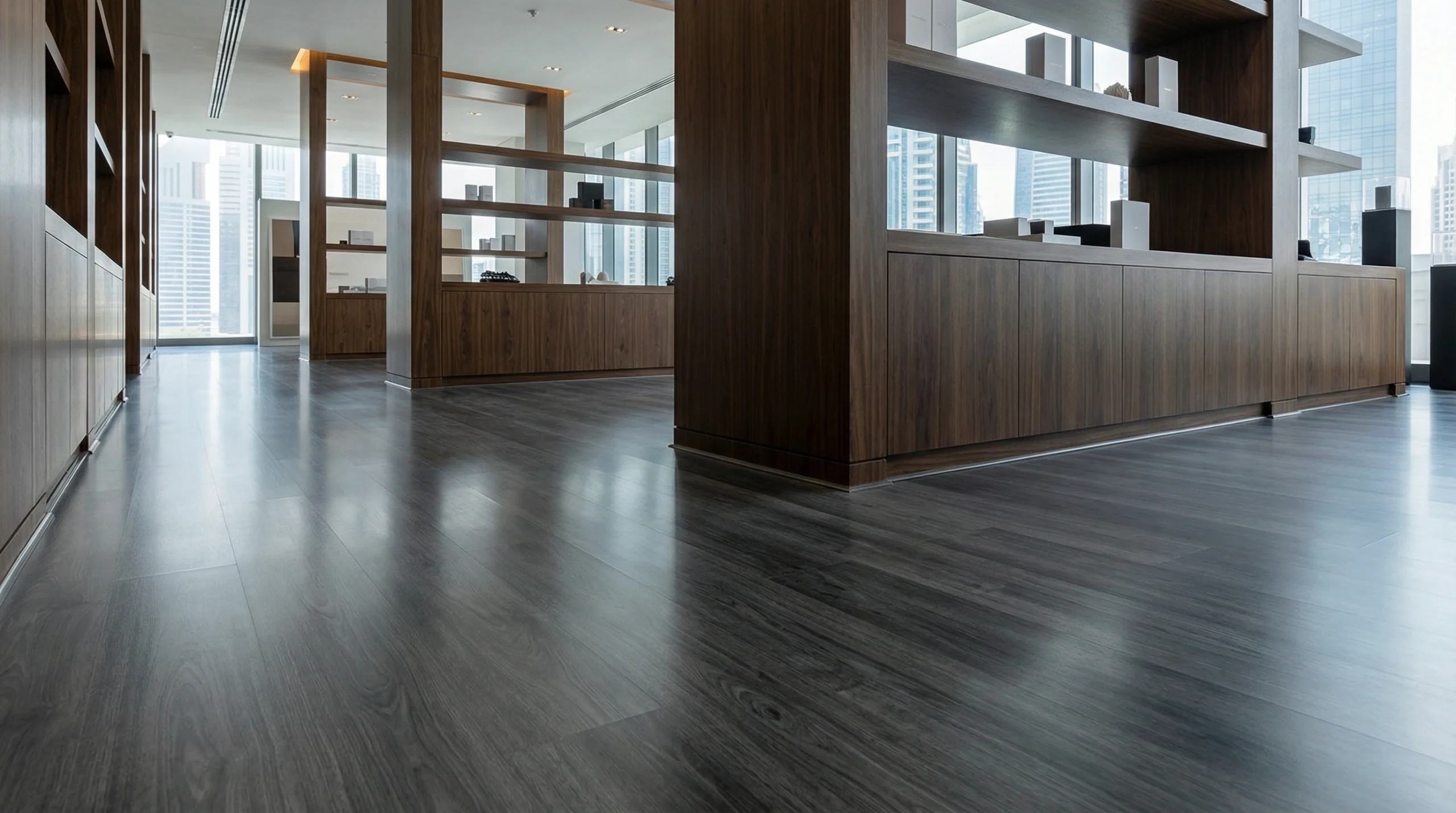
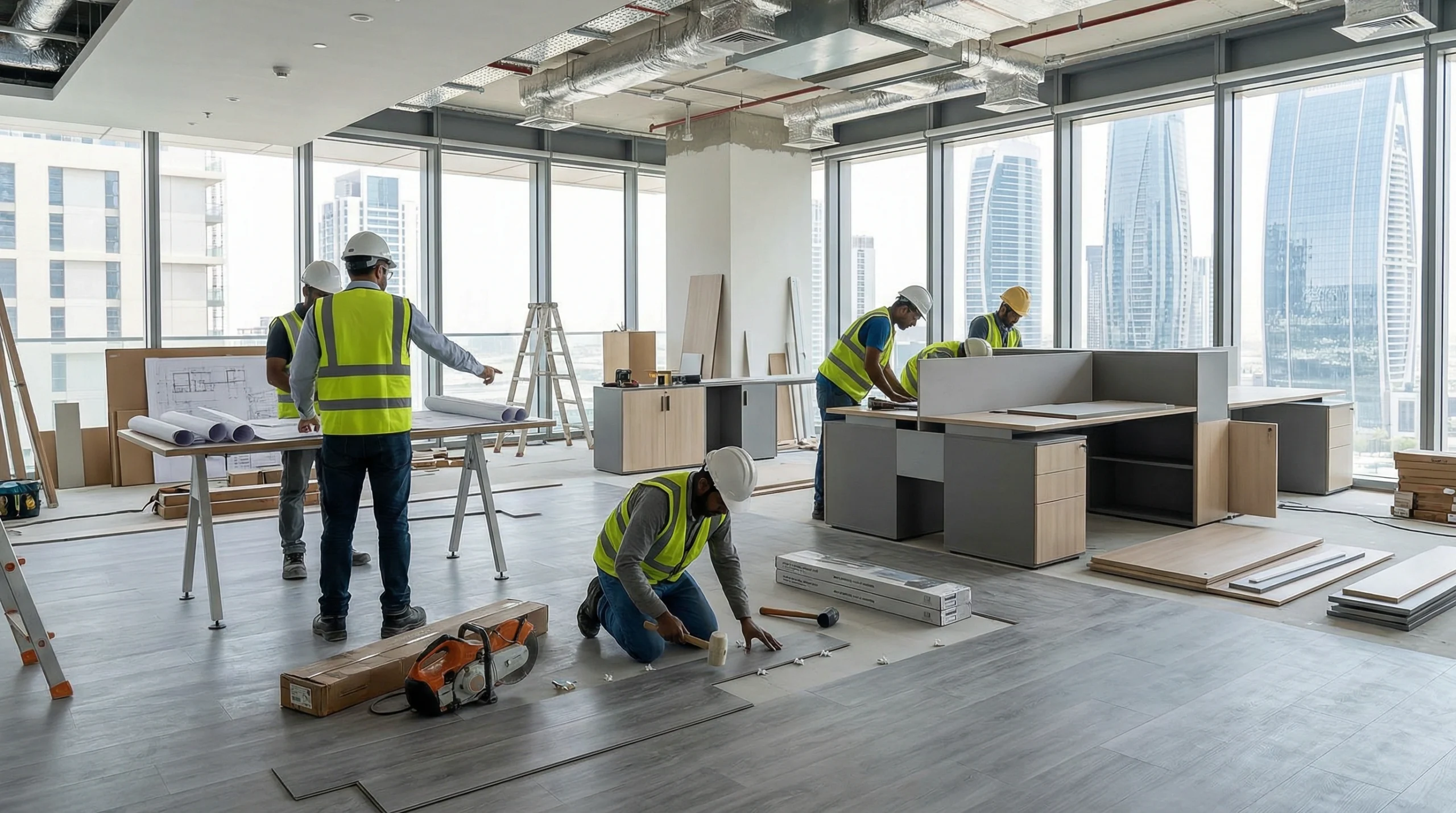
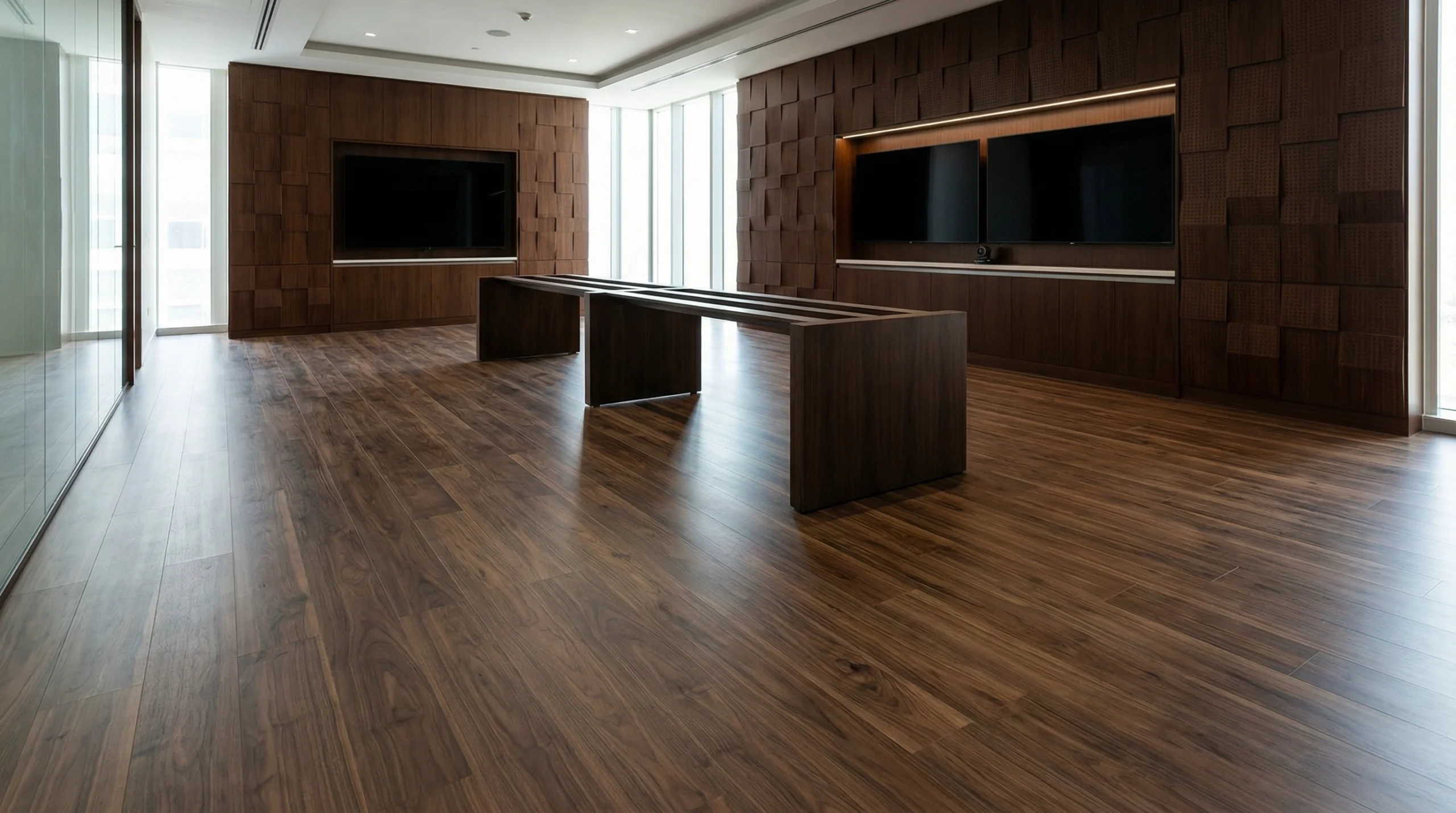
A financial services firm needed sophisticated professional appearance with rapid installation during their three-week office fit-out window. We installed dark walnut laminate throughout the 340-square-meter suite including reception, open workspace, private offices, and conference rooms. AC6 commercial rating ensures the floor handles heavy daily traffic from 40+ employees and regular client visits. Installation occurred over two extended weekends, allowing electrical and furniture contractors to continue their work during weekdays. The dark flooring creates striking contrast against white walls and glass partitions, exactly matching the firm’s desired high-end aesthetic.
Jumeirah Beach Residence Apartment – 95 SQM Coastal Installation
JBR’s coastal humidity requires flooring that handles moisture exposure from opened balcony doors and humidity infiltration. We installed waterproof stone-look laminate throughout this 2-bedroom apartment’s living areas and bedrooms, with specialized acoustic underlay to minimize impact noise transmission to the apartment below. The stone appearance suited the owner’s contemporary minimalist design preferences while the waterproof core provided essential protection against JBR’s challenging moisture conditions. After three years, the floor shows zero edge swelling or seam separation—validating the waterproof product specification for coastal locations.
Arabian Ranches Townhouse – 180 SQM Family-Friendly Flooring
Young parents with toddler twins needed durable, safe flooring that could handle constant activity and inevitable spills. We installed AC4 light oak laminate throughout the ground floor living areas and AC3 in the upstairs bedrooms, all with waterproof specifications. The installation included child-safe transition strips with low profiles to prevent tripping hazards. Two years later, the parents report the flooring looks nearly new despite daily toy drops, food spills, and constant foot traffic. The easy-clean surface saves them hours weekly compared to their previous carpeted areas.
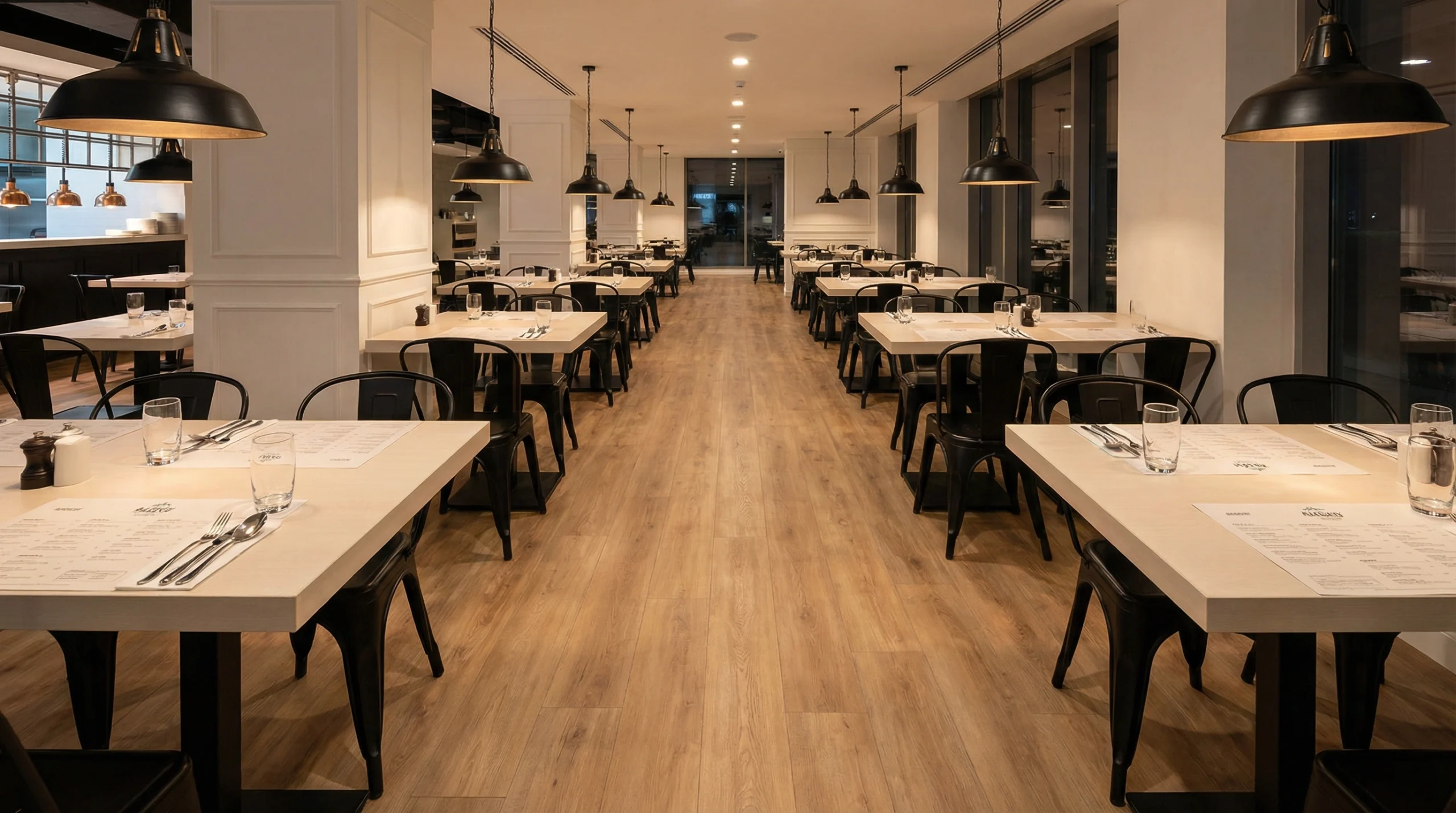
Business Bay Restaurant – 280 SQM Commercial Dining Space
This casual dining restaurant interior in Business Bay Dubai, commercial laminate wood flooring throughout dining area, contemporary restaurant design, ambient lighting, occupied tables with diners, professional restaurant photography showing busy atmosphere, focus on flooring durability and attractive appearance in commercial setting. We installed AC6 commercial waterproof laminate in wood-look finish throughout the dining area, with specialized industrial-grade waterproof laminate in the kitchen and service areas meeting Dubai Municipality commercial kitchen requirements. Installation occurred over five nights while the restaurant remained closed, completing just before the scheduled reopening. After 18 months of heavy use, the floor shows minimal wear and requires only simple mopping for daily cleaning.
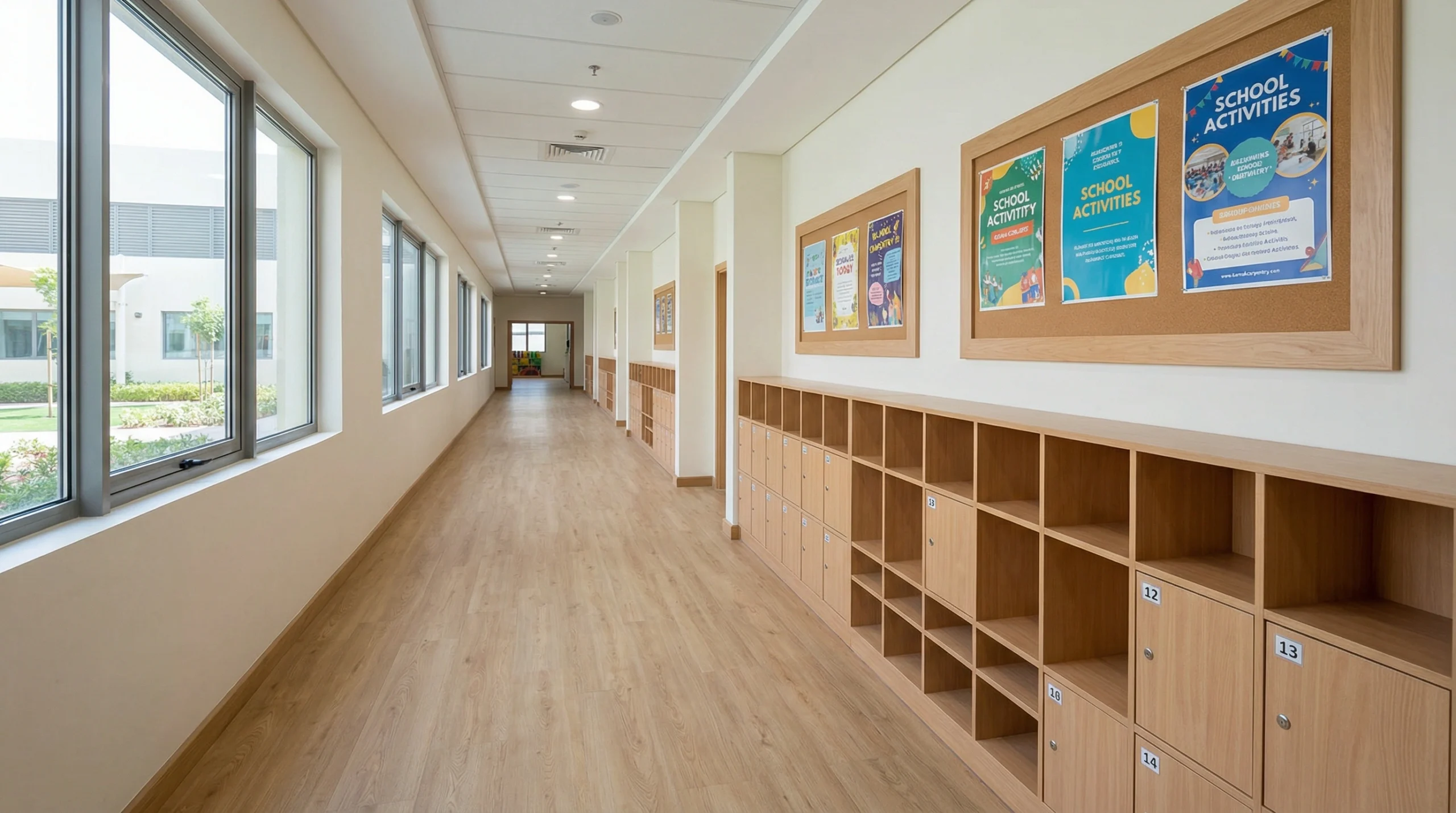
Sharjah Private School – 460 SQM Classroom Wing
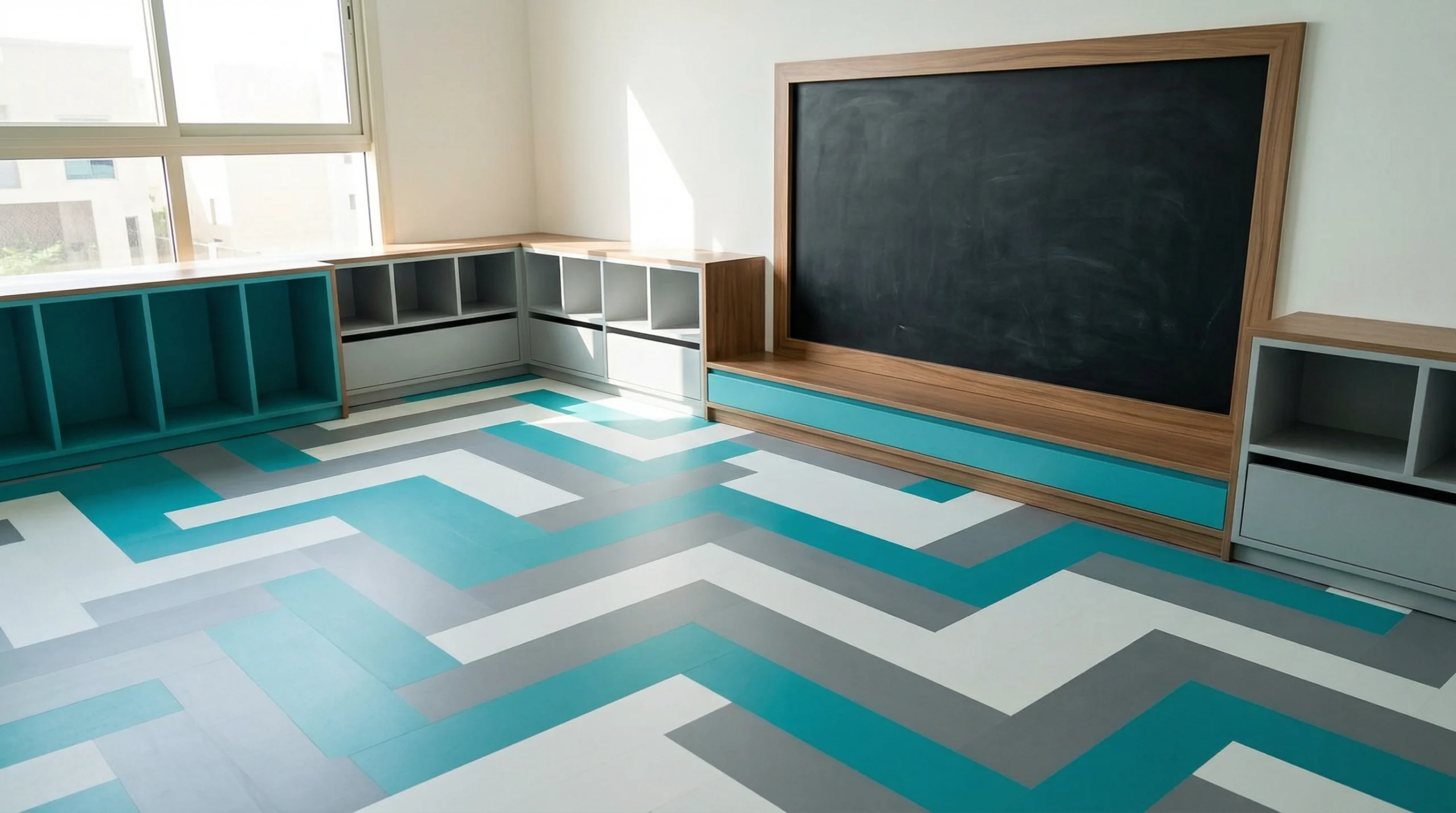
Educational environments need flooring that withstands constant foot traffic, chair movement, and occasional rough treatment while maintaining safe, clean surfaces. We installed AC5 educational-grade laminate throughout a 12-classroom wing including hallways and a resource center. The installation occurred during summer break to avoid disrupting school operations. Specialized acoustic underlay reduces noise transmission between floors. After two academic years of use by 300+ students daily, the floor maintains excellent appearance with only normal cleaning requirements.
Mirdif Villa – 380 SQM Multi-Phase Installation
The homeowner wanted to upgrade from ceramic tile but needed to phase the project across three months to manage budget. We installed laminate in three phases: first the ground floor living areas, then upstairs bedrooms and hallways, finally the kitchen and utility areas with waterproof specifications. Careful product batch coordination ensured perfect color matching across all three phases despite months separating installations. This phased approach allowed the family to maintain normal routines while progressively upgrading their home’s flooring.
Dubai Silicon Oasis Apartment – 110 SQM Modern Rental Property
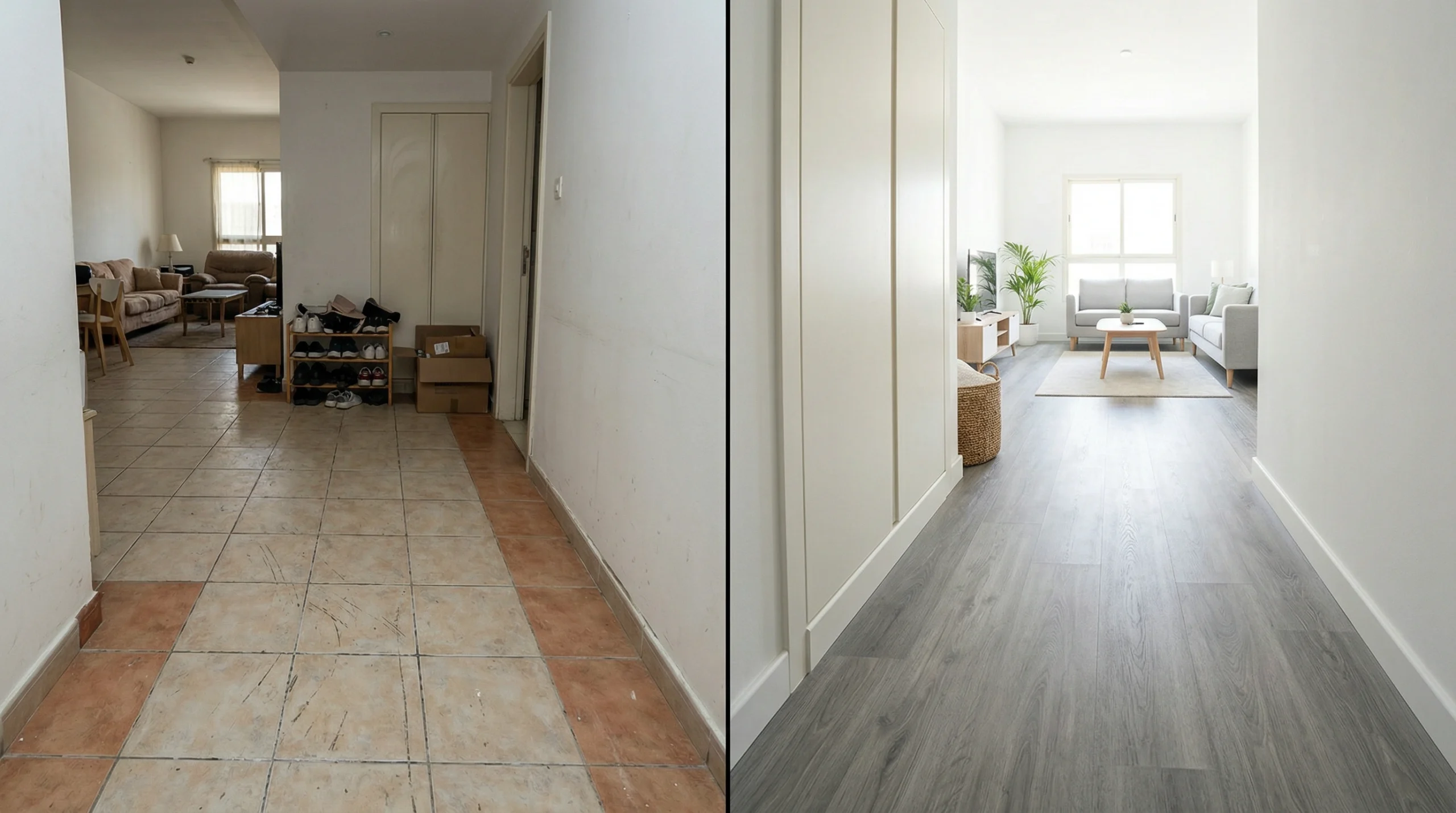
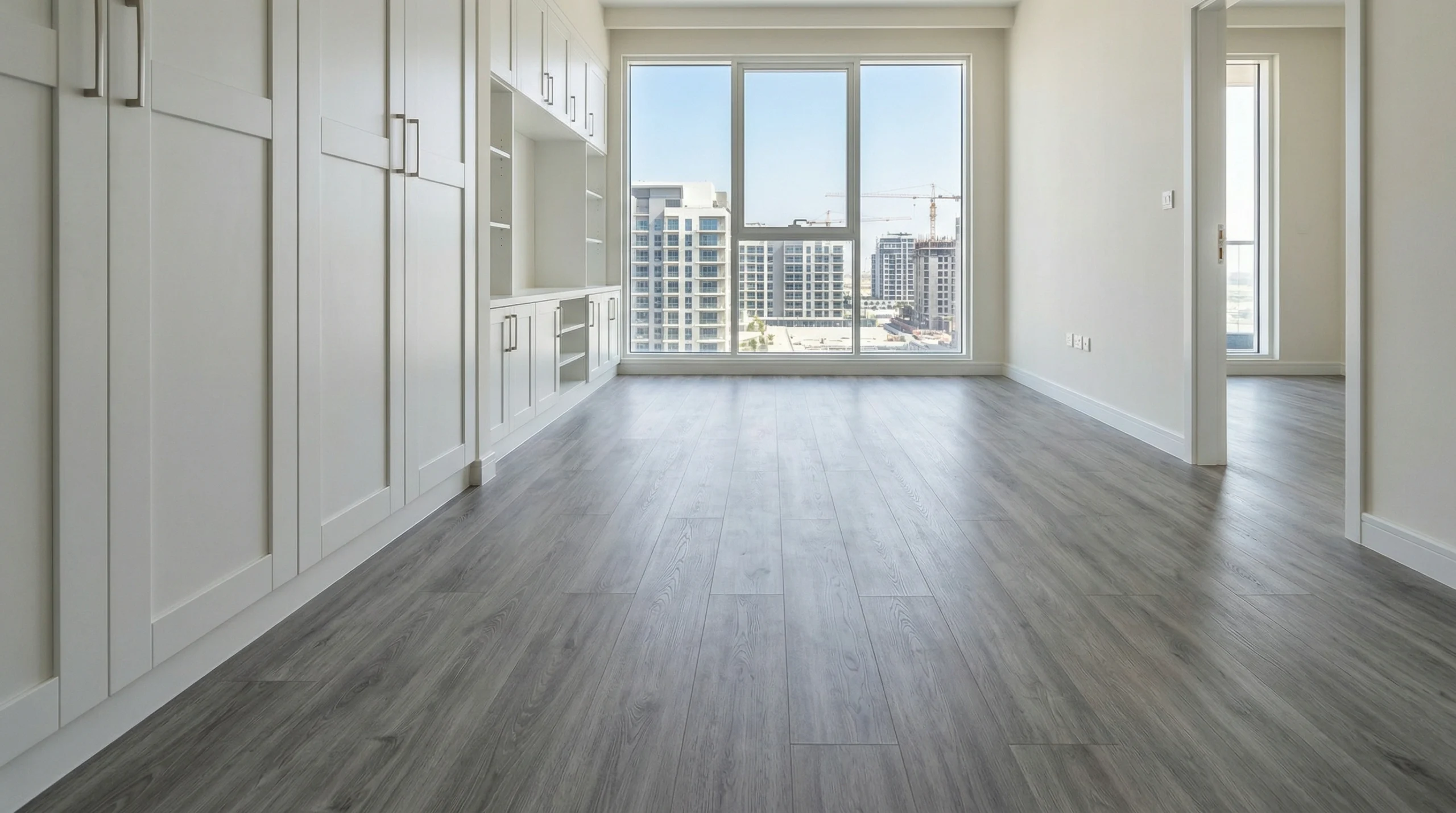
A property investor needed attractive, durable flooring for a rental apartment that would appeal to tech sector tenants while withstanding turnover between residents. We installed mid-tone gray oak laminate throughout, a contemporary finish that suits various furniture styles and shows minimal wear. AC4 rating and waterproof specification in bathroom and kitchen provide durability for rental use. The installation took three days, minimizing the property’s vacancy period. The investor reports the flooring photograph quality helps the listing stand out in competitive DSO rental market.
Abu Dhabi Villa – 620 SQM Luxury Residence
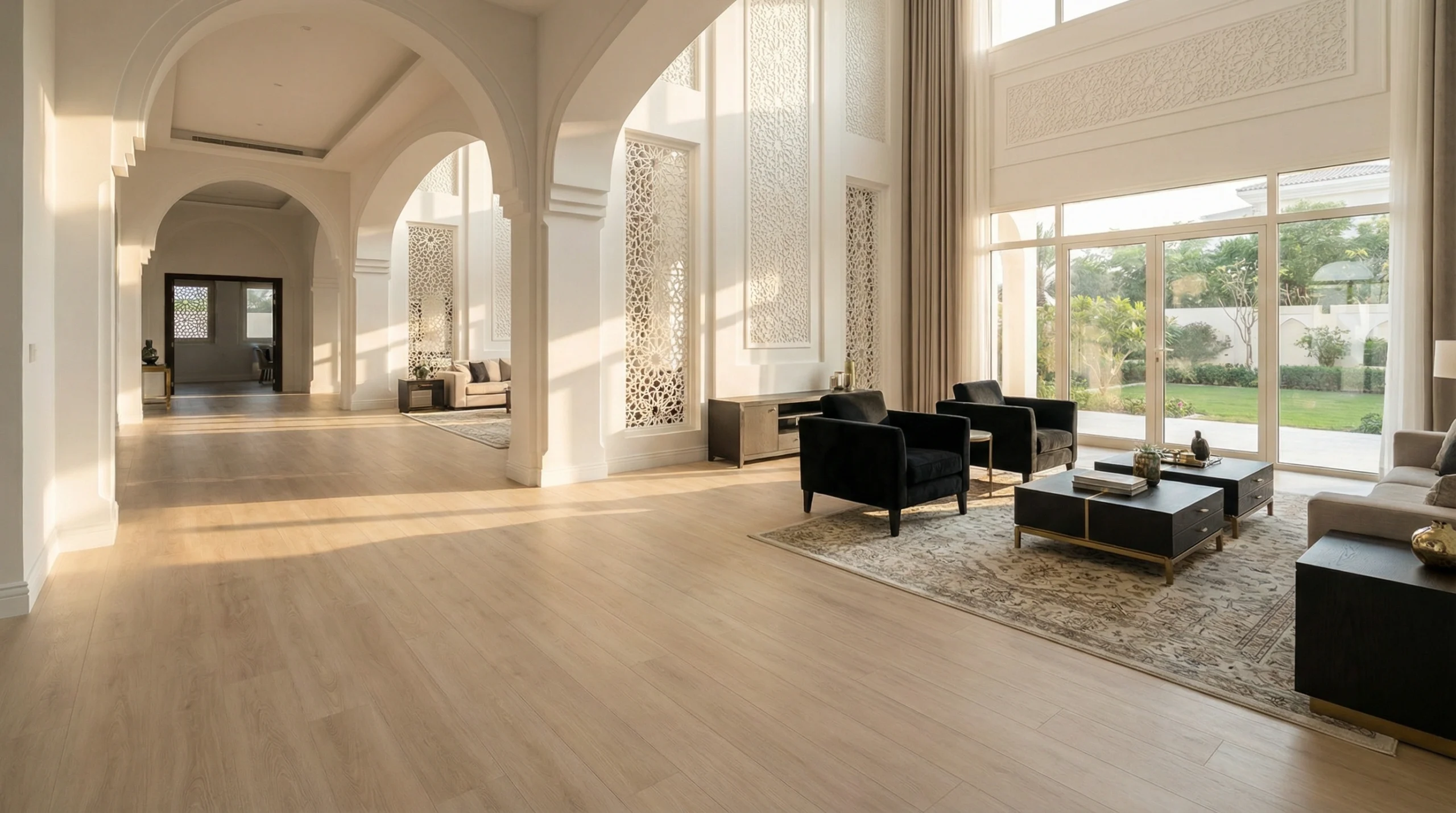
This newly constructed villa needed flooring throughout the main residence including formal living areas, family spaces, bedrooms, and study areas. We installed premium wide-plank oak laminate in natural finish across 620 square meters, creating seamless flow throughout the expansive home. The project required careful coordination with marble installers completing entrance areas and bathrooms. Installation occurred over two weeks with 4-person teams working simultaneously in different wings. The result is elegant, cohesive flooring that complements the villa’s contemporary Arabic architecture.
Ajman Beach Resort – 380 SQM Guest Corridor Renovation
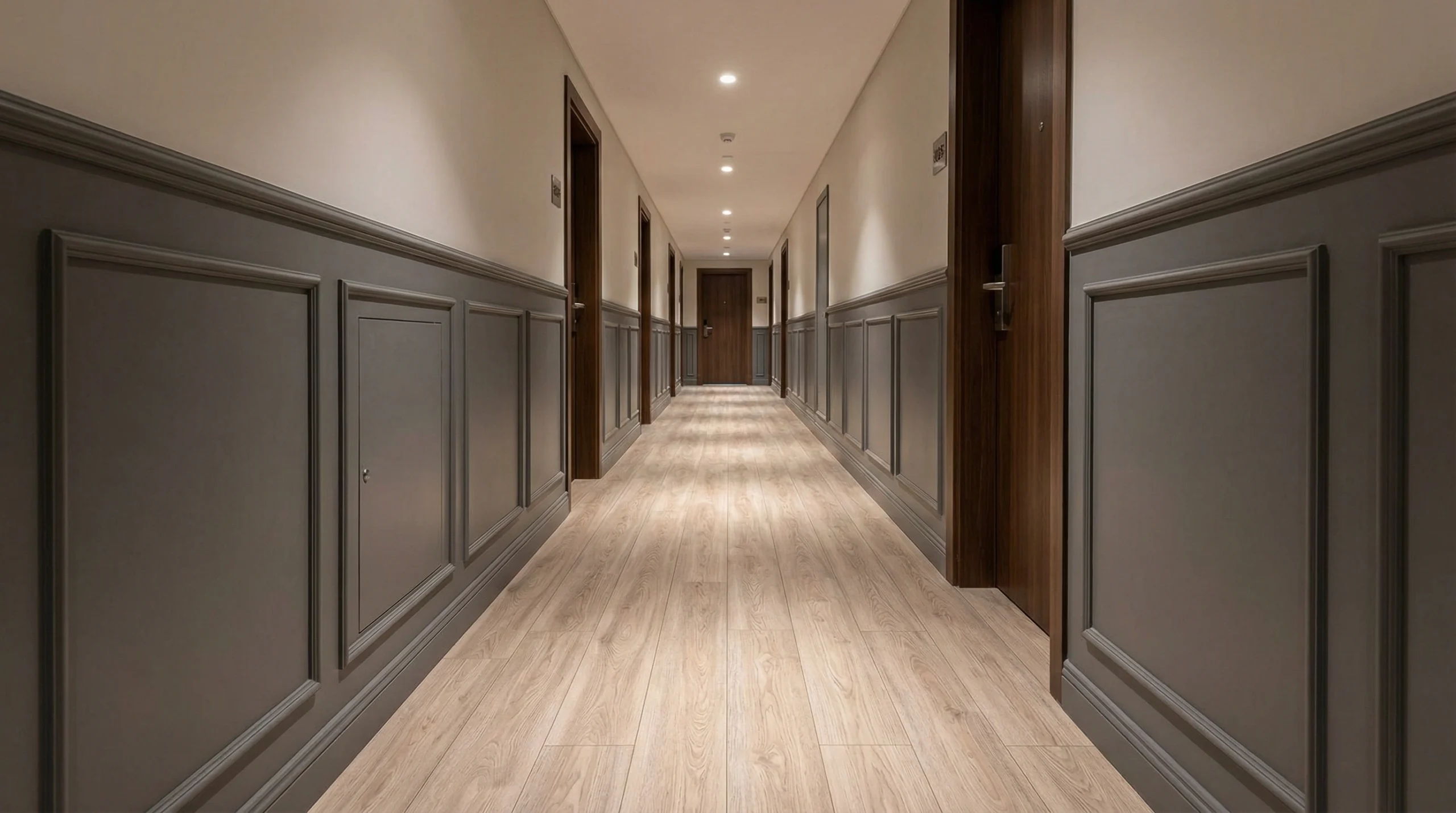
This beachfront resort needed corridor flooring that could handle constant foot traffic from beach-going guests while resisting moisture and sand infiltration. We installed commercial-grade waterproof laminate designed specifically for hospitality environments. The wood-look finish maintains the resort’s warm coastal aesthetic while the waterproof core handles the inevitable moisture and cleaning requirements. Installation occurred room-by-room to maintain resort operations, completing all corridors over three weeks during moderate occupancy period.
Laminate Flooring Questions - Expert Answers
Quality laminate flooring installed properly typically lasts 15-25 years in Dubai residential applications and 10-18 years in commercial settings, though several factors significantly affect actual lifespan. The product's AC rating largely determines durability—AC3 laminate in high-traffic areas might show noticeable wear after 8-10 years, while AC5 in the same conditions remains attractive for 15-20 years. We've inspected laminate we installed in 2008 that still looks excellent in moderately-used guest bedrooms but have seen poorly-specified products fail within five years in active family living rooms.
Dubai's climate affects longevity primarily through thermal expansion cycles. Buildings with poorly-regulated air conditioning create temperature swings that stress laminate more than stable environments. Coastal humidity adds another challenge—standard moisture-resistant laminate eventually shows edge swelling in high-humidity locations, while waterproof specifications remain stable indefinitely. We've documented waterproof laminate installed in 2015 in JBR coastal apartments showing zero moisture damage, while standard laminate in similar conditions developed edge swelling by 2018.
Maintenance practices also dramatically affect lifespan. Laminate cleaned appropriately with dry or barely-damp mopping and manufacturer-approved cleaners maintains appearance for decades. Excessive water use during cleaning, harsh chemical cleaners, or abrasive cleaning tools can degrade protective wear layers and reduce lifespan by 30-50%. We provide detailed care instructions with every installation because proper maintenance often matters more than initial product quality for long-term performance.
Laminate flooring costs vary significantly based on product quality, installation complexity, and property conditions, but realistic budgets for Dubai installations typically range from AED 45-120 per square meter for complete installed projects. Basic AC3 residential laminate with standard foam underlay costs approximately AED 45-65 per square meter installed. Mid-range AC4 residential laminate with cork underlay runs AED 70-95 per square meter. Premium AC5 laminate with acoustic underlay and waterproof specifications costs AED 100-120 per square meter.
These ranges include all standard installation elements: removal and disposal of existing flooring (if applicable), subfloor preparation and minor leveling, quality underlay appropriate to the specification, the laminate itself, professional installation with proper expansion gaps, skirting boards or baseboard installation, and transition strips between rooms. Additional costs arise for extensive subfloor repairs, furniture moving services, complex layouts requiring significant custom cutting, or accelerated installation timelines requiring larger crews.
Commercial projects typically run AED 80-150 per square meter depending on grade requirements and timeline constraints. Commercial installations often need AC5 or AC6 ratings, waterproof specifications, enhanced acoustic underlay for multi-tenant buildings, and installation during restricted hours—all of which increase costs compared to residential projects. The higher investment is justified because commercial flooring failures create business disruption costs far exceeding the initial savings from cheaper products.
Material costs represent roughly 40-55% of total installed price, with labor and preparation accounting for the remainder. Clients sometimes ask why they can't just purchase materials themselves and hire installers separately—this approach usually fails because installers won't warranty work over materials they didn't supply, and coordination problems create expensive delays. Our integrated supply and installation ensures all components work together and provides single-source accountability if any issues arise.
Laminate can be successfully installed over existing ceramic or porcelain tile in many situations, potentially saving significant time and money compared to tile removal. However, several critical conditions must be met for over-tile installation to perform properly long-term. The tile surface must be completely level within 3mm over any 3-meter span—uneven tile creates the same problems as uneven concrete, telegraphing through laminate and causing squeaking, movement, and premature wear.
All tiles must be firmly adhered to the subfloor beneath without any loose or hollow-sounding tiles. We test this by walking the entire surface and tapping tiles with rubber mallets listening for hollow sounds indicating delamination. Even one loose tile creates a weak point that will fail under laminate's pressure and foot traffic. Grout lines wider than 10mm or significantly recessed below tile surface create irregularities that show through laminate—these require filling with leveling compound before installation proceeds.
The additional height that laminate adds over existing tile creates transition challenges. Tile typically sits 12-18mm above the subfloor; adding 8-12mm laminate plus 2-4mm underlay raises the finished floor level by 22-34mm total. This affects doorways, potentially requiring door trimming or threshold adjustments. Transitions to adjacent rooms with different flooring become more pronounced and may need custom solutions. Kitchen and bathroom fixtures installed at specific heights relative to existing tile may sit too low or high relative to new laminate levels.
When over-tile installation isn't feasible, removal becomes necessary. Tile removal in Dubai properties typically costs AED 15-25 per square meter including disposal. The process is loud, messy, and sometimes damaging to underlying concrete—particularly in older buildings where tile adhesive bonded very strongly. We recommend tile removal when existing tile is damaged or loose, when height differences would create unacceptable transitions, when tile surface is too uneven for correction with leveling compounds, or when clients want to minimize final floor height for door clearance or aesthetic reasons.
Modern laminate flooring works well with underfloor heating systems when products are specifically rated for this application and installation follows manufacturers' thermal resistance requirements. Not all laminate is suitable for heated floors—the product specifications must explicitly state underfloor heating compatibility, and thermal resistance (R-value) must fall within system requirements, typically 0.10-0.15 m²K/W for the combined floor covering and underlay.
Laminate thickness affects thermal performance. Thinner 7-8mm laminate transfers heat more efficiently than 12mm versions, though the difference is relatively minor. Underlay selection matters significantly—standard foam underlay often has thermal resistance too high for underfloor heating, blocking heat transfer and reducing system efficiency. Specialized thin-density underlay designed for heated floors provides necessary moisture protection and minor cushioning while allowing heat transfer. We use 1.5-2mm underfloor heating underlay rather than standard 3-4mm products for heated applications.
Temperature limitations protect laminate from damage. Underfloor heating systems beneath laminate should never exceed 27°C surface temperature—higher temperatures can cause laminate to dry excessively, leading to gaps between planks, surface cracking, or joint separation. Most modern heating systems include thermostats with floor temperature sensors that prevent overheating. We verify these controls are properly installed and functioning before laminating over heating systems.
Installation over underfloor heating requires gradual heating protocols. The heating system must be switched off at least 48 hours before installation and remain off until installation completes and adhesives cure (if applicable). Post-installation, the system should be restarted at minimum temperature and gradually increased by 2-3°C daily until reaching desired temperature. This gradual warming allows laminate to adjust to temperature changes without shocking the material with sudden heat exposure.
Some underfloor heating types work better with laminate than others. Electric mat systems and water-based systems both function well when properly controlled. We've installed laminate successfully over both types numerous times in Dubai villas where owners wanted heated floors in master bathrooms or cool-touch bedrooms during winter. The combination provides comfort and energy efficiency when specified and installed correctly.
Laminate flooring requires minimal maintenance compared to hardwood, tile, or carpet, making it particularly attractive for busy Dubai families and commercial environments. Daily or regular maintenance involves dry or barely-damp mopping to remove dust and surface dirt that accumulates quickly in UAE's sandy, dusty conditions. We recommend microfiber mops for daily use—they capture fine dust effectively without requiring water or chemicals.
For deeper cleaning, use very lightly dampened (not wet) mops with laminate-specific cleaning solutions or simple mixtures of water with small amounts of white vinegar. Excessive water is laminate's enemy—standing water or saturated mops can penetrate seams and damage core materials even in water-resistant products. We teach clients to wring mops until nearly dry, leaving just enough moisture to lift stubborn dirt without leaving puddles. Spills should be wiped immediately rather than leaving them to sit and potentially penetrate joints.
Harsh chemicals, abrasive cleaners, and steam mops should never be used on laminate flooring. Products containing ammonia, bleach, or strong solvents can damage protective wear layers and dull finish. Abrasive scrubbing pads scratch surfaces. Steam mops force hot moisture into seams, causing swelling and delamination. We've seen clients destroy expensive laminate within months through steam mopping despite manufacturers' explicit warnings against this practice.
Preventive maintenance protects long-term appearance. Entry mats at exterior doors trap sand and debris before it gets tracked onto laminate—particularly important in Dubai where sand infiltrates homes constantly. Furniture pads beneath all chair and table legs prevent scratching and indentation. Area rugs in high-traffic zones reduce wear. Window treatments minimize direct sunlight exposure that causes fading over time. These simple measures extend laminate lifespan significantly.
Periodic deep cleaning every 4-6 months maintains optimal appearance. This involves more thorough damp mopping, gentle buffing with soft cloths to restore shine on high-gloss finishes, and inspection for any damage needing repair. Some clients schedule professional cleaning annually for large areas, though this isn't necessary if regular maintenance stays consistent. The key principle is keeping laminate clean and dry—following this simple rule ensures decades of beautiful performance.
Laminate flooring feels warmer underfoot than ceramic tile or marble but cooler than carpet in air-conditioned environments. The temperature perception relates to thermal conductivity—how quickly materials absorb heat from your feet. Tile rapidly draws heat away, feeling very cold. Carpet insulates, feeling warm. Laminate falls between these extremes, feeling relatively neutral at typical indoor temperatures.
In Dubai's heavily air-conditioned interiors, floor surface temperature usually matches ambient air temperature around 22-24°C. At this temperature, laminate feels comfortable to most people for normal walking. Prolonged standing or sitting on floors (children playing) might feel slightly cool compared to carpet, but significantly warmer than tile. The HDF wood fiber core conducts heat less than stone materials, creating this moderate thermal characteristic.
Underlay selection influences thermal comfort. Thick cork underlay provides more insulation than thin foam, creating warmer feeling floors. However, excessive underlay thickness can make laminate feel soft or unstable underfoot—there's a balance between thermal comfort and structural feel. We typically recommend 3mm cork underlay as an optimal compromise for Dubai residential applications.
For clients particularly sensitive to cool floors, several options improve comfort. Underfloor heating systems warm laminate surfaces to comfortable temperatures—popular in master bathrooms and bedrooms. Area rugs in seating and play areas provide warm surfaces without carpet's maintenance requirements throughout the home. Some clients choose laminate for main living areas and carpet for bedrooms, combining laminate's durability where needed with carpet's warmth in private spaces.
The cooling sensation that concerns some clients actually provides benefit in Dubai's context. Unlike external environments where you want warm flooring, indoor spaces are intentionally cooled. Slightly cool laminate reinforces the air-conditioned comfort rather than fighting against it. Many clients initially concerned about temperature find they appreciate laminate's moderate coolness during hot months when arriving from outdoor heat.
Waterproof laminate can be successfully installed in UAE bathrooms when properly specified and installed according to bathroom-specific protocols. Traditional moisture-resistant laminate is unsuitable for bathroom use—inevitable water exposure from showers, baths, and sinks will eventually cause core swelling and failure. Only products with completely waterproof cores designed for wet area installation should be considered for bathroom applications.
The distinction between water-resistant and waterproof laminate is critical. Water-resistant products resist casual water exposure for limited timeframes but fail under repeated or prolonged wetness. Waterproof laminate uses rigid polymer cores instead of wood-fiber HDF, making them impervious to water absorption. These products can sit in standing water for extended periods without damage—we've tested this extensively and found quality waterproof laminate shows zero swelling even after 48-hour water submersion.
Bathroom installation requires enhanced moisture protection protocols beyond standard laminate installation. We install continuous waterproof barriers beneath flooring extending up walls 150mm to create bathtub-like containment. All perimeter gaps around bathtubs, showers, toilets, and vanities get sealed with flexible silicone designed for wet areas. Transitions between bathroom laminate and adjacent room flooring include raised thresholds that prevent water migration during cleaning or overflow events.
Ventilation becomes critical in bathroom environments. Bathrooms with inadequate ventilation develop high humidity levels that eventually affect even waterproof flooring. We recommend bathroom exhaust fans rated for the room volume and humidity generation to maintain reasonable moisture levels. Running exhaust fans during showers and for 20-30 minutes afterward prevents excessive humidity accumulation that can infiltrate seams over time.
Limitations exist even with waterproof laminate. Products designed for residential bathroom use may not meet commercial specifications for hotel bathrooms, gym locker rooms, or public facilities with constant water exposure and heavy traffic. Standing water should still be wiped reasonably promptly—waterproof laminate survives temporary flooding but isn't designed for permanent wet conditions. Bathroom flooring is one area where we sometimes recommend luxury vinyl plank as an alternative to laminate because LVP offers even superior water resistance and flexibility for extremely wet applications.
Brand selection significantly affects laminate quality, performance, and longevity, making this decision worth careful consideration. The UAE market includes dozens of laminate brands ranging from premium European manufacturers to budget Asian alternatives. Our three decades installing various brands has revealed clear performance patterns that guide our recommendations.
European manufacturers—particularly German and Belgian brands—consistently deliver superior quality. Kronotex, Egger, Quick-Step, and Pergo maintain rigorous quality control, use advanced manufacturing technology, and invest heavily in product development. Their AC ratings accurately reflect performance, their moisture resistance genuinely protects against UAE humidity, and batch-to-batch consistency ensures purchases years apart match perfectly. These brands cost 30-50% more than budget alternatives but typically last twice as long and maintain appearance throughout their lifespan.
We've extensively tested various Asian-manufactured laminate over the years. Some products perform adequately for budget applications, but consistency is the recurring problem. One batch might meet specifications while the next shows defects or performance failures. The cost savings often disappear when factoring in shorter lifespan and higher replacement probability. For Dubai installations where summer heat and humidity stress flooring, we've found the premium European products justify their cost through superior durability.
Specific performance factors distinguish quality brands. Look for companies providing detailed technical specifications including precise AC rating testing results, core density measurements, wear layer thickness specifications, and moisture resistance test data. Reputable manufacturers back products with meaningful warranties—15-25 years for residential, 5-15 years for commercial. Brands offering only 1-3 year warranties signal quality concerns.
Manufacturing origin matters for environmental reasons and performance. Laminate made from sustainably harvested wood with FSC certification ensures responsible forestry. European environmental regulations require lower formaldehyde emissions compared to some Asian manufacturers. This affects indoor air quality—particularly important in tightly sealed, air-conditioned Dubai homes where air exchange is minimal.
We maintain direct relationships with several premium manufacturers, allowing us to source products reliably and provide technical support when needed. This supplier reliability means we can confidently warranty our installations knowing the materials will perform as expected. When clients request budget brands we don't typically supply, we're honest about our concerns regarding their long-term performance in UAE conditions.
Laminate and luxury vinyl plank (LVP) are frequently confused because both create wood or stone appearances at mid-range prices, but they're fundamentally different products with distinct advantages and limitations. Understanding these differences helps clients select the best option for specific applications.
Construction forms the primary difference. Laminate uses high-density fiberboard cores topped with photographic images and protective wear layers. LVP uses flexible vinyl layers with photographic designs sandwiched between protective coatings. This makes laminate rigid while LVP is flexible—you can bend LVP planks significantly without damage, while laminate is rigid like wood and snaps if bent too far.
Water resistance differs substantially. Standard laminate is moisture-resistant but damaged by standing water. Waterproof laminate resists water better but still uses rigid cores that can be affected by extreme moisture exposure. LVP is completely waterproof throughout—you can install it in extremely wet conditions including commercial kitchens, pool areas, or outdoor covered spaces where laminate would fail. For Dubai bathrooms with heavy shower use or homes with pool access, LVP often outperforms even waterproof laminate.
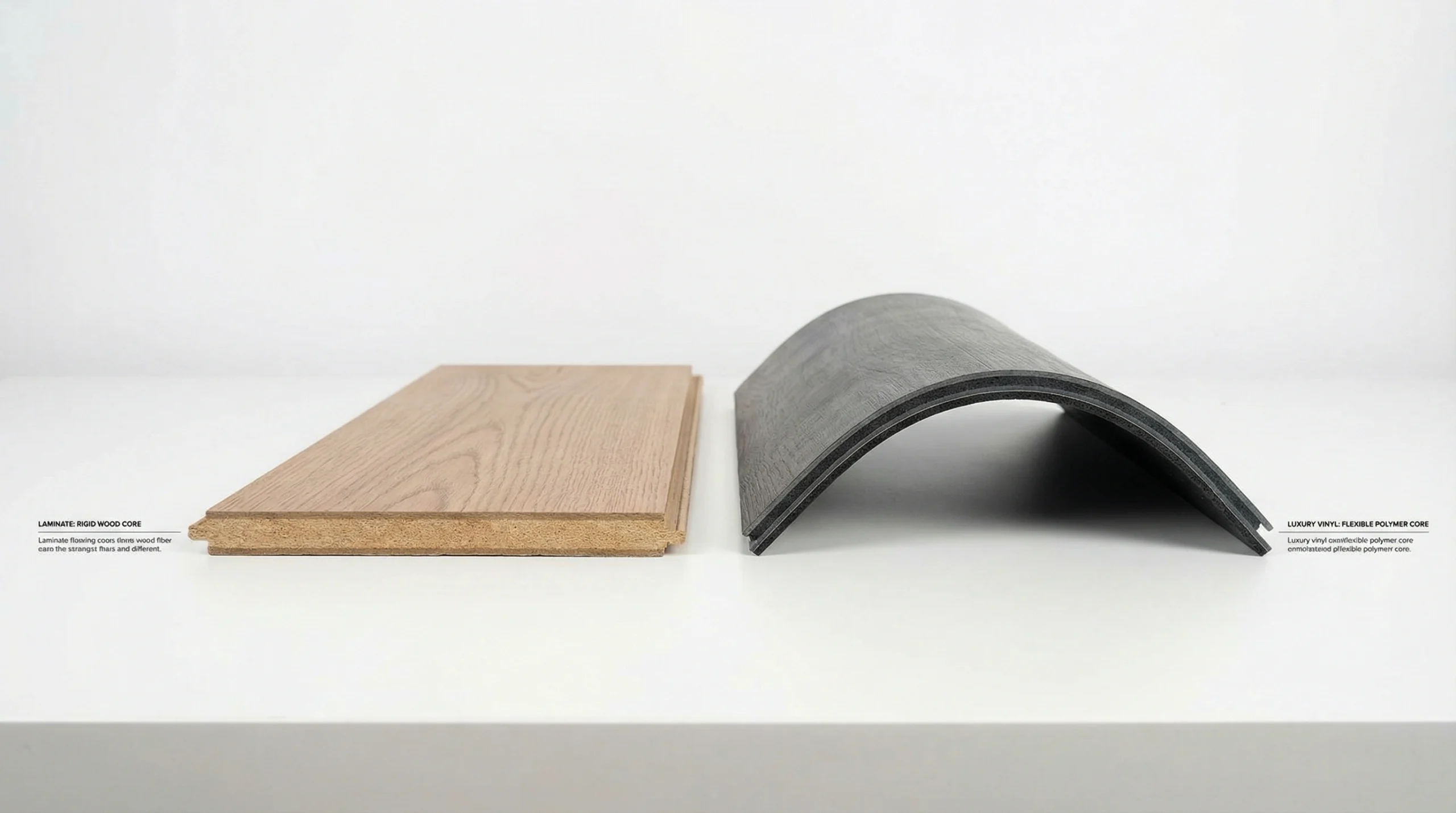
Aesthetic realism varies between products. High-end laminate often looks more convincingly like real wood than comparably-priced LVP because laminate's embossing and texturing technologies are more advanced. However, premium LVP has closed this gap significantly in recent years. Both products now offer impressive realism that fools most observers from normal viewing distances.
Acoustic properties favor laminate. LVP's flexible construction transmits impact noise more than laminate's rigid structure, creating louder footfall sounds in apartments with neighbors below. This makes laminate preferable for multi-story buildings where noise transmission is a concern, though quality underlay beneath either product improves acoustic performance.
Temperature comfort is similar for both products. Both feel warmer than tile but cooler than carpet. Both work with underfloor heating when specifications allow. Neither feels particularly cold in air-conditioned Dubai environments.
Installation complexity is comparable. Both use click-lock floating installation systems requiring similar techniques and tools. LVP's flexibility makes cutting slightly easier. Laminate's rigidity makes alignment slightly easier. Experienced installers work efficiently with either product.
Cost ranges overlap significantly. Budget laminate costs less than budget LVP. Premium laminate and premium LVP sit at similar price points. Installation costs are nearly identical for both products.
We recommend laminate for living areas, bedrooms, dining rooms, and offices where aesthetics and noise control are priorities and moisture exposure is limited. We recommend LVP for bathrooms, kitchens, laundry rooms, and any areas with significant moisture risk or flexible flooring preferences. Many clients install both products in different areas of the same property, using each where its specific advantages matter most.
Installation timeline depends on project scope, property conditions, and client scheduling requirements, but understanding realistic timeframes helps with project planning. A standard 100-square-meter Dubai apartment with basic preparation requirements typically needs 2-3 days for complete laminate installation from start to finish.
Day one usually involves any existing flooring removal, subfloor preparation and leveling, and initial laminate installation in accessible areas. Furniture removal happens before or during this phase depending on whether clients or we handle this service. Day two completes remaining installation, cuts all transitions and perimeter trim, and begins skirting board installation. Day three finishes trim work, conducts quality inspection, handles any final adjustments, and returns furniture to completed areas if we're managing this service.
Larger properties scale proportionally. A 250-square-meter villa might require 4-6 days. A 500-square-meter space could need 7-10 days. These timelines assume normal conditions—level subfloors, straightforward layouts, standard product specifications, and work proceeding during normal daytime hours.
Several factors extend timelines significantly. Extensive subfloor repairs or leveling can add 1-3 days depending on the severity. Complex layouts with many transitions, angled walls, or intricate cutting patterns increase installation time by 20-40%. Furniture moving coordination where we work around occupied spaces rather than empty rooms adds time. Custom trim work or specialized transition requirements extend finishing phases.
Commercial projects often face tighter constraints. Retail installations might require overnight-only work to avoid disrupting business operations. We've completed 200-square-meter restaurant installations over three consecutive nights using larger crews working compressed schedules. Office installations sometimes happen over weekends. These accelerated schedules increase costs due to overtime labor and larger crew requirements but allow businesses to maintain normal operations.
Material acclimation requirements affect total project duration from start to finish. Laminate should acclimate to installation environment conditions for 48-72 hours before installation begins. This means total time from material delivery to completed installation is typically 4-7 days for standard residential projects even though actual installation work only spans 2-3 days. Clients planning around move-in dates or events need to account for this full timeline.
Phased installations let clients spread disruption and costs over time. We've completed villa installations in 3-4 phases over several months, allowing families to maintain livable spaces while progressively upgrading their flooring. This approach takes longer overall but makes the project more manageable for occupied properties.
Laminate flooring does experience some fading when exposed to intense direct sunlight over extended periods, though quality products resist this significantly better than cheaper alternatives. The photographic layer and protective wear layer both affect fade resistance—premium products use UV-resistant inks and coatings that maintain color accuracy for 10-15 years even with significant sun exposure.
Dubai's intense sunlight and high UV index create particularly challenging conditions for any flooring material. Floor-to-ceiling windows in modern apartments and villas allow strong afternoon sun to strike floors for hours daily. We've documented noticeable color lightening in budget laminate near south-facing windows after just 3-4 years, while premium European products in identical conditions show minimal change over 8-10 years.
The fading pattern is gradual and often goes unnoticed until furniture is moved and unexposed areas show their original color. Direct sunlight areas fade first and most noticeably. Indirect light areas fade slowly over many years. Shaded areas maintain original color indefinitely. This creates contrast issues when moving furniture or area rugs that have protected certain floor sections.
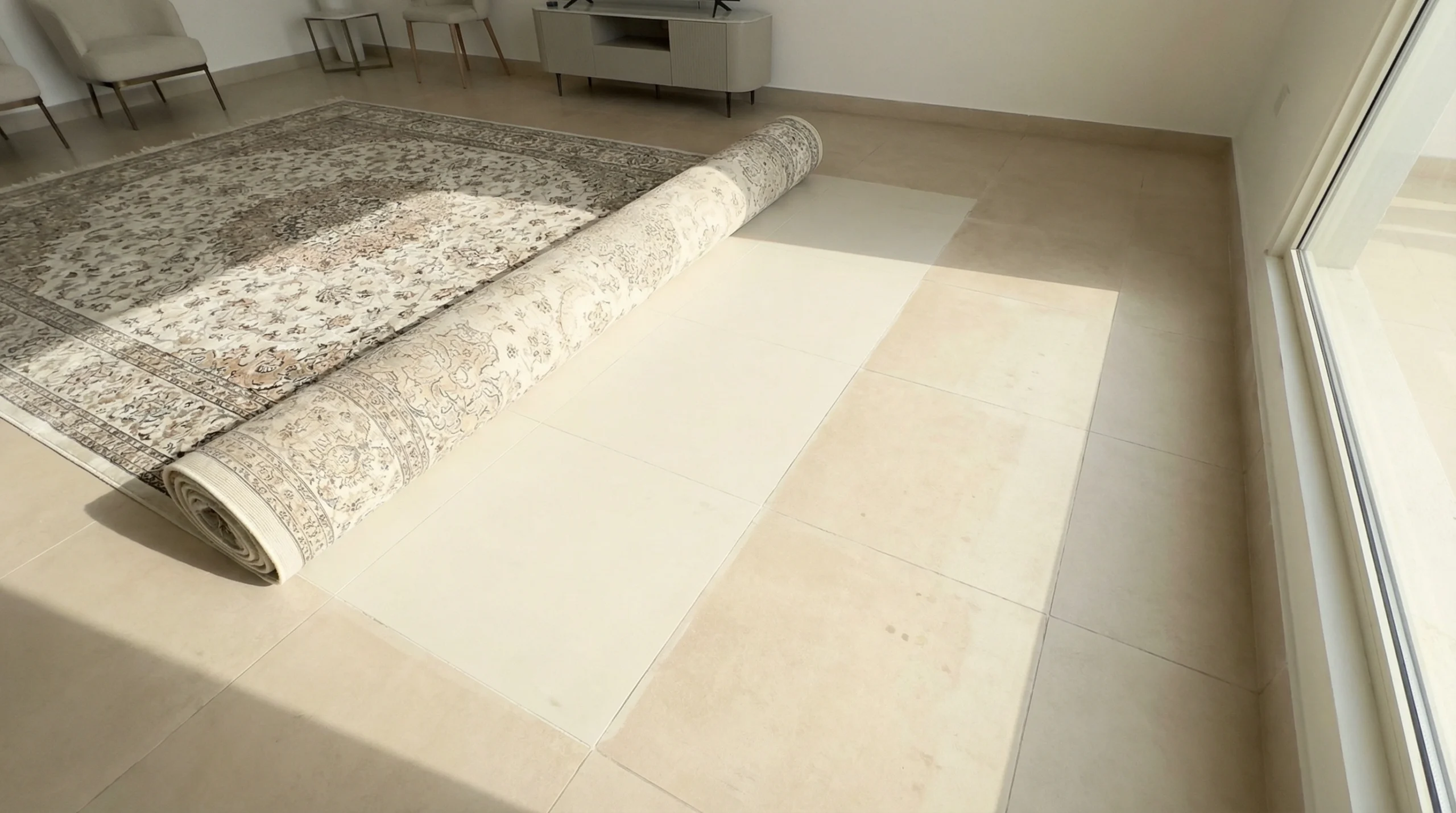
Several strategies minimize fading concerns. Window treatments like sheer curtains, solar shades, or UV-blocking films reduce direct sunlight intensity while maintaining natural light. These solutions cut UV transmission by 40-70% depending on product selection. Area rugs in sunny zones provide decorative elements while protecting floor from direct exposure. Specifying darker laminate colors shows fading less noticeably than very light shades—medium to dark oak tones maintain appearance better than bleached or very light natural oak.
Premium product selection dramatically affects fade resistance. We recommend laminate with explicitly stated UV protection in wear layer formulations for Dubai installations. This costs modestly more but provides significantly extended colorfastness. Manufacturers like Kronotex and Pergo specifically engineer their products for international markets including high-UV regions, making their offerings more suitable than brands designed primarily for Northern European climates with limited sun exposure.
Comparing laminate to other flooring options provides context. Laminate fades more than ceramic tile or stone (which are essentially fade-proof) but less than most carpeting and many hardwoods. Engineered hardwood shows similar fading patterns to laminate. LVP exhibits comparable UV resistance to quality laminate. No wood-appearance flooring product is completely fade-proof, making protection strategies valuable regardless of material choice.
Minor laminate damage can often be repaired effectively without replacing entire floors, though the repair success depends on damage severity and type. Deep scratches, small chips, and gouges often respond well to laminate repair kits containing colored putties matching common wood tones. These repairs work best on textured laminate where the filled area blends into surrounding embossing—high-gloss smooth laminate shows repairs more noticeably.
For scratches that haven't penetrated through the wear layer into the decorative print layer, gentle buffing with fine-grade furniture polish sometimes minimizes their appearance. Deeper scratches require filling with color-matched wax sticks or putty. The repair process involves cleaning the damaged area, applying filler compound matching the laminate color, smoothing excess material flush with surrounding surface, and allowing proper curing time. Results vary—some repairs become nearly invisible while others remain somewhat noticeable upon close inspection but acceptable from normal viewing distances.
Severely damaged individual planks can be replaced, though the process requires carpentry skill and careful work to avoid damaging surrounding undamaged planks. Replacing planks in floating laminate installations involves cutting and removing the damaged plank without disturbing the click-lock connections of surrounding planks, then installing a new replacement plank with modified locking mechanism since it can't be clicked into place from above. This works well for isolated damage but becomes impractical for multiple damaged planks across large areas.
The main challenge with individual plank replacement is color matching. Laminate color and finish can vary between production batches, making years-old installations difficult to match perfectly with newly purchased products. We photograph and record specific product codes for all installations, allowing us to source matching replacements when manufacturers still produce the same product line. For discontinued products, we sometimes salvage planks from closets or less-visible areas to repair damage in prominent spaces, then install close-match replacements in the hidden areas.
Water damage presents particular challenges. Once laminate cores swell from moisture infiltration, they rarely return to original dimensions even after drying. Attempting to repair water-damaged laminate usually fails—the damaged planks must be removed and replaced. Extensive water damage affecting multiple planks or large areas often makes complete floor replacement more practical and cost-effective than repairs.
Prevention remains the best approach to laminate damage. Furniture pads prevent scratching and denting. Prompt spill cleanup prevents moisture damage. Entry mats trap abrasive sand. These simple protective measures avoid most damage that would require repair, making investment in prevention far more cost-effective than repairs after damage occurs.
Laminate flooring works excellently in many commercial applications when specified appropriately for the traffic level and use requirements. Commercial-grade laminate rated AC5 or AC6 handles heavy foot traffic, frequent cleaning, and demanding conditions that would destroy residential-grade products. We've installed commercial laminate successfully in offices, retail stores, restaurants, clinics, educational facilities, and hospitality environments across Dubai.
Office environments represent ideal commercial laminate applications. AC5 laminate handles typical office traffic from employees and visitors, looks professional and sophisticated, reduces noise compared to hard surfaces like tile or stone, and maintains appearance with standard cleaning procedures. Dubai's numerous DIFC, Business Bay, and Dubai Silicon Oasis office installations we've completed show excellent long-term performance in these moderate-traffic commercial settings.
Retail environments require more careful specification. Small boutiques and showrooms with limited traffic work well with AC5 laminate. High-traffic retail in malls or popular shopping districts needs AC6 commercial-grade products designed specifically for retail punishment. We installed AC6 laminate in a Dubai Mall retail location experiencing 2,000+ daily visitors—after four years, the floor remains in excellent condition because the specification matched the traffic reality.
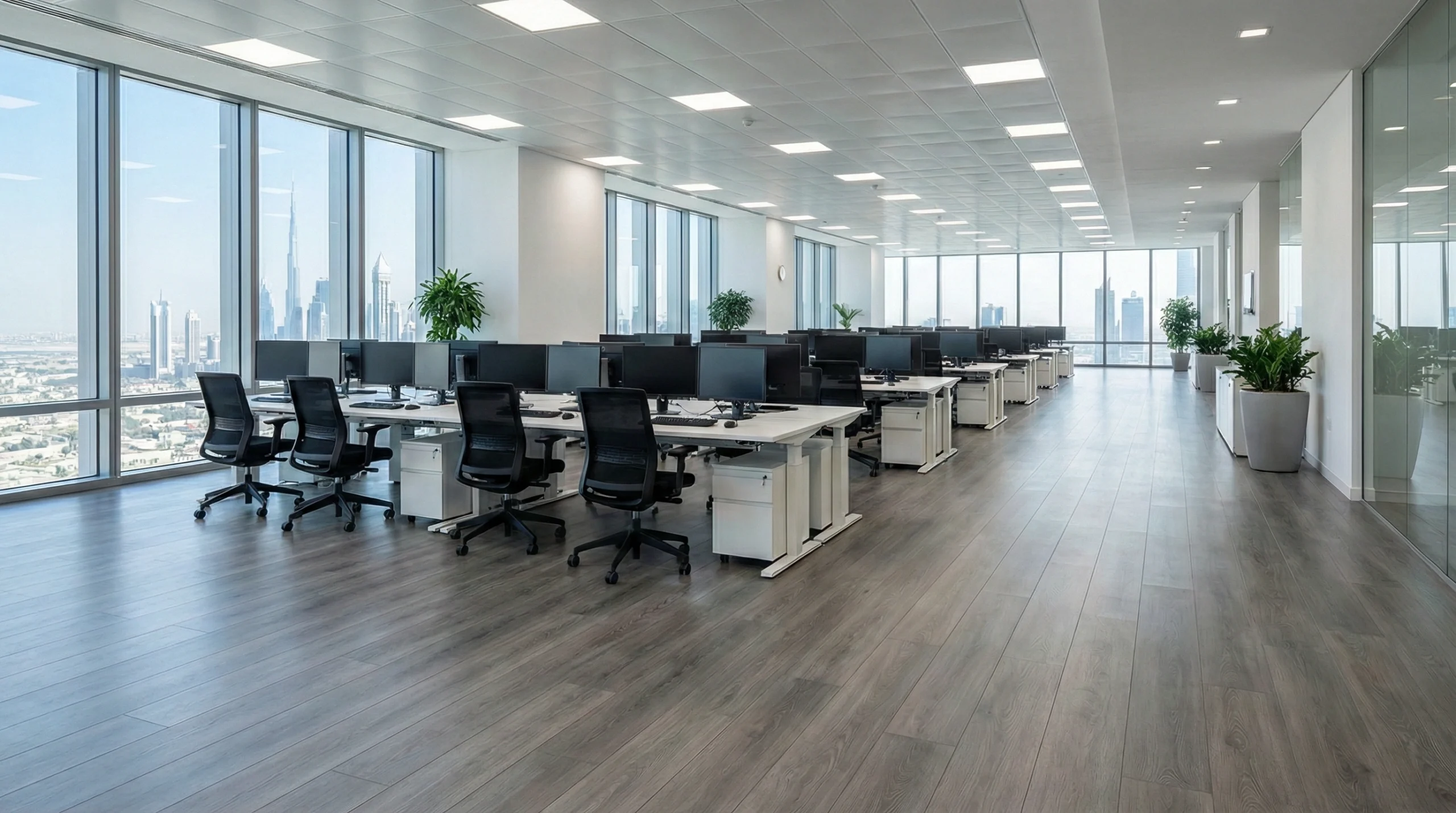
Restaurants and cafes present specific challenges. Dining areas work well with AC5-6 waterproof commercial laminate that resists spills and frequent cleaning. Kitchen areas require specialized industrial waterproof laminate meeting Dubai Municipality commercial kitchen flooring requirements. Bar areas with potential for significant liquid exposure need waterproof specifications. We've completed numerous restaurant installations where appropriate product selection allows laminate to perform excellently in food service environments.
Healthcare and educational facilities benefit from laminate's hygiene advantages. Unlike carpet which harbors allergens and dust mites, laminate provides smooth, easily sanitized surfaces. Commercial laminate with antimicrobial treatments works particularly well in clinics, medical offices, and childcare facilities. The quiet acoustic properties compared to tile make laminate attractive for schools and healthcare where noise reduction improves environments for learning and healing.
Commercial installation timing often requires compressed schedules during non-business hours. We regularly complete commercial projects during nights and weekends to minimize business disruption. Retail installations in operating malls happen overnight. Restaurant projects occur during closed days. Office installations use weekends and holidays. This operational flexibility makes commercial laminate projects feasible even in continuously-operating businesses.
Limitations exist for extremely demanding commercial applications. Heavy industrial environments, commercial kitchens with constant moisture and grease, outdoor or semi-outdoor commercial spaces, and areas subject to heavy equipment or forklift traffic exceed laminate's capabilities. These applications require specialized flooring solutions like epoxy coatings, industrial vinyl, or commercial-grade tile.
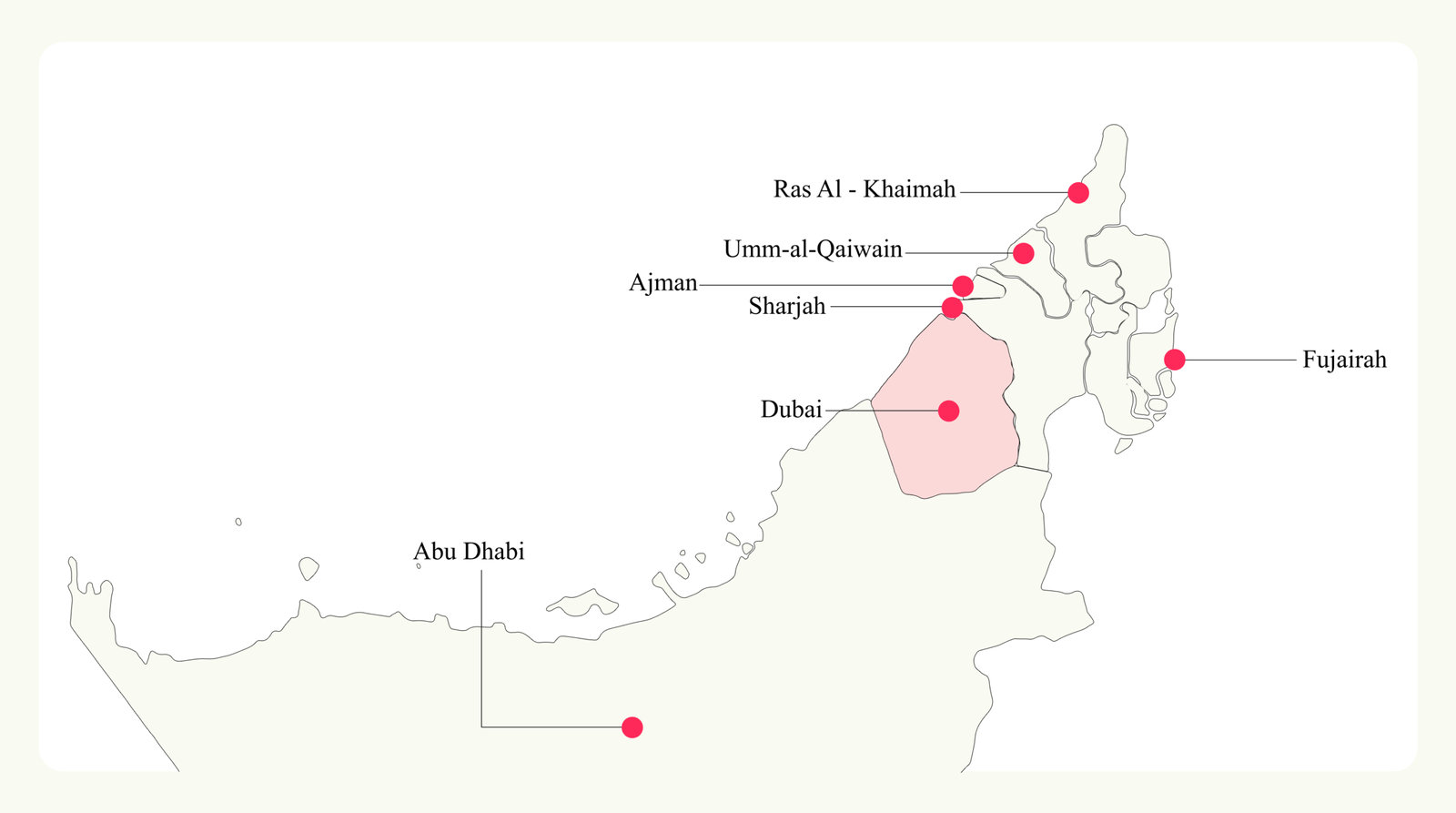
Laminate Flooring Coverage Throughout UAE
Our laminate flooring installation teams serve all seven emirates with consistent expertise and quality standards. Dubai-based crews handle the majority of installations throughout Dubai and Northern Emirates, while our Abu Dhabi team covers the capital region. Response times for consultation visits average 1-2 business days throughout the UAE.
Dubai: We complete laminate flooring projects across all major communities including Downtown Dubai, Business Bay, DIFC, Dubai Marina, JBR, Palm Jumeirah, Emirates Hills, Arabian Ranches, The Springs, The Meadows, The Lakes, Jumeirah Park, Dubai Sports City, Motor City, Dubai Silicon Oasis, International City, Discovery Gardens, JLT, IMPZ, Barsha Heights, Mirdif, Festival City, and all other residential and commercial areas. Our Dubai warehouse stocks extensive laminate inventory allowing rapid project commencement for standard specifications.
Abu Dhabi: Coverage extends throughout Abu Dhabi city, Al Reem Island, Yas Island, Saadiyat Island, Al Reef, Khalifa City, Mohammed Bin Zayed City, Baniyas, and surrounding areas. Our Abu Dhabi team maintains local material inventory and equipment to serve the capital region efficiently without dependency on Dubai-based resources.
Sharjah, Ajman, RAK, Fujairah, UAQ: These emirates receive service from our mobile teams that travel from Dubai with project-specific materials and equipment. Consultation scheduling typically occurs within 2-3 business days. Installation timing coordinates with material delivery and client scheduling requirements.
Start Your Laminate Flooring Project
Transforming your space with beautiful, durable laminate flooring begins with a simple conversation. Our consultation process is thorough, informative, and completely obligation-free. We’ll help you understand your options, specify appropriate products for your specific conditions and requirements, and provide transparent pricing so you can make confident decisions about your flooring investment.
IF YOU HAVE ANY QUESTION? WE ARE GLAD TO
CONSULT YOU AS SOON AS POSSIBLE
Get Started
Immediate assistance from our team regarding your project details.
Form Submitted!
Thank you for contacting us. Our team will get back to you within 24 to 48 hours regarding your query.
Contact us on WhatsApp for Quick Response