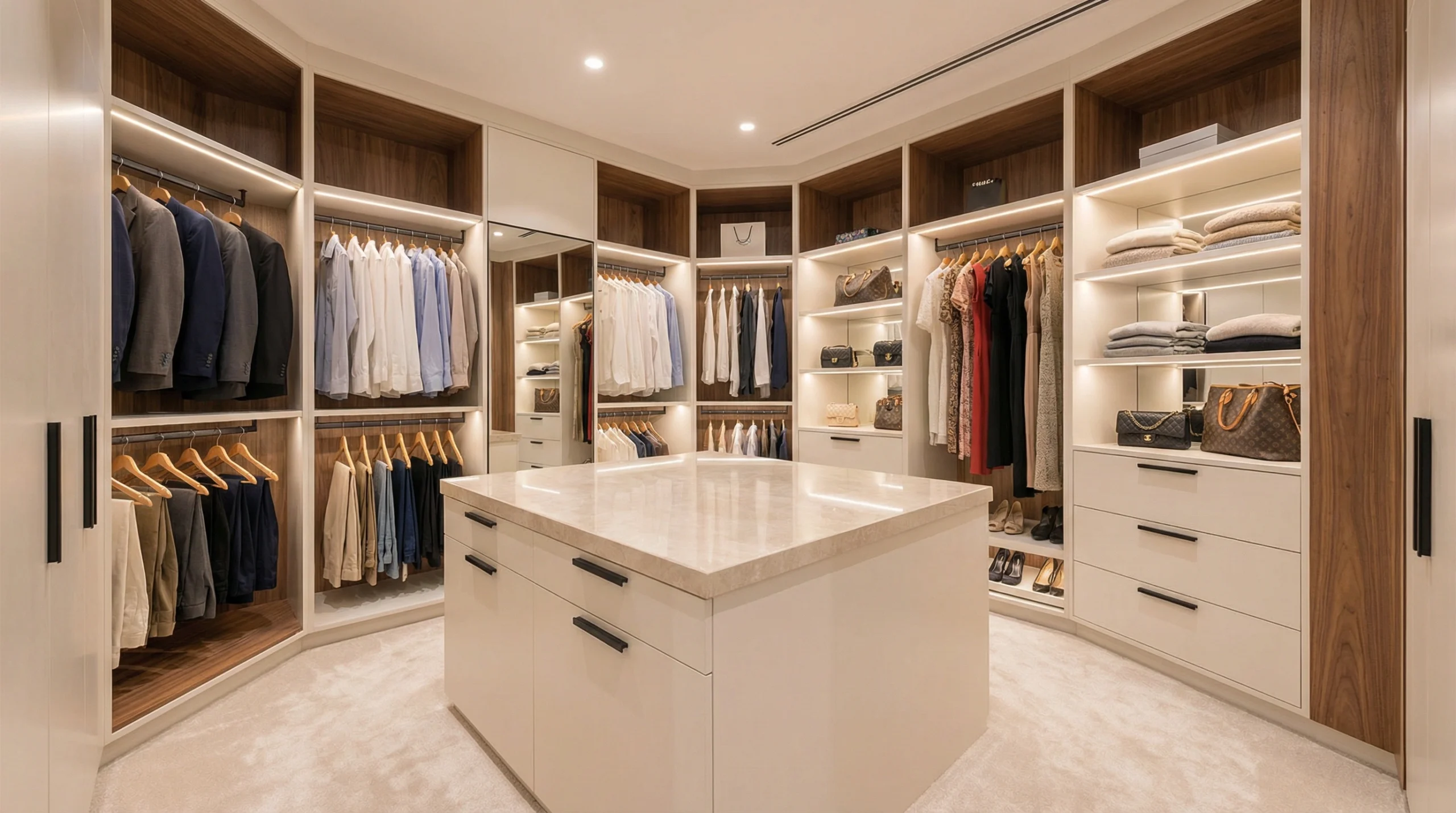
Walk-In Closets Dubai: Custom Designed & Built to Last a Lifetime
From the first design consultation to the final fitting, every Karnak walk-in closet is crafted to reflect how you actually live — your wardrobe, your rituals, your space.
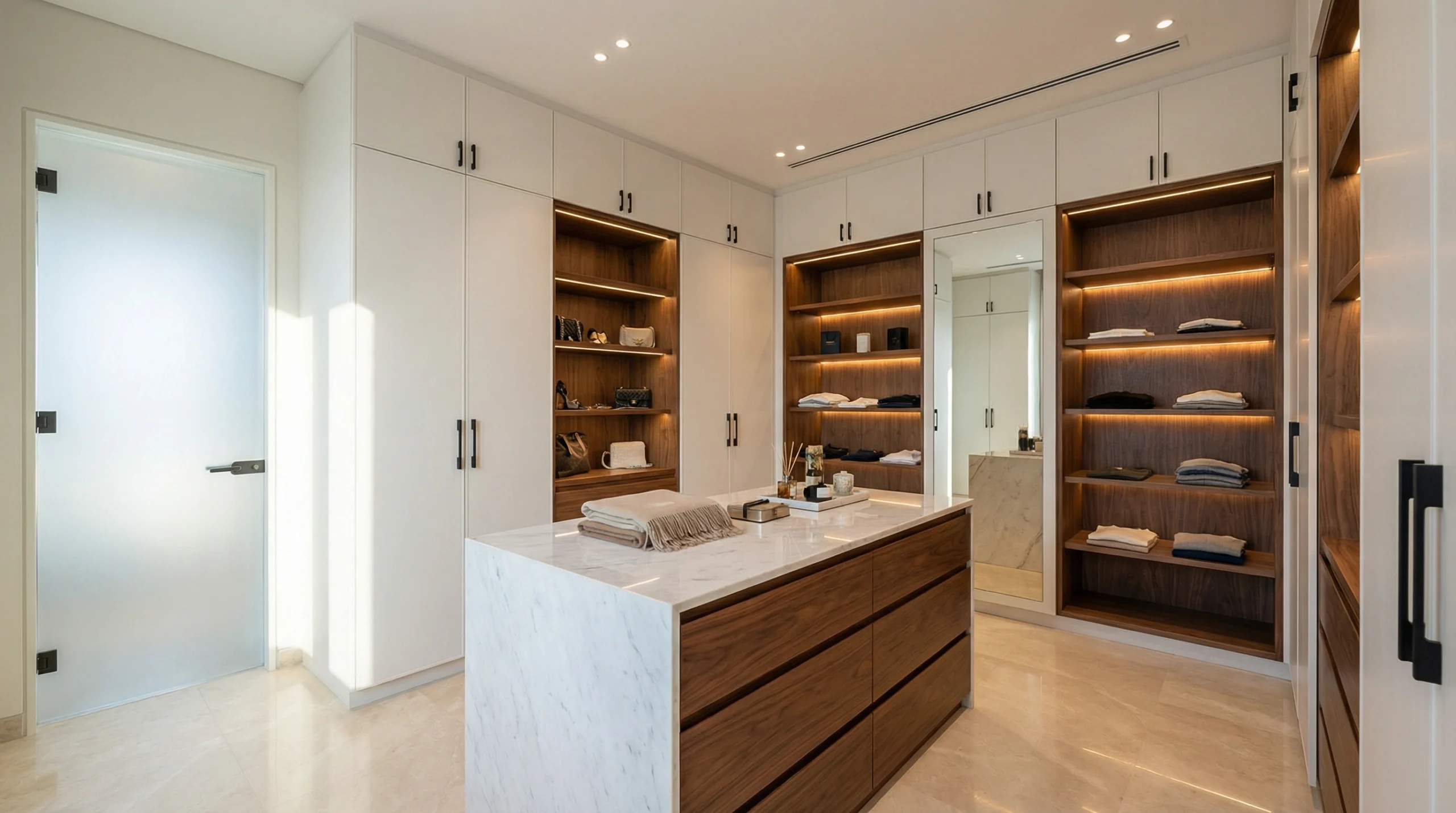
A walk-in closet is one of those things that changes how you start your day. When it’s designed right — every rail at the right height, every drawer exactly where you’d reach for it, every shoe displayed like it belongs — getting dressed becomes effortless. When it’s designed wrong, you live with a beautiful-looking cabinet that quietly frustrates you every morning. At Karnak Carpentry, we’ve been building walk-in closets across Dubai and the wider UAE since 1988, and that single distinction — function meeting quality — is the standard we’ve held for over 35 years.
Dubai’s residential market presents specific challenges that make wardrobe design here genuinely different from anywhere else. The ambient humidity in coastal areas like Dubai Marina, JBR, and Palm Jumeirah can attack poorly sealed cabinetry from the inside — warping shelves, swelling doors, degrading drawer slides within two or three years. The premium apartments in Downtown and DIFC often have irregular ceiling heights and structural columns that demand custom engineering, not off-the-shelf modules. Villas in Emirates Hills or Arabian Ranches frequently have master suites large enough to justify full dressing rooms with island units, ottomans, and integrated lighting schemes that rival boutique retail environments. These aren’t edge cases in our work — they’re the norm.
Over 10,000 projects completed across all seven emirates means we’ve encountered virtually every spatial constraint, client requirement, and material challenge this market produces. Our workshop in Dubai handles every stage of fabrication in-house, from cutting and edge-banding to assembly and finishing — which gives us a level of quality control that outsourced production simply can’t match. When you commission a walk-in closet from Karnak, you’re working with the team that will design it, build it, and install it.
Walk-In Closet Design: Getting the Layout Right Before a Single Board Is Cut
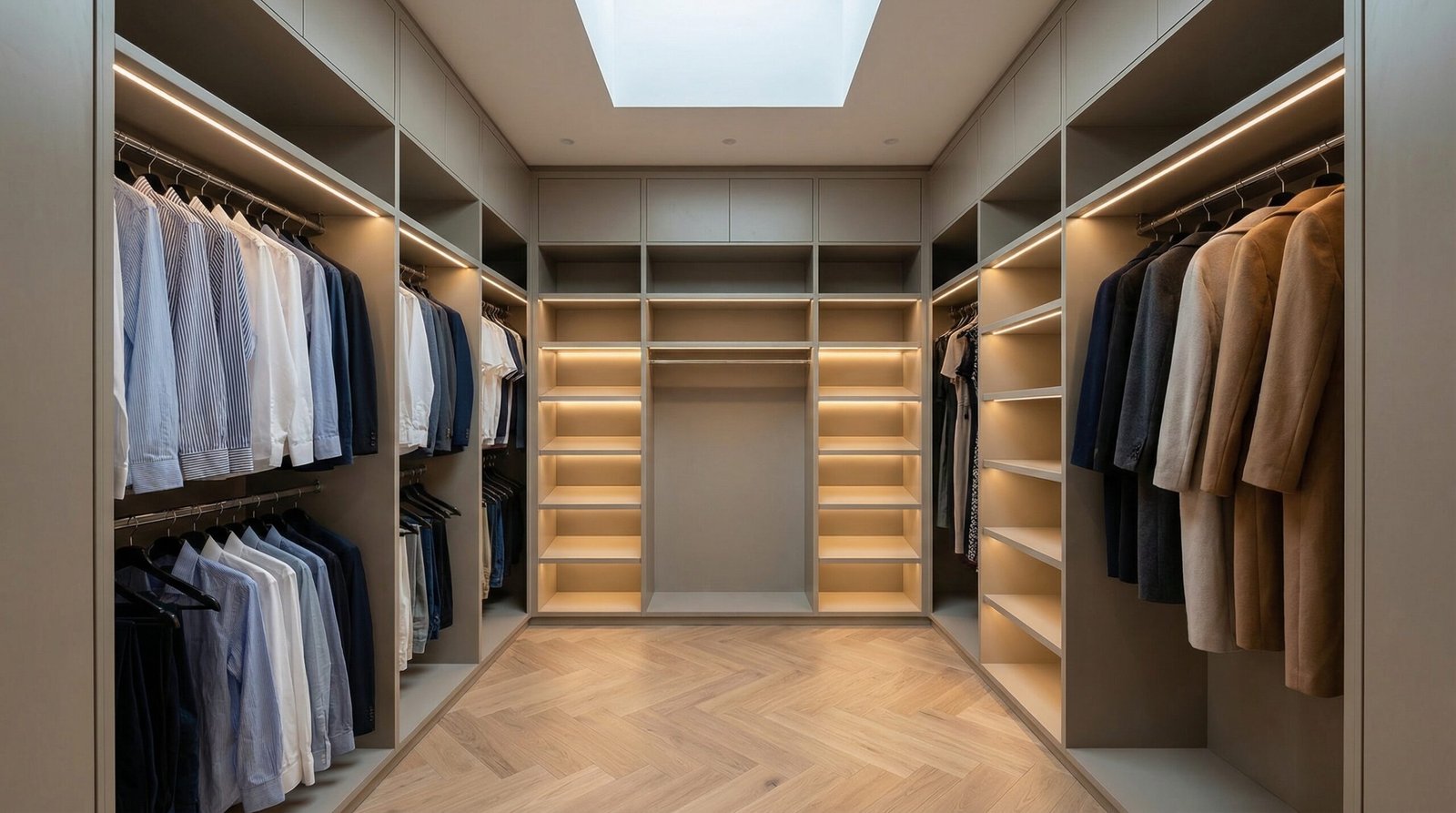
The difference between a walk-in closet that works perfectly for a decade and one that becomes a source of daily irritation is almost always a design decision made in the first hour of planning. Layout is everything. And layout isn’t just about fitting your clothes in — it’s about understanding how you dress, what you own, and how your habits will evolve.
Understanding Your Wardrobe Before Designing the Space
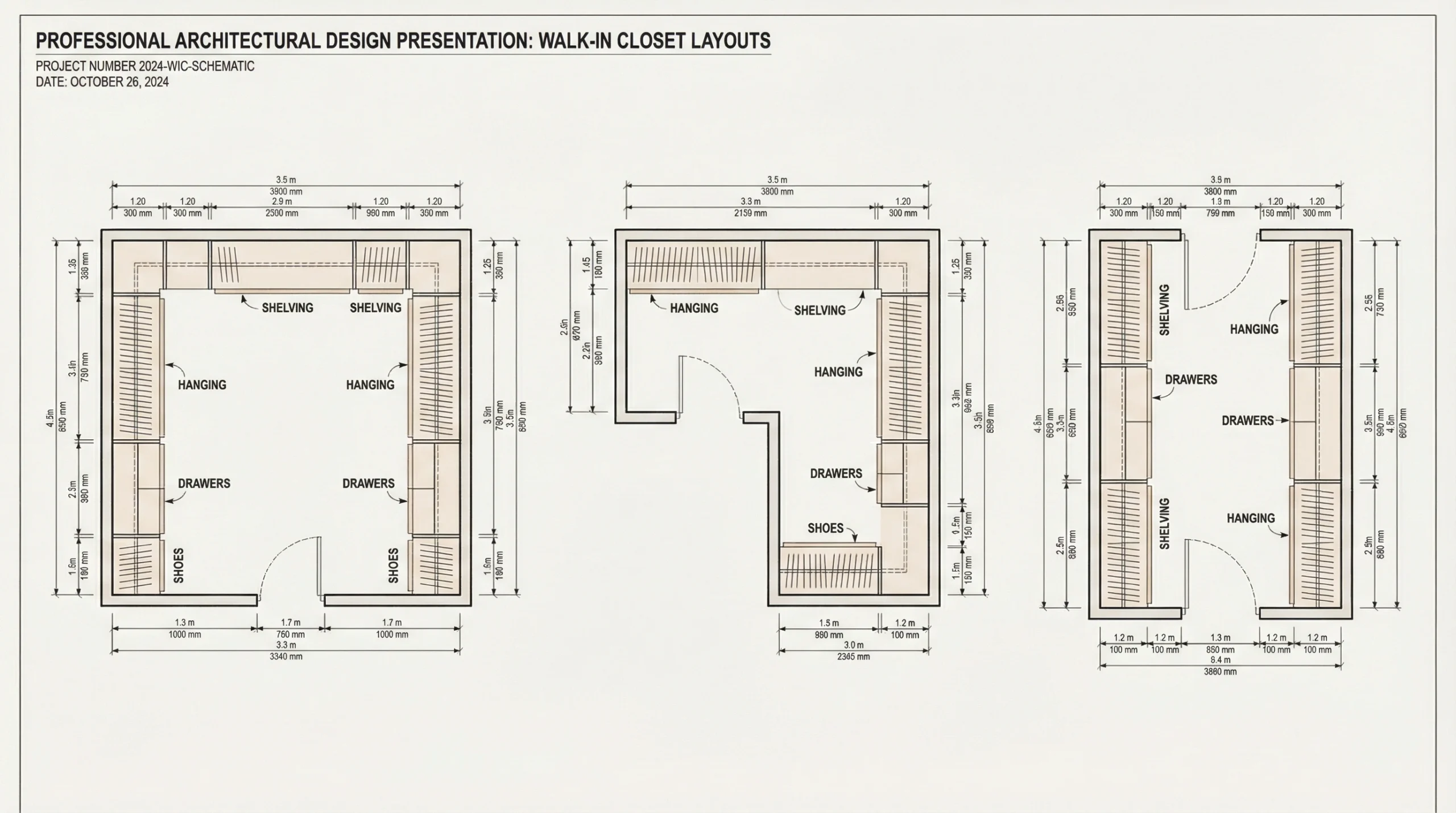
Most people underestimate how much they own. When we begin a walk-in closet project, we ask clients to photograph their current wardrobe, count hanging garments by length, estimate folded items, and catalogue shoes and accessories. This isn’t pedantic — it’s the data that drives every dimension in the design. A client who owns 40 pairs of shoes needs completely different storage to someone with 10. Someone who wears mostly long dresses needs single-hang sections, not the double-hang configuration that maximizes hanging capacity for shirts and trousers.
In UAE households, wardrobes often need to accommodate clothing from multiple climates. Dubai residents frequently travel internationally, which means seasonal storage for heavy coats, ski gear, or formal occasion wear that won’t be touched for months at a time. We design for this — dedicated sections for out-of-season storage, often with dust-proof doors or pull-out fabric boxes, placed at the less accessible upper sections of the closet so prime space is reserved for daily use.
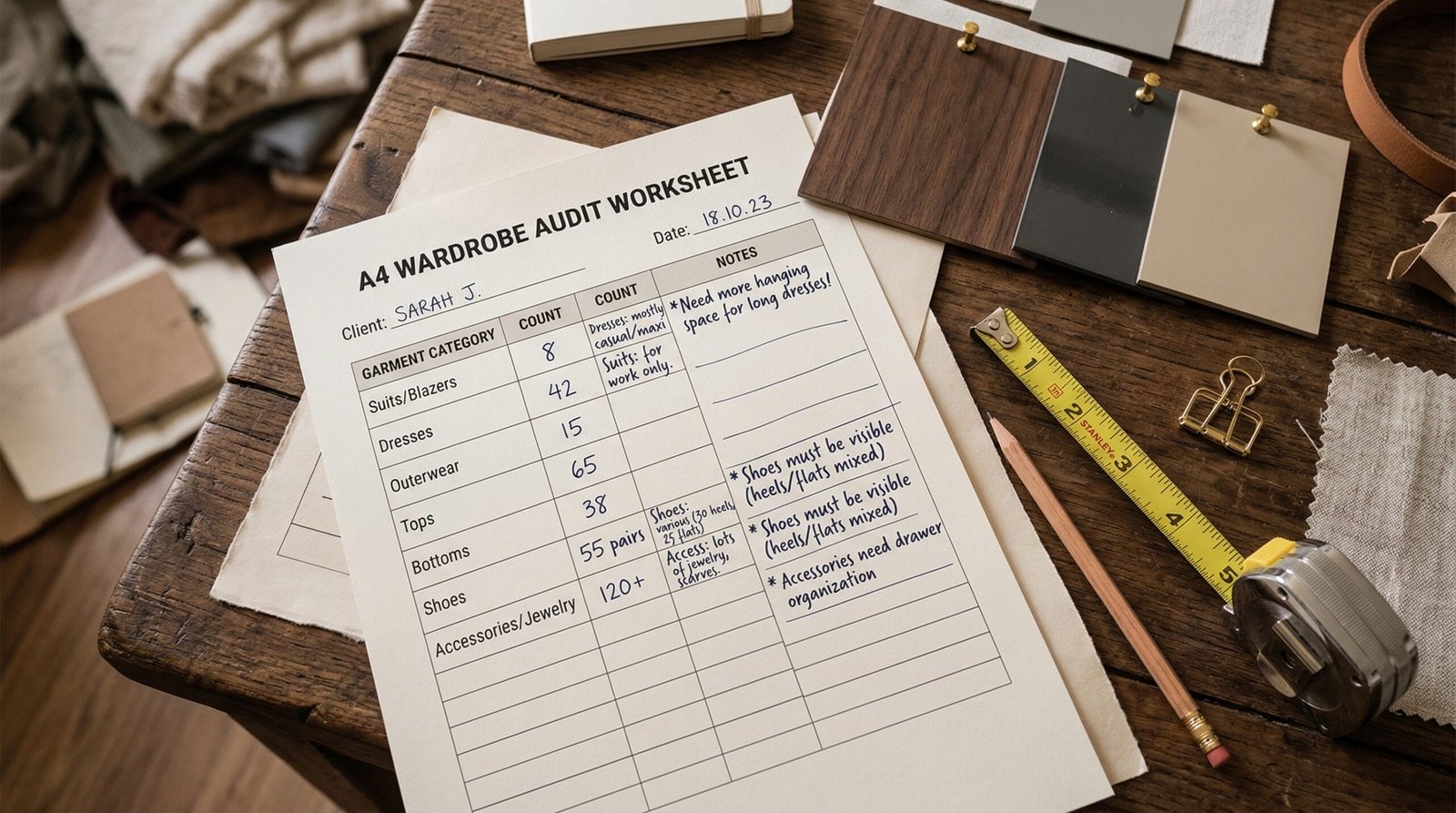
The standard walk-in closet configurations we design include the U-shape (ideal for larger rooms, 2.5m × 3m minimum), the L-shape (adaptable, suits many master bedroom layouts), the parallel layout (excellent for longer, narrower rooms), and the single-wall configuration for boutique dressing areas. Each has different strengths, and none is universally superior. The room dimensions, door positioning, window placement, and air conditioning outlet location all influence which layout will actually deliver the best result in your specific space.
The Role of the Central Island Unit
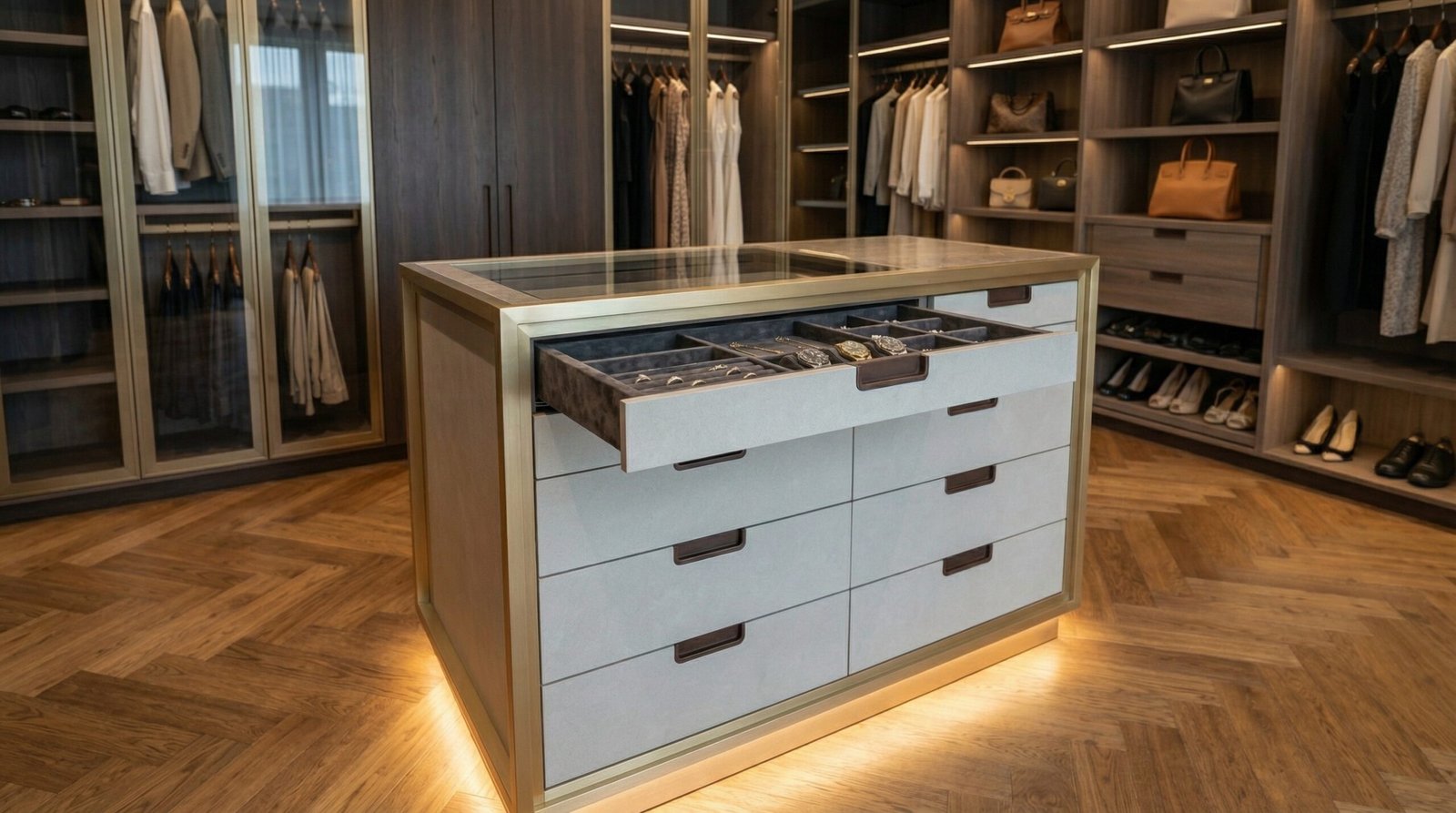
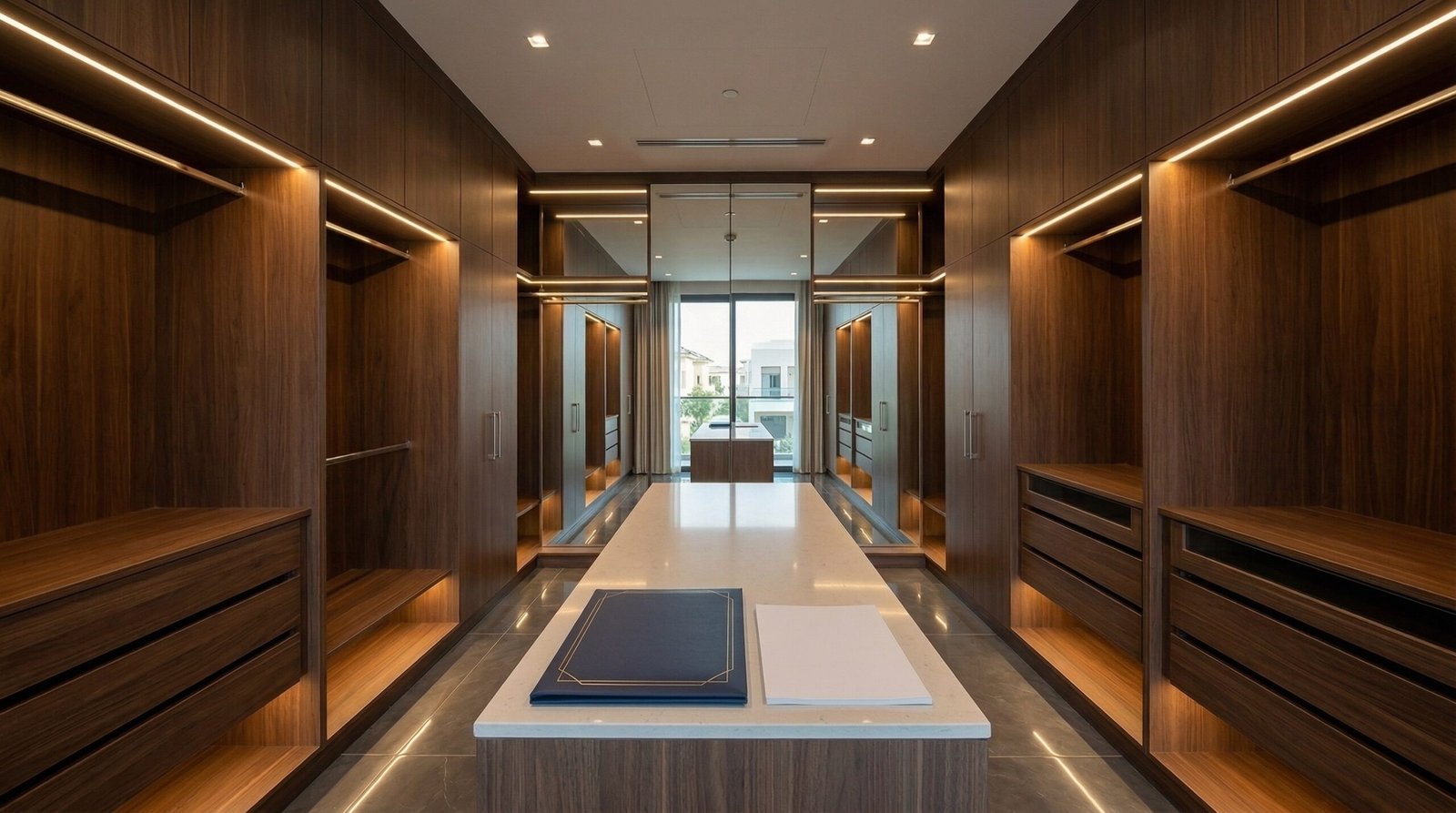
Not every walk-in closet has room for an island, but when the space allows, it’s one of the most functional additions we build. A properly designed island unit adds folded storage in deep drawers, a dedicated surface for laying out outfits, a location for jewellery trays and watch boxes, and in many cases an integrated pull-out ironing board. It transforms a storage room into a genuine dressing room.
We fabricate island units to the client’s exact specifications — height calibrated to whether you prefer to stand or sit when accessing drawers, width proportioned to leave comfortable circulation space on both sides (a minimum of 90cm clearance is our standard, and we recommend 100-110cm for comfort), and surface material chosen from marble, quartz, lacquered MDF, or timber veneer depending on the aesthetic. Some clients request a soft seating element integrated into the island end — a cushioned ottoman drawer that doubles as a bench. This is entirely achievable when planned from the outset.
Lighting: The Single Most Underestimated Element of Walk-In Closet Design
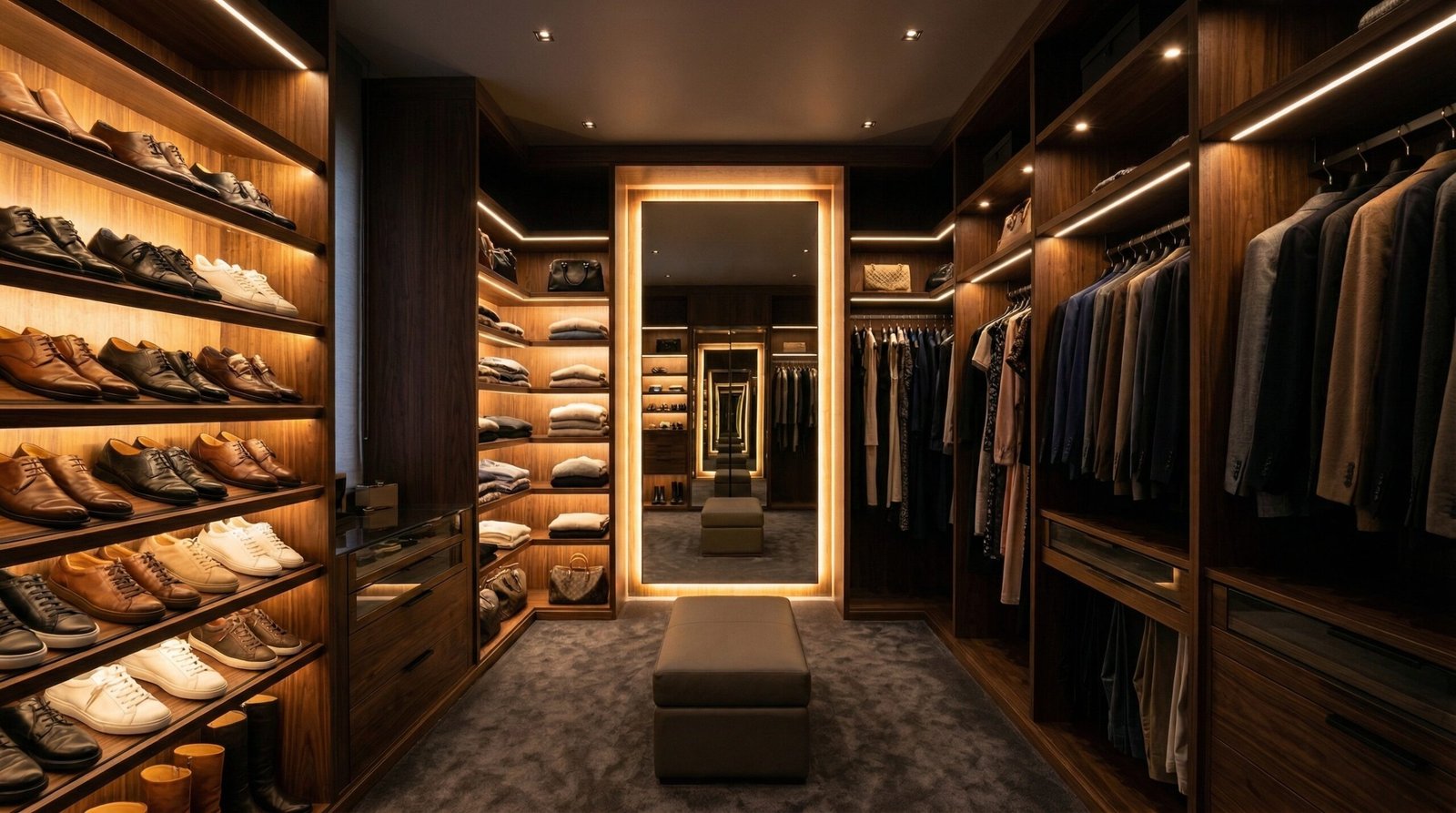
We’ve seen expensive closets that look mediocre because the lighting was an afterthought, and we’ve seen modestly specified closets that feel luxurious because the lighting was designed deliberately. In a walk-in wardrobe, light serves a functional purpose that’s different from any other room in the house — you need to see colour accurately, identify garments quickly, and eliminate shadows in every section.
Our standard lighting specification for walk-in closets includes recessed ceiling downlights on a dimmer circuit, LED strip lighting along the underside of upper shelves and inside hanging sections, and motion-activated interior lighting in deeper drawer units and cabinets. For clients who want true colour-accurate dressing, we specify LEDs with a colour rendering index (CRI) of 90 or above — the kind of light that shows navy as navy and black as black, not some ambiguous dark tone. Wardrobe lighting circuits are coordinated with the client’s electrician or fit-out contractor, and we provide full wiring documentation at the handover stage.
Materials, Finishes, and Hardware: What Separates a Good Wardrobe from a Great One
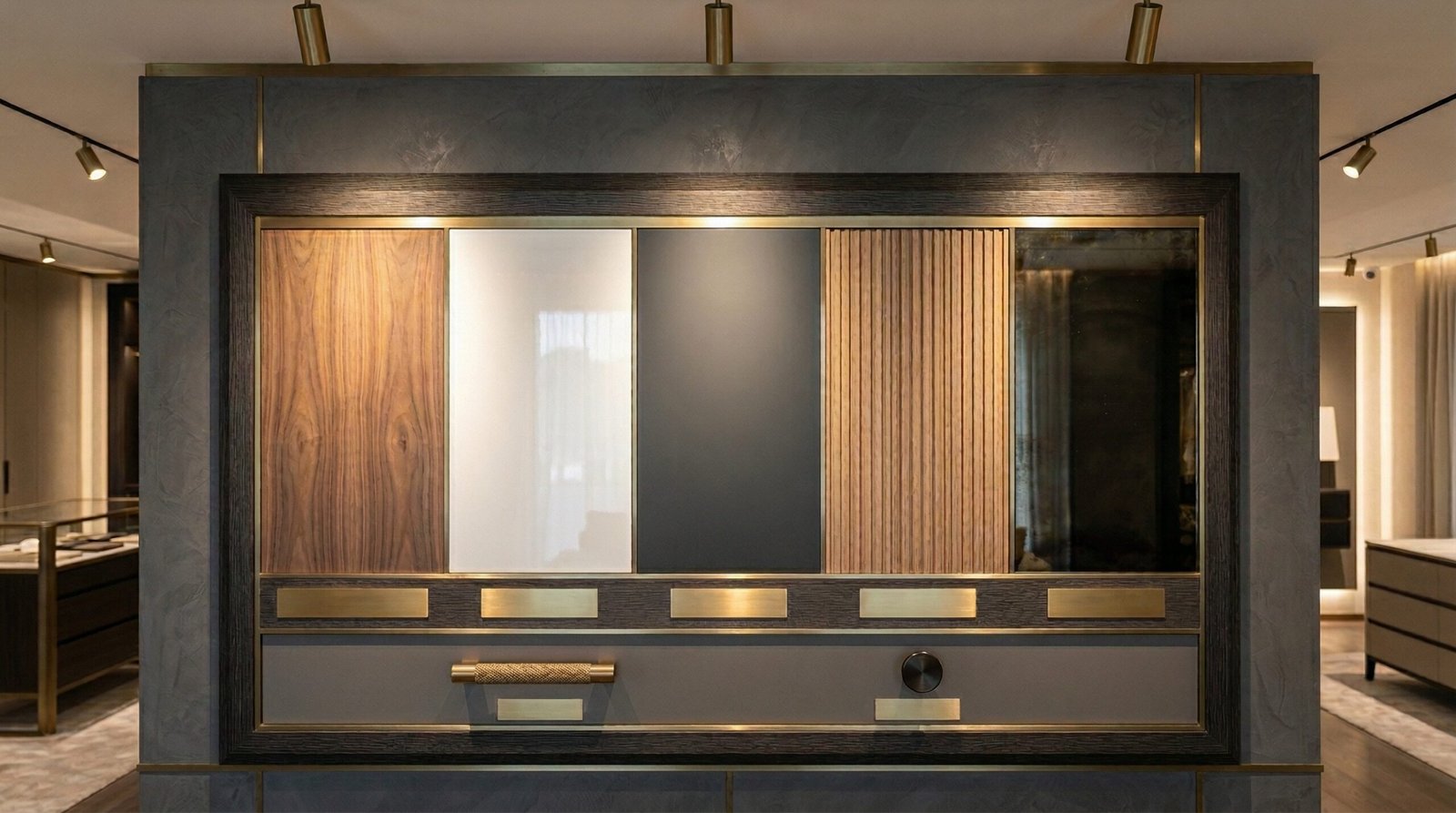
The choices made in materials and hardware determine whether a walk-in closet looks the same in ten years as it does the day it’s installed. In Dubai’s climate — with its combination of air conditioning running continuously and occasional humidity excursions — these choices are not just aesthetic. They’re structural.
Board Materials and Core Construction
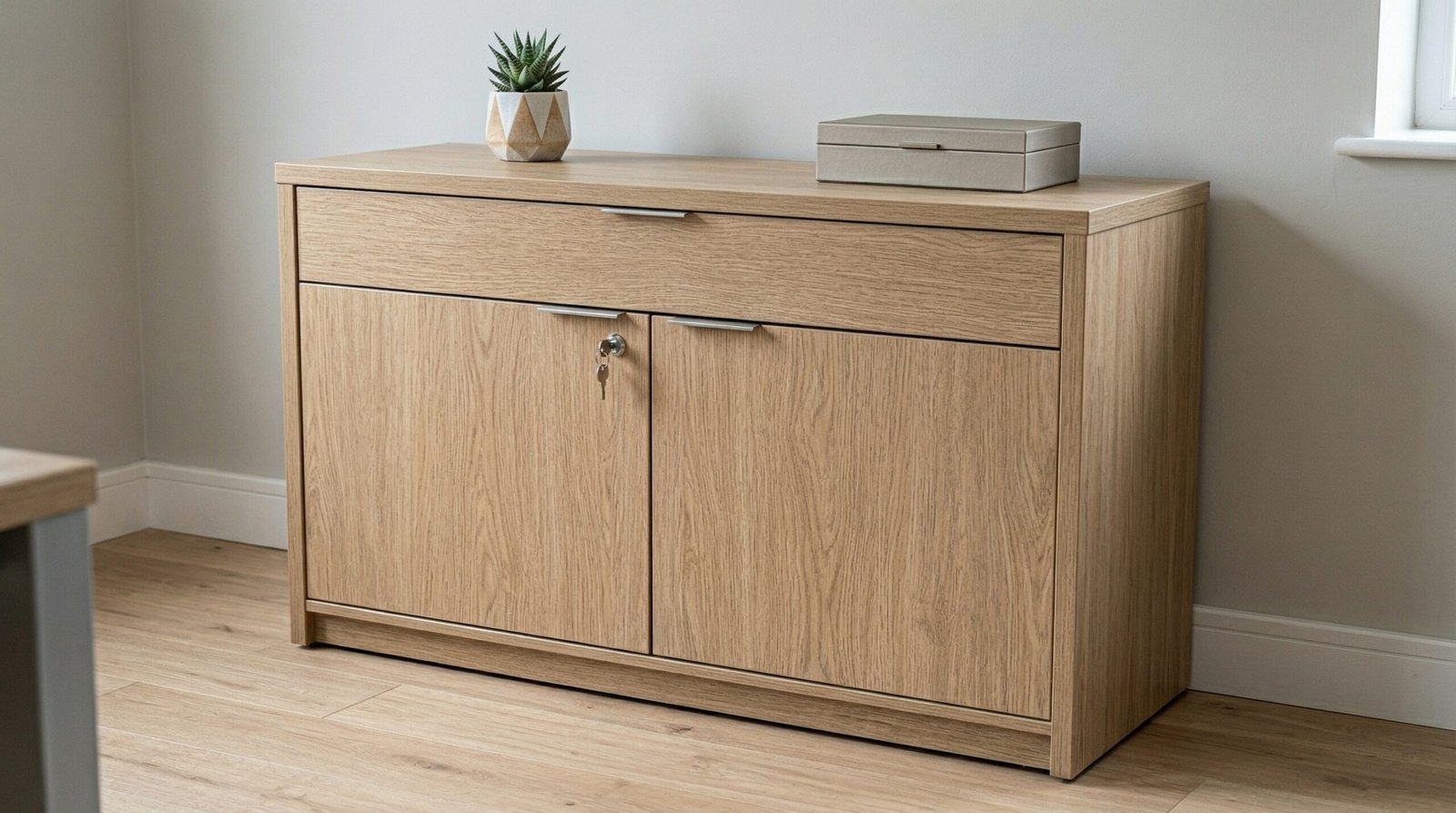
The substrate of most built-in wardrobes is MDF (medium-density fibreboard) or moisture-resistant MDF (MR-MDF), and for walk-in closets in Dubai we specify MR-MDF as a baseline, not an upgrade. Standard MDF absorbs moisture and can swell at joints if conditions allow it. MR-MDF, identifiable by its green core, is formulated to resist this. It’s particularly important for wardrobe bases and areas near external walls in apartments where condensation can be a factor.
For clients who want a step beyond MDF, we work with solid timber for frame elements and visible surfaces, and plywood for carcass construction. Plywood offers superior screw-holding compared to MDF, making it the better structural choice for heavy-load applications like shoe racks bearing substantial weight or hanging sections that will hold dense garments. The premium end of our range uses European birch plywood carcasses with solid timber or veneer fronts — a specification that you’ll find in high-end European wardrobe fit-outs, and one that will genuinely outlast MDF construction by 15-20 years under similar conditions.
Door Fronts: Lacquer, Veneer, and Glass
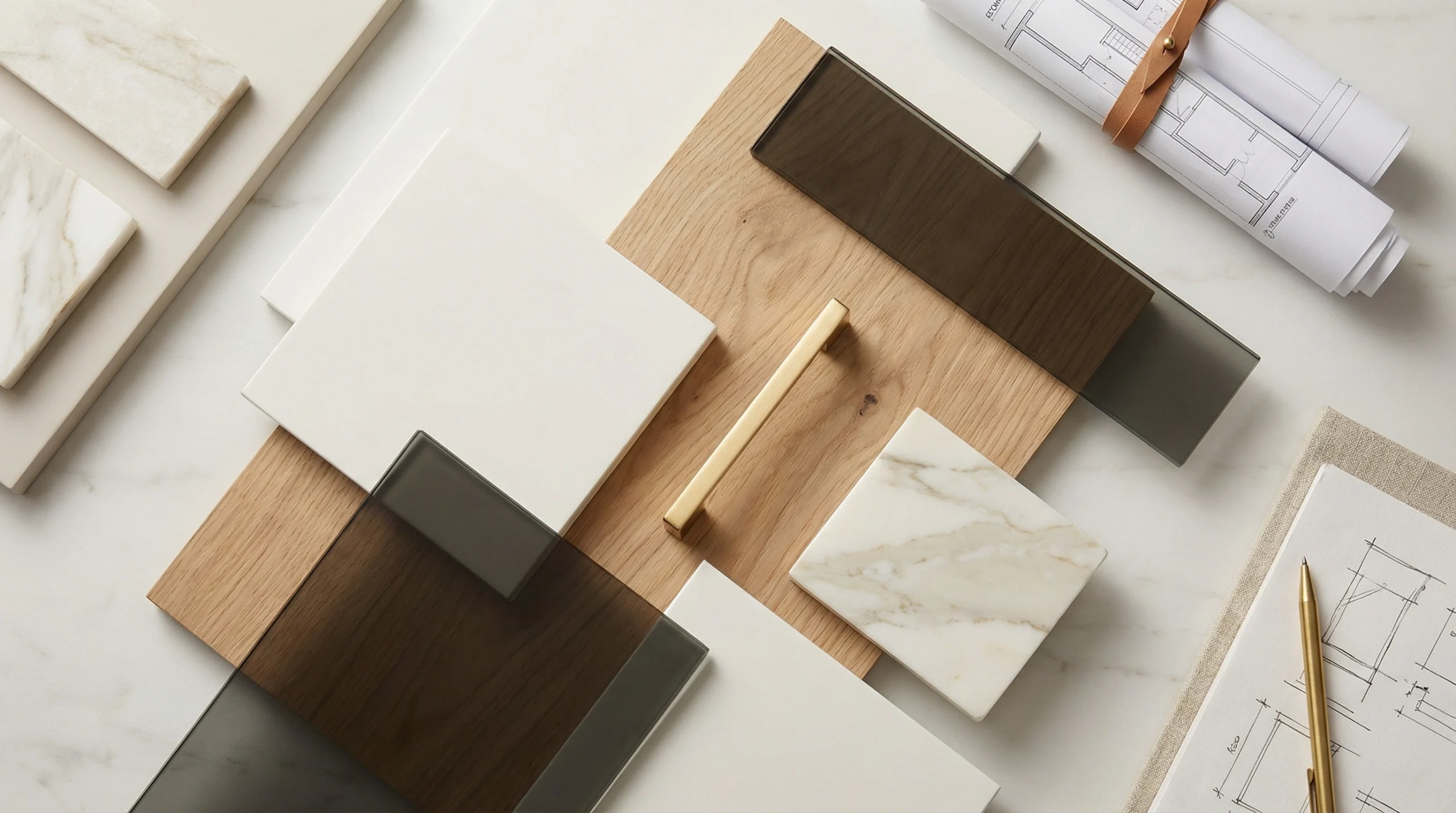
The door is what you see. Everything else is what you feel. The door front material and finish defines the wardrobe’s visual identity more than any other element, and we offer a broader range than most UAE carpentry firms because our in-house finishing capabilities extend to spray lacquer in over 300 RAL colours, natural and reconstituted timber veneer, and high-gloss acrylic for clients who want that mirror-like surface.
Lacquered MDF fronts remain our most popular specification for Dubai walk-in closets. The finish is durable, wipeable, available in any colour, and — when applied in our controlled workshop environment — achieves a quality that site-applied paint cannot match. Timber veneer fronts bring warmth and character that no synthetic finish can replicate, and we source veneers from certified sustainable suppliers with FSC-certified sustainable materials documentation available on request. For dressing rooms where a more dramatic effect is desired, we incorporate smoked glass or fluted glass panels into door fronts — a specification that reads as genuinely high-end without requiring imported European cabinetry.
Hardware: Where Quality Becomes Tactile
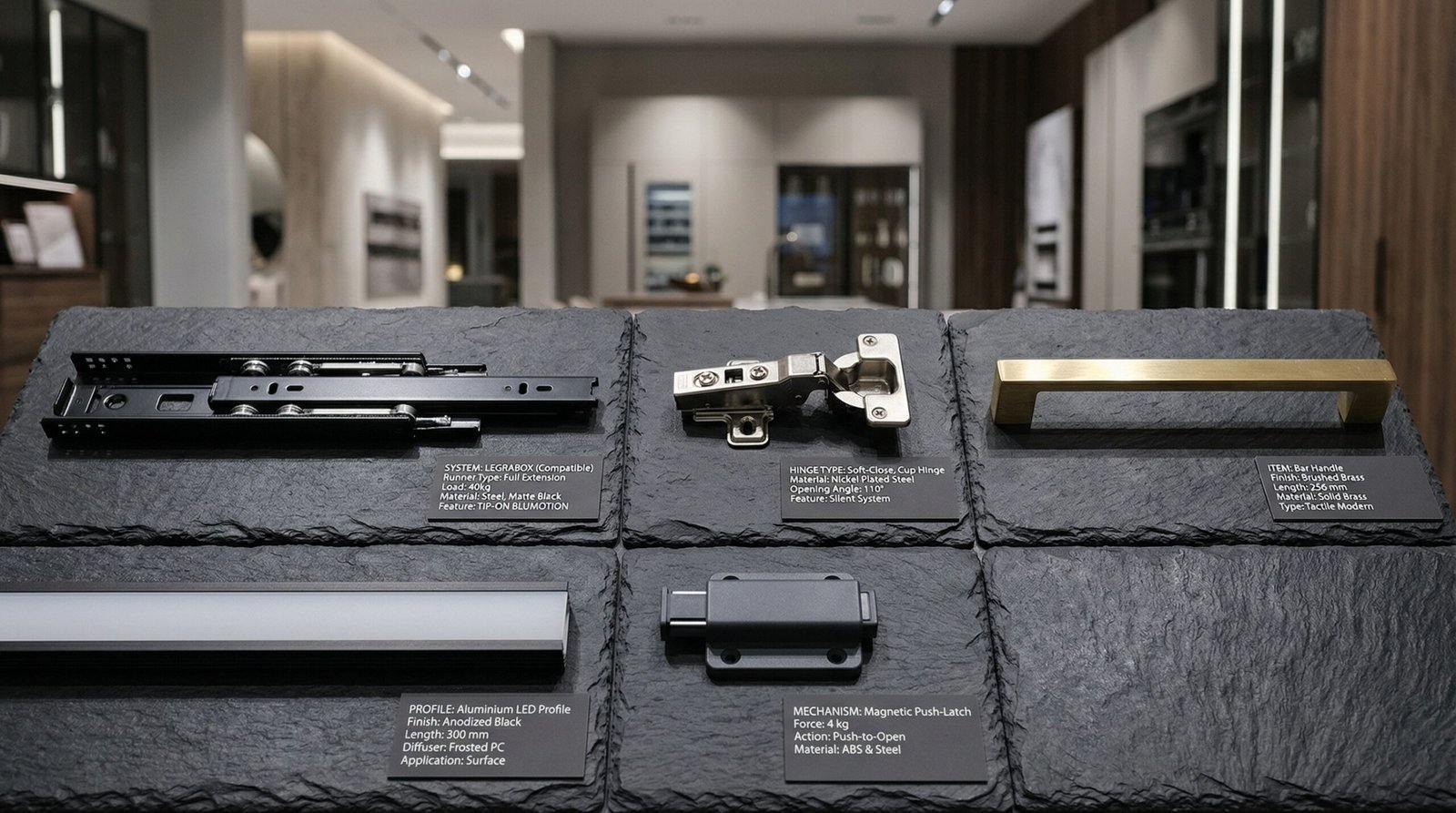
Door handles and drawer pulls are the parts of your wardrobe you touch every day. We source hardware from Hettich, Blum, and Hafele — the three European hardware manufacturers whose product quality we’ve tested across thousands of UAE projects and whose drawer systems, hinges, and lift mechanisms consistently outperform alternatives. Blum’s Tandem box drawer system, for example, carries a load rating of 70kg per pair and a tested cycle life of 500,000 opens and closes. That’s not a marketing claim — it’s an engineering specification, and it’s the reason we specify it for every full-height drawer unit we build.
Soft-close mechanisms on all doors and drawers are a standard inclusion in our walk-in closet builds, not an optional extra. In the quiet of a master suite, the sound of a drawer slamming or a door catching is jarring. Soft-close eliminates this, and it also reduces wear on joints and faces over time. Similarly, our wardrobe lifts for upper-rail sections — the pull-down rod mechanisms that bring clothes from high hanging rails to accessible height — are specified from Hettich’s KA 1500 range, which operates smoothly with one hand and holds up to 15kg of loaded garments.
Wardrobe Interior Fittings and Accessories
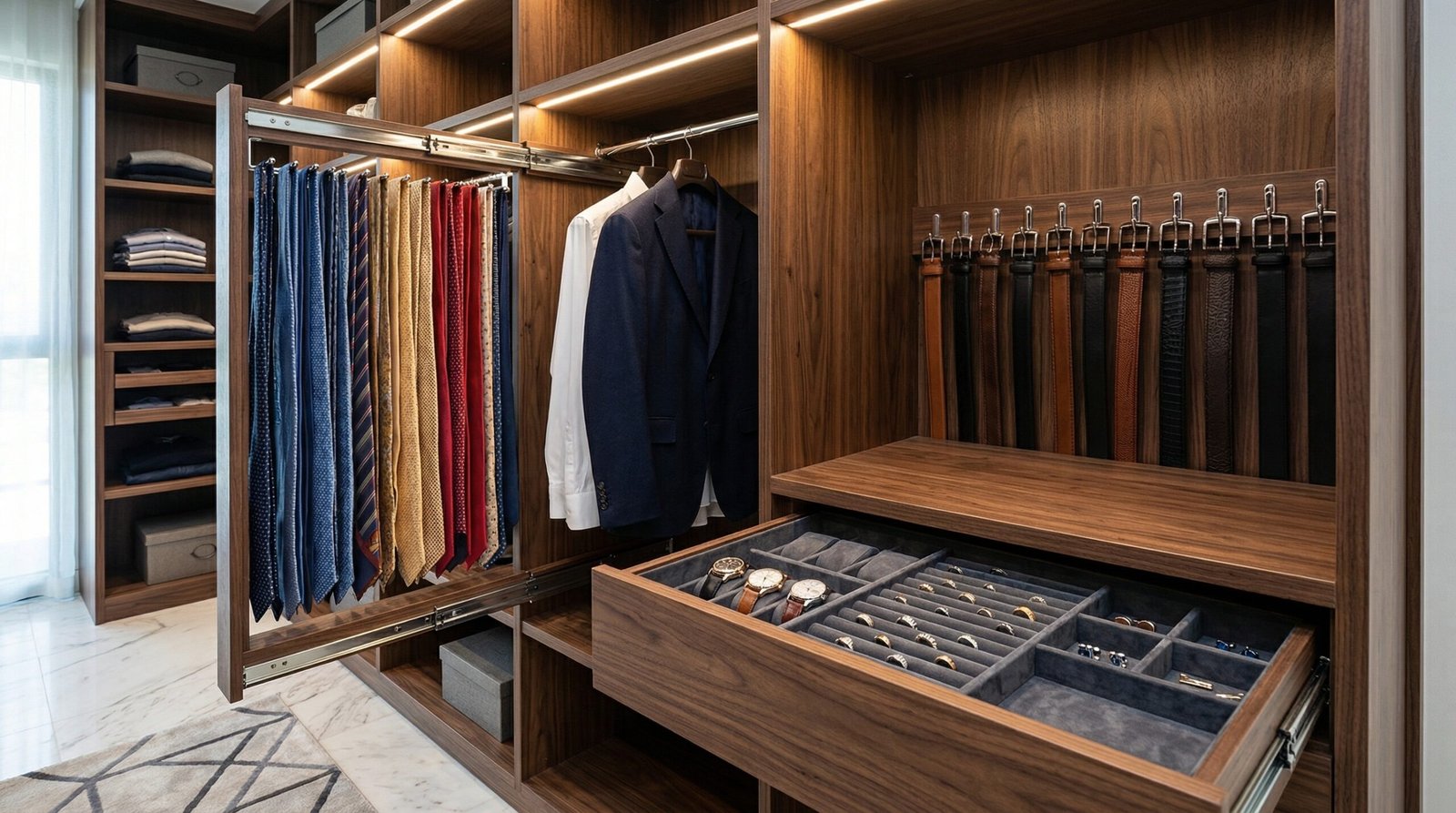
The interior of a walk-in closet is where the customisation becomes granular. Beyond the main carcass, shelving, and rails, we incorporate a range of specialist fittings that most clients don’t know to ask for until they see them: pull-out tie and belt racks, valet rods for laying out tomorrow’s outfit, jewellery drawers with custom velvet inserts, trouser racks (the pull-out kind that keep creases intact, not just flat shelves), fold-out ironing boards, shoe drawers with angled shelves to display footwear rather than simply stack it, and mirror panels that integrate flush into the wall of the wardrobe rather than protruding as an afterthought.
We discuss these options during the design stage rather than presenting them as add-ons at the final quote. Our view is that a walk-in closet that’s missing the fitting you use daily isn’t a successful project, regardless of how the main carcasses look.
Walk-In Closet Sizes and Spatial Planning for Dubai Homes and Apartments
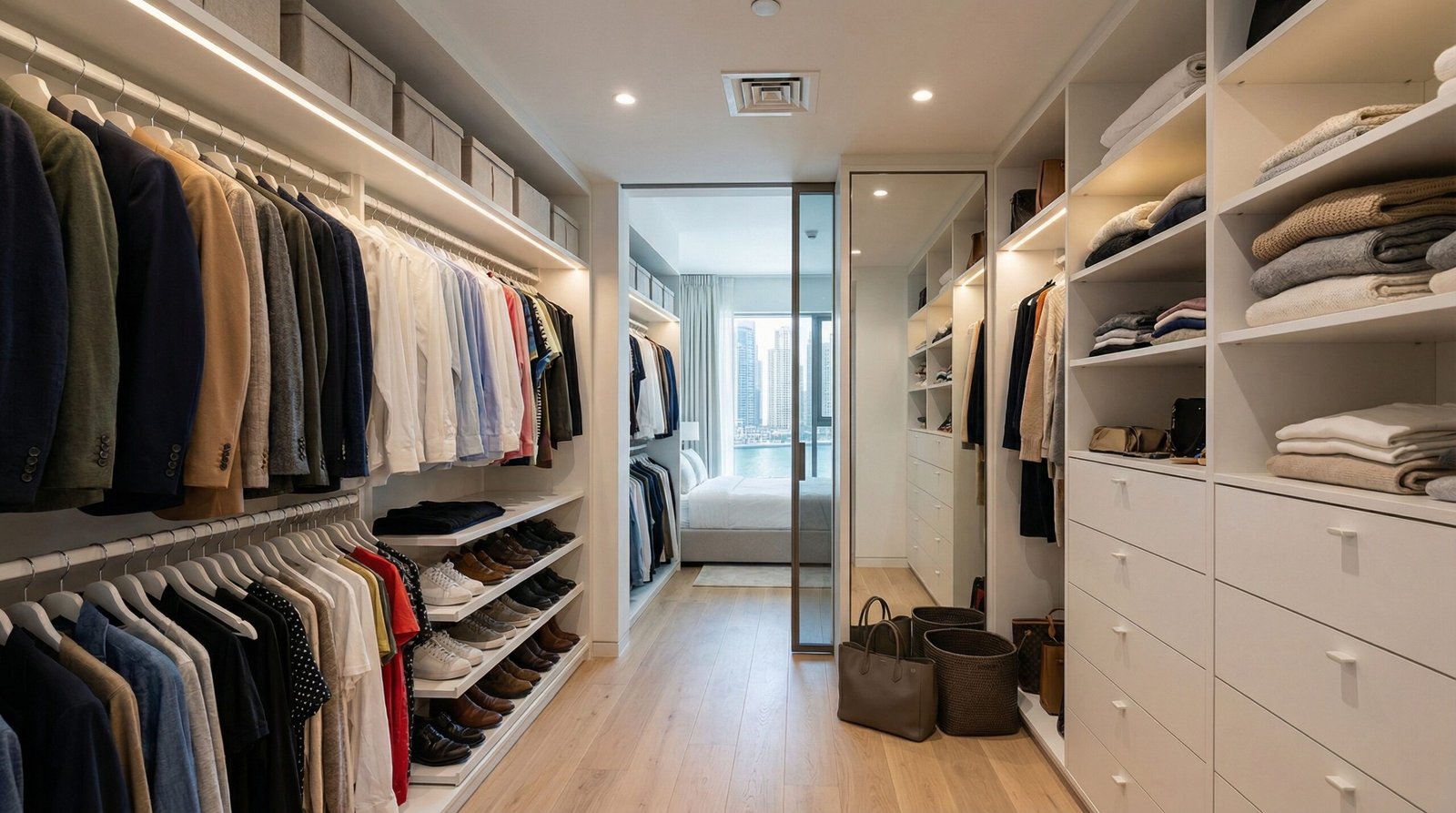
Spatial planning for a walk-in closet in Dubai is complicated by the extraordinary diversity of property types across the emirate. A master bedroom in a Jumeirah villa operates at a completely different scale to a compact en-suite wardrobe in a Marina apartment, and the design logic differs accordingly. There is no universal minimum for a “walk-in” closet — the term technically applies to any wardrobe you can step inside — but functionally, we consider anything below 1.8m in depth to be a reach-in rather than a true walk-in.
Compact Walk-In Closets for Dubai Apartments
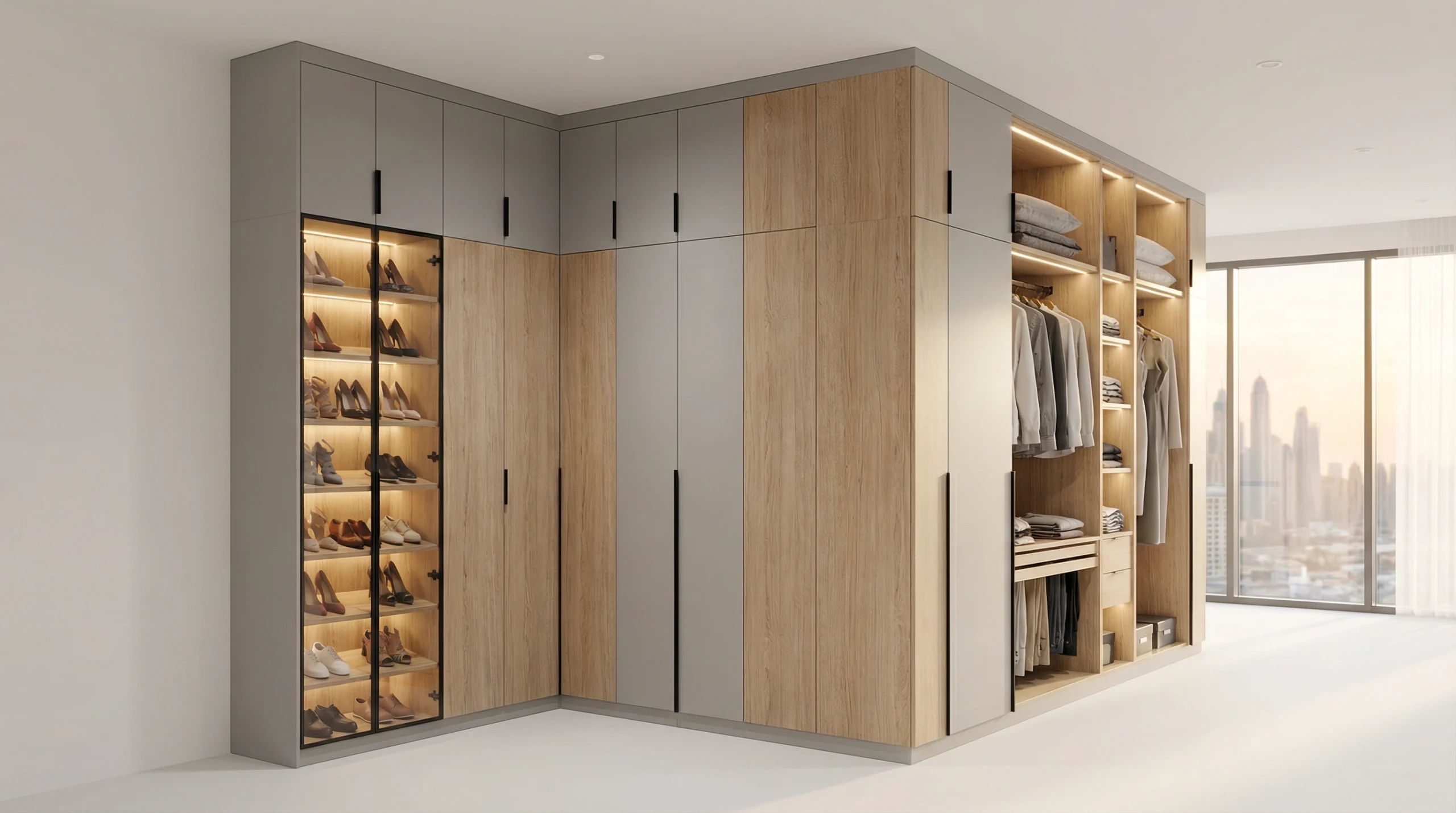
Many Dubai apartment master bedrooms don’t have a dedicated dressing room — they have an alcove or a generous master bedroom layout where a walk-in wardrobe can be partitioned off. For spaces between 2m² and 5m², a well-designed L-shape or single-wall configuration can achieve remarkable storage capacity. The key in compact configurations is vertical maximisation. We typically take the cabinetry to ceiling height (or close to it, with a structural infill above the carcasses if the ceiling is very high) to capture every cubic metre available.
In apartments with regular ceiling heights of 2.7m to 3m, we design the closet in two zones: a primary access zone from floor to 2m, which contains all daily-use storage, and an upper zone from 2m to ceiling, accessed by a wardrobe lift or a slim library ladder on a rail (a fitting detail that elevates both functionality and aesthetics considerably). This approach can increase storage capacity in a compact space by 30-40% compared to a standard floor-to-cornice design.
Full Dressing Rooms in Dubai Villas and Townhouses
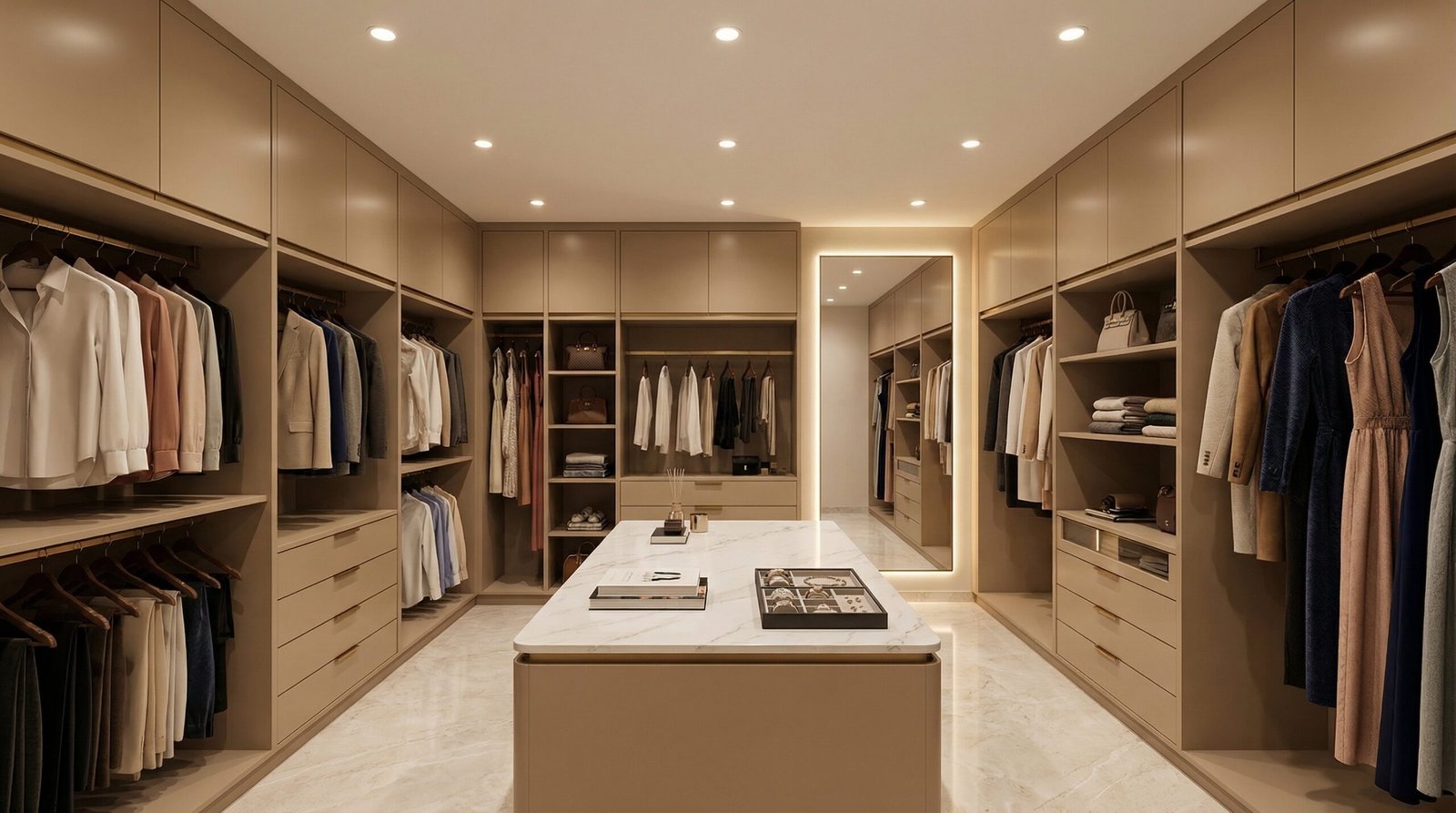
At the larger end of the scale, the master suites in Emirates Hills, Palm Jumeirah, and the premium villa communities of Damac Hills and Arabian Ranches frequently offer dedicated dressing room spaces of 12m² to 25m² — rooms where the walk-in closet design is essentially a full interior architecture project. These projects typically include his-and-hers sections with differentiated internal fittings (full-length rails and long storage versus hanging and shirt sections), a central island unit, a dedicated vanity area with built-in mirror and lighting, and often a seating area. We’ve completed dressing rooms in Dubai villas that include all of this plus integrated safe housing, a bespoke shoe wall accommodating 80+ pairs, and display niches for handbags with museum-quality integrated lighting.
At this specification level, the walk-in closet design process takes on many qualities of a retail or hospitality fit-out: material specifications are reviewed against imported alternatives, lighting is designed by a specialist, and the installation is coordinated with the property’s wider interior design scheme. Our team has extensive experience operating in this space alongside UAE interior designers and project managers from the country’s leading design studios.
His-and-Hers Walk-In Wardrobe Design
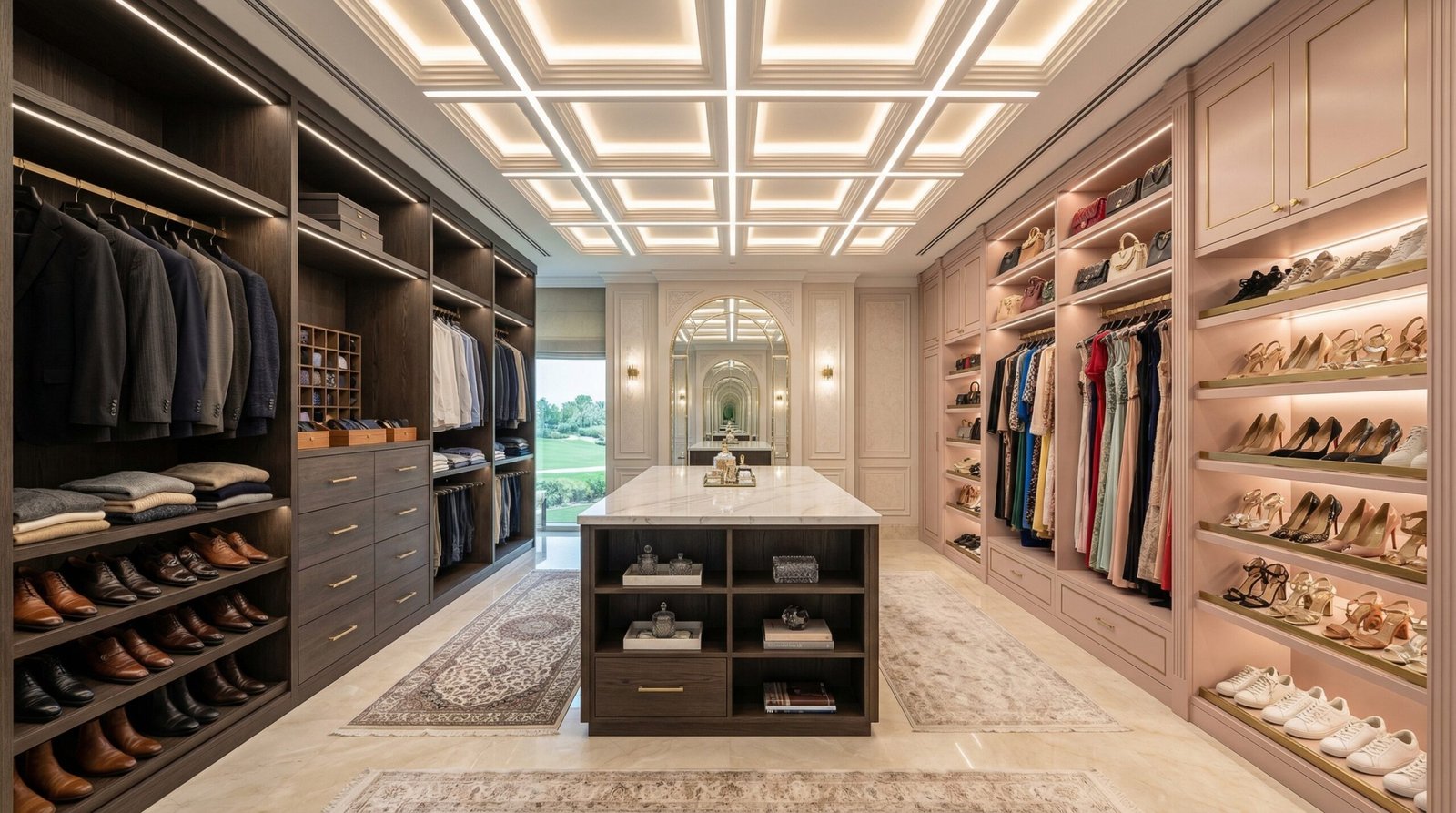
The combined or shared walk-in closet is one of the most common wardrobe briefs we receive for Dubai master suites, and it requires careful negotiation of space allocation, zone definition, and sometimes entirely different internal fitting specifications for each occupant’s section. The key principle is that a truly functional his-and-hers wardrobe isn’t just a single closet divided down the middle — it’s two distinct storage systems that happen to occupy the same room.
We approach these projects with a clear spatial strategy: assign zones first (typically one wall or section per occupant in a U-shape, or two sides of a parallel layout), then design the internal fittings for each zone independently. Women’s sections typically require more hanging space at both full-length and half-height, more drawer storage, dedicated shoe and accessory storage, and a vanity position. Men’s sections typically emphasise drawer storage for folded items, a full-height hanging section, a dedicated shelf for shoe boxes or displayed shoes, and a tie or belt organiser. These aren’t assumptions — they’re starting points that we refine based on the actual inventory each client brings to the design stage.
The Karnak Process for Walk-In Closet Projects
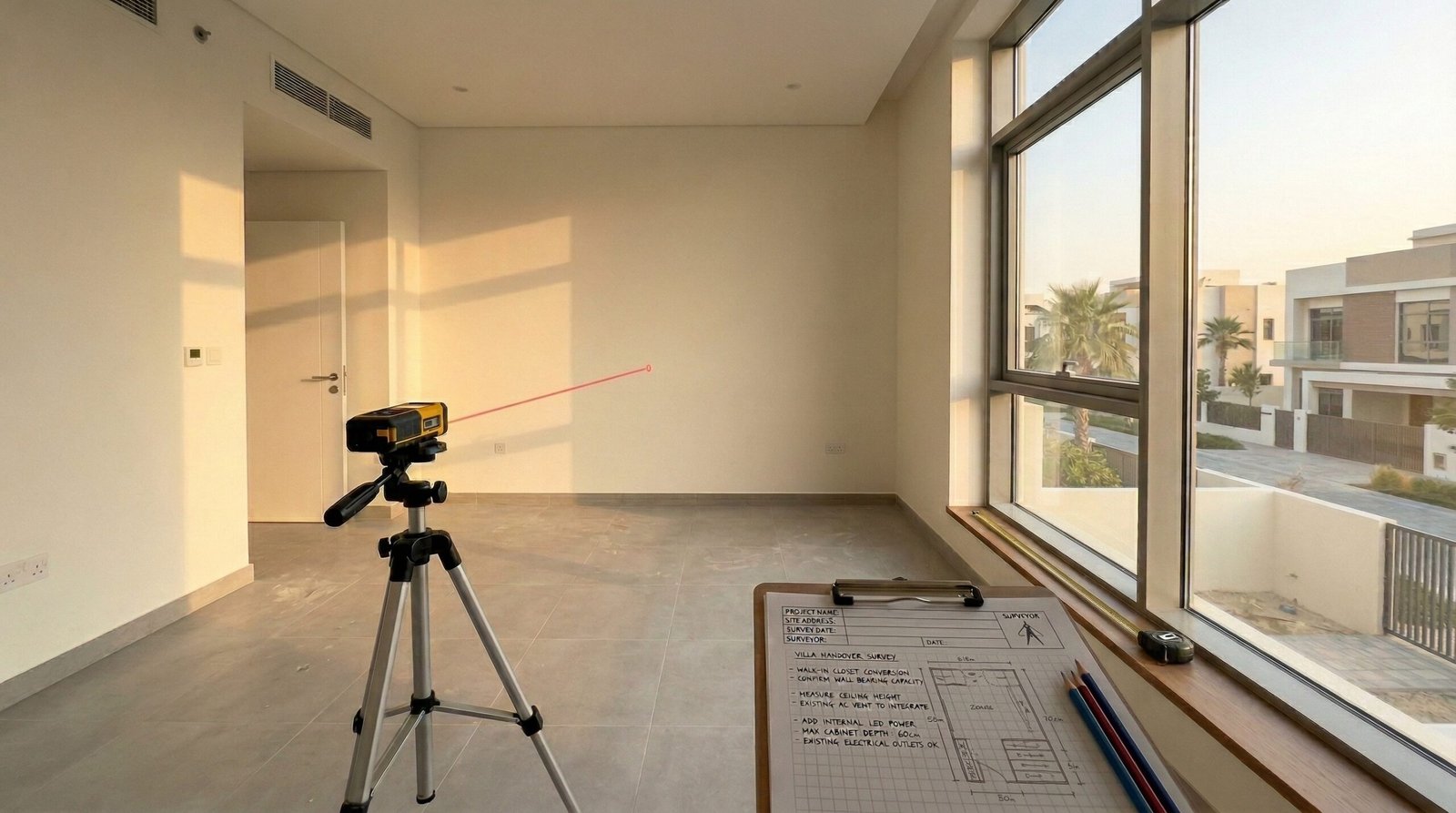
Every walk-in closet we build goes through the same structured process, developed over 35 years and refined to ensure the finished result matches the design intention in every detail. This isn’t a generic construction process — it’s the specific workflow we follow for wardrobe fit-outs across Dubai and the UAE.
Step 1: The Design Consultation
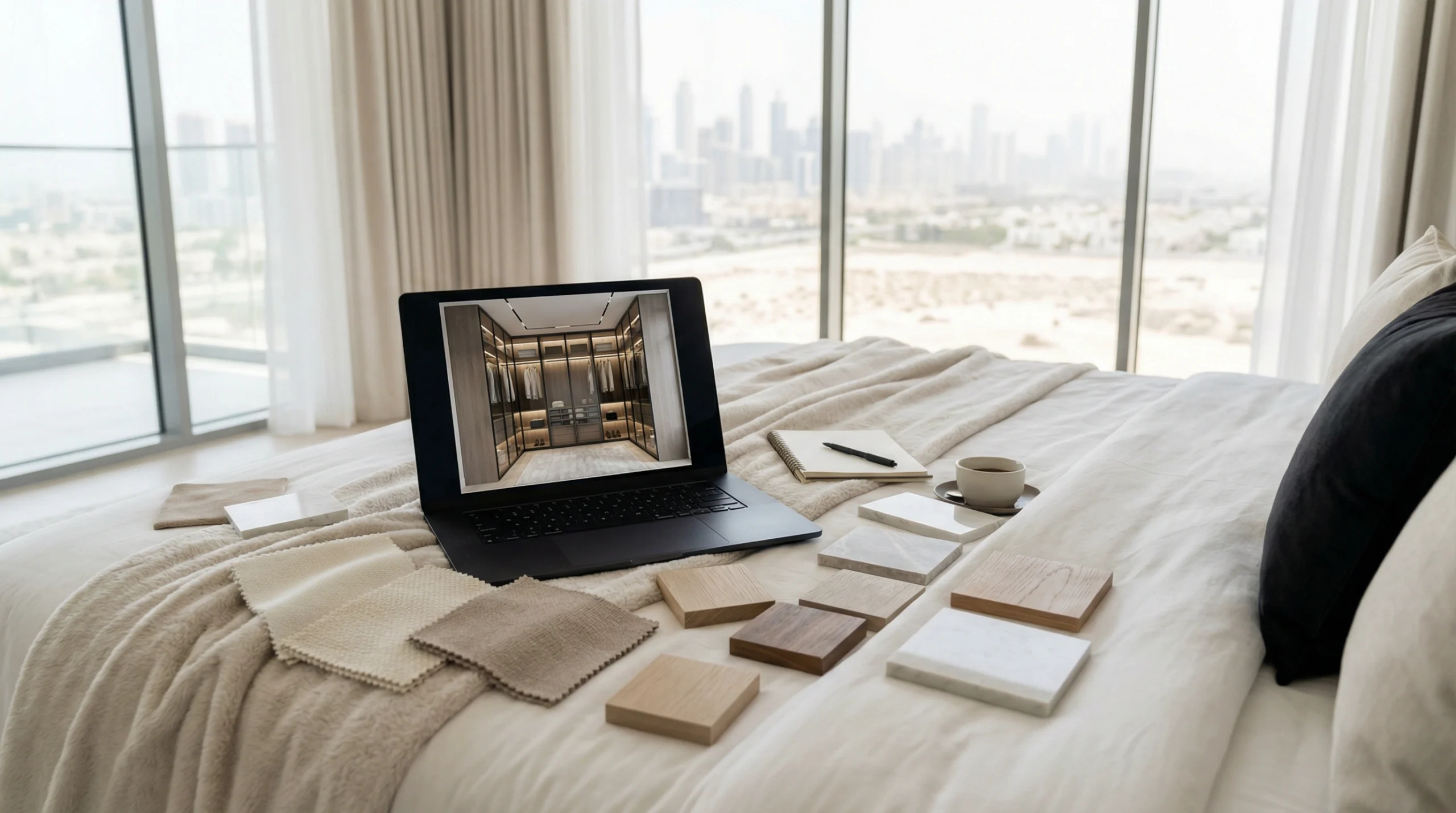
The first meeting is where we learn. Our designer will visit your property, take precise measurements of the space (including ceiling height, floor levelness, position of electrical outlets and air conditioning units, door swing directions, and any structural elements that will influence the design), and then spend time understanding how you actually use your wardrobe. We ask questions most clients don’t expect: how many minutes do you typically spend getting dressed in the morning, whether you dress with the lights on or off initially, whether you share the space with a partner whose routine differs from yours.
This information feeds directly into the design. The consultation typically takes 60-90 minutes for a standard walk-in, and up to half a day for a large villa dressing room project. Within 5-7 working days of the consultation, you’ll receive a full 3D rendered design showing the wardrobe from multiple angles, a detailed specification sheet listing every material and fitting by reference, and a fixed-price quotation.
Step 2: Design Refinement and Approval
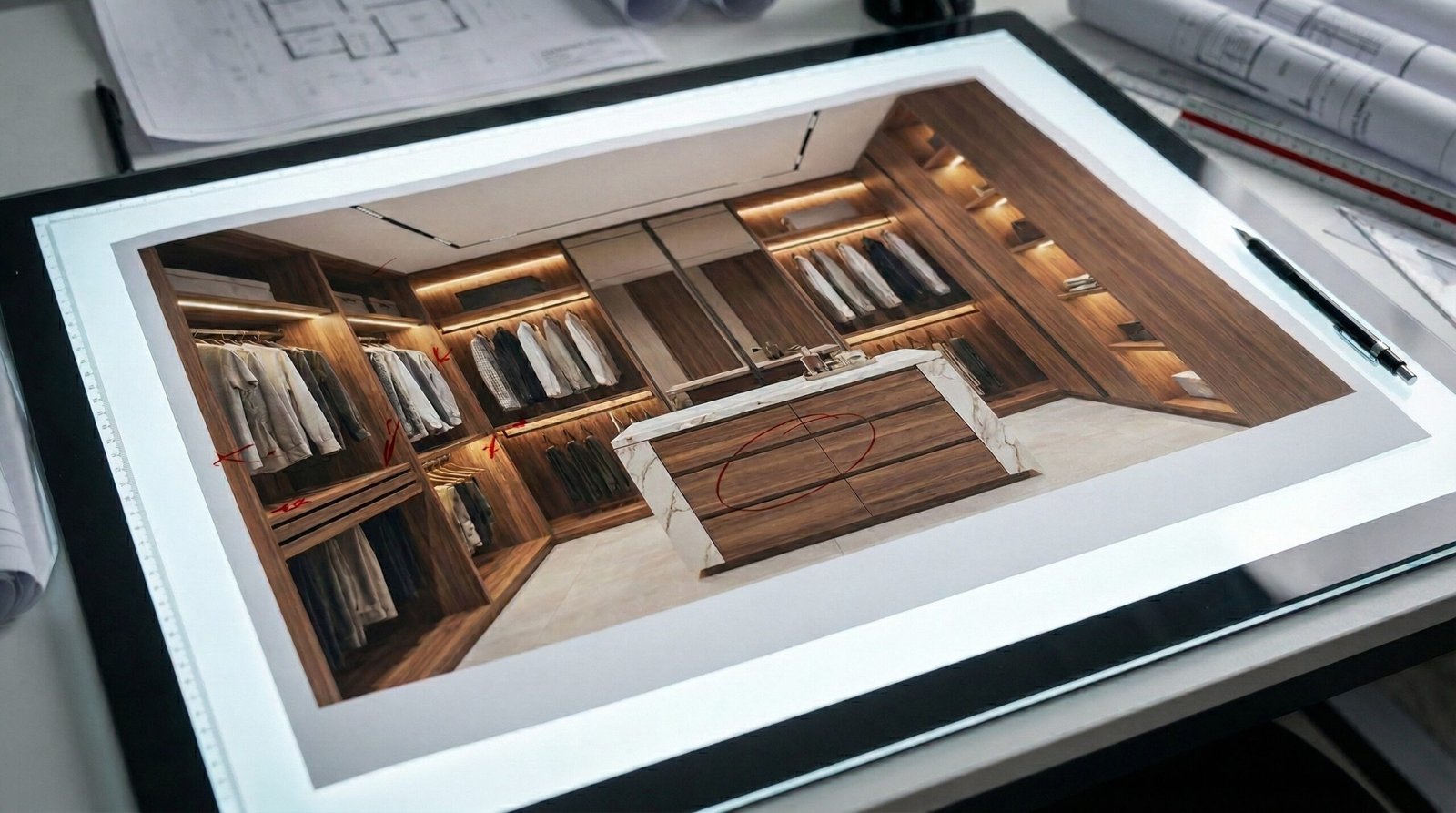
Most clients request at least one round of design changes after seeing the initial render — and we factor this into our timeline. Our design software allows us to update the 3D model in real time during a screen-share session, so you can see immediately how a colour change, an additional shelf section, or a reconfigured drawer bank affects the overall design. We don’t charge for design revisions within the first two rounds; thorough design refinement at this stage is far less expensive than site changes during installation.
Once the design is approved and the quotation signed off, we begin material procurement and workshop scheduling. Lead time from design approval to installation start varies between 2-4 weeks for standard specifications, and 4-8 weeks for projects requiring imported materials or specialist hardware.
Step 3: Workshop Fabrication
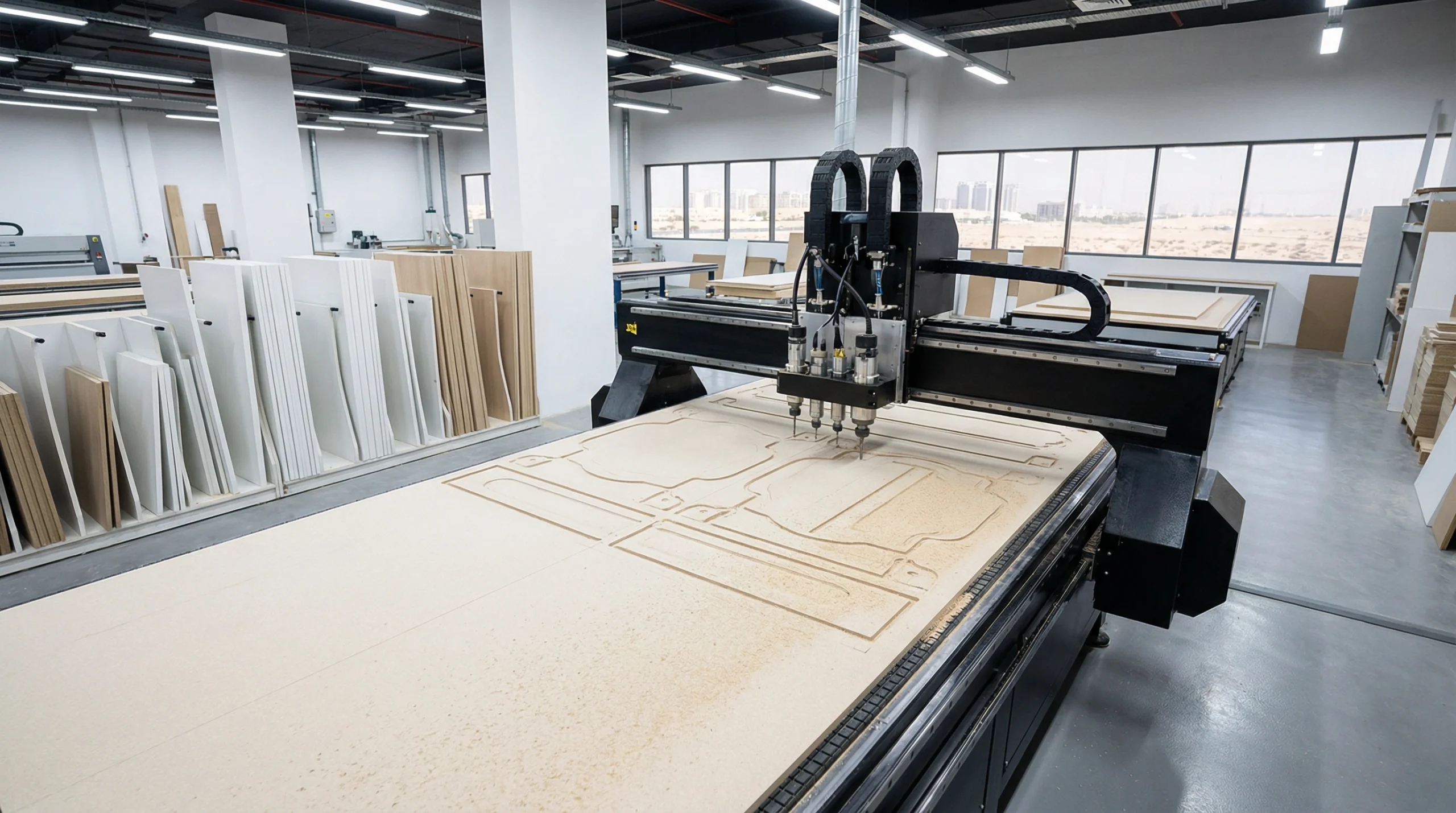
All Karnak walk-in closet components are fabricated in our Dubai workshop. We use a combination of CNC routing for precision panel work and traditional hand craftsmanship for edge detail, corbels, decorative moulding, and bespoke elements. This matters because CNC ensures consistency — every shelf is exactly the same depth, every carcass side is cut to the same dimension — while hand craftsmanship allows us to execute the design details that make the difference between functional and exceptional.
Panels are edge-banded with matching or contrasting ABS edging (2mm thick, applied with hot-melt adhesive under pressure), carcasses are assembled and checked for square before face fronts are fitted, and drawers are tested through a full cycle before they leave the workshop. We aim for a workshop defect rate below 0.5%, which means that when components arrive on site, installation proceeds without the material rejections and replacements that delay many carpentry projects.
Step 4: Site Preparation and Installation
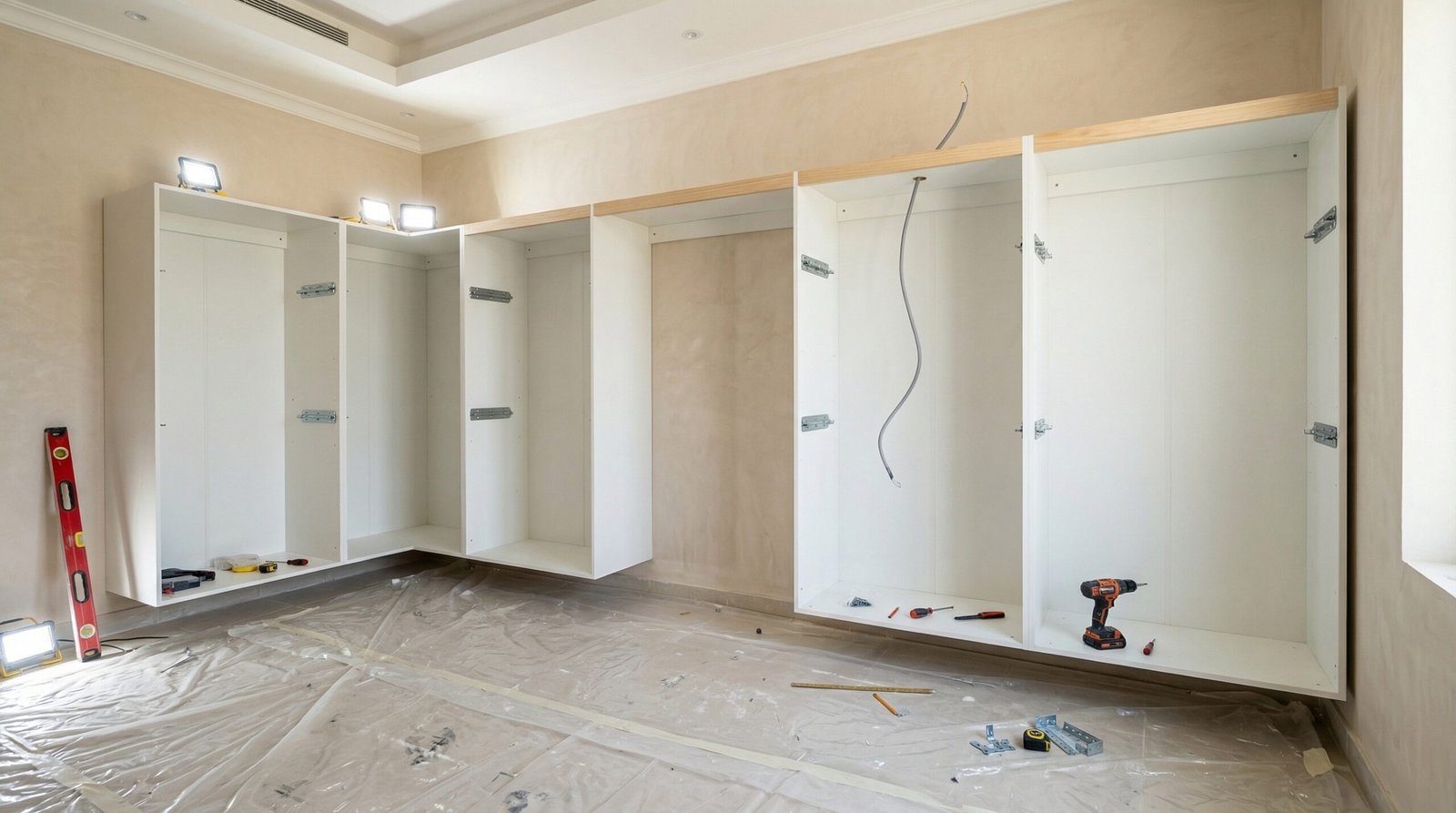
Our installation team arrives on site with all components pre-fabricated and pre-finished, which minimises disruption to the property. For a standard master bedroom walk-in closet, installation typically takes 1-3 days depending on complexity. Larger villa dressing rooms with island units, integrated lighting, and multiple specialist fittings may take 4-7 days.
The installation follows a precise sequence: wall preparation and levelling (important in older Dubai properties where original construction tolerances can be generous), carcass installation and levelling, face front fitting and adjustment, hardware installation and adjustment, lighting wiring (coordinated with the property electrician), and final snagging. We don’t consider a project complete until every door aligns, every drawer operates without resistance, and every lighting circuit functions as designed. Our site supervisor signs off on a completion checklist before our team leaves.
Step 5: Handover and Aftercare
At project completion, we provide a full handover pack that includes care and maintenance instructions for every material and finish specified, hardware warranty documentation (Blum and Hettich warranties run to 10 years for most products), touch-up paint or lacquer for minor surface repairs, and contact details for our after-sales team. For clients who take out our extended care plan, we schedule a 12-month inspection visit to adjust any hinges or drawer slides that may have settled.
Why Dubai Homeowners Choose Karnak for Walk-In Closets
Thirty-Five Years of UAE-Specific Experience
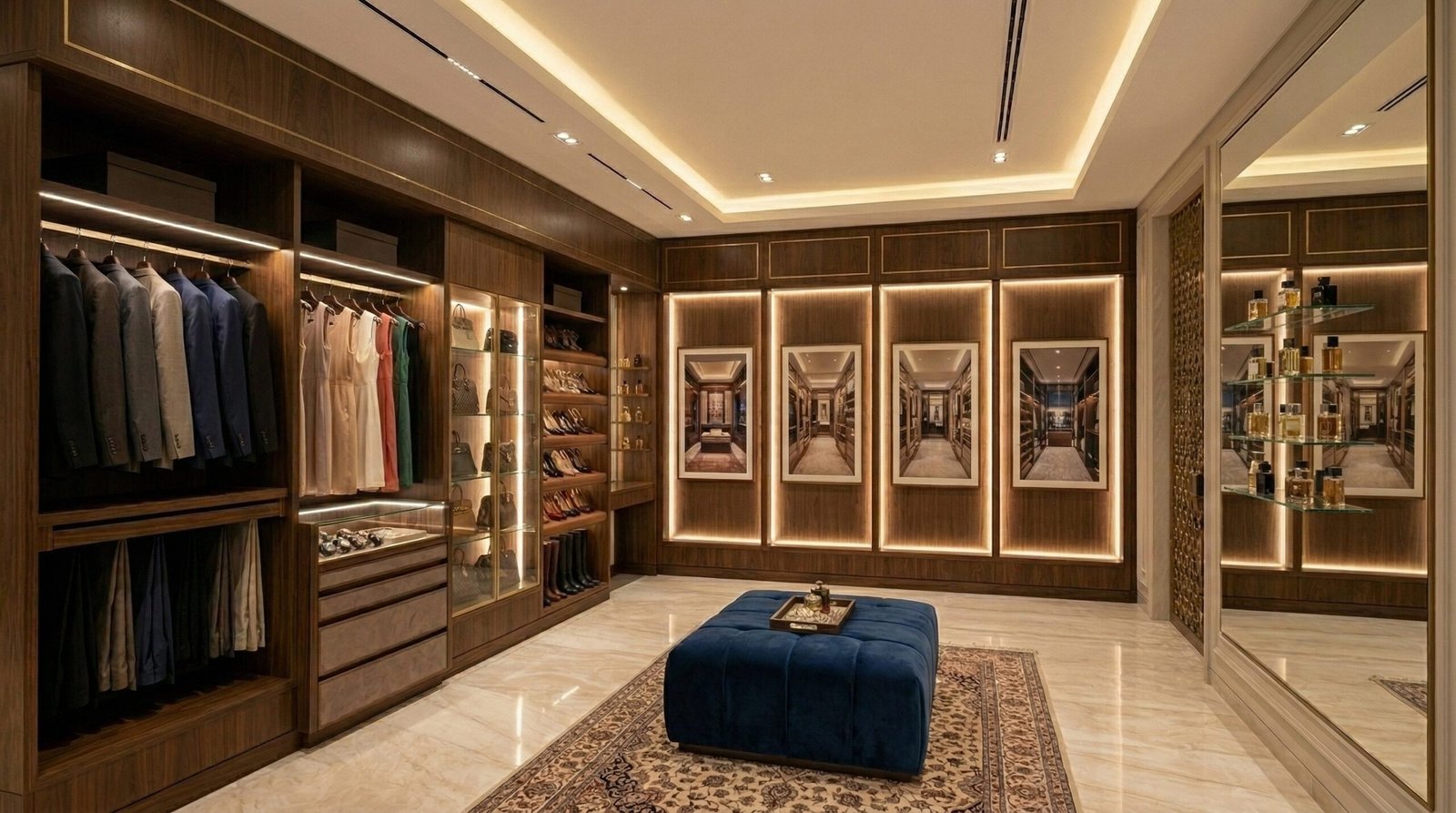
Since 1988, Karnak has completed carpentry projects in virtually every residential community in Dubai and across the UAE. Walk-in closets and fitted wardrobes represent one of our most requested services, and the knowledge we’ve accumulated across thousands of these projects is not something you can replicate quickly. We know which materials perform in which conditions, which hardware specifications hold up in coastal high-rises, and which design decisions clients later regret.
In practical terms: we know that fully lacquered wardrobe interiors look beautiful in show-home photography but collect every fingerprint in daily use, so we recommend them only for outer surfaces and opt for foil-wrapped or satin-finish interiors where hands touch frequently. We know that wardrobe lifts in rooms with ceilings above 3.2m require a specific lift model that can extend to the required reach, and which models on the market fail to achieve this despite their marketing claims. This isn’t theoretical knowledge — it’s accumulated from solving the same problems across 10,000+ projects.
In-House Workshop, Not Outsourced Production
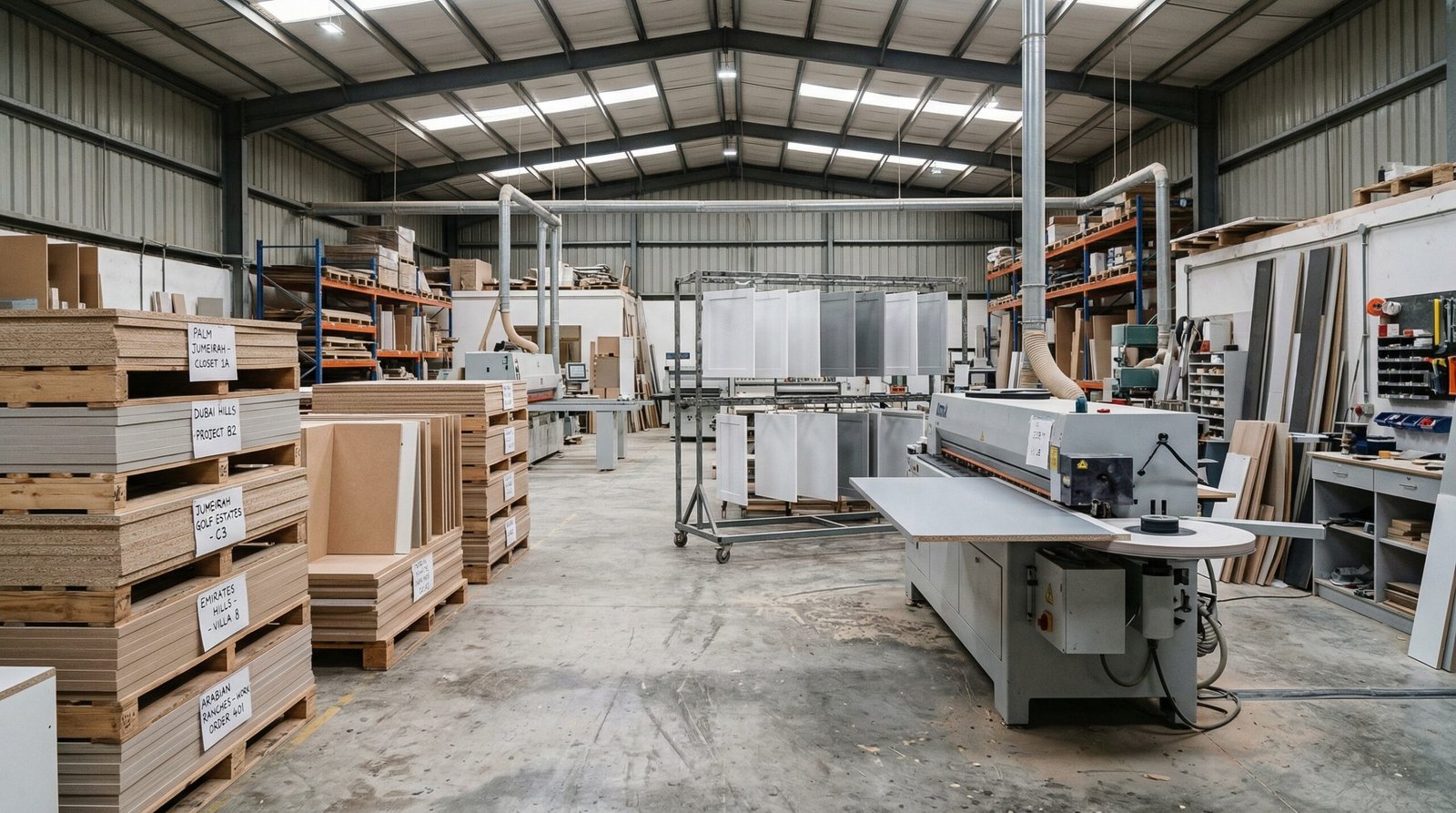
Our Dubai workshop is not a packaging facility — it’s a full production environment where our own craftsmen fabricate every component of your walk-in closet. The alternative — common among smaller UAE carpentry firms — is to send designs to an external factory in Ras Al Khaimah or overseas, receive finished panels, and assemble them on site. This model can work, but it separates design intent from production quality. When we find a material issue or a measurement discrepancy during production, our workshop team resolves it in real time, under the same roof as the designers. That’s a quality advantage that directly affects your finished wardrobe.
Fixed-Price Quotations — No Post-Project Surprises
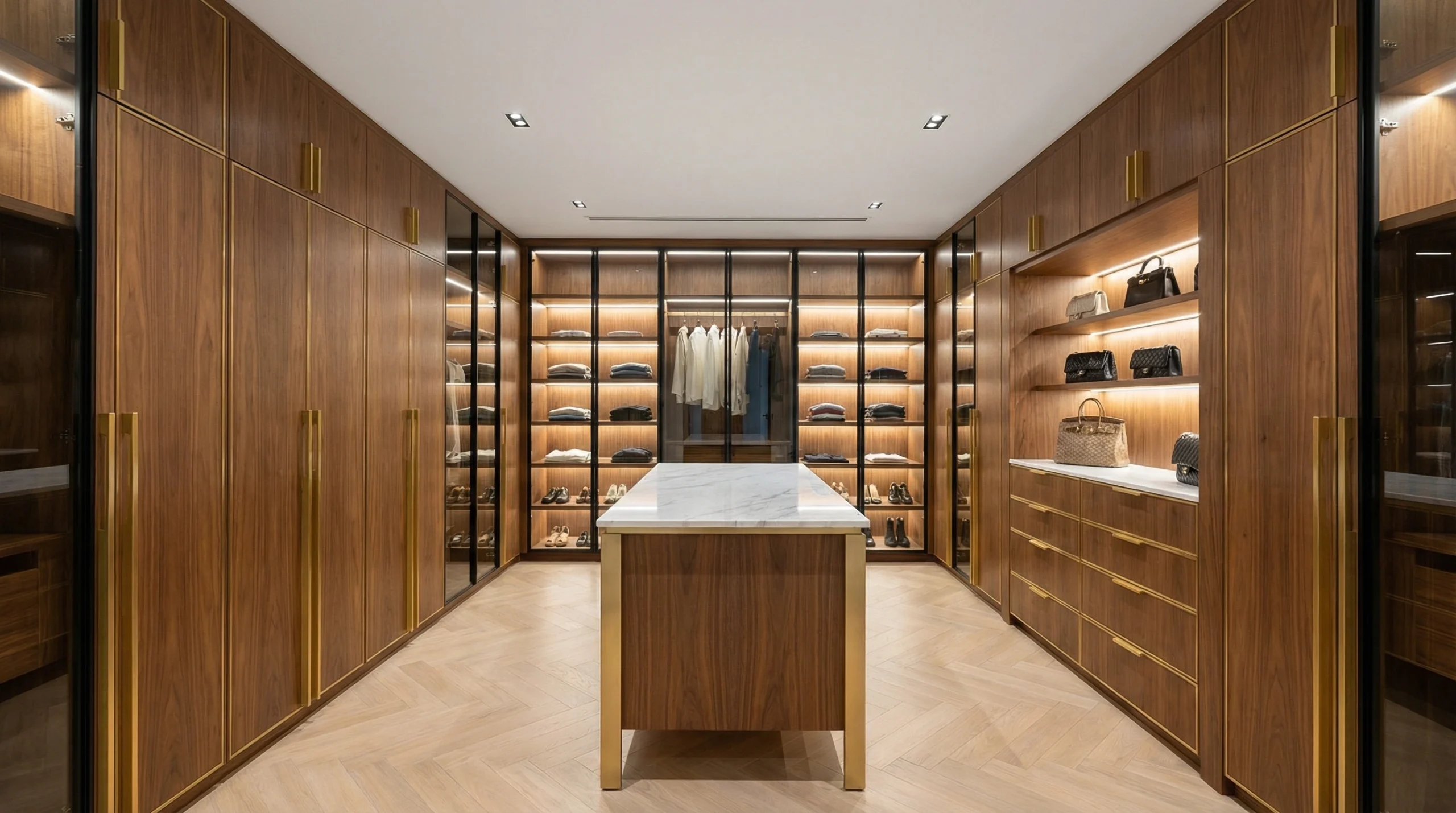
Every Karnak walk-in closet project is priced on a fixed-price basis from the design approval stage. The quotation covers all materials, fabrication, delivery, installation, hardware, and snagging — nothing excluded. UAE clients are familiar with carpentry contractors whose initial quotes grow substantially by the time a project completes. Our approach is the opposite: we take the time to specify accurately before work begins so that the number you approve is the number on the final invoice.
Serving All Seven Emirates
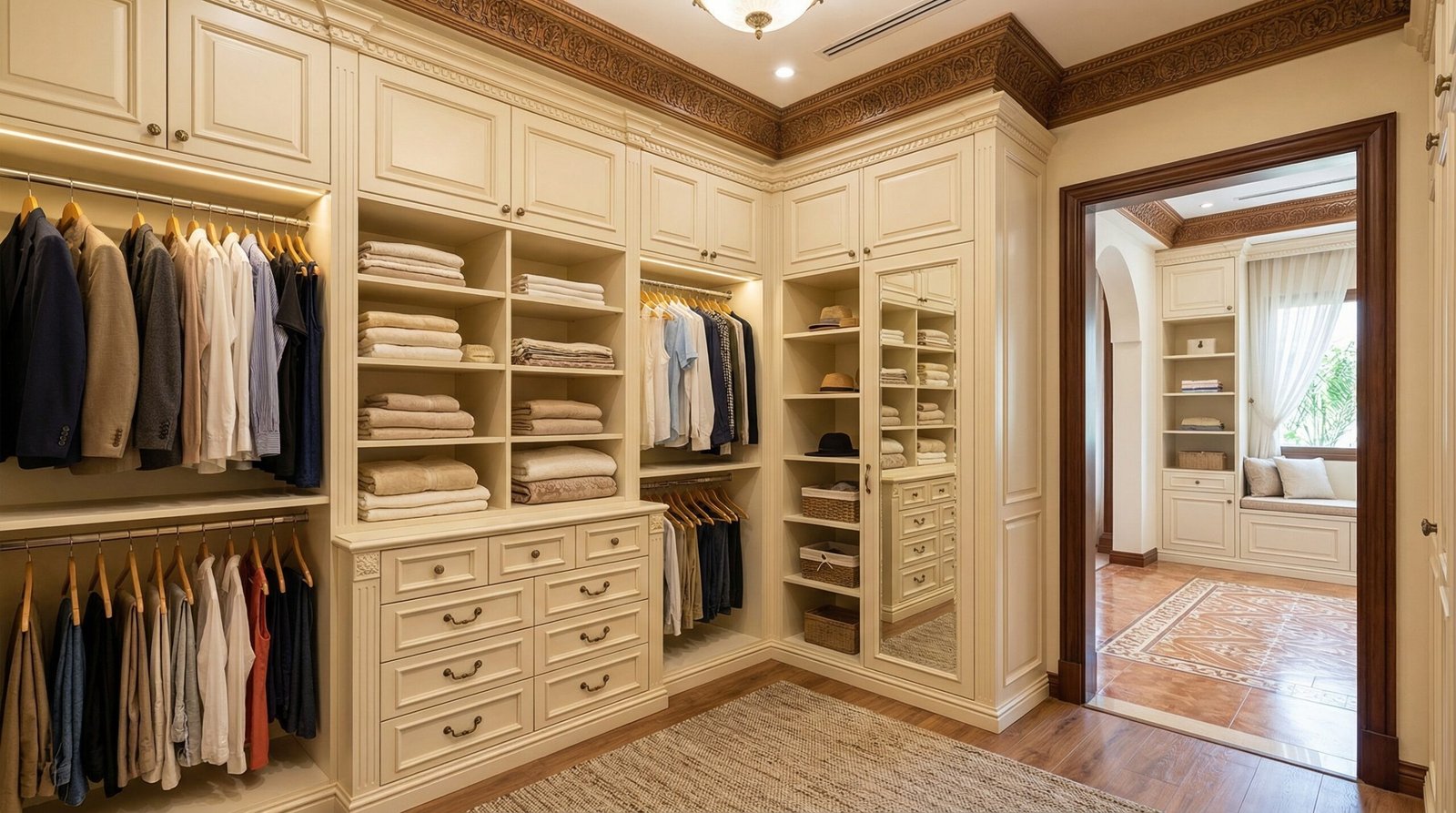
Our Dubai workshop serves projects across all seven UAE emirates. For clients in Abu Dhabi, Sharjah, or the northern emirates, our installation teams travel with all equipment and components. We’ve completed walk-in closet projects in Abu Dhabi’s Khalidiyah and Al Reem Island, Sharjah’s Al Majaz waterfront residences, and villas in Ras Al Khaimah’s Al Hamra community, with the same Dubai quality standard applied consistently across locations.
Recent Walk-In Closet Projects Across the UAE
The Dubai Marina Penthouse — His-and-Hers Dressing Room
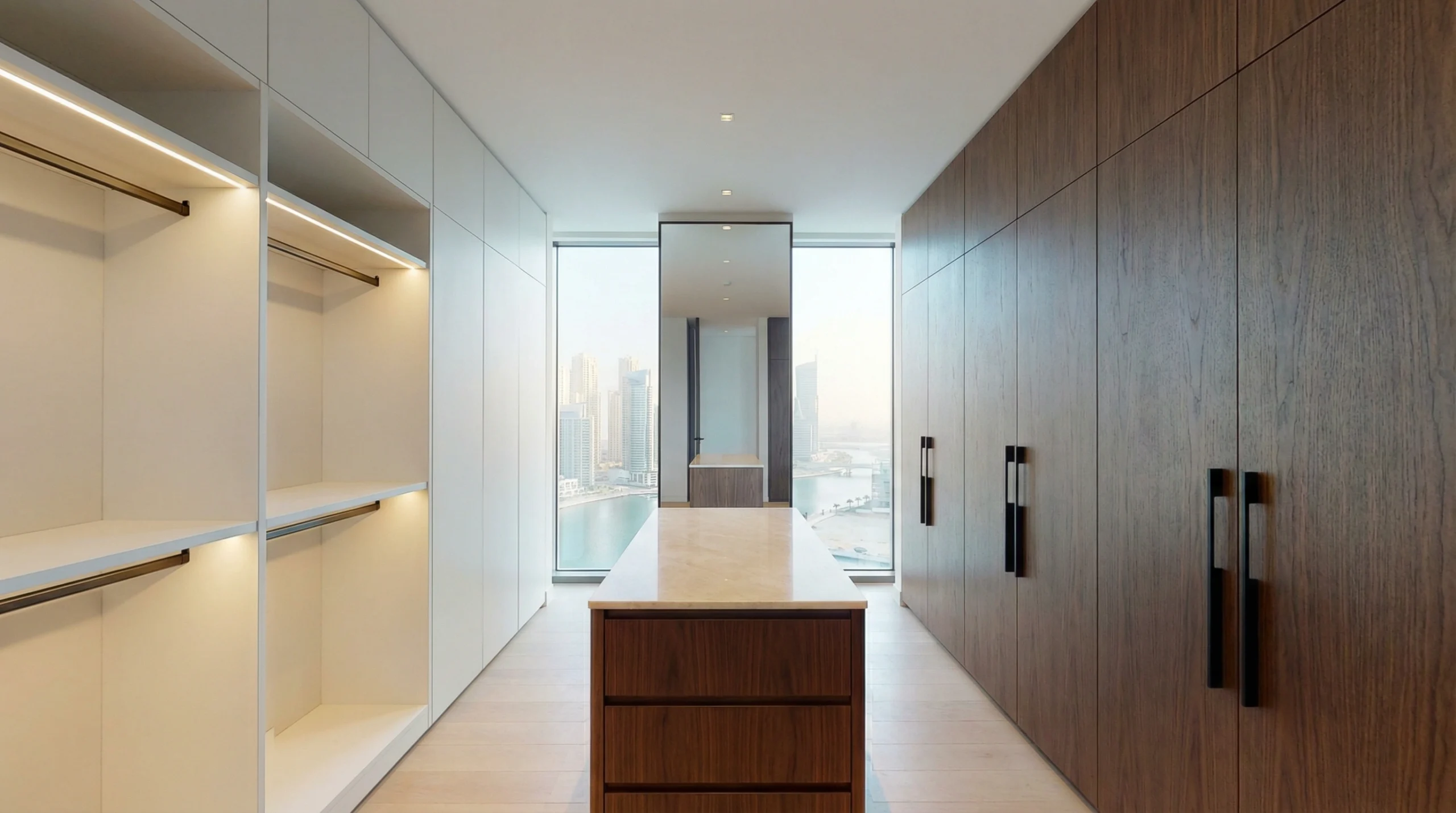
A 22m² dedicated dressing room for a penthouse on Dubai Marina, commissioned by a couple with distinct wardrobe requirements and schedules. The design incorporated fully differentiated his-and-hers sections — one wall in matte white lacquer with integrated LED lighting, full-length and half-length hanging, and a dedicated vanity nook; the opposite wall in dark walnut veneer with deep drawer storage, double hanging, and a watch display cabinet. A central island in Calacatta marble top with six deep drawers anchors the space. Installation was completed in 4 days, with zero snags at handover.
Emirates Hills Villa — Full Master Suite Dressing Room
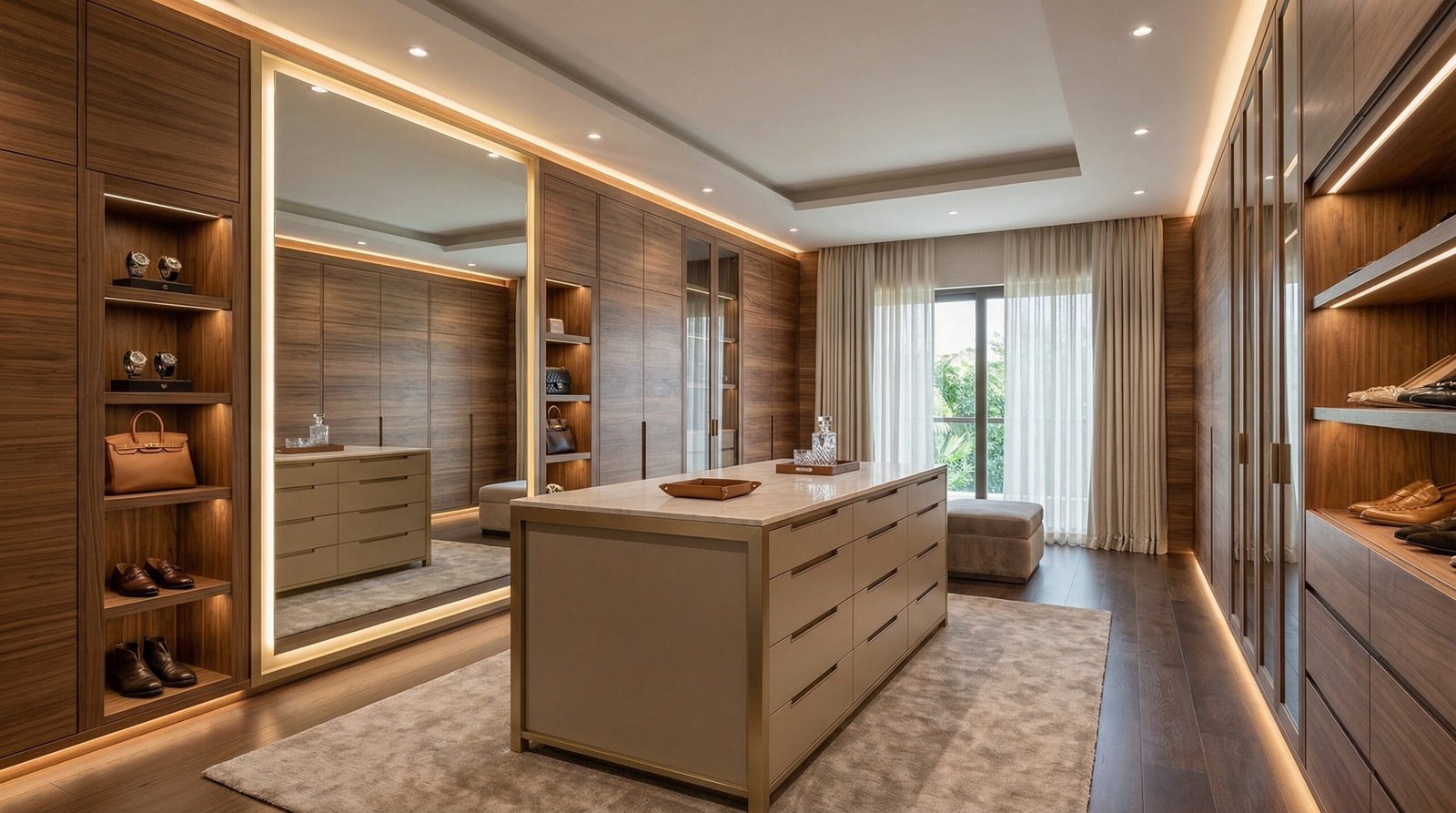
An 18m² master suite dressing room in an Emirates Hills villa, specified with European birch plywood carcasses, book-matched American walnut veneer fronts, and Blum Orion drawer systems throughout. The brief required storage for 120+ pairs of shoes, a dedicated handbag display section with museum-quality spotlighting, and a full-length triple mirror on a swing-out pivot so it could be angled as required. The central island incorporates a discreetly housed electronic safe and a valet rod pull-out. Project duration: 6 installation days.
Al Reem Island, Abu Dhabi — Apartment Walk-In Wardrobe
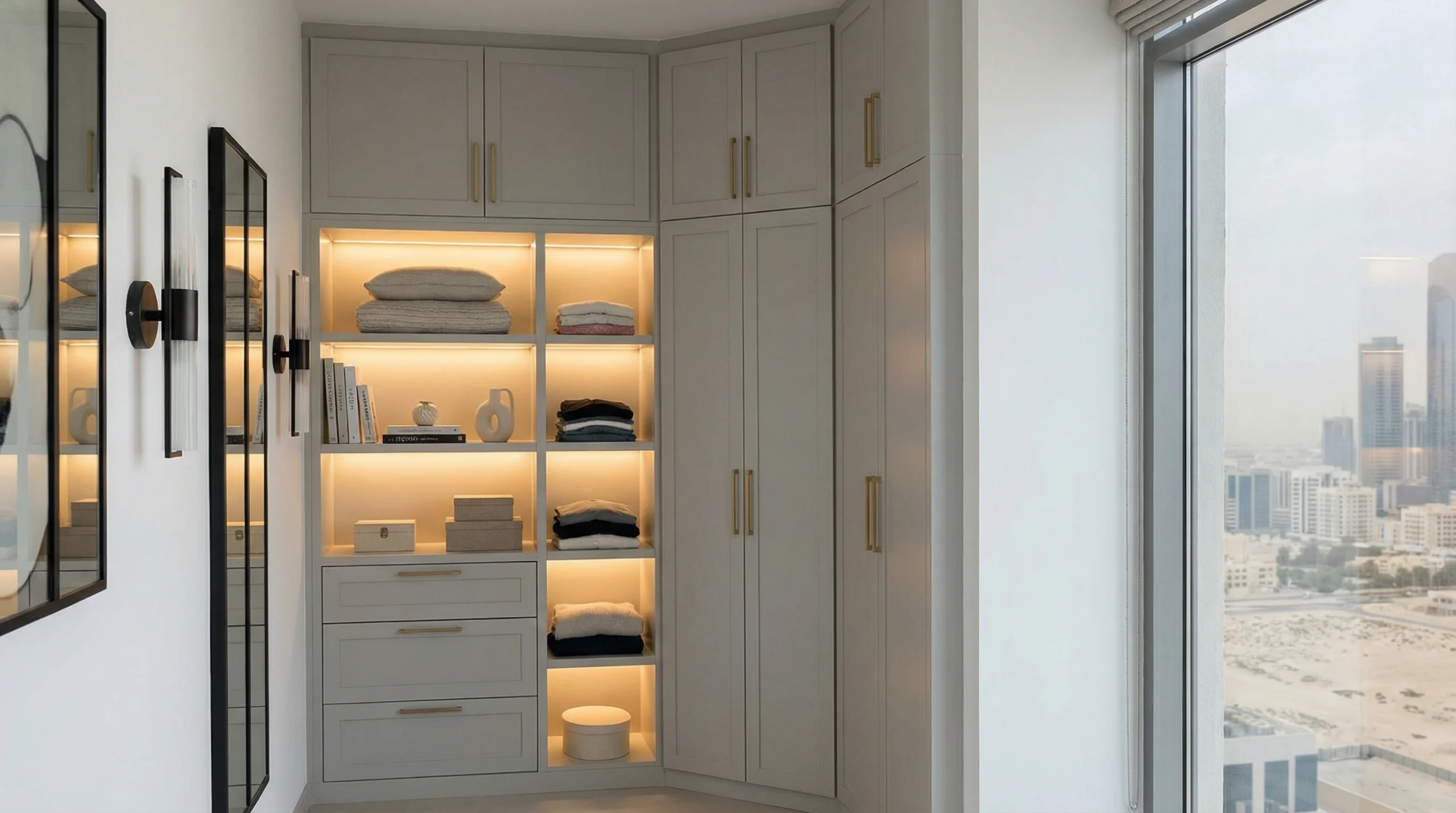
A compact but meticulously designed walk-in wardrobe in an Al Reem Island apartment, maximising a 4.5m² alcove space with floor-to-ceiling L-shape cabinetry. The client requested a soft grey lacquer finish with warm brass hardware — a combination that works exceptionally well in the apartment’s contemporary interior. A wardrobe lift system was installed for the upper rail section, and a pull-out shoe rack accommodating 30 pairs was fitted into the base of the hanging section. Total storage capacity increased by approximately 60% compared to the builder’s wardrobe the closet replaced.
JBR Apartment — Built-In Wardrobe with Sliding Doors
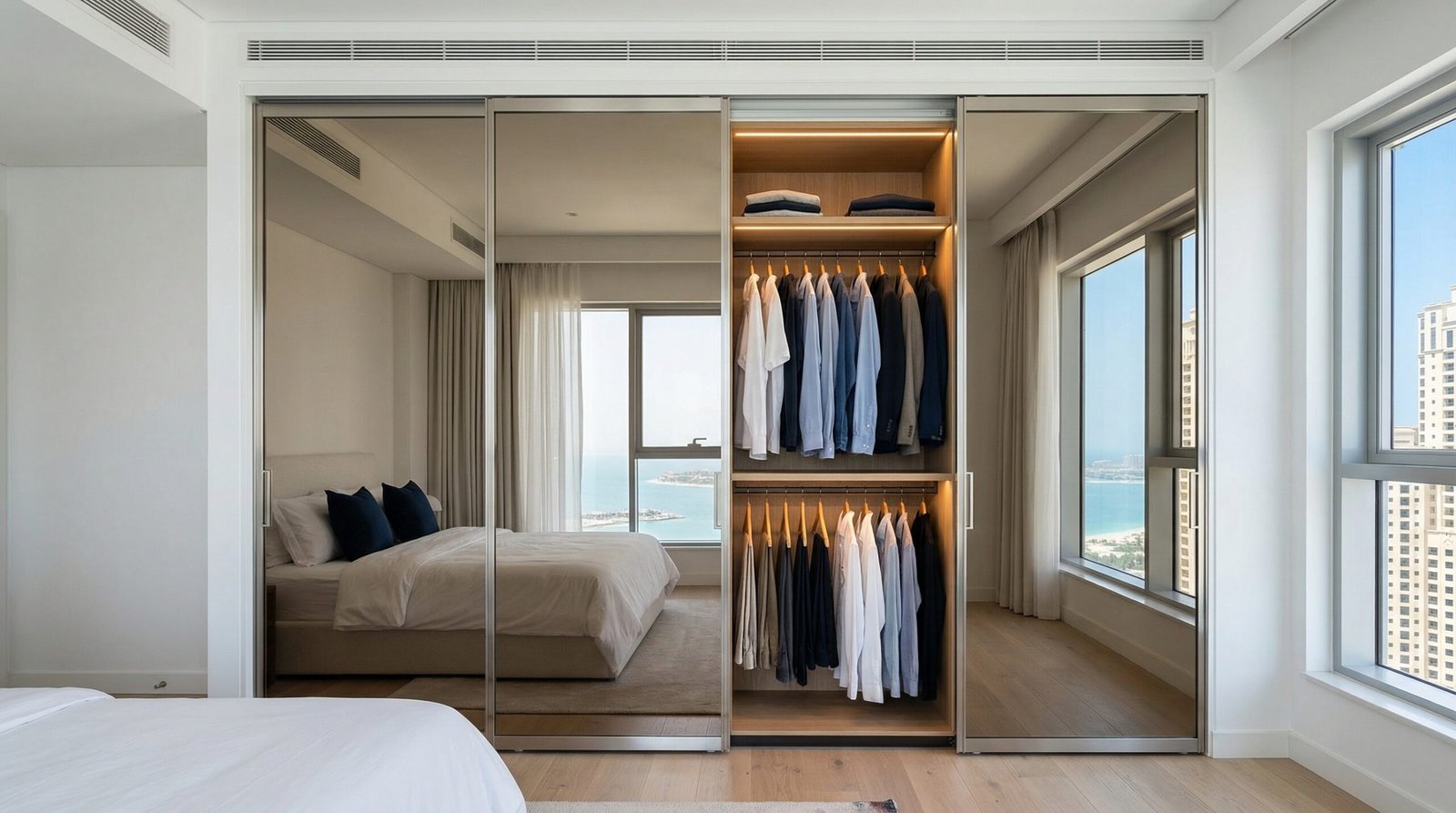
A JBR coastal apartment where humidity management was a primary consideration. The client had experienced warping in a previous wardrobe built by another contractor. We specified MR-MDF throughout, applied a sealed lacquer finish on all internal surfaces, and installed aluminium-framed sliding glass doors — which eliminate the risk of expansion at door hinges that swing doors can develop in humid environments. Ventilation slots were incorporated into the carcass backs to allow air circulation. The wardrobe has now been in service for three years with no humidity-related issues.
Downtown Dubai — Compact Master Bedroom Wardrobe
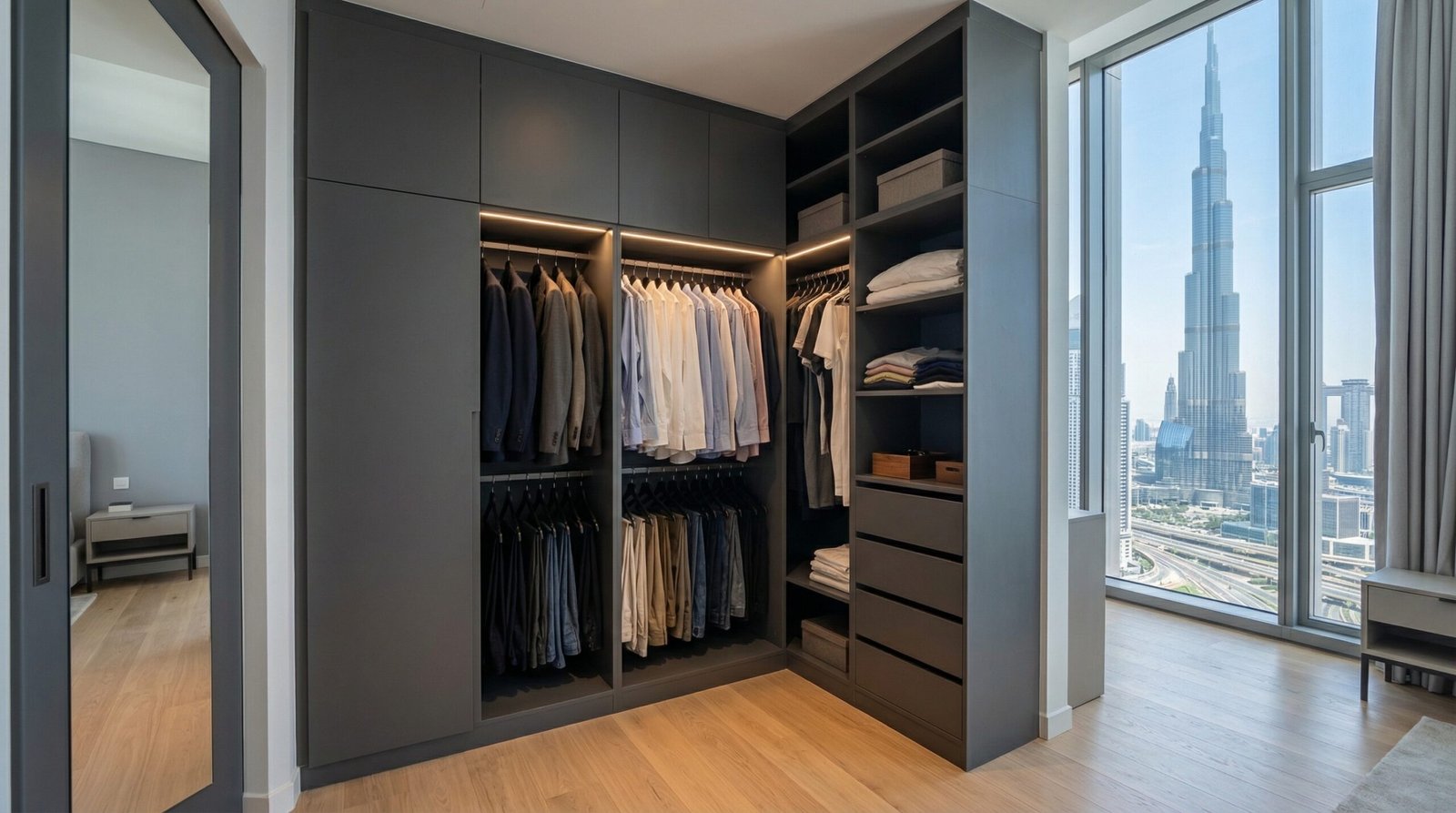
A one-bedroom apartment in Downtown Dubai with a master bedroom barely large enough to accommodate a bed. The wardrobe brief required us to design a floor-to-ceiling unit along one wall — 3.8m wide, 2.8m high — with integrated sliding doors in smoked glass that reflect the room and make the space feel larger. Internal fittings are accessible behind two door panels: one section dedicated to hanging with a pull-out trouser rack, one to shelving and drawer storage. The unit transformed a cramped room into a genuinely functional master suite.
Jumeirah Villa — Children’s Walk-In Wardrobes
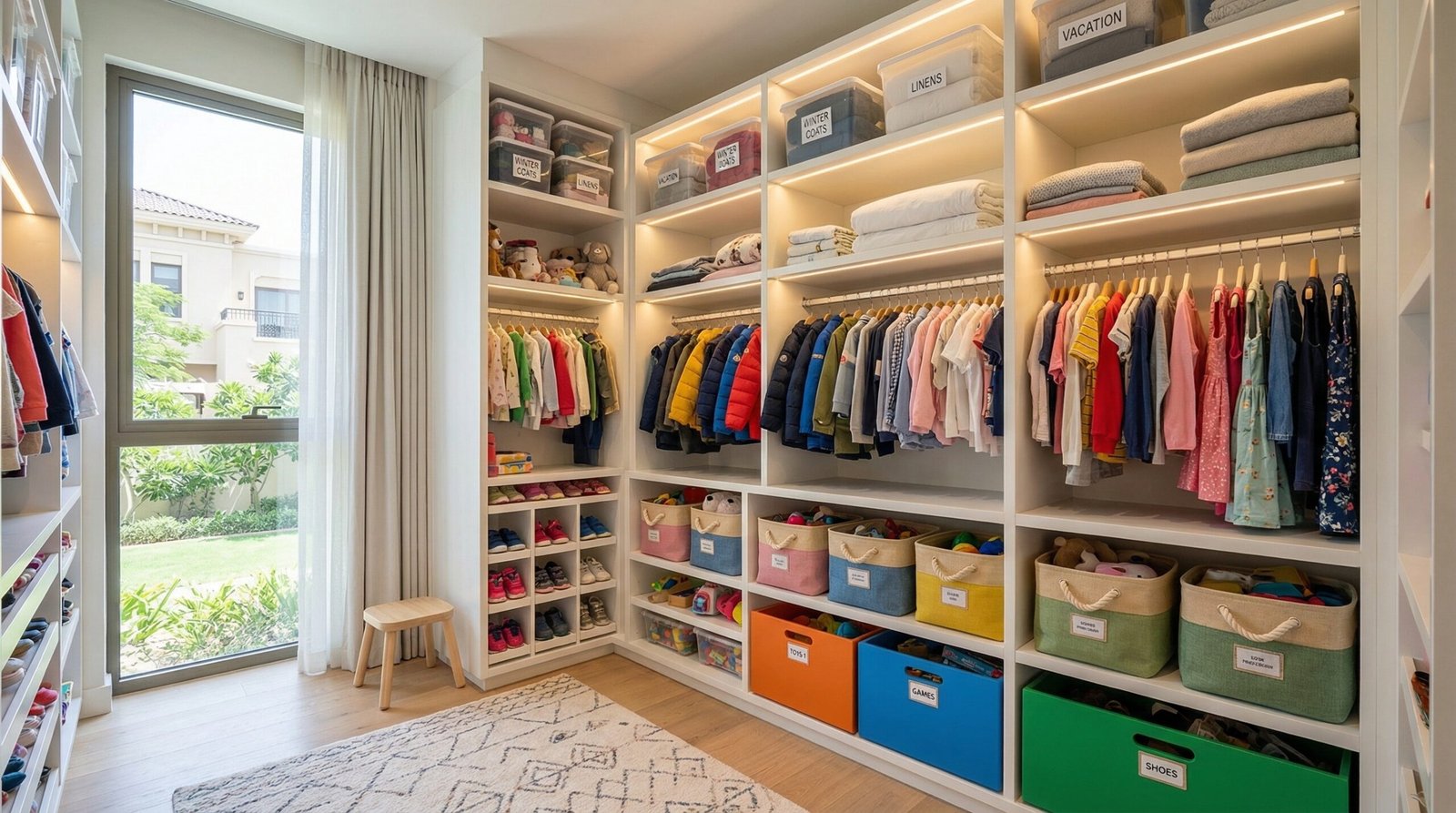
A Jumeirah villa renovation where two children’s bedrooms each received dedicated walk-in wardrobe spaces. The brief required age-appropriate design — low-level accessible hanging at 1.2m for items children can reach themselves, adjustable shelving to accommodate changing storage needs as the children grow, and a full-height zone for parent-managed storage. We specified a robust paint-grade finish that can be repainted rather than replaced when the children’s aesthetic preferences inevitably change. Both units were installed in 2 days total.
Palm Jumeirah — Luxury Wardrobe with Integrated Dressing Table
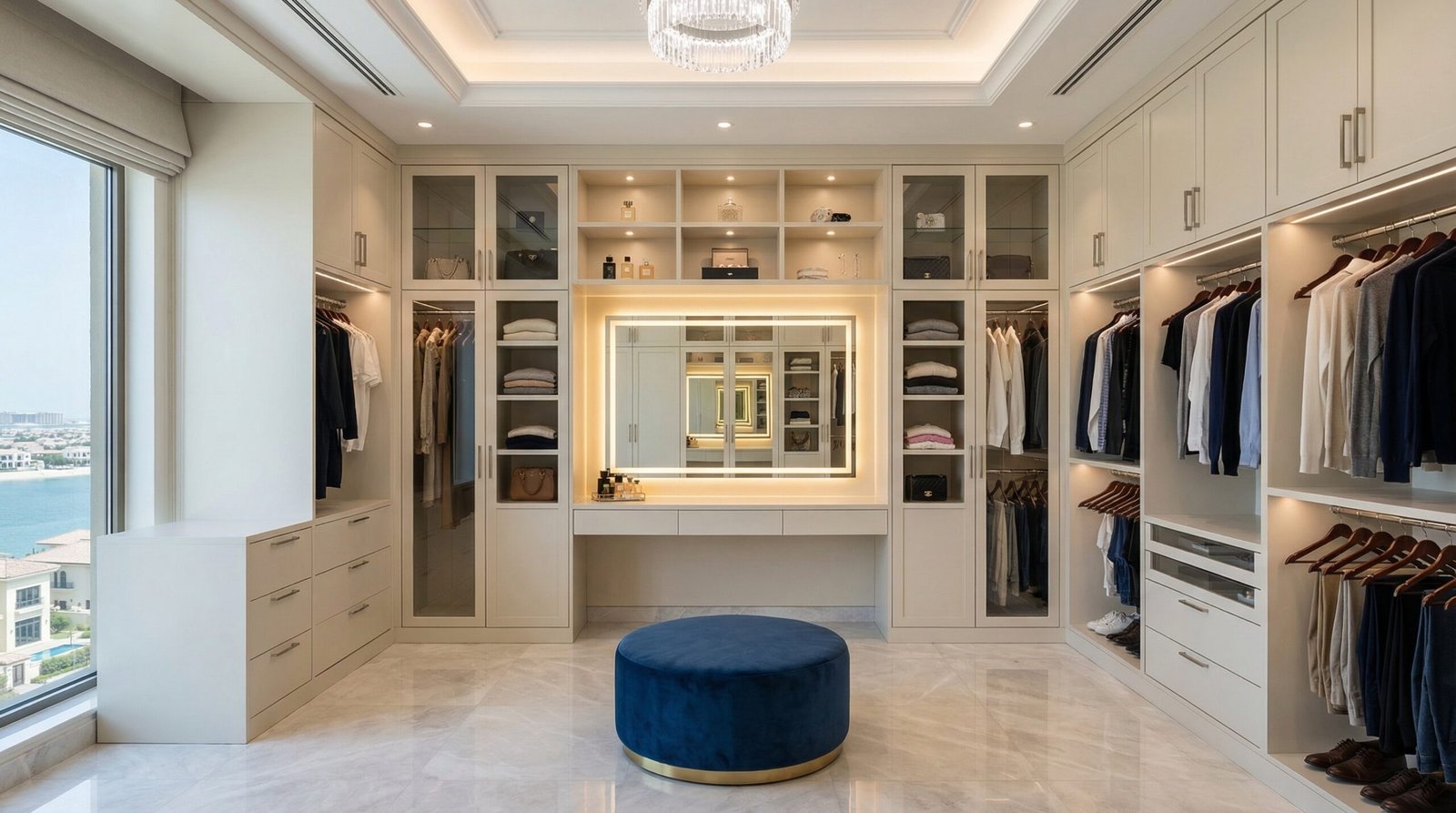
A Palm Jumeirah frond villa where the walk-in closet included a fully integrated dressing table — not a separate piece of furniture, but a custom cabinetry unit with a mirrored alcove, Hollywood-style bulb lighting surround, drawer storage for cosmetics, and a knee-hole recess sized to the client’s preference. The unit continues seamlessly into the wardrobe cabinetry on either side, so it reads as part of the room rather than an insertion. A task lighting circuit independent of the main wardrobe lighting allows the dressing table to be used without illuminating the entire closet.
Walk-In Closet Questions — Expert Answers
Walk-in closet pricing in Dubai varies significantly based on size, material specification, and the complexity of internal fittings. As a practical guide, a compact walk-in wardrobe in an apartment (5-8m²) with standard MR-MDF construction, lacquer finish, and quality European hardware typically falls between AED 15,000 and AED 35,000. A full master suite dressing room in a villa (12-25m²) with premium materials, an island unit, integrated lighting, and specialist fittings typically ranges from AED 45,000 to AED 150,000+. The variables that move the number most are material grade (standard MDF versus plywood, basic lacquer versus timber veneer), the number and type of internal fittings, door specification (hinged MDF versus sliding aluminium-framed glass), and site complexity.
We provide fixed-price quotations following a design consultation, so you'll know the exact cost before committing to anything. We don't believe in ballpark estimates that grow once work starts.
The complete timeline from first consultation to installed, snagged, and handed-over wardrobe typically runs 5-10 weeks for standard projects. Design consultation and 3D render delivery takes approximately 7-10 working days. Design approval and revision takes 3-7 days. Material procurement and workshop fabrication runs 2-4 weeks for standard materials, 4-8 weeks if imported materials are specified. Installation takes 1-7 days depending on complexity. We provide a project schedule at the design approval stage with confirmed dates, and we meet them in well over 90% of projects.
We complete walk-in wardrobe installations in apartments across Dubai and the UAE. The majority of our residential projects are actually in apartments — from compact studio alcove wardrobes to full second-bedroom dressing room conversions and master suite walk-ins in larger units. The design adapts to the space, not the other way around. We've transformed spaces as small as 2.5m² into genuinely functional walk-in configurations, and we've worked in buildings across JBR, Dubai Marina, Downtown, Business Bay, DIFC, and across Abu Dhabi and Sharjah. If your building requires an NOC or contractor approval, we assist with the documentation.
MDF (medium-density fibreboard) is the standard substrate for most built-in wardrobes — it's dimensionally stable, takes paint and lacquer exceptionally well, and is cost-effective. We specify moisture-resistant MDF (MR-MDF) for all Dubai and UAE projects as standard, because the regular grade can swell in humid conditions. Plywood is structurally superior to MDF — it holds screws more firmly, handles heavy loads better, and is lighter at equivalent thickness. European birch plywood carcasses represent the premium structural tier for walk-in closets and will significantly outlast MDF under the same conditions. Solid timber is the most premium option and is typically used for visible face elements, frames, and decorative components rather than full carcass construction — pure solid timber wardrobes are beautiful but move seasonally with humidity changes, which requires careful design management. Most of our premium walk-in closets use a combination: plywood carcasses, MDF or solid timber fronts, and solid timber detailing.
For the vast majority of walk-in closet installations, you don't need to vacate your home. The work is contained to the wardrobe space, and our teams work in a way that respects the rest of the property. We use dust sheets to protect adjacent flooring and furniture, and we remove all waste daily. In larger dressing room projects where significant carpentry work is occurring over several days, some clients prefer to sleep in a different room, but this is a preference rather than a necessity. We're explicit in our project briefing about what to expect each day, so there are no surprises.
Humidity management is a genuine consideration for walk-in wardrobes in Dubai, particularly in coastal areas like JBR, Dubai Marina, and Palm Jumeirah, and in older buildings where air conditioning systems may not maintain as stable an environment as newer properties. Our approach combines material selection (MR-MDF as standard), surface sealing (all internal surfaces receive a sealed finish, not just external faces), hardware specification (aluminium rather than steel components in high-humidity situations, to prevent rust), ventilation allowances in the carcass design, and where appropriate, the recommendation of a supplementary dehumidifier for the wardrobe space. In 35 years and thousands of wardrobe projects across UAE coastal properties, we've developed a clear understanding of which measures make the material difference.
We specify primarily Blum (Austria), Hettich (Germany), and Hafele (Germany) — the three hardware manufacturers whose products we've tested at scale across the UAE and whose quality holds up. The difference matters in practical terms: Blum's Tandem box drawer system carries a 70kg load rating and a 500,000-cycle tested life. Budget drawer systems from unspecified manufacturers may fail within 2-5 years under regular use. Similarly, Blum and Hettich hinges are factory-set to specific torque tolerances that keep doors aligned over time; cheaper hinges lose their adjustment within months. You won't see the hardware brand in a marketing photograph, but you'll feel the difference every day.
Yes, and this is a significant part of our commercial and premium residential work. We routinely receive material schedules, finish specifications, and design documents from interior designers and architects and fabricate to those specifications precisely. We also provide material samples, production renders, and prototype components for sign-off where required by a design team. If you're working with a UAE interior designer and want to bring Karnak in as the fabrication partner, we're experienced in that collaboration and have established relationships with a number of the country's leading design studios.
The range of internal fittings available for custom walk-in closets is extensive. Standard inclusions in most of our projects are single and double hanging rails, adjustable shelving at multiple heights, deep and shallow drawer banks, and shoe storage in either open shelf or angled drawer format. Specialist fittings available on request include pull-out trouser racks (individual trouser hooks on an extending frame), pull-out tie and belt organisers, valet rods (a short extending rod for laying out tomorrow's outfit), wardrobe lifts for upper rail sections, jewellery drawers with custom velvet inserts, integrated mirror panels, fold-out ironing boards, pull-out laundry baskets, display niches with integrated spotlighting, and safe housing. We also integrate custom island units with marble or stone tops, library ladders on wall-mounted rails, and full vanity/dressing table units with Hollywood lighting surrounds.
A well-specified and properly installed walk-in closet built with MR-MDF or plywood carcasses, quality European hardware, and a professional lacquer or veneer finish should remain in excellent functional condition for 15-25 years under normal residential use. The hardware will likely outlive the cabinetry — Blum warranties run to 10 years, but the products typically far exceed this. Cabinetry lifespans depend primarily on material quality, humidity management, and the care taken during installation — particularly joint integrity and the quality of edge sealing. We've returned to service clients who commissioned wardrobes from us 20 years ago and found the carcasses in excellent structural condition. The most common maintenance required over time is hinge adjustment and minor lacquer touch-up at high-contact areas.
We consider a genuine walk-in closet to require a minimum internal clear dimension of 1.8m in depth — enough to have storage on at least one side and clear access space. For a U-shape configuration with storage on three sides, a minimum room dimension of approximately 2.5m × 2.5m (clear internal) is needed, though 2.5m × 3m is more comfortable. L-shape configurations can work from approximately 2m × 2m. Single-wall walk-ins — more of a wide wardrobe alcove than a true walk-in room — can be effective from 1m depth and any width. Below these dimensions, we'd typically recommend a well-designed hinged or sliding-door wardrobe rather than a walk-in configuration, because the storage density per square metre is actually higher in a well-designed fitted wardrobe than in a very cramped walk-in. We're honest about this — if a walk-in doesn't actually serve you better, we'll say so.
Yes. Every Karnak walk-in closet project includes a detailed 3D rendered design as part of the design process. The render shows your specific room dimensions, the exact cabinetry layout, door styles and handles, internal fittings visible through open doors, and the lighting scheme. It's generated from our design software using the precise measurements taken at the consultation visit, so it's an accurate representation of what will be built — not a generic illustration. We review the render with clients via a screen-share or in-person meeting and revise until the design is approved. The 3D render process is included at no additional cost within our standard project process.
Yes, and this is the case for the majority of our installations. Built-in walk-in closet cabinetry is installed using a combination of wall fixings and floor-to-ceiling structure — no major structural work, no demolition, and in most Dubai apartment buildings, no need for building authority approval (though the relevant NOC should be obtained from the building management if required under your tenancy agreement or owners' association rules). For walk-in closets created by partitioning part of a room or enclosing an open space, some lightweight wall construction may be required, which we can coordinate — but this is a lighter intervention than most clients anticipate.
Our project portfolio is available on our website, and we can show you specific completed projects relevant to your brief — by style, size, material specification, or location. For clients undertaking significant dressing room projects, we can sometimes arrange a reference visit to a completed project, subject to the relevant client's agreement. We also have a materials and finishes showroom at our Dubai facility where you can see and touch the actual boards, veneer options, hardware samples, and drawer system demonstrations. This is particularly valuable for clients choosing between material finishes — colour and texture read very differently in a physical sample than on a screen.
Our after-sales process is defined before installation begins. All Karnak walk-in closet installations include a 12-month workmanship warranty covering any defects in the installation or fabrication. Hardware warranties (Blum 10 years, Hettich 10 years) run independently of this. If an issue arises — a drawer that starts to bind, a door that goes out of alignment, a finish defect — we ask you to notify our after-sales team, and we aim to schedule a response visit within 5 working days. For straightforward adjustments, our team can usually resolve the issue in a single visit. For clients who want more structured ongoing support, we offer an extended care plan that includes an annual inspection visit and priority scheduling for any issues that arise.
We design and specify the wardrobe lighting system in detail, including circuit layout, lighting type and specification (LED strip type, colour temperature, CRI rating), switch or sensor locations, and dimmer requirements. Physical installation of the electrical wiring is coordinated with your building's electrician or your appointed electrical contractor — this is a legal requirement in Dubai, as electrical work must be carried out by a licensed electrical contractor. We provide a wiring diagram and specification document that any competent electrician can follow, and we coordinate the timing of lighting installation to fit within our cabinetry installation sequence. In projects where the client doesn't have an established electrical contractor, we can recommend several licensed Dubai-based contractors we work with regularly.
Walk-In Closet Services Across All UAE Emirates
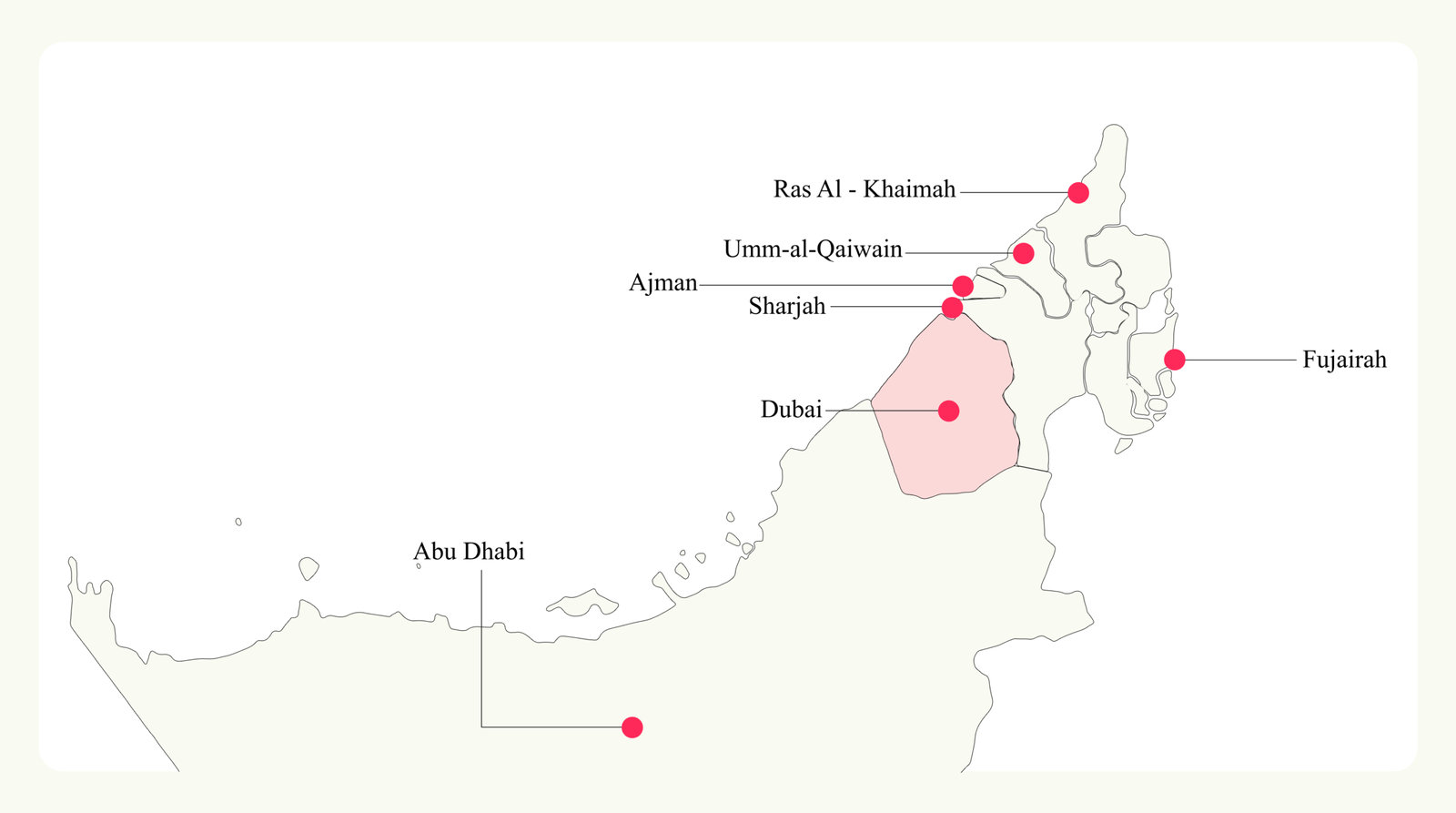
Our walk-in closet and fitted wardrobe teams serve every emirate in the UAE from our Dubai workshop, applying the same materials, hardware, and quality standards regardless of location.
- Dubai: We complete walk-in closet and wardrobe projects across Business Bay, DIFC, Dubai Marina, JBR, Downtown Dubai, Palm Jumeirah, Arabian Ranches, Emirates Hills, The Springs, The Meadows, The Lakes, Jumeirah Golf Estates, Jumeirah, Mirdif, Deira, Bur Dubai, Al Quoz, Dubai Silicon Oasis, Damac Hills, Akoya, Dubai South, and all other communities. Our Dubai installation teams typically operate on a same-week scheduling basis for new projects.
- Abu Dhabi: We serve residential and commercial wardrobe projects across Al Reem Island, Khalidiyah, Al Bateen, Corniche, Yas Island, Saadiyat Island, Al Mushrif, Khalifa City, Mohammed Bin Zayed City, and Abu Dhabi Island. Our Abu Dhabi projects include apartment wardrobes and full villa dressing rooms across the emirate’s premium residential addresses.
- Sharjah, Ajman, Ras Al Khaimah, Fujairah, and Umm Al Quwain: We serve residential and commercial wardrobe and closet projects across all northern emirates. Our teams travel with all equipment and components, so the service experience is equivalent to our Dubai operations. We’ve completed walk-in wardrobe projects in Sharjah’s Al Majaz and Corniche residences, Al Hamra Village in RAK, and Fujairah’s residential communities.
Start Your Walk-In Closet Project
A great walk-in closet starts with a conversation about how you actually live. Book a consultation with our design team and we’ll visit your property, take proper measurements, ask the right questions, and come back to you within 7-10 working days with a 3D rendered design and a fixed-price quotation — no obligation, no pressure.
We’ve been designing and building walk-in closets for Dubai and UAE clients since 1988. That experience is yours to draw on from the first meeting.
IF YOU HAVE ANY QUESTION? WE ARE GLAD TO
CONSULT YOU AS SOON AS POSSIBLE
Get Started
Immediate assistance from our team regarding your project details.
Form Submitted!
Thank you for contacting us. Our team will get back to you within 24 to 48 hours regarding your query.
Contact us on WhatsApp for Quick Response