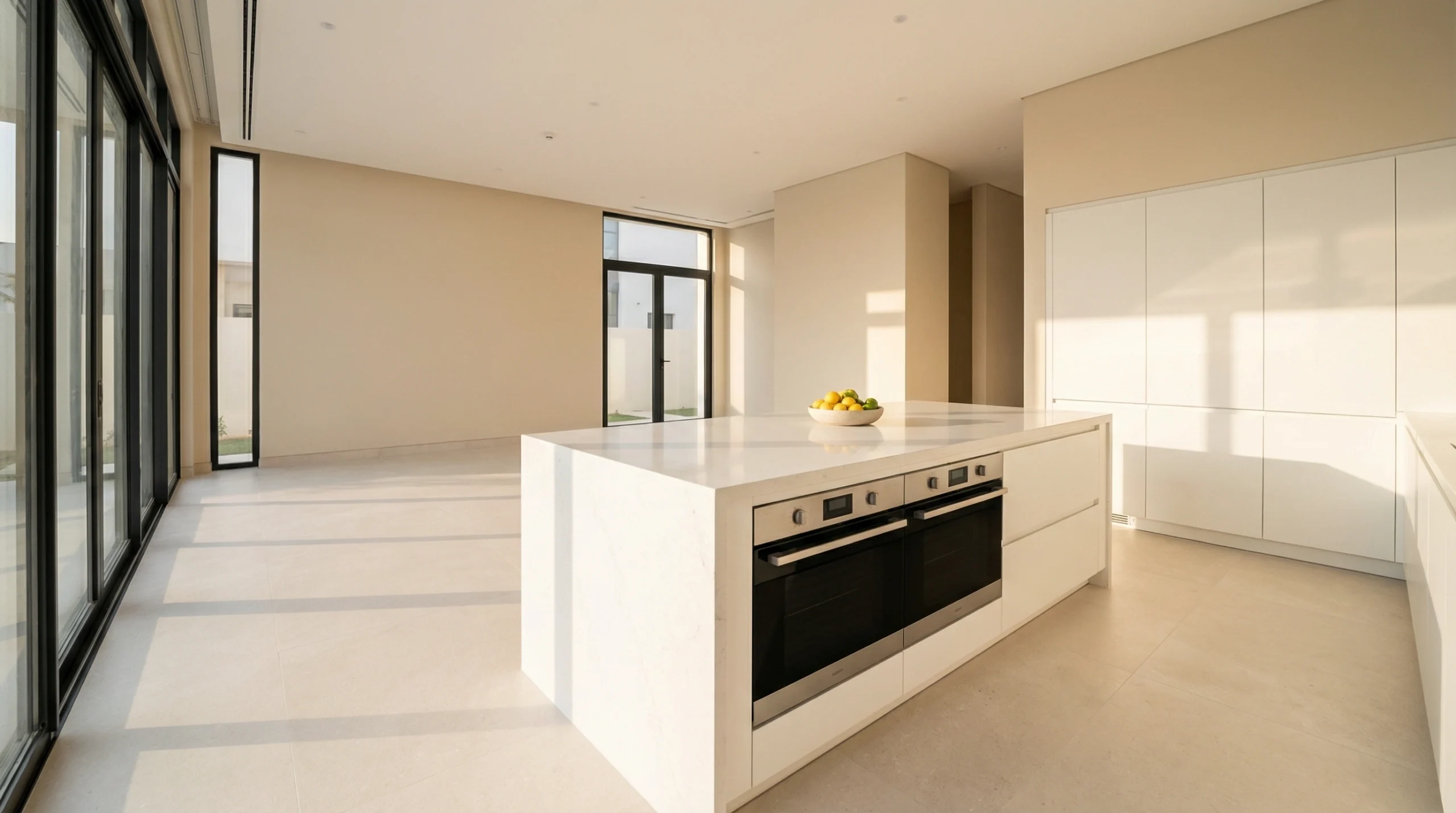
Transform Your Kitchen With Kitchen Island Dubai Built for UAE Living
Dubai’s most trusted carpentry workshop creates kitchen islands dubai that solve your space, storage, and style challenges—designed specifically for Emirates homes and climates.
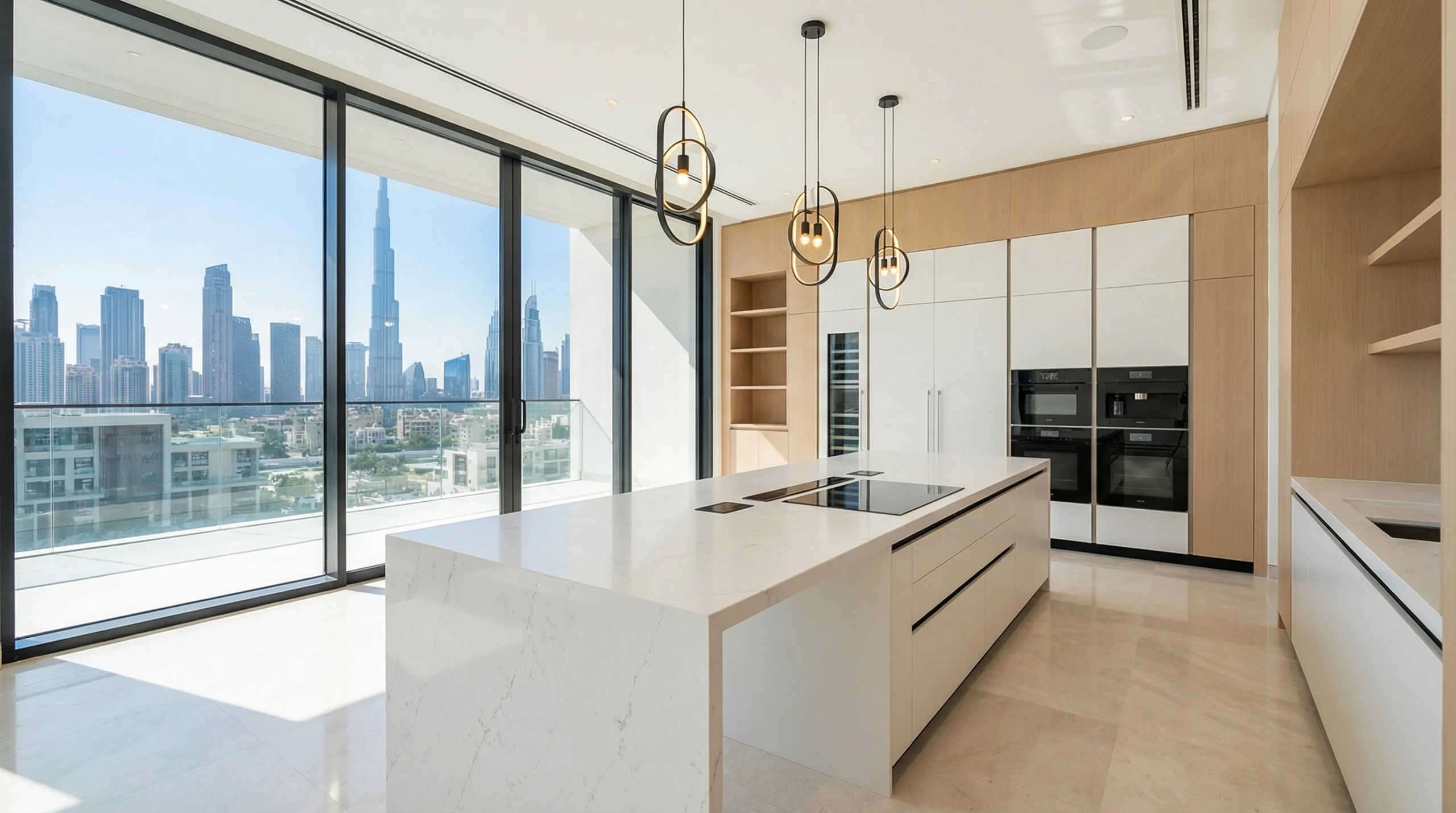
When you’re planning a custom kitchen island dubai, you’re making one of the most important decisions for your home’s functionality and value. The difference between a kitchen island table dubai that becomes your family’s gathering place and one that creates workflow problems comes down to understanding UAE-specific requirements—from humidity-resistant materials to Dubai Municipality specifications to power outlet positioning that meets Emirates Authority for Standardization regulations.
We’ve designed and installed over 2,400 kitchen island UAE since 1988. That experience means we know exactly which stone countertops withstand Dubai’s temperature fluctuations, which wood species resist coastal humidity in Marina apartments, and which configurations work best in the compact spaces common to Dubai’s mid-rise developments versus sprawling Emirates Hills villas.
Every project starts with understanding how you actually use your kitchen. We spend time learning whether you need serious prep space for daily cooking, a breakfast bar where kids eat before school, integrated appliances for entertaining, or a combination that serves multiple purposes throughout the day.
Understanding Kitchen Island Dubai Design for UAE Homes
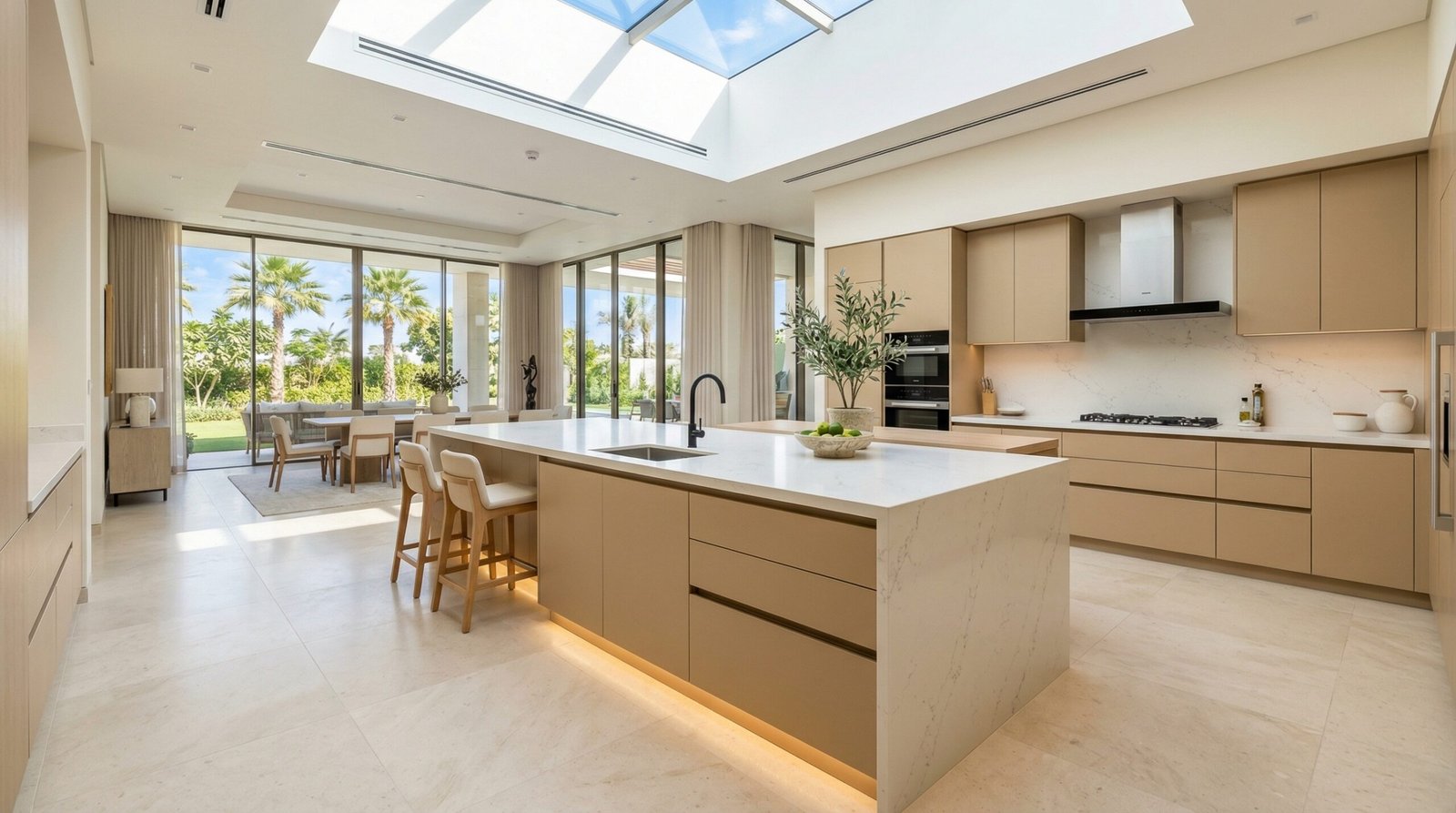
The kitchen island dubai design process for Emirates properties differs significantly from international standards, and those differences determine whether your investment delivers lasting value or creates expensive problems. Dubai’s climate subjects kitchen materials to humidity levels that fluctuate between 30% and 90% within the same week during seasonal transitions. Interior temperatures can swing 15 degrees when air conditioning cycles. Cabinet materials that perform flawlessly in European or North American homes can warp, crack, or delaminate within months here.
We approach every kitchen island dubai as an engineering challenge first, aesthetic opportunity second. The structural foundation needs to account for stone countertops weighing 180-250 kilograms, appliance loads, and the reality that residents will lean on, sit on, and use the island in ways beyond its designed purpose. Your island must also integrate seamlessly with existing kitchen workflow patterns while meeting the specific electrical and plumbing codes enforced by Dubai Municipality and DEWA.
Material Selection for Emirates Climate Conditions
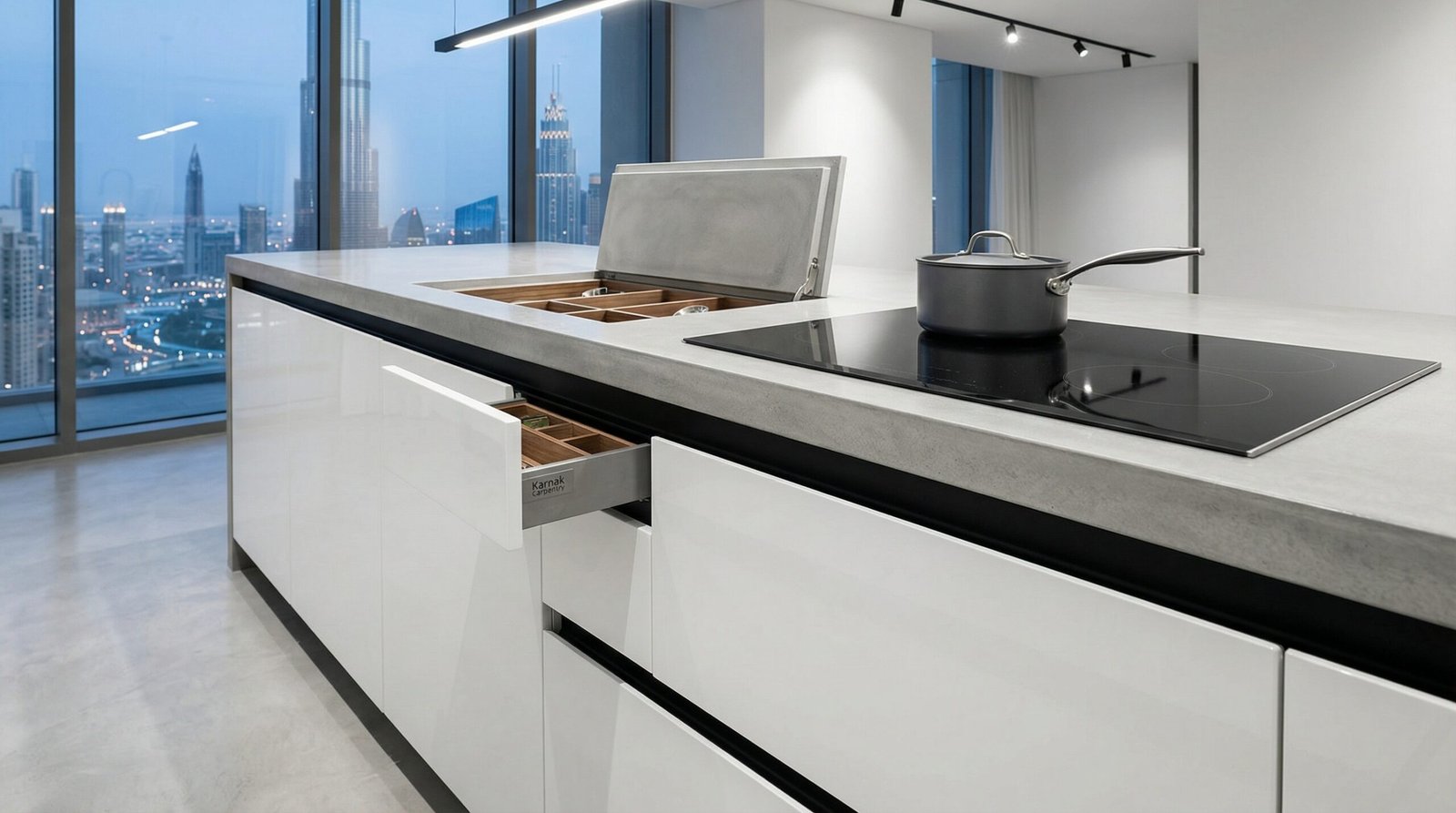
The materials we specify for your kitchen island dubai directly impact its performance over the 15-20 year lifespan you should expect from quality carpentry. Solid wood construction sounds premium, but in UAE conditions it requires specific species and preparation. We work primarily with European oak, American walnut, and select hardwoods that have been kiln-dried to 8-10% moisture content, then acclimatized in our climate-controlled workshop for minimum 30 days before fabrication begins.
Marine-grade plywood forms the structural core of most islands we build. This 18mm or 25mm substrate uses phenolic resin adhesives that maintain bond strength despite humidity exposure. The plywood undergoes moisture barrier treatment before any veneer or solid wood facing gets applied. For lower cabinets and hidden structural elements, we specify moisture-resistant MDF with density ratings above 720 kg/m³—considerably denser than standard MDF used in temperate climates.
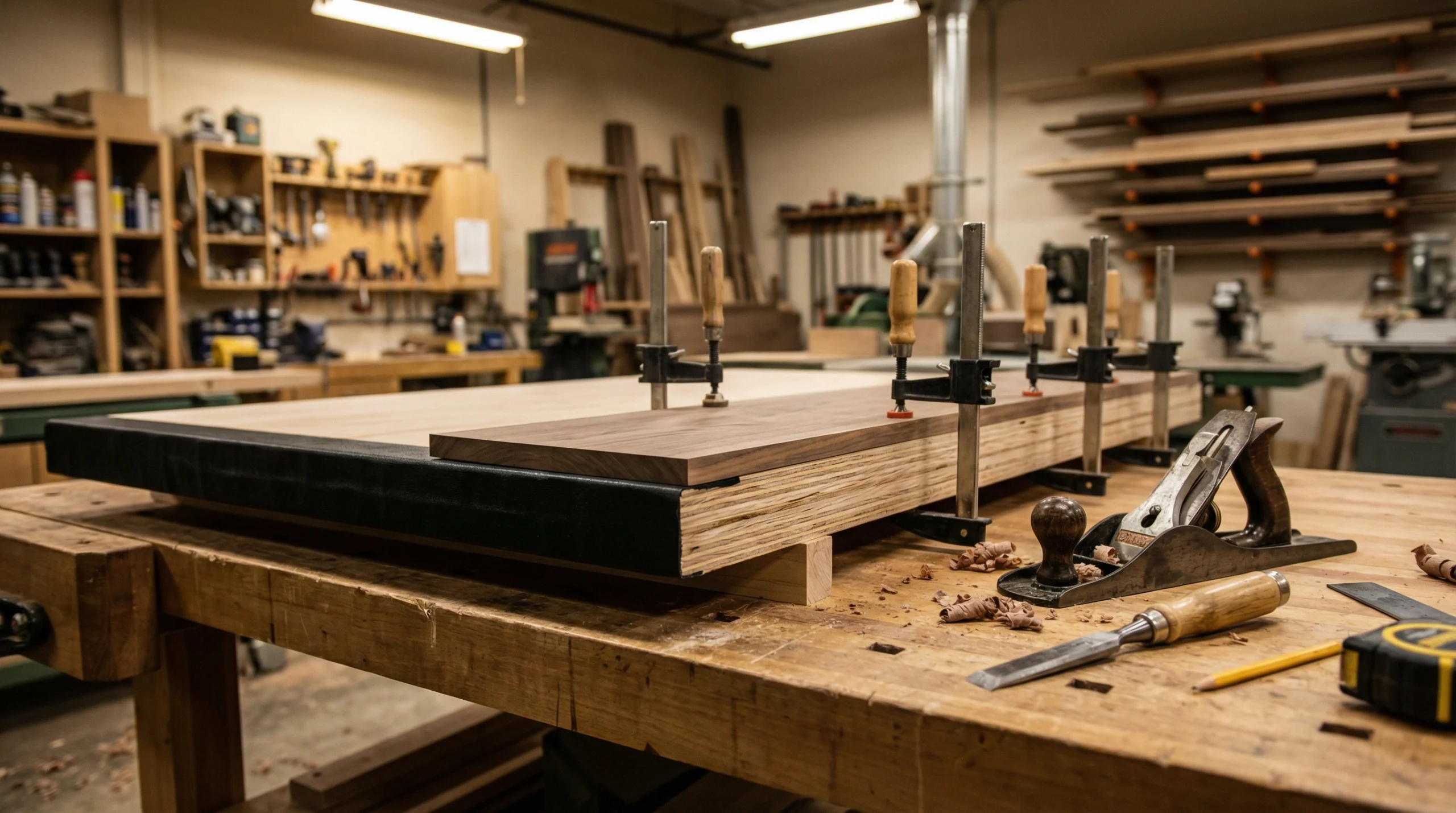
Stone countertops present their own complexity. Granite remains popular for its durability and heat resistance, essential when someone sets a hot pan directly on the surface despite knowing better. Quartz engineered stone has gained preference for its non-porous surface that resists staining from turmeric, pomegranate juice, and the other ingredients that feature in UAE kitchens. Marble creates stunning visual impact but requires realistic expectations about maintenance—it will etch and patina over time, which some clients love and others can’t tolerate.
Structural Engineering and Load Distribution
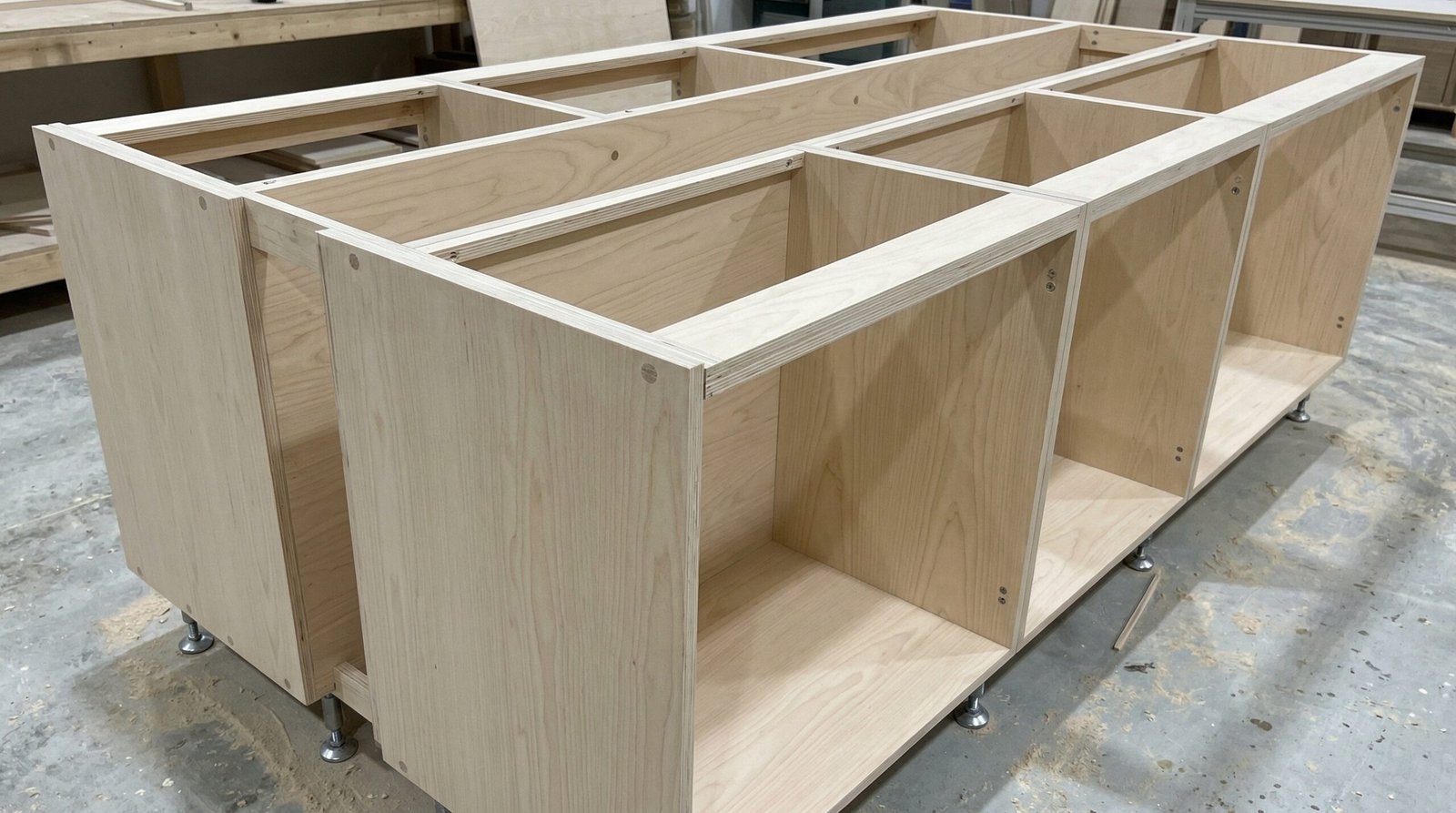
Kitchen island dubai that fail typically do so because structural requirements were underestimated during design. A standard quartz countertop measuring 2400mm x 1000mm weighs approximately 190 kilograms. Add an integrated sink, a dishwasher (40kg), wine fridge (50kg), and you’re supporting 300+ kilograms before anyone places a pot on the surface or leans against the edge while cooking.
The support framework we engineer uses 45mm x 70mm solid wood posts at maximum 600mm spacing, with cross-bracing every 800mm. This creates a rigid structure that eliminates flexing and the stress cracks that appear in stone countertops when support proves inadequate. Corner joints use mortise and tenon construction reinforced with structural adhesive and dowels—no reliance on mechanical fasteners that loosen over time.
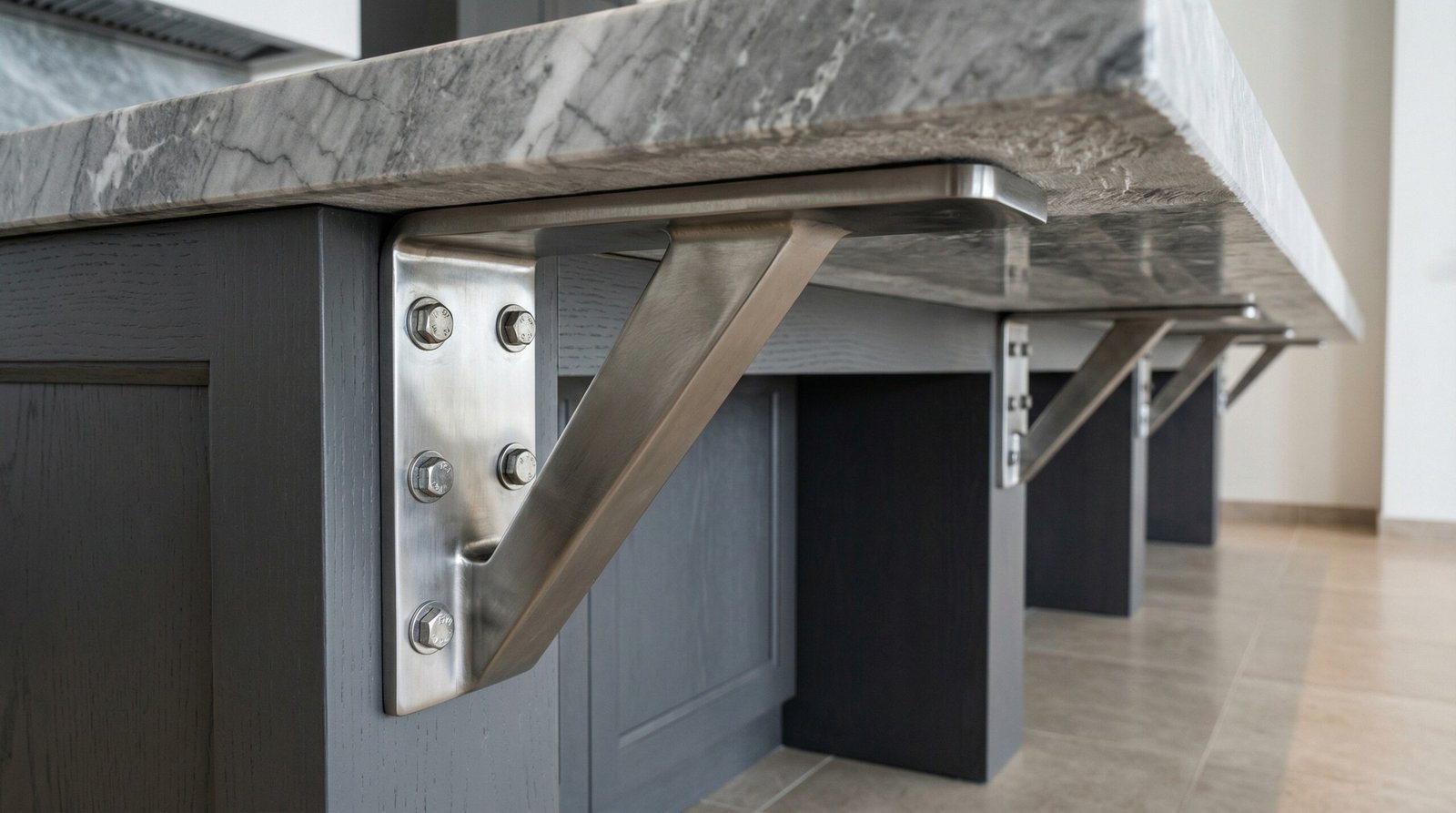
For kitchen island dubai incorporating seating areas, cantilever design becomes critical. A breakfast bar overhang supporting adults seated on stools requires steel reinforcement bar embedded into both the cabinetry structure and the stone countertop substrate. We’ve seen DIY installations and budget contractors skip this reinforcement, resulting in cracked countertops within months when the cantilevered section flexes under normal use.
Power, Plumbing, and Appliance Integration
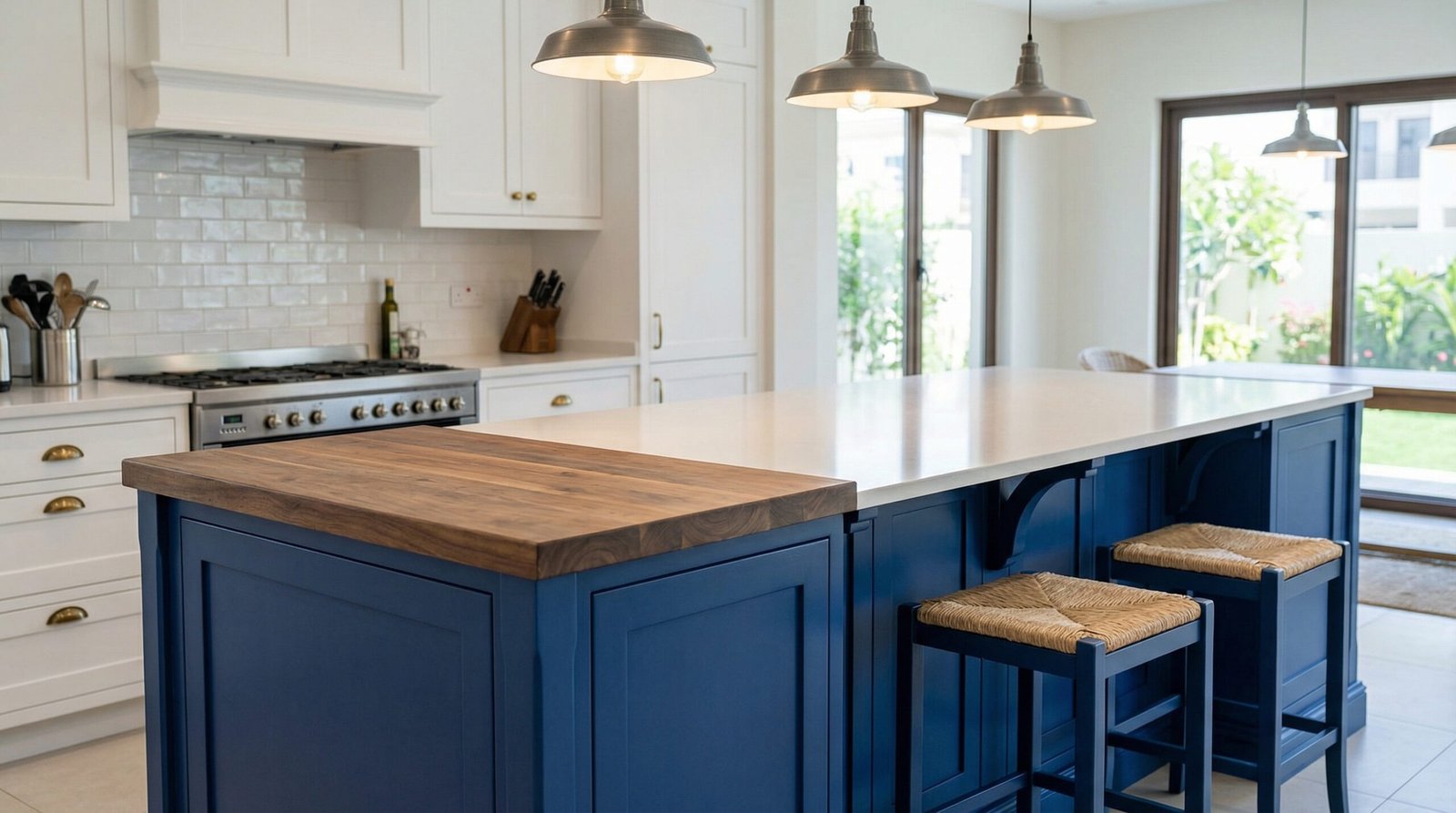
Electrical outlet placement on kitchen island dubai must satisfy both DEWA requirements and practical workflow needs. Code requires GFCI protection on all outlets within 1.8 meters of water sources. We typically install a combination of standard outlets positioned on the island ends (never on seating sides where they create visual clutter) plus pop-up outlet boxes that remain hidden until needed, then extend from the countertop surface.
Islands that incorporate sinks need proper plumbing venting to prevent drainage problems and trap seal failure. The UAE’s plumbing code follows British Standards with local amendments, requiring adequate trap seal depth and proper vent sizing. We coordinate with licensed plumbers to ensure vent pipes route correctly through floor systems—particularly complex in upper-floor apartments where structural elements limit routing options.
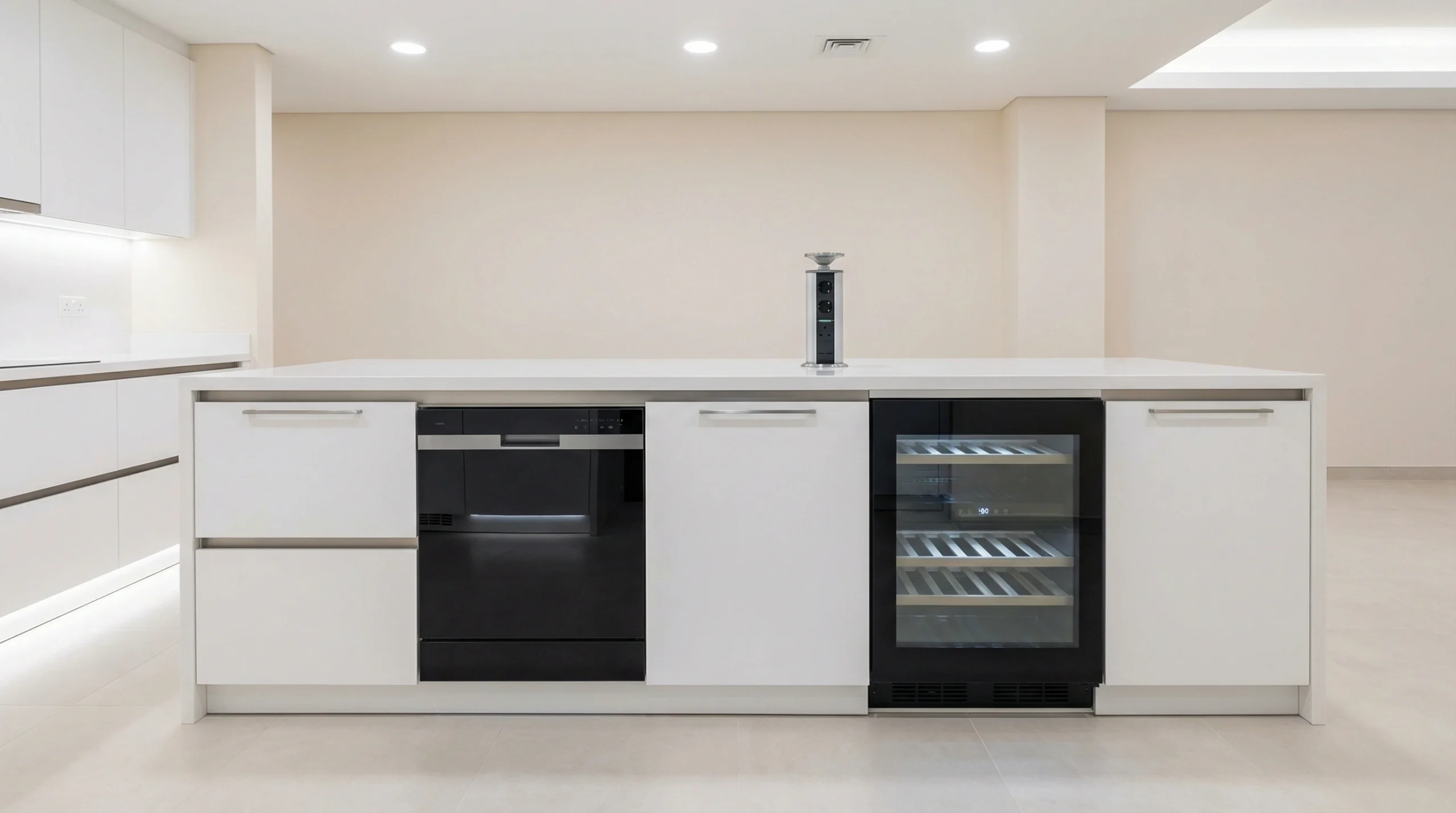
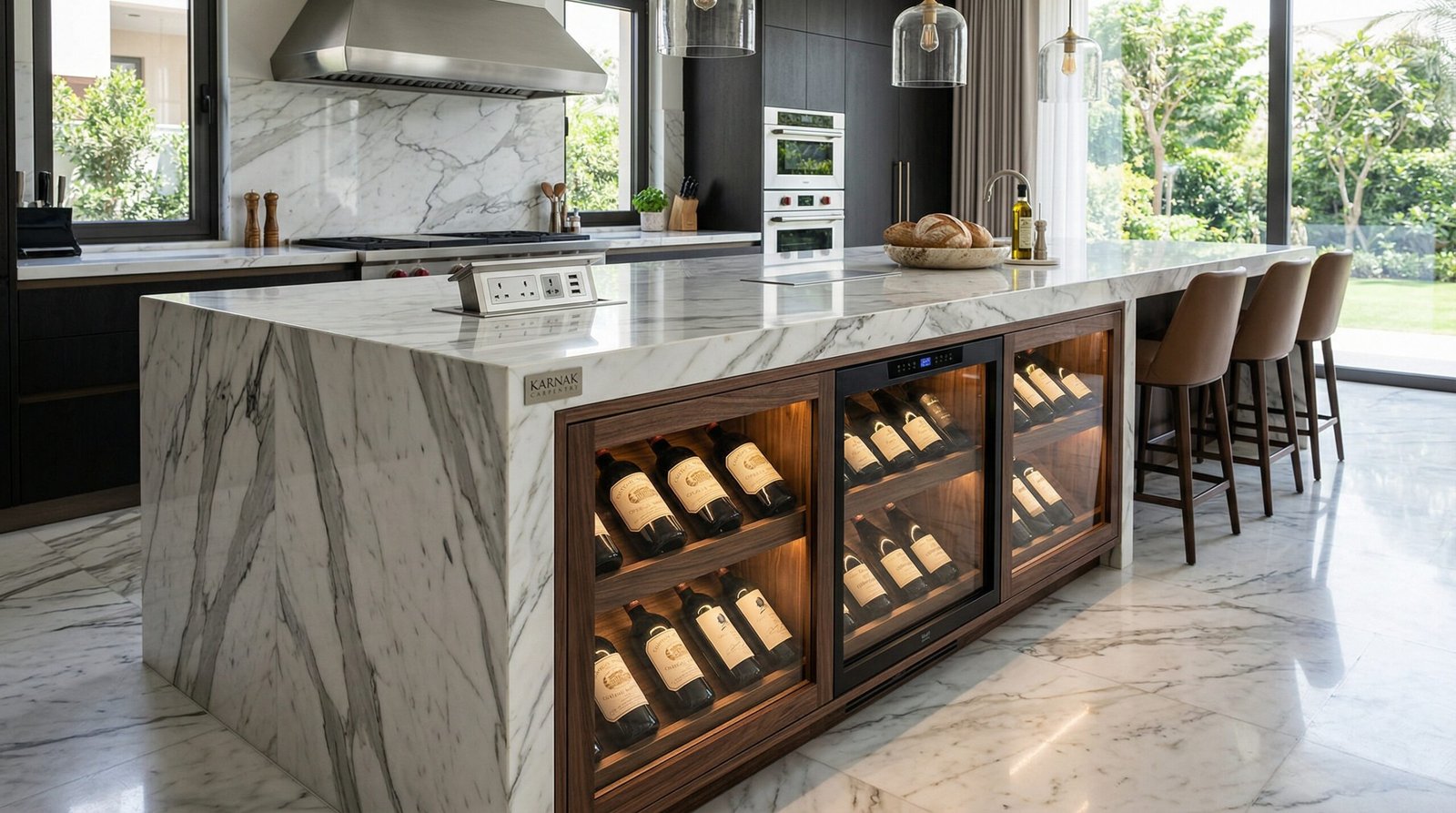
Integrated appliances transform islands into true kitchen command centers. Dishwashers installed in islands need careful acoustic planning because the appliance sits in the middle of your living space rather than tucked against an exterior wall. We specify low-noise models (43-46 dB) and add acoustic dampening panels in the cabinet cavity. Wine fridges and beverage centers need adequate ventilation clearance—manufacturers specify requirements, but installation reality in Dubai’s temperatures often demands more aggressive ventilation than spec sheets suggest.
Kitchen Island Dubai Styles That Work in UAE Properties
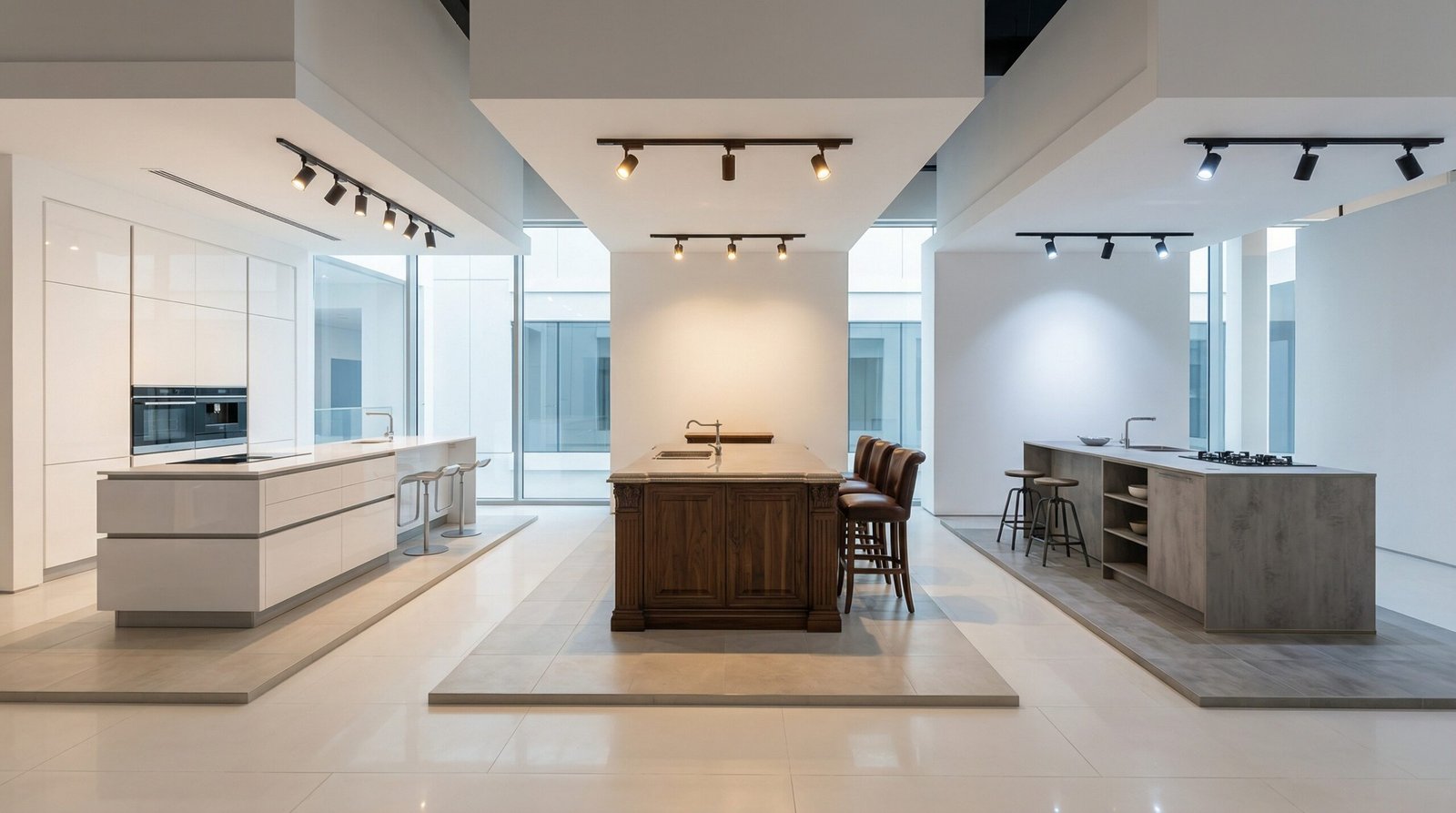
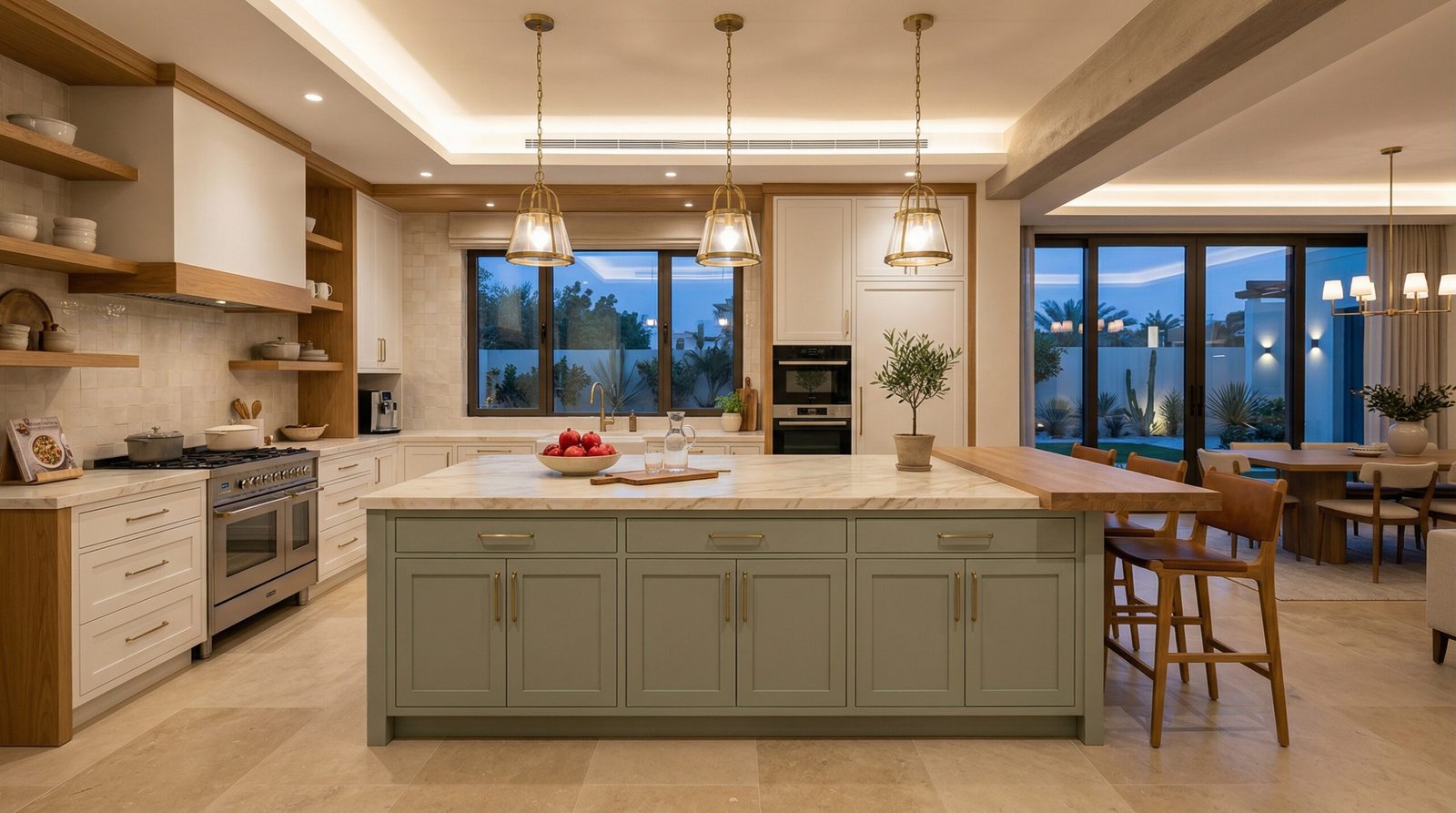
Style selection for your kitchen island dubai shouldn’t be a Pinterest-driven decision disconnected from how UAE homes actually function. The open-plan layouts common in Dubai apartments and villas since 2010 mean your island sits prominently visible from living and dining areas. It’s architectural furniture, not just kitchen equipment. The style you choose communicates throughout your entire ground floor or main living level.
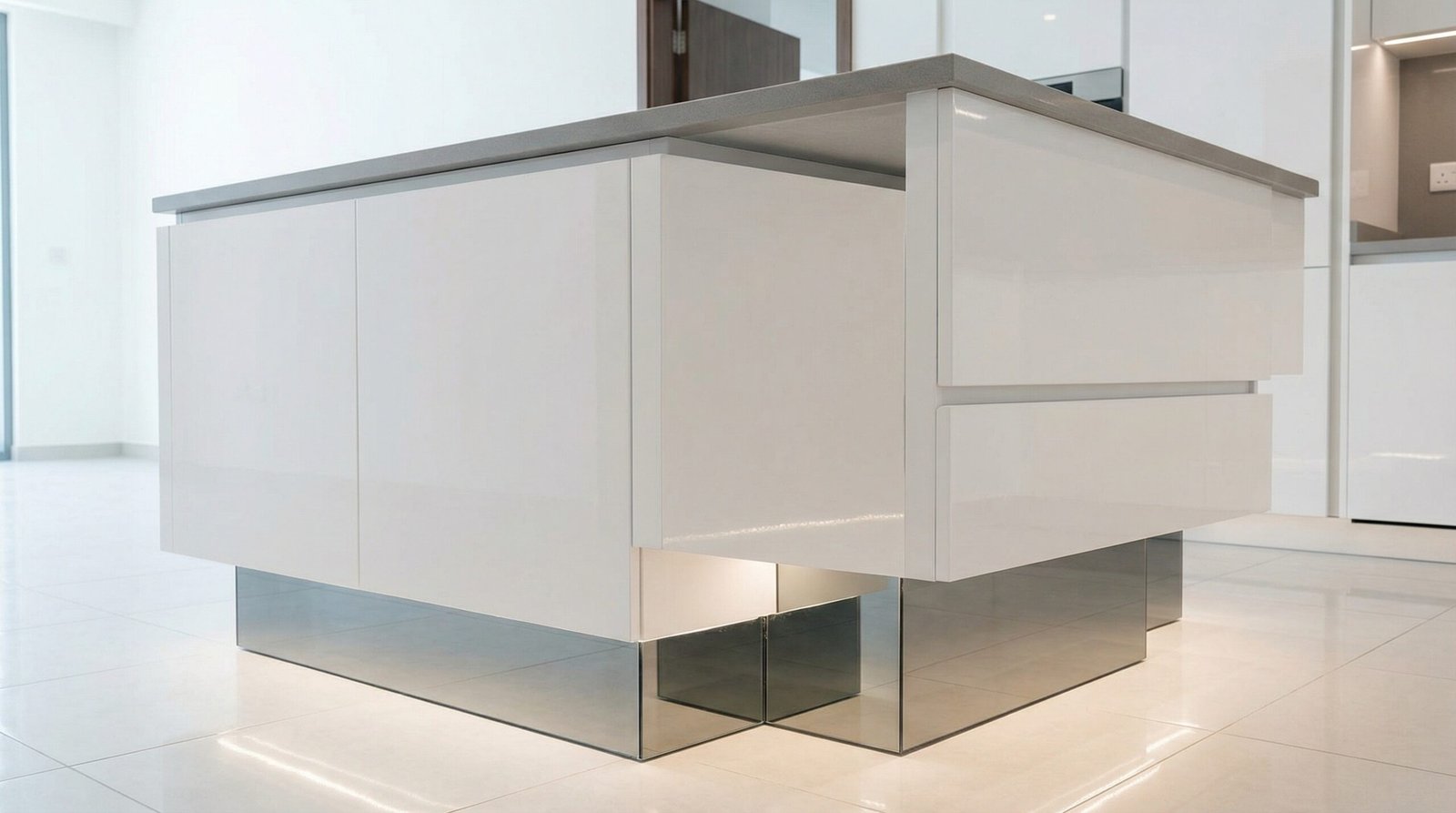
Contemporary minimalist designs dominate recent projects we’ve completed, particularly in newer developments like Business Bay, City Walk, and Dubai Hills Estate. These islands feature handleless cabinets with push-to-open mechanisms, flat-front door panels, and countertops with minimal edge profiling. The aesthetic reads clean and uncluttered—important when the island anchors an open space that serves multiple functions throughout the day.
Contemporary Minimalist Islands
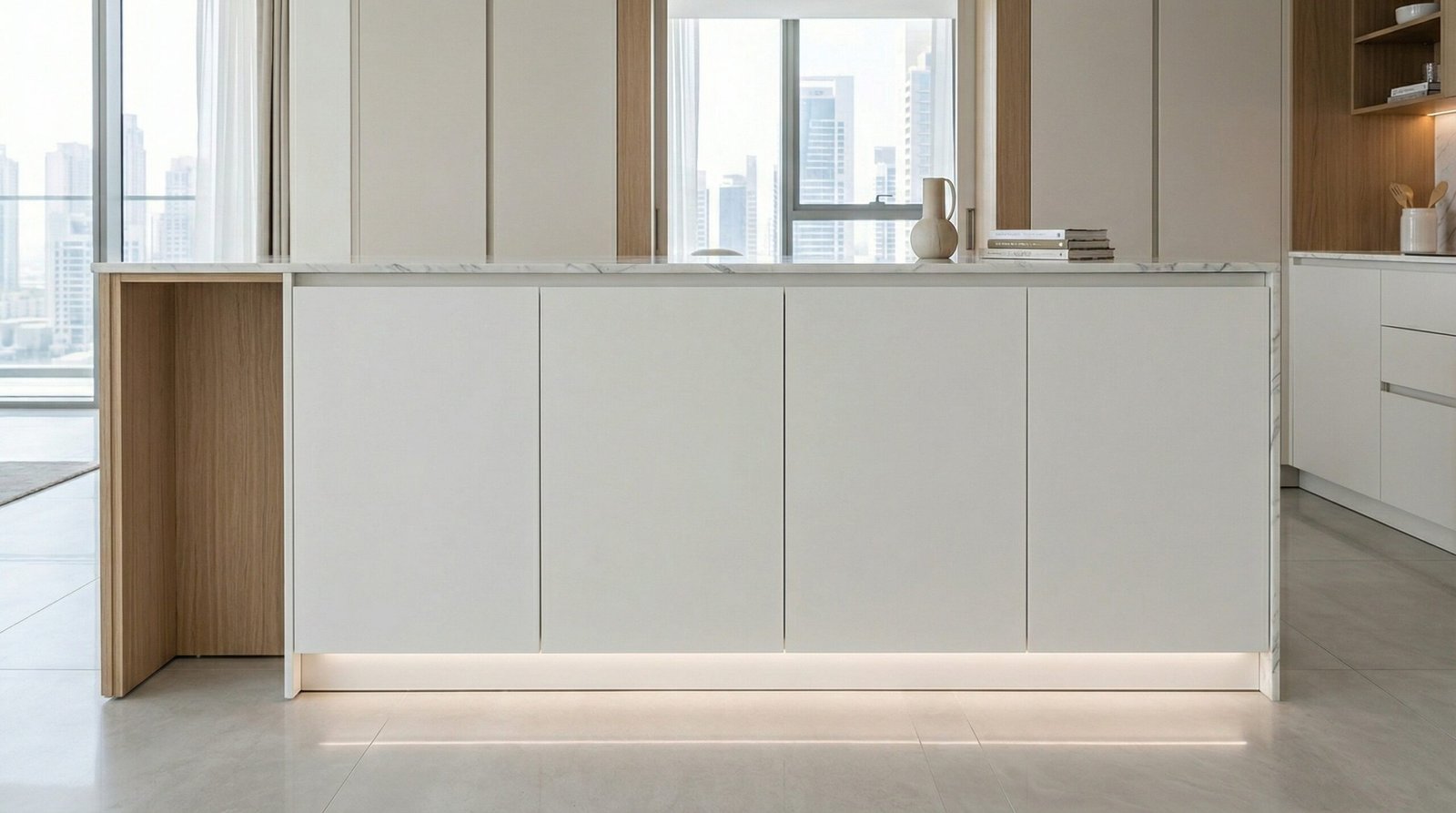
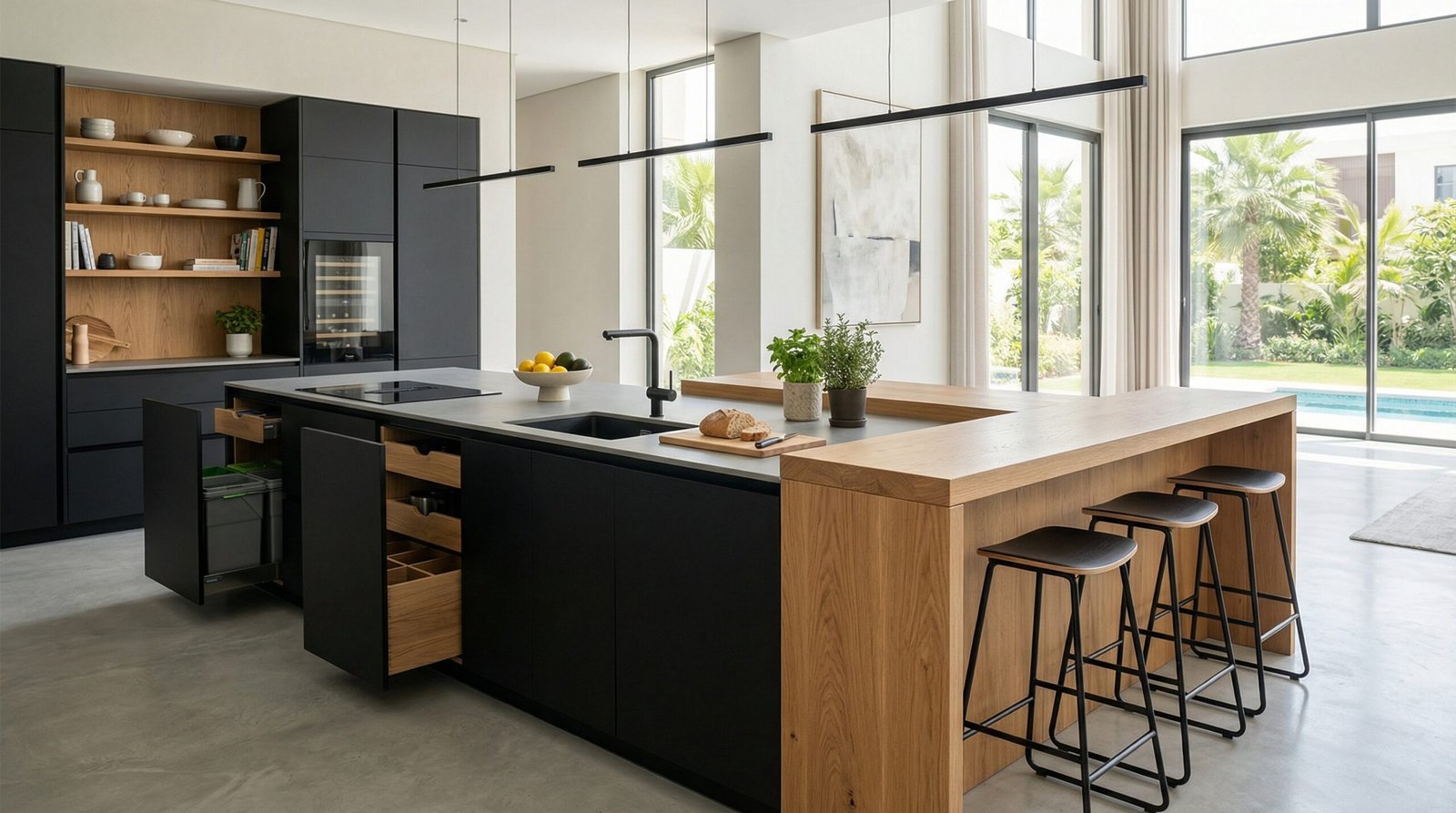
Contemporary design philosophy in kitchen island dubai emphasizes horizontal lines, flush surfaces, and restrained color palettes. We fabricate these islands using slab-style cabinet doors with integrated J-channel handles or push-to-open hardware that eliminates visible pulls entirely. The result appears furniture-grade rather than utilitarian kitchen cabinetry.
Material selection reinforces the minimalist aesthetic. High-gloss lacquered finishes in whites, grays, and neutral tones reflect light and create the impression of larger space—particularly valuable in apartments where kitchen and living areas share 40-50 square meters. Matte lacquer finishes have gained popularity for their sophisticated appearance and superior resistance to showing fingerprints, an important practical consideration in family homes.
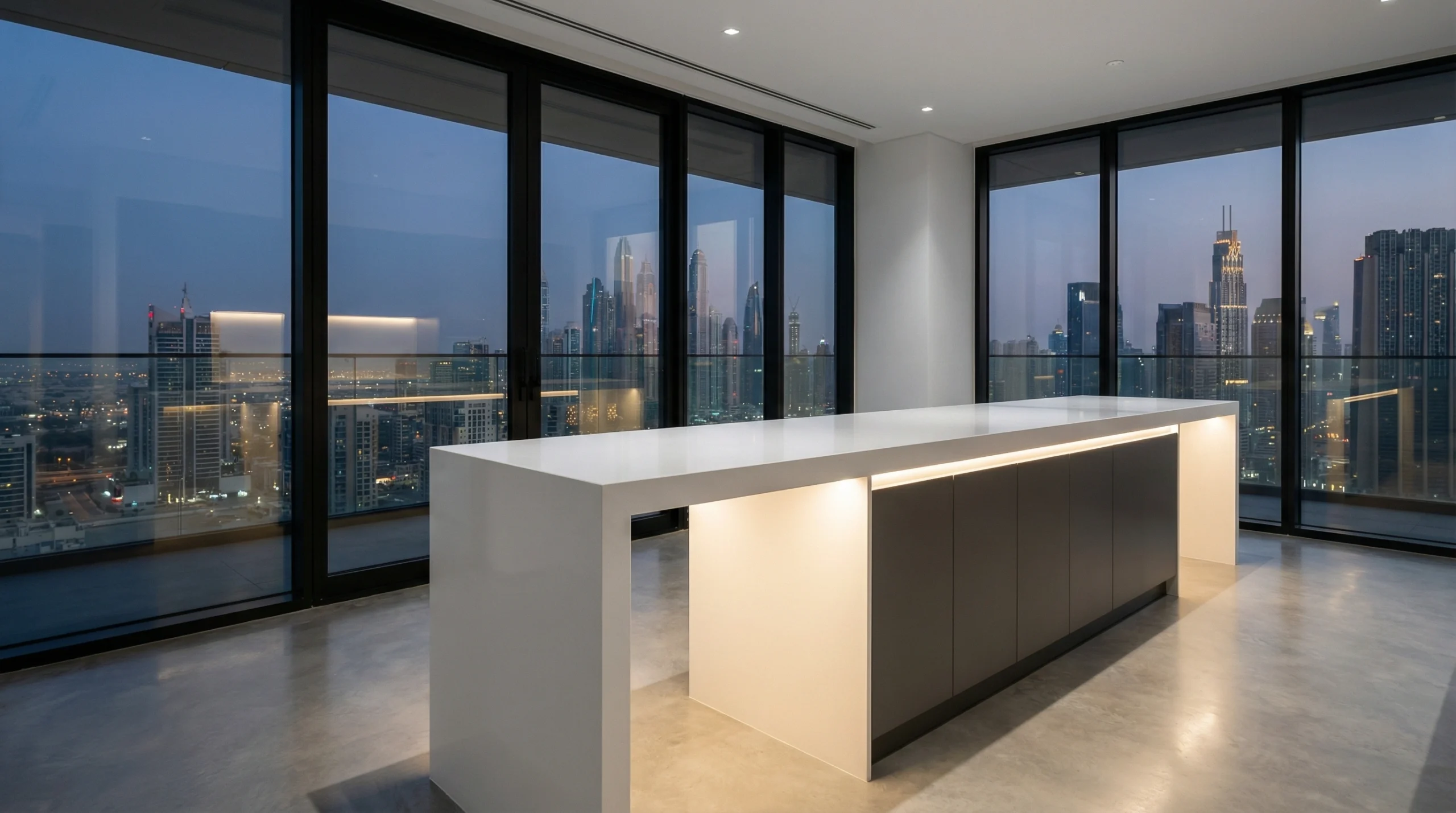
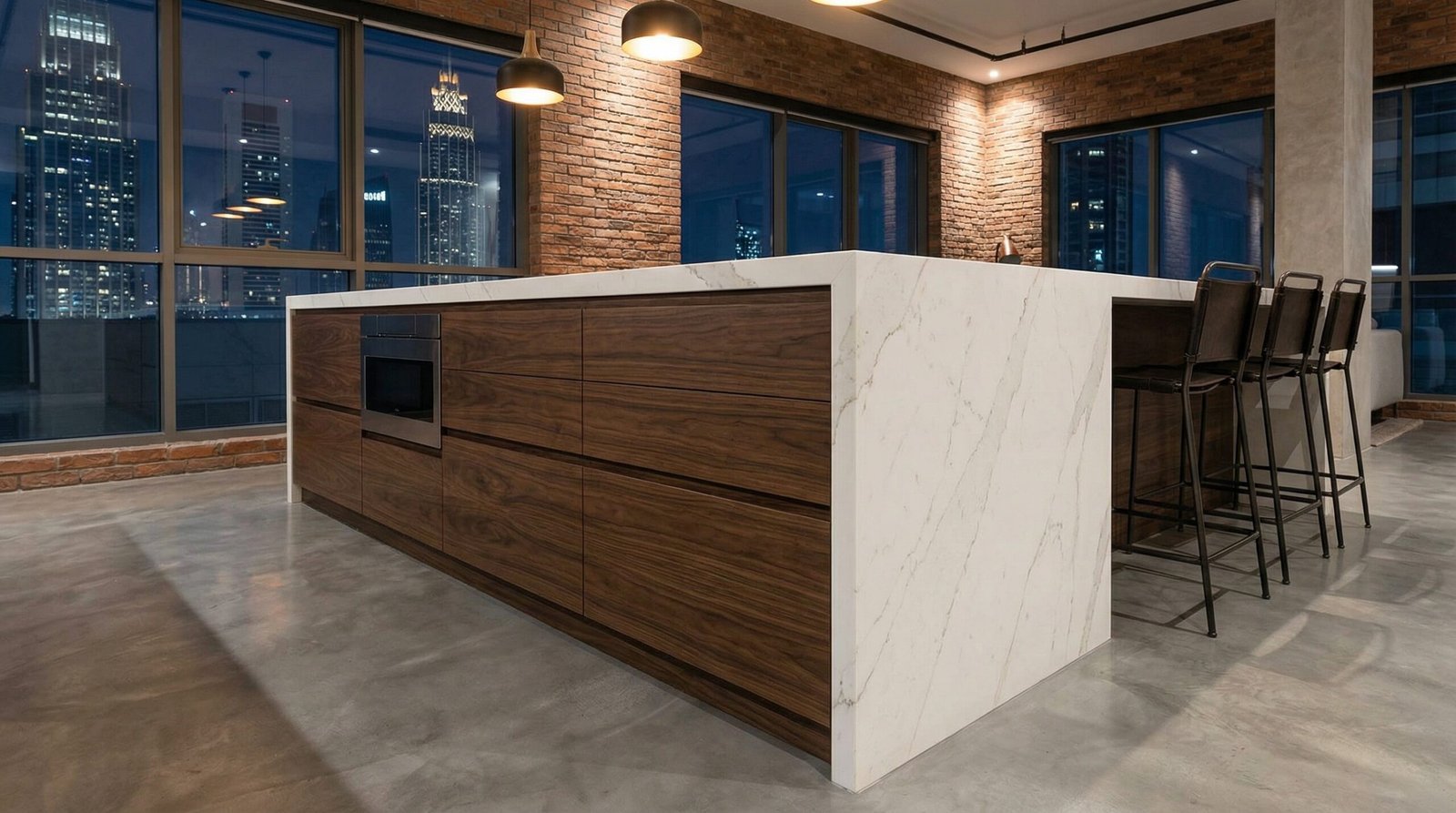
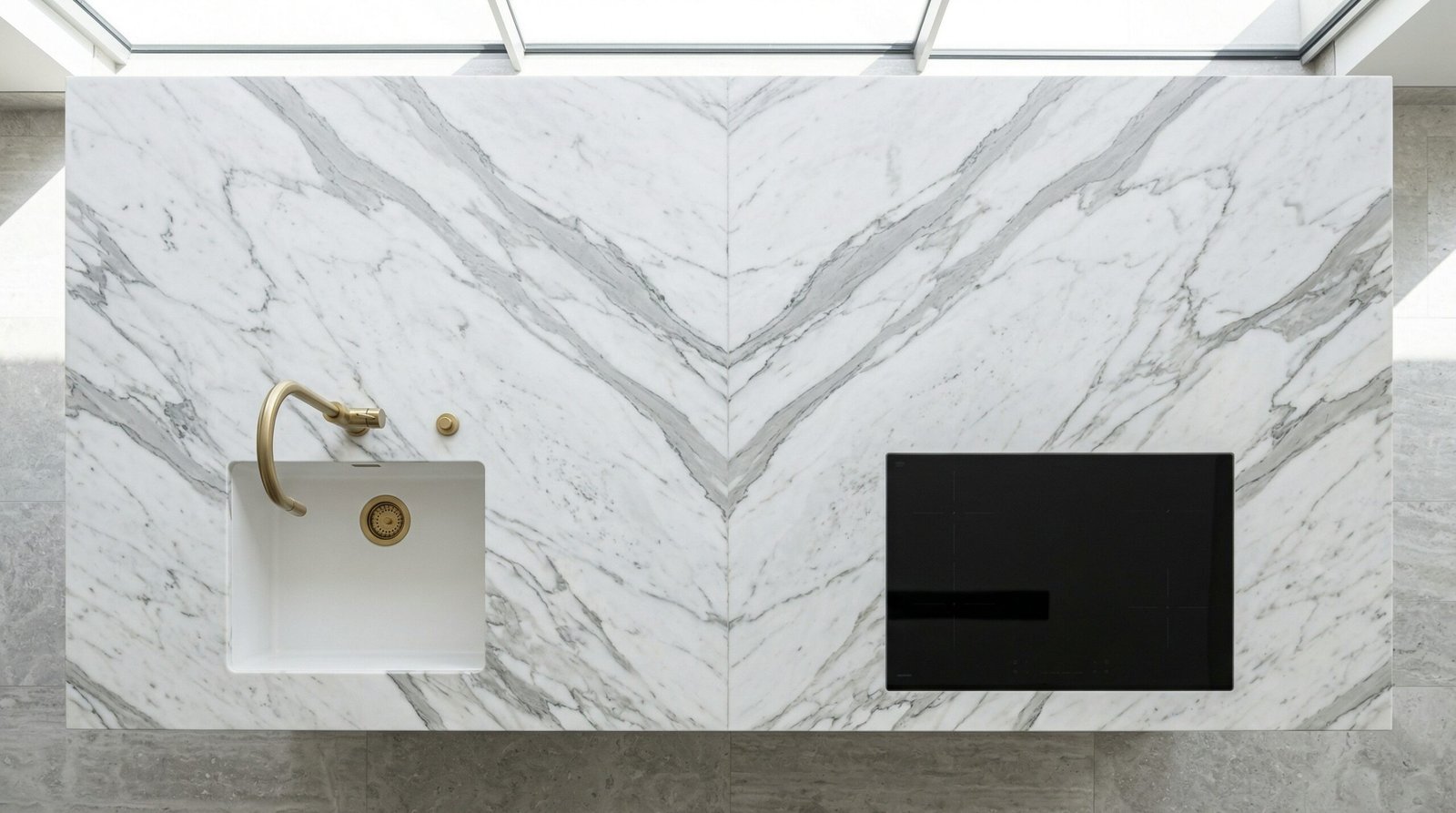
Waterfall edge countertops—where the stone surface continues vertically down the island ends—define contemporary luxury in current UAE design trends. This detail costs 30-40% more than standard countertop edges because it requires book-matched stone pieces and precise mitering, but the visual impact justifies the investment for clients focused on creating statement pieces. The continuous stone surface emphasizes material quality and craftsmanship while protecting the cabinet ends from damage.
Traditional and Transitional Designs
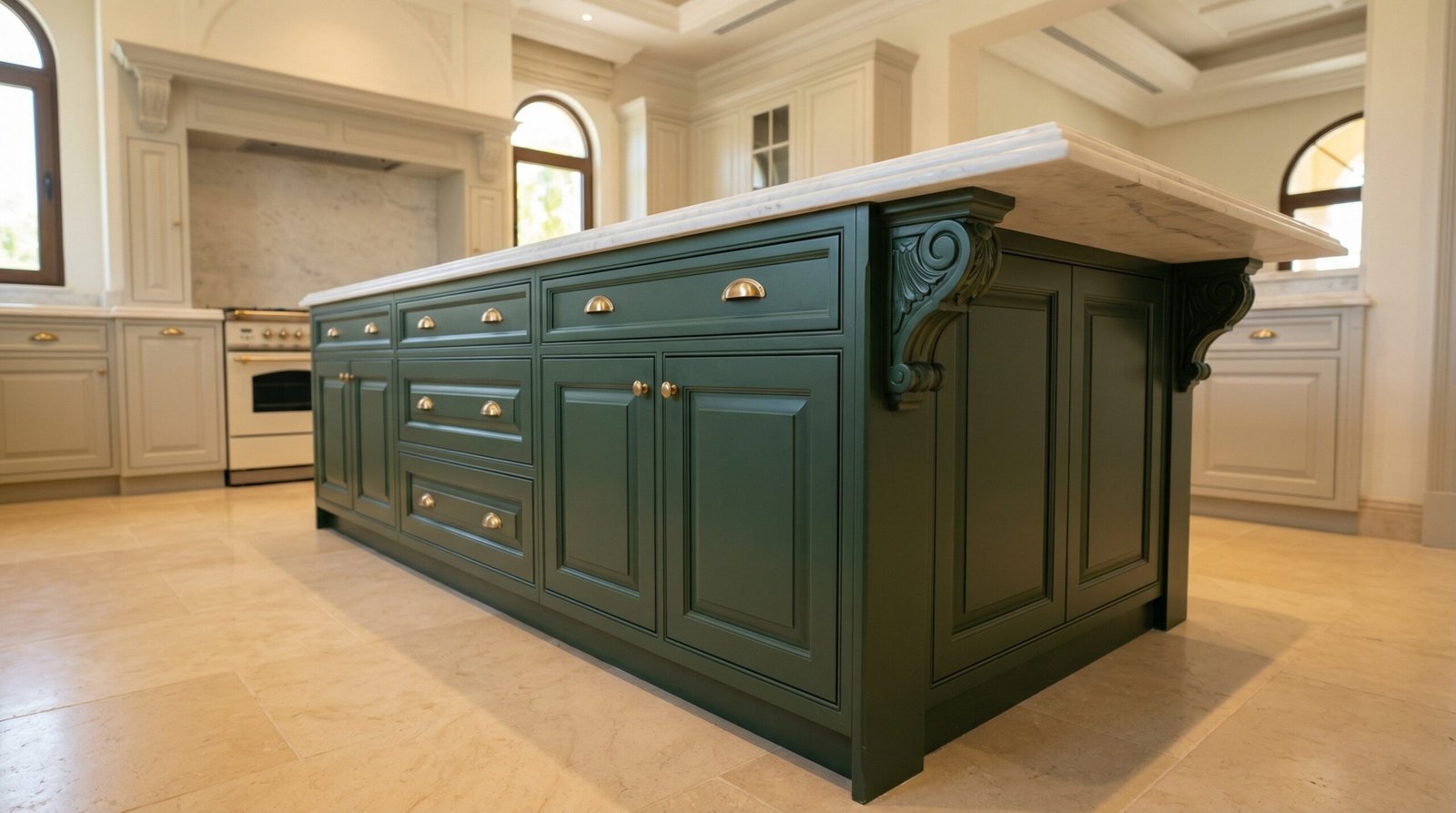
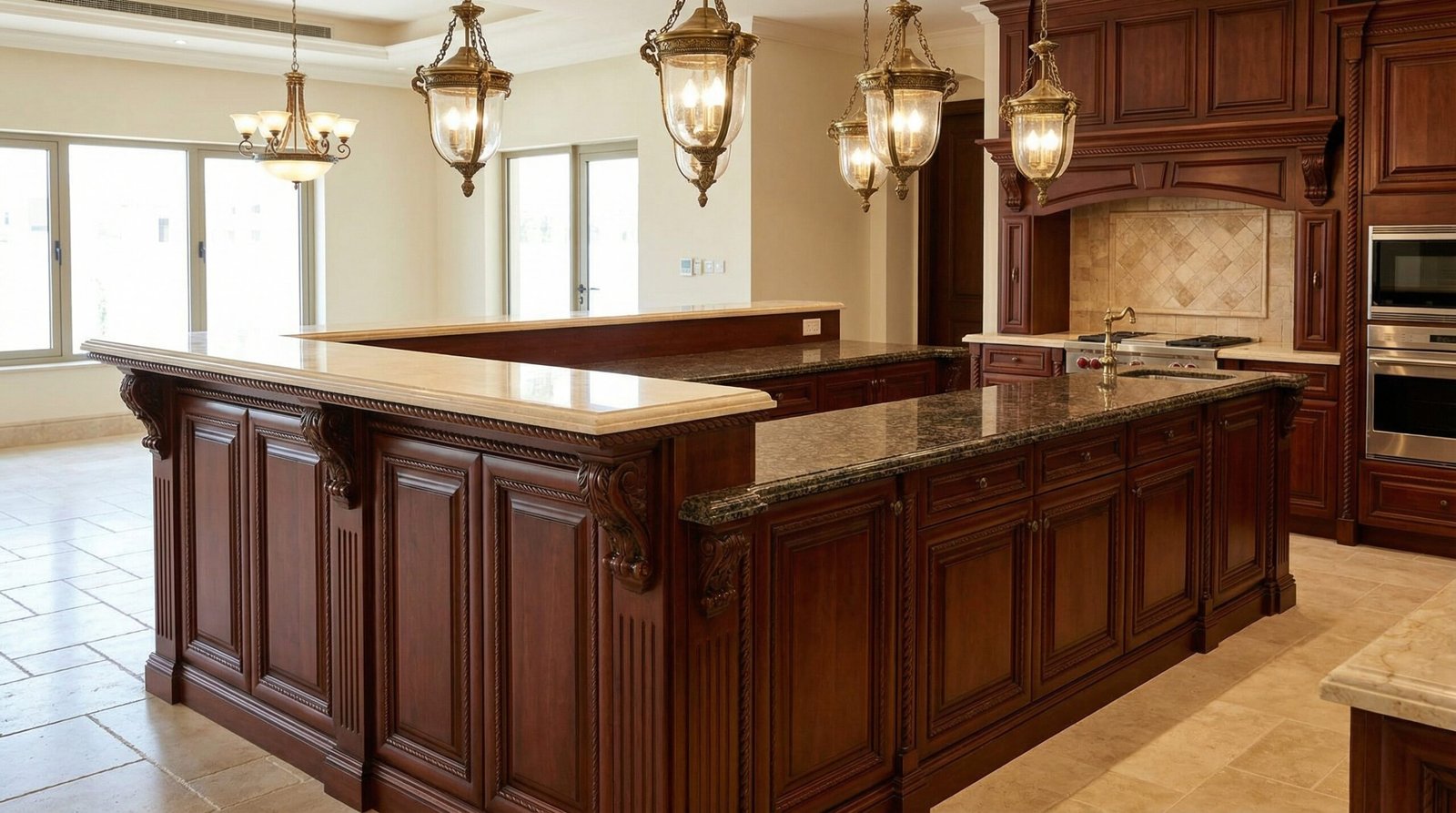
Traditional kitchen island dubai bring architectural detail and visual warmth that suits villa properties, particularly in established communities like Arabian Ranches, The Springs, and Jumeirah where architectural styles reference classical influences. These islands incorporate raised panel doors, decorative corbels supporting countertop overhangs, furniture-style feet, and turned posts that create visual weight and substance.
The construction techniques for traditional islands demand different skills than contemporary work. Raised panels require precise dimensioning so seasonal wood movement doesn’t create gaps or binding. We mill these components in our workshop using shapers and routers, then finish sand to 220 grit before any finish application begins. The profiles we cut reference classical furniture design—ogee edges, roundovers, beaded details—creating shadow lines and texture absent from flat contemporary surfaces.
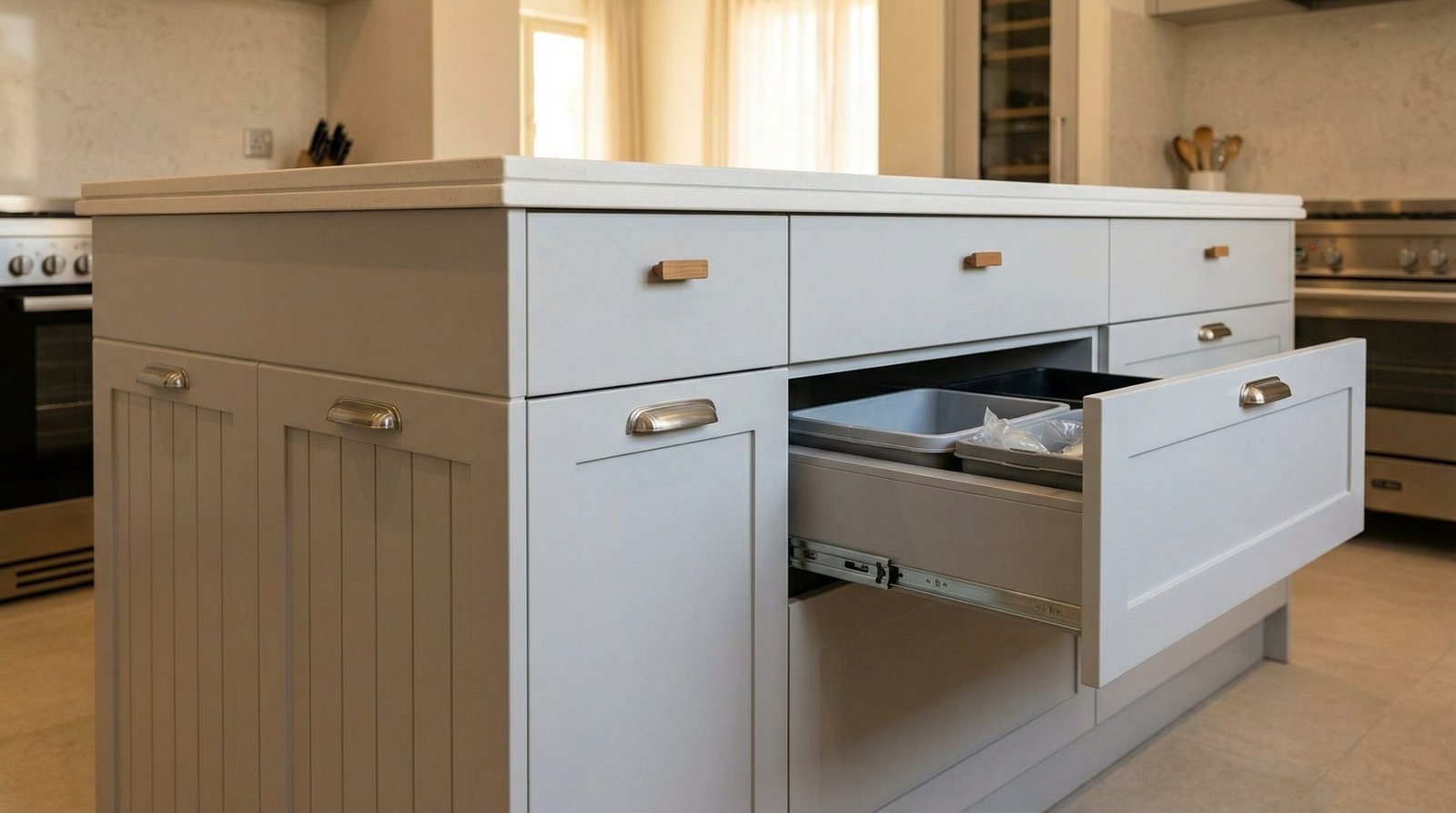
Transitional design bridges contemporary and traditional, combining clean lines with subtle traditional references. A transitional island might use flat-front Shaker-style doors rather than fully raised panels, simple edge profiles instead of elaborate moldings, and restrained decorative elements that nod to traditional design without committing fully. This approach works well for clients who find pure contemporary too stark but don’t want full traditional detailing.
Wood species selection dramatically impacts traditional and transitional aesthetics. Cherry develops rich amber tones with age and UV exposure. Walnut offers dramatic grain figure and chocolate brown coloring. Oak provides pronounced grain texture and durability. For traditional work, we often apply glazing techniques that add depth and age simulation to the finish—a multi-step process involving base stain, sealer, glaze application in recesses, and final protective topcoat.
Arabic and Culturally-Inspired Designs
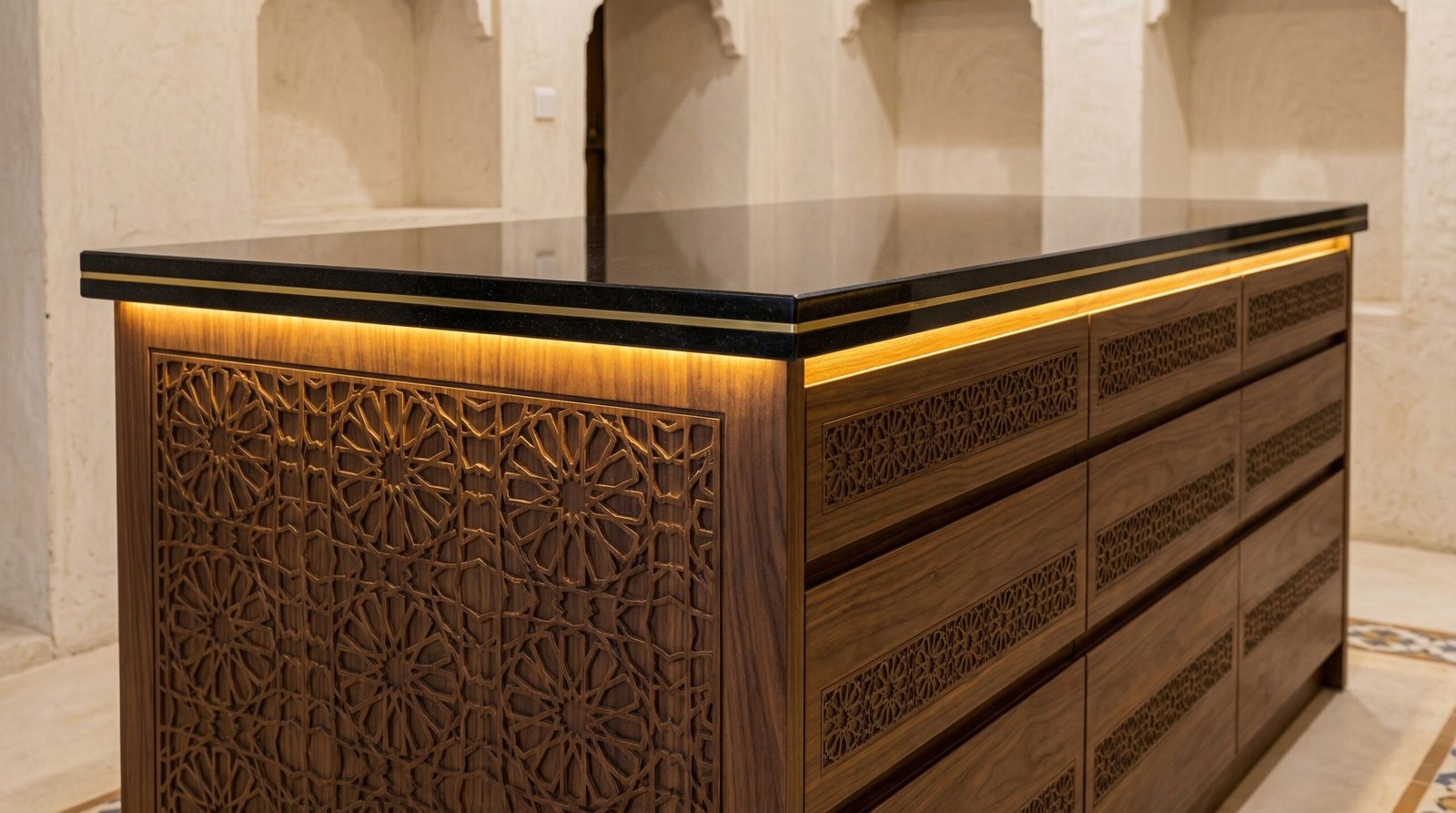
Kitchen island dubai that incorporate Arabic design elements create distinctive spaces that honor regional cultural heritage while meeting modern functional requirements. We’ve completed several projects integrating mashrabiya-inspired patterns into island cabinet doors and side panels—the traditional latticed screens that filtered light and provided privacy in historical architecture now reinterpreted in contemporary materials.
Geometric patterns fundamental to Islamic art translate beautifully to kitchen island uae design. We’ve fabricated cabinet doors featuring laser-cut metal panels with intricate geometric repeating patterns, backlit with LED strips to create dramatic visual effects. These panels use powder-coated aluminum or brass-finished steel that introduces metallic accents while maintaining durability in kitchen environments.
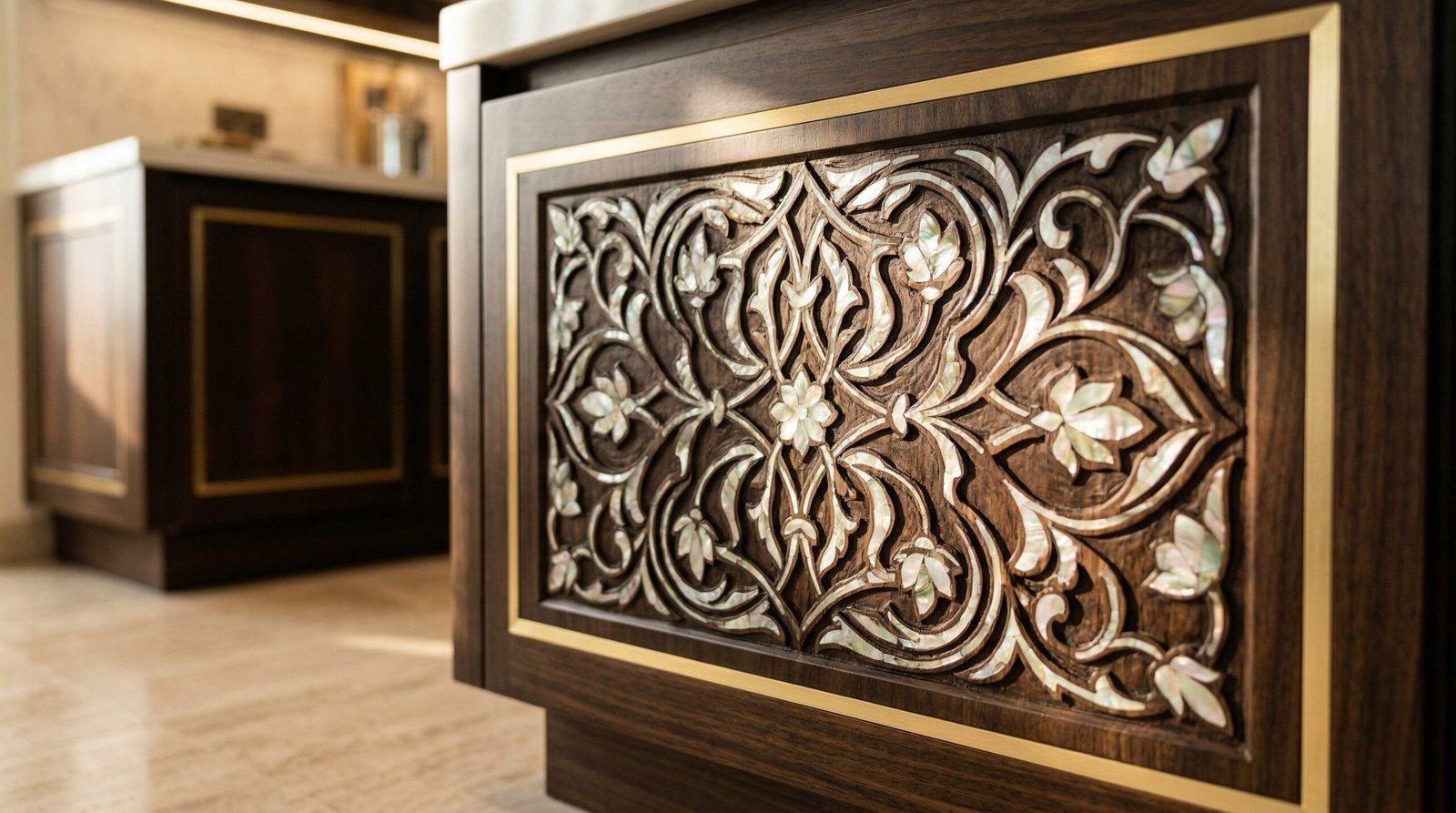
Calligraphy integration presents a more personal design opportunity. Several clients have commissioned custom islands incorporating Arabic script phrases meaningful to their families—verses from poetry, family names, or inspirational sayings. We work with local artists to create the calligraphy designs, then execute them through various techniques: carved wood panels, metal inlay work, or stone relief carving in the island’s structural side panels.
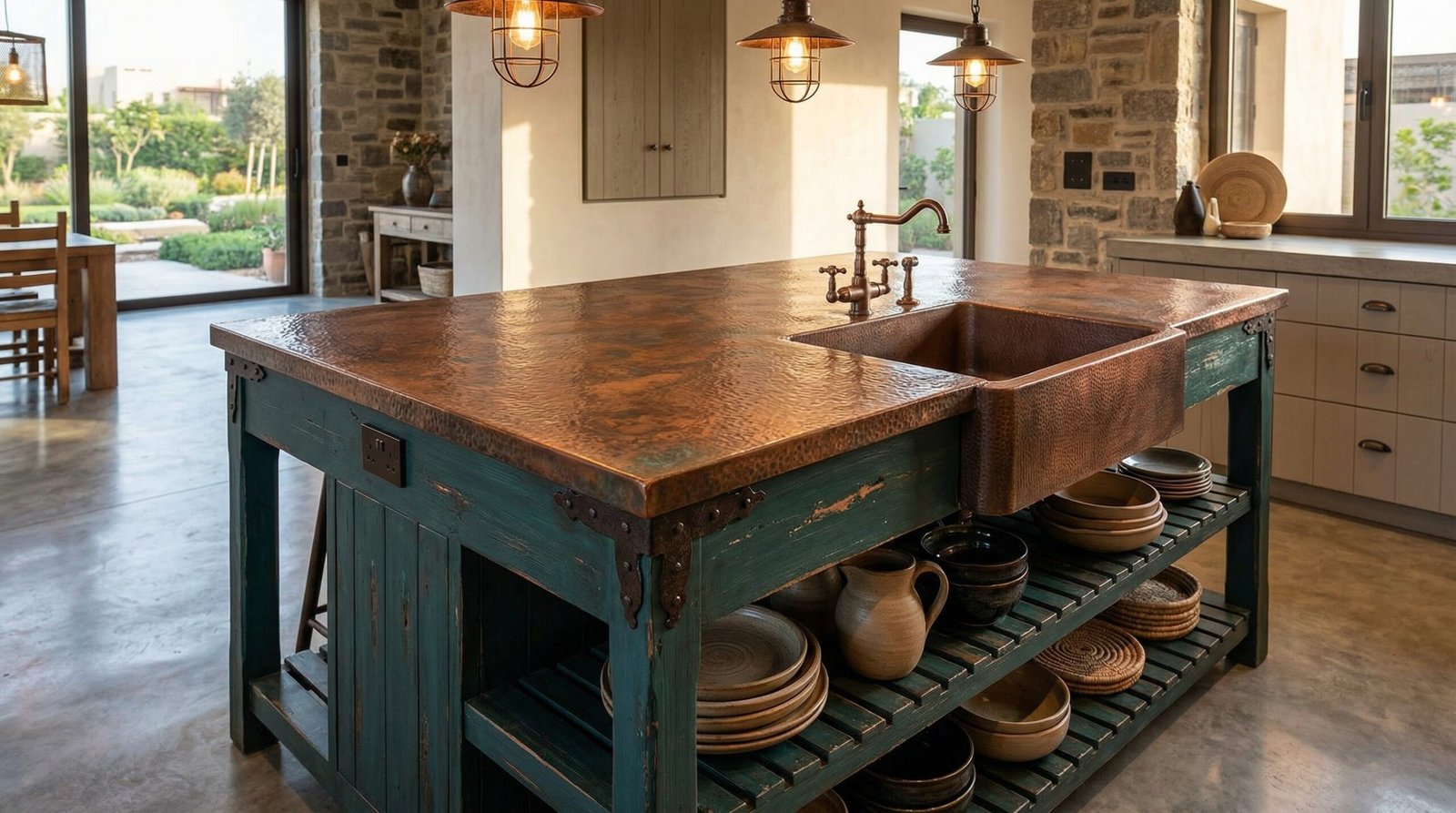
The color palettes for Arabic-inspired islands often reference traditional architectural elements: warm earth tones, deep blues reminiscent of ceramic tiles, gold and bronze metallic accents. We pair these colors with luxurious materials—marble countertops with dramatic veining, rich wood species like mahogany, mother-of-pearl inlay details. The result creates islands that function as art pieces celebrating cultural identity while serving practical kitchen needs.
Comprehensive Kitchen Island Dubai Services We Provide
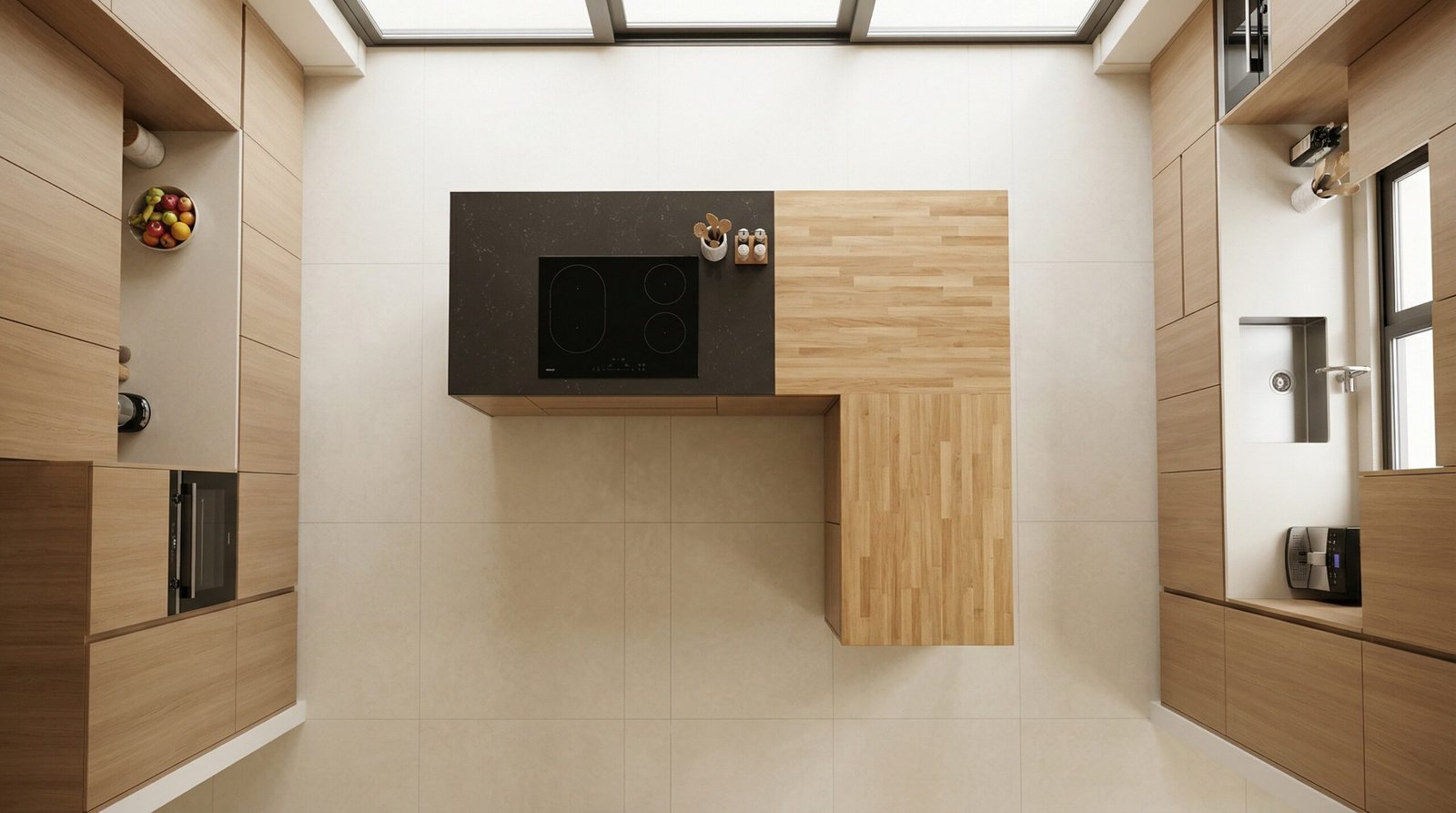
Our kitchen island services span from initial concept through installation and beyond, with each phase backed by specialized expertise and the quality standards we’ve maintained since 1988. This comprehensive approach means you work with one trusted team through your entire project rather than coordinating between designers, fabricators, contractors, and installers who may never communicate effectively.
Custom Design and Space Planning
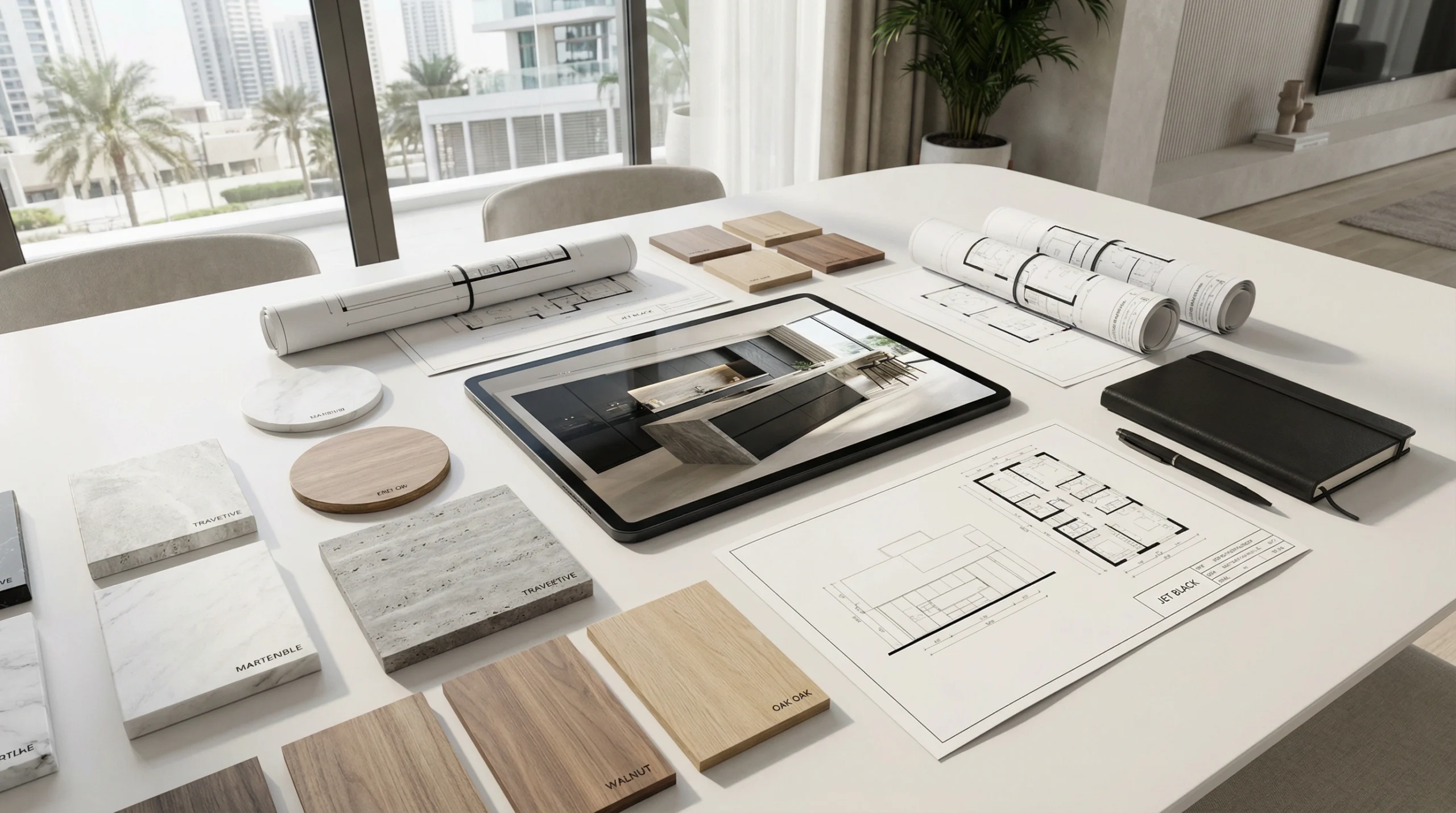
Every successful kitchen island begins with thorough space analysis and workflow planning. We measure your existing kitchen carefully, documenting not just dimensions but also traffic patterns, work triangle relationships between sink-stove-refrigerator, existing electrical outlets and plumbing locations, natural light sources, and sightlines from adjacent spaces. These factors determine what island configurations work practically rather than just visually.
The design consultation examines how you actually use your kitchen daily. A family that cooks elaborate meals needs substantial prep space, multiple work zones, and probably integrated appliances. Parents with young children benefit from seated areas where kids can do homework while dinner preparation happens. Clients who entertain frequently might prioritize a dramatic stone countertop and wine storage over maximum storage capacity. There’s no universal ideal—only what serves your specific lifestyle.
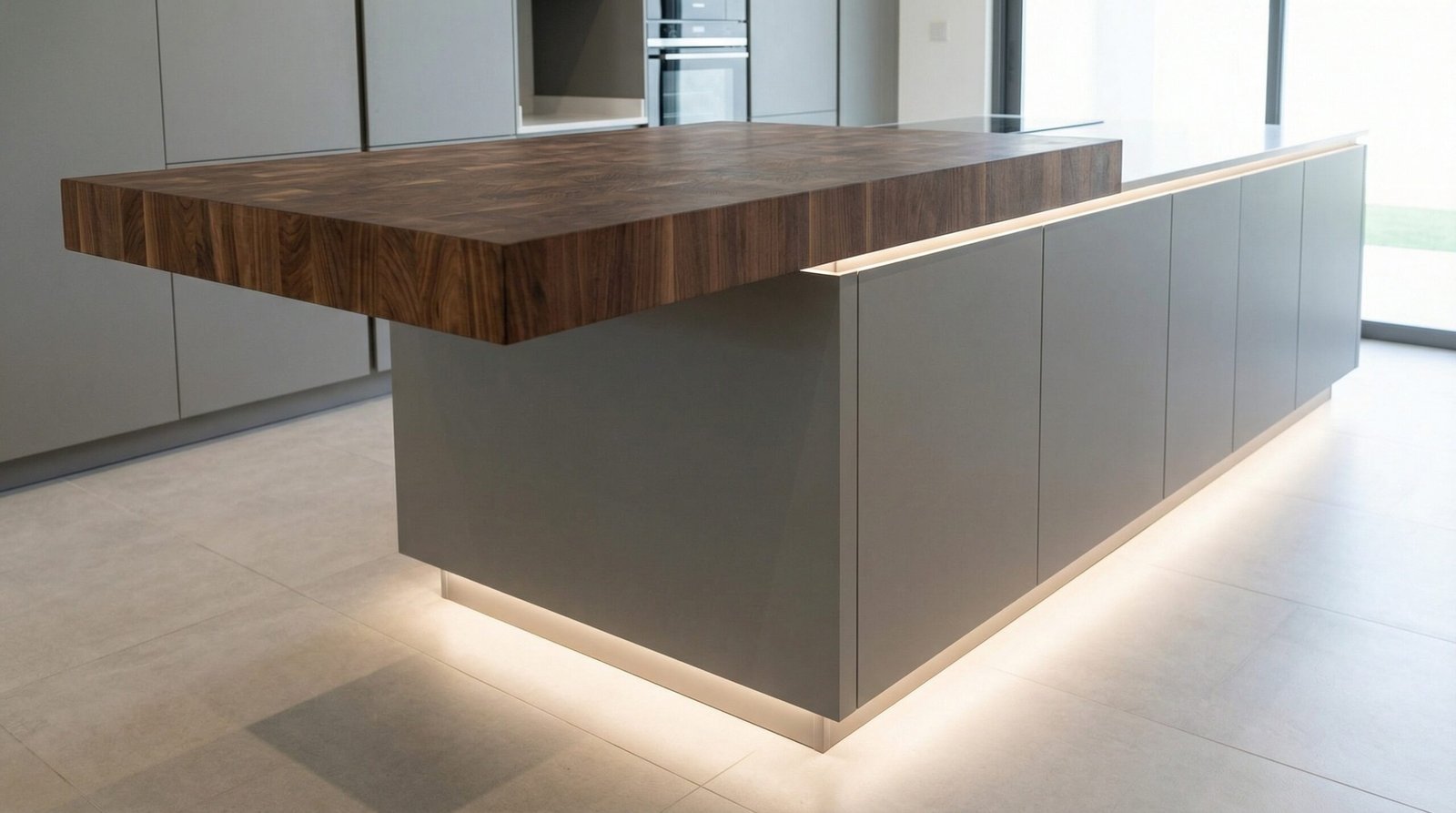
We create detailed 3D renderings showing your proposed island in your actual space, rendered with accurate materials, lighting, and surrounding context. These visualizations eliminate the confusion that 2D drawings create for most clients. You see exactly how the island relates to your existing cabinets, how much clearance remains for traffic flow, whether the scale feels appropriate for your room size, and how the finished piece will look from your living area sightline.
Technical drawings then document every dimension, material specification, hardware detail, and construction method. These drawings serve multiple purposes: they guide our workshop fabrication, communicate requirements to trade contractors installing electrical and plumbing, satisfy Dubai Municipality approval requirements, and provide you with comprehensive documentation of exactly what we’re building before fabrication begins.
Precision Workshop Fabrication
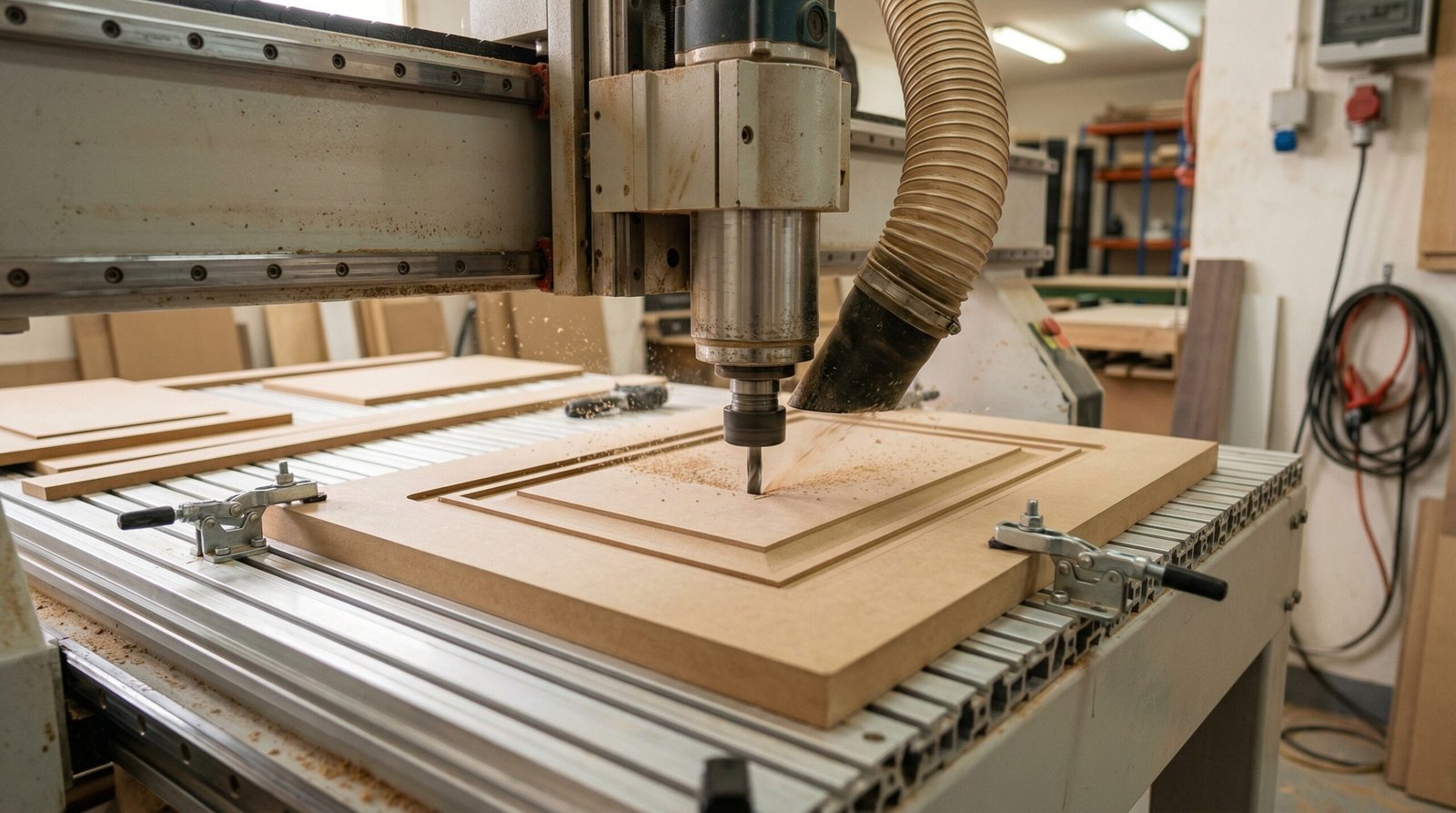
Our 2,000-square-meter climate-controlled workshop in Dubai allows us to fabricate kitchen island table dubai under optimal conditions rather than attempting construction in uncontrolled environments where humidity and temperature fluctuate. Climate control isn’t luxury—it’s necessary to prevent wood movement issues and ensure adhesive bonds cure properly.
The fabrication process for a typical custom island spans 3-4 weeks depending on complexity. Initial rough milling brings wood components to approximate dimensions with allowance for further movement as materials fully stabilize. Components rest for several days, then we complete final dimensioning when any additional movement has occurred. This patience prevents the dimensional problems that appear when rushed fabrication tries to compress timelines.
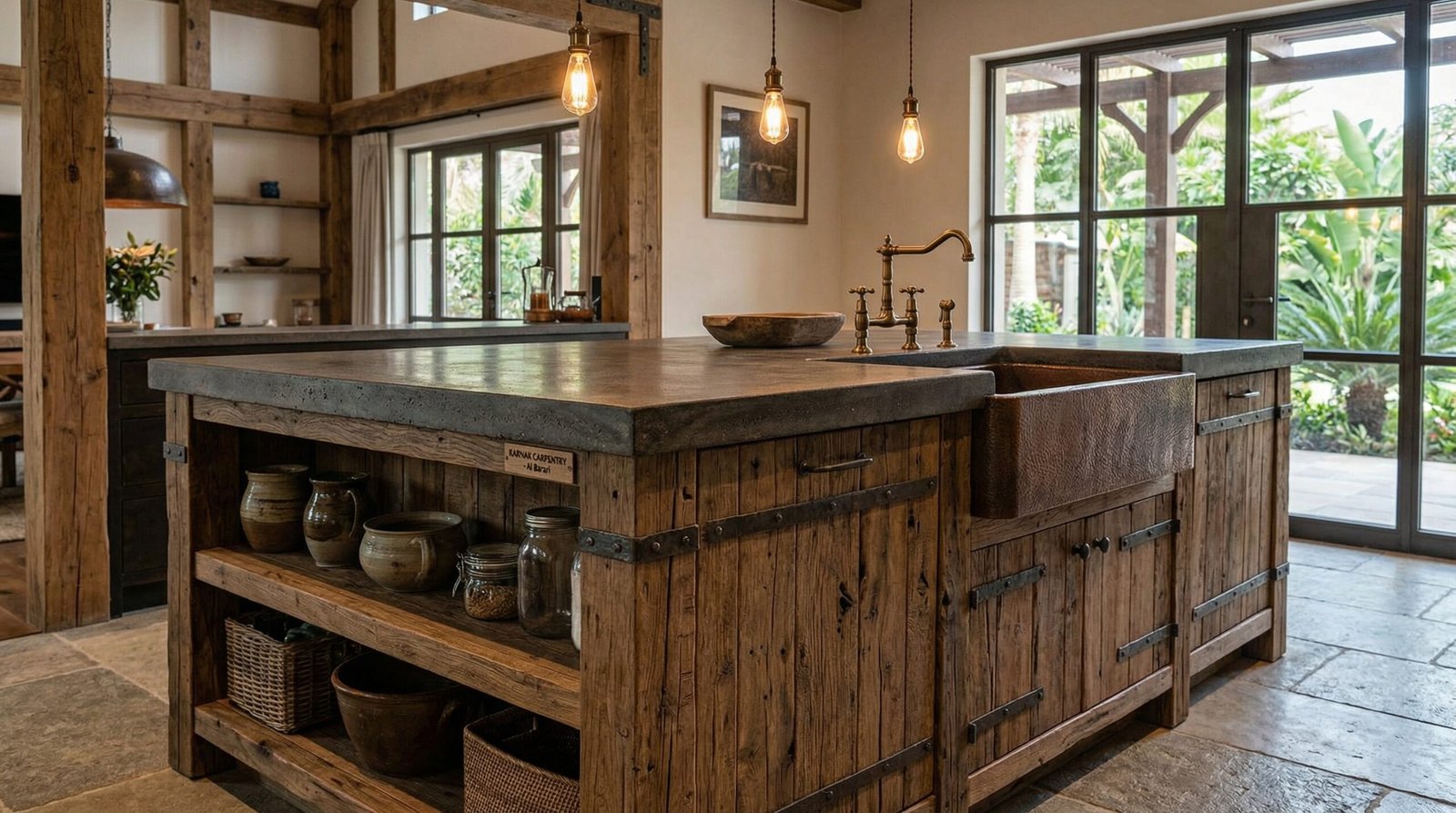
Cabinet box construction uses doweled joints reinforced with adhesive for rigid, square assemblies that won’t rack or twist over time. We build every cabinet box with 18mm or 25mm sides rather than the 12-15mm material budget manufacturers use. Thicker material provides more holding power for hinge screws and eliminates the flexing that causes door alignment problems after installation. Backs use 12mm plywood rather than thin hardboard, adding substantial structural rigidity.
Door and drawer front fabrication requires different techniques depending on style. Flat contemporary doors need perfectly flat panels—we achieve this through careful material selection, proper grain orientation, and machining techniques that minimize internal stress. Traditional raised panel doors demand precise profile routing and panel fitting within the frame. All door components receive edge sealing before assembly to prevent moisture absorption along end grain.
Drawer systems we install use full-extension soft-close slides rated for 30-40kg loads—critical for drawers that will hold heavy pots, small appliances, or dish collections. The drawer boxes themselves use 12mm Baltic birch plywood with dovetailed corners, far superior to the stapled particle board drawers common in production cabinetry. Proper drawer construction means your grandchildren will still use these drawers decades from now.
Stone Countertop Templating and Installation
Stone countertop work requires specialized expertise separate from carpentry dubai, though we coordinate the entire process to ensure seamless results. After your cabinet island base arrives at site and we’ve verified level installation, we schedule stone templating. The fabricator creates precise templates of your actual installed cabinets rather than working from drawings—critical because job-site realities never match plans perfectly.
Template creation uses either traditional wood templates or digital laser measuring systems. Digital templating provides accuracy within one millimeter, eliminating the accumulated error that can occur with manual methods. The template captures every detail: overall dimensions, sink cutout location and size, cooktop cutout if applicable, edge profile specifications, any radius corners or angled sections, and the location of seams if your island requires multiple stone pieces.
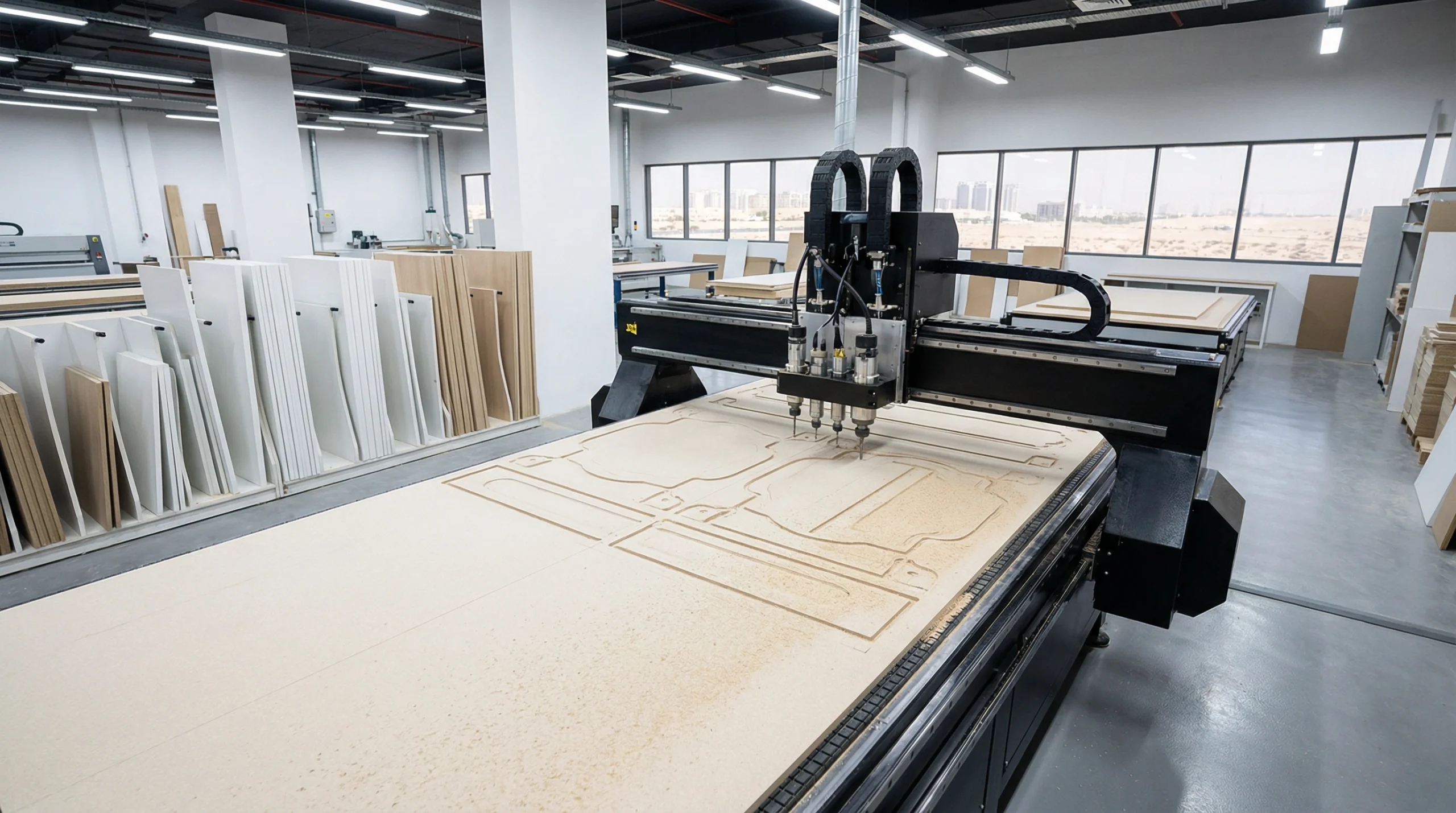
Stone fabrication happens at specialized facilities with CNC cutting equipment that achieves precision impossible with manual methods. For waterfall edge designs or book-matched patterns, the fabricator selects stone pieces from the same section of the slab to ensure color and pattern consistency. Quality fabricators allow you to visit their facility to select the specific stone pieces for your island—important for natural materials like granite or marble where each section of slab differs significantly.
Installation day brings the fabricated stone pieces to your property. The installation team verifies the cabinet base remains level, applies silicone adhesive along support areas, positions the countertop pieces, checks level and alignment, creates invisible seams using color-matched epoxy, and seals the stone against the island base. The entire process typically requires 4-6 hours. We remain on-site during stone installation to address any questions or coordination issues immediately.
Professional Installation and Site Coordination for kitchen island table dubai
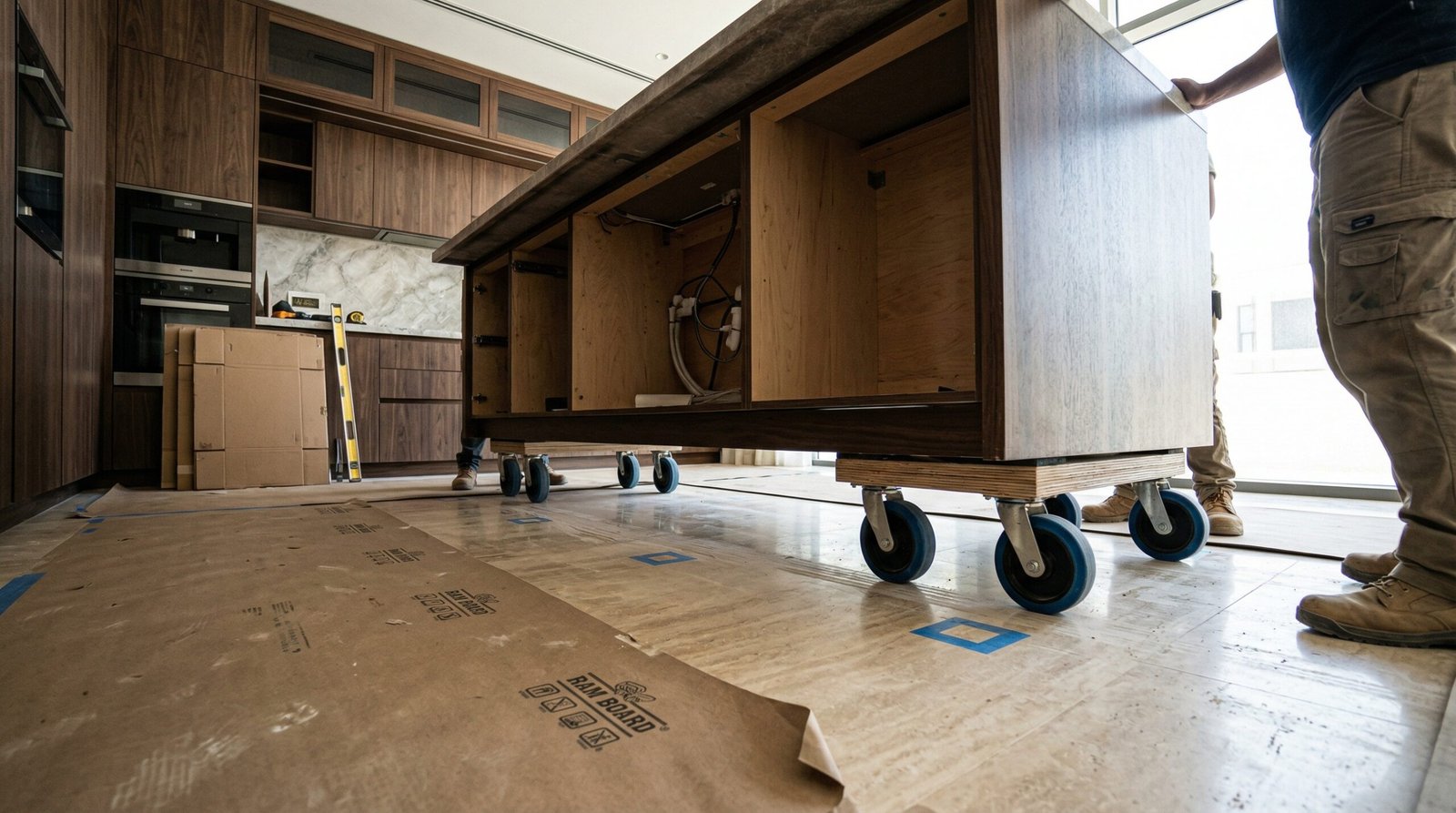
Installation transforms components and materials into your finishedkitchen island table dubai. We schedule installation when other trades have completed their work—you don’t want cabinet installers working around electricians still running wiring, or plumbers returning to adjust pipes after cabinets are positioned. Proper scheduling prevents the constant rework that plagues poorly coordinated projects.
Our installation teams arrive with the necessary tools and equipment to work efficiently and protect your property. Floor protection goes down first—heavy-duty cardboard or plywood pathways from entry points to the work area, preventing damage from equipment carts and foot traffic. We use furniture sliders and lifting straps for moving heavy cabinet sections rather than dragging them across your floors.
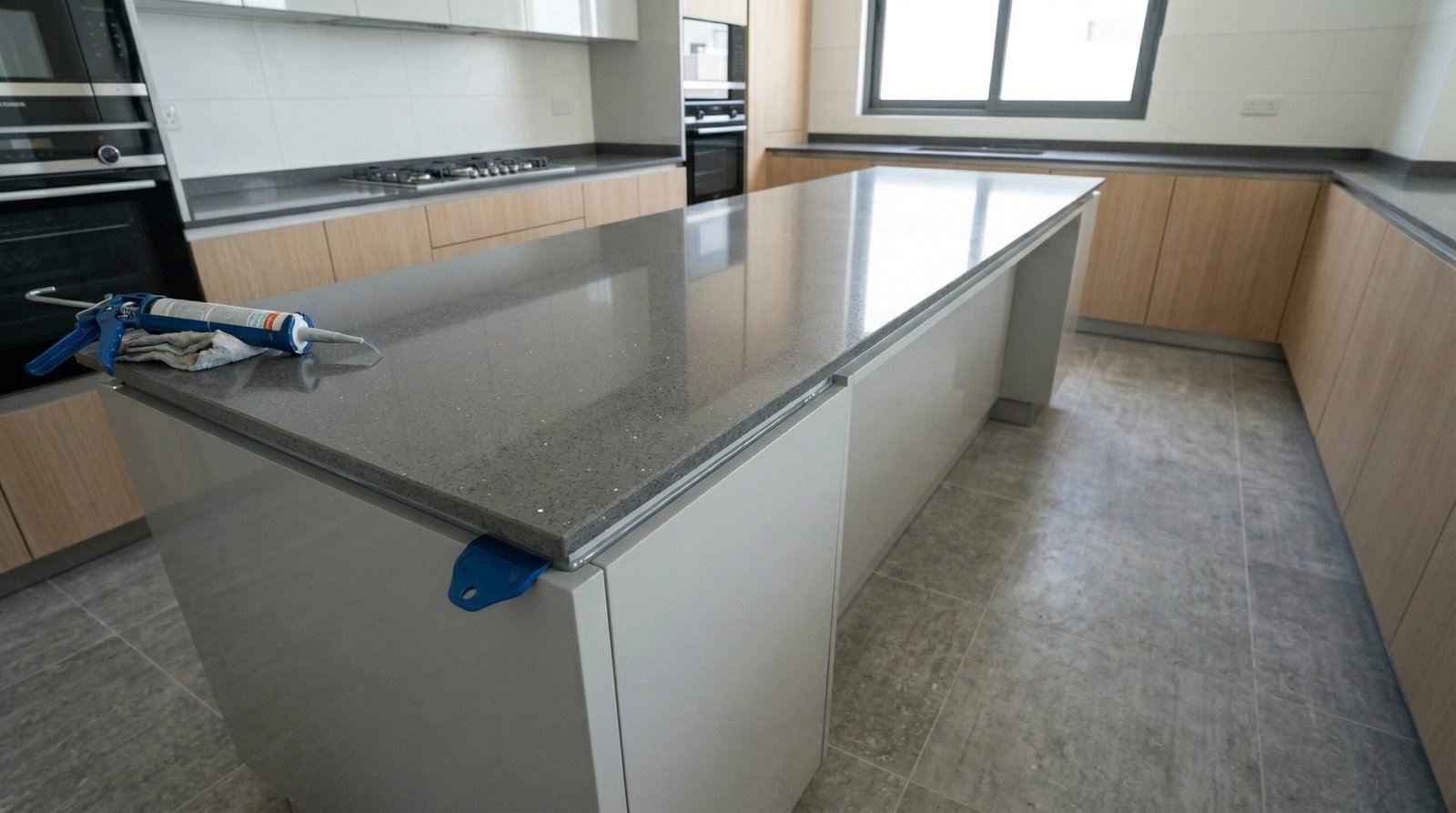
The island base gets positioned and leveled using adjustable feet and precise measurement from reference points. Level installation is non-negotiable—even two millimeters of variation causes drawer operation problems, door alignment issues, and potential stone countertop stress. We check level in multiple directions at multiple points, making micro-adjustments until the entire base sits perfectly flat.
Cabinet sections get joined together using special cabinet connector bolts that pull adjoining sides tightly together and hold them in permanent alignment. Face frames get aligned so doors will have consistent reveal gaps. Drawers receive final fitting adjustments. We install any interior organizational elements—pull-out shelves, trash bin systems, spice racks, whatever accessories your design includes. Every door gets adjusted for even margins and smooth operation. Every drawer slides smoothly without binding.
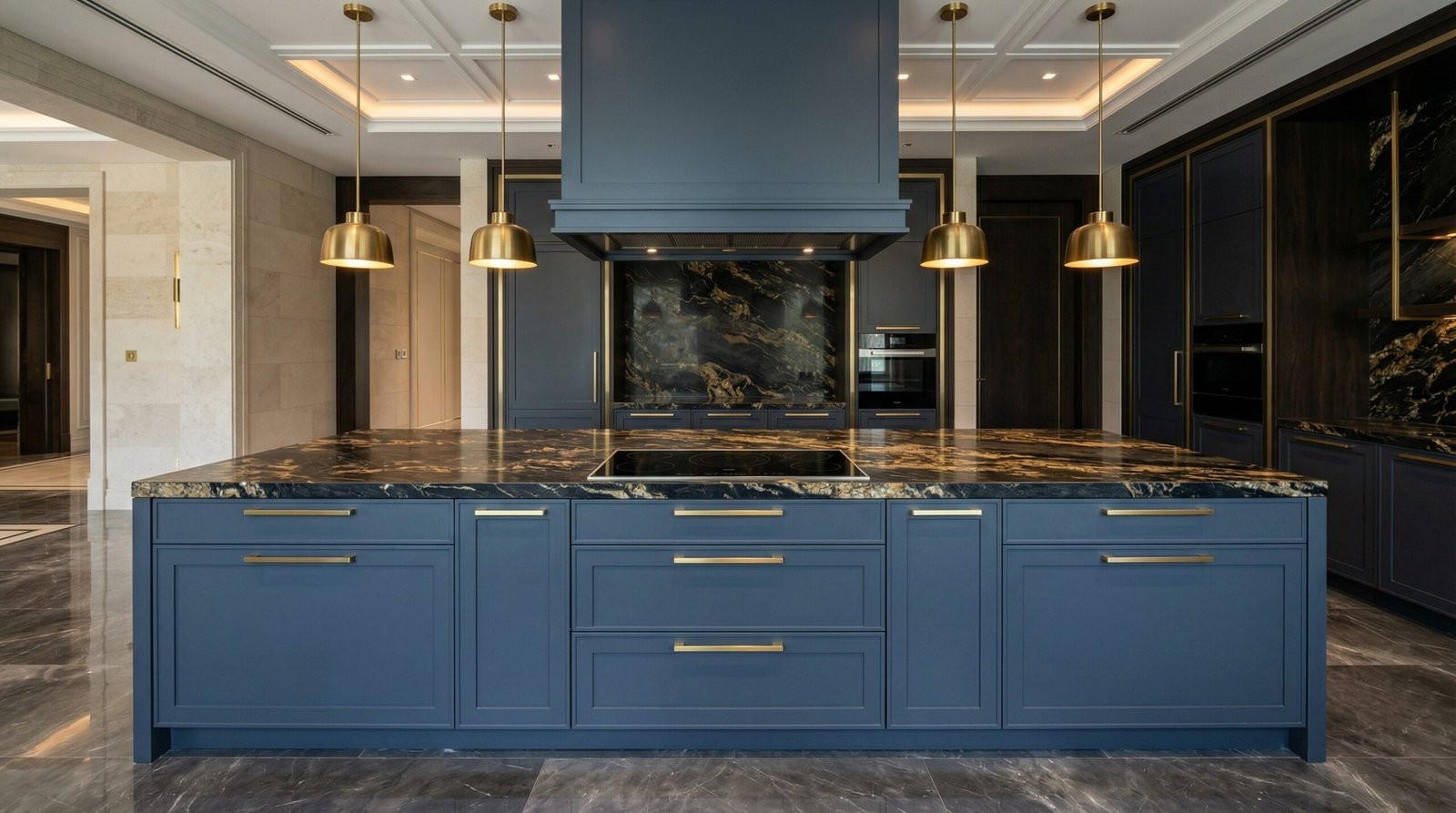
Electrical and plumbing connections happen next, coordinated with licensed trade contractors. Pop-up outlets get installed and tested. Integrated appliances go into their cabinet openings—we ensure dishwashers sit level, refrigeration units have proper ventilation clearance, and all appliances operate correctly. Any final trim work—toe kick installation, scribing pieces against walls or floors, decorative end panels—gets completed to factory finish standards.
Finishing and Protection
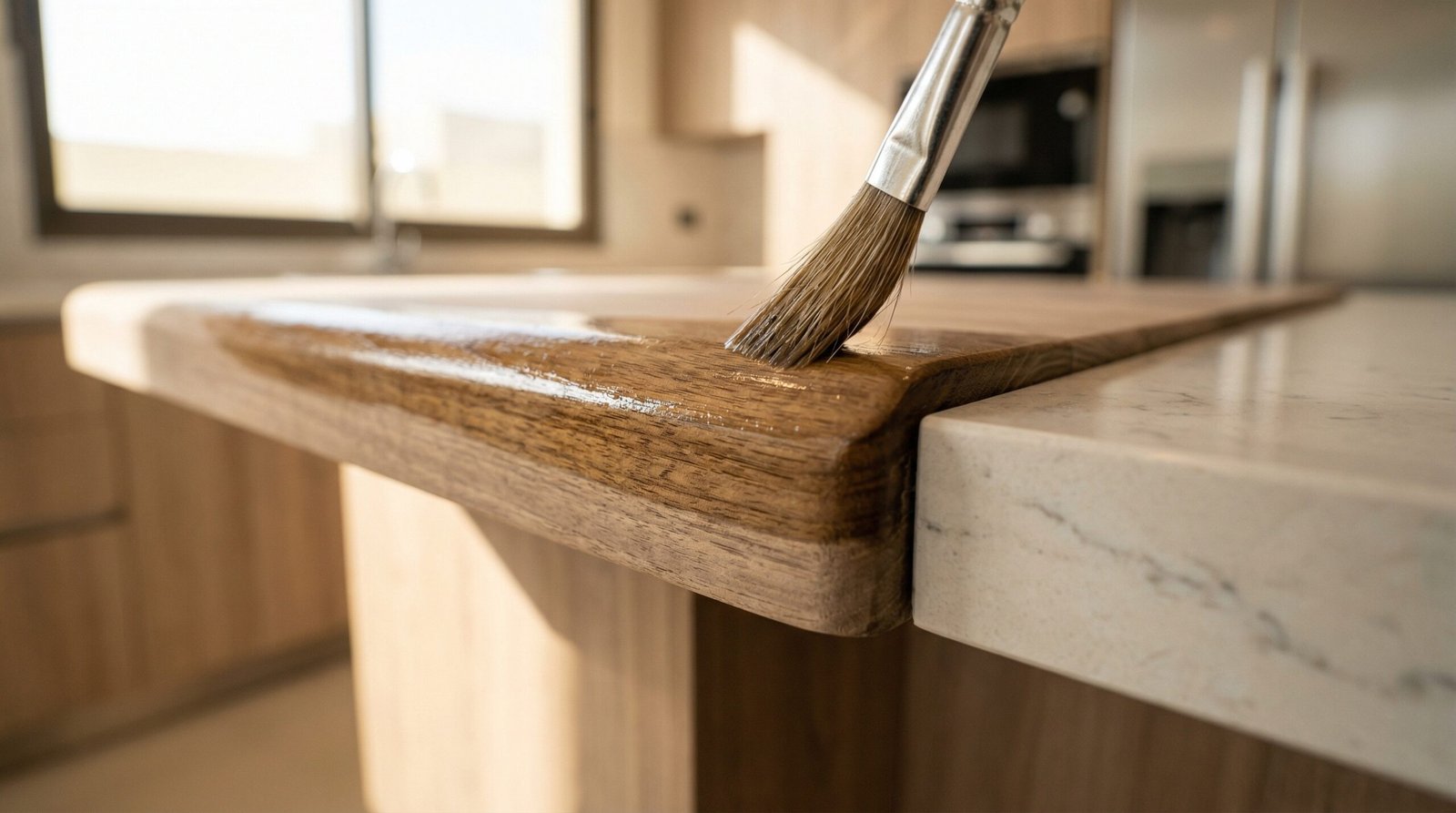
The finishing process determines how your island looks and how it weathers years of daily use. For painted finishes, we apply conversion varnish or catalyzed lacquer—professional-grade coatings that cure to a hard, chemical-resistant surface far superior to standard paint. Multiple coats build depth and durability, with careful sanding between coats creating the glass-smooth surface expected in luxury kitchens.
Stained wood finishes require more steps. The wood must be properly prepared—sanded progressively through multiple grits, raised grain addressed, any natural color variation equalized through toning. Stain application happens in controlled conditions to ensure even color absorption. We apply sealer coats to lock in the color and prepare the surface for topcoats. The final protective finish uses either conversion varnish for maximum durability or traditional rubbed-oil finishes for subtle natural appearance.
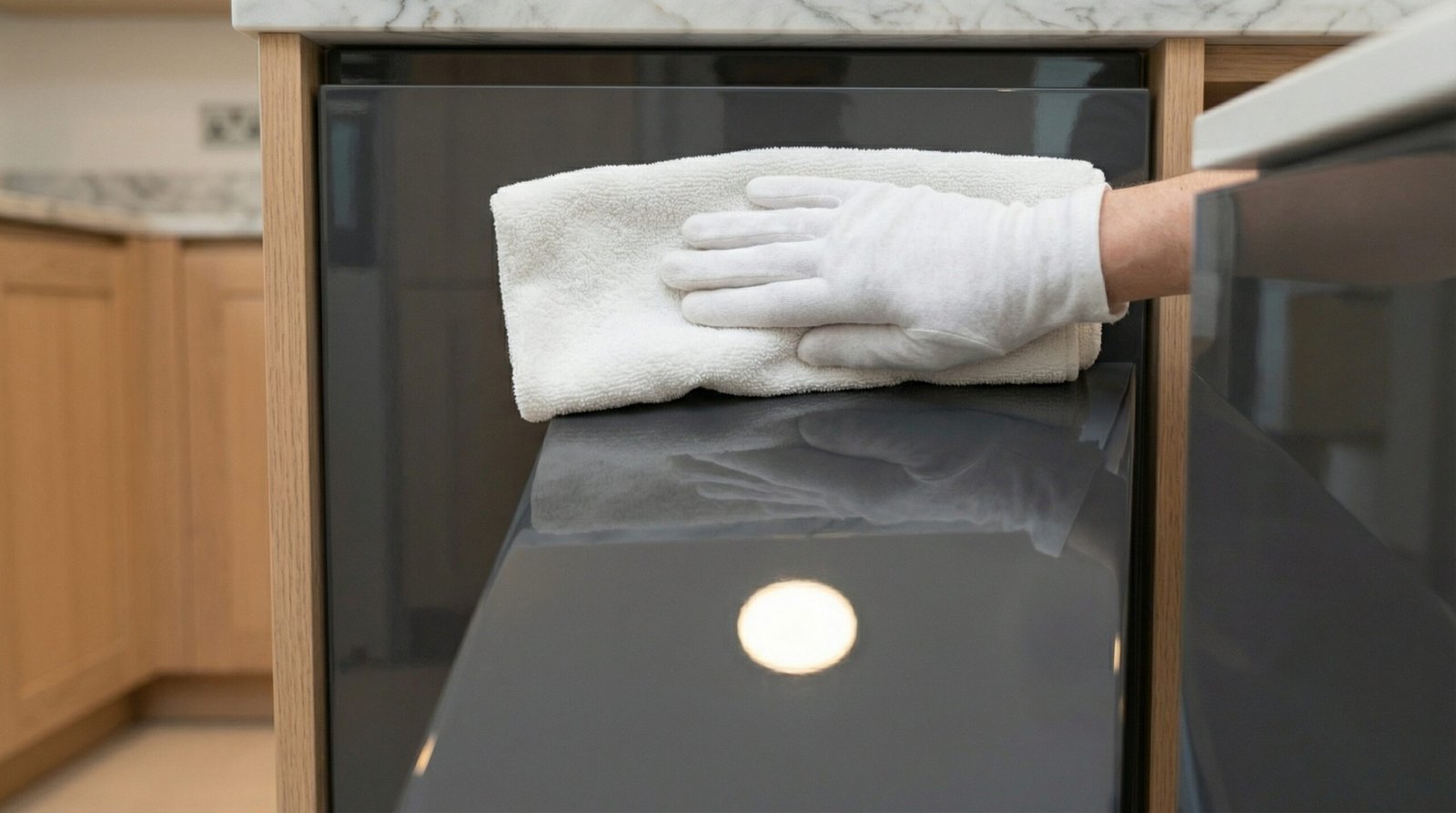
Stone countertops receive sealing treatment during installation. Granite and marble require penetrating sealers that fill microscopic pores, reducing staining susceptibility while maintaining natural appearance. Quartz engineered stone requires no sealing since the resin binders create a non-porous surface. We provide specific care instructions for your particular countertop material—what cleaning products to use, what to avoid, when to reseal natural stone.
Protection during the final construction phases prevents damage to your completed island before you actually use it. We apply protective film to countertops and temporary cardboard wrapping to cabinet surfaces. This protection remains until other construction activity completes, final cleaning happens, and your kitchen is truly ready for occupancy.
The Karnak Carpentry Kitchen Island Dubai Process
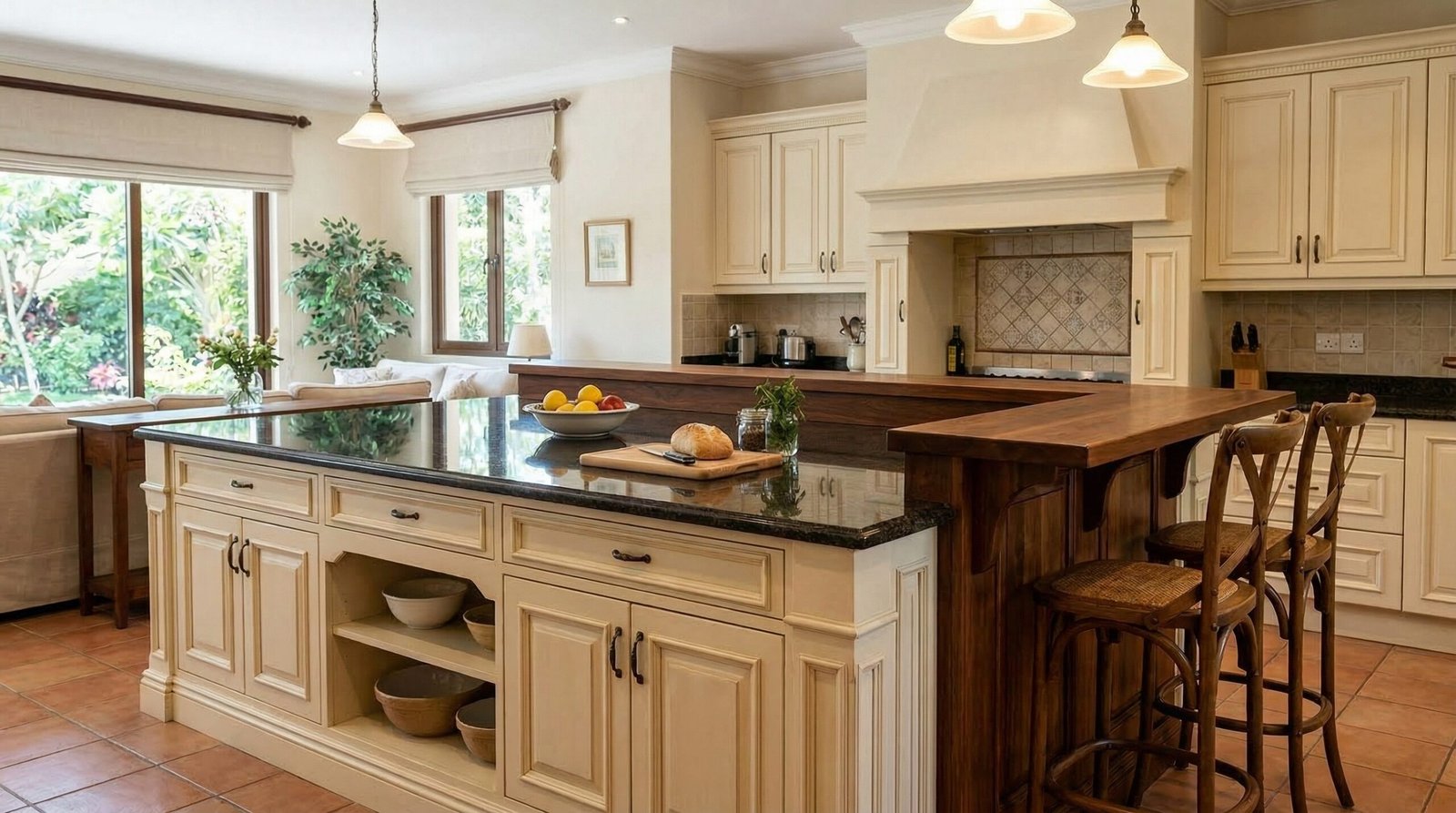
Our structured process takes you from initial ideas through completed installation with clarity at every stage. You always know what’s happening, what comes next, who handles each element, and when you’ll reach completion. This transparency eliminates the anxiety that construction projects typically create.
Step 1: Initial Consultation and Site Assessment
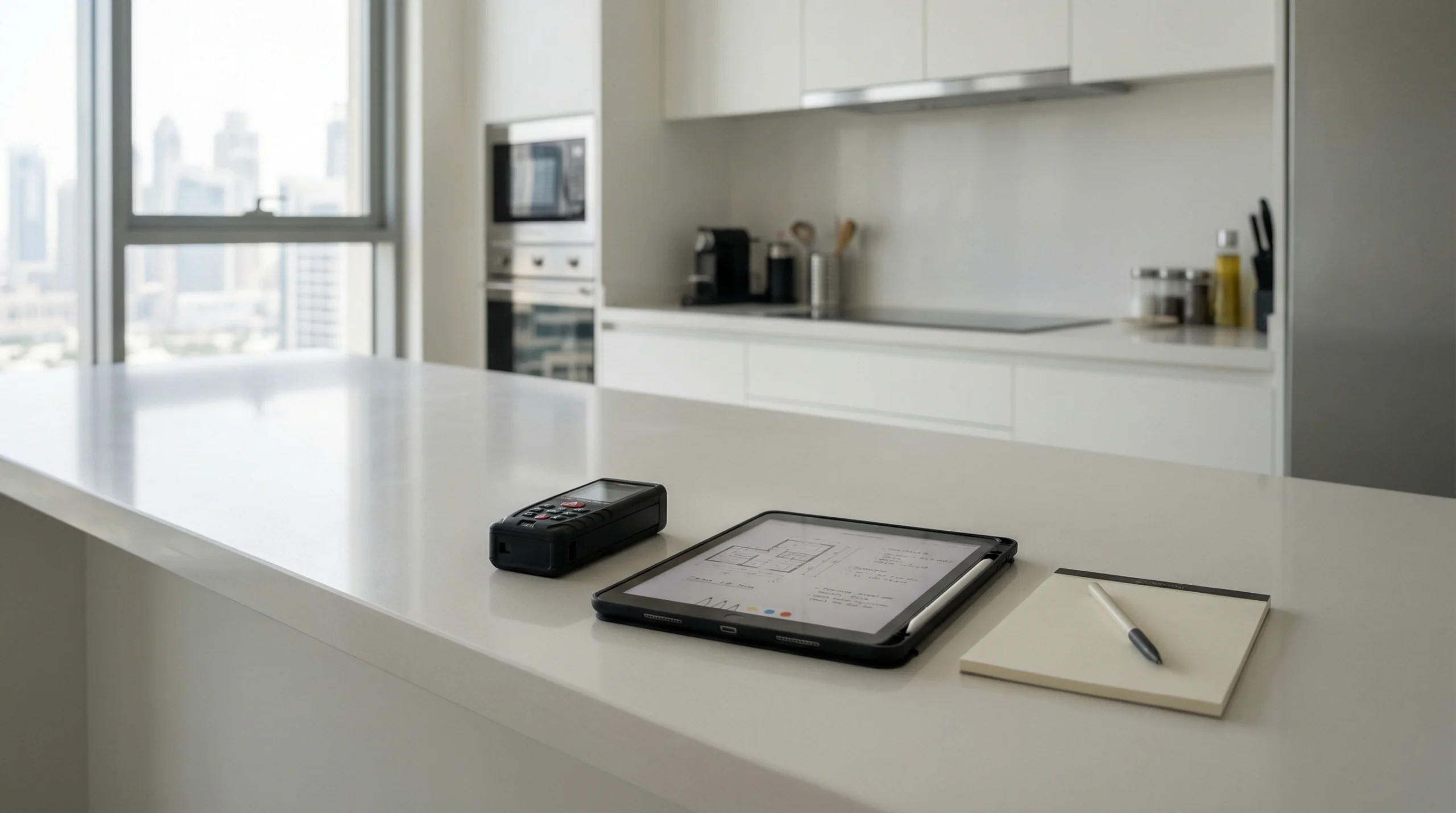
The process begins with a conversation about your vision and requirements. We discuss your cooking habits, entertaining style, storage needs, aesthetic preferences, and budget expectations. This conversation happens in person at your property so we can see your existing kitchen, understand your space constraints and opportunities, and identify any potential complications early.
During the site visit, we take comprehensive measurements and photographs. We note locations of existing electrical outlets, plumbing lines, light fixtures, windows, doors, and any architectural elements that impact island placement. We measure ceiling heights and check for level floors—unlevel floors require strategic accommodation in island design to prevent gaps under the toe kick. We observe traffic patterns and how you move through the space, informing practical decisions about clearances and work zone positioning.
We also assess any regulatory requirements your project may involve. Residential kitchen remodels typically don’t require building permits in Dubai unless you’re relocating plumbing or making structural changes. Commercial kitchens in restaurants or hospitality properties require comprehensive approvals from Dubai Municipality, Civil Defense, and potentially other authorities depending on property location. We identify what approvals apply to your project and explain the timeline implications.
This initial consultation is complimentary and involves no obligation. You receive honest assessment of your project scope, realistic timeline and budget guidance, and confidence that we understand your requirements before you commit to proceeding.
Step 2: Design Development and Proposal
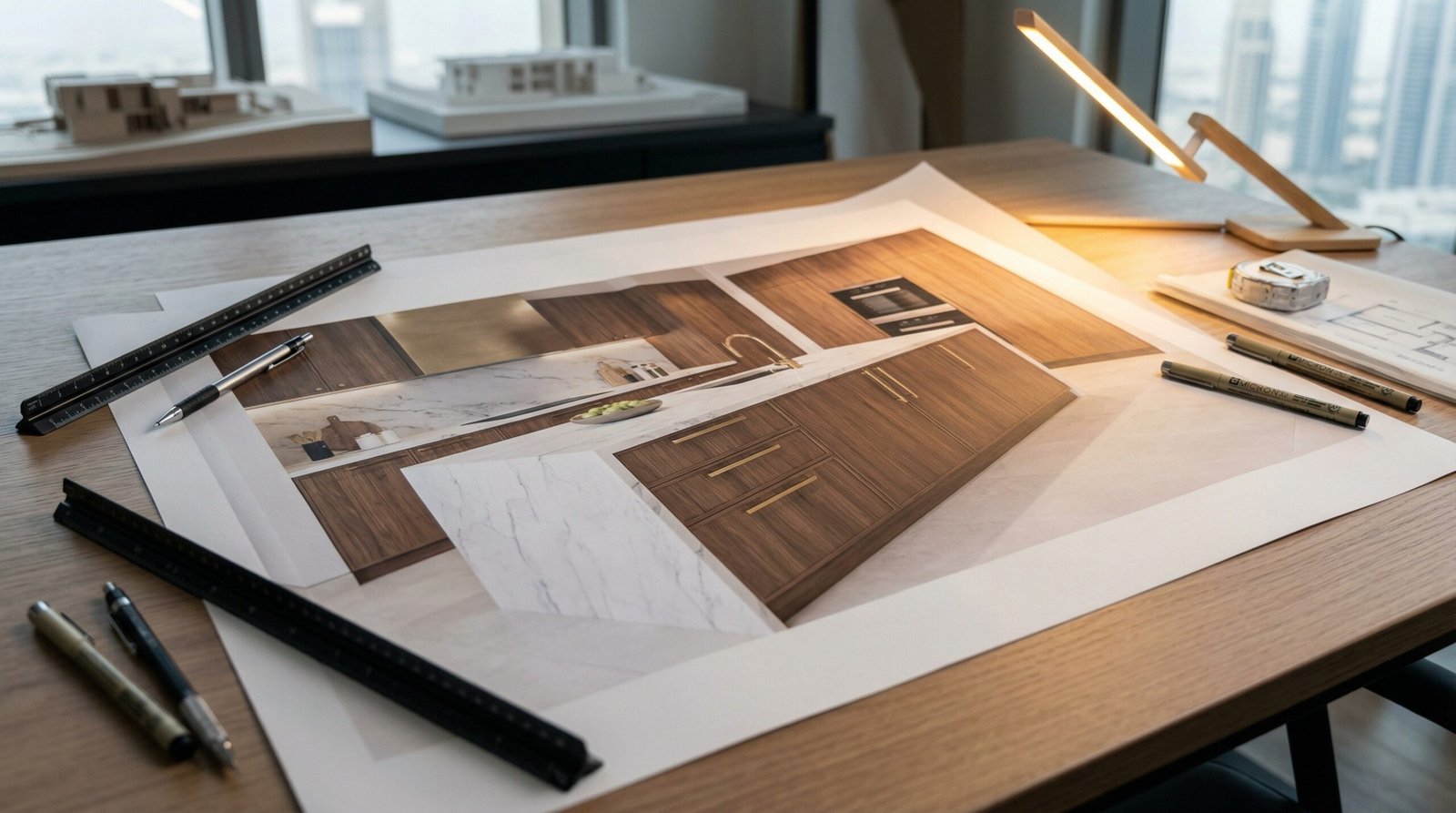
Following the initial consultation, our design team develops concepts that address your requirements while incorporating our expertise about what works best in UAE conditions. We create multiple design directions when your project allows different approaches—perhaps one emphasizing maximum storage, another prioritizing seating and social interaction, a third balancing both priorities differently.
The 3D renderings we generate show your island rendered realistically in your actual space. You see accurate materials—the specific stone you’re considering, the actual wood species and finish, realistic lighting on the surfaces. You see the island from multiple angles including the sightline from your living area, the cook’s perspective, and overhead plans showing traffic flow and dimensional clearances.
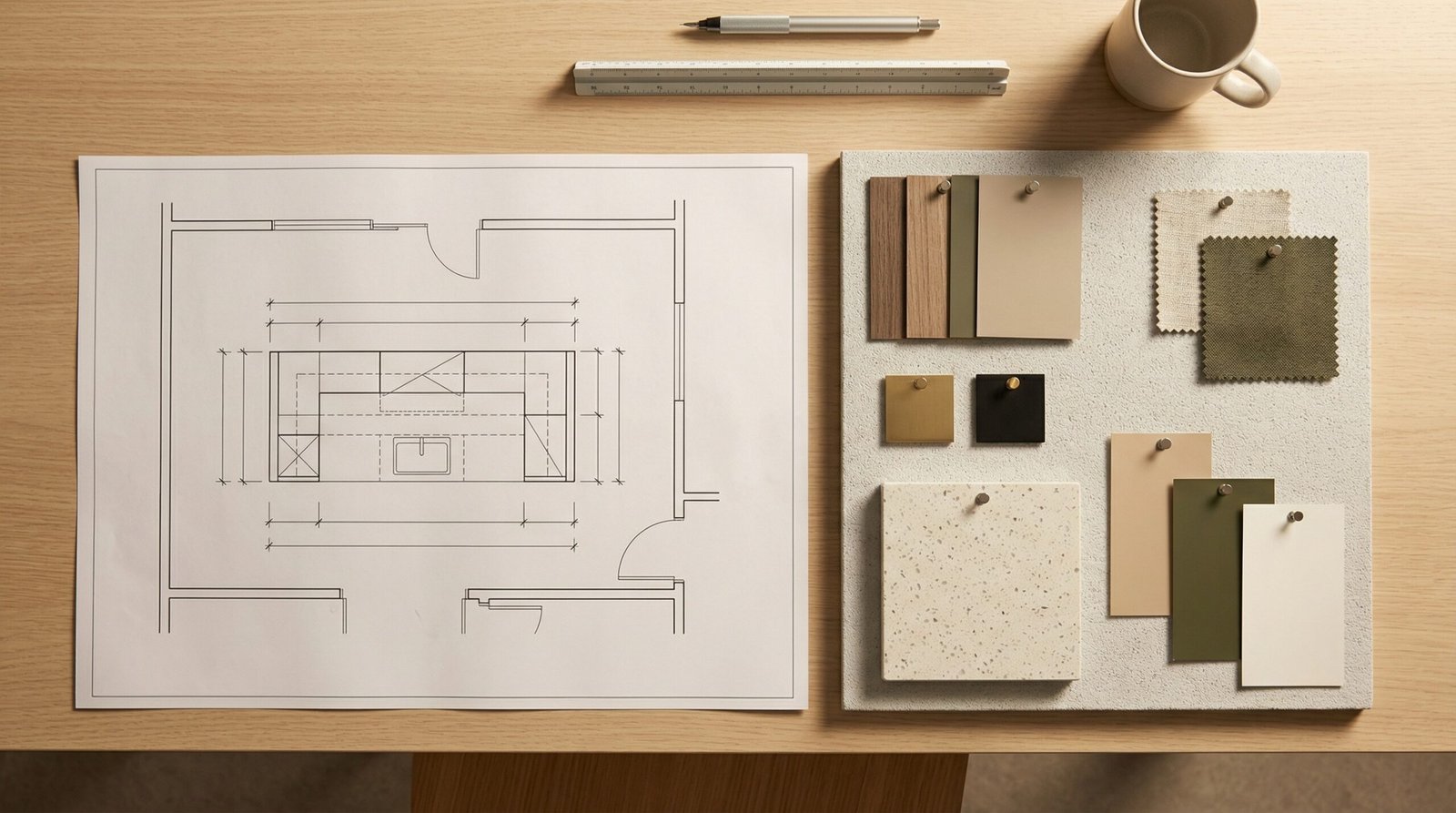
The written proposal accompanying design presentations specifies everything we’ll provide: materials by manufacturer and model number, hardware selections, appliances if we’re supplying them, stone type and edge profile, electrical requirements, plumbing modifications, installation scope, timeline from order to completion, and itemized pricing. This detail ensures you understand exactly what your investment includes and prevents surprises later.
We review the proposal with you in detail, answering questions and making revisions based on your feedback. Perhaps you prefer a different countertop material after seeing the rendering, or you want to add a pop-up power outlet, or modify the drawer configuration. We revise the design and proposal until it aligns perfectly with your vision and budget.
Step 3: Material Selection and Specification Finalization
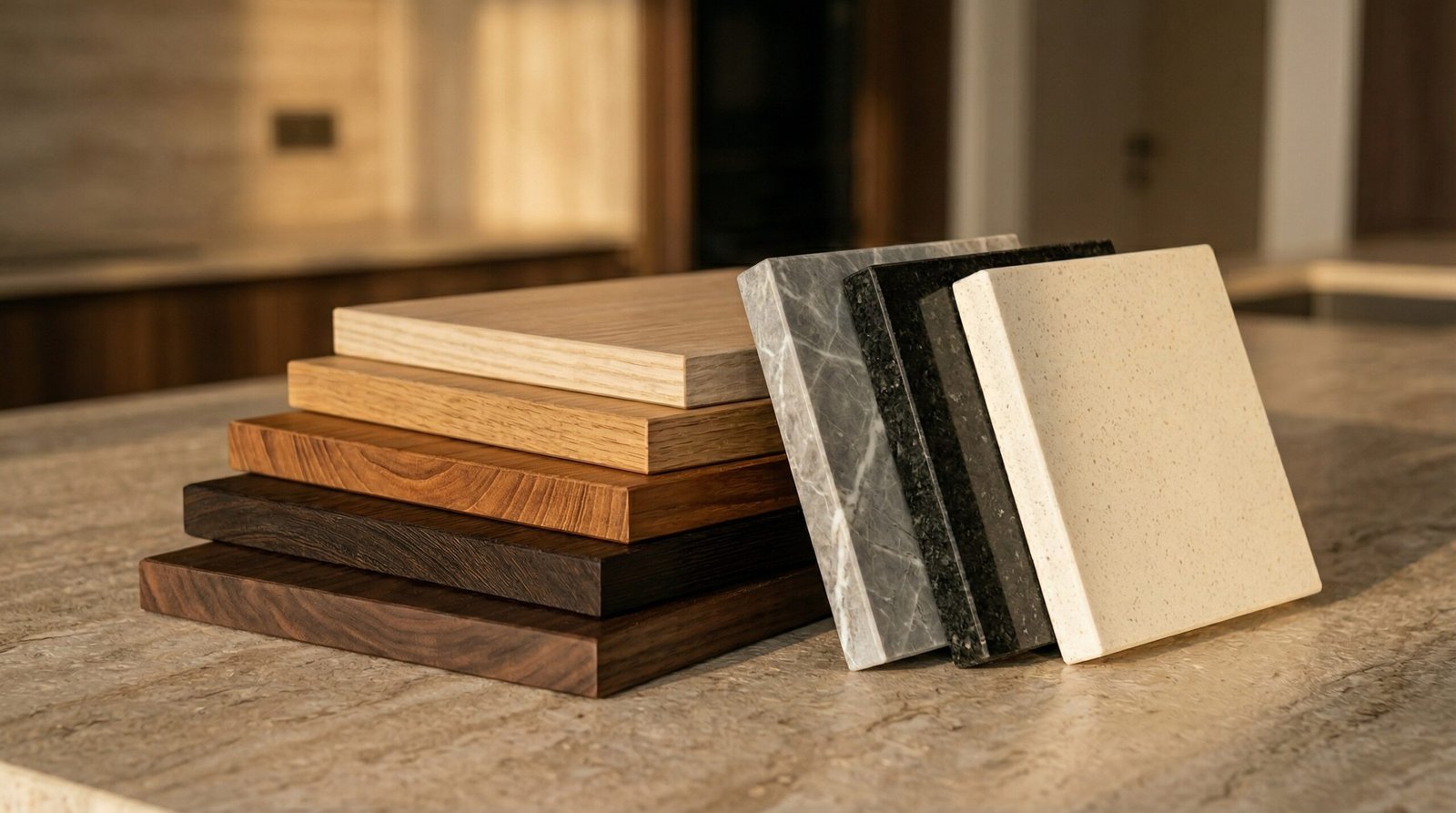
Once you’ve approved the design direction, we refine material selections to exact specifications. This phase involves making final decisions on elements that significantly impact both aesthetics and budget.
For stone countertops, we typically visit the stone supplier’s facility together. You’ll see the actual slabs available in your selected material type, examine color variation and veining patterns, and choose the specific pieces for your island. This visit is particularly important for natural stone materials like granite and marble where each slab differs dramatically. Manufactured quartz offers more consistency, though we still recommend reviewing actual samples under different lighting conditions since colors appear different in showroom lighting versus your home’s natural daylight.
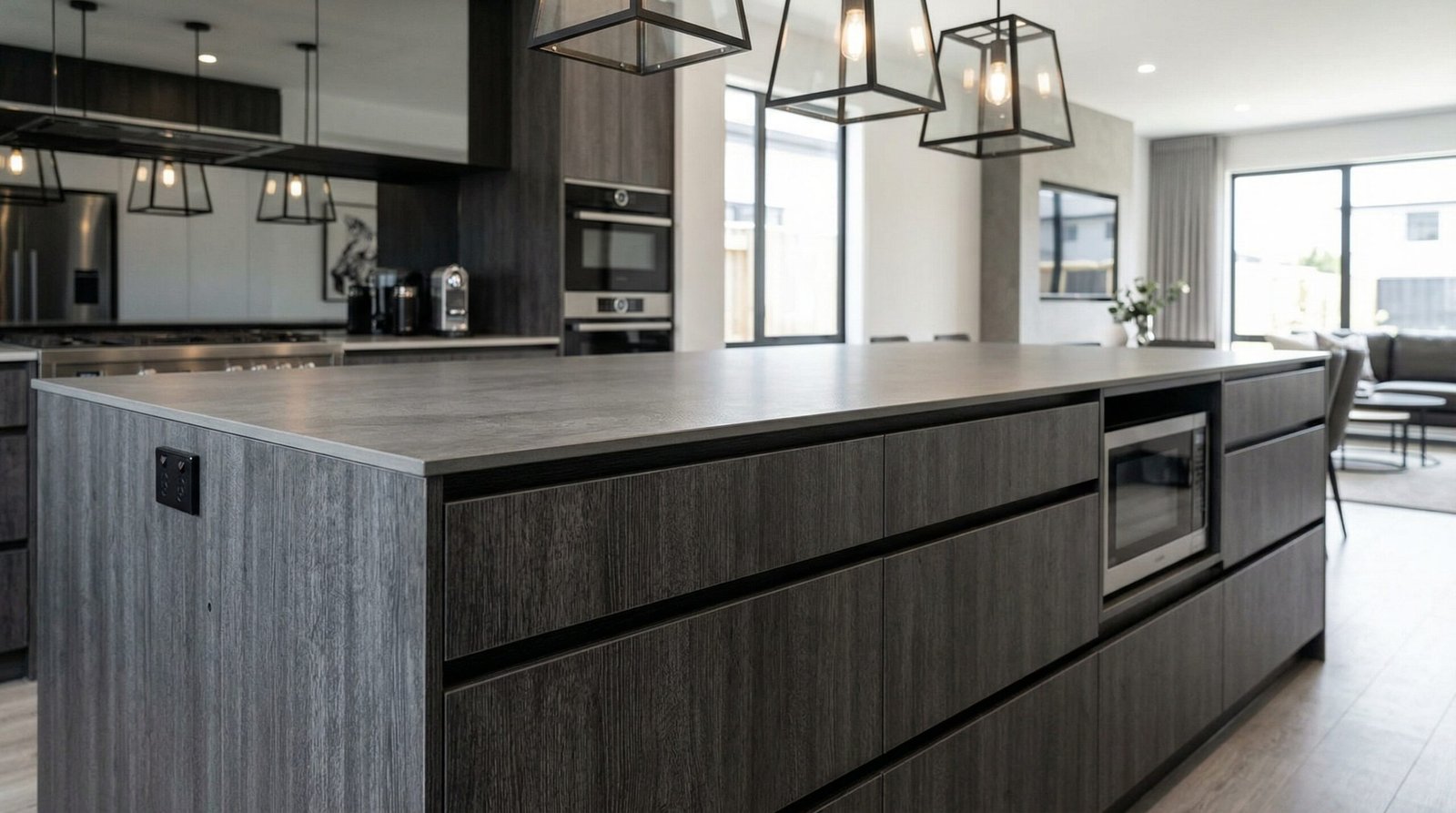
Cabinet finish selections get finalized using actual finish samples rather than small chips or photos. We provide door samples finished in your selected color so you can evaluate the true appearance in your home’s lighting. You can compare finish options against your existing design elements—flooring, backsplash materials, wall colors, and other fixed features that your island must coordinate with.
Hardware selections—cabinet handles, drawer pulls, hinges, slides—impact both aesthetics and long-term functionality. We present options appropriate to your design style and budget, explaining the practical differences between standard-grade and premium hardware. The cost difference often surprises clients—upgrading to premium soft-close hinges and heavy-duty drawer slides might add 8-10% to cabinet costs but substantially improves daily experience and longevity.
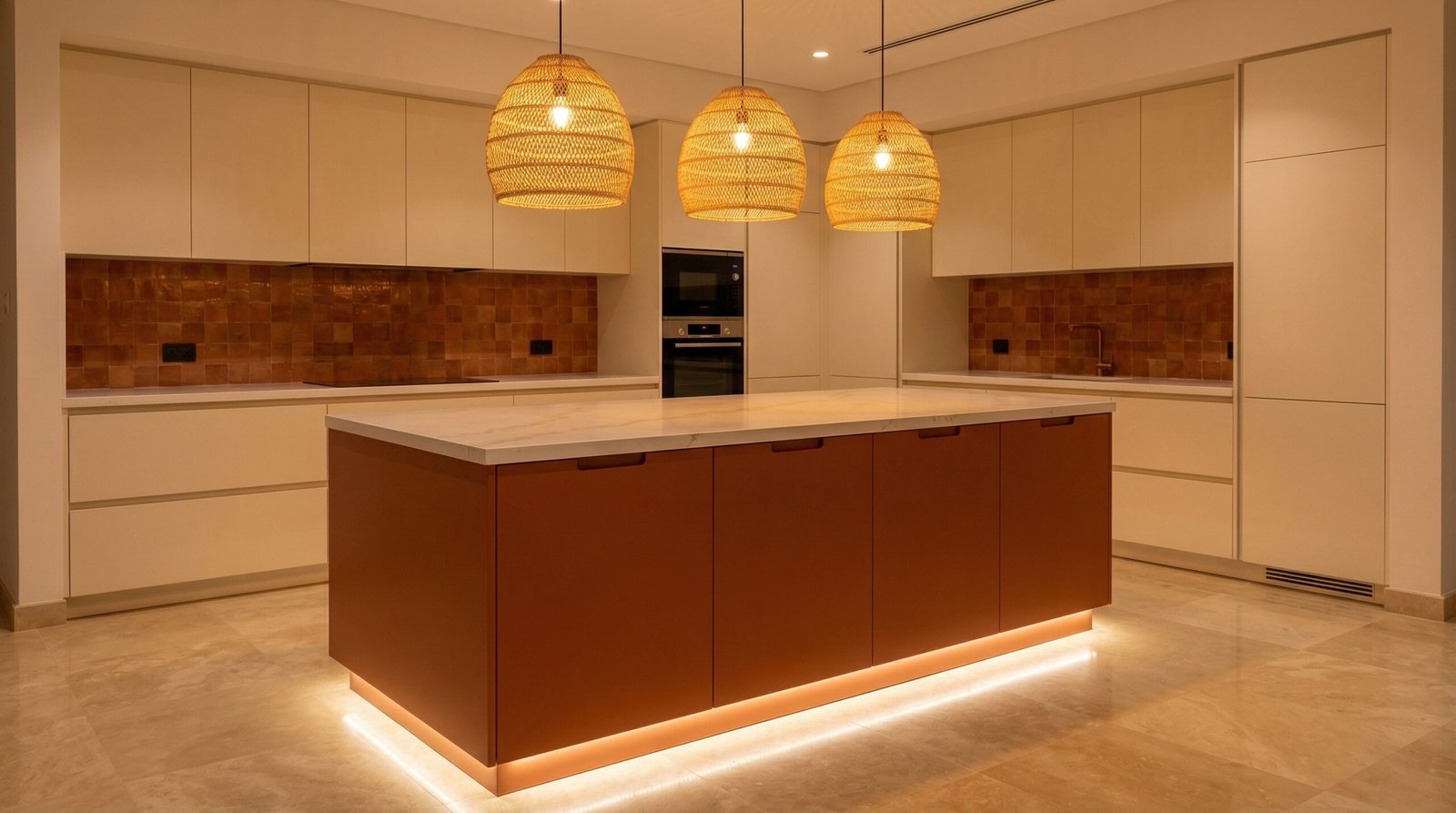
If your island incorporates integrated appliances, we finalize the specific models during this phase. Appliance selection involves balancing features, dimensions, energy efficiency, and budget. We provide guidance based on our installation experience—some dishwasher models prove difficult to service, certain wine fridge brands have compressor reliability issues in UAE temperatures, particular induction cooktops integrate better with stone countertops than others.
Step 4: Technical Drawings and Municipality Approvals
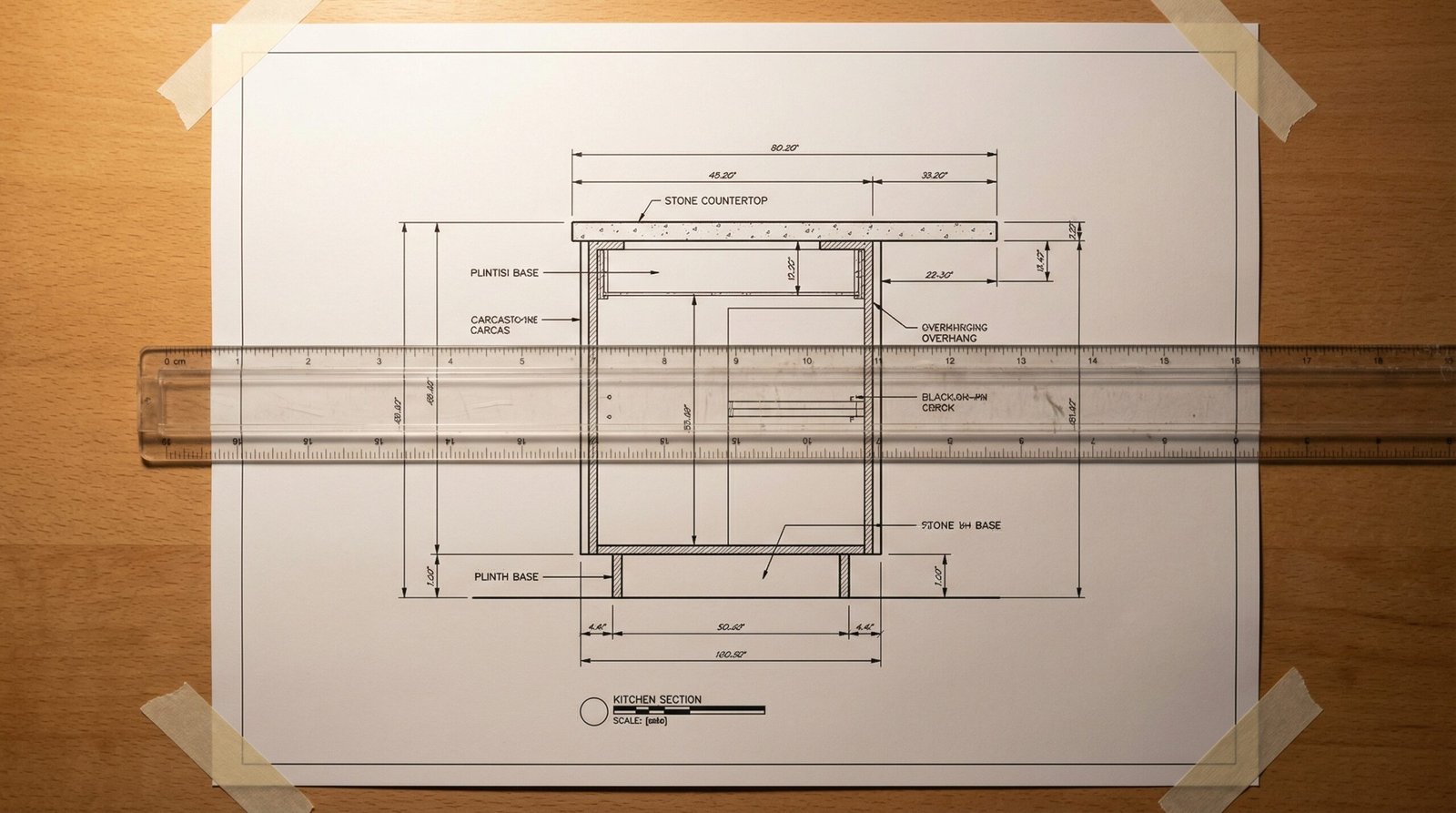
With materials finalized, we create comprehensive technical drawings documenting every aspect of your island project. These drawings serve multiple purposes—they guide our workshop fabrication, communicate requirements to electrical and plumbing contractors, and satisfy any required approvals from authorities.
The drawings include cabinet elevations showing all dimensions and configurations, plan views illustrating the island’s footprint and relationship to surrounding elements, electrical plans indicating outlet locations and circuit requirements, plumbing schematics if your island includes a sink or integrated appliances requiring water connection, and detailed sections through the island showing internal construction and how components connect.
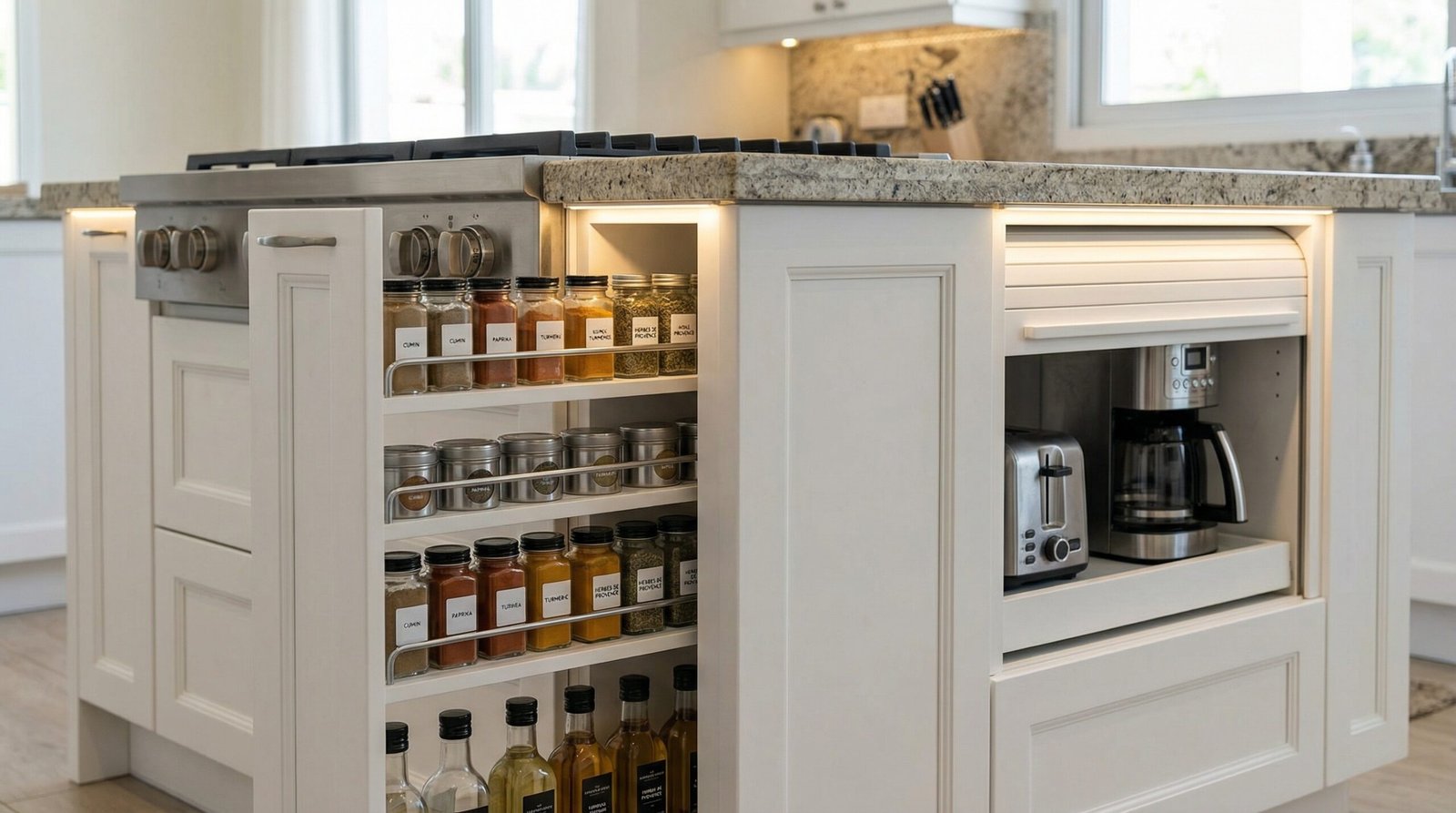
For commercial kitchen projects or residential projects involving licensed trade work, we prepare submittal packages for Dubai Municipality and other relevant authorities. We handle this process completely—preparing required documents, submitting applications, responding to any comments or requests for clarification, and securing final approvals. The timeline for approvals varies from 2-3 weeks for straightforward residential work to 6-8 weeks for complex commercial installations requiring multiple authority reviews.
During the approval process, we begin ordering long-lead materials to compress the overall timeline. Stone slabs get reserved, hardware gets ordered, any special-order appliances get put into the supply chain. This parallel processing means fabrication can begin immediately once approvals arrive rather than waiting additional weeks for material procurement.
Step 5: Workshop Fabrication
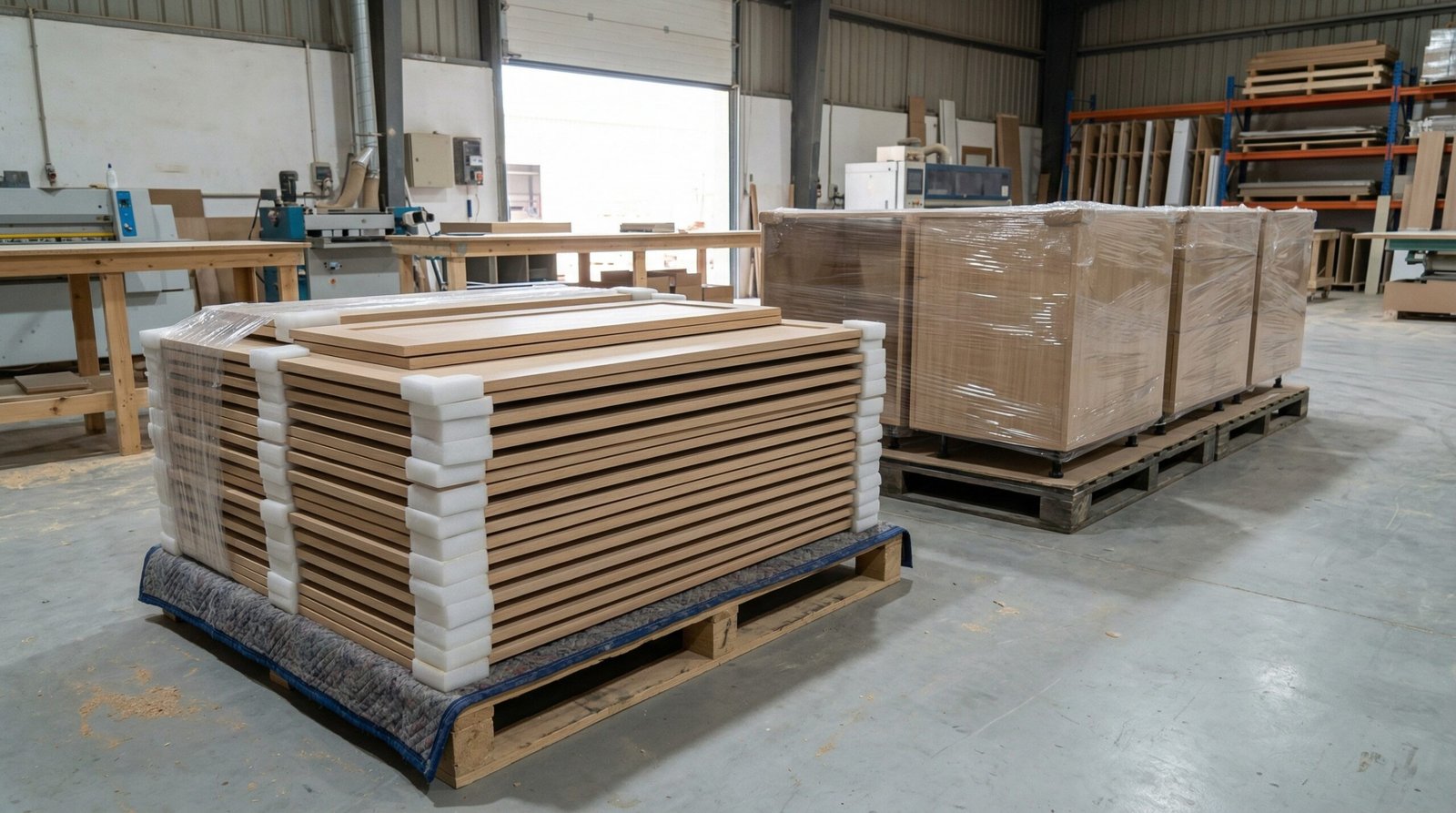
Fabrication begins when all materials have arrived and quality-checked. Our workshop team builds your island following the approved technical drawings with precision that ensures everything fits correctly during installation.
Cabinet construction starts with rough milling all components slightly oversized, then allowing them to stabilize for several days in our climate-controlled workshop. Final dimensioning happens once this movement completes. We cut all joints—dowels for cabinet boxes, mortise-and-tenon for face frames, dovetails for drawer boxes—using computer-controlled equipment that ensures consistency across all components.
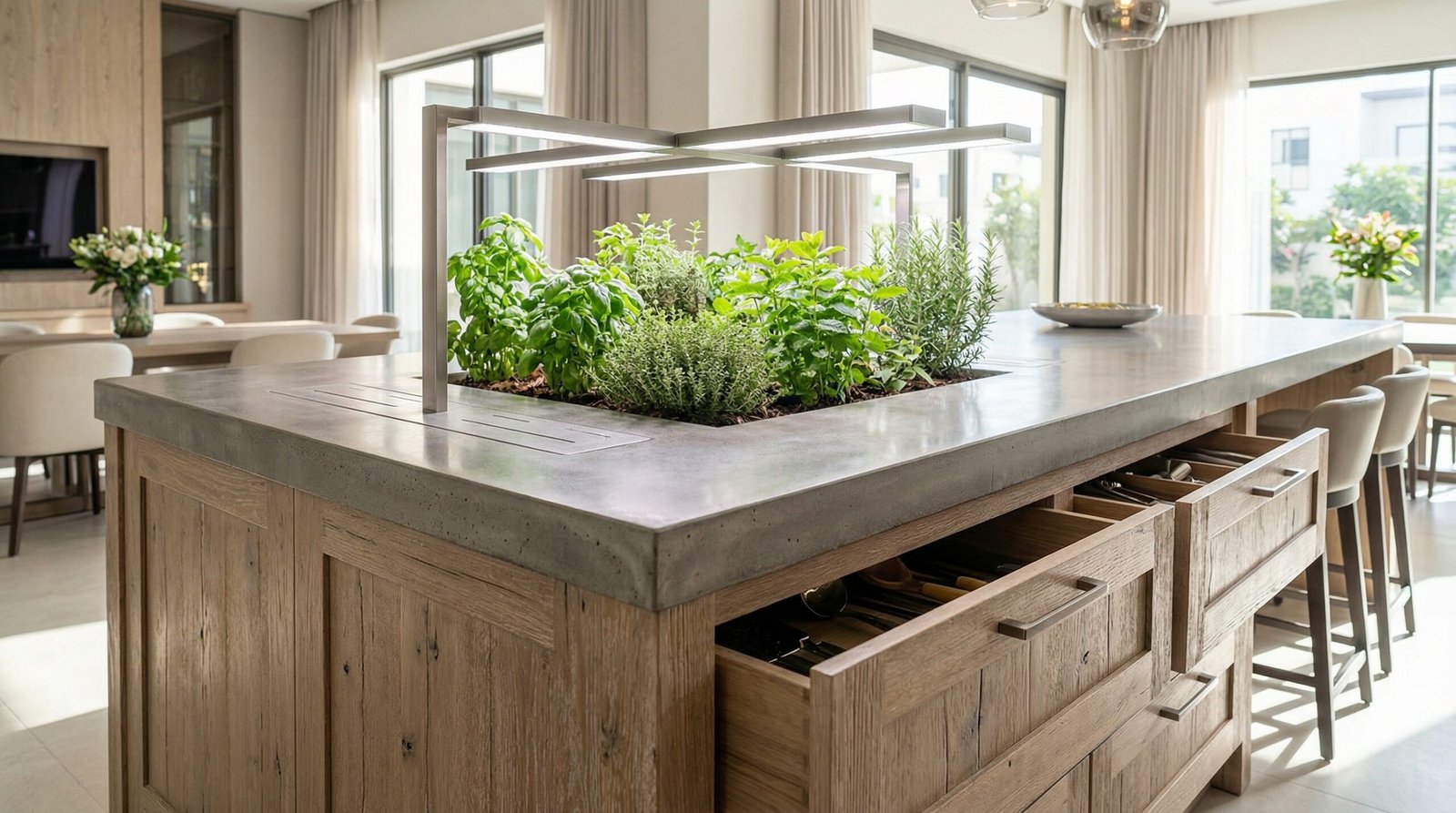
Assembly uses structural adhesives and mechanical fasteners appropriate to each joint type. We build substantially—using more adhesive, more fasteners, heavier materials than minimum standards require—because our reputation rests on these islands still functioning perfectly a decade from now. Every cabinet box gets checked for square and twist before moving to the next fabrication stage.
Door and drawer front fabrication follows cabinet construction. We machine all edge profiles, sand progressively through grits from 120 to 220, apply any edge banding on plywood components, and complete final fitting before finishing begins. For painted finishes, we apply several primer coats, sanding between each coat, before applying finish paint. Stained finishes receive equal care—proper grain raising and sanding, careful stain application ensuring even color, multiple clear coat applications building depth and protection.
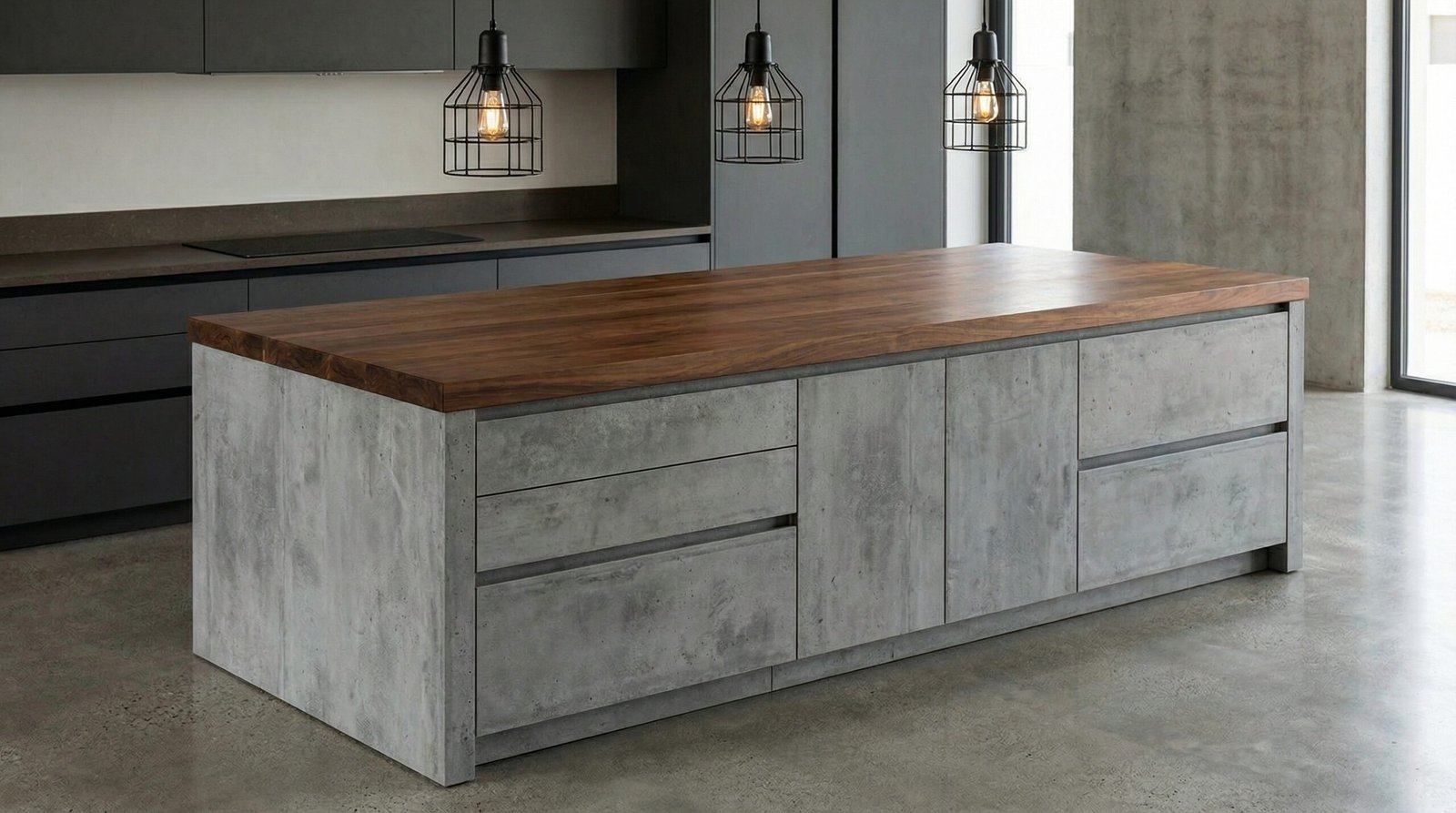
We maintain detailed documentation through fabrication, photographing components at various stages and tracking progress against schedule. Clients receive progress updates at key milestones. This transparency allows you to plan your kitchen island dubai preparation activities—you know when to schedule final electrical and plumbing work, when to complete any wall painting or flooring work that would be difficult after island installation, when to prepare for installation day logistics.
Step 6: Coordinated Installation
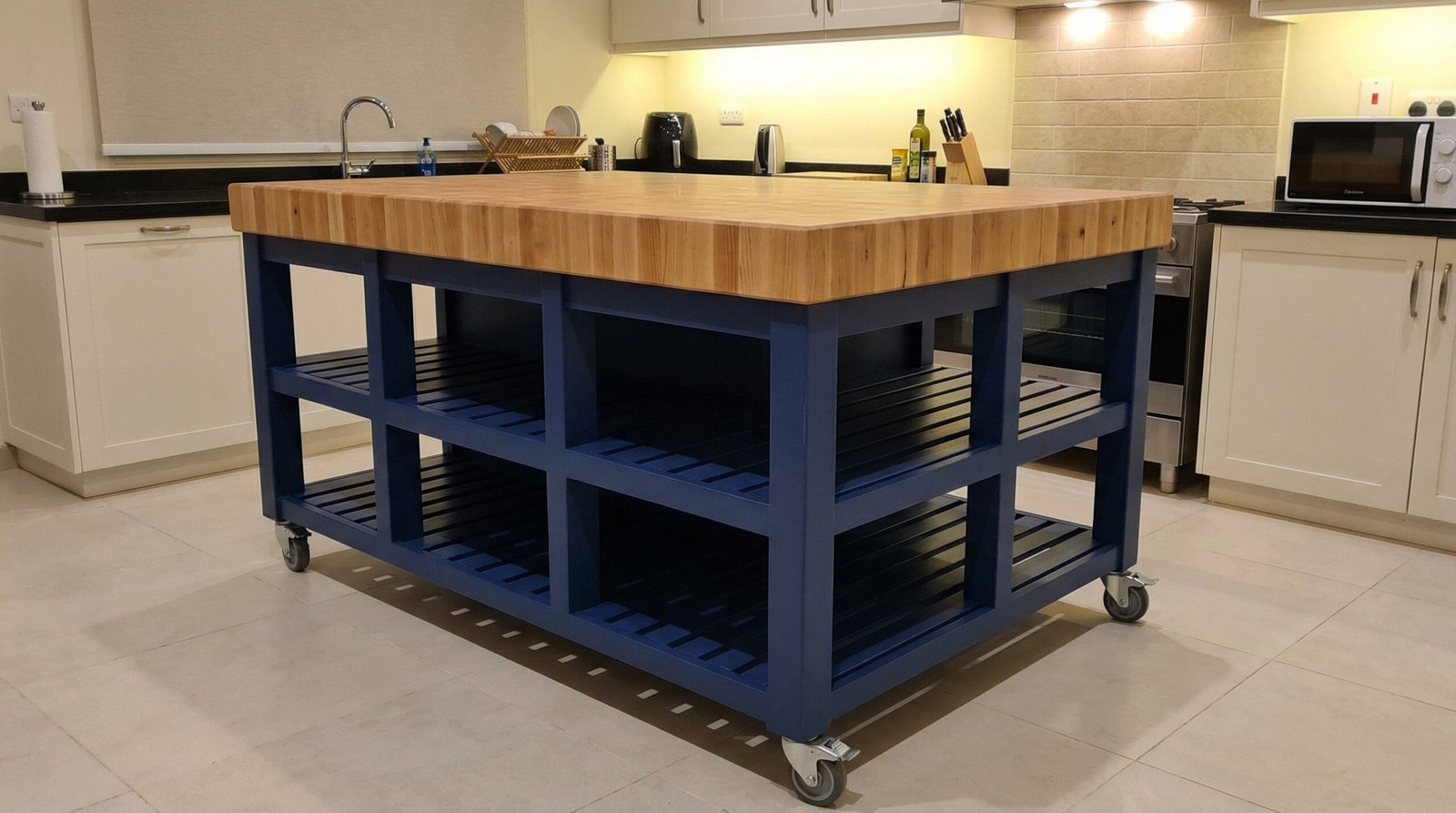
Installation day represents the culmination of weeks of planning, material procurement, and fabrication. We coordinate our arrival with completion of any prerequisite work—electrical outlets installed, plumbing rough-in completed, flooring finished, walls painted.
The installation team arrives with all necessary components, tools, and equipment. We protect your floors and traffic pathways before bringing any materials inside. Cabinet sections get positioned, leveled carefully using adjustable feet and precision measurement, joined together using cabinet connector hardware, secured to floor or walls as appropriate for your island configuration.
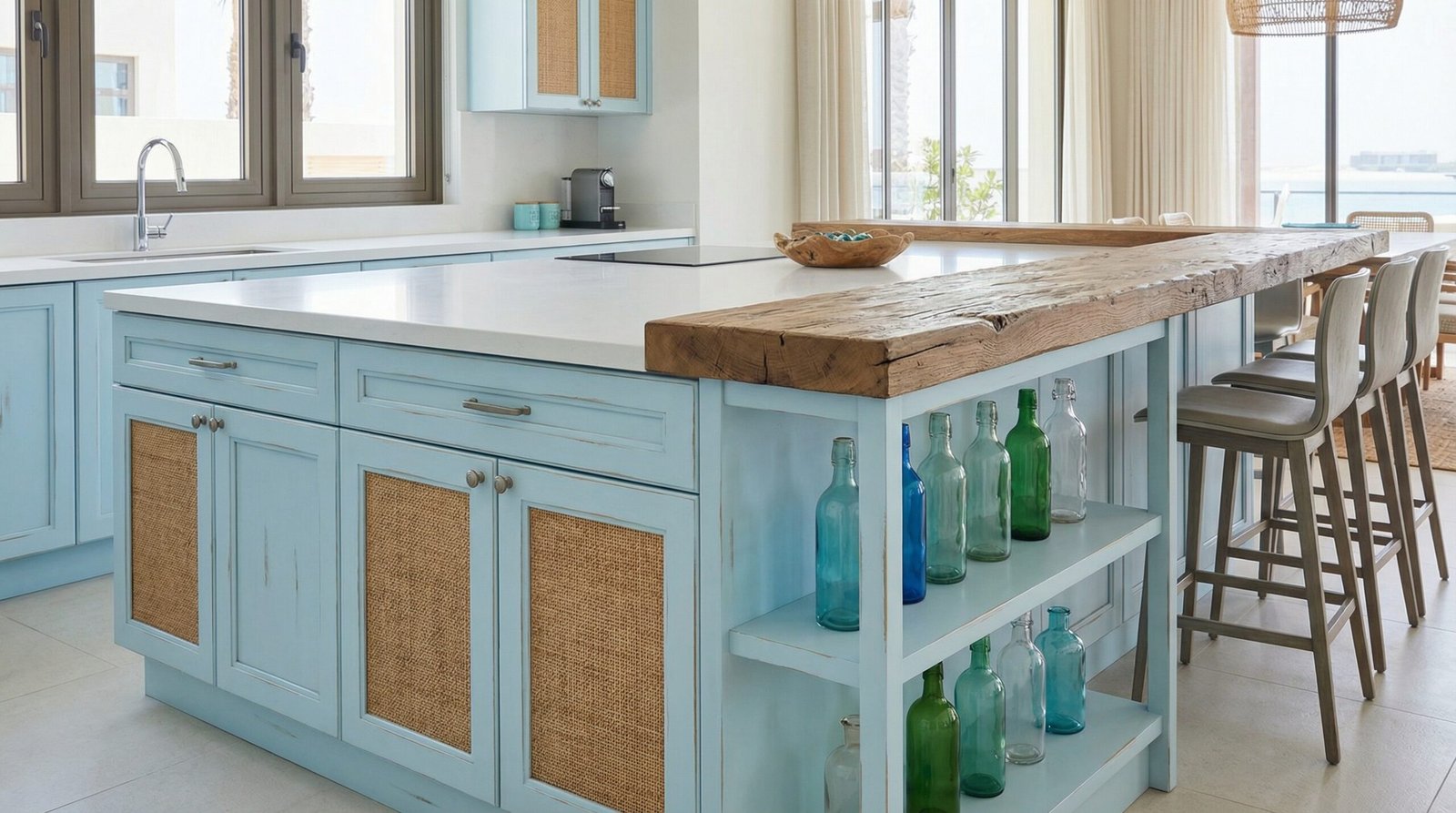
All interior components get installed—drawer boxes go into their openings and get adjusted for smooth operation, doors get hung and adjusted for even margins and proper alignment, shelves go onto their supports, any organizational elements get installed and fitted. We install end panels, finished toe kicks, and any decorative elements specified in your design.
If your island includes a sink, we coordinate with plumbers to make final connections—supply lines, drain piping, trap installation, faucet mounting. For integrated appliances, we coordinate with electricians for final power connections, then position the appliances in their cabinet openings, secure them properly, test operation, and ensure they integrate cleanly with surrounding cabinetry.
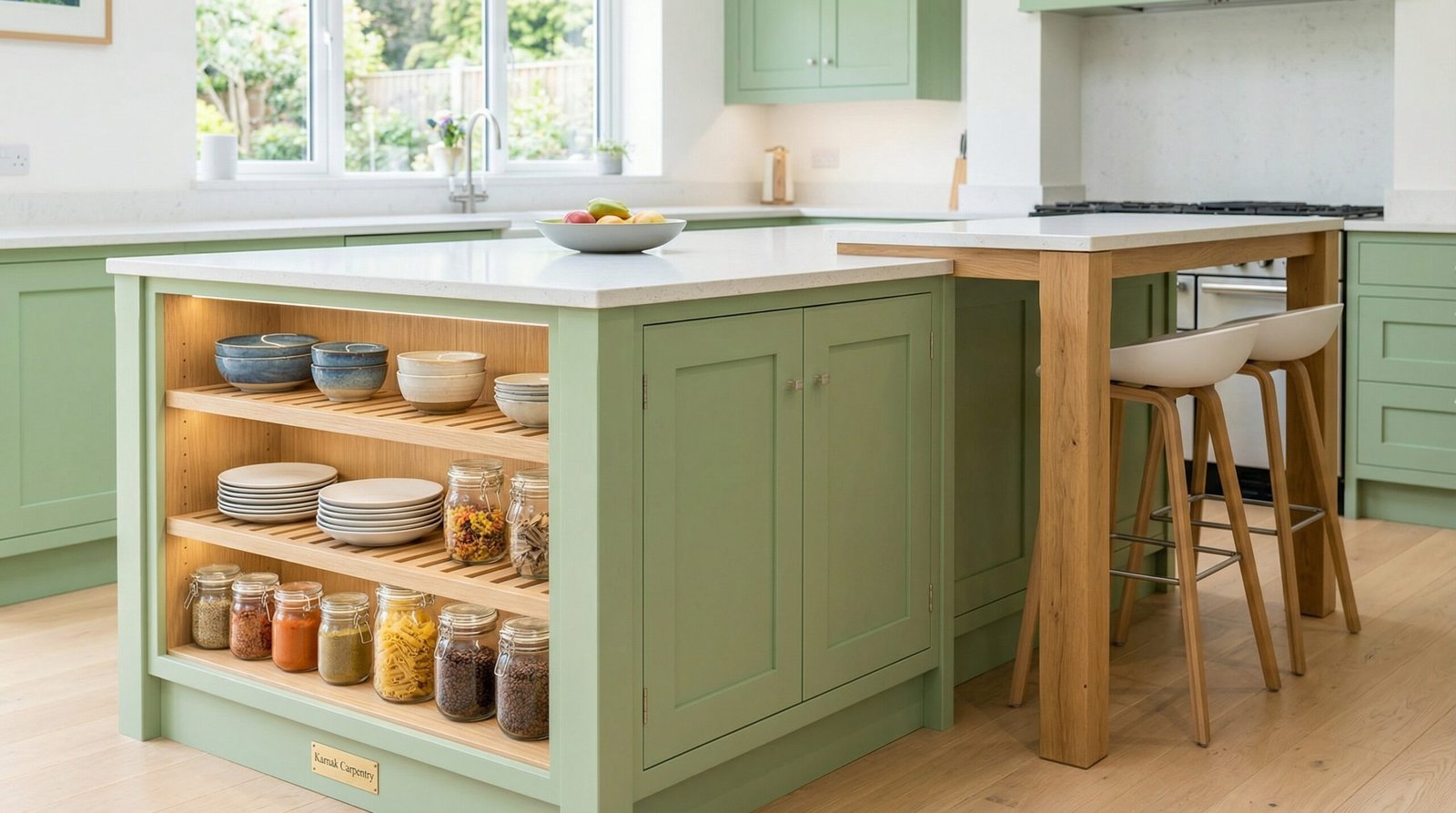
Throughout installation, we maintain your property protection and work efficiently to minimize disruption to your daily routine. Most kitchen island dubai installations complete within one to two days depending on complexity. More elaborate islands with extensive appliance integration, custom details, or coordination challenges may require additional time.
Step 7: Stone Installation and Final Details
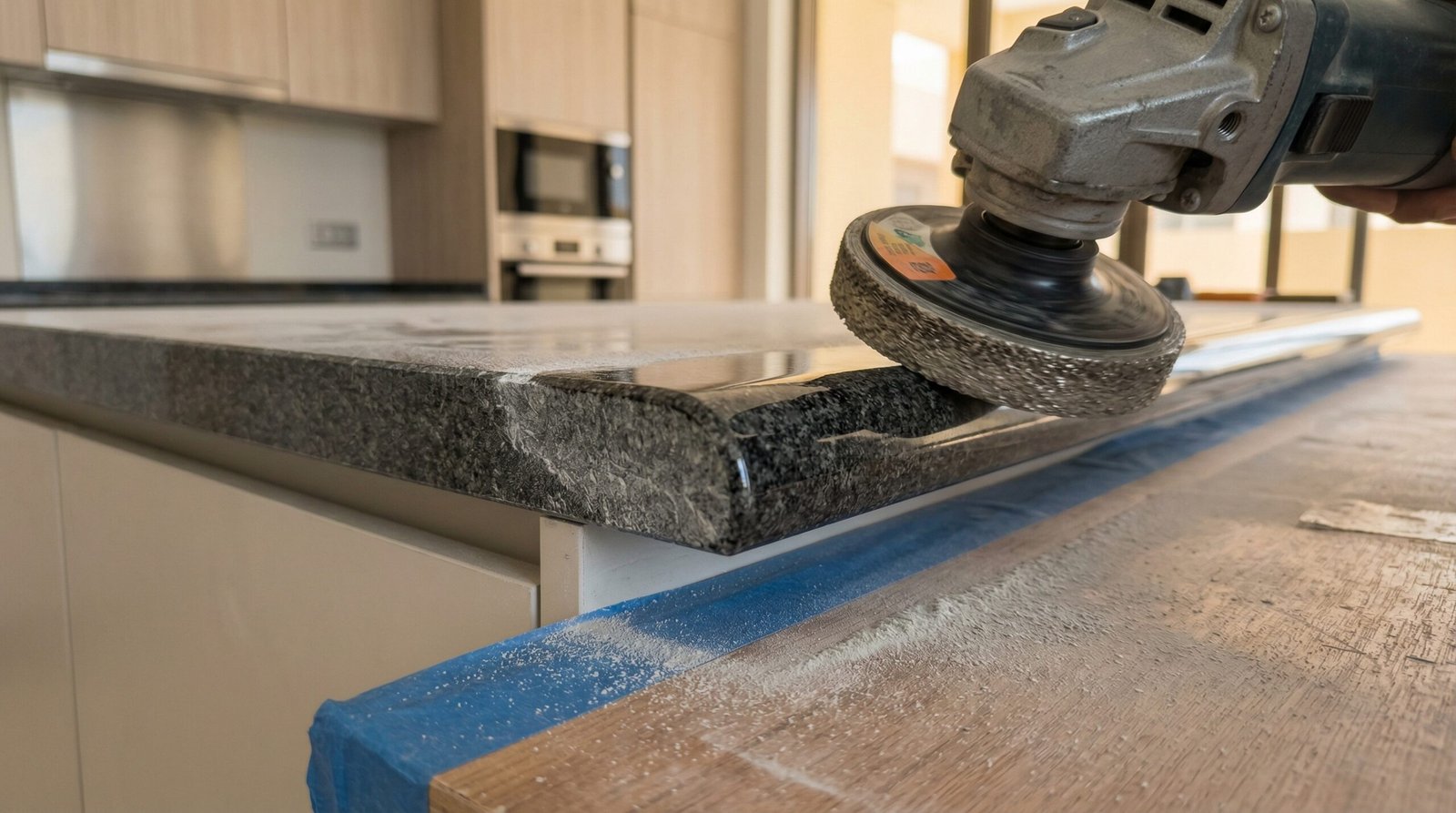
Stone countertop installation typically occurs one to two days after cabinet installation, allowing time for final cabinet verification and any minor adjustments before permanent countertop placement. The stone fabricator arrives with countertop pieces ready to install.
Installation begins with confirming the cabinet base remains level and properly positioned. The installers apply silicone adhesive along cabinet tops where the stone will rest. They position the countertop pieces, checking level and alignment carefully. For multi-piece installations requiring seams, they ensure seam joints align perfectly and gaps remain minimal—visible seams indicate poor fabrication or installation quality.
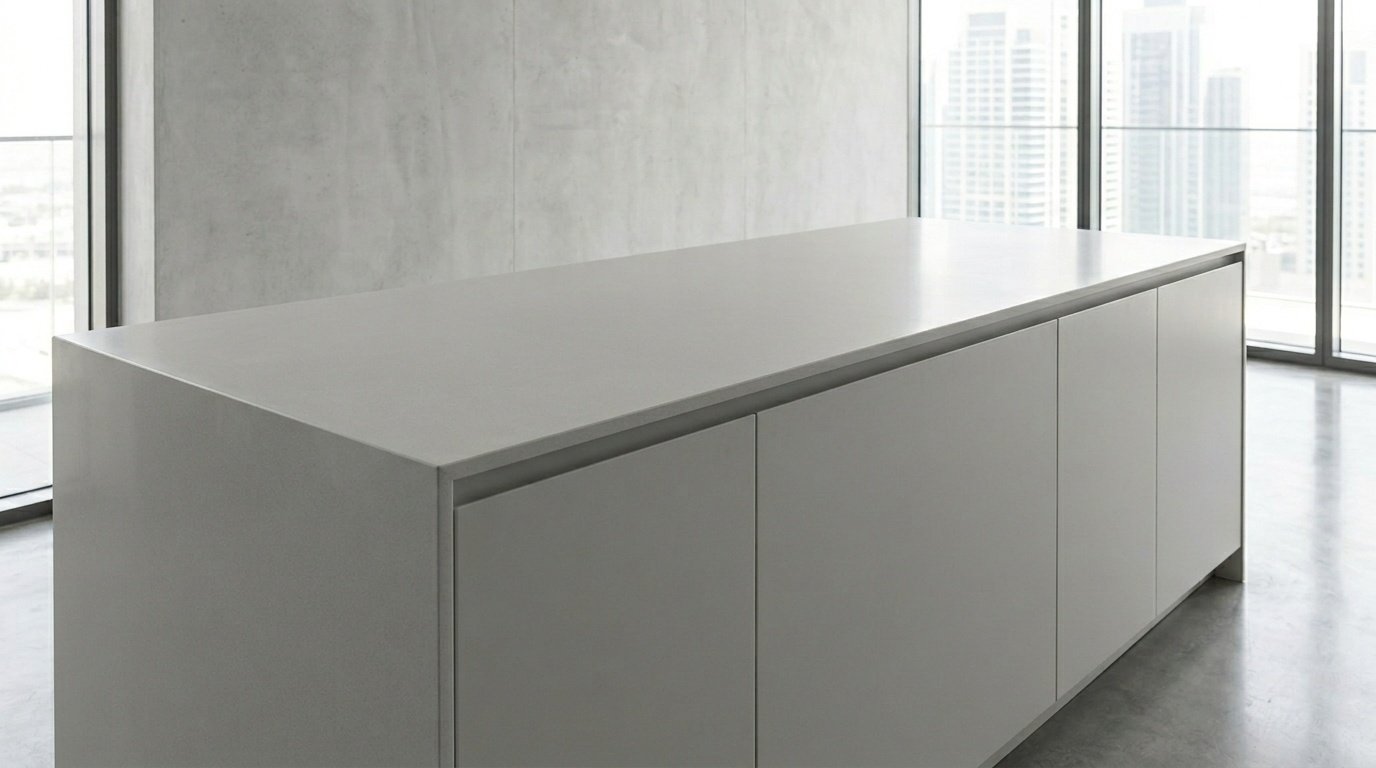
The installers fill seam joints with color-matched epoxy, carefully wiping away excess and polishing the seam area until it becomes nearly invisible. They seal natural stone countertops with penetrating sealer, apply final edge finishing, and clean the surface completely. Any sink cutouts get fitted with the sink, sealed properly to prevent water infiltration around the rim.
With the stone installed, we complete final details. Any scribing pieces get fitted—these trim pieces fill small gaps between the island and adjacent walls or cabinets, creating clean visual transitions. We install outlet covers, make final hardware adjustments, clean all surfaces thoroughly, and conduct a complete quality inspection with you present.
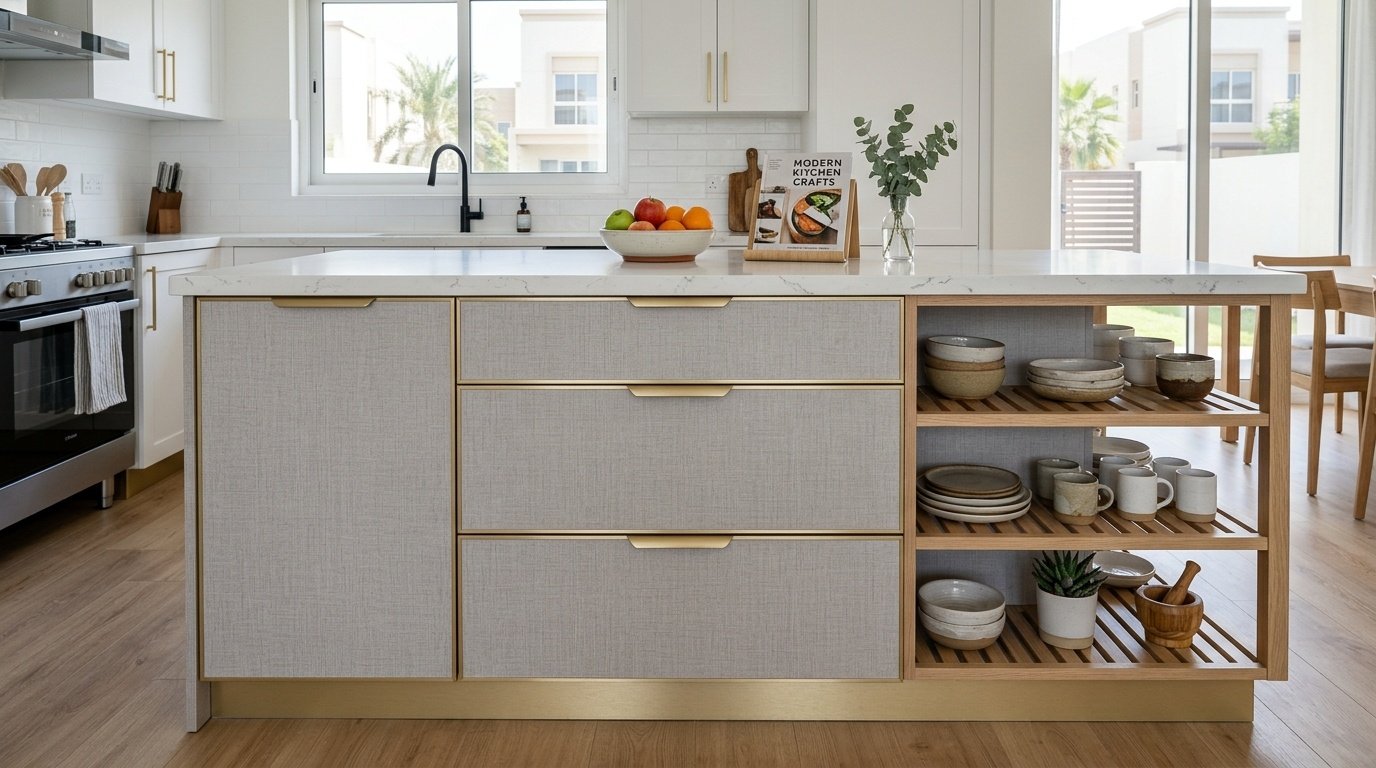
We walk through the completed installation, demonstrating proper use and care for all components. We explain how to adjust soft-close hinges if needed, how to maintain stone countertops, how to operate integrated appliances, what cleaning products to use and avoid. We provide written care instructions and warranty information. We remove all packaging materials and construction debris, leaving your kitchen ready to use immediately.
Why UAE Businesses and Homeowners Choose Karnak Carpentry for Kitchen Islands
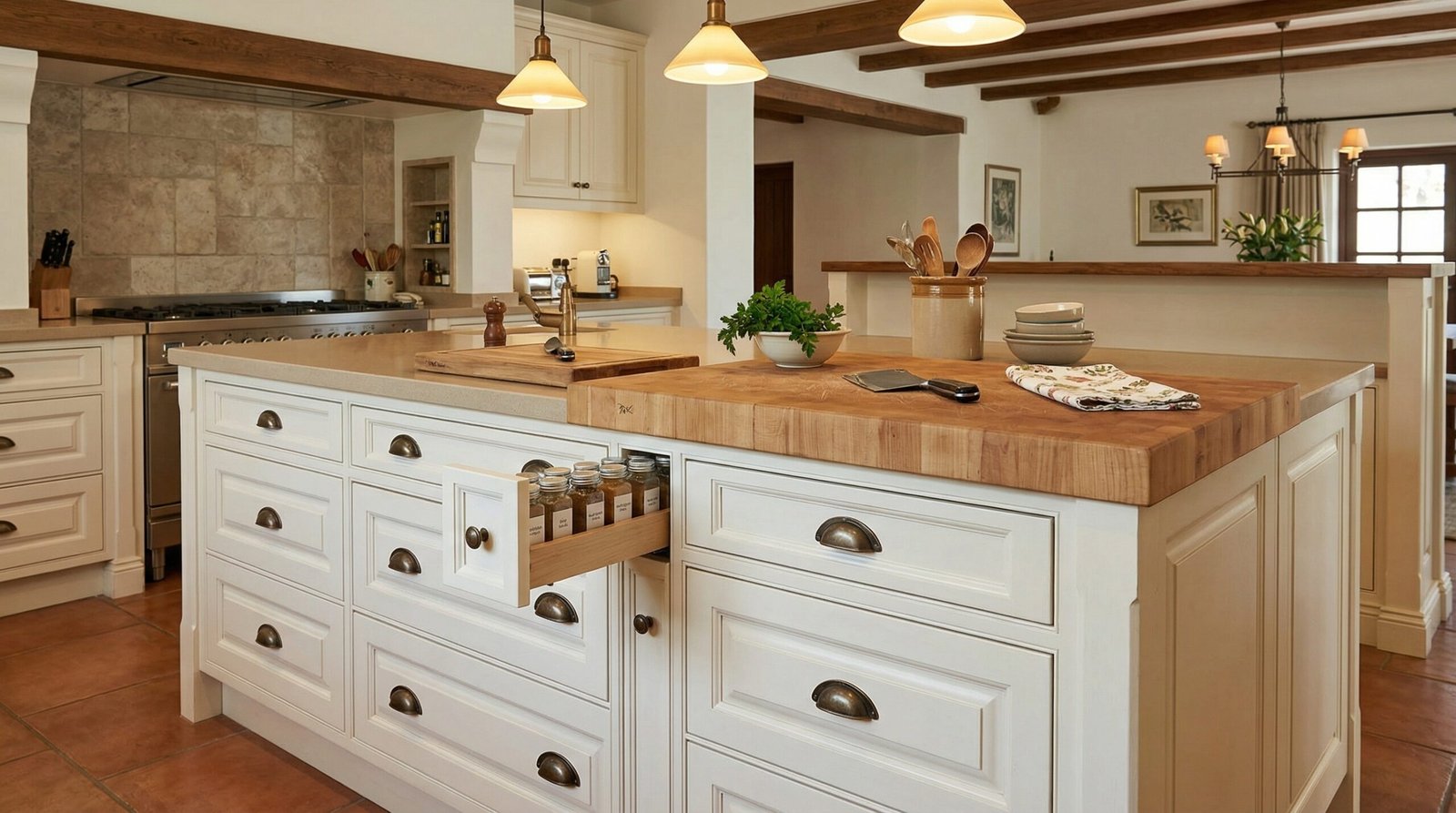
Your kitchen island uae represents a substantial investment in both money and the daily functionality of your most-used home space. The difference between an island that delights you for decades and one that creates ongoing frustration comes down to the expertise, materials, and construction quality behind it.
Three Decades of UAE-Specific Expertise
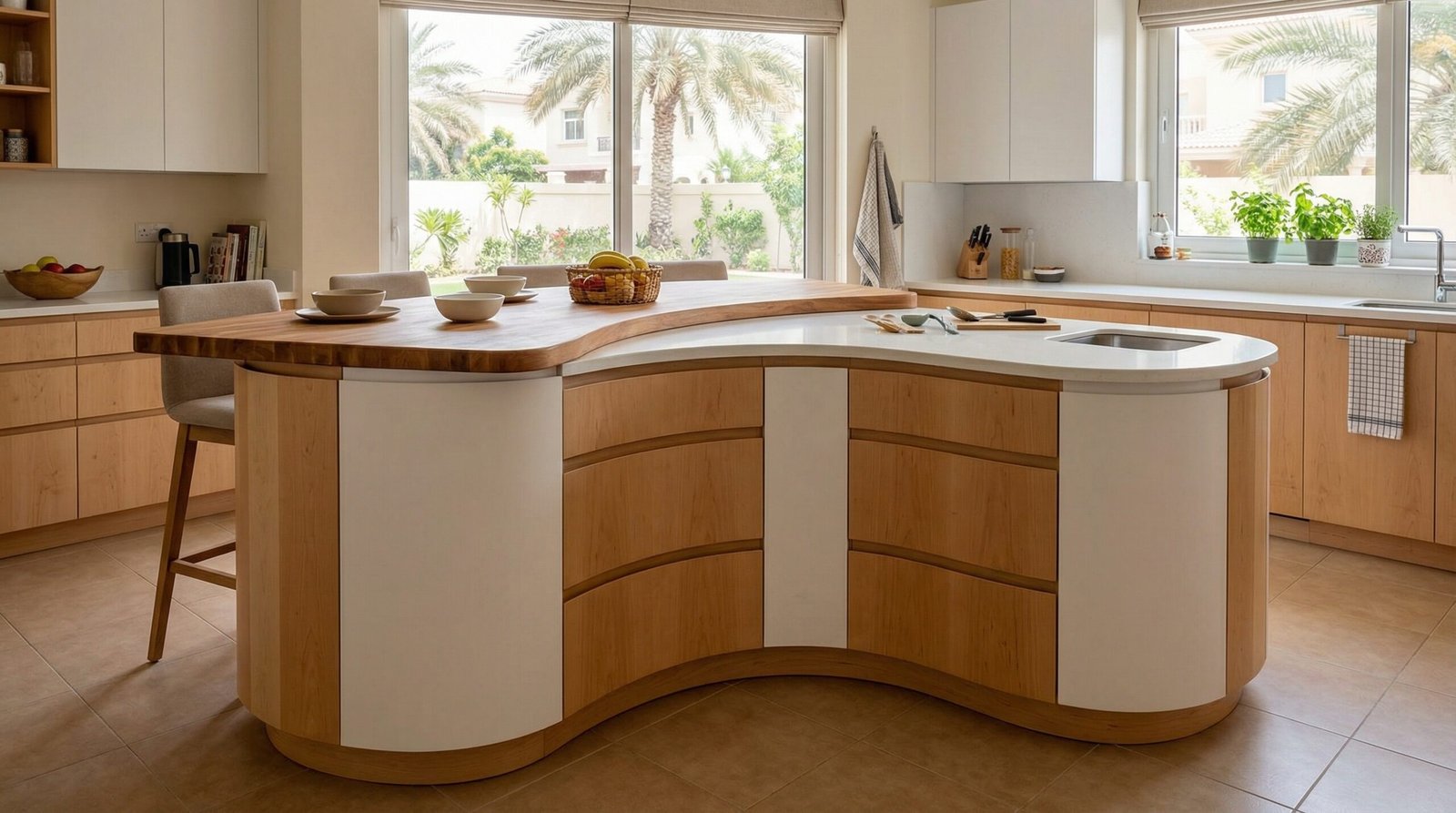
We’ve operated continuously in Dubai since 1988, which means we’ve refined our understanding of what works in Emirates conditions through thousands of real-world projects. This experience spans the evolution of UAE construction standards, the introduction of new materials and techniques, dramatic climate variation from coastal humidity to desert dryness, and changing lifestyles as the country developed from regional center to global city.
That 35-year history translates to practical advantages for your project. We know which adhesives maintain bond strength in humidity fluctuations that range from 30% to 90% within the same week during seasonal transitions. We’ve tested wood species under UAE conditions and can tell you definitively that European oak performs reliably while certain North American species warp predictably. We understand Dubai Municipality approval processes thoroughly because we’ve navigated them over 3,000 times for commercial projects.
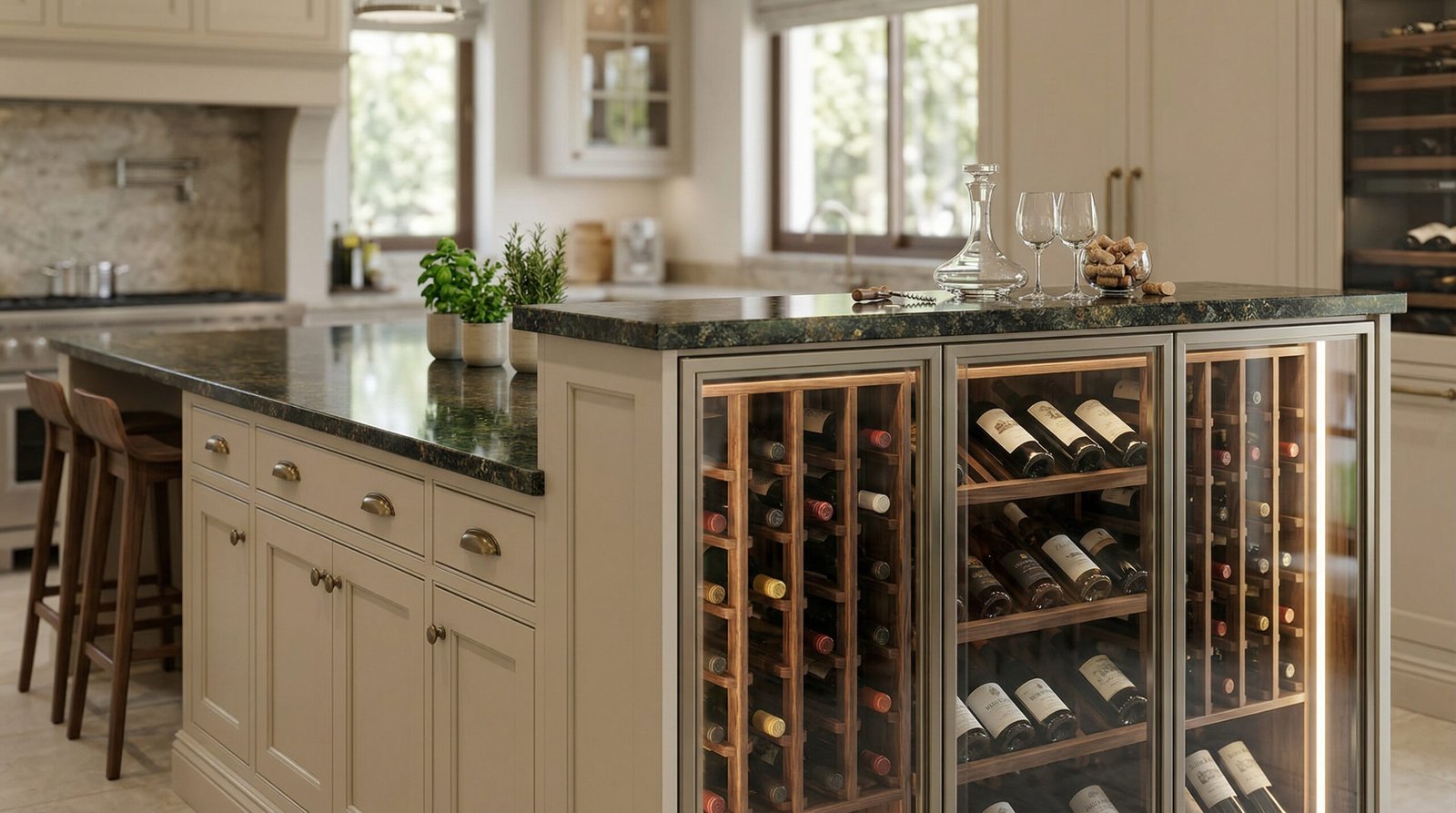
The depth of our experience shows in details most contractors overlook. We know to specify stainless steel rather than zinc-plated hardware for coastal properties because salt air causes rapid corrosion. We understand that stone countertops need specific support spacing in UAE temperatures to prevent thermal stress cracking. We’ve solved the problem of soft-close mechanisms failing in extreme heat by using German-manufactured hardware engineered for wider temperature ranges. These aren’t theoretical considerations—they’re lessons learned from decades of follow-up and refinement.
Comprehensive In-House Capabilities
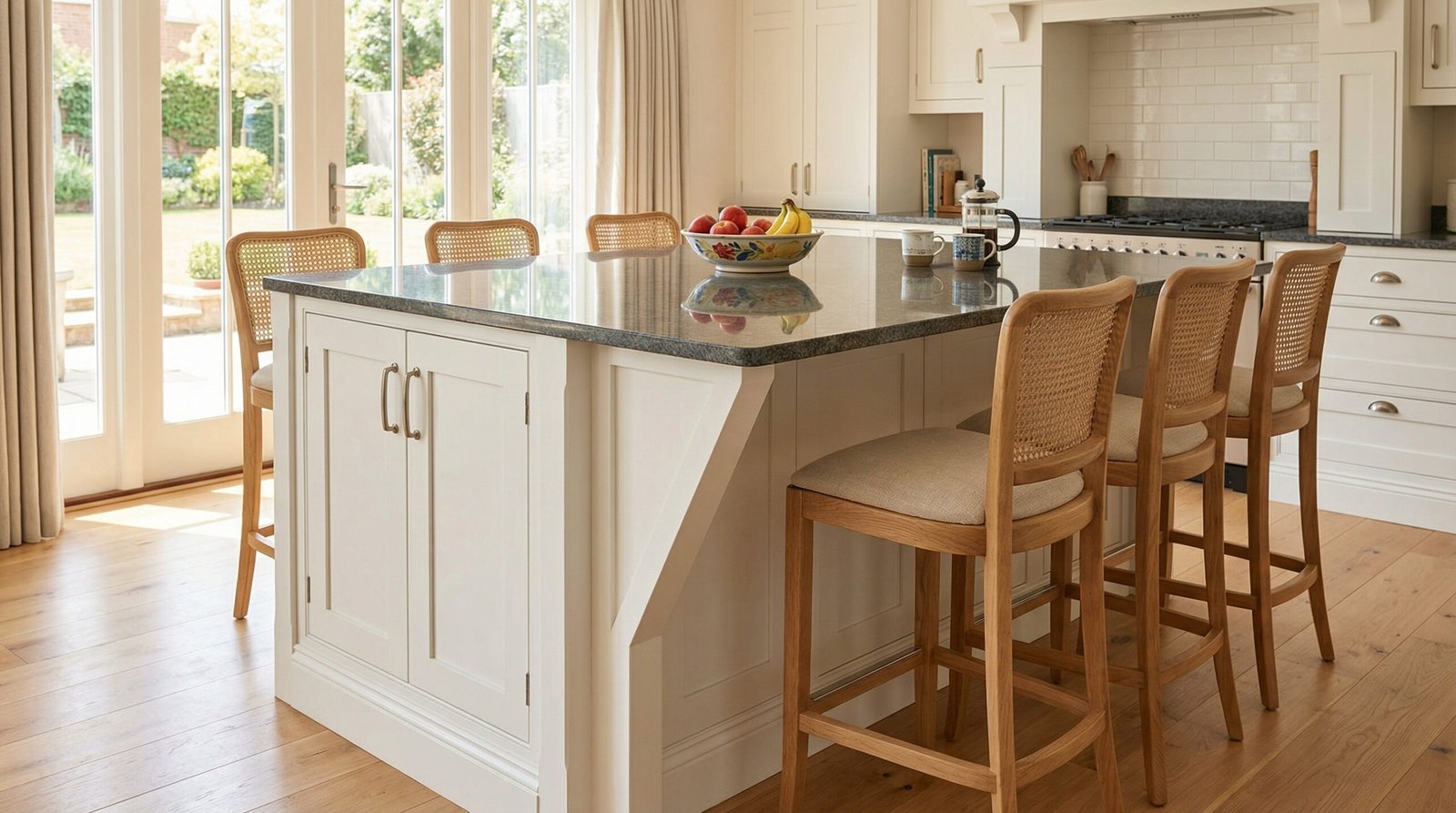
Our 2,000-square-meter climate-controlled workshop allows us to handle every fabrication aspect internally rather than subcontracting elements to third parties. This vertical integration creates better quality control, shorter timelines, and accountability that never fragments across multiple companies.
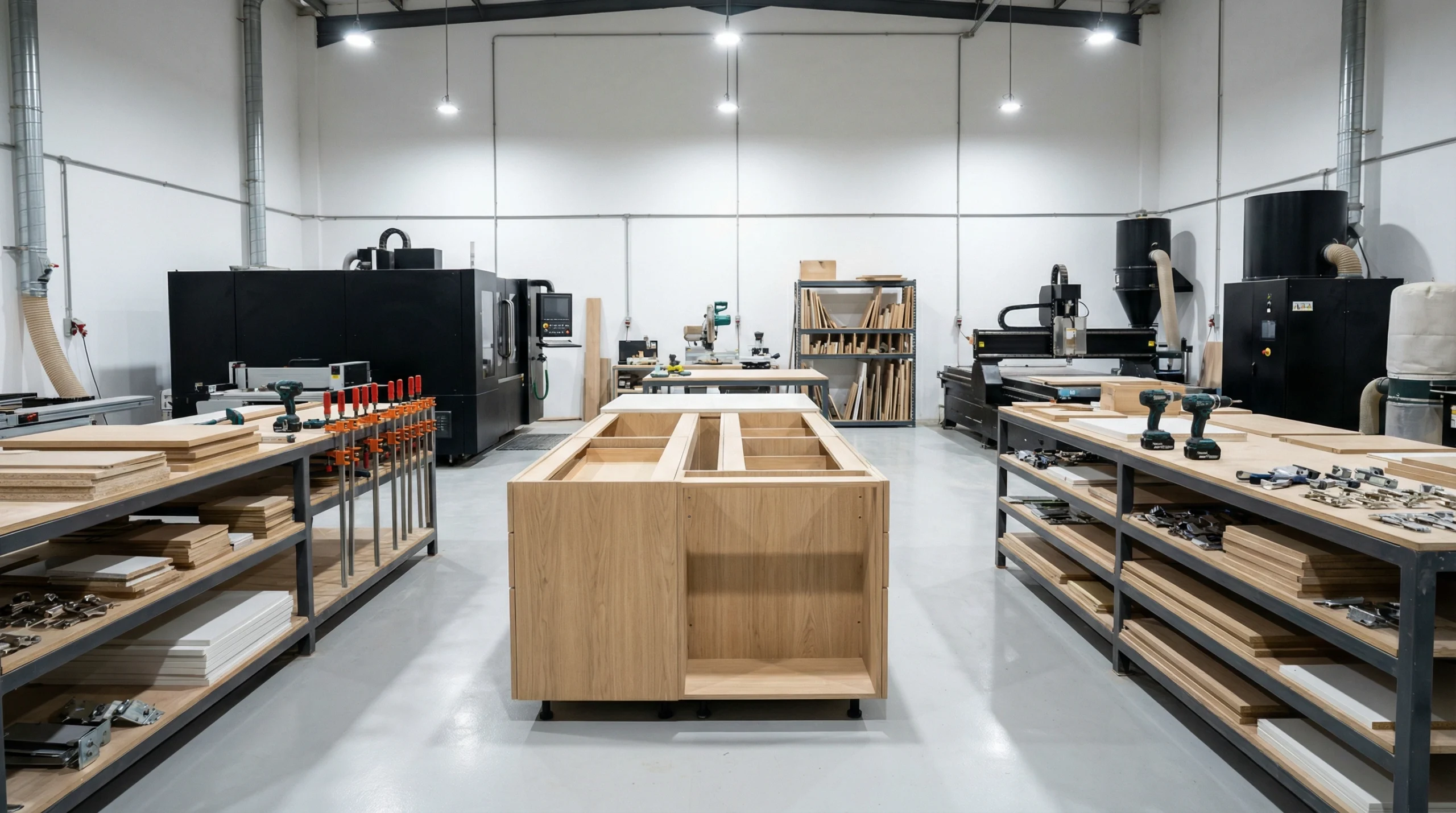
When we fabricate your kitchen island table dubai, our craftsmen use the same wood-working equipment found in European fine furniture workshops—SCM panel saws, Biesse CNC machines, Weinig molders, Festool finishing equipment. We’ve invested significantly in this machinery because it enables precision impossible with basic contractor-grade tools. Computer-controlled equipment cuts joints with 0.1mm accuracy. Dust extraction systems keep workshop air clean, preventing finish contamination. Climate control maintains 21°C and 50% relative humidity year-round, eliminating the wood movement problems that plague fabrication in uncontrolled environments.
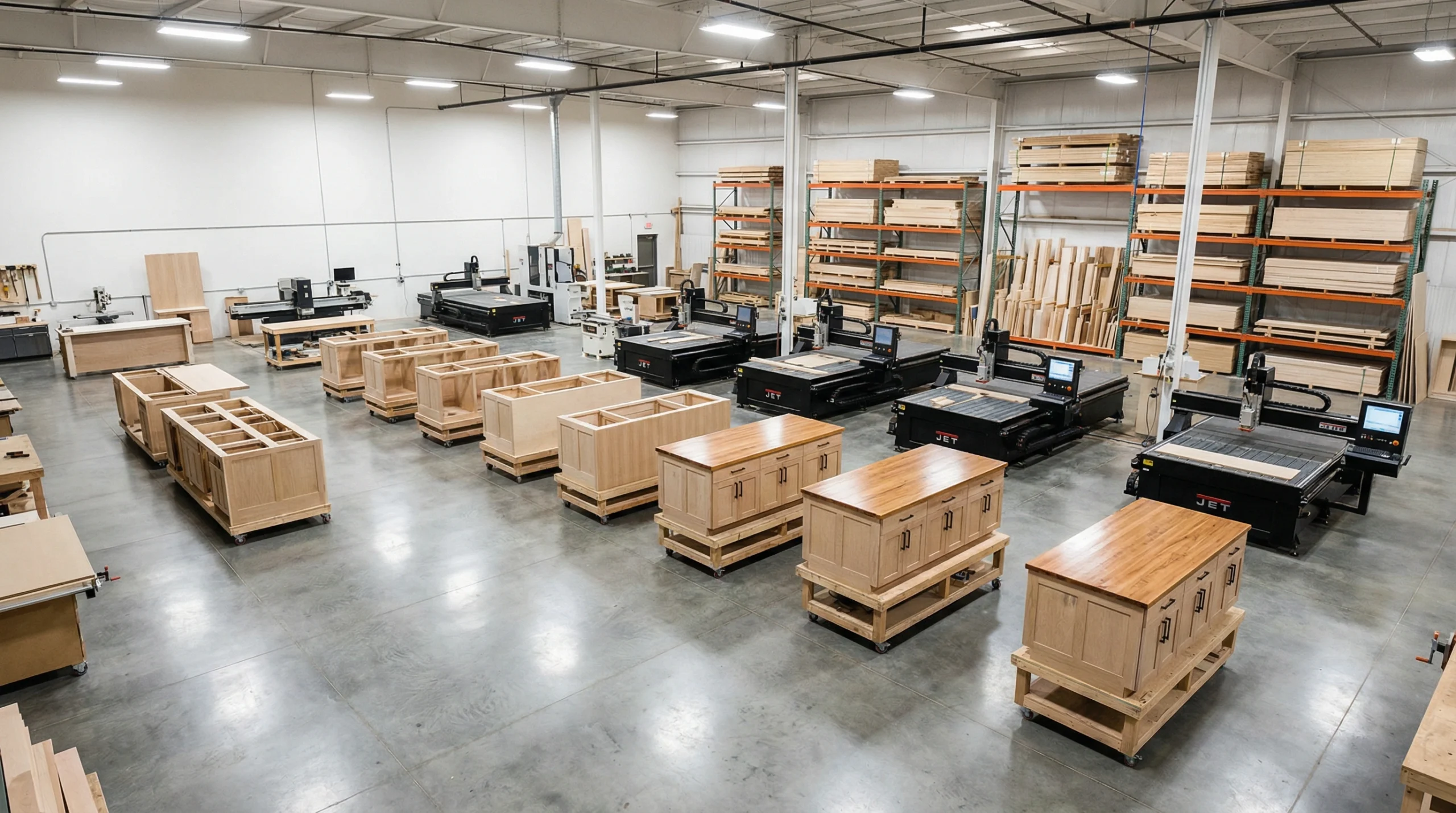
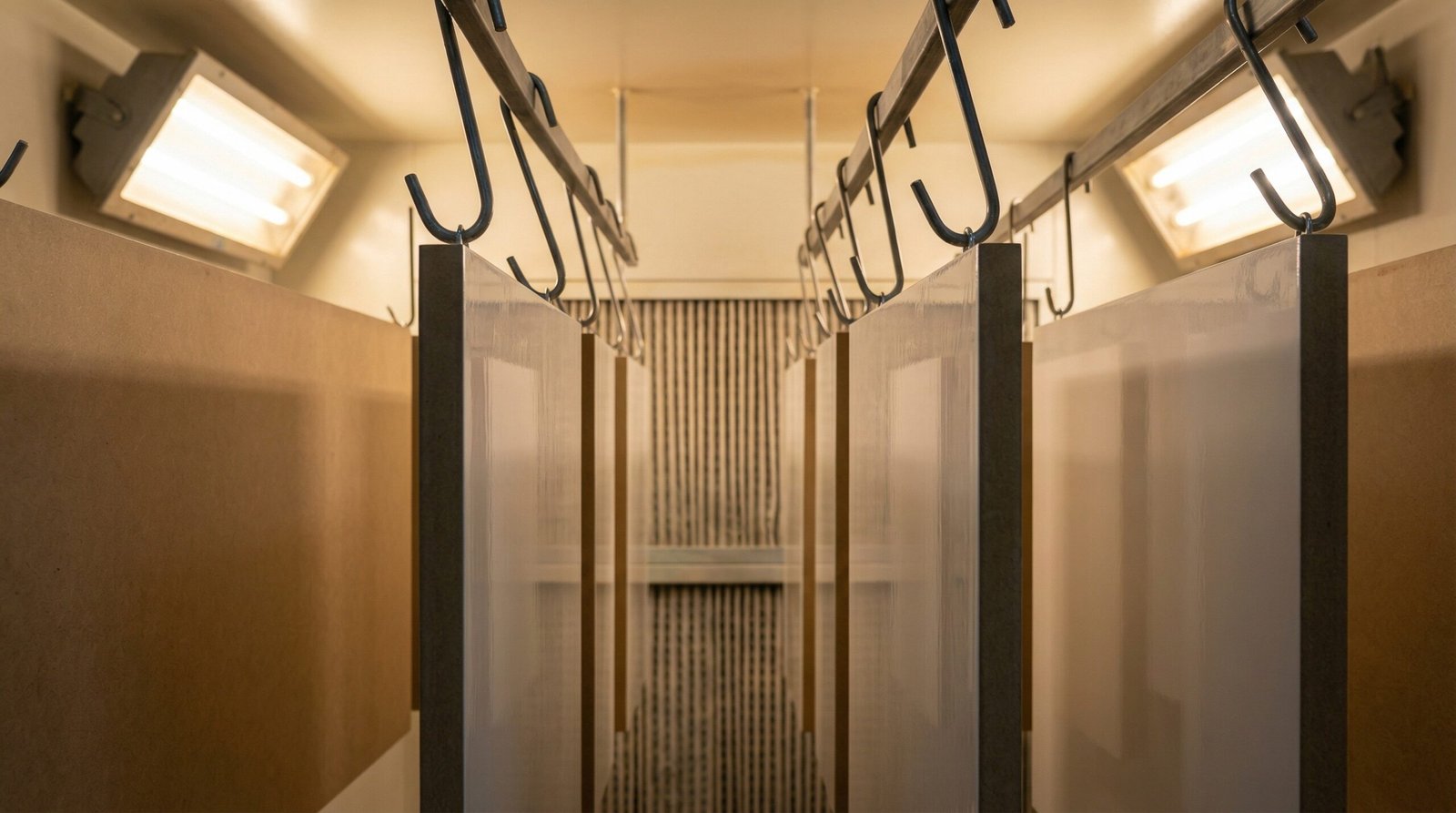
Our finishing room provides proper ventilation and temperature control for applying catalyzed lacquers and conversion varnishes that require specific curing conditions. We have spray booths for even finish application, racks for drying without surface contact, and curing ovens that speed the chemical hardening process while ensuring complete cure. The result: finishes that resist chemicals, impacts, and wear far better than field-applied finishes or production cabinet coatings.
Beyond carpentry equipment, we maintain a full complement of installation tools and specialty equipment. Cabinet lifting systems, laser levels, heavy-duty drills and drivers, precision measuring tools—we bring the right equipment to every installation rather than improvising with inadequate tools. This preparation accelerates installation and prevents the damage that occurs when installers lack proper equipment for handling heavy materials safely.
Material Sourcing and Quality Standards
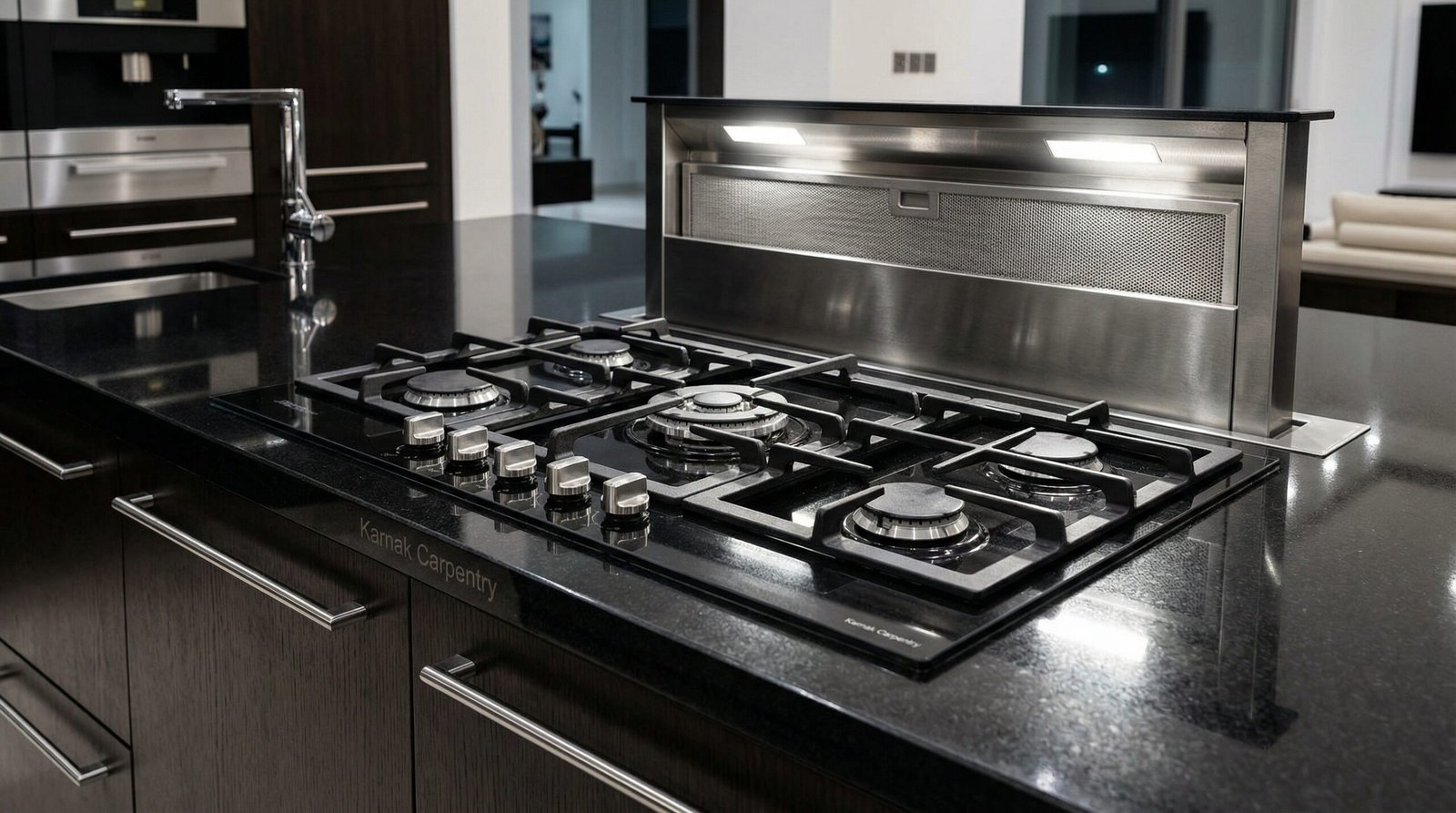
The materials we use in your kitchen island directly determine its performance and longevity. We maintain relationships with premium suppliers worldwide, giving us access to materials that meet our quality standards rather than accepting whatever generic products local suppliers stock.
Our primary wood suppliers include FSC-certified European mills providing oak, ash, and beech; North American hardwood exporters supplying walnut, cherry, and maple; and tropical hardwood specialists for exotic species when projects demand unique aesthetics. All solid wood arrives kiln-dried to 8-10% moisture content, then spends minimum 30 days in our climate-controlled warehouse before fabrication begins. This acclimatization period allows the wood to stabilize at UAE ambient conditions, preventing the dimensional changes that cause problems when fresh-imported wood gets fabricated immediately.
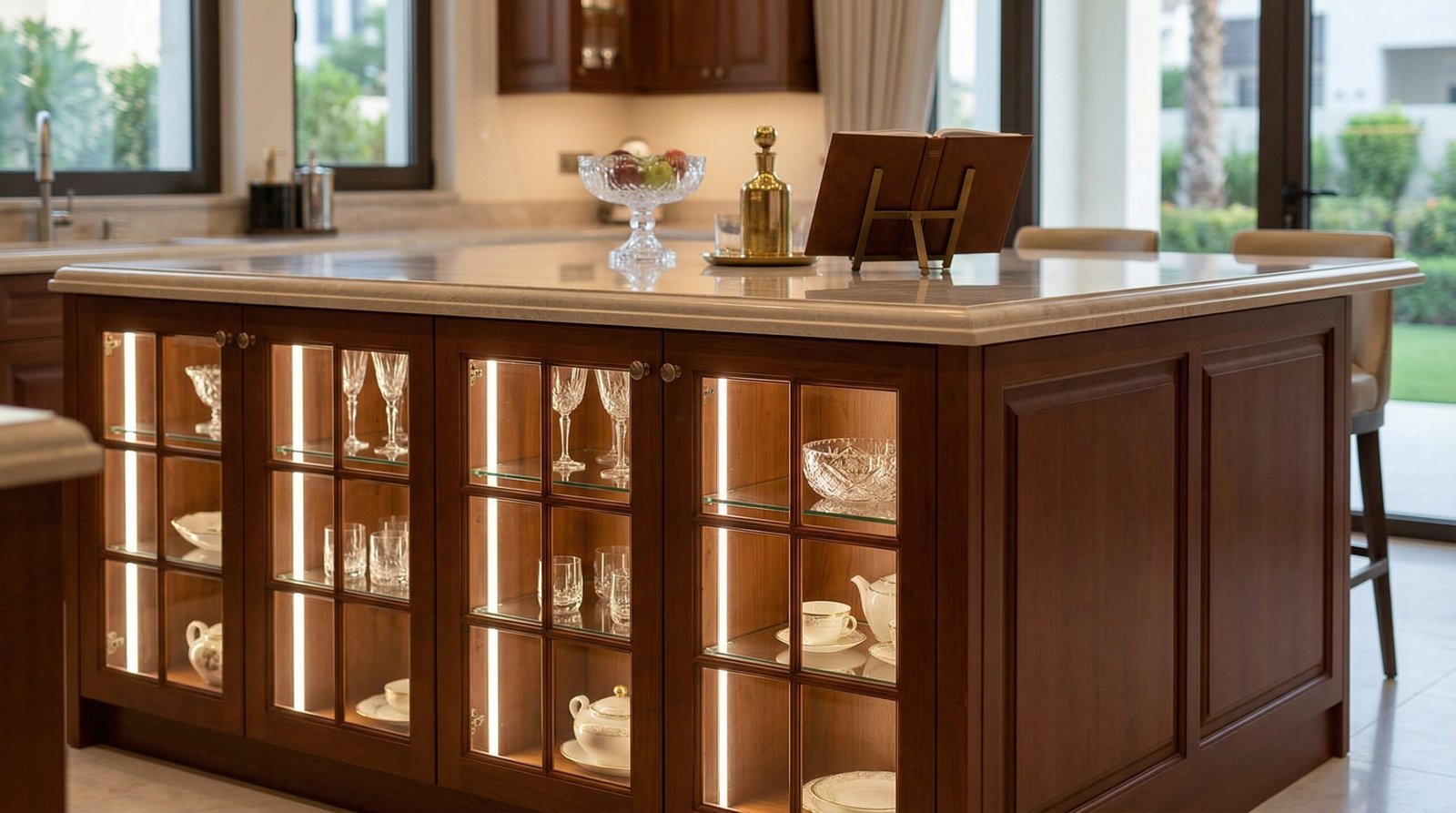
For sheet goods—plywood and MDF that form cabinet box cores and structural elements—we specify marine-grade and moisture-resistant variants from manufacturers like Egger, Kronospan, and Finsa. Standard construction-grade plywood uses urea-formaldehyde adhesives that deteriorate when exposed to moisture. Marine plywood uses phenolic resins that maintain strength even after water exposure. The cost difference is modest—15-20% more—but the performance difference proves critical in UAE humidity.
Stone countertop materials come from suppliers maintaining substantial inventories of premium materials. We work with distributors carrying Silestone, Caesarstone, and Compac for engineered quartz; Brazilian, Italian, and Indian natural stone importers for granite and marble; and specialty suppliers for exotic materials like quartzite and soapstone. Our relationships with these suppliers mean you see extensive material selections and often negotiate better pricing through our volume purchasing.
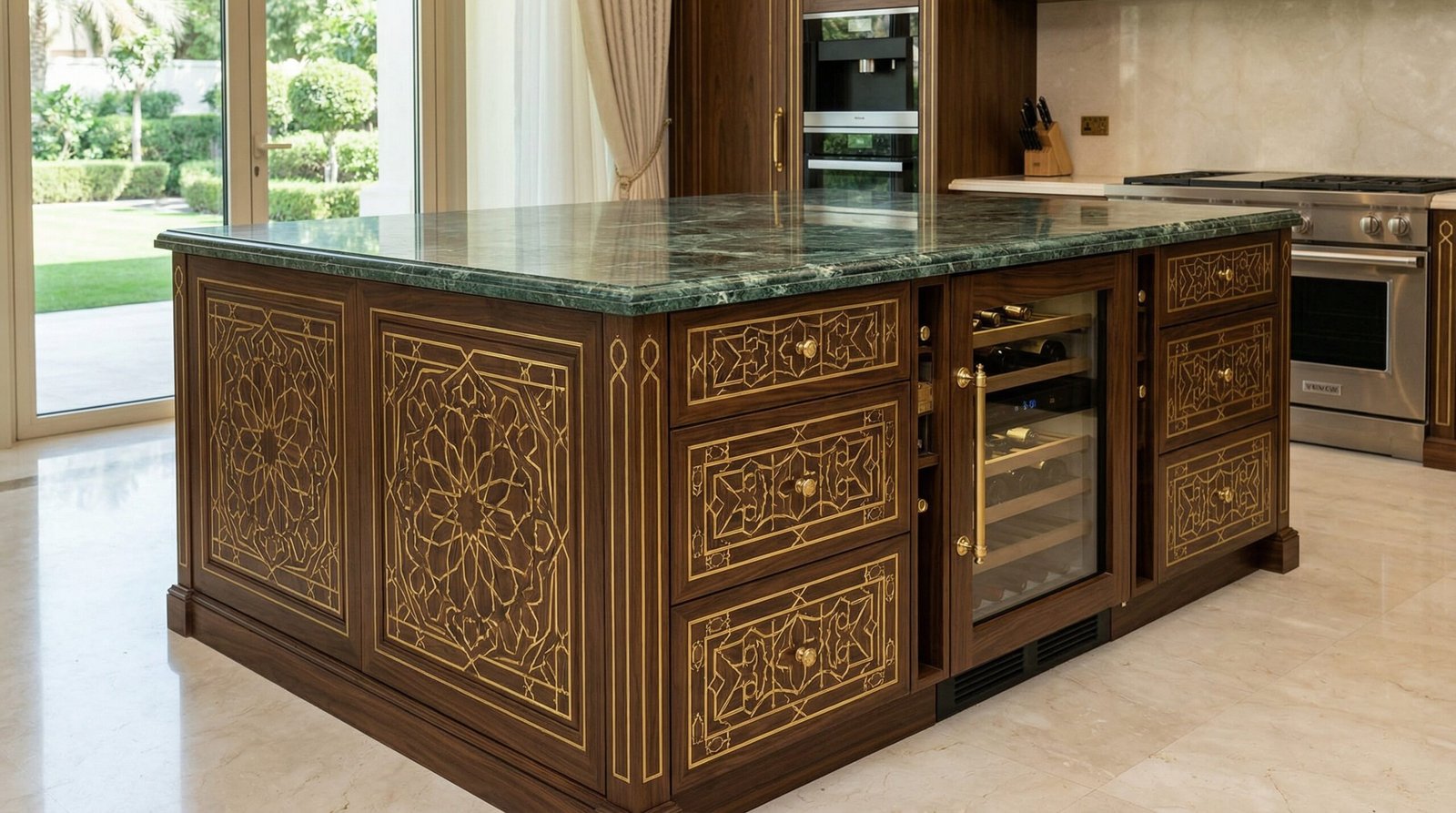
Hardware components—hinges, drawer slides, locking systems, organizational accessories—use brands proven reliable in our experience: Blum, Hettich, Grass for cabinet hardware; Hafele for organizational systems; Grohe and Franke for sink and faucet components. We’ve tested budget alternatives and learned that saving 30% on drawer slides creates service calls two years later when slides fail under normal use. Premium hardware costs more initially but operates smoothly for decades.
Skilled Craftsmen and Installation Teams
Our workshop employs 24 full-time craftsmen, many who’ve worked with us over 10-15 years. This continuity means experienced hands build your island rather than new hires learning on your project. Our senior craftsmen have carpentry backgrounds from UAE, India, Pakistan, Philippines, and European countries, bringing diverse technical traditions that inform our approach to complex projects.
Continuous training keeps skills current as new materials and methods emerge. We send senior staff to equipment manufacturers for training on new machinery. We host suppliers for product training when new hardware systems or finishing products enter our workflow. We maintain a small library of technical references—woodworking textbooks, finishing guides, joinery manuals—that craftsmen consult when projects present unusual challenges.
Installation teams work in pairs or trios depending on project scale. Every team includes at least one member with 10+ years experience who serves as lead, making decisions about sequencing and problem-solving issues that arise during installation. We don’t send junior installers to handle complex projects unsupervised. Your substantial investment deserves experienced professionals managing the critical installation phase.
Transparent Process and Communication
Construction projects often frustrate clients because of poor communication and unclear expectations. You don’t know what’s happening, when things will occur, or who to contact with questions. We’ve intentionally structured our process to eliminate this confusion.
Every project gets assigned a project coordinator who serves as your single point of contact through design, fabrication, and installation. This coordinator answers questions, provides updates, schedules site visits and installations, coordinates trade contractors, and ensures nothing falls through cracks. You have their direct mobile number and email. They respond to messages within hours during business hours, not days.
We provide detailed timeline expectations at project start, showing when each phase occurs: design completion, material procurement, fabrication duration, installation scheduling. We update this timeline if delays occur—if stone delivery delays by two weeks, we communicate that immediately and revise the schedule accordingly rather than letting you discover the delay when installation doesn’t happen as expected.
Progress updates happen at key milestones without you needing to ask: when materials arrive and pass quality inspection, when fabrication begins, when components move to finishing, when installation gets scheduled, when any issues arise requiring your input. This proactive communication means you always know your project status.
Financial transparency matters equally. Our proposals itemize costs clearly—you see exactly what you’re paying for cabinetry, countertops, hardware, appliances, installation, and any contingency amounts for anticipated site conditions. If scope changes during the project, we provide written change orders with pricing before proceeding with additional work. You never receive surprise charges for work you didn’t explicitly approve.
Warranty and Post-Installation Support
We warranty our carpentry work for five years covering manufacturing defects and installation issues. This warranty protects you against hinge failure, drawer slide malfunction, finish peeling or cracking, cabinet structure failure, door warping, and similar problems that indicate construction defects rather than normal wear or user damage.
The warranty explicitly excludes damage from misuse—scoring the countertop with knives, placing extremely hot pots directly on stone despite being warned this can cause thermal shock cracking, using harsh chemical cleaners that damage finishes, excessive weight loads beyond design specifications. The warranty is comprehensive but not insurance against improper use.
For stone countertops, you receive the fabricator’s warranty, typically 2-3 years, covering seam failure, cracking not resulting from impact damage, and installation problems. We coordinate any warranty claims on your behalf rather than requiring you to negotiate directly with stone suppliers.
Post-installation support continues beyond warranty periods. If you need minor adjustments—a hinge that’s worked loose, a drawer that’s developed a slight squeak, a door that needs realignment—we handle these service calls promptly, typically within 48 hours of your request. We maintain detailed records of every project we complete, so even years later we can reference your specific materials, hardware, and construction details if questions arise.
Recent Kitchen Island Projects Across UAE
Our portfolio spans the full range of UAE residential and commercial properties, from compact Dubai Marina apartments to sprawling Arabian Ranches villas, from neighborhood restaurants to major hotel F&B facilities. These recent projects illustrate the breadth of solutions we design and build.
Contemporary Villa Island – Emirates Hills
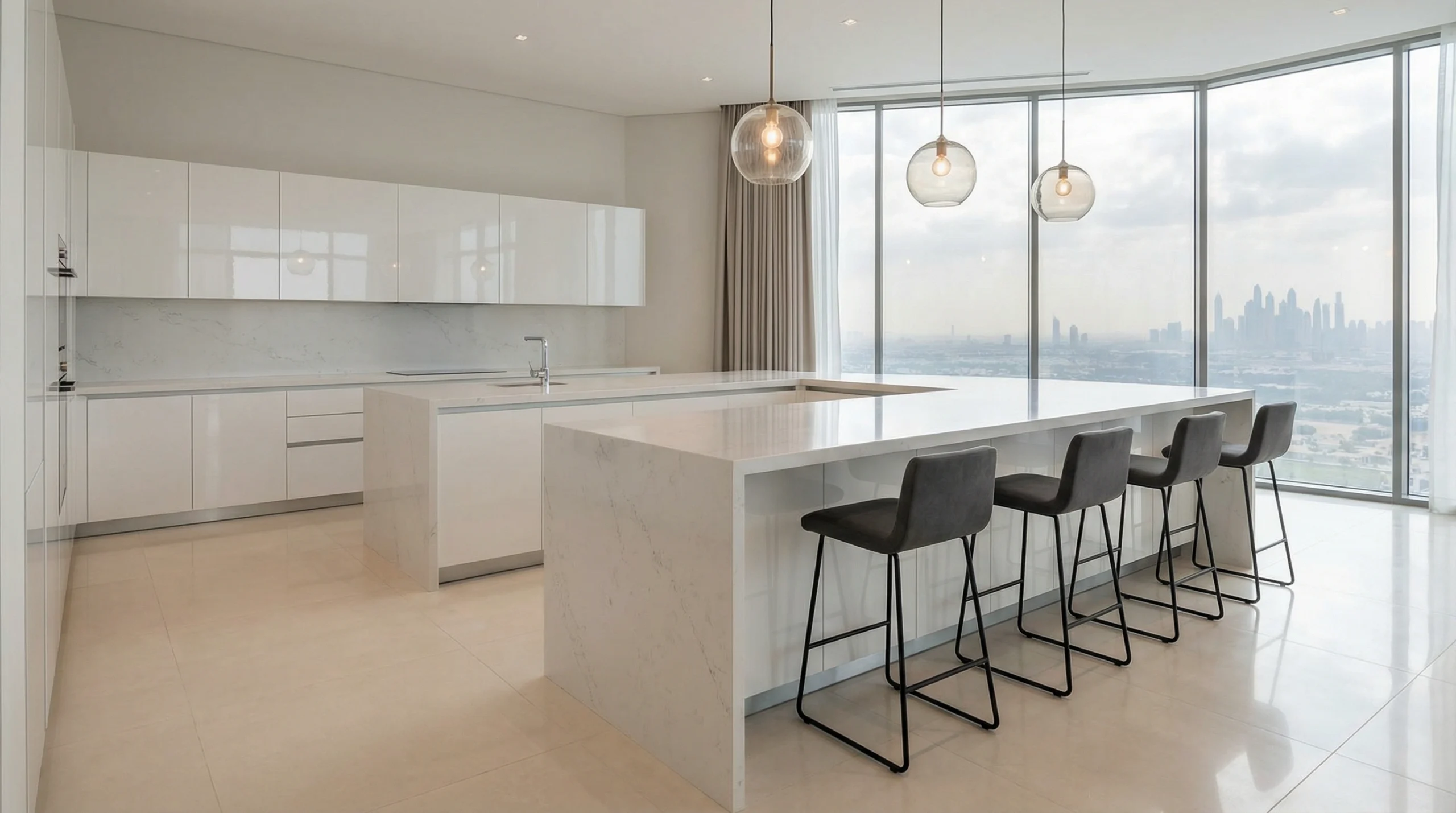
This family requested an island serving dual purposes: serious cooking workspace and casual dining area for five. We designed a 3.8-meter L-shaped island with 45mm waterfall-edge Calacatta quartz countertops. The long section houses an undermount sink, waste disposal unit, and substantial prep space. The perpendicular section provides elevated seating for four on the living room side while concealing a 24-inch dishwasher and wine fridge facing the kitchen work zone. High-gloss white lacquered cabinets complement the villa’s modern minimalist aesthetic. Installation took three days including all electrical work and stone. Project timeline from design approval to completion: seven weeks.
Restaurant Chef’s Island – Al Barsha
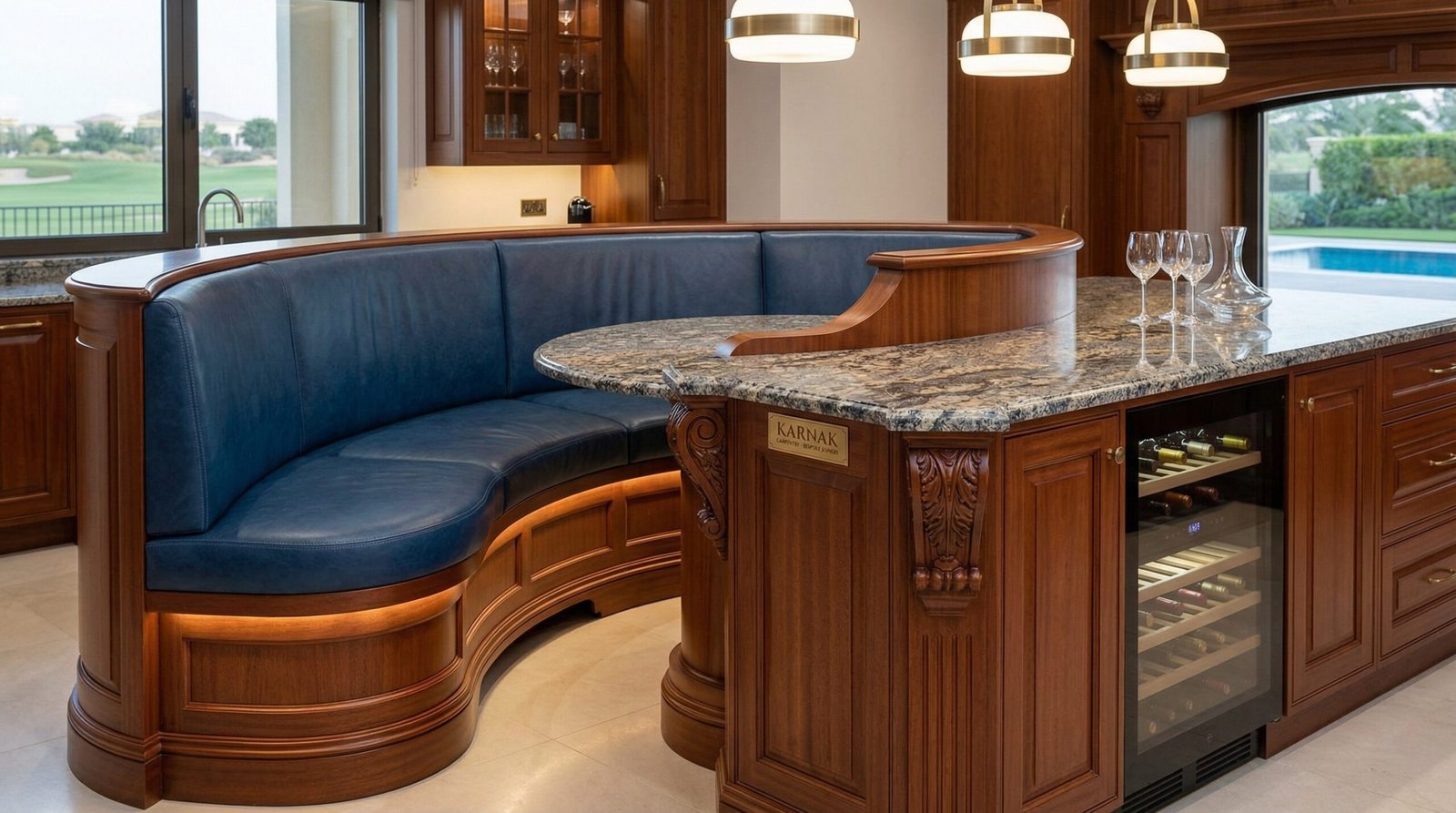
A contemporary fusion restaurant needed a centerpiece island for their open kitchen concept where diners watch food preparation. We fabricated a 4.2-meter island with matte black cabinetry, stainless steel countertop with integrated backsplash, and commercial-grade equipment integration including induction cooking zones, refrigerated drawers, and prep sink. Structural reinforcement accommodates the weight of cooking equipment and provides stability for chefs working rapidly during service. The design prioritizes functionality and cleanability over residential aesthetics while maintaining visual appeal appropriate for the dining room sightline. Civil Defense and Dubai Municipality approvals required six weeks; fabrication and installation completed in two weeks once approvals arrived.
Apartment Kitchen Renovation – Dubai Marina
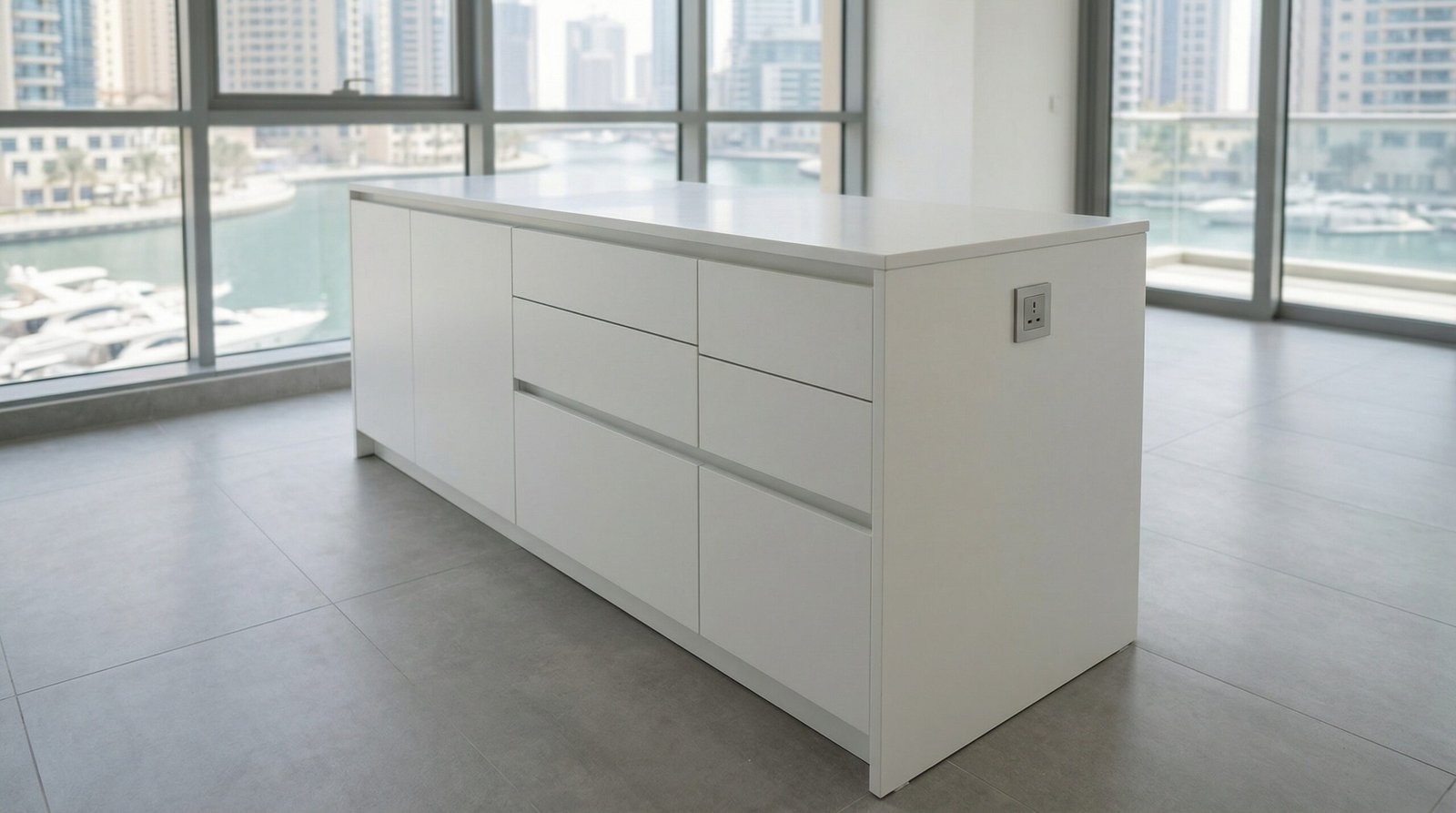
This 90-square-meter apartment presented typical space constraints for Marina developments. The clients wanted maximum kitchen functionality without the island dominating their open living space. We designed a 2.2-meter island with 35mm quartz countertop, concealing storage below and accommodating two adults seated on one side. The island provides essential prep space and casual dining without blocking traffic flow in the narrow kitchen. Light gray matte lacquer cabinets maintain an airy feeling appropriate to the compact space. The entire project from consultation to completion spanned six weeks, with installation completed in a single day to minimize disruption to the occupied apartment.
Traditional Villa Island – Arabian Ranches
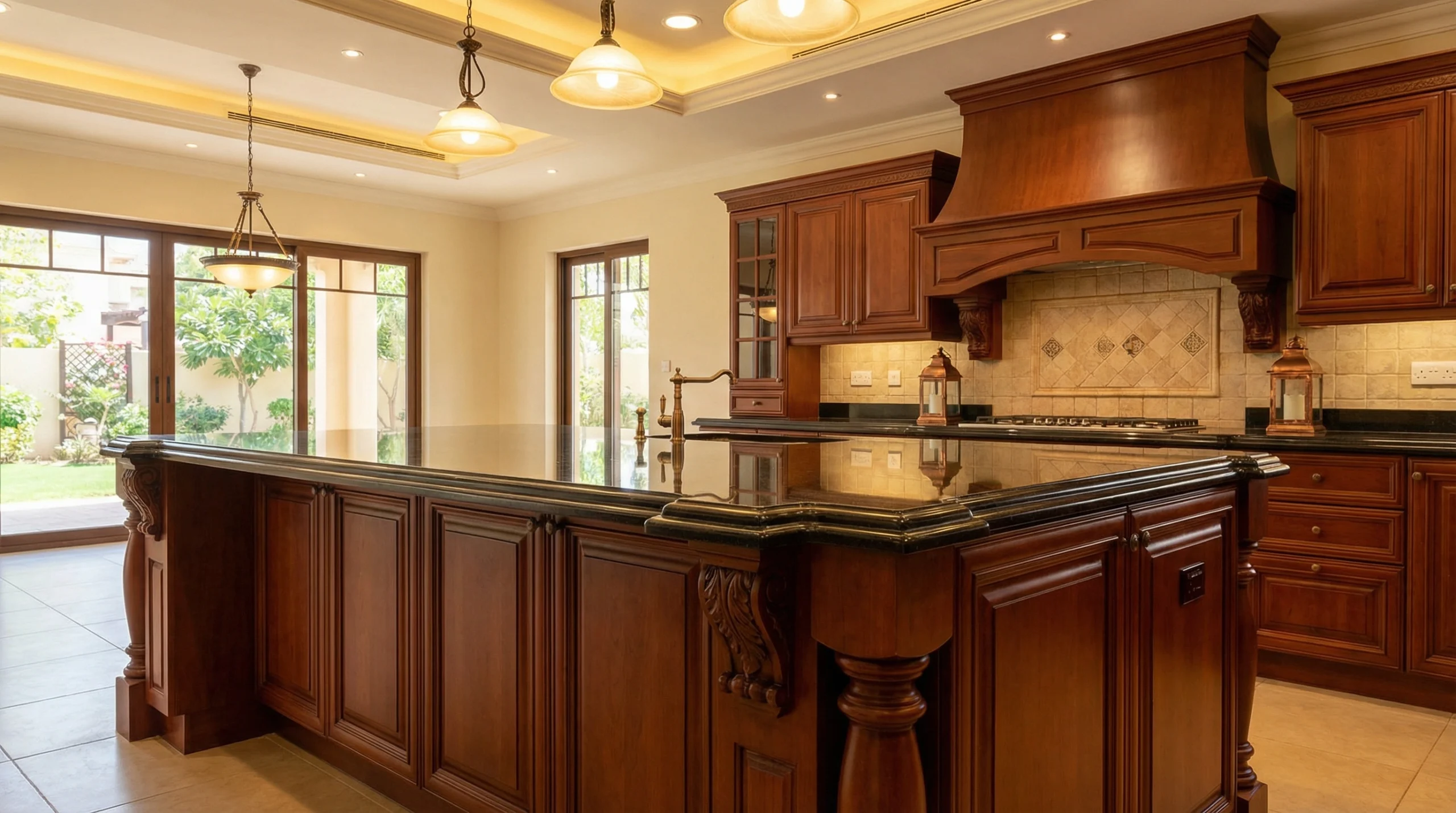
A family seeking traditional aesthetic warmth selected cherry wood cabinetry with raised panel doors, decorative corbels supporting the countertop overhang, and furniture-style turned posts at corners. The 3.5-meter island includes extensive storage with deep drawers for pot and pan storage, pull-out trash and recycling bins, and custom spice drawer organization. Absolute Black granite countertop with ogee edge profile complements the traditional detailing. This island anchors a recently renovated kitchen where the overall style references classical design while incorporating modern appliances and functionality. Installation required two days due to the complex trim details and decorative elements. Project completion: nine weeks from design to final installation.
Penthouse Entertainment Island – Business Bay
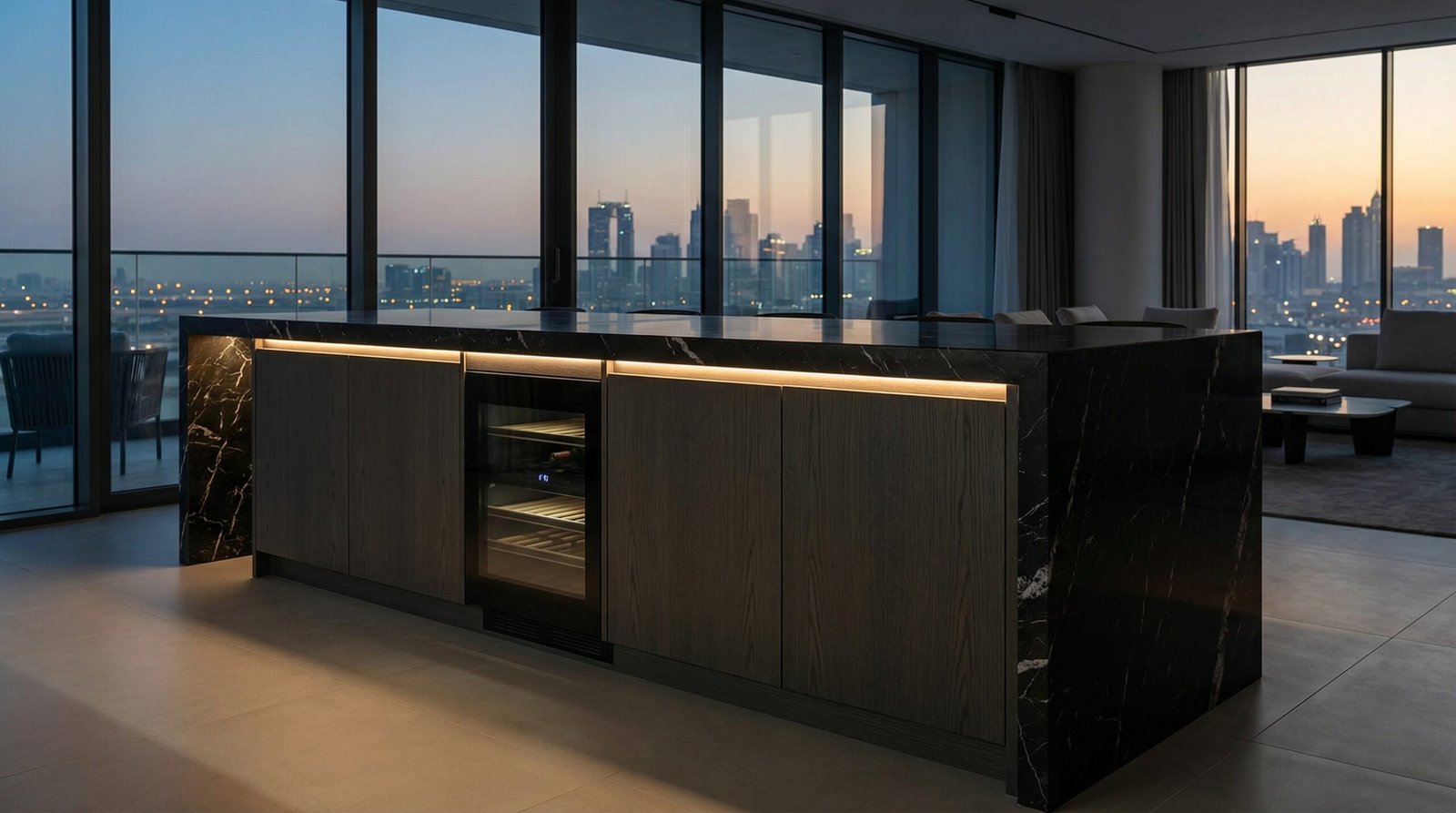
This dramatic 4.5-meter island serves as the central gathering point for frequent entertaining. The design features a raised bar section at one end creating two-level countertops—the main work surface at standard 900mm height, and an elevated bar at 1100mm height with seating for six. Bookmatched Calacatta Viola marble creates a dramatic visual statement with purple and gold veining patterns. The lower cabinets incorporate a built-in wine cooler maintaining capacity for 46 bottles, beverage refrigerator, and extensive glassware storage. Integrated LED strip lighting under the raised bar section provides ambient lighting for evening entertaining. This complex project required detailed structural calculations for the cantilevered raised bar section and careful stone selection to achieve the desired visual drama. Timeline: twelve weeks including stone sourcing and fabrication.
Restaurant Prep Island – The Walk JBR
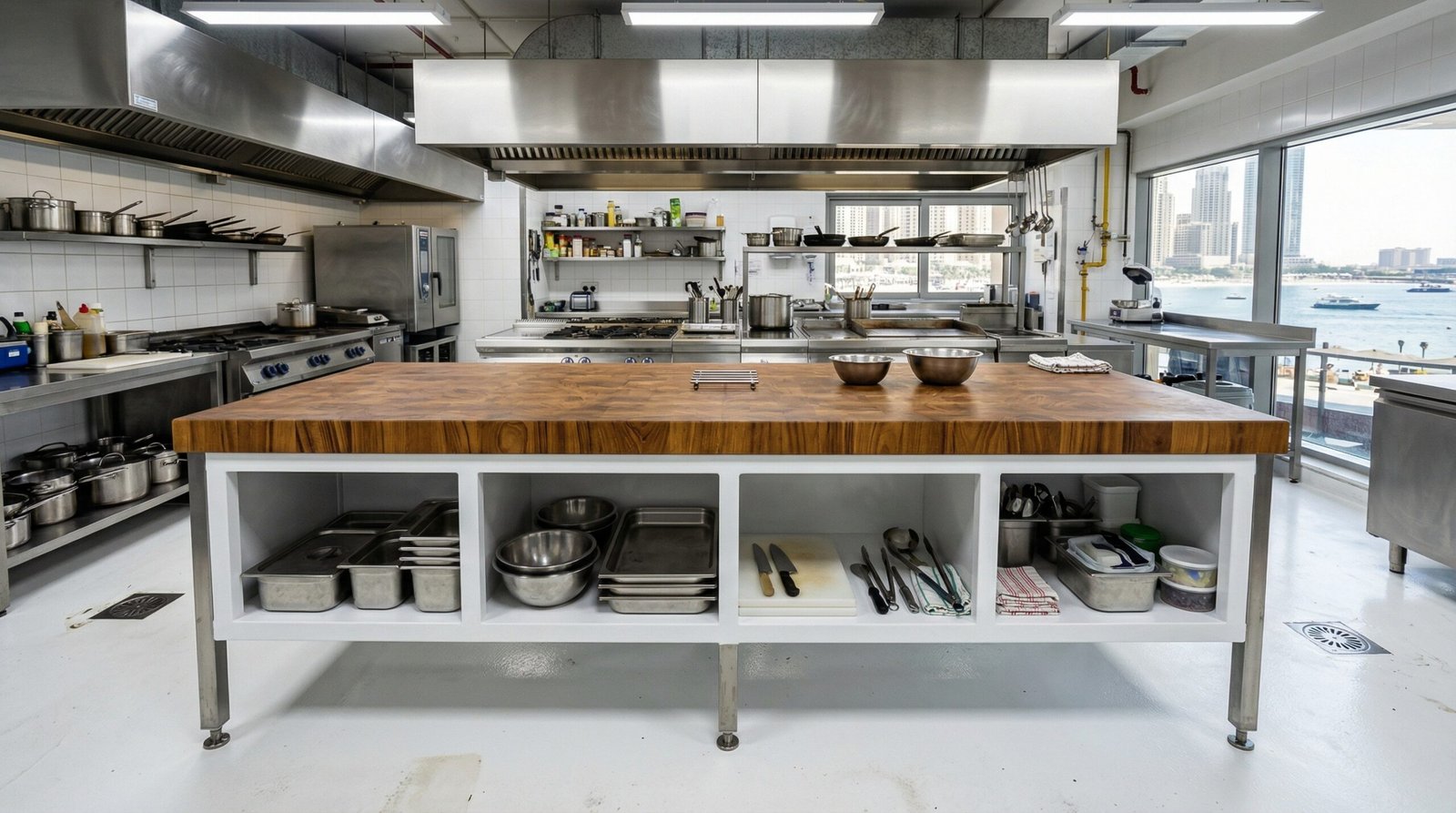
A high-volume beachfront restaurant required a central prep island for their back kitchen serving multiple cooking stations. We fabricated a 3.8-meter island with stainless steel countertop and lower shelving, commercial-grade heavy-duty casters allowing repositioning for cleaning, and integrated electrical outlets for small equipment. The design prioritizes durability and sanitation—stainless steel welded construction throughout, no wood components subject to moisture damage, all joints sealed and caulked for easy cleaning. This purely functional piece required Dubai Municipality and Civil Defense approvals as part of the full kitchen permit. The island installation coordinated with multiple other trades during the restaurant’s construction phase. Fabrication and delivery completed within three weeks once final dimensions were confirmed.
Contemporary Apartment – City Walk
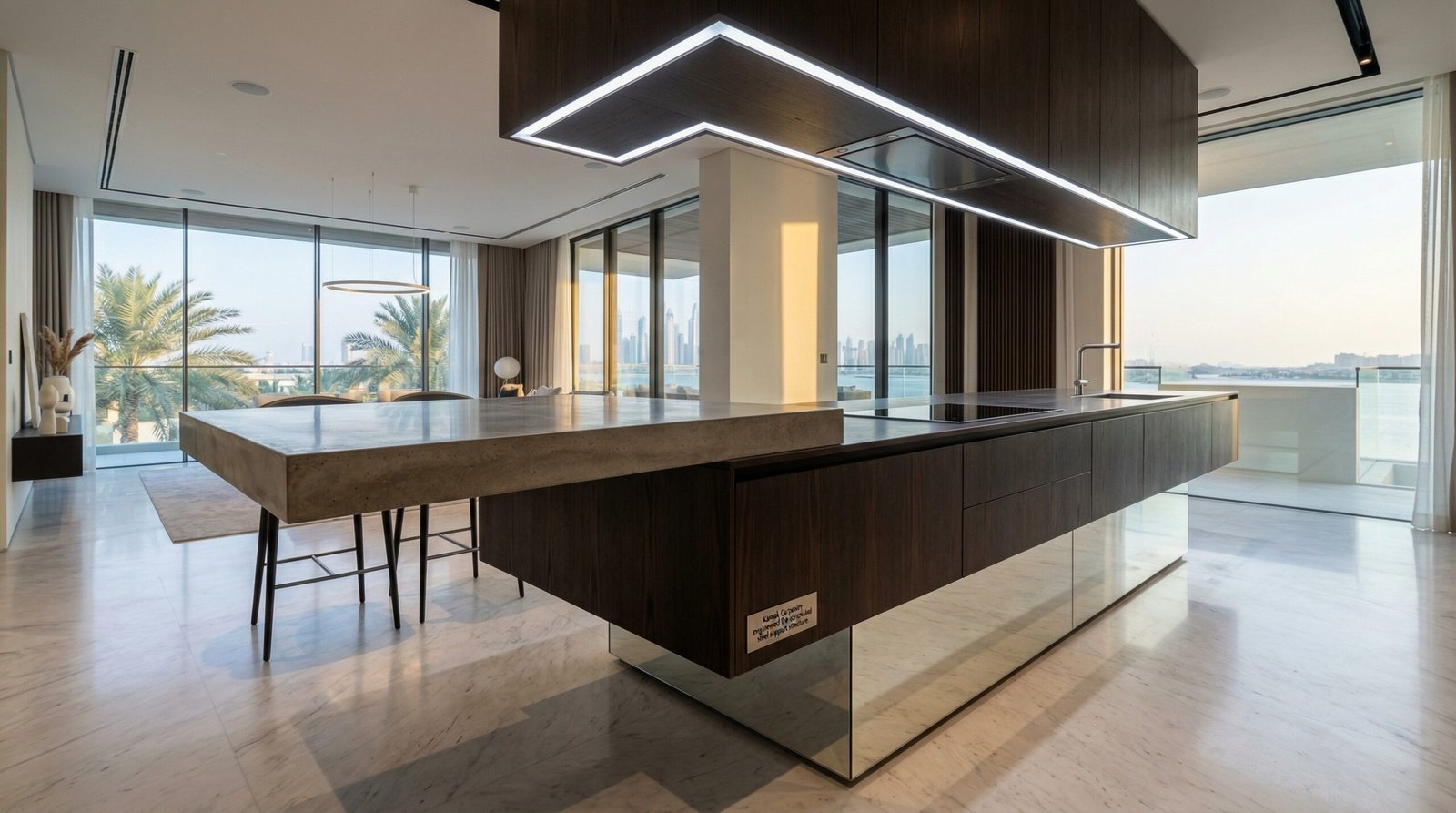
A young professional couple requested a minimalist island maximizing storage efficiency in their 75-square-meter apartment. We designed a 2.4-meter island with handleless push-to-open doors, full-height storage reaching almost to the countertop level, and a single deep drawer for small appliances. The white matte lacquer finish coordinates with their European kitchen system while the quartz countertop with waterfall edge on one end creates a sophisticated detail. Interior organization includes a pull-out garbage and recycling system, narrow spice pull-out, and adjustable shelving for flexible storage configuration. Total project duration including design, fabrication, and installation: seven weeks.
Villa Kitchen Expansion – The Springs
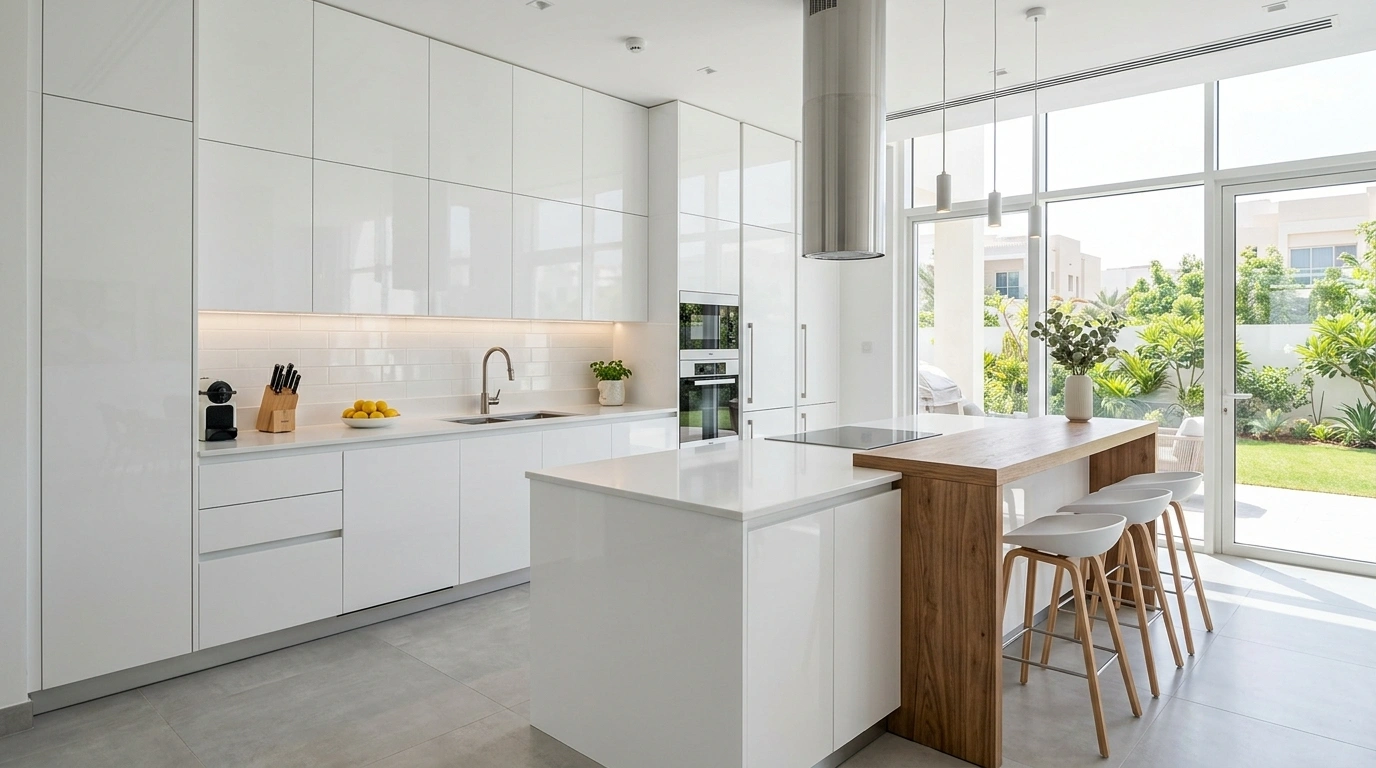
This project involved expanding an existing traditional kitchen by adding an island to improve functionality and storage. The clients owned their villa for eight years and wanted to avoid a complete kitchen renovation—just add a substantial island matching their existing cherry cabinets. We fabricated a 3.2-meter island with raised panel doors matching their kitchen’s style, using stain color analysis to achieve accurate color matching with their aged cabinets. New granite countertop sourced from the same quarry as their existing countertops ensured color consistency. The island includes a vegetable prep sink with dedicated faucet, pull-out cutting board storage, and deep pan drawers. Installation required careful coordination with the existing kitchen layout and slight plumbing modifications for the secondary sink. Project completion: eight weeks.
Commercial Office Pantry – DIFC
A professional services firm renovating their DIFC office wanted a kitchen island table dubai for their employee pantry serving 40 staff. We designed a 3.0-meter island with laminate cabinets in modern gray finish, quartz countertop, undercounter refrigerator, microwave shelf with electrical outlet, and extensive storage for coffee supplies, dishes, and pantry items. The design emphasizes durability for high-traffic commercial use—reinforced shelving, commercial-grade drawer slides, impact-resistant laminate surfaces. Dubai Municipality approval required as part of the office fit-out permit. Fabrication and installation coordinated with other trades during the office construction. Timeline from order to installation: five weeks.
Luxury Villa Master Suite – Palm Jumeirah
An unusual application: this villa master suite includes a kitchenette for morning coffee and light meal preparation without traveling downstairs to the main kitchen. We fabricated a 2.8-meter island with high-gloss walnut veneer cabinetry, marble countertop, small undercounter refrigerator, drawer-style microwave, and coffee station with dedicated electrical circuit. The design integrates seamlessly with the bedroom suite’s luxury aesthetic while providing genuine functionality for the busy couple who own the villa. Custom interior drawer organization includes velvet-lined compartments for coffee and tea storage. Project completion: eight weeks including custom stone fabrication.
Kitchen Island Questions - Expert Answers
Custom kitchen island costs in Dubai vary substantially based on size, materials, complexity, and integrated features, typically ranging from AED 15,000 for basic designs to AED 80,000+ for elaborate luxury installations. Understanding what drives cost helps you budget appropriately and make informed decisions about where to invest your money.
A straightforward 2.5-meter island with painted MDF cabinets, laminate countertop, basic hardware, and simple installation typically costs AED 15,000-22,000. This budget level provides functional storage and workspace but uses value-grade materials without premium finishes or special features. Mid-range islands spanning 3.0-3.5 meters with real wood or high-quality lacquered cabinets, quartz countertops, soft-close hardware, and some interior organization typically range AED 30,000-45,000. This range represents the sweet spot for many homeowners—substantial quality improvements over basic construction without reaching luxury pricing.
Premium custom islands incorporating exotic wood species, marble or high-end quartz countertops with waterfall edges, premium hardware systems, elaborate interior organization, integrated appliances, and complex details like furniture feet or decorative corbels typically cost AED 55,000-80,000+. The upper end of this range involves substantial islands (4+ meters), rare materials like bookmatched marble slabs, multiple integrated appliances, and architectural details requiring significant fabrication labor.
Material choices dramatically impact cost. A quartz countertop costs AED 1,800-3,500 per linear meter depending on brand and style, while granite ranges AED 1,200-2,800 per meter, and laminate costs just AED 400-800 per meter. Wood species selection similarly impacts pricing—oak and maple cabinets cost 20-30% less than walnut or cherry. Hardware represents another significant cost variable—basic hinges and slides add AED 1,500-2,500 to an island, while premium Blum or Hettich systems cost AED 4,000-6,500 for the same cabinet count.
Integrated appliances add to the base island cost: dishwashers typically cost AED 2,500-5,500, wine coolers range AED 3,500-9,000, and undercounter refrigerators run AED 2,800-6,500 depending on capacity and brand. Installation complexity affects pricing as well—straightforward installation in a prepared space costs less than projects requiring significant electrical work, plumbing modifications, or coordination challenges in occupied properties.
When evaluating quotes from different contractors, ensure you're comparing equivalent scope. Some quotes include countertops while others price them separately. Some include appliances while others assume you're providing them. Some include installation while others charge it separately. Request itemized proposals showing exactly what each line item includes to make accurate comparisons.
Timeline expectations for custom kitchen island projects depend on complexity, approval requirements, material availability, and workshop scheduling, but typical residential projects span 6-10 weeks from initial design consultation through completed installation. Understanding the timeline components helps you plan appropriately and avoid the frustration of unrealistic expectations.
The design phase typically requires 1-2 weeks for straightforward residential projects. This includes initial consultation and site measurement, concept development with 3D renderings, proposal preparation, client review and revision cycles, and final design approval. More complex projects involving elaborate details or clients who need extended time for decision-making can extend design phase to 3-4 weeks.
If your project requires government approvals—typical for commercial installations or residential projects involving licensed trade work—add 3-6 weeks for the approval process. Dubai Municipality approvals for straightforward residential work typically process within 2-3 weeks once properly submitted. Commercial approvals involving Civil Defense review, health department inspection requirements, or multiple authority coordination can require 5-8 weeks. We submit approvals early in the process, often before final design completion, to compress the overall timeline.
Material procurement overlaps with approvals when possible. Standard materials like common plywood, standard lacquer colors, and stock hardware ship within days. Custom items like special-order countertop materials, specific wood species requiring import, or European hardware systems can require 2-4 weeks for delivery. We order long-lead items immediately upon design approval to prevent material delays from extending the project.
Workshop fabrication typically requires 3-4 weeks for most kitchen islands. This includes material preparation and acclimatization, cabinet box construction, door and drawer fabrication, finishing work with multiple coats and curing time, hardware installation, quality inspection, and preparation for delivery. Complex islands with extensive details, special finishes, or large size may require 4-5 weeks fabrication. We don't rush fabrication—proper curing time for finishes and careful quality control prevent problems that create expensive remediation work later.
Installation scheduling depends on site readiness and coordination with other trades. Once fabrication completes, we typically schedule installation within 1-2 weeks. The installation itself usually requires 1-2 days for cabinet installation, followed by stone countertop templating, 3-5 days for stone fabrication, then final stone installation and detailing. Total installation phase spans roughly 2 weeks from cabinet delivery to complete project.
Putting this together: straightforward residential islands typically complete 6-8 weeks from design approval to installation. Projects requiring approvals extend to 9-12 weeks. Complex luxury islands with elaborate details, special materials, or coordination challenges may require 12-14 weeks. We provide detailed timeline expectations in our proposal so you can plan accordingly—schedule other renovation work, plan kitchen disruption periods, coordinate moving appliances or furniture.
Determining optimal island size requires balancing your functional needs against space constraints, traffic flow requirements, and proportional aesthetics—there's no universal answer, only the right solution for your specific kitchen layout and lifestyle. We evaluate multiple factors during design to identify the island dimensions that work best for your situation.
Minimum clearances around your island are non-negotiable for functional kitchen workflow. You need minimum 1000mm (about 40 inches) clearance on all working sides of the island—the sides where you'll stand preparing food, loading the dishwasher, or accessing cabinets. This clearance allows comfortable movement, appliance door opening, and two people passing each other without constant contact. In single-cook households with limited space, you might reduce clearance to 900mm on non-primary sides, but going narrower creates genuine frustration during daily use.
If your island includes seating, the seated side requires different clearance considerations. Bar stools need 600mm depth for the seating area, plus 300mm behind the stools for foot clearance and standing room when people get up or sit down. This means a standard island with seating on one side needs the base cabinets (typically 600mm deep), plus 600mm overhang, plus 900-1000mm clearance behind the stools—roughly 2.5 meters minimum from the island's seated side to the opposite wall or furniture.
Island length typically ranges 2.0-4.5 meters for residential kitchens. A 2.0-2.5 meter island works in compact spaces, providing meaningful prep space and some storage without dominating the kitchen. This size suits apartments and smaller villas where space is precious. Mid-size islands spanning 2.8-3.5 meters offer more generous workspace, substantial storage, and often room for integrated appliances or seating areas. This range suits typical villa kitchens and larger apartments. Islands exceeding 3.8 meters work in spacious villas where the kitchen occupies 30+ square meters—these provide multiple work zones, extensive storage, and can accommodate several integrated appliances.
Counter height follows standard ergonomic guidelines: 900mm for primary work surfaces, 1050-1100mm for raised bar seating areas if your design includes a two-level countertop. Some clients prefer 950mm height if the primary cook is particularly tall, though this makes the island less comfortable for shorter family members. We sometimes create two-height islands—standard 900mm work surface on one end, raised bar section on the other—providing both comfortable prep height and elevated seating appropriate for bar stools.
Proportion matters for aesthetic success. An island that's too large for your kitchen looks awkward and creates traffic flow problems. One that's too small appears undersized and fails to provide adequate functionality. We evaluate proportion by examining the island's size relative to your overall kitchen dimensions, the relationship to other architectural elements like windows and doorways, and sightlines from adjacent living spaces. The 3D renderings we create during design show these proportional relationships clearly, helping you understand whether proposed dimensions feel appropriate before construction begins.
Your specific usage patterns should drive final dimension decisions. If you cook elaborate meals daily, prioritize prep space over seating. If you rarely cook but frequently entertain, emphasize seating capacity and maybe integrated wine storage over extensive cabinet storage. If you have young children who do homework at the island while you cook, ensure adequate seating plus good sightlines between work and seated areas. There's no universal ideal—only what serves your particular needs best.
Countertop material selection significantly impacts your island's performance, maintenance requirements, and longevity in UAE conditions, with each material offering distinct advantages and limitations. The "best" choice depends on your priorities regarding aesthetics, durability, maintenance tolerance, and budget.
Quartz engineered stone has become the most popular choice for UAE kitchen islands over the past decade, and for good reasons. Quartz combines crushed natural quartz (92-95%) with polymer resins and pigments, creating a non-porous surface that resists staining, requires no sealing, and maintains consistent appearance across the slab. This material handles Dubai's temperature fluctuations well since the manufacturing process creates uniform density without the internal stress patterns found in natural stone. Quartz resists scratching reasonably well, though not as effectively as granite. Heat resistance is good but not perfect—you can place moderately hot pots on the surface briefly, but very hot cookware directly from the stovetop can potentially cause thermal shock damage or resin discoloration.
Major quartz brands available in UAE include Silestone, Caesarstone, and Compac, each offering extensive color and pattern ranges. Prices range AED 1,800-3,500 per linear meter installed depending on brand and style. Popular colors include whites and light grays that coordinate with contemporary kitchen aesthetics, though the full palette spans dramatically veined marble-lookalikes to solid colors to glittery metallic-flecked designs. Maintenance is straightforward—daily cleaning with mild soap and water, no sealing required, resistance to most kitchen chemicals and stains.
Granite remains a strong choice for its unmatched heat resistance, durability, and natural beauty. This natural stone forms under extreme heat and pressure, resulting in a surface that handles hot pots without damage, resists scratching from knives and utensils, and develops character over years of use rather than looking worn. Granite requires sealing every 1-2 years to maintain stain resistance—unsealed granite can absorb oil, wine, and colored liquids, creating permanent stains.
Each granite slab differs significantly in color and veining since it's natural stone cut from quarries. This uniqueness appeals to some clients while others prefer the consistency of engineered materials. Granite costs typically range AED 1,200-2,800 per linear meter installed depending on the specific stone type—common varieties like Absolute Black or Kashmir White cost less than exotic patterns requiring import from specific quarries. Edge profile options are extensive since granite can be machined into complex shapes. Dubai's granite suppliers maintain substantial inventory of popular colors, allowing you to see actual slabs before purchase.
Marble creates the most dramatic aesthetic impact with its distinctive veining and prestigious associations, but requires realistic expectations about maintenance and patina development. Marble is calcium carbonate, meaning acidic substances (lemon juice, vinegar, wine, tomatoes) will etch the surface, creating dull spots in the polish. Marble also stains more readily than granite or quartz. Despite sealant application, marble demands more careful use and regular maintenance than other options.
For clients who love marble's appearance but want better durability, we often suggest marble-look quartz or porcelain slabs that simulate marble's veining without the maintenance challenges. These alternatives have become remarkably convincing—high-quality marble-lookalike quartz can be difficult to distinguish from natural Calacatta or Statuario marble at casual glance. Authentic marble remains the choice for clients who value natural material and don't mind the maintenance requirements, or who actually prefer the aged patina that develops over years of use.
Solid surface materials like Corian offer some advantages: integral sinks with no seam between counter and bowl, repairable damage since scratches can be sanded out, thermoformable into curved shapes, non-porous surface requiring no sealing. However, solid surface shows scratches more readily than stone, has limited heat resistance requiring trivets for hot pots, and generally reads less luxurious than stone despite similar pricing in the AED 1,400-2,200 per meter range. These materials work well for specific applications—commercial settings requiring sanitary seamless surfaces, designs incorporating integral curved details, or clients prioritizing repairability over prestige aesthetics.
Butcher block wooden countertops create warm, natural aesthetic and provide excellent knife-friendly cutting surfaces, but require significant maintenance in Dubai's climate. Wood needs regular oiling to prevent drying and cracking. Water exposure causes warping and staining if not addressed immediately. Heat causes scorching. Most clients who love wood aesthetics choose it for a section of their island—perhaps a 800mm butcher block cutting area within an otherwise stone countertop—rather than using wood throughout. This provides the warm aesthetics and practical cutting surface while maintaining stone's durability for the majority of the work surface.
Matching existing kitchen cabinets for island additions requires careful analysis of the original construction, precise color matching processes, and realistic expectation setting about achievable results—exact matches are sometimes possible, close matches are usually achievable, and even approximate matches can work well with proper design consideration.
The starting point is determining what's possible based on your existing cabinet construction. If your cabinets came from a specific manufacturer whose product line remains available, we can often order matching doors and drawer fronts. European kitchen systems from brands like Haecker, Nobilia, or Rational maintain consistent specifications over decades, making perfect matches feasible for kitchens less than 10-15 years old. Custom cabinets built by local carpenters or cabinets from discontinued product lines require recreation rather than ordering matching components.
For painted cabinets, color matching is quite achievable. We take precise color measurements using spectrophotometer equipment that analyzes the existing finish and generates paint formulas matching that color. We then produce sample door panels, compare them against your existing cabinets under various lighting conditions in your actual kitchen, and adjust the formula if needed before final production. Multiple factors affect painted finish matching—the sheen level (gloss, semi-gloss, matte) must match perfectly since even identical colors appear different at different sheen levels, the paint system we use must be compatible with your existing finish to ensure similar aging characteristics, and we may need to adjust for UV fading if your existing cabinets have darkened or lightened significantly over years of sun exposure.
Stained wood finishes present more complexity. Each wood board has different grain patterns, absorbs stain differently based on density variations, and changes color over time through UV exposure and oxidation. We start by identifying your exact wood species—oak, cherry, maple, walnut—since stain color can't overcome fundamental differences in wood color and grain pattern. Once species is matched, we develop stain formulas matching your existing color, apply them to sample boards, allow proper drying time, apply topcoat finishes, then compare samples against your existing cabinets.
Realistic expectations are important: perfect matches are rare for stained wood because natural material variation and aging effects create subtle differences even with careful color matching. What we can reliably achieve is a close match that appears harmonious rather than conspicuously different. The new island doors might be slightly lighter or darker than your aged existing cabinets when viewed in direct comparison, but from normal sightlines across the kitchen, the overall impression reads as matching.
Sometimes matching isn't the right strategy even when technically feasible. If your existing cabinets show significant wear, fading, or damage, building a new island that matches the aged appearance perpetuates those aesthetic compromises. We often suggest a complementary approach instead—creating an island that coordinates with existing cabinets without attempting exact matching. This might mean using the same wood species in a different stain color, using painted finishes that complement rather than match existing stained cabinets, or creating deliberate contrast with the island as an accent piece rather than attempting seamless integration.
The design approach you choose affects how much matching precision matters. If your new island sits completely separate from existing cabinets with significant space between them, minor color variations become unnoticeable. If the new island connects directly to existing cabinet runs with no visual break, matching precision becomes more critical since direct comparison occurs constantly. We consider these sightline relationships during design, sometimes adjusting island positioning to minimize situations where perfect color matching becomes essential.
Hardware matching is usually straightforward—we identify your existing handle or pull model, verify availability, and either order matching hardware or select current equivalent designs if the original model has been discontinued. Hardware manufacturers maintain more consistent product lines than cabinet manufacturers, making this aspect of matching typically simpler than cabinet finish matching.
Electrical work for kitchen islands requires careful planning, proper licensing, DEWA code compliance, and coordination with licensed electricians to ensure safe, legal installations that provide adequate power for your needs. We manage this process completely but work with licensed electrical contractors for all actual wiring and connections.
UAE electrical regulations require licensed electricians to perform all electrical installation work. Our role involves designing the electrical requirements, coordinating with the electrician, preparing the island structure to accommodate wiring, and ensuring the finished installation integrates cleanly. The actual wiring from your distribution board to the island, outlet installation, and appliance connections must be completed by licensed professionals who understand DEWA requirements and can obtain necessary approvals.
Power requirements for kitchen islands depend on what integrated features your design includes. At minimum, most islands need 1-2 standard outlets (13-amp, 220V) for small appliances like mixers or food processors. These outlets typically position on the island ends or sides—never on the seating side where they create visual clutter and possible safety concerns. DEWA code requires GFCI (ground fault circuit interrupter) protection on all kitchen outlets within 1.8 meters of water sources, which includes most island locations.
If your island incorporates a dishwasher, it requires a dedicated circuit rated appropriately for the appliance's power requirements—typically a 13-amp circuit for residential dishwashers. Wine coolers and undercounter refrigerators similarly need dedicated circuits. Induction cooktops integrated into islands demand higher amperage circuits—30-40 amps depending on the specific unit—plus proper wire sizing and circuit protection. We determine these requirements during design based on manufacturer specifications for your selected appliances.
Pop-up outlet boxes have become popular for islands, especially those with extensive seating areas where permanent outlets would be conspicuous. These devices sit flush with the countertop until needed, then lift up to reveal multiple outlets and sometimes USB charging ports. They require larger openings through the countertop and cabinet structure than standard outlet installation, plus careful waterproofing around the countertop penetration to prevent moisture entry. Pop-up outlets cost AED 600-1,500 per unit depending on style and features, plus installation labor.
Wiring routing to the island depends on your home's construction. In villas with concrete slab floors, electrical supply typically routes through channels cut in the floor slab, covered with conduit and refinished. This approach requires coordination with flooring contractors for refinishing work. In apartments or upper floors, wiring may route through ceiling space below your floor, entering the island through the floor deck. Some situations allow routing through adjacent base cabinets if the island connects to your perimeter kitchen cabinets.
During construction, we coordinate timing carefully. The island base cabinet gets positioned first, establishing exact locations for outlet positions. The electrician then routes wiring and installs outlet boxes, rough-in connections for integrated appliances, and any required junction boxes. We complete the island installation including countertops. Final electrical work—installing outlet covers, connecting appliances, testing all circuits—occurs after stone installation completes and everything is ready for final finishing.
If your project requires Dubai Municipality approval—typical for villa renovations involving new circuits or commercial projects—the electrical contractor prepares and submits electrical plans as part of the overall permit package. These plans show circuit routing, load calculations, outlet positioning, and appliance connections. Inspections occur after rough-in completion and again at final completion before DEWA will approve service.
For projects in occupied homes, we work to minimize electrical disruption. Circuit installation work typically requires shutting off power to affected areas for 2-4 hours during wiring. We schedule this work at convenient times and coordinate with you to minimize inconvenience. Testing and final connections usually require only brief power interruptions.
Costs for electrical work vary based on complexity. Simple outlet installation for a basic island might add AED 1,500-2,500 to the project. More complex electrical including dedicated circuits for multiple appliances, extensive wiring routing, pop-up outlets, and coordination with municipality approvals can cost AED 5,000-8,000. We include these estimates in the project proposal so you understand total costs before committing.
Strategic interior organization transforms kitchen islands from simple storage boxes into highly functional command centers that improve daily workflow and reduce clutter throughout your kitchen. The best solutions depend on what you're storing and how you use your kitchen, not on universal formulas applied to every project.
Deep drawers have become the dominant storage solution for modern kitchen islands, offering several advantages over traditional door cabinets. Drawers provide easy access to items at the back—you pull the drawer fully open rather than reaching deep into a dark cabinet. Full-extension soft-close drawer slides make this access effortless even for heavy loads like stacked dishes or large pots. Multiple drawer heights allow efficient organization: shallow drawers for utensils and cutlery, medium drawers for dish storage, deep drawers for pots, appliances, or pantry items.
We typically configure island storage with 2-4 drawers per section depending on overall height and your specific needs. A common arrangement includes one shallow drawer (120-150mm high) for utensils or linens, two medium drawers (220-280mm) for dishes or food storage, and one deep drawer (350-450mm) for pots, pans, or small appliances. This configuration adapts to various storage needs while maintaining organized sections that prevent the everything-in-one-place chaos that happens with single large compartments.
Drawer organization inserts maximize efficiency within drawers. Cutlery trays with divided sections keep utensils organized and easy to locate. Peg systems for pot and pan storage allow flexible arrangement while preventing items from sliding around when drawers open and close. Spice drawer inserts with angled tiers let you see every jar at a glance rather than digging through stacked containers. Knife block inserts keep sharp blades safely stored and organized. We source these organizational elements from Hafele, Blum, and similar manufacturers known for durable systems.
Pull-out trash and recycling systems solve a common island challenge—where to locate waste bins in a piece of furniture that's visible from your living spaces. These systems use heavy-duty slides to pull a trash container (or multiple containers for sorting recyclables) out from behind a cabinet door. Quality systems include soft-close mechanisms preventing lid slamming, odor-control features, and sturdy construction handling daily use abuse. We typically locate trash systems at one island end for easy access from work zones while remaining relatively hidden from the dining or living area sightline.
Open shelving on one island side creates display opportunities for cookbooks, decorative items, or frequently used serving pieces while maintaining an open, less boxy appearance than cabinets on all four sides. This works particularly well when the island separates kitchen and living spaces—the open side faces the living area, providing visual interest and preventing a solid furniture-block appearance. Structural design must account for the lateral rigidity lost when one side lacks a cabinet back panel, typically requiring additional reinforcement in the frame structure.
Integrated appliance storage requires specific accommodation. Wine coolers and beverage refrigerators need proper ventilation clearances—typically 50mm on sides and 100mm at the back—plus electrical outlet access. Dishwasher installation demands proper support for the appliance weight, clearance for the door to open fully, and coordination with plumbing connections. Microwave drawer installations require reinforced mounting brackets and precise cabinet opening dimensions matching the appliance specifications exactly.
Specialized storage solutions address specific needs. Pull-out cutting boards that store within a narrow cabinet slot provide additional prep surface when needed while remaining hidden otherwise. Tilt-out sink front trays use the false drawer front below the sink for sponge and brush storage. Corner carousel units maximize storage in L-shaped islands where standard shelves would leave deep, inaccessible corners. Vertical tray dividers store sheet pans, cutting boards, and serving platters on edge where they're easy to access rather than stacked horizontally where lower items become trapped.
One increasingly popular approach: creating a hidden charging station within a drawer for phones, tablets, and other devices. A modified drawer with power outlets inside and a ventilated back panel allows devices to charge out of sight, eliminating countertop cord clutter. The drawer stays slightly open during charging for heat dissipation and cord routing.
Storage capacity expectations should be realistic. A 3-meter island with doors and drawers on both long sides plus one end provides roughly 1.2-1.5 cubic meters of usable storage—substantial, but not unlimited. Clients sometimes want to relocate everything from existing overcrowded cabinets into the new island, which rarely works mathematically. Effective island storage design identifies your highest-priority storage needs, accommodates those efficiently, and coordinates with your overall kitchen storage strategy rather than attempting to solve all storage challenges in one piece of furniture.
Kitchen island plumbing is optional rather than required, but incorporating a sink or integrated appliances requiring water supply significantly enhances island functionality while adding complexity and cost to the project. Whether to include plumbing depends on how you'll use the island and your kitchen's existing layout.
The primary reason to add island plumbing is installing a secondary prep sink. This sink handles vegetable washing, food prep cleanup, and filling pots without occupying the main sink where dishes may be soaking or the dishwasher is running. A prep sink works especially well in larger kitchens where substantial distance separates the island from the perimeter sink—you avoid constant back-and-forth trips during cooking. Many clients also appreciate having someone preparing salad at the island sink while another person works at the main sink without interfering with each other.
Island sinks require both supply lines (hot and cold water) and drain lines with proper venting. Supply lines are straightforward—flexible supply tubes can route through the floor and up into the island base cabinets with minimal complications. Drain lines present more challenges because proper drainage requires adequate slope (typically 1/4 inch per foot of horizontal run) and proper venting to prevent drainage problems and sewer gas issues.
UAE plumbing code follows British Standards with local amendments, requiring minimum trap seal depth and proper vent sizing based on drain diameter. For island sinks, proper venting often requires one of several solutions: an air admittance valve (AAV) mounted within the island base cabinet below the countertop, a loop vent that rises above the flood level rim before connecting to the main vent stack, or a separate vent pipe routed through the floor and up through wall cavities to connect with the main stack or exit through the roof. Each solution has advantages and limitations depending on your home's construction and local interpretation of plumbing codes.
Installation costs for island plumbing vary significantly based on complexity. In villas with crawl space access below or homes with concrete slab floors where cutting channels for pipe routing is straightforward, costs typically range AED 3,000-5,500 including materials and labor. Upper-floor apartments present more challenges since plumbing must route through structural elements or ceiling space of the unit below, potentially increasing costs to AED 5,500-8,500 if extensive routing or coordination with neighbors is required.
Integrated appliances add different plumbing requirements. Dishwashers need both water supply and drain connection. Most modern dishwashers can use cold water only—their internal heaters warm the water as needed—simplifying the supply connection to a single line. Wine coolers typically don't require plumbing unless they include ice makers, which need both water supply and drain connections for the ice-making cycle.
If your island will include plumbing, we coordinate timing carefully during construction. Rough-in plumbing occurs before the island base installation. Plumbers install all pipes to approximate locations, leaving them capped and ready for final connections. We then install the island base cabinets, verifying that plumbing locations align correctly with cabinet design—sink cutout position, appliance locations, access for shutoff valves. After stone countertop installation and sink mounting, plumbers return for final connections, testing for leaks, and adjusting trap and vent components.
Clients sometimes ask about adding plumbing to existing islands years after initial installation. This is feasible but often disruptive and expensive since it requires removing the island or at least the countertop, cutting into floors for pipe routing, refinishing floors after plumbing installation, and reinstalling everything. The cost typically exceeds what initial plumbing would have cost by 50-100% due to demolition and refinishing work. We recommend deciding about island plumbing during initial design rather than revisiting the question later.
One alternative worth considering: if you're uncertain about needing island plumbing, we can design the island structure and position it in a location that would accommodate future plumbing installation with minimal disruption. This might mean positioning the island over a floor area where plumbing routing wouldn't require extensive floor work, or including an access panel in the base cabinet that would simplify future plumbing installation. This provides flexibility while avoiding current costs and construction disruption.
Quality custom kitchen islands built with proper materials and construction techniques typically provide 20-30 years of service before requiring significant renovation, with many lasting even longer if properly maintained. The longevity depends primarily on construction quality, material selection, and how well the island is maintained through its life.
Cabinet structure longevity starts with material durability. Marine-grade plywood and moisture-resistant MDF that we use in cabinet construction resist humidity effects, maintaining structural integrity where standard materials would deteriorate. Proper joinery—doweled cabinet boxes, solid wood face frames with mortise-and-tenon joints, dovetailed drawer boxes—creates rigid assemblies that don't rack or twist over decades of use. Cabinet boxes built from 18-25mm material provide more holding power for hinges and slides than the thin 12-15mm material budget cabinets use, preventing the stripped screw holes and sagging that causes cabinet failure.
Drawer slides are often the first component requiring replacement in aging kitchens. Budget slides using plastic rollers wear out within 5-7 years of regular use. The Blum and Hettich premium slides we specify use steel ball bearings and precision tracks rated for 30,000-50,000 open/close cycles—roughly 20-30 years at typical usage rates. Even when these slides eventually wear, replacing them is straightforward and inexpensive relative to the original island cost.
Hinges follow similar patterns. Quality European hinges with soft-close mechanisms remain functional for 15-20 years before the dampening mechanism might weaken. Hinges are consumable hardware—they're designed for eventual replacement. Quality soft-close hinges cost AED 35-50 each; replacing all hinges on a typical island might cost AED 800-1,200 in materials plus labor, a minor expense to refresh the island's functionality.
Stone countertops are essentially permanent materials. Granite and engineered quartz maintain appearance and durability indefinitely with proper care. Decades from now your island's stone will likely look nearly identical to installation day aside from minor wear at high-use areas like where you set down pots or cut food directly on the surface despite knowing better. Natural marble shows age more gracefully—developing patina, subtle etching, character that many owners appreciate rather than consider damage.
Finish longevity varies by type. Conversion varnish and catalyzed lacquer finishes we apply in controlled workshop conditions create hard, chemical-resistant surfaces that resist yellowing, cracking, and wear far better than field-applied finishes. Properly applied, these finishes remain attractive for 15-20 years before you might want to refresh them for aesthetic reasons rather than because they've failed functionally. Stained wood finishes develop patina through UV exposure and oxidation—cherry darkens to rich amber, walnut mellows to chocolate brown. Many clients appreciate these aging characteristics rather than considering them problems.
Maintenance requirements are modest for quality islands. Daily cleaning uses mild dish soap and water applied with soft cloth or sponge. Avoid abrasive cleaners or scrubbing pads that scratch finishes. For stone countertops, use pH-neutral cleaners specifically designed for stone—many common household cleaners are too acidic or alkaline and cause etching or dulling. Natural stone requires resealing every 12-24 months depending on use intensity and stone porosity.
Annual maintenance should include checking hardware for any loosened screws—hinges, drawer slides, handles—and tightening as needed. Inspect caulk joints between stone and cabinets for any separation or cracking, reapplying if necessary to prevent moisture infiltration. Check soft-close mechanisms on doors and drawers, adjusting tension if closing speed has changed. These simple preventive steps take perhaps 30 minutes annually and prevent minor issues from becoming major problems.
When problems do develop, most are repairable rather than requiring full island replacement. Scratched stone countertops can be professionally refinished and repolished. Damaged cabinet doors or drawer fronts can be replaced individually without disturbing the entire island. Failed hardware gets replaced. Even finish damage from excessive heat, chemicals, or wear can be addressed through refinishing—sanding down the existing finish, repairing any wood damage, and applying fresh finish coats.
The main reasons kitchen islands get replaced before their structural lifespan expires are aesthetic—owners want updated styles—or functional—families' needs change and the current island configuration no longer serves well. An island that's structurally sound at 20 years old might get replaced because the owner wants contemporary styling instead of the traditional style they chose two decades earlier, or because they now want integrated appliances the original island doesn't accommodate. This is renovation, not failure.
Investment in quality construction and materials costs more initially but proves economical long-term. An island that lasts 25 years amortizes to perhaps AED 1,800 per year for a mid-range custom island costing AED 45,000. Even premium islands costing AED 75,000 cost just AED 3,000 per year over 25 years—reasonable for a piece of furniture your family uses multiple times daily and that significantly impacts your home's functionality and value.
Kitchen islands offer more flexibility for future reconfiguration than perimeter cabinets, though the practicality of moving or modifying them depends significantly on the original construction method, integrated features, and your home's structural constraints.
Freestanding islands—those not attached to floors, walls, or plumbing—offer maximum future flexibility. These islands can theoretically relocate anywhere in your kitchen or even to a different property if you move. In practice, several factors limit this flexibility: the island dimensions must fit through doorways and corridors (we've seen expensive islands that couldn't leave the kitchen where they were built), the new location must provide adequate clearances, and your new kitchen's aesthetic may not coordinate with the island's existing design. Many clients planning future moves prefer portable islands for this flexibility, though truly freestanding islands sacrifice some structural advantages and often can't incorporate plumbing or hardwired electrical features.
Islands with plumbing connections—sink, dishwasher, ice maker—face more constraints for relocation. Moving these islands requires abandoning the original plumbing connections, capping pipes properly, cutting new routes through flooring to the new location, installing new supply and drain lines, and potentially refinishing floors along the entire route. This work typically costs AED 4,000-7,000 depending on distance and complexity, approaching the cost of building a new island in many cases. For this reason, islands with plumbing rarely relocate—if major kitchen renovation occurs, the island either remains in place or gets replaced entirely as part of the renovation.
Electrical connections present less constraint than plumbing but still affect relocation feasibility. Hardwired connections for integrated appliances require licensed electrician involvement to disconnect, reroute, and reconnect properly. Islands with simple plug-in connections to standard outlets offer more flexibility since moving them only requires ensuring outlet access at the new location.
Reconfiguring existing islands without moving them is often quite feasible depending on what changes you want. Adding or modifying drawer organization, replacing hardware with different styles, changing door handles—these updates require minimal work and modest cost. Replacing countertops with different materials involves removing the existing stone, potentially modifying cabinet tops for proper new stone support, templating, and installing new stone—typically AED 8,000-15,000 depending on size and material selection.
More extensive reconfigurations might involve altering cabinet arrangements—converting door cabinets to drawers, adding integrated appliances, removing shelves to install pull-out trash systems. These modifications typically require partial or full island deconstruction, rebuilding modified sections, and refinishing to match existing components. Costs vary dramatically based on scope but often run 40-60% of new island construction costs for the affected sections.
Some modifications prove impractical due to structural limitations. Adding a sink to an island originally built without plumbing accommodation requires routing water supply and drain pipes through the floor—disruptive and expensive. Converting a cabinet section to accept a dishwasher might not work if the existing structure lacks proper dimensional clearances or reinforcement for the appliance weight. These limitations highlight why thorough initial design matters—anticipating future needs during original planning avoids expensive compromises later.
If you're uncertain about future needs, we can design with adaptability in mind. This might mean positioning the island to allow future plumbing installation without extensive floor work, specifying drawer slides rated for heavier loads than currently needed so future drawer content changes don't exceed capacity, or using modular construction approaches that facilitate future modification. Some additional cost during initial construction buys significant flexibility for future adaptation.
One approach clients sometimes consider: designing islands as two separate cabinet sections—perhaps a 2.0-meter prep/storage section plus a 1.5-meter bar/seating section—joined with countertop but structurally independent. This allows future reconfiguration by repositioning the sections relative to each other, removing one section entirely, or even separating them for use in different kitchen areas. This approach costs slightly more than single-unit construction due to additional structural requirements but provides genuine flexibility.
The economic reality is that major island reconfiguration often approaches new construction costs while delivering compromised results. If your kitchen layout changes significantly, your aesthetic preferences evolve dramatically, or your functional needs shift substantially, building a new island designed optimally for current circumstances usually makes more sense than extensively modifying an existing island designed for different priorities. The existing island might find new life in a different property, repurposed as a home bar or secondary food prep station, or simply replaced with something better suited to your current life.
Regulatory approval requirements for kitchen islands depend on the project scope, property type, and emirate where you're located, with Dubai having specific processes through Dubai Municipality and other authorities. Understanding what approvals apply prevents delays and ensures legal compliance.
Most residential kitchen island installations in Dubai don't require building permits when the project involves only cabinet and countertop work without structural modifications, plumbing relocation, or new electrical circuits. If you're simply adding or replacing an island using existing electrical outlets and no plumbing, you typically proceed without formal approvals. This applies to apartments, villas, and townhouses where you're working within your property boundaries without affecting building systems or common areas.
Approvals become necessary when your project involves licensed trade work beyond simple connections. Installing new electrical circuits for island outlets or integrated appliances requires electrical contractor submissions to DEWA (Dubai Electricity and Water Authority). Significant plumbing work—especially in apartments where work affects building systems—typically requires Dubai Municipality approval even for residential projects. If your renovation includes structural modifications to accommodate the island—removing walls, altering columns, affecting load-bearing elements—you absolutely need structural engineer review and municipality approval.
Commercial kitchen islands in restaurants, cafes, hotels, and similar hospitality properties require comprehensive approvals regardless of scope. Dubai Municipality reviews all commercial kitchen plans as part of the fit-out approval process, examining equipment placement, ventilation systems, drainage, storage, workflow, and sanitation standards. Civil Defense reviews fire safety aspects including kitchen fire suppression systems, means of egress, and flammable materials storage. Health & Safety Department may review food preparation area standards. The approval timeline for commercial projects typically runs 4-8 weeks depending on complexity and how thoroughly prepared the submittal documentation is.
For villa renovations, Dubai Municipality has introduced online approval systems streamlining the process for minor renovations not affecting structure. If your project requires approvals, your contractor prepares a submittal package including architectural plans showing the proposed island location, electrical plans if new circuits are involved, plumbing plans if water supply or drainage modifications occur, and a no-objection certificate from the building management company if you're in a master community. The municipality reviews submissions within 2-3 weeks typically, though incomplete submissions return for corrections adding time to the process.
Apartment building regulations add another approval layer. Most apartment buildings require you to obtain approval from the building management company before commencing renovations. They review your plans to ensure compliance with building rules, coordinate access for contractors and material deliveries, and verify the work won't damage common property or disturb neighbors. Some buildings require deposits refundable after inspection confirms no damage occurred. Building management approval processes typically take 1-2 weeks though timelines vary by building.
Master community developments (Arabian Ranches, Springs, Meadows, etc.) enforce their own design guidelines beyond municipality requirements. Community management reviews external changes to ensure aesthetic consistency—generally not applicable to interior kitchen islands unless the island involves structural work or visible external modifications. Some communities require advance notification of major renovations even when they don't formally approve internal work.
Free zone properties follow different approval processes depending on which free zone. DIFC, DAFZA, JAFZA, and others have their own building departments handling approvals independently from Dubai Municipality. The specific requirements and processes vary by free zone. Commercial kitchen installations in free zones typically require approval from the free zone authority plus potentially Dubai Municipality Health & Safety Department for food service operations.
We handle approval processes for our clients, preparing required documentation, submitting applications, responding to any review comments, and coordinating inspections when needed. This service is included in our project management rather than charged separately. We've refined approval submissions through thousands of prior projects, minimizing rejection risks and approval timeline delays.
Clients sometimes ask whether they can skip approvals for projects technically requiring them. This creates several risks: if building management or authorities discover unauthorized work, they can require removal, impose fines, or issue violations affecting property records. More significantly, insurance coverage may be voided if property damage occurs from work completed without required approvals. Lender mortgages sometimes require confirmation that all property modifications followed proper approval processes. The modest cost and time of obtaining proper approvals outweighs these risks significantly.
During initial consultation, we assess whether your project requires approvals and explain the specific processes that apply. We identify timeline implications so you can plan appropriately. We coordinate all submissions and handle any questions or issues arising during review. This approach ensures compliance while minimizing project delays and client burden managing bureaucratic processes.
Well-designed kitchen islands substantially enhance property value and marketability in UAE real estate markets, with buyers consistently prioritizing modern kitchens featuring functional islands over outdated kitchens lacking this feature. The value impact depends on execution quality, appropriateness to property type, and overall kitchen integration.
Real estate agents consistently report that quality kitchen renovations—particularly those adding or upgrading islands—rank among the highest-return home improvements, typically recovering 70-90% of investment costs at resale for mid-range renovations and sometimes exceeding 100% return for strategic upgrades in premium properties. A well-designed island signals to buyers that the kitchen functions as a modern lifestyle space rather than merely a utilitarian cooking area.
The value equation works differently across property types. In Dubai apartments where space is precious, a properly sized island that improves functionality without making the space feel cramped adds significant appeal. Buyers specifically shopping for apartments often prioritize open-plan layouts with integrated kitchen islands over traditional closed kitchens, making islands a strong differentiator in competitive markets. The value premium varies by apartment size and location but typically runs 3-6% of property value in markets like Marina, Business Bay, and Downtown.
Villa renovations incorporating quality islands show even stronger returns because the investment cost represents a smaller percentage of total property value while significantly impacting buyer perception. In villa communities like Arabian Ranches, Springs, Meadows, and similar areas where many homes feature developer-standard kitchens from 2005-2010, a renovated kitchen with contemporary island immediately stands out during property tours. Buyers appreciate not facing renovation projects themselves and value the finished spaces appropriately. Premium villas in Emirates Hills, Palm Jumeirah, or Al Barari market to buyers with high expectations—quality kitchen islands are expected features rather than premium additions.
Market research from Dubai property platforms shows kitchens with islands sell 30-40% faster on average than comparable properties without islands, all other factors being equal. This velocity advantage matters because carrying costs—mortgage payments, service charges, cooling costs—accumulate during extended marketing periods. Properties that sell three months faster save substantial holding costs while often receiving better offers since extended time on market signals buyer skepticism.
The quality of island execution significantly impacts value contribution. A poorly executed island—wrong size for the space, traffic flow problems, budget materials showing wear, dated styling—may actually reduce property value compared to a well-designed kitchen without an island. Buyers recognize quality carpentry, proper material selection, and thoughtful design. Islands that appear as afterthoughts rather than integrated kitchen elements won't deliver positive value impact.
Current buyer preferences in UAE markets favor contemporary styling over traditional aesthetics, though this varies by property location. Marina apartments and Business Bay properties appeal to younger buyers preferring minimalist contemporary design—islands with clean lines, handleless cabinets, waterfall edge stone, integrated appliances. Villa properties in established communities see more diverse buyer preferences—some seeking contemporary aesthetics, others preferring traditional styling with classic details.
The integration of smart home features, sustainable materials, and energy-efficient appliances increasingly influences buyer decisions, particularly among younger demographics. Islands incorporating these elements—LED lighting with smart controls, FSC-certified wood cabinets, energy-efficient integrated appliances—appeal to environmentally conscious buyers and differentiate properties in competitive markets.
Practical considerations affect value impact too. Islands with proper clearances, adequate storage, functional workflow design, and quality construction deliver stronger value than those prioritizing appearance over utility. Buyers evaluate kitchens imagining their daily use—meal preparation, family interaction, entertaining. Islands that clearly facilitate these activities while also looking attractive command premium valuations.
One caution about over-improvement: extremely high-end island installations in mid-market properties may not recover costs. Installing a AED 85,000 luxury island with rare marble, elaborate details, and premium features in a Springs 2E villa valued at AED 2.5 million represents proportionally excessive investment unlikely to return fully at resale. The same investment in a AED 8 million Emirates Hills villa fits market expectations appropriately. Matching renovation investment to property value bracket ensures optimal returns.
For clients planning relatively short ownership periods (under 5 years), we often recommend focusing investment on features with highest buyer appeal—quality stone countertops, contemporary styling, functional storage, popular color palettes—while avoiding custom elements or unusual features that might narrow the buyer pool. Clients intending longer ownership should prioritize their personal preferences and lifestyle needs since they'll enjoy the island for years before resale considerations matter.
The strategic value of island investments extends beyond purely financial returns to lifestyle enhancement, daily enjoyment, and pride of ownership. Clients rarely regret quality kitchen renovations even if financial returns don't fully recover costs because the daily quality-of-life improvements justify the investment independent of resale considerations. The financial value serves as additional benefit rather than the sole justification.
Kitchen Island Coverage Throughout UAE
Our kitchen island design, fabrication, and installation services reach clients across all seven emirates with identical quality standards, material access, and craftsmanship regardless of project location. Thirty-five years operating in UAE markets means we understand regional preferences, regulatory differences, and logistical requirements throughout the country.
Dubai: We complete kitchen island projects across Business Bay, DIFC, Dubai Marina, JBR, Downtown Dubai, Palm Jumeirah, Arabian Ranches, Emirates Hills, The Springs, The Meadows, Jumeirah, Mirdif, Dubai Silicon Oasis, Dubai Hills Estate, City Walk, and all other communities. Our Dubai workshop and showroom location allows efficient material delivery and installation scheduling throughout the emirate. We’ve completed over 1,600 kitchen island projects in Dubai across residential apartments, villas, townhouses, and commercial restaurant applications.
Abu Dhabi: Our Abu Dhabi service includes Saadiyat Island, Al Raha Beach, Yas Island, Al Reef, Al Reem Island, Khalifa City, Mohammed Bin Zayed City, Masdar City, and central Abu Dhabi locations. We maintain regular installation schedules in Abu Dhabi, typically traveling with material and installation teams 2-3 times weekly. Projects requiring extensive installation time or coordination with other trades may involve overnight stays to compress timeline and minimize travel overhead. Abu Dhabi clients receive the same design consultation, workshop fabrication, and installation quality as Dubai projects.
Sharjah: Sharjah clients benefit from our proximity—the border sits just 20 minutes from our Dubai workshop. We’ve completed numerous projects in Al Majaz, Al Nahda, Al Taawun, Al Khan, and other Sharjah communities. Sharjah Municipality approval processes differ slightly from Dubai’s system, though our experience with both jurisdictions ensures smooth approval coordination when required. Response times for Sharjah consultations and installations match Dubai availability.
Ajman: Despite being the UAE’s smallest emirate, Ajman has experienced substantial residential development over the past decade. We’ve completed kitchen island projects in Ajman’s residential towers and villa communities, working with the Ajman Municipality approval system when necessary. Travel time from our workshop requires approximately 40 minutes, allowing efficient scheduling and service delivery.
Ras Al Khaimah (RAK): RAK’s growing residential and hospitality sectors generate consistent demand for quality carpentry services. We’ve completed projects in Al Hamra Village, Mina Al Arab, and RAK city residential developments plus several restaurant and hotel kitchen installations. The 90-minute travel time from Dubai requires careful scheduling and typically involves completing RAK projects in concentrated installation periods to maximize efficiency.
Fujairah: Fujairah’s east coast location involves approximately two-hour travel time from Dubai, requiring strategic scheduling for consultations and installations. We’ve completed residential villa projects plus commercial work in Fujairah’s resort and hospitality properties. Material delivery and coordination requires advance planning to ensure efficient installation without multiple trips.
Umm Al Quwain (UAQ): UAQ’s smaller market generates fewer projects, though we service this emirate when clients contact us. The 45-minute drive from our workshop allows reasonable scheduling for consultations and installations. Projects proceed identically to other emirates with same quality standards and processes.
Our UAE-wide service means material sourcing, fabrication quality, and installation expertise remains consistent regardless of project location. We fabricate all islands in our climate-controlled Dubai workshop regardless of installation emirate, ensuring identical quality control and construction standards. Only the installation logistics and potential approval processes vary by location—the carpentry quality remains constant.
For projects outside Dubai requiring extensive installation time—large complex islands, coordination with multiple trades, challenging site conditions—we schedule installations in complete multi-day blocks to maximize efficiency and minimize travel overhead. This approach reduces project costs compared to multiple short trips while ensuring our installation team works efficiently without daily travel disruptions.
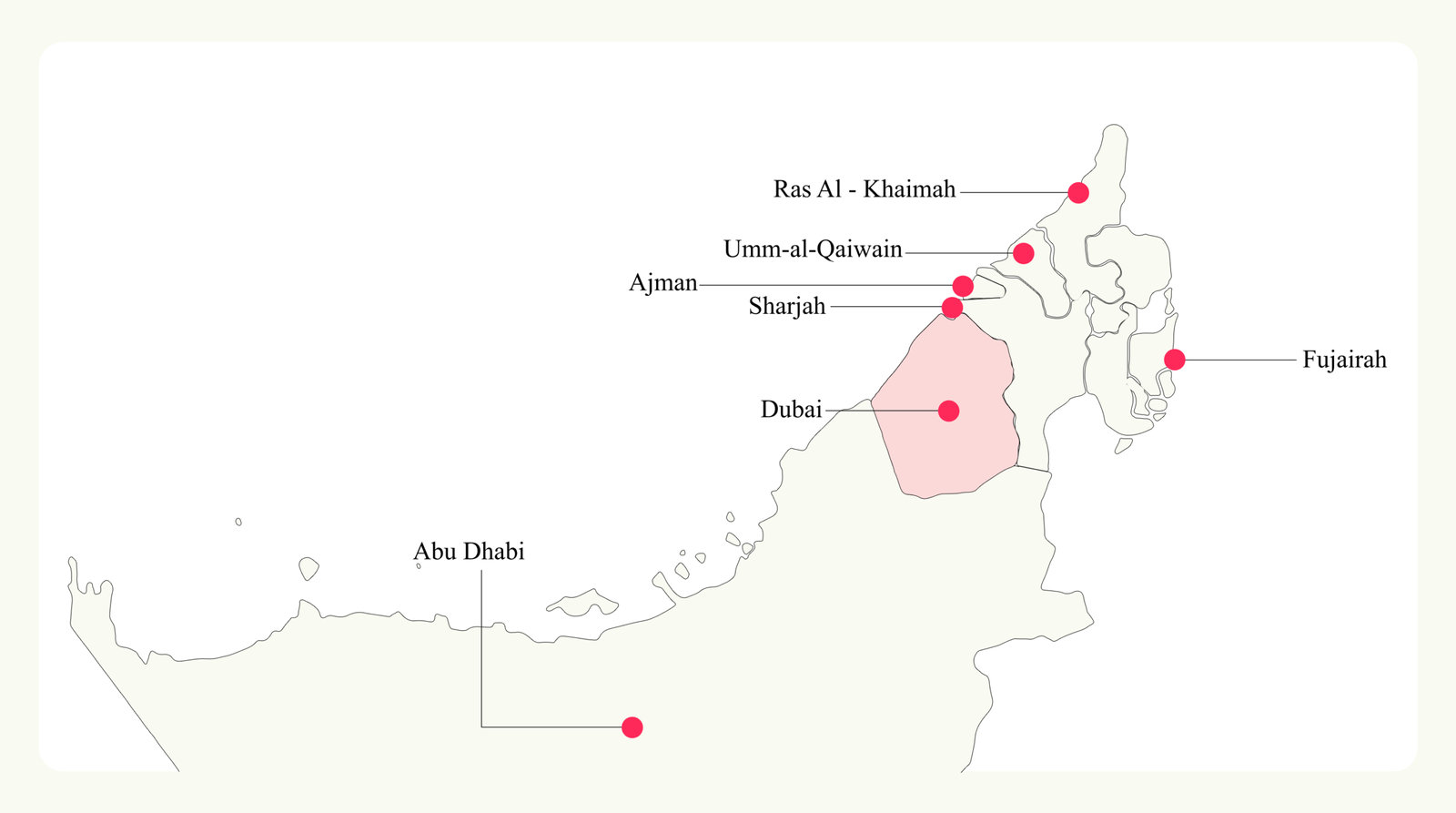
Start Your Kitchen Island Project
You’ve imagined a kitchen island that transforms how your family uses one of your home’s most important spaces. We have the expertise to make that vision reality with craftsmanship that lasts decades. The next step simply involves a conversation about your specific needs, space, style preferences, and budget—with no obligation and no pressure.
During your free consultation, we measure your space carefully, discuss how you use your kitchen daily, understand your aesthetic preferences, identify any complications early, explain realistic timeline and budget expectations, and answer every question you have. You walk away with clear understanding of what’s possible, what’s practical, and what investment creates the island that serves your lifestyle best.
IF YOU HAVE ANY QUESTION? WE ARE GLAD TO
CONSULT YOU AS SOON AS POSSIBLE
Get Started
Immediate assistance from our team regarding your project details.
Form Submitted!
Thank you for contacting us. Our team will get back to you within 24 to 48 hours regarding your query.
Contact us on WhatsApp for Quick Response