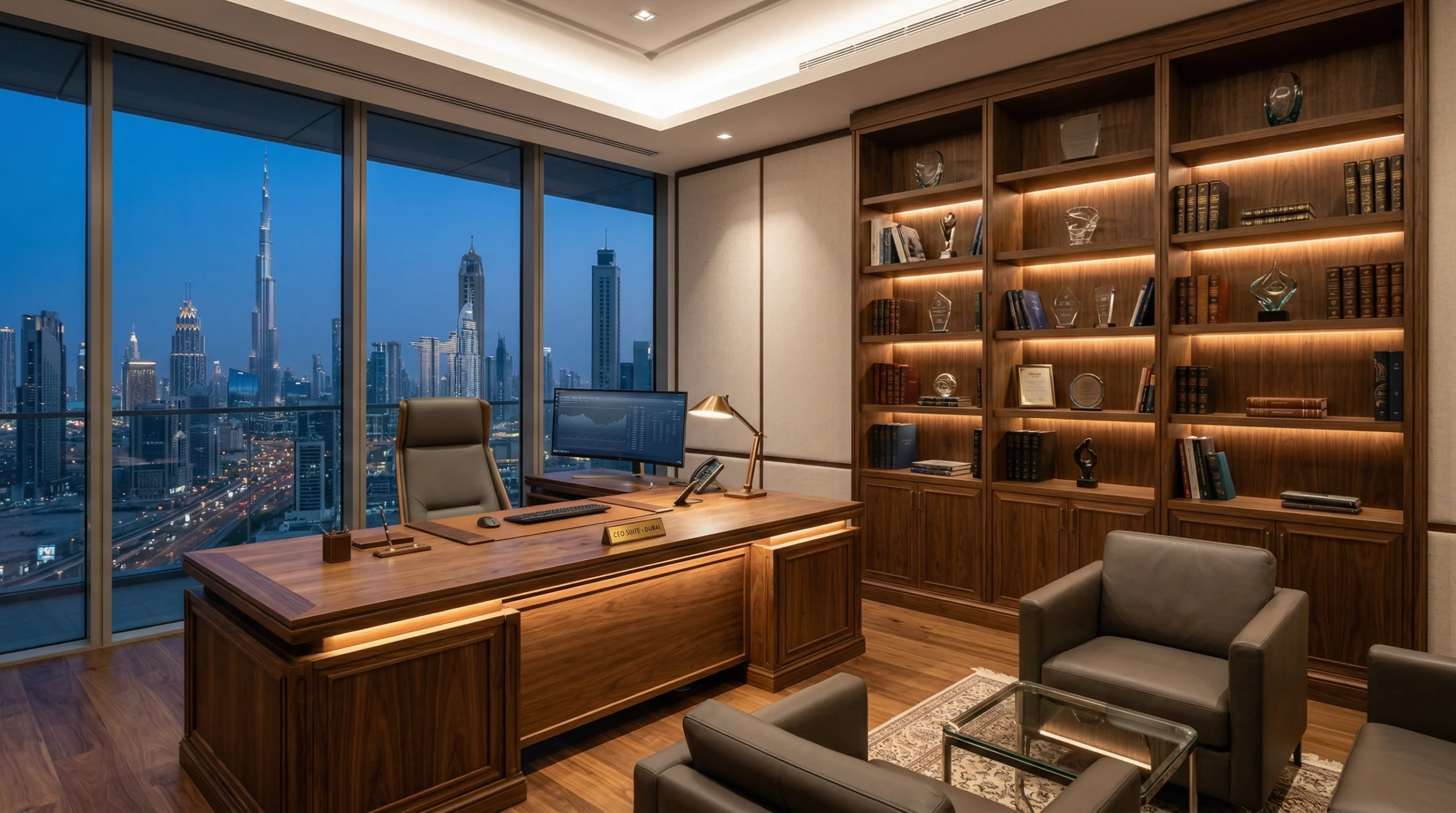
Office Fit-Out Carpentry in Dubai That Transforms How Your Business Works
Your office environment shapes how your team performs, how clients perceive your company, and how your brand tells its story. Since 1988, Karnak Carpentry has built workspaces across the UAE that do exactly that—with precision craftsmanship that holds up to the demands of commercial use.
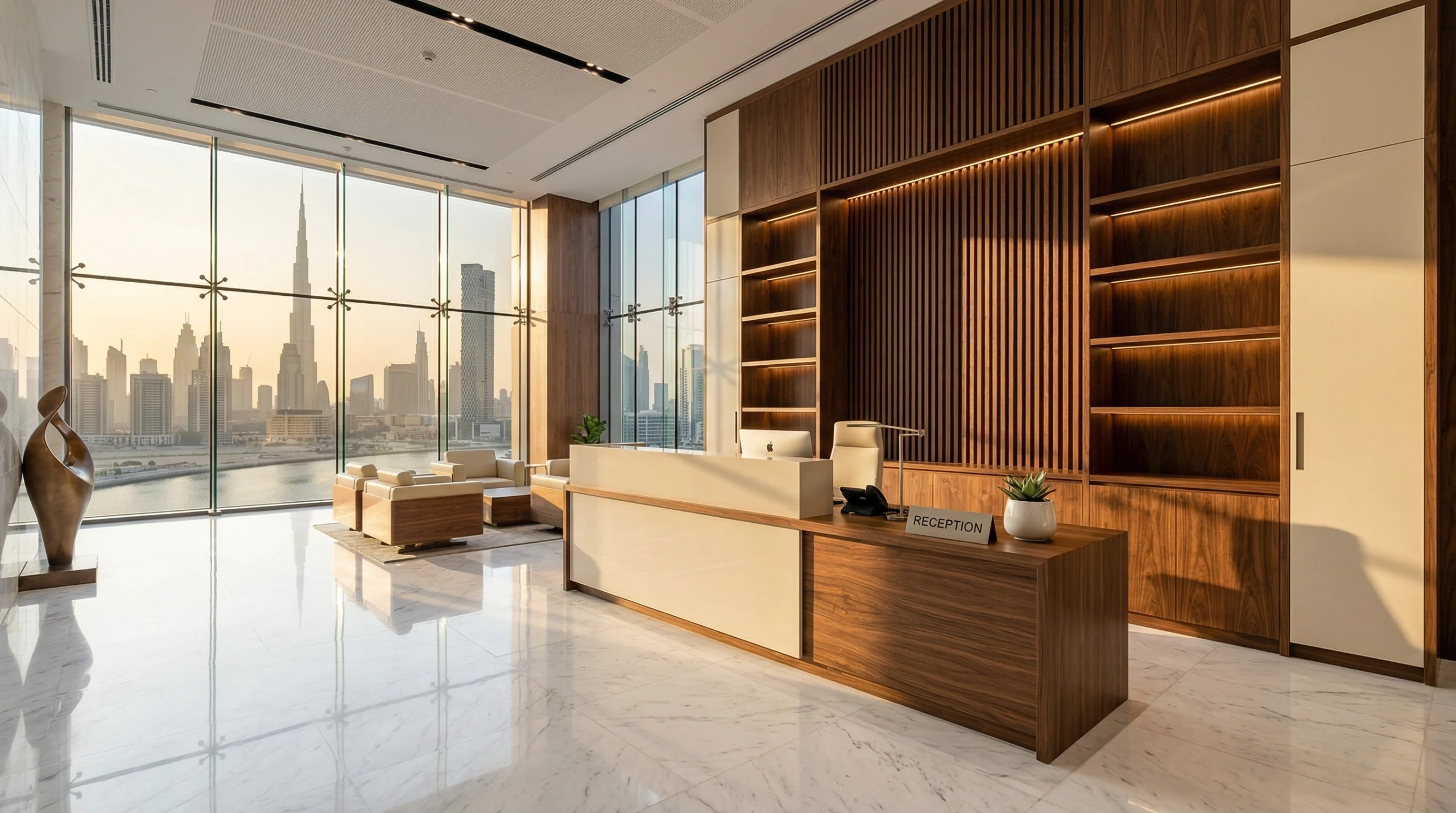
Office fit-out carpentry in Dubai is a category where the gap between competent and exceptional is enormous — and where the consequences of getting it wrong are measured in wasted budget, delayed openings, and workspaces that wear out before their time. Karnak Carpentry has been delivering commercial joinery across the UAE since 1988, and over those 35 years we’ve completed more than 50,000 projects that range from single-office fit-outs in Deira to full headquarters installations across multiple floors in DIFC and Downtown Dubai.
The UAE’s commercial property market operates at a pace and standard that few carpentry contractors genuinely understand. Fit-outs in Business Bay, DIFC, and Dubai Marina must meet specific Dubai Municipality requirements, satisfy developer standards, and endure the thermal stress that comes from a climate where building systems cycle dramatically between summer extremes and over-cooled Office interior. MDF boards that perform beautifully in Europe can delaminate and swell in a Dubai building without adequate vapour barriers. Veneers applied without the right adhesion methods will lift and bubble within eighteen months. These are not theoretical problems — they’re failures we’ve been called in to fix on other contractors’ work more times than we can count.
What qualifies us to handle your project isn’t just the years — it’s the specific knowledge those years built. Our commercial carpentry expertise now spans every category of office environment, and our in-house workshop in Dubai gives us fabrication control that site-only contractors simply cannot match.
What Small office fit-out Dubai Carpentry Actually Involves
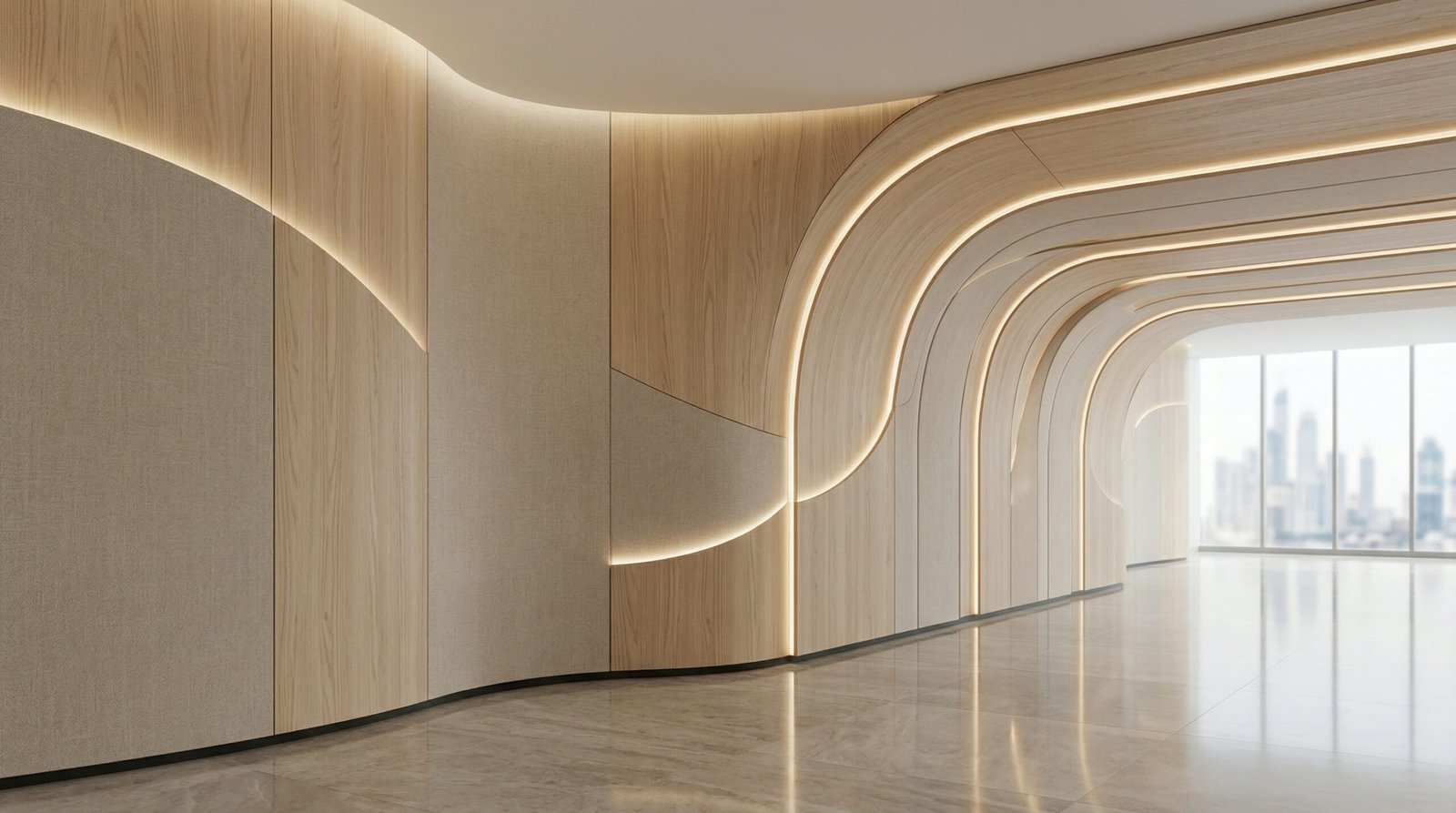
People outside the industry often underestimate how central carpentry is to a commercial fit-out. When your Office fit-out contractor Dubai talks about “FF&E” — furniture, fixtures, and equipment — the carpentry component frequently accounts for 40 to 60 percent of visible finished surfaces. The reception desk, boardroom wall panelling, workstation screens, storage walls, pantry cabinetry, manager office joinery, and decorative feature walls are all carpentry. Get the carpentry right and the entire space looks coherent and considered. Get it wrong and no amount of good lighting or flooring will save it.
The Scope of a Commercial Joinery Package
A complete small office fit-out Dubai carpentry package covers far more than most clients realise when they first approach us. The scope typically begins with the reception — the first physical impression any visitor forms of your organisation — and extends through the entire floor plate. We fabricate and install reception desks and counters, feature walls and branded joinery, floor-to-ceiling storage and filing systems, raised access floor structures where required, office partition frames and cladding, integrated cable management systems, tea point and pantry cabinetry, manager and director small office fit-out Dubai, boardroom and meeting room joinery, and custom workstation configurations.
Beyond the primary spaces, a thorough commercial joinery scope includes all internal door frames, architraves, skirting and wall panelling, display and shelving systems in communal areas, prayer room joinery and fittings, and the bespoke elements that make a space feel designed rather than assembled. Our residential carpentry services use the same fabrication standards — when we build office furniture, we build it with the longevity you’d expect in a private home, not the disposability that typifies some commercial-grade joinery.
Materials and UAE Climate Considerations
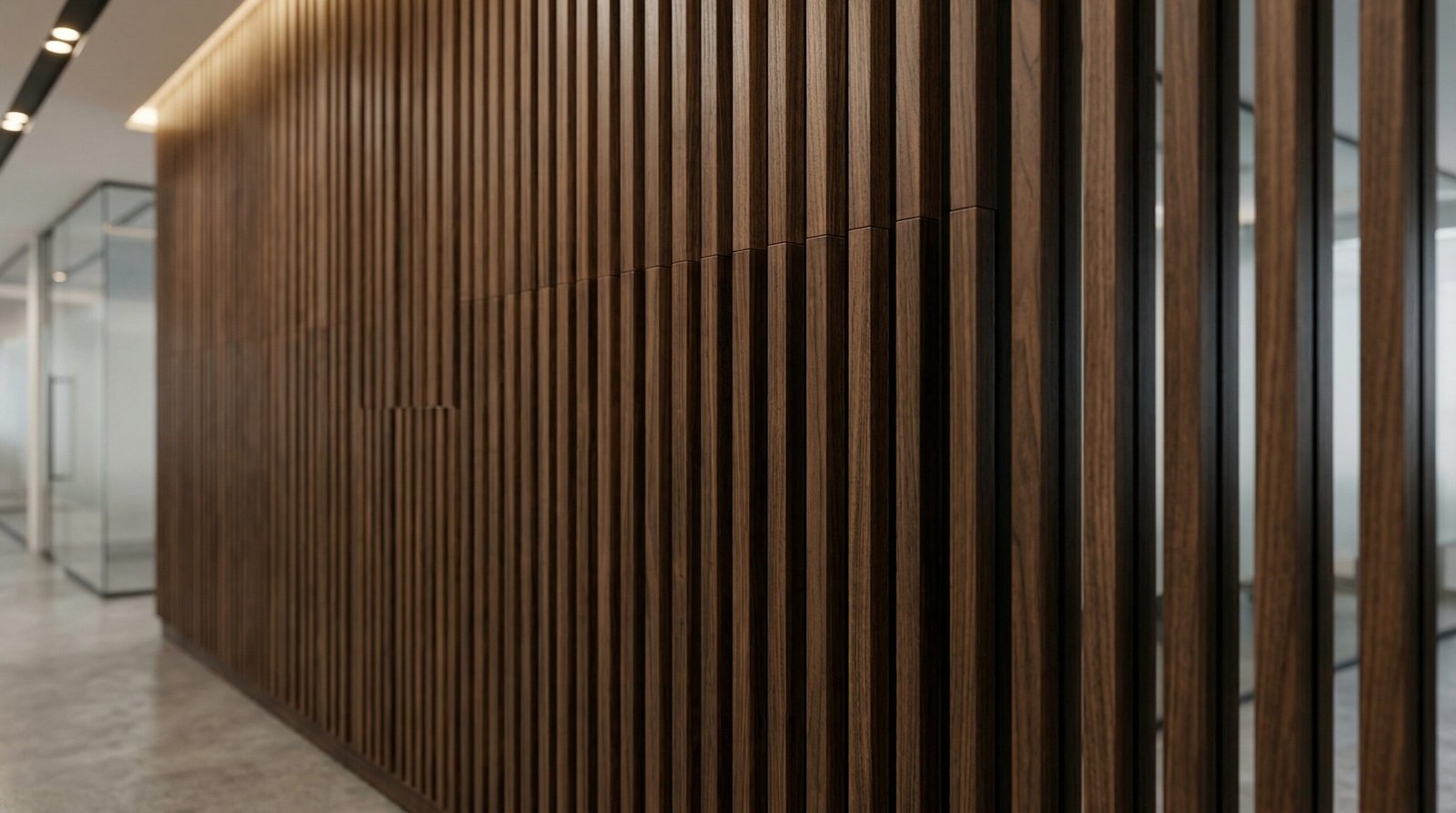
Material specification for Dubai office fit-outs is more nuanced than it appears. The fundamental challenge is that office buildings in the UAE run their HVAC systems aggressively, which creates internal conditions that can be quite low in humidity compared to what solid timber expects. At the same time, during building work and handover periods, those systems may not be running at full capacity, and natural humidity in coastal areas like Dubai Marina or JBR is significantly higher. The result is a material that needs to be stable across a fairly wide range of conditions.
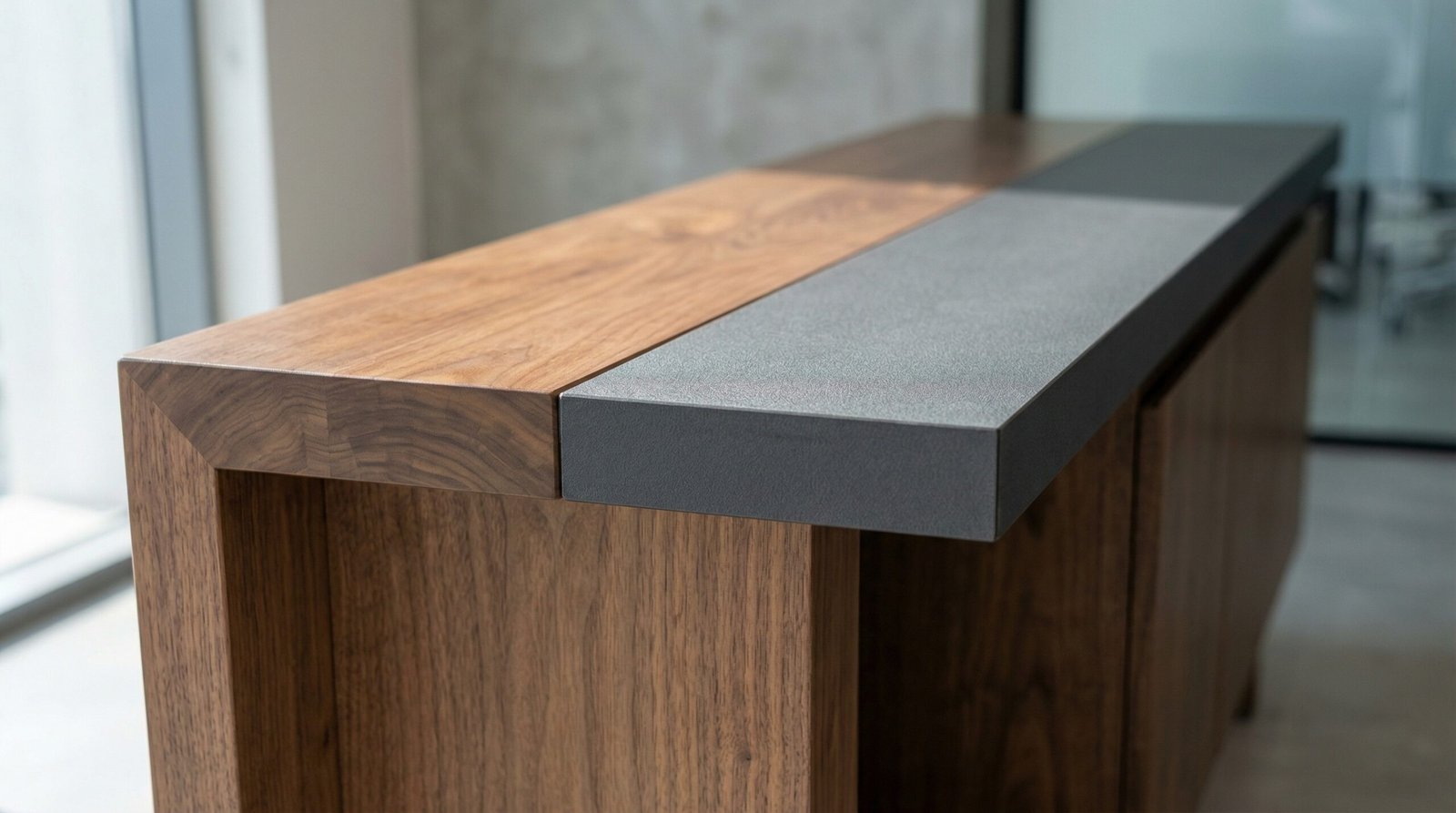
For most commercial joinery, we work primarily with moisture-resistant MDF as a core substrate — specifically grades that carry E1 or E0 formaldehyde ratings, which matters increasingly for LEED-targeted office projects. This core is then finished with engineered veneer, HPL laminate, lacquer, or solid timber facing depending on the specification and budget. Where clients want the visual warmth of real wood without the movement risk, engineered veneer on an MR-MDF core gives us the best of both. For high-traffic surfaces like reception desk tops and boardroom table edges, we typically specify solid timber hardwood edges that can be refinished when they eventually show wear — a detail that adds perhaps five percent to Office renovation cost UAE but extends the furniture’s useful life by a decade.
We’re also seeing strong interest in sustainable materials from companies pursuing LEED or WELL Building certification, and we work with FSC-certified sustainable materials from our supplier network for projects with these requirements.
Technical Integration in Modern Office Joinery
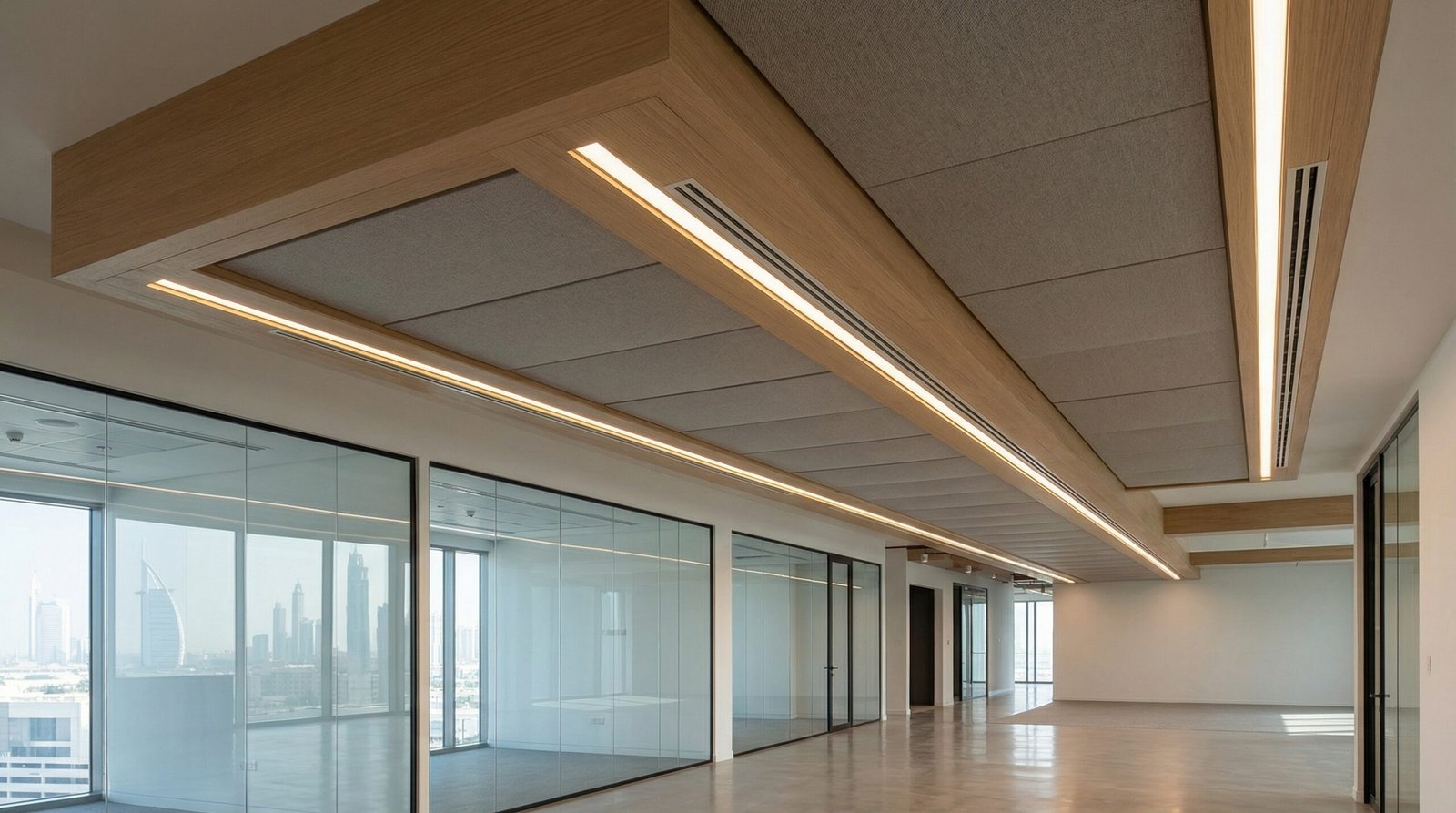
The office joinery of 2024 has to do things joinery never had to do before. Cable management is now architectural — visible cable runs are simply not acceptable in a properly designed workspace. This means our reception desks include integrated conduit runs for power and data, with cleanly finished access panels. Our workstation screens incorporate cable channels as a designed element. Our boardroom walls include flush-mounted AV rack spaces and integrated display mounting structures.
We work alongside AV contractors, IT cabling teams, and MEP subcontractors throughout the fit-out process — not after them. The reason this matters is that retrofitting cable runs into completed joinery always looks like exactly what it is: an afterthought. We schedule our site visits to coordinate with each trade so that when joinery is installed, every conduit is already routed and the finished surfaces are uninterrupted.
Office Reception Carpentry: First Impressions in Solid Wood
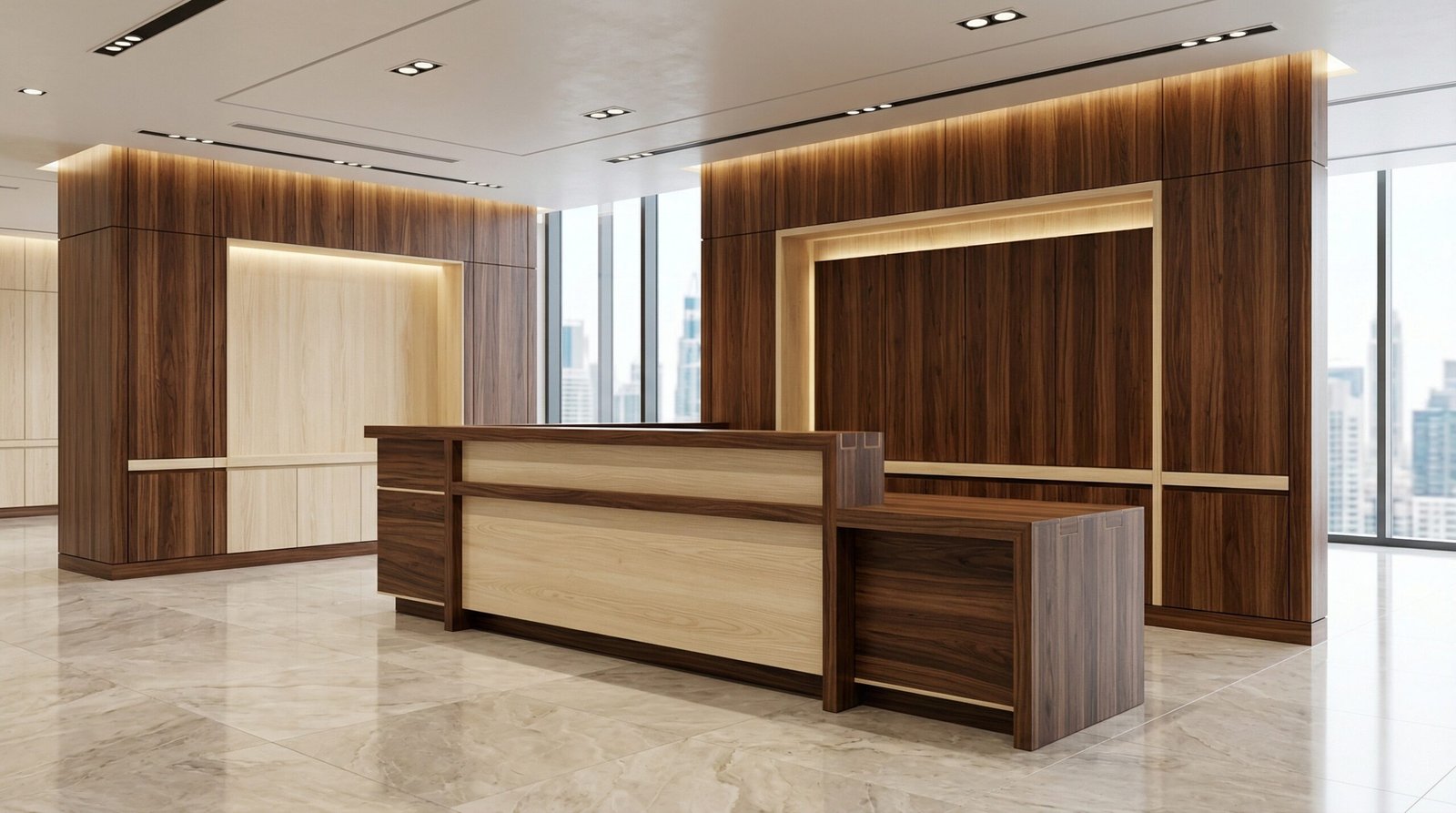
The reception area delivers the first Office interior impression of every organisation. It’s the space where brand values, company culture, and commercial success are either confirmed or quietly questioned by every person who enters. After 35 years building reception fit-outs across Dubai and the wider UAE, we’ve developed a very clear philosophy about what makes one work — and what makes it fail.
Reception Desk Design and Fabrication
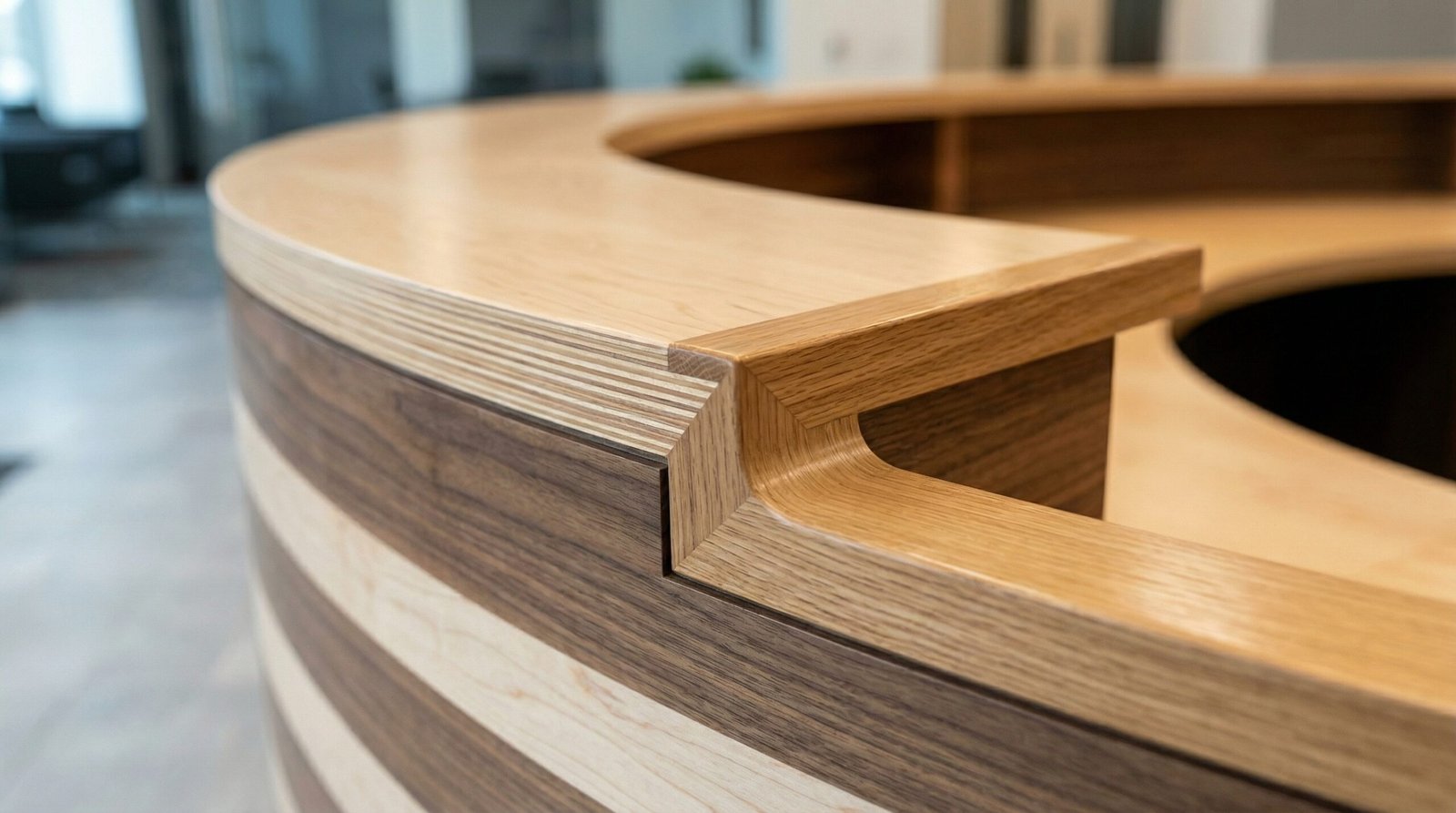
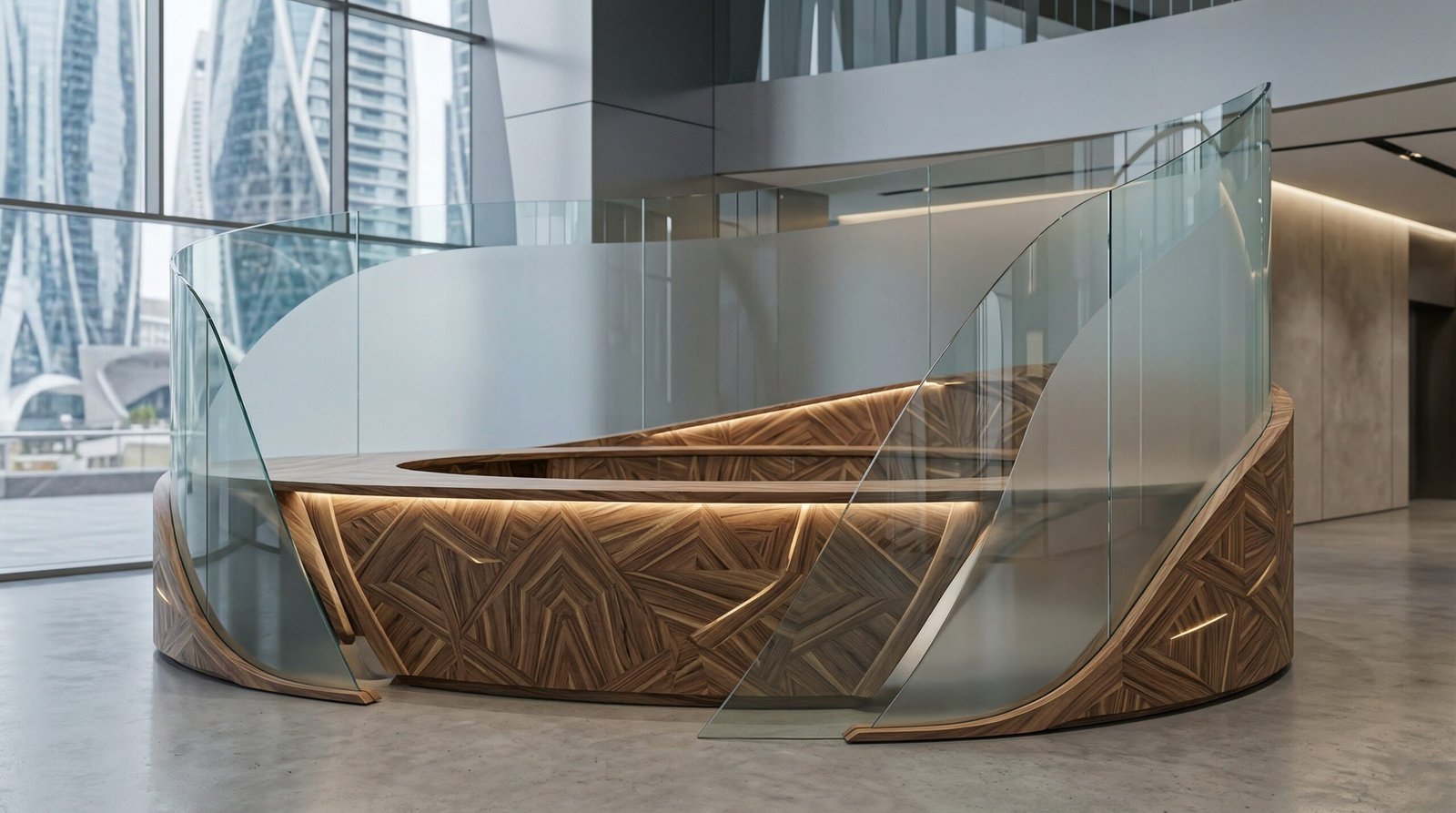
A reception desk has to function as furniture, as signage, as brand expression, and as a working station for one or more people simultaneously. The tension between these requirements is where design skill shows itself. Desks that look impressive in a render often fail in use because the designer prioritised appearance over ergonomics, or specified materials that show every fingerprint and chip within six months.
Our reception desk fabrication process begins with a detailed brief that establishes not just dimensions and finishes but how the desk will actually be used — how many reception staff, whether the desk needs integrated visitor management systems, whether a lower-level accessible counter section is required, how secure-area access is managed. From this brief we produce workshop drawings before any material is cut. This prevents the most common and expensive failure mode in bespoke joinery: fabricating first and discovering problems on site.
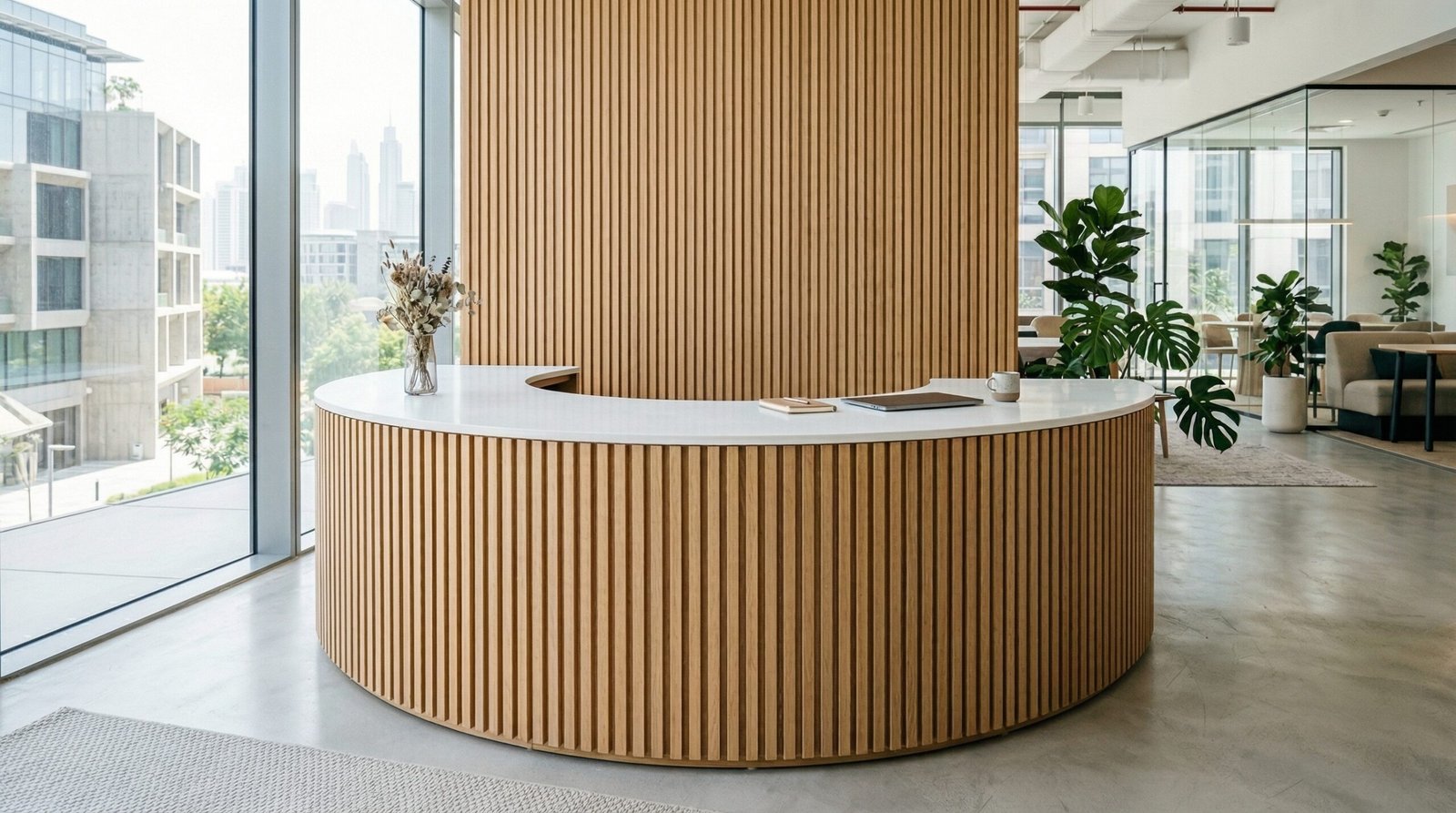
Typical reception desk specifications for our Dubai commercial clients involve a combination of an MR-MDF carcass structure, solid timber or stone fascia panels, engineered stone or hardwood counter surface, integrated LED lighting (increasingly popular for feature reception pieces), and backlit logo panels. We’ve built reception pieces that cost AED 8,000 and pieces that cost AED 280,000 — the process is the same, the materials and complexity differ.
Reception Feature Walls and Brand Integration
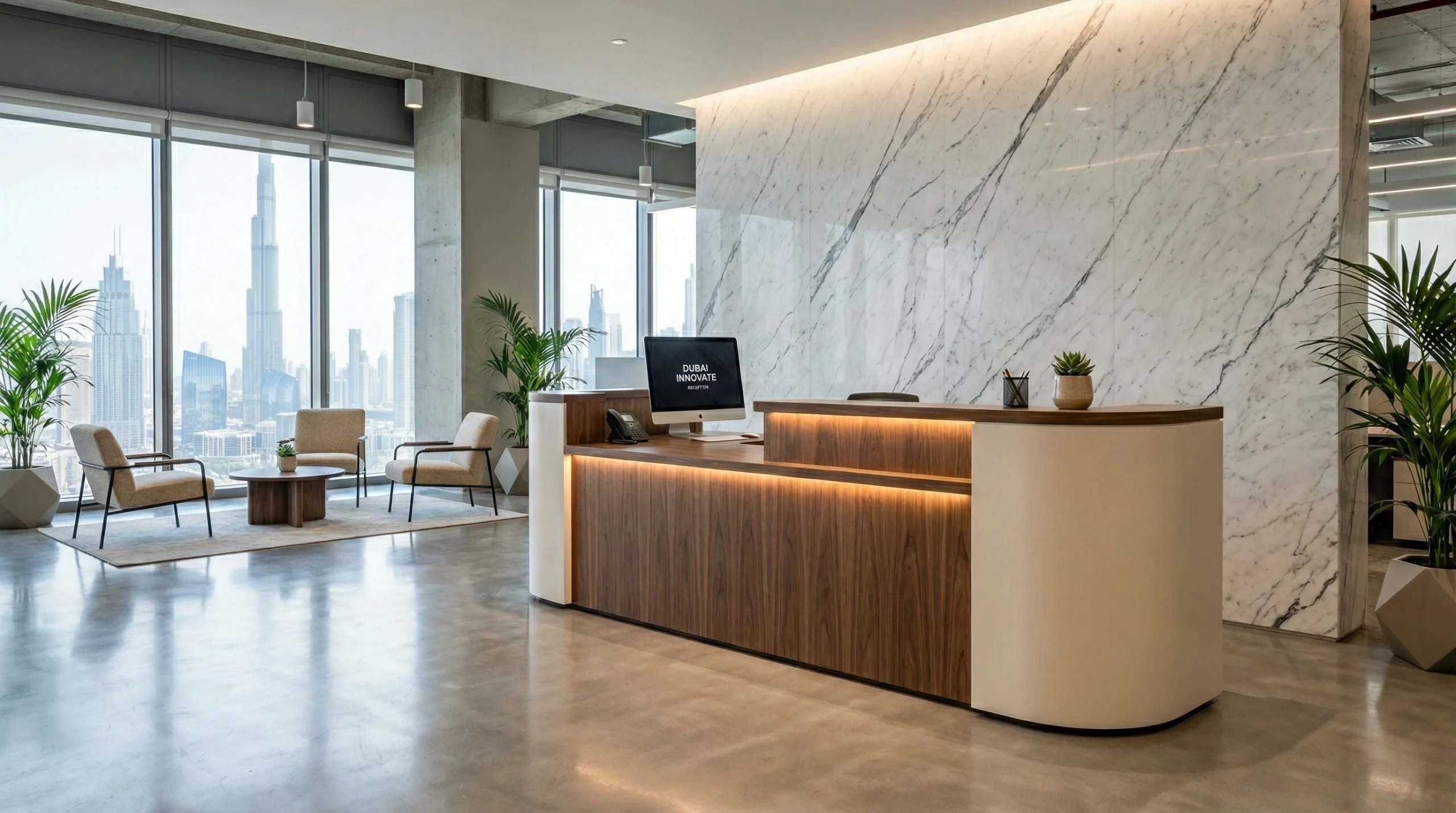
The wall behind the reception desk is arguably the highest-value surface in your office. It’s where every visitor photograph is taken, where every video call background sits, and where brand values have to be expressed in material and form rather than just graphics. We’ve built these walls in every configuration: full-height timber veneer panelling, back-painted glass with indirect lighting, geometric carved MDF with lacquer finish, fluted timber panels in various rhythms, and combinations of mixed materials where texture and depth create visual interest without relying on colour.
The most successful reception walls we’ve built share one quality: they feel deliberate. Not decorated, not assembled — designed. This requires the carpentry contractor to engage with the design intent, not just execute dimensions. Our team includes project managers with genuine interior design understanding, not just site management experience.
Boardroom and Meeting Room Joinery
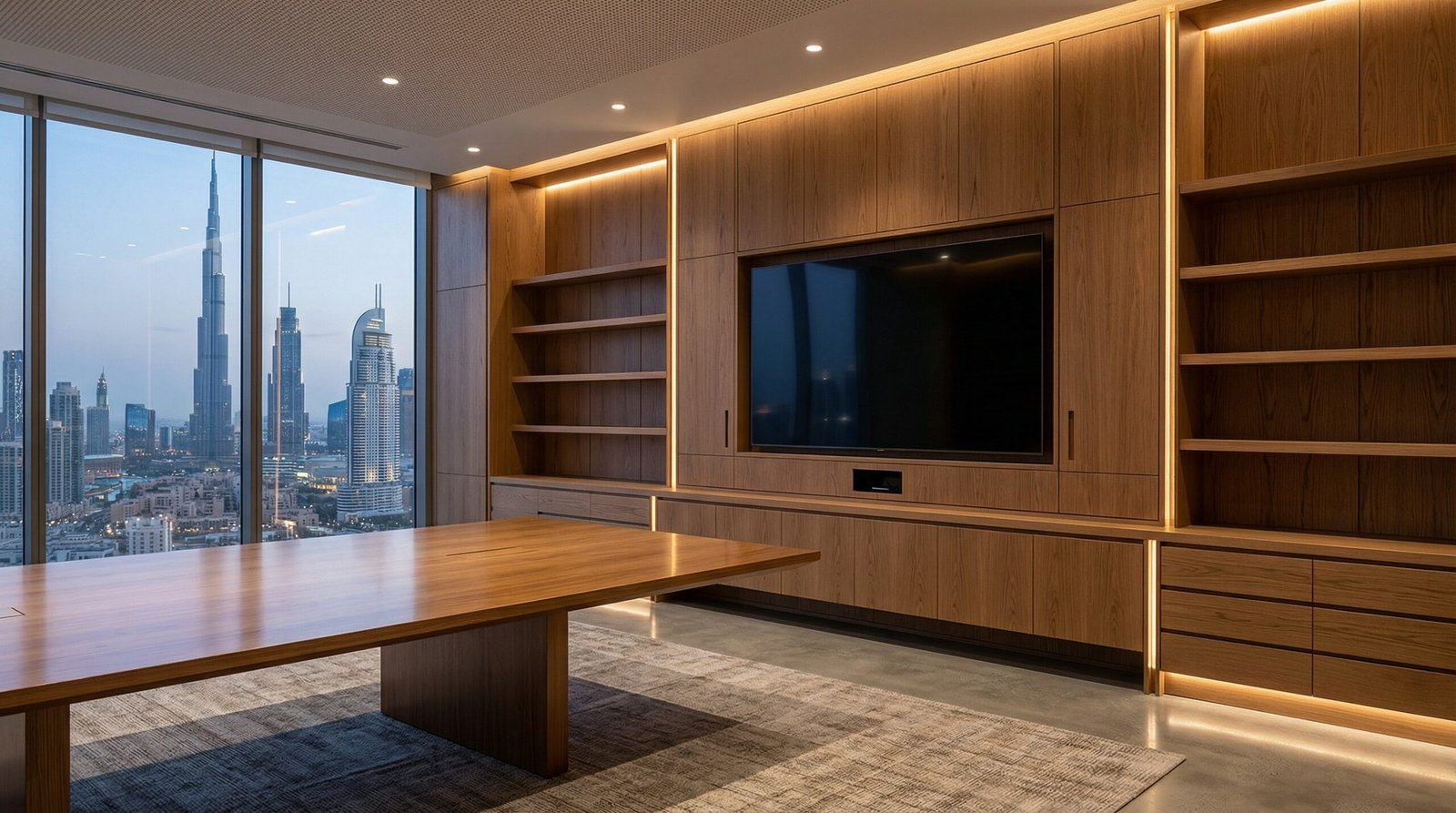
The boardroom is where your organisation makes its most significant decisions and presents itself to its most important relationships. The joinery in this space carries a communicative weight that’s easy to underestimate until you sit in a room where it’s been done badly.
Boardroom Wall Panelling and Feature Elements
Boardroom wall panelling has experienced a genuine renaissance in UAE corporate design over the last decade. Where the early 2000s favoured bare painted walls and standalone furniture, the current trend — driven partly by the hospitality-influenced design sensibility that characterises Dubai’s premium commercial market — is toward fully considered rooms where walls, furniture, ceiling elements, and lighting work as a unified composition.
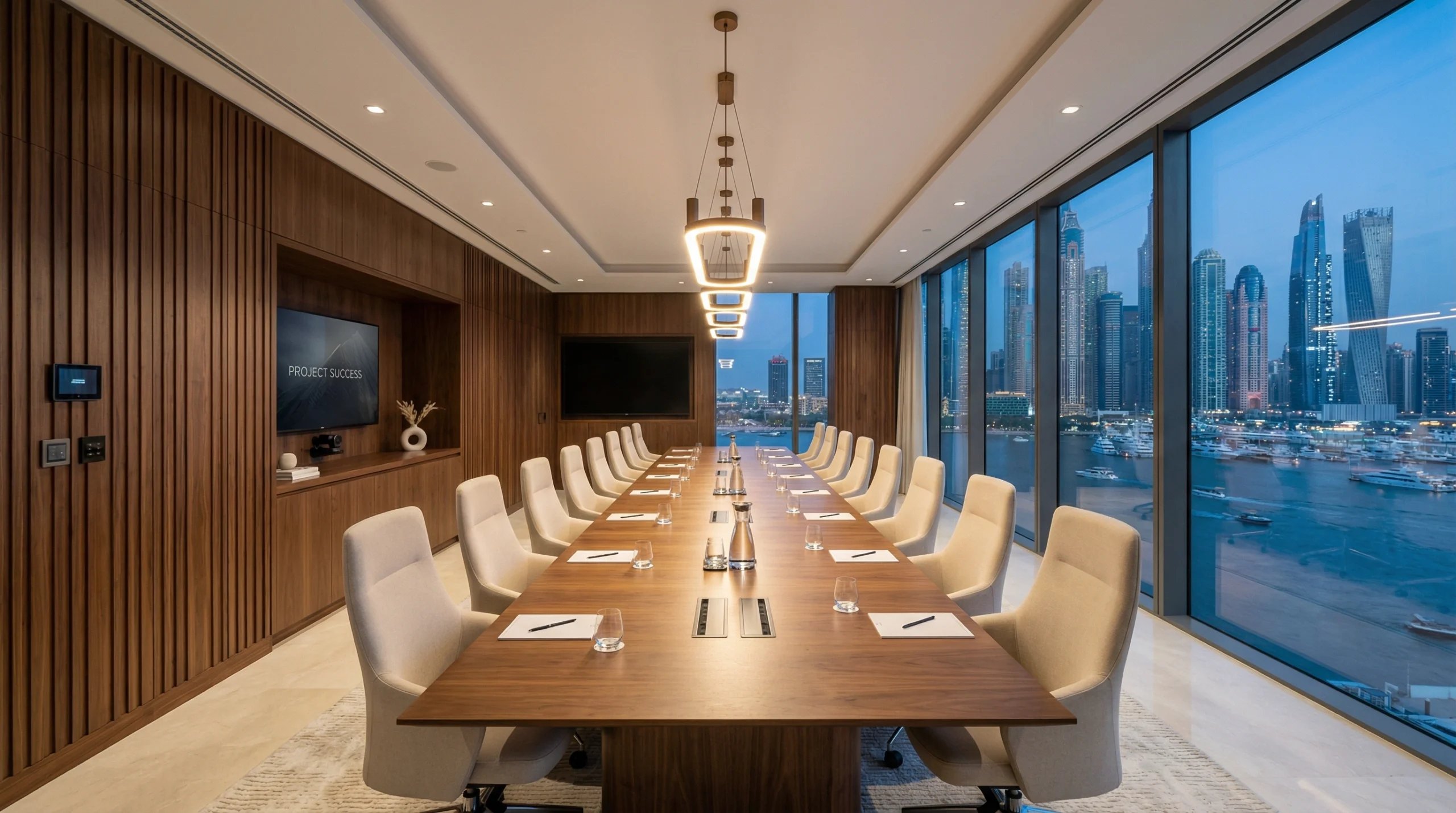
We fabricate boardroom wall panelling in solid timber, engineered veneer panels, fluted MDF systems, lacquered panels with integrated acoustic treatment, and hybrid approaches that combine materials across different wall zones. Acoustic performance is worth raising here: a boardroom that looks beautiful but echoes badly undermines every meeting that happens in it. We work with acoustic panel suppliers to integrate sound-absorbing materials behind architectural veneered surfaces — the acoustic layer performs its function invisibly while the aesthetic surface does its visual work.
Boardroom tables fabricated by Karnak Carpentry are designed from the wiring out. Before a single board is cut, we establish the AV configuration — where screens mount, where the videoconference camera positions, how power and data reach every seat position, how the central spine of the table manages cable consolidation. This infrastructure is then built into the table structure, with flush-mounted pop-up power units or integrated fixed modules depending on client preference.
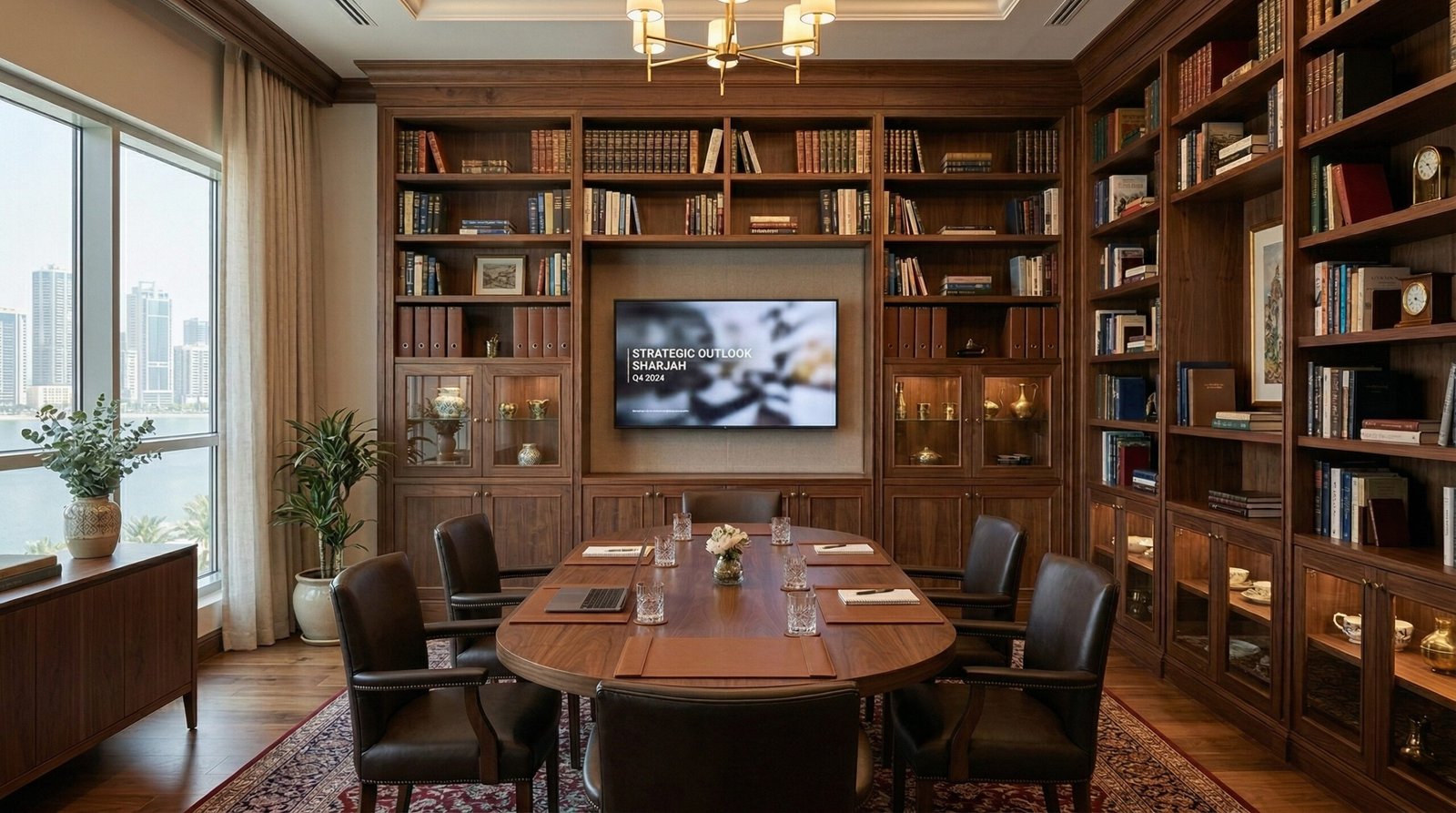
We build boardroom tables in sizes from 8-seat to 30-seat configurations, in shapes from standard rectangular to barrel, boat, and fully custom geometries. Materials range from engineered stone and glass tops to veneer over MDF and full solid timber construction. Lead times for a custom boardroom table with full integration run from 3 to 6 weeks from drawing approval depending on complexity.
Meeting Room Carpentry and Joinery
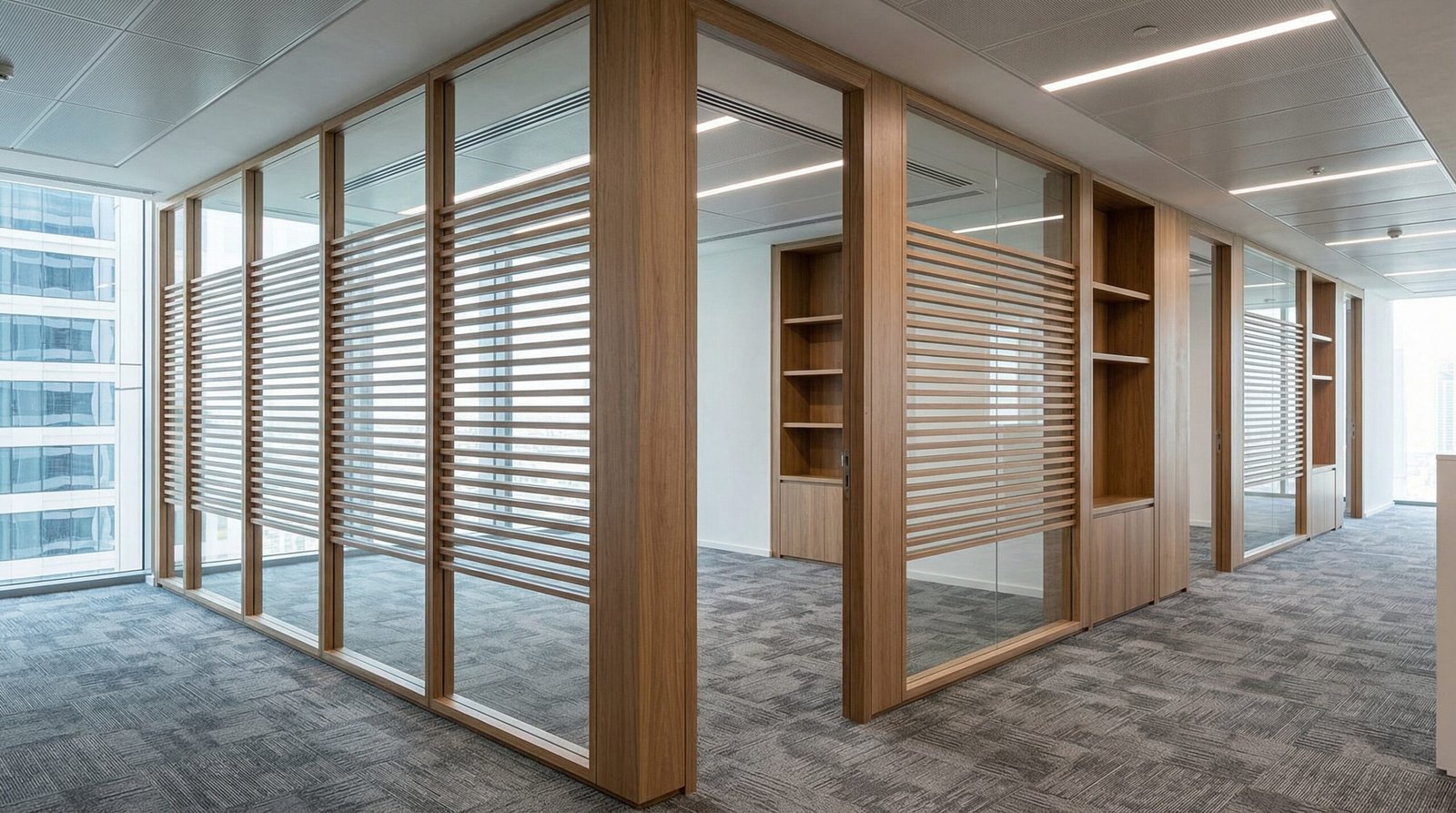
Beyond the main boardroom, most office fit-outs include multiple meeting rooms of varying sizes and specifications. The joinery package for these rooms typically includes wall-mounted credenzas or storage units, display mounting structures, acoustic panel installation, and sometimes purpose-built collaborative furniture pieces. We approach each meeting room with the same fabrication rigour as the boardroom — the materials and finishes may differ to reflect budget allocation, but construction quality does not.
Office Storage, Workstations, and Operational Joinery
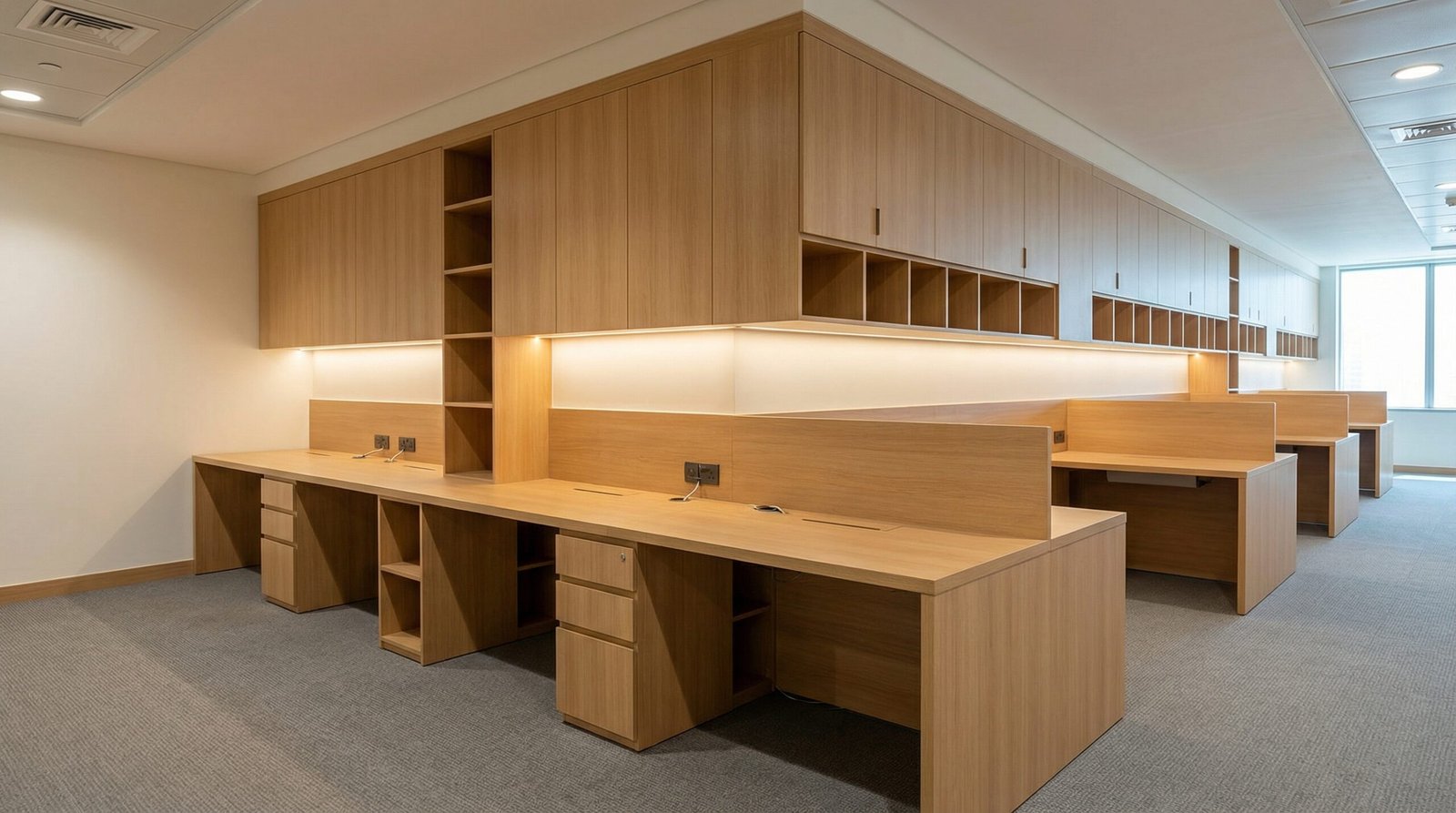
The parts of an office fit-out that people interact with most every day — workstations, filing walls, personal storage, pantry and tea point facilities — receive less design attention than reception and boardrooms but have the most direct impact on how well the workspace actually functions. Joinery failures in these areas affect productivity every day.
Custom Workstation Systems and Screen Joinery
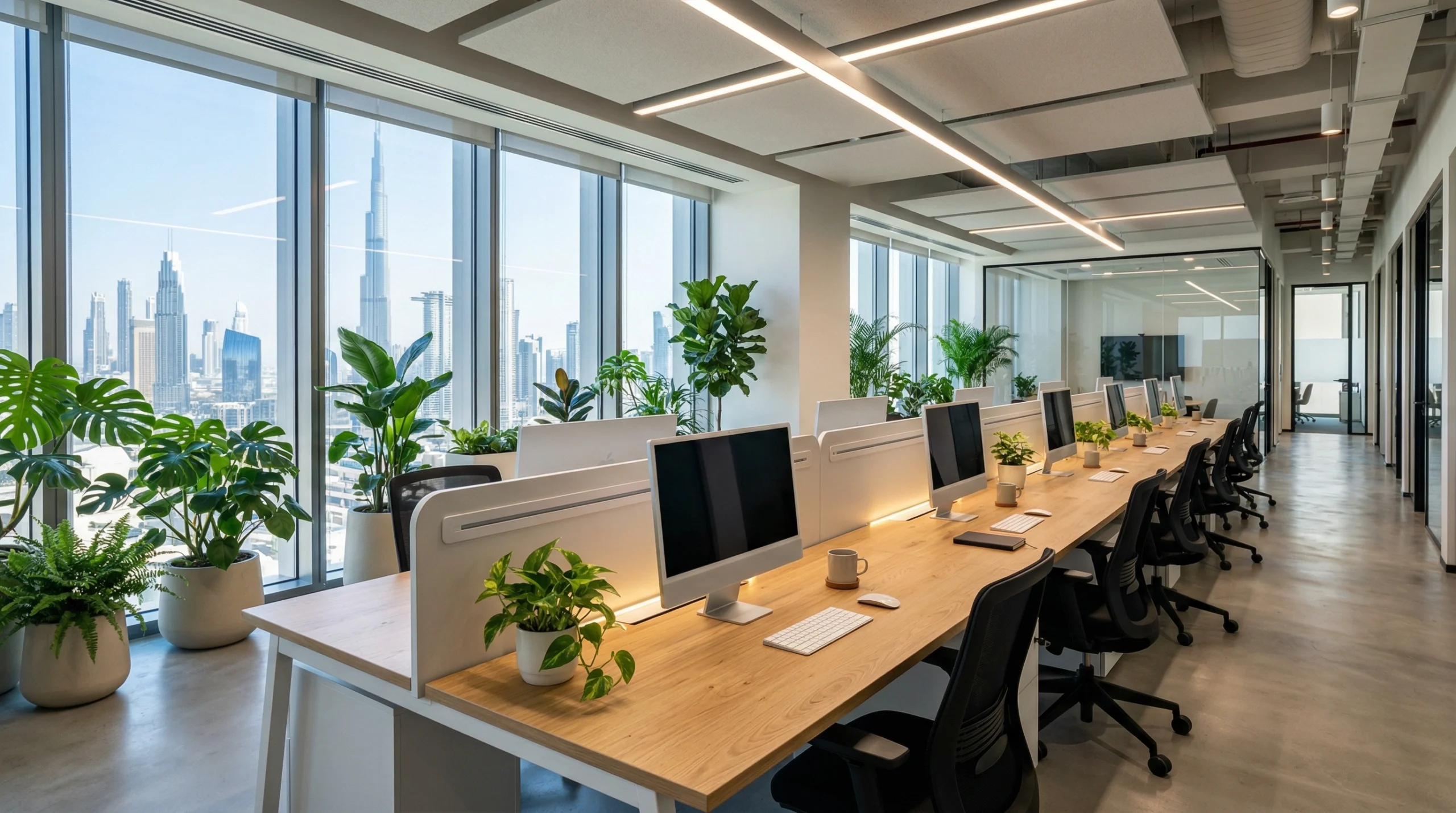
Standard modular workstation systems from furniture manufacturers serve many offices adequately. But they serve few offices perfectly. The constraints of a particular floor plate — irregular columns, sloped ceilings, unusual dimensions, specific power distribution requirements — often mean that custom workstation joinery delivers better spatial efficiency and functionality than modular systems at comparable or lower total Office renovation cost UAE when you account for the waste inherent in adapting standard modules to non-standard spaces.
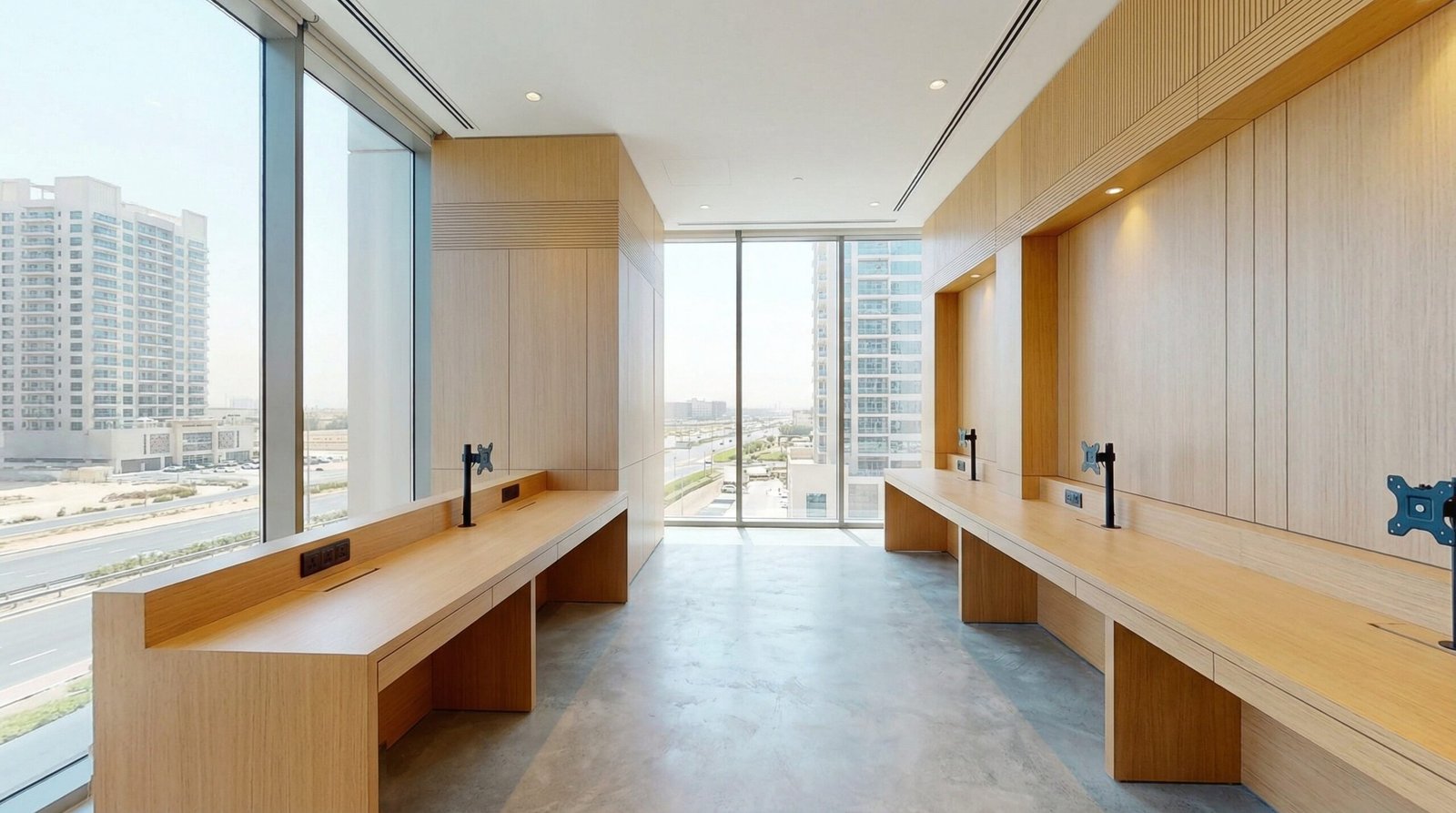
Our custom workstation joinery includes screen-based systems with integral cable management, peninsula and island configurations, height-adjustable frame integration, and specialist stations for specific work types — trading floors, design studios, reception positions, and monitoring suites all have requirements that general workstation systems don’t address well. We’ve built workstation environments for up to 300 desk positions in single fit-outs, coordinating installation sequencing with IT cabling and power distribution to minimise disruption to live office environments.
Built-In Storage and Filing Systems
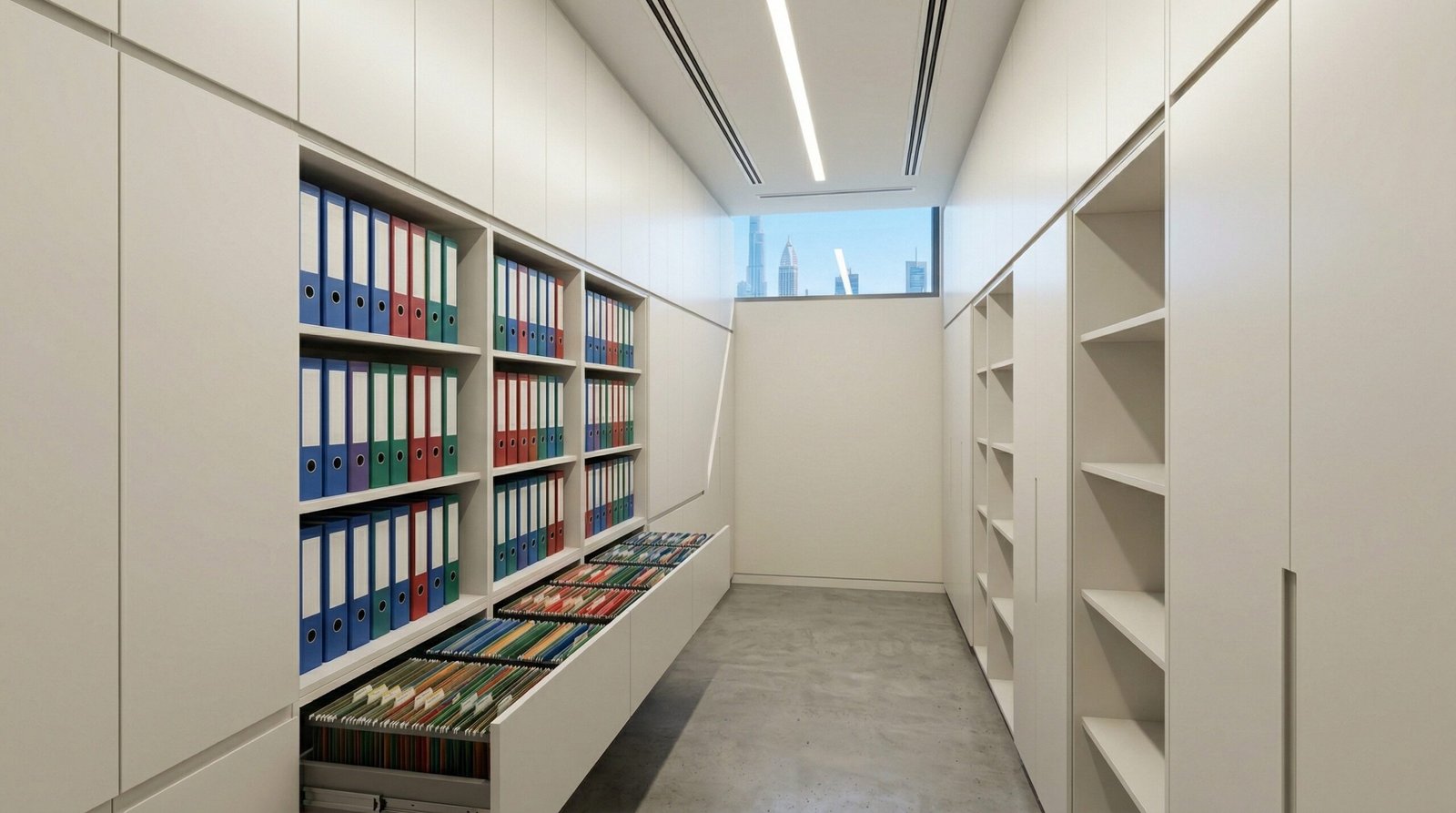
Filing and storage in a modern office needs to be more than functional — it needs to be designed. Floor-to-ceiling storage walls that use every available centimetre of vertical space while maintaining visual order transform what might otherwise be a cluttered office into a space that looks considered. We design and build storage systems that integrate personal lockers, shared filing, printer stations, display shelving, and equipment housing into coherent architectural elements rather than freestanding furniture afterthoughts.
For open-plan environments, storage walls frequently double as spatial dividers — creating a degree of acoustic and visual separation between zones without the permanence and Office renovation cost of partition walls. We’ve built storage systems up to 12 metres long that define the entire perimeter of an open-plan floor, turning what had been dead space along a structural wall into a major functional and aesthetic asset.
Pantry, Tea Point, and Kitchen Joinery
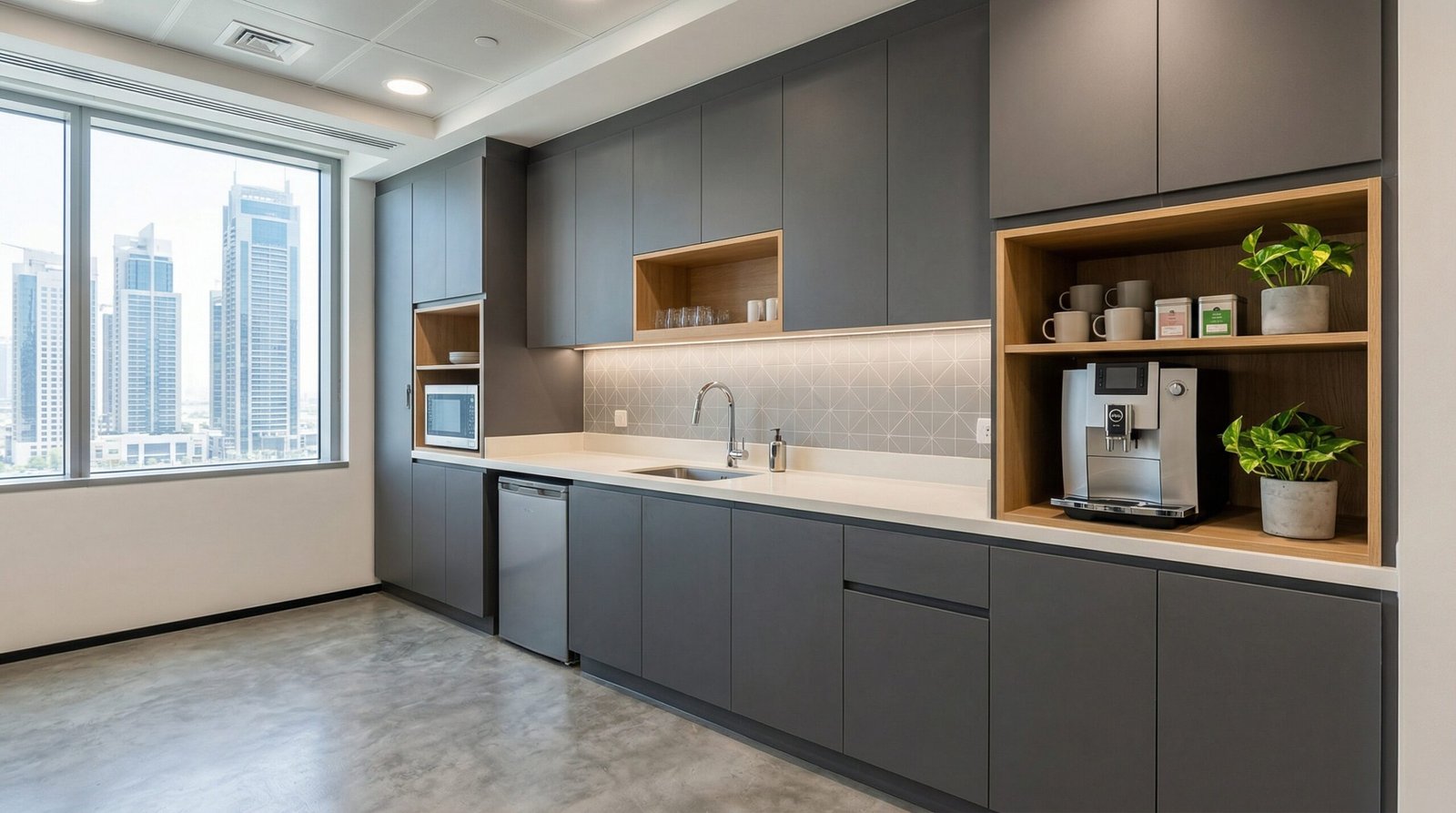
Every office needs functional food preparation areas, and in the UAE’s corporate culture these spaces carry social significance beyond their practical function. The pantry or kitchen is where informal relationships are maintained, where teams decompress, and where the quality of the work environment is privately assessed by both staff and visitors. Poorly designed or cheaply finished pantry joinery undermines office culture in ways that are hard to measure but easy to feel.
We build tea point and pantry joinery to kitchen standards — properly rated materials for areas near water, correctly sealed edges and joints, commercial-grade hinges and drawer runners, and integrated appliance housing that allows replacement without cabinet demolition. Finishes range from high-gloss lacquer to timber veneer and HPL, with worktop materials including engineered stone, solid surface, and timber depending on specification and use intensity.
The Karnak Carpentry Office Fit-Out Carpentry Process

Delivering a commercial fit-out on time and to specification in Dubai requires a process that accounts for the realities of working in occupied or partially occupied buildings, coordinating with multiple trades, managing material lead times, and maintaining quality under commercial time pressure. After 35 years, our process is refined through experience rather than optimism.
Step 1: Site Survey and Technical Brief
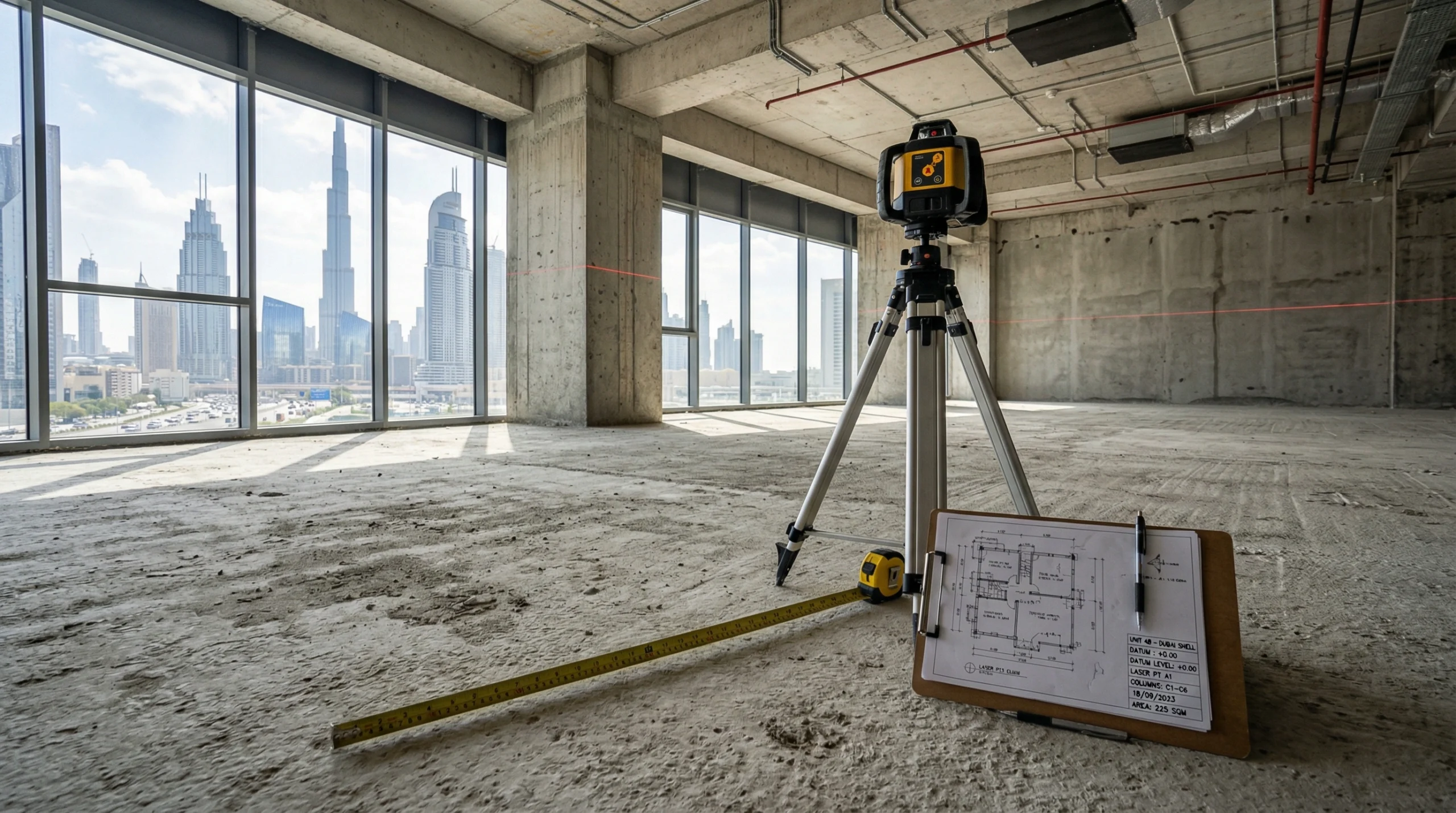
Every project begins with a physical site survey — not just a review of drawings. Drawings for commercial spaces in Dubai frequently diverge from as-built reality in ways that matter for joinery: actual dimensions differ, services run in unexpected locations, floor and ceiling levels aren’t quite what the drawing shows. Our site survey establishes verified dimensions, documents all service locations that affect joinery positioning, photographs all relevant conditions, and produces a technical brief that our workshop and design team work from.
For fit-outs in occupied buildings, we also assess access constraints, noise-sensitive hours, and building management requirements during this initial visit, so that our installation planning accounts for these factors from the outset rather than discovering them as problems during execution.
Step 2: Design Development and Workshop Drawings
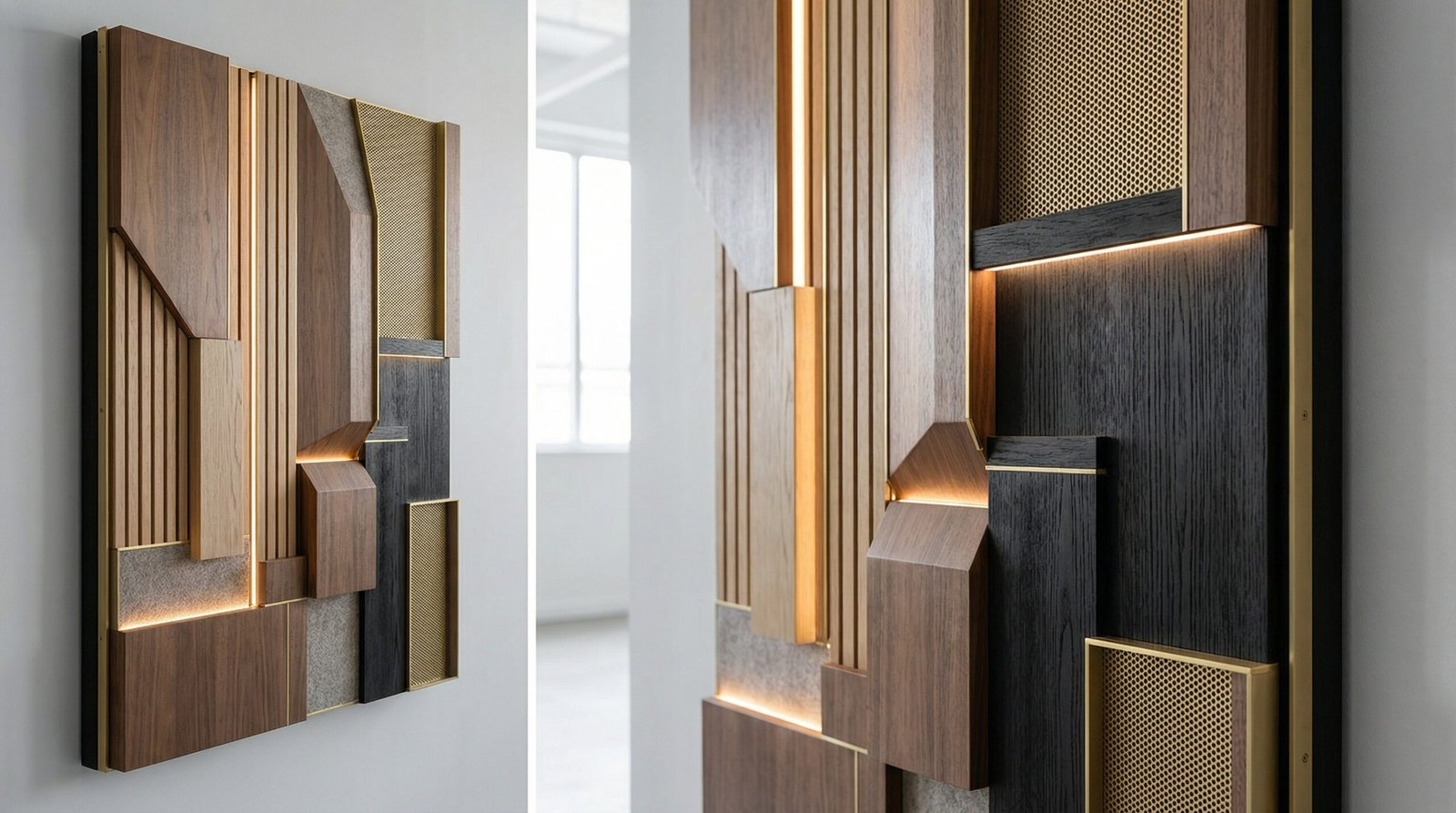
Following the survey, our design team produces detailed workshop drawings — not just the concept elevations that fit-out designers produce, but the precise technical drawings our craftsmen work from in fabrication. These show every joint, every edge profile, every hardware position, every internal structure. Clients receive these drawings for approval before fabrication begins, and this is the most important stage for preventing site problems.
Workshop drawings are not the same as office interior design drawings. An interior design drawing shows what something should look like. A workshop drawing shows how it will be built. We produce both, and we require both to be signed off before material is committed. This adds a week to the front end of a project and saves weeks at the back end.
Step 3: Material Procurement and Workshop Fabrication
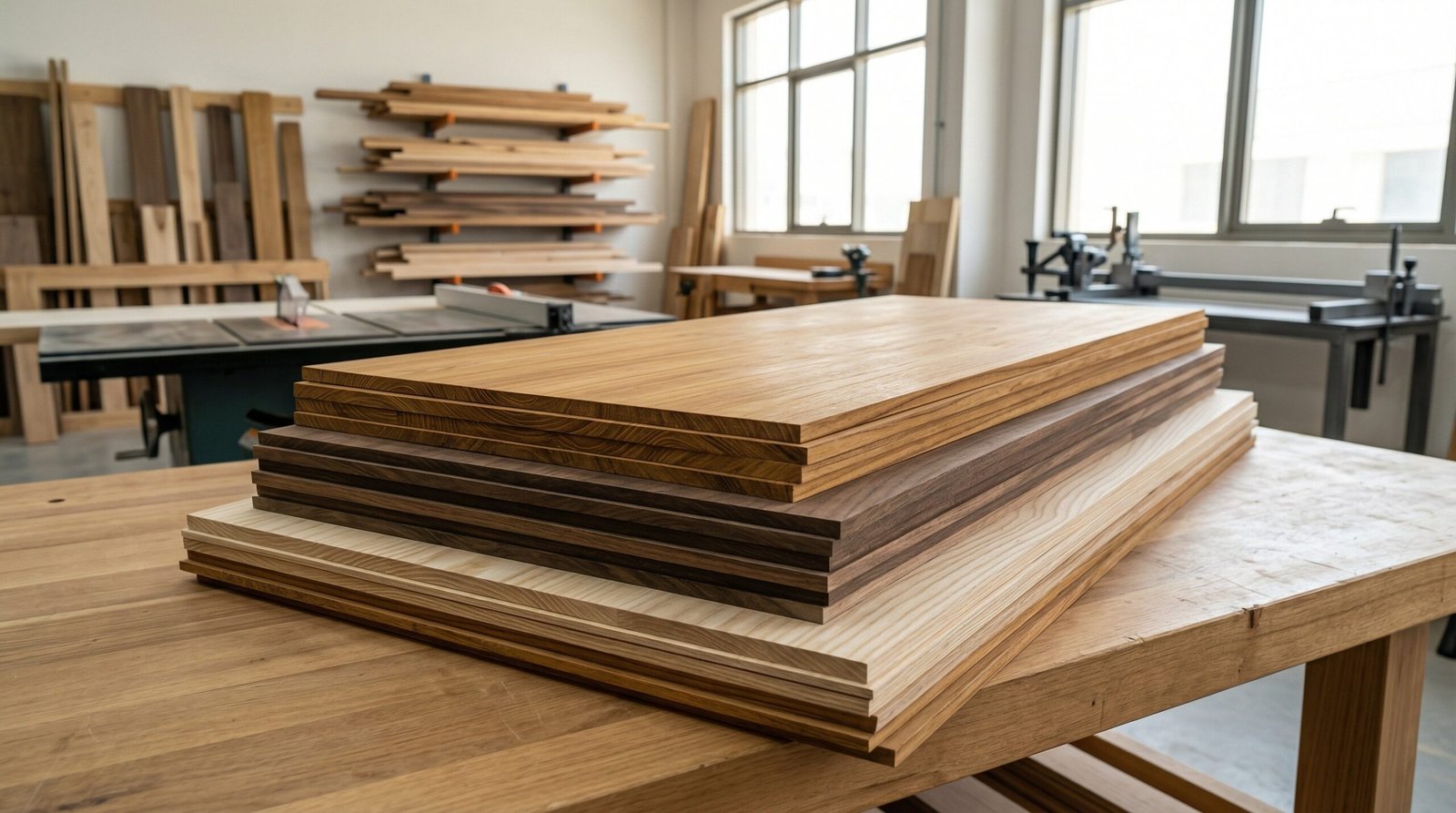
Material procurement for commercial joinery in Dubai requires relationships with the right suppliers and lead time awareness. Specific veneer species, specialist hardware from European manufacturers, premium lacquer finishes — these have lead times. We begin procurement as soon as drawings are approved, running procurement in parallel with any remaining design coordination rather than sequentially.
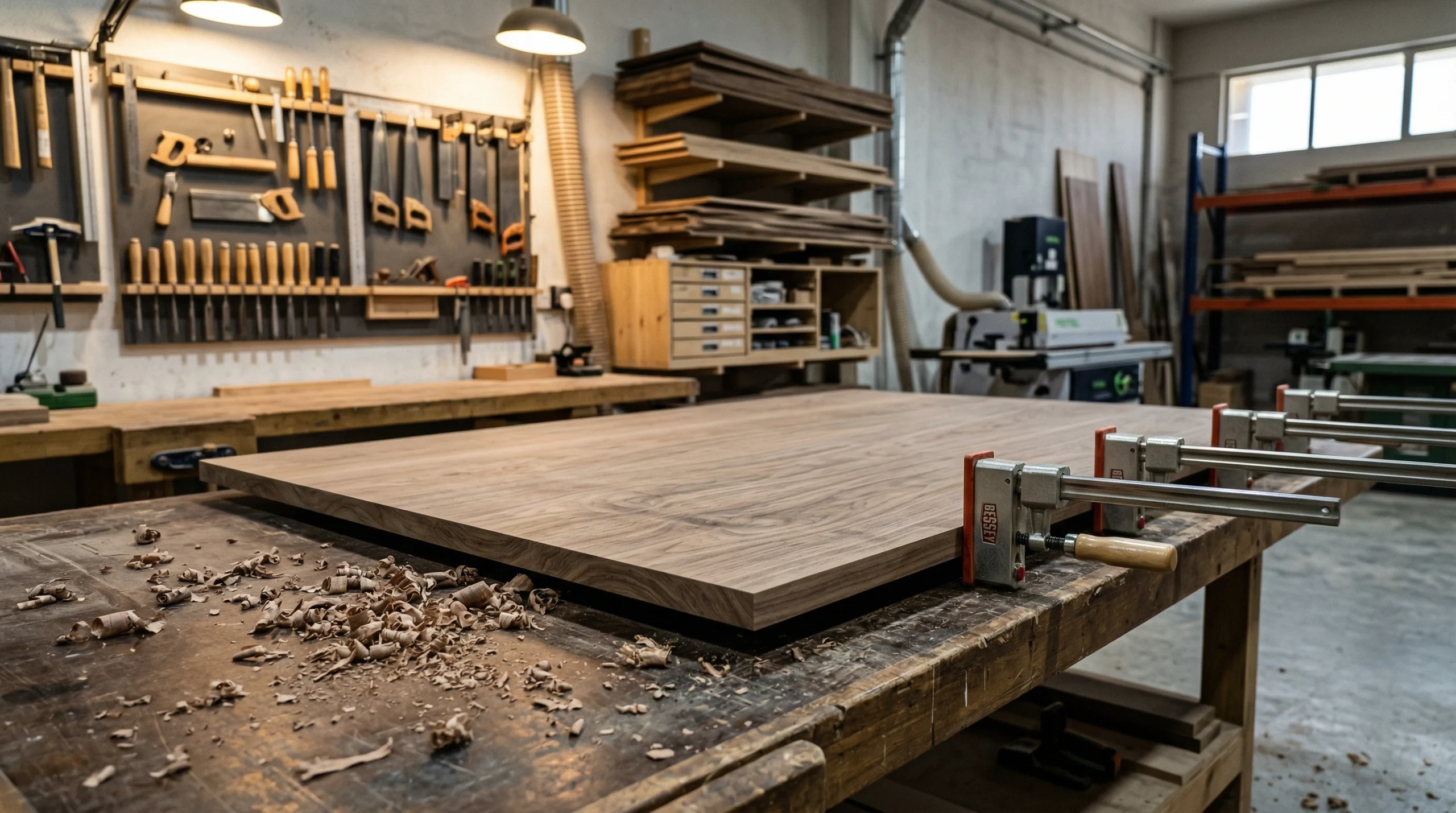
Our workshop fabrication takes place in our dedicated facility in Dubai. All cutting, assembly, veneer application, lacquering, and hardware fitting happens here under controlled conditions before anything arrives on site. A piece that arrives on site 95 percent complete installs in a fraction of the time of a piece that arrives as components and is assembled in-situ. This matters enormously in commercial fit-outs where installation time on site is the most constrained and most expensive part of the project.
Step 4: Site Installation and Trade Coordination
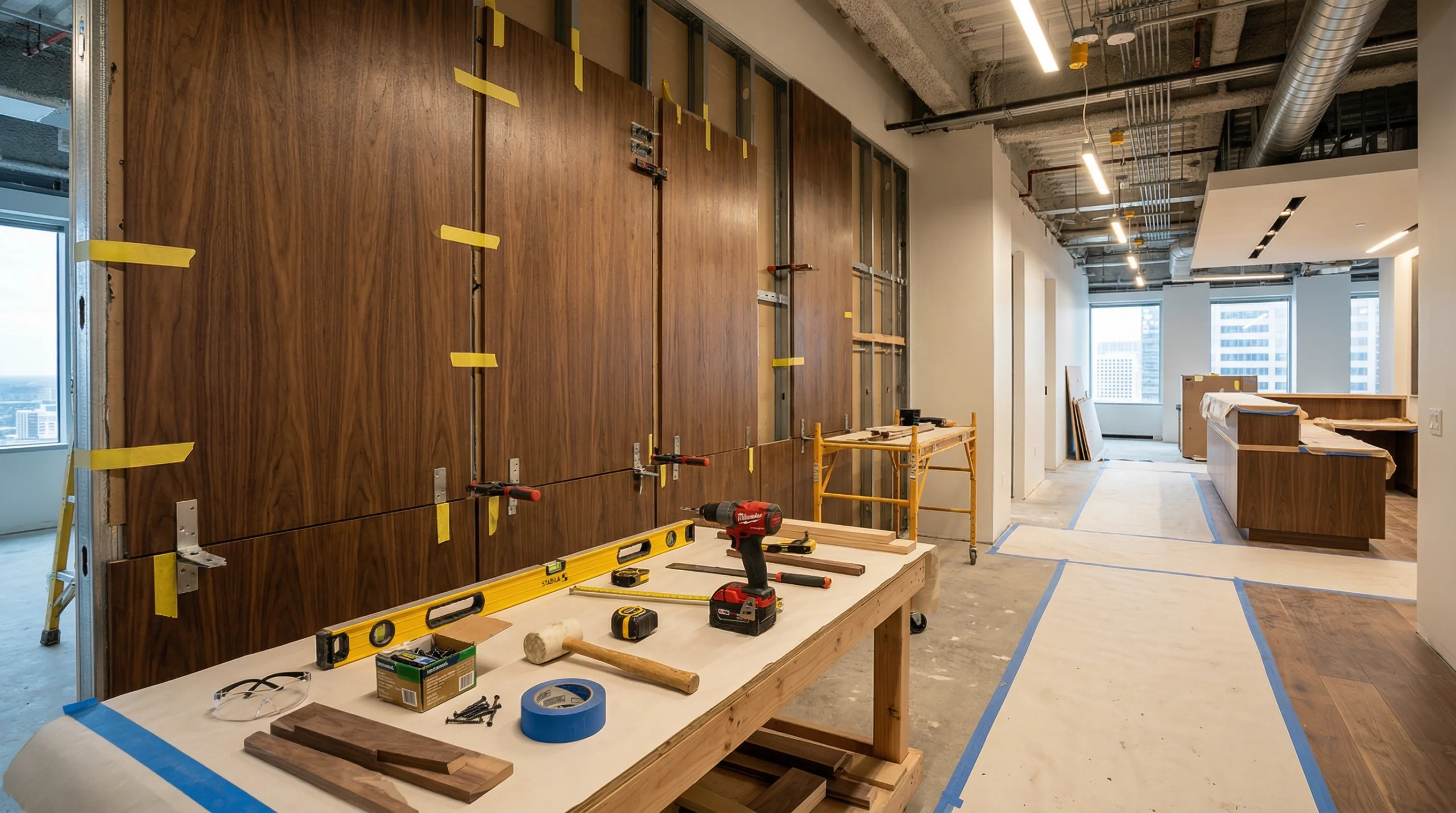
Installation sequencing in a commercial fit-out requires active coordination with every other trade. Flooring must be sufficiently complete before joinery reaches its final position. Electrical first-fix must be completed before joinery enclosures close around it. AV rough-in must precede joinery installation in boardrooms and meeting rooms. Lighting pelmet positions must be finalised before ceiling joinery is fixed.
We assign a dedicated project manager to every commercial fit-out who maintains the installation schedule and coordinates with the principal Office fit-out contractor Dubai and other specialist subcontractors. This person is on site daily during the installation phase — not available by phone, not visiting weekly. Daily, because the decisions that need to be made in an active commercial fit-out happen daily.
Step 5: Finishing, Snagging, and Handover
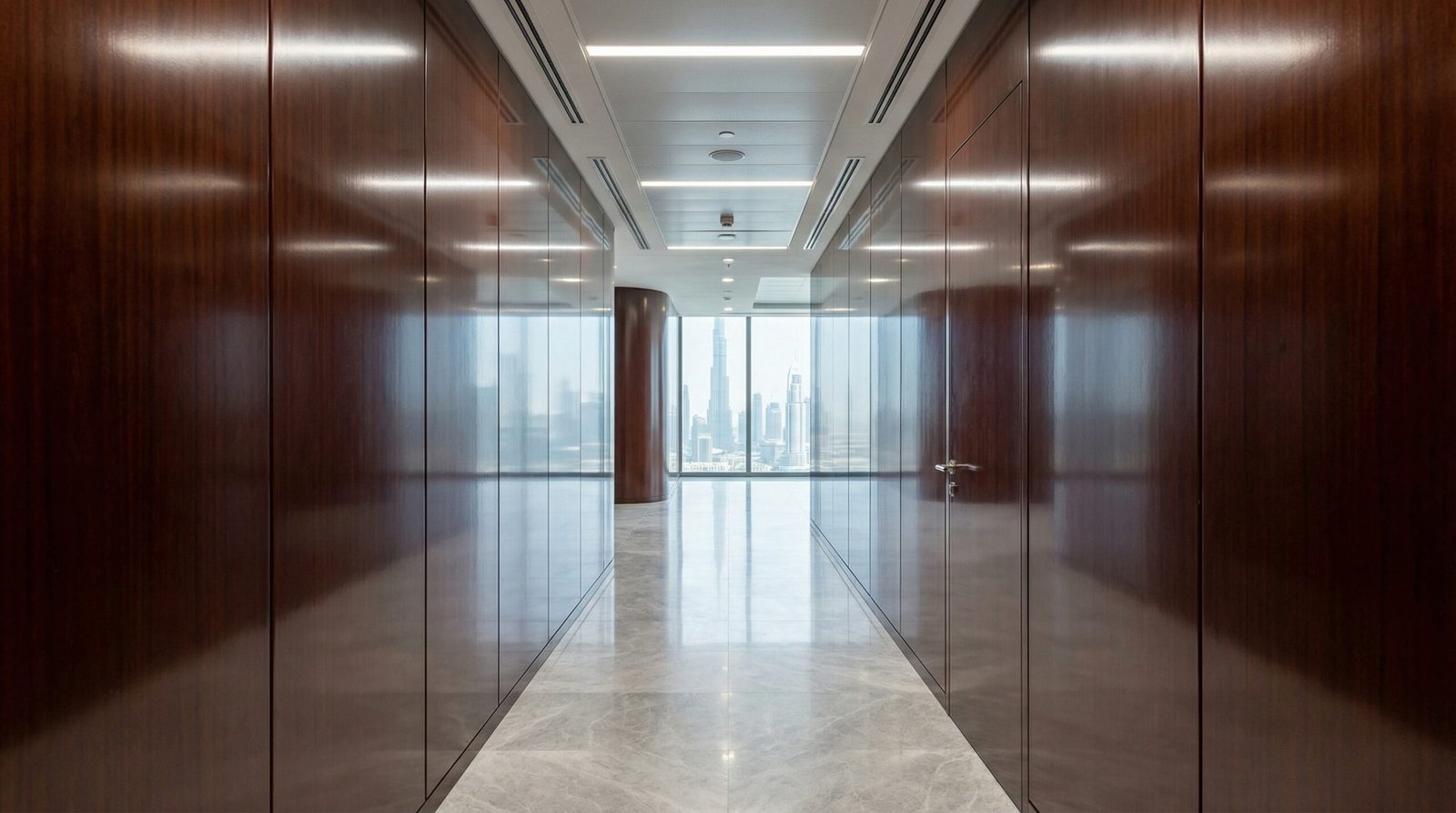
The final two weeks of a commercial fit-out are where many carpentry contractors lose the quality they’ve built over the preceding months. Pressure to meet a handover date leads to rushed finishing, paint touching-up on surfaces that should be refinished properly, and snagging lists that transfer problems to the client rather than solving them. Our finishing process is separate from installation — our finishing team follows the installation team through the space, addressing every detail that doesn’t meet our standard before it reaches the client’s snagging list.
We also conduct our own pre-handover inspection walk-through, producing an internal snag list and resolving it before the client’s formal inspection. The result is that client snagging lists on Karnak Carpentry projects are consistently shorter than industry average — not because we argue snags down, but because we’ve already fixed them.
Step 6: Post-Handover Support and Maintenance
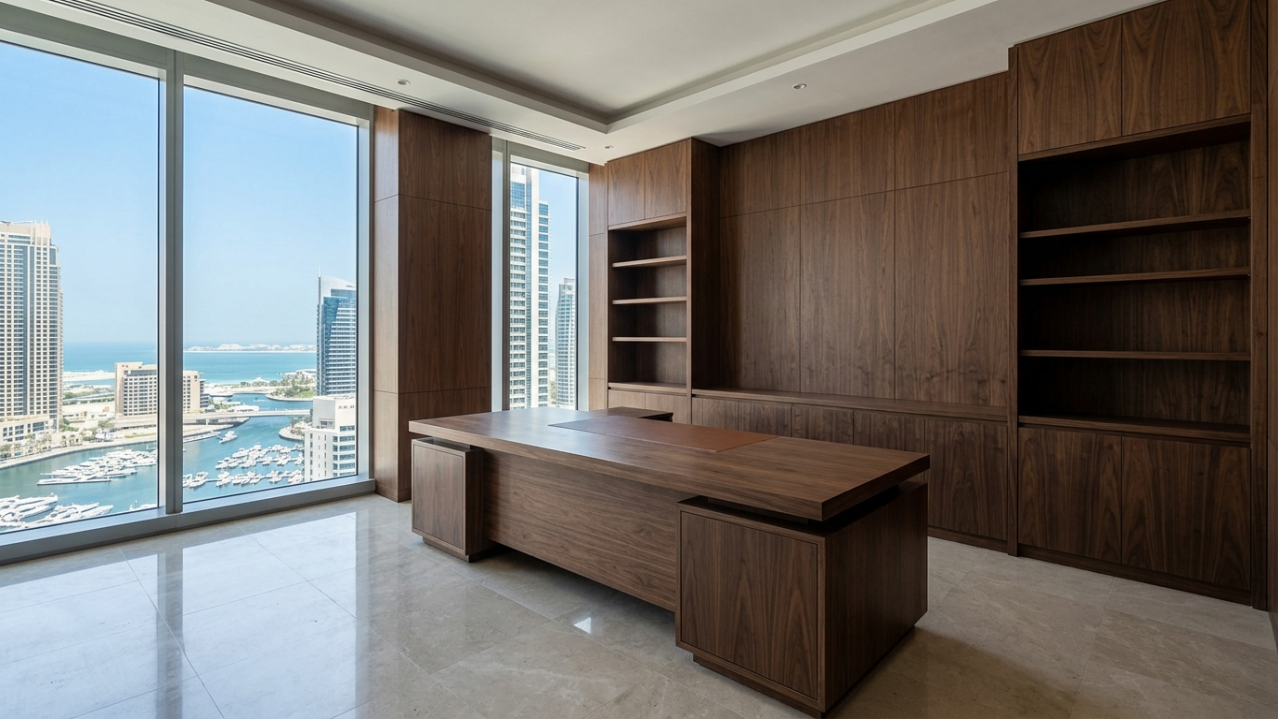
Commercial joinery in an occupied office building is subject to daily use and periodic damage. Chairs roll into desk panels. Moving people drag storage units. Doors are opened hundreds of times a day. We offer post-handover support contracts for commercial clients that cover periodic inspection, minor repairs, hardware adjustment, and touch-up of surfaces showing wear. This is not a standard offering in the carpentry market — it reflects our view that the relationship with a commercial client should last as long as the office does, not end at handover.
Why UAE Businesses Choose Karnak Carpentry for Office Fit-Out Carpentry
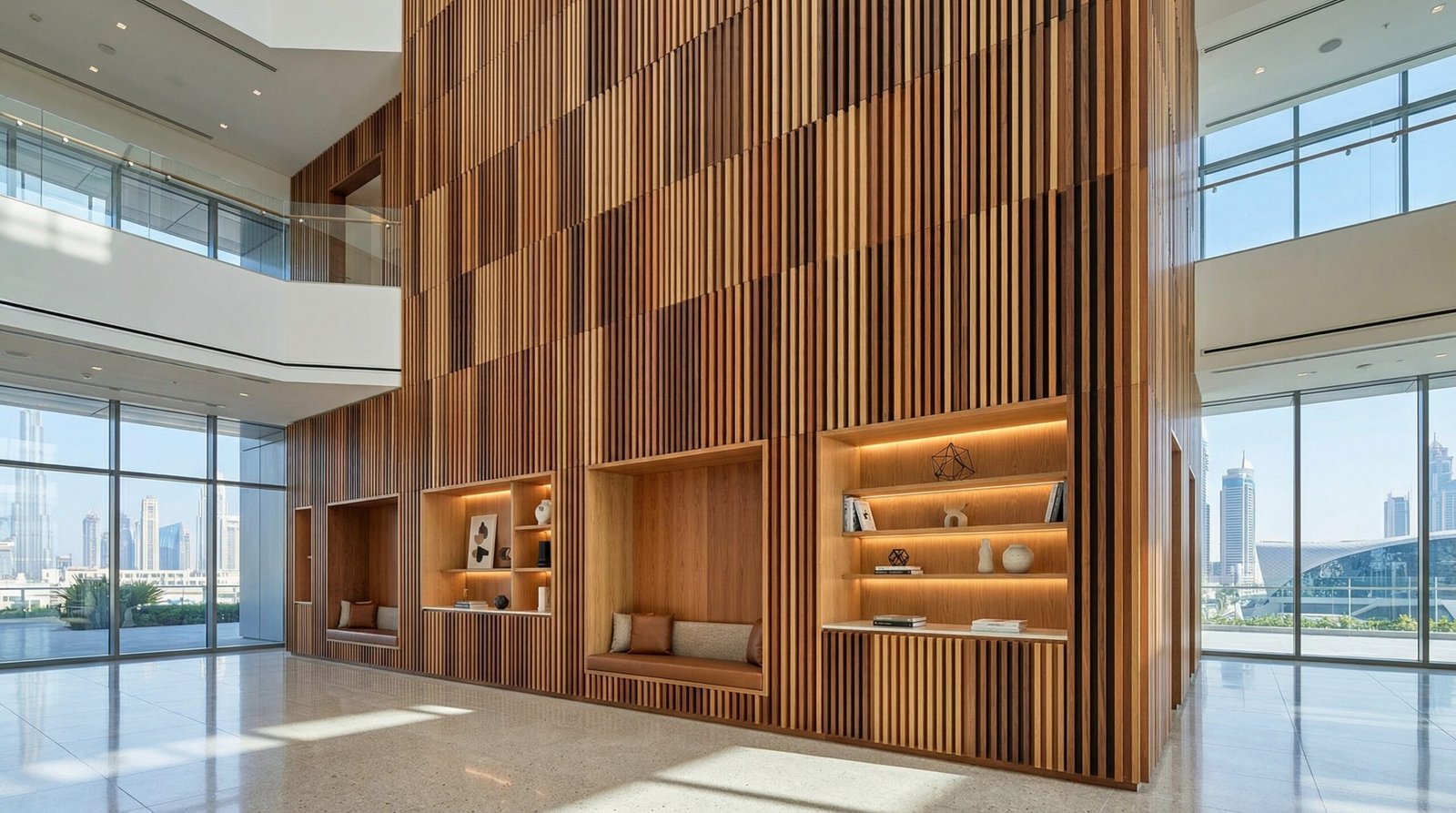
Choosing a carpentry Office fit-out contractor Dubai for a commercial fit-out is a decision with consequences that will be visible and functional for five to fifteen years. The factors that matter most are rarely those that are easiest to compare in a quotation document.
Thirty-Five Years of UAE Commercial Experience
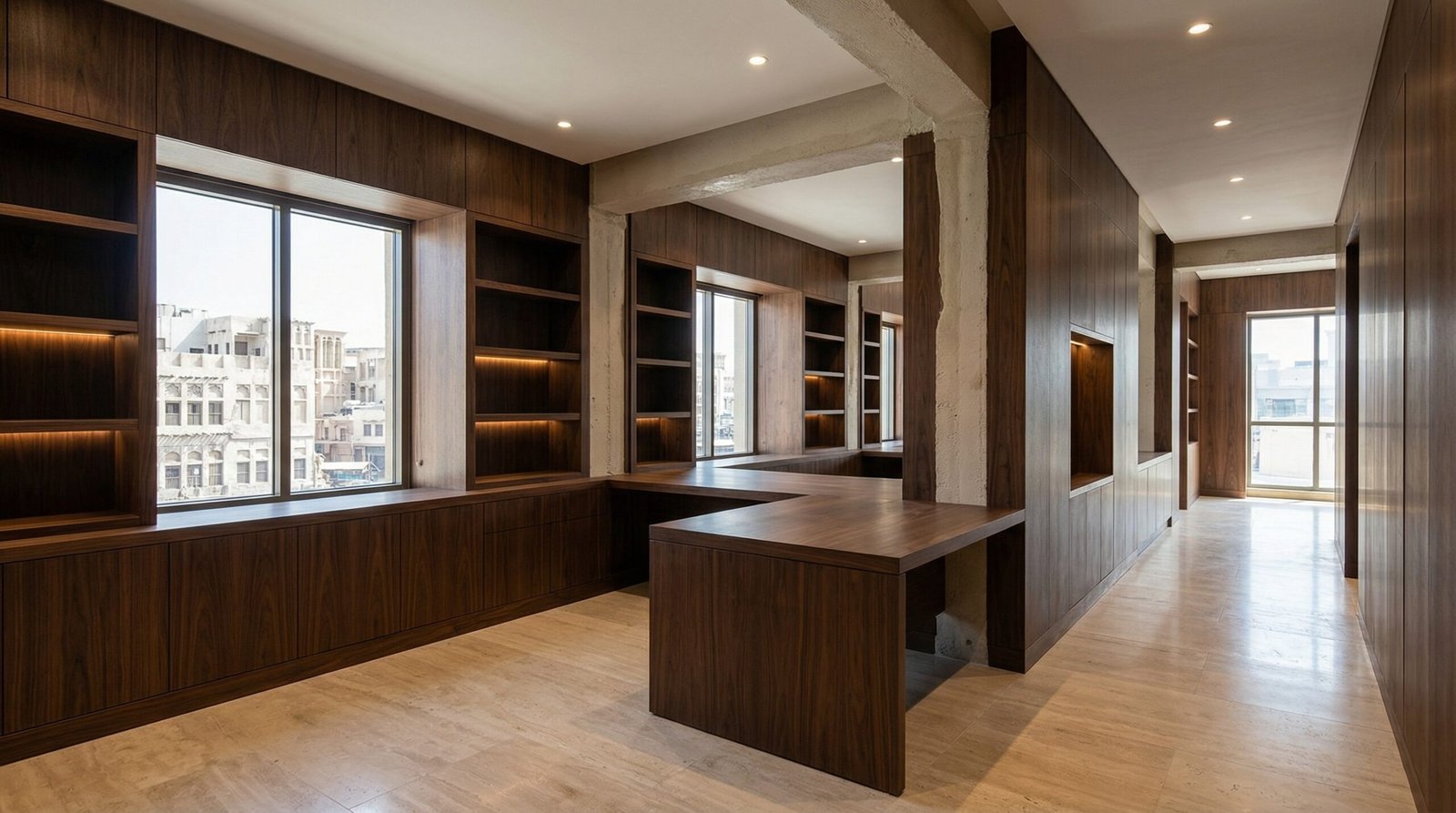
Since 1988, Karnak Carpentry has been building commercial office interiors across the UAE. This isn’t a credential we repeat because we have nothing else to say — it’s relevant because commercial joinery in the UAE has specific requirements that take years to learn properly. We’ve navigated Dubai Municipality building requirements for commercial fit-outs through multiple regulatory revisions. We know which developers in DIFC, Business Bay, and Downtown Dubai have the most stringent fit-out approval processes and how to prepare documentation that sails through rather than cycling back with comments. We know which material specifications will and won’t satisfy the fire rating requirements in high-rise commercial buildings.
This specific, accumulated knowledge is what you’re buying when you appoint Karnak Carpentry. It’s not easily replicated and it doesn’t show up in a quotation comparison.
In-House Workshop Fabrication
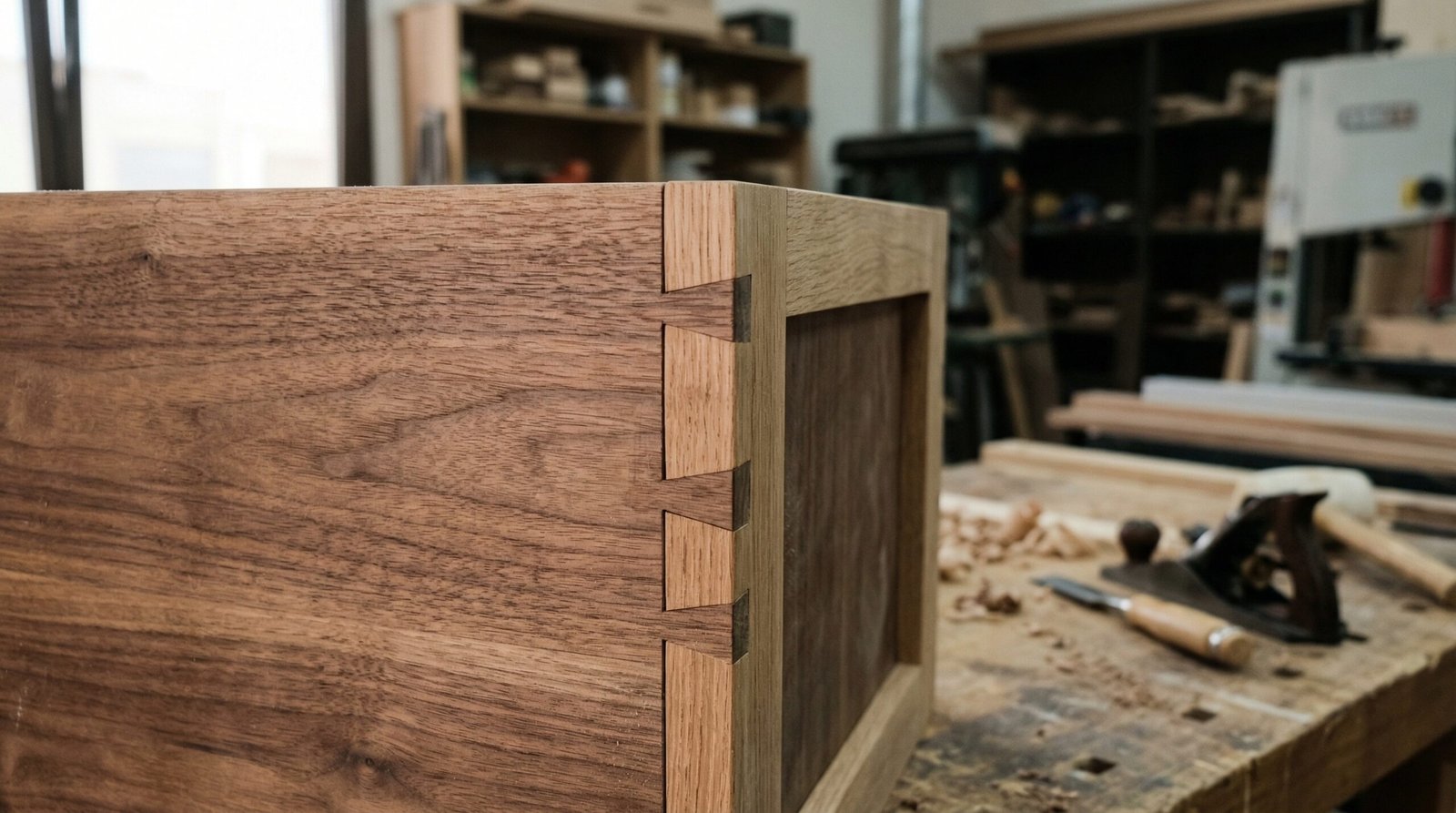
Our Dubai workshop is a genuine competitive advantage. Contractors who don’t have their own workshop are dependent on third-party fabricators, which means they have less control over quality, less flexibility to respond to design changes, and less ability to absorb the inevitable modifications that arise during an active commercial fit-out.
Our workshop holds current work-in-progress for multiple projects simultaneously. When a design change is requested — and changes are requested on every significant project — we can respond in days rather than going back to an external fabricator and waiting in their queue. This responsiveness is not an added service. It’s the baseline of how we operate.
Project Management Standards
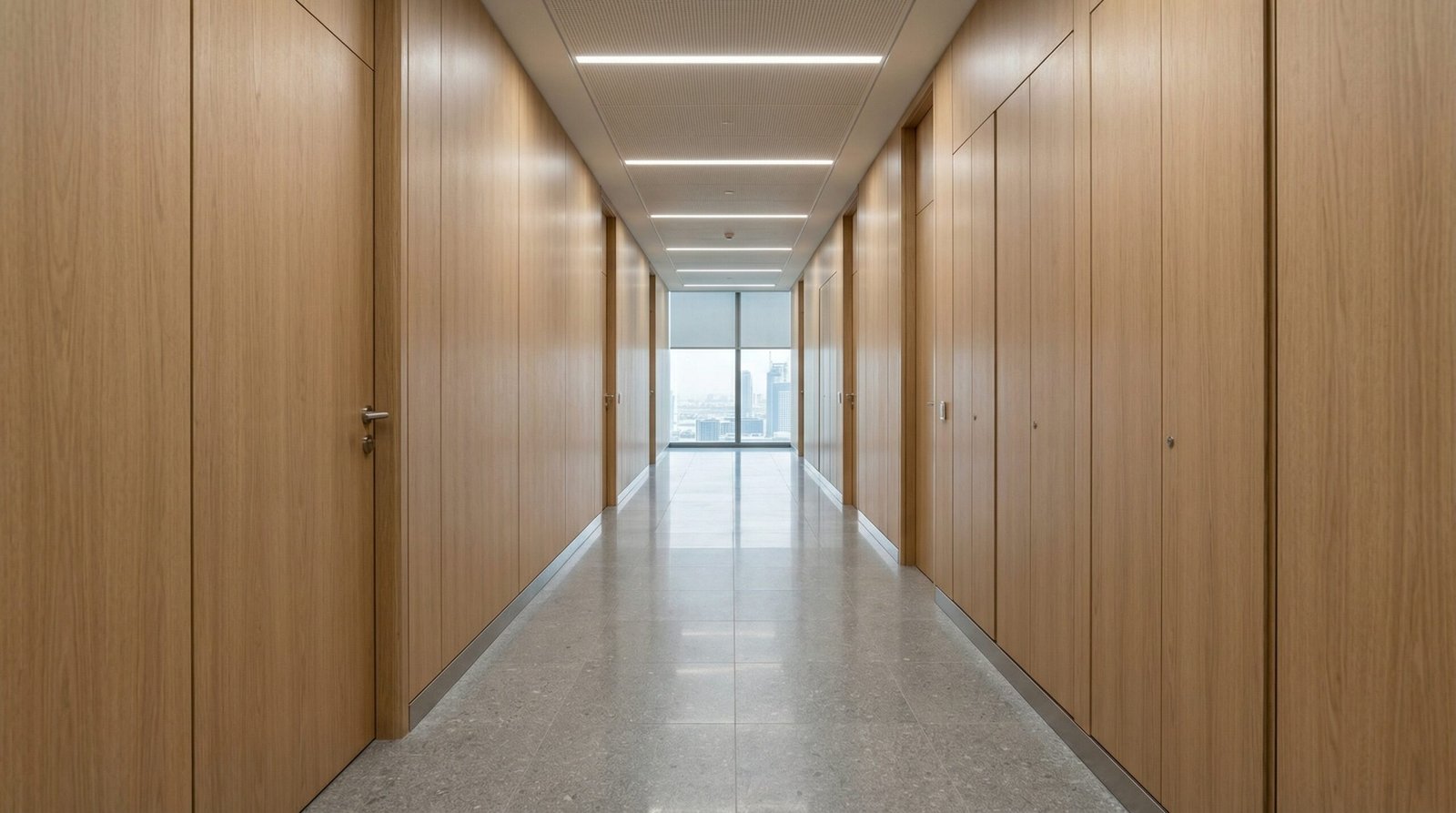
Commercial fit-outs fail more often because of coordination and scheduling failures than because of craftsmanship failures. The carpentry work can be excellent but arrive in the wrong sequence, or be installed before the preceding trades are complete, or miss the critical path in ways that cascade through the programme. Our project management approach treats the fit-out schedule as a living document, updated daily, shared with all relevant parties, and actively managed rather than passively monitored.
We work within principal contractors’ programmes and alongside direct-appointment models — we’re experienced with both, and our project management adapts accordingly.
Warranty and Durability Standards
All Karnak Carpentry commercial joinery carries a 2-year workmanship warranty as standard, with extended warranty options available for major commercial clients on long-term support arrangements. But warranty periods are less important than the underlying quality standard that determines whether the warranty ever needs to be called upon. We build to a standard where warranty claims are genuinely rare — not because we avoid them procedurally, but because our fabrication quality makes them uncommon.
Design Capability and Collaboration
We work with client-appointed office interior designers, with design-and-build principal contractors, and directly with clients who don’t have a designer. In each context, our role is different. When working with an office interior designer, we translate their vision into buildable joinery with the technical rigour their drawings sometimes lack. When working without a designer, our in-house design capability — developed over decades of commercial project experience — fills that gap. In either case, the result is joinery that is both well-designed and correctly built.
Recent Office Fit-Out Carpentry Projects Across UAE
DIFC Tower — International Law Firm, Dubai
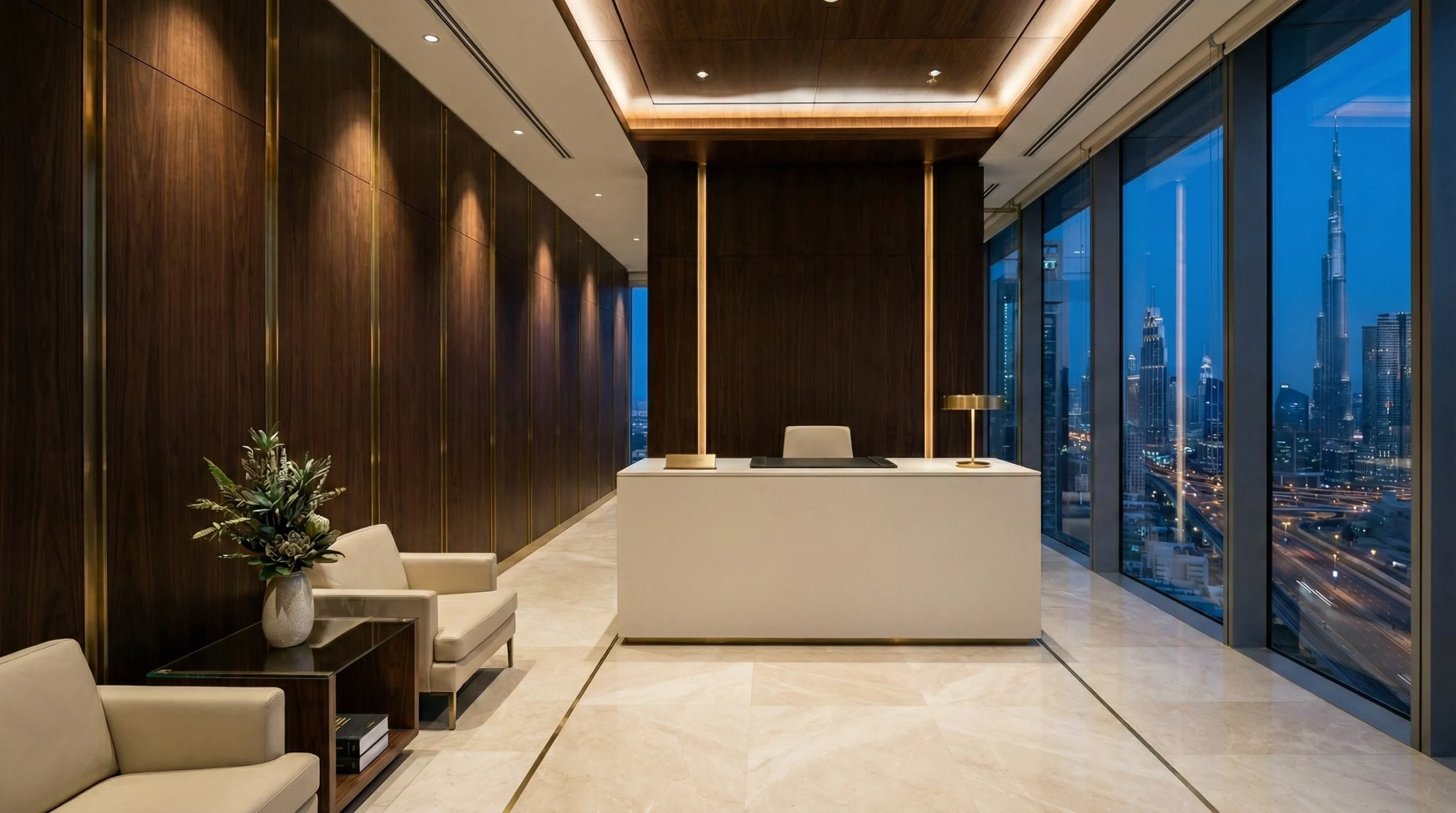
A global law firm expanding its Dubai office across two floors of a DIFC tower required a fit-out that reflected its international standing while meeting the tower’s strict materials and fire rating requirements. We delivered a complete joinery package covering 1,200 square metres: full-height walnut veneer reception wall with integrated brass lettering, curved reception desk in cream lacquer and stone, 18-seat boardroom with floor-to-ceiling panelling and integrated AV, 12 individual meeting rooms with coordinated credenzas and acoustic panelling, partner offices with bespoke fitted storage and leather-detailed desk systems, and an open-plan workstation environment for 120 staff. Programme: 14 weeks from drawing approval to handover.
Business Bay Headquarters — Regional Technology Company
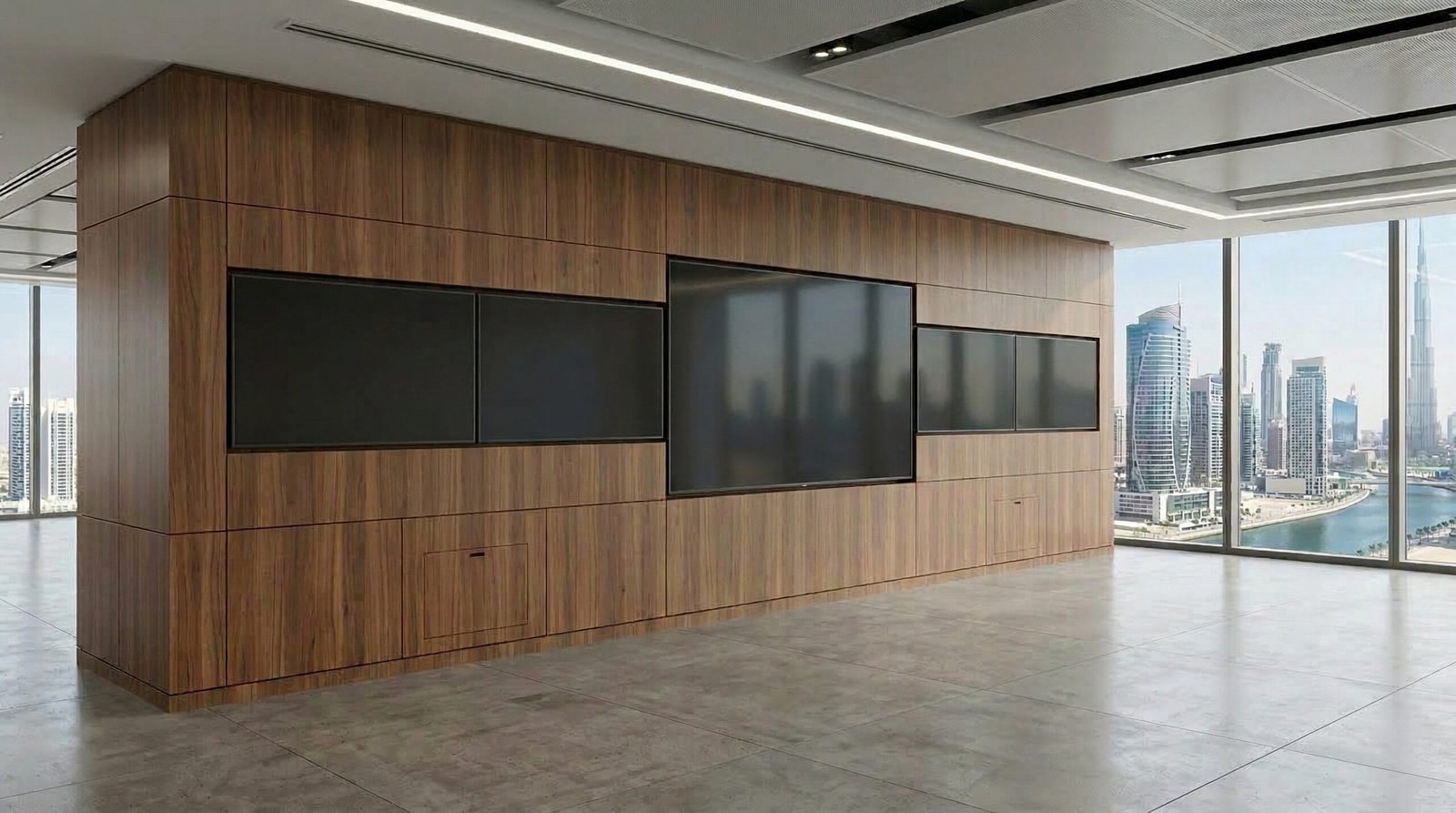
A regional technology company relocating its headquarters to Business Bay required a fit-out that expressed its identity as a modern, innovative organisation without the cold minimalism that technology environments sometimes default to. We designed and built a reception environment with a custom curved desk in white lacquer with an illuminated undercarriage, a feature wall of CNC-routed geometric panels in graduated tones, and a 14-seat boardroom with fully retractable acoustic partitioning integrated into the ceiling. Total joinery area: 850 square metres. Programme: 10 weeks.
Downtown Dubai — Financial Services Firm
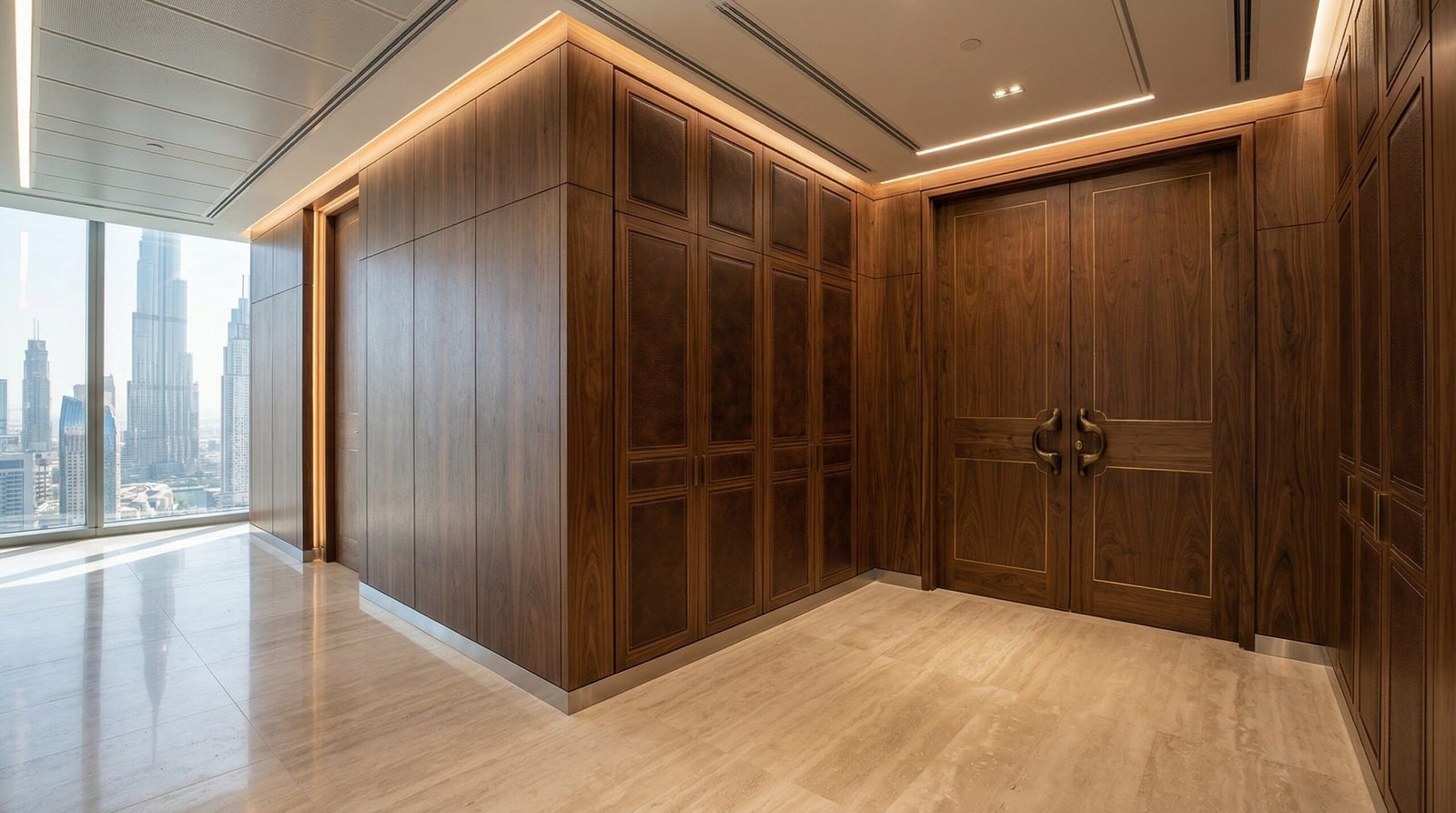
This 600-square-metre office fit-out for a financial services company in Downtown Dubai had an unusual brief: the client wanted their carpentry to feel more like a premium private home than a typical financial services office. We delivered against this by using a residential specification of materials — solid American oak flooring transitioned from the lobby through all carpentry pieces, solid timber door frames throughout, and hand-finished lacquer panels in the meeting rooms. The result is a space that consistently draws comment from clients and visitors, and that won a mention in a regional office interior design publication.
Abu Dhabi — Government Entity Fit-Out, Al Reem Island
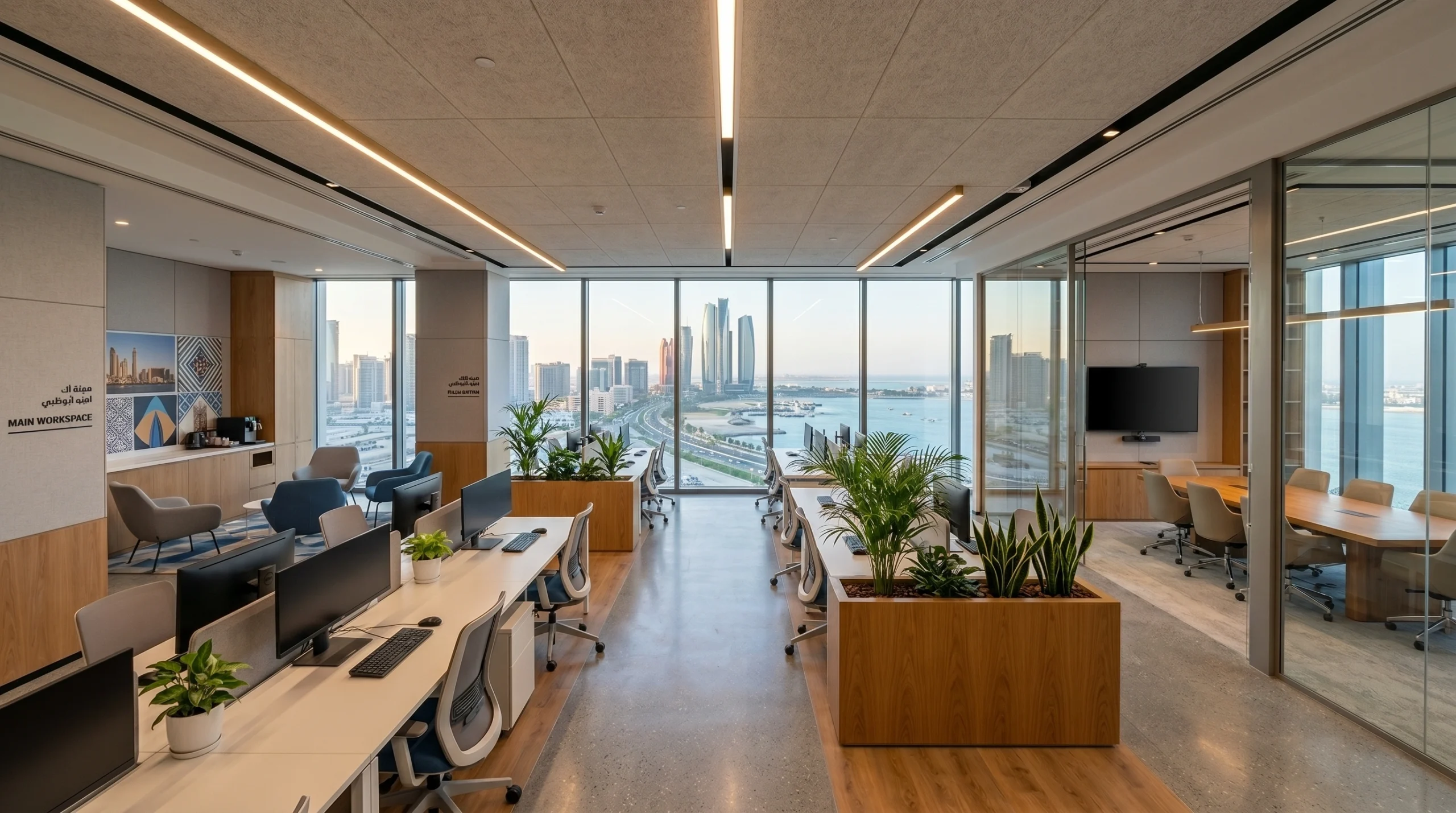
A federal government entity establishing a new operations centre on Al Reem Island required a large-scale carpentry package across 2,400 square metres of office space. The specification included Arabic design elements integrated into the reception and VIP meeting room joinery — specifically mashrabiya-inspired screen panels and geometric pattern inlay work that referenced traditional Islamic geometric art. We worked with the client’s design team to develop these elements from concept through to fabricated pieces, which now form the design centrepiece of the facility.
Dubai Marina — Professional Services Firm, 4 Floors
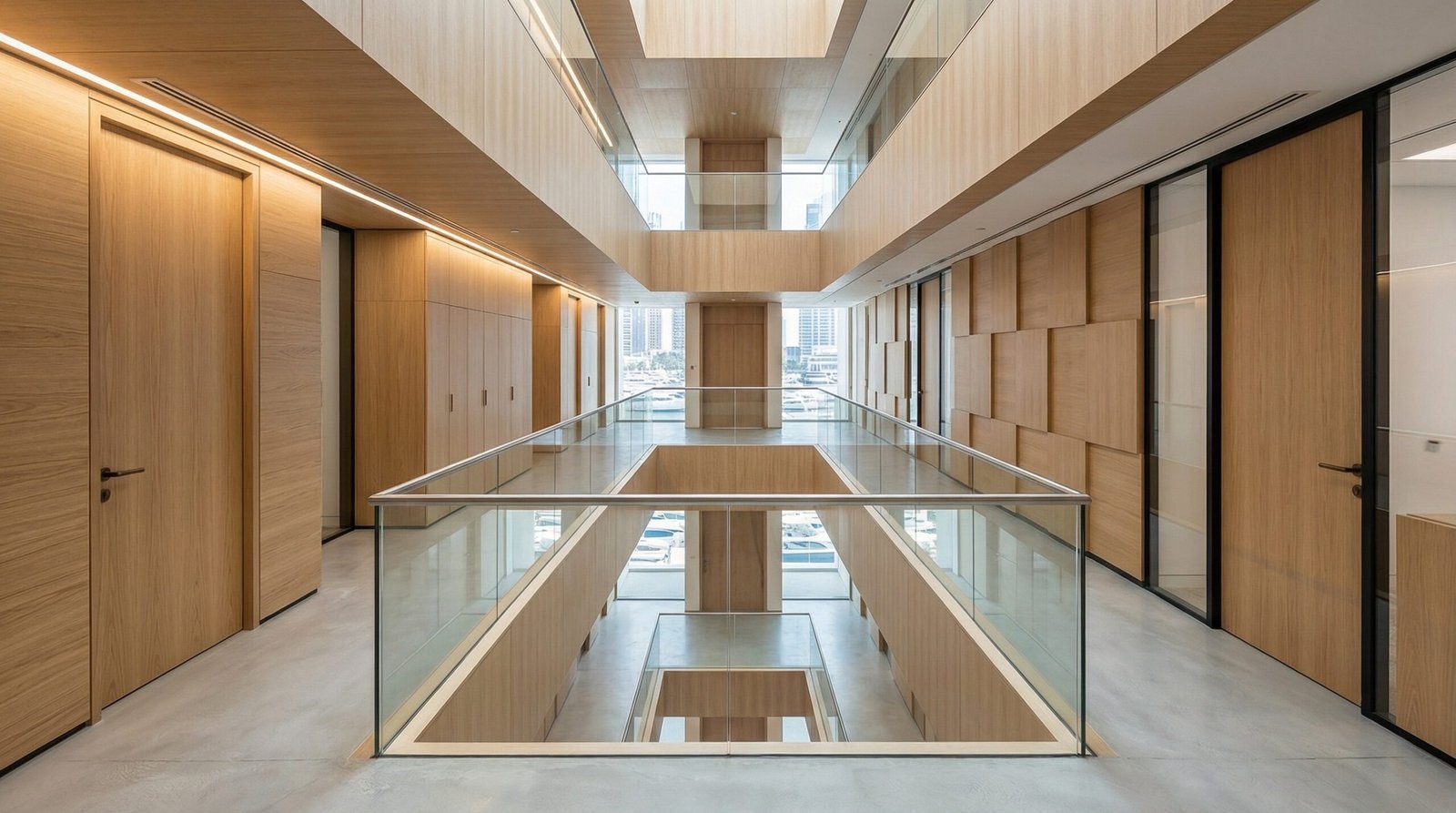
Perhaps our most complex Marina project: a professional services firm occupying four full floors of a Marina tower, requiring consistent carpentry aesthetic treatment across 3,100 square metres while accommodating the different spatial configurations of each floor. The project involved 62 individual enclosed offices, a full trading room workstation installation for 80 positions, a senior partners’ lounge with hotel-quality joinery finishes, and four separate reception areas at each floor level. Total programme from first survey to final handover: 22 weeks.
Sharjah — Healthcare Administration Office, University City
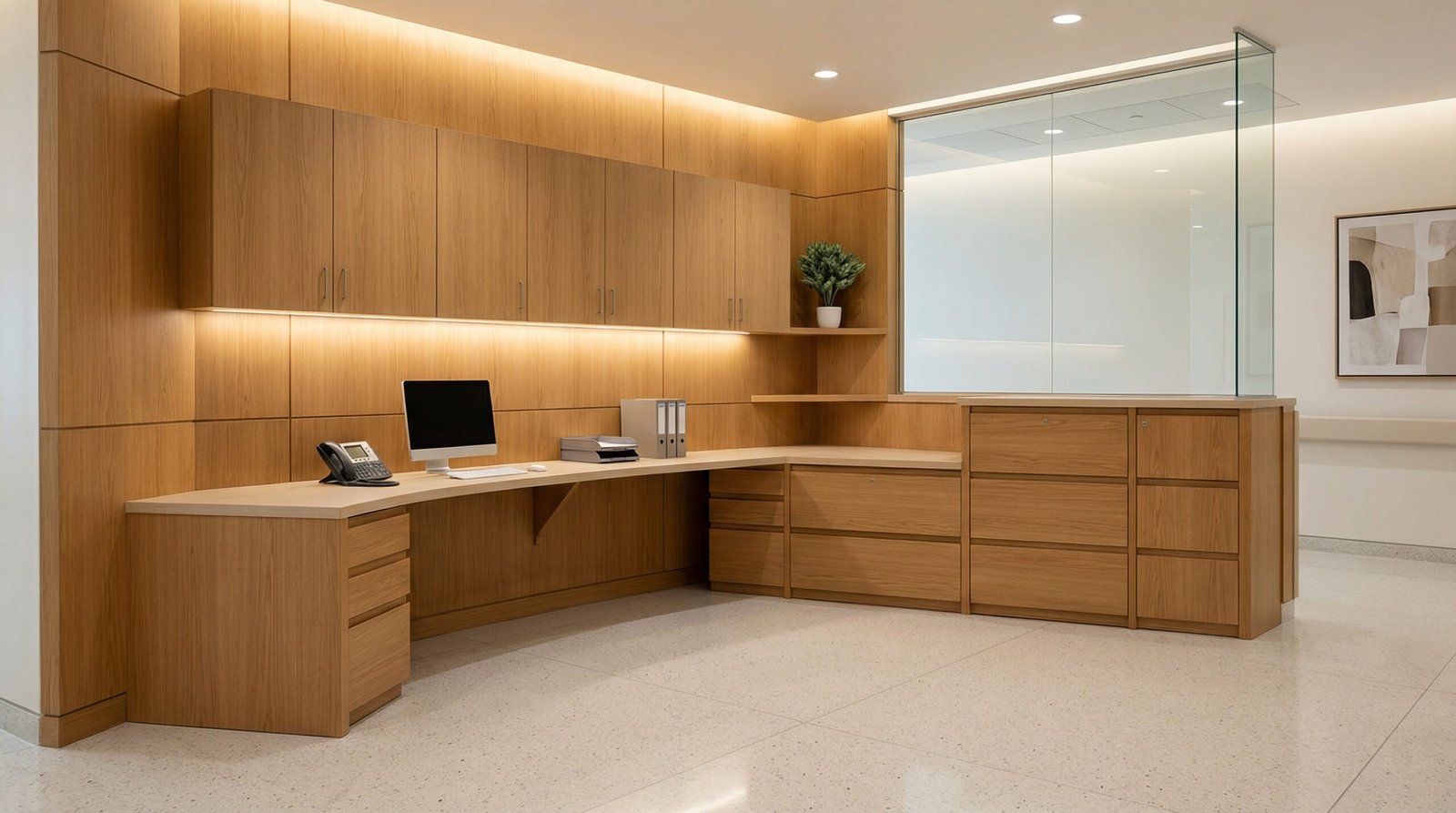
Commercial fit-out carpentry extends beyond Dubai, and we’ve built significant projects throughout Sharjah, including this healthcare administration facility in University City. The 700-square-metre fit-out had specific hygiene requirements for joinery surfaces in clinical administrative areas — sealed edge details to prevent bacterial ingress, non-porous laminate finishes throughout, and concealed storage for medical documentation with secure locking systems. Delivered within a 9-week programme while the adjacent clinical facility remained operational.
RAK — Hospitality Group Headquarters
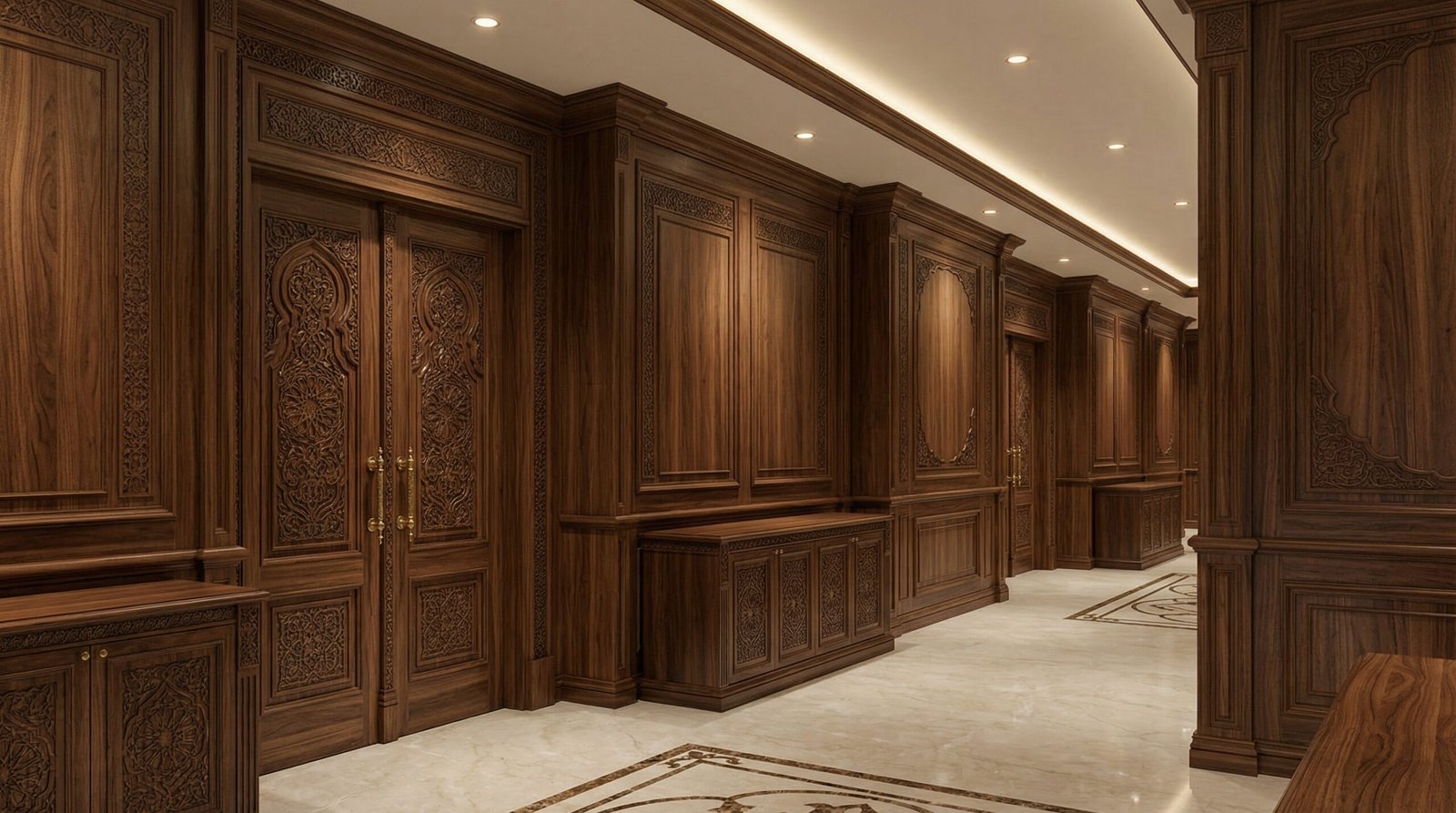
A major Ras Al Khaimah hospitality group consolidating its corporate offices into a new headquarters facility required carpentry that reflected the hospitality aesthetic their brands represent. We delivered a boardroom and executive suite package in which the joinery quality and material specification would not look out of place in one of their five-star properties — solid timber veneer in a custom bronze-stained ash finish, integrated minibar and display cabinet units in the executive lounge, and a CEO office with bespoke built-in furniture including a custom partner desk in American black walnut.
Office Fit-Out Carpentry Questions — Expert Answers
Office fit-out carpentry costs in Dubai vary enormously depending on scope, specification, and the level of customisation involved. As a rough framework that reflects real project experience: budget commercial carpentry using standard HPL finishes and MDF construction typically runs from AED 180 to AED 350 per square metre of fitted space. Mid-range specification — engineered veneer, better hardware, more custom geometry — runs from AED 350 to AED 650. Premium specification with solid timber elements, stone integration, specialist finishes, and high complexity typically starts at AED 650 and has no upper limit for exceptional projects.
These are fit-out carpentry costs, not total fit-out costs. Carpentry is one element alongside flooring, ceilings, partitions, MEP, AV, and furniture. What we can say from experience is that investing in quality carpentry specification typically returns its value in durability — a fit-out that lasts 12 years rather than 7 represents a significant real cost saving even if it costs 20 to 30 percent more at outset.
The best way to understand what your specific project will cost is a proper scope and specification review. We provide this consultation at no charge.
Timeline depends almost entirely on the scale and complexity of the joinery package, the quality of design information available at the start, and the coordination environment of the overall fit-out. For a typical Karnak commercial project:
Design review and workshop drawing production takes 1 to 3 weeks depending on complexity. Material procurement runs concurrently with design finalisation for standard materials, though specialist materials may add lead time. Workshop fabrication for a medium-scale office fit-out (500 to 1,000 square metres) typically runs 3 to 5 weeks. Site installation depends on site access and trade sequencing — typically 2 to 4 weeks for this scale. Finishing and handover adds 1 to 2 weeks.
A well-managed medium-scale project therefore runs 8 to 14 weeks from drawing approval. Larger projects scale proportionately. Rush programmes are possible but add cost — the workshop capacity and site manpower required to compress a programme significantly are real expenses.
No — we work in multiple configurations. Many of our direct commercial clients come to us without a designer appointed, and we bring in-house design capability to these projects. We produce concept elevations, material boards, and full design intent drawings, and we manage the design process through to workshop drawing stage.
For clients who have an interior designer appointed, we work as their preferred joinery contractor, taking their design intent and translating it into fabrication-ready drawings. In this context, our role is to make the designer's vision buildable while protecting the client's interests on quality and programme.
For clients who are working through a principal fit-out contractor, we operate as a specialist joinery subcontractor — this is a common model in DIFC and Business Bay where the building developer or leasing agent specifies a principal contractor, and specialist trades are appointed directly or nominated by the client.
Commercial fit-outs in Dubai require approval from Dubai Municipality and, in some zones, from the relevant free zone authority — DIFC, DAFZA, JAFZA, and others each have their own additional approval layer. The primary concern for joinery is fire rating: materials used in commercial spaces in Dubai must comply with UAE fire safety regulations, which specify minimum fire resistance requirements for materials used within certain distances of means of escape and in common areas.
This means that not all joinery materials are permitted in all locations. MDF and timber veneer products used in commercial fit-outs typically need to be tested to BS 476 Part 7 Class 1 or equivalent, and fire-retardant treatment may be required for certain applications. We've navigated this regulatory environment for decades and specify compliant materials as standard — it should never be an afterthought.
Matching existing joinery is a specialist skill that requires careful assessment of the original specification — or, when that documentation doesn't exist, physical sampling and analysis. We do this regularly for clients expanding or partially refurbishing existing offices that we either fitted originally or that were built by other contractors.
The process involves taking physical samples of veneers, lacquers, and hardware where possible, analysing construction methods on existing pieces to understand how the new work needs to connect structurally, and producing test pieces for client approval before full fabrication begins. Perfect matching isn't always achievable — veneers age and change colour, lacquer formulations change, hardware gets discontinued — but close matching that passes casual inspection is almost always achievable with the right process.
The UAE climate creates challenges for office joinery that aren't immediately obvious but have significant implications. The primary issue is the combination of high ambient humidity in some coastal areas and the very low internal humidity that aggressively air-conditioned offices create. Wood-based products move in response to moisture content changes — when that range is large and cyclical, products that aren't properly specified and constructed will move enough to cause problems: veneer lifting, paint cracking at joints, swelling or shrinking that causes doors and drawers to bind or gap.
We address this through material selection — MR-grade substrates, properly stabilised veneers, species selection that considers movement coefficients for solid timber applications — and through construction detailing that allows for controlled movement rather than restraining it until something fails. The specification decisions that prevent these problems add perhaps five to eight percent to material costs and are entirely invisible in a new fit-out. They're very visible three years later when a correctly specified office still looks new and an incorrectly specified one doesn't.
All Karnak commercial joinery carries a 2-year workmanship warranty covering defects arising from fabrication or installation. This covers joint failures, veneer adhesion issues, hardware failures attributable to incorrect fitting, and dimensional problems that affect function.
The warranty excludes damage from misuse, impact damage, water ingress from building defects, and fair wear and tear. It also excludes situations where the client or their other contractors have modified, repaired, or worked adjacent to the joinery after handover in ways that have caused damage.
Beyond the formal warranty period, we maintain records of material specifications for all projects so that matching repairs and replacements are possible years after the original installation. For clients who want structured ongoing support, we offer annual maintenance agreements that cover inspection, minor repairs, and hardware adjustments.
Carpentry and joinery is our core expertise, and it's what we do best. We don't offer full fit-out management — we're not a principal contractor. We work within the fit-out process as specialist joinery contractors, which is the right model: you want your joinery done by specialists, not as a line item within a general contractor's package.
That said, we have established relationships with reputable principal fit-out contractors across Dubai and the wider UAE, and we're happy to recommend suitable contractors for clients who need a full fit-out solution and are at the stage of assembling their project team.
Sustainable office certifications are increasingly common in Dubai's commercial market, particularly for multinationals and financial services firms whose parent companies have global sustainability commitments. The joinery implications for LEED certification primarily relate to materials — specifically low-VOC adhesives and finishes, FSC-certified timber and board products, and materials that contribute to recycled content targets.
We've managed the materials documentation process for multiple LEED projects, producing the material data sheets, certification documentation, and Environmental Product Declarations that the certification process requires. WELL certification adds further requirements around VOC emissions from interior finishes — we specify compliant materials and can provide the testing data to support certification submissions.
We cover all areas of Dubai and all seven Emirates. For Dubai specifically, we're experienced in all the major commercial districts: DIFC, Business Bay, Downtown Dubai, Dubai Marina, JLT, Dubai Internet City, Dubai Media City, Deira, Bur Dubai, Al Quoz industrial area, Dubai Silicon Oasis, and all other commercial zones. We're fully familiar with the specific approvals processes and developer requirements in DIFC and Business Bay, which have the most complex regulatory environments for fit-outs.
The honest answer depends on the specific comparison. For workstations and storage in standard configurations, well-specified modular furniture from good manufacturers can be competitive with custom joinery on quality and cost. For anything that needs to fit a non-standard space, express a brand, function in a specific way, or last significantly longer than typical commercial furniture, custom joinery wins on every measure.
The premium for custom over modular is typically 15 to 35 percent depending on complexity. Against that, custom joinery is built to your space exactly, your specification exactly, and your timeline. It also typically carries better longevity — we build to furniture standards, not to the shorter replacement cycles that commercial furniture manufacturers sometimes design for.
The most useful starting point for a quote is a site visit and scope discussion — we need to understand what you're trying to achieve, see the space you're working with, and understand any constraints around timeline, specification, or integration with other trades. From this, we can produce a detailed indicative estimate.
For projects that have design drawings available, we can often produce a preliminary estimate from drawings review before visiting site. Contact our commercial team directly to discuss your project — we aim to provide a first response within 24 hours and can typically arrange a site visit within 48 hours of initial contact.
Yes, and we do regularly. Working in live environments requires careful scheduling, appropriate containment of dust and noise, coordination with building management for deliveries and working hours, and clear communication with the client about what areas will be affected and when. We have extensive experience working in occupied commercial buildings, particularly for phased fit-outs and refurbishments where the business cannot vacate.
The constraints of working in occupied offices add time and cost to installation — typically 20 to 30 percent additional programme and site management overhead compared to vacant-building work. We're transparent about this in our quotations so clients can make informed decisions about phasing.
Commercial buildings in Dubai are governed by Dubai Civil Defence fire safety requirements, which specify material classes for different building and application types. For most office environments, joinery materials in circulation spaces and near fire exits must achieve at minimum Class 1 fire spread performance under BS 476 Part 7, or equivalent under EU or NFPA standards depending on which the building's design is based on.
Practically, this means that standard untreated MDF and timber veneers may need fire-retardant treatment, or that treated versions of these materials need to be specified. It also means that certain materials — some plastics, certain composite products — cannot be used in these applications regardless of aesthetics. We specify compliant materials as standard and can provide material fire rating certification for all products used in commercial projects.
Both, and both at full quality. Our design service for commercial clients covers initial concept development, material and finish specification, detailed design drawings, and coordination with other design disciplines. This is provided in-house by our project design team, which includes experienced commercial interior design professionals.
For clients with their own designer, we operate in pure fabrication and installation mode — or in a hybrid mode where we provide technical design support that makes the designer's concept buildable. The model depends on what the project needs, and we adapt accordingly.
Office Fit-Out Carpentry Service Coverage Across UAE
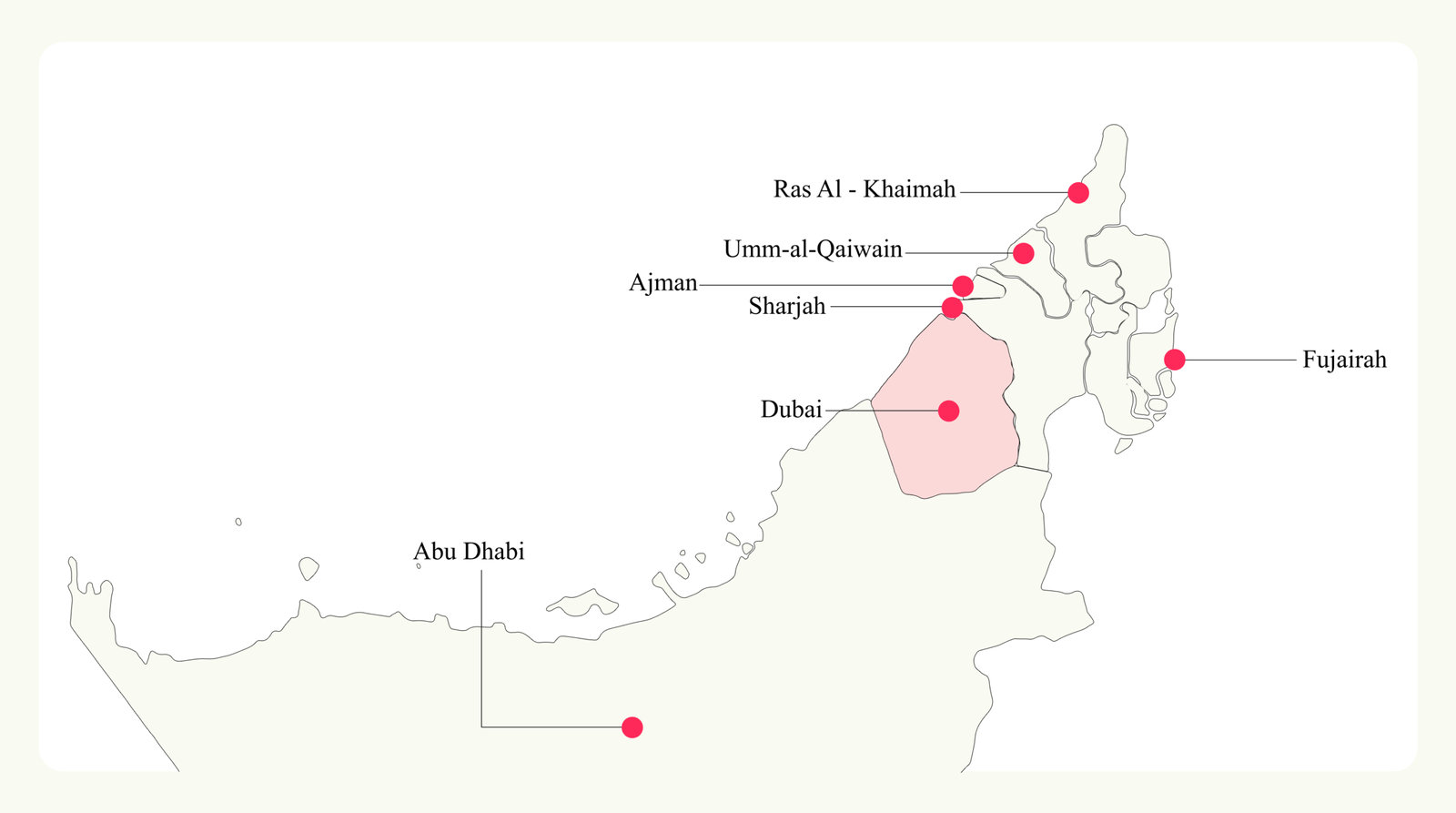
Our commercial joinery teams serve all seven Emirates with consistent quality standards, project management rigour, and the same in-house workshop fabrication process. All projects, regardless of location, are designed and fabricated in our Dubai workshop, with installation managed by our own employed teams.
Dubai: We deliver office fit-out carpentry across every commercial district in Dubai — DIFC, Business Bay, Downtown Dubai, Dubai Marina, Jumeirah Lake Towers, Dubai Internet City, Dubai Media City, Tecom, Dubai Silicon Oasis, Dubai World Trade Centre, Al Quoz, Bur Dubai, Deira, Port Saeed, and all other commercial and mixed-use areas. We’re familiar with the fit-out approval requirements of all major Dubai commercial developers and free zone authorities.
Abu Dhabi: Our Abu Dhabi commercial joinery work covers Al Reem Island, Al Maryah Island, the ADGM financial centre, Khalidiyah, Corniche Road commercial properties, Al Wahda, Hamdan Street, Khalifa City, and all other commercial areas of the capital. Abu Dhabi government entity fit-outs are a specific area of experience for us.
Sharjah, Ajman, Ras Al Khaimah, Fujairah, and Umm Al Quwain: We serve commercial clients across all Northern Emirates, with regular active projects in Sharjah’s industrial and commercial areas, Ras Al Khaimah’s growing hospitality and commercial sector, and Fujairah’s port and logistics corporate environments.
Start Your Office Fit-Out Carpentry Project
The first step is a conversation — about your space, your timeline, your aspirations for what the finished office needs to do. There’s no commitment involved and no fee for the consultation. What there is, is 35 years of commercial fit-out carpentry experience that we bring to every project discussion, including yours.
We typically arrange initial site visits within 48 hours of first contact and produce preliminary cost indications within 5 working days of a full scope discussion. Whatever stage your project is at — early planning, active design, or ready to appoint — we can engage usefully.
IF YOU HAVE ANY QUESTION? WE ARE GLAD TO
CONSULT YOU AS SOON AS POSSIBLE
Get Started
Immediate assistance from our team regarding your project details.
Form Submitted!
Thank you for contacting us. Our team will get back to you within 24 to 48 hours regarding your query.
Contact us on WhatsApp for Quick Response