
Blog
What Must a Carpentry Contract in Dubai Legally Include? A Complete Checklist


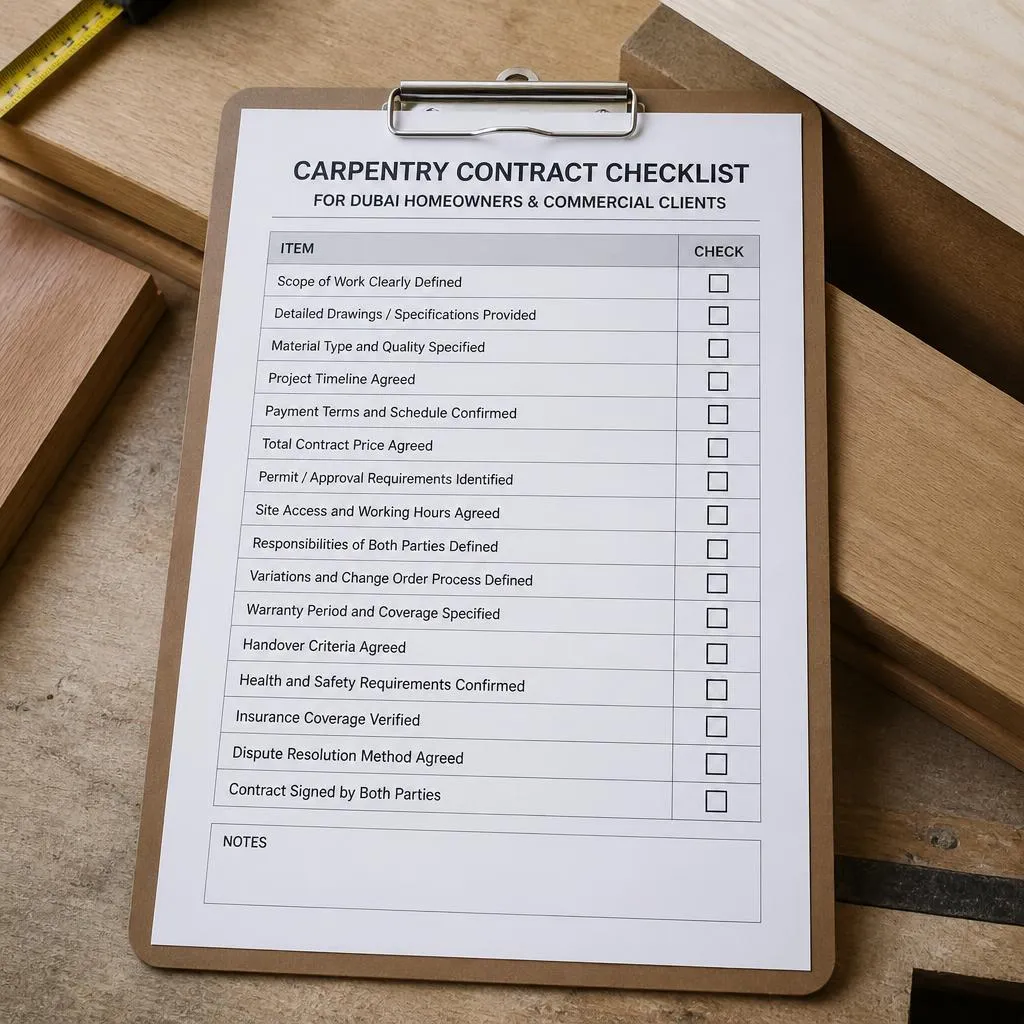
,
Dubai’s interior fit-out and carpentry market is one of the most active in the world. Thousands of residential and commercial projects launch every month across the emirate and the wider UAE. Villas in Arabian Ranches get fully refitted. Offices in DIFC and Business Bay undergo complete interior transformations. Hotels on Sheikh Zayed Road refresh their lobbies and guest rooms. Retail spaces across Dubai Mall and City Walk change their fit-out between seasons. Behind every one of these projects, there should be a carefully written, legally sound contract that protects both the client and the contractor from the moment work begins to the moment the final invoice is settled. Carefully should be this carpentry contract Dubai legal checklist made.
To navigate this fast-paced market safely, many villa owners turn to trusted local fit-out specialists like Karnak Home to ensure compliance with Dubai’s strict community developer standards. Yet homeowners, villa owners, developers, and commercial clients across the UAE consistently make one of the most common and costly mistakes: starting a carpentry or joinery project with nothing more than a verbal agreement, a WhatsApp message, or a one-page quotation that lists a total price without any supporting terms. When things go well, these informal arrangements hold together.
However, because the harsh Gulf climate places unique engineering demands on timber structures
Referencing structural guidelines from established building science platforms like Fine Homebuilding can help you define mandatory material tolerances in your written agreements. Furthermore, studying international projects on architectural networks like ArchDaily can help you outline clear, high-specification benchmarks for your contractor. Solidifying these details in writing before work begins is the only reliable way to ensure a flawless execution that lasts for years
When things go wrong and in a busy, high-pressure market like Dubai’s, things do go wrong—the absence of a proper contract leaves clients with no legal footing and no practical recourse. Even when dealing with residential properties or developments under the broader oversight of authorities like the Dubai Land Department, resolving civil or financial disputes over poorly executed woodwork becomes nearly impossible without a comprehensive, signed contract to prove your case.
Why a Written Carpentry Contract Is Non-Negotiable in Dubai
In any market, written contracts are preferable to verbal agreements. In Dubai specifically, a written contract is not just preferable. It is the only instrument that gives you meaningful legal protection under UAE civil and commercial law. The UAE legal system, governed by Federal Law and emirate-level regulations, recognizes written agreements as the primary evidence of contractual intent. Without a written document, proving the terms of any disputed agreement becomes extremely difficult, time-consuming, and expensive.
The carpentry and fit-out industry in Dubai involves significant financial commitments. Even a modest residential project covering a kitchen and two bedrooms can run to tens of thousands of dirhams. A full villa fit-out or a commercial office installation can reach hundreds of thousands. At these values, relying on anything less than a comprehensive written contract is a serious financial risk that no informed client should accept.
The Legal Framework Governing Construction Contracts in the UAE
Carpentry and joinery contracts in the UAE fall primarily under the provisions of the UAE Civil Code, specifically Federal Law No. 5 of 1985 and its subsequent amendments, which govern contracts for works and services. These provisions establish the core obligations of both parties, set out the general principles of contract formation, and define the remedies available when either party fails to perform.
For commercial fit-out projects, additional regulations may apply depending on the nature of the building, the emirate in which the work is carried out, and the regulatory authority overseeing the development. Projects in free zones such as DIFC and ADGM may fall under different legal frameworks with their own dispute resolution mechanisms. Any contract for fit-out work in these zones should reflect the specific governing law applicable to that jurisdiction.
For clients commissioning residential carpentry for villas and apartments, the Consumer Protection Law adds a further layer of rights that govern quality standards, warranty obligations, and the supplier’s duty of disclosure. Understanding that these legal frameworks exist, even at a general level, helps you recognize why every term in your carpentry contract matters and why vague language in any clause creates exploitable gaps.
What Happens When You Rely on a Verbal Agreement
The consequences of proceeding with a carpentry project on a verbal agreement alone are well documented across Dubai’s property and legal communities. Contractors claim they were never asked to deliver a specific finish or use a specific material. Clients insist a completion date was promised that the contractor now denies. Payments are made against no clear milestone structure, leaving clients with partially complete work and no contractual leverage to compel completion. Change orders, material upgrades, and scope additions get added without written approval and appear as surprise charges on the final invoice.
In each of these scenarios, the client who relied on a verbal agreement has little practical recourse. UAE courts will hear the evidence of both parties, but without written documentation, the outcome is unpredictable and the legal costs of pursuing a dispute often exceed the value of the claim itself. A properly written carpentry contract eliminates every one of these vulnerabilities before the project starts.
Checklist Item 1: Full Identification of Both Parties
The first and most basic requirement of any legally enforceable carpentry contract in Dubai is clear, complete identification of both parties to the agreement. This sounds obvious, but it is surprising how often contracts in the fit-out market circulate with incomplete or inconsistent party information that creates ambiguity about who is actually bound by the terms.
What Business and Personal Details Must Appear in the Contract
For the carpentry contractor, the contract must include the full registered legal name of the business exactly as it appears on the trade license, the trade license number, the issuing authority, the registered business address, and the name and title of the authorized signatory who is executing the agreement on the company’s behalf. If the company operates under a brand name that differs from its registered legal name, both names should appear.
For the client, the contract must include the full legal name of the individual or entity commissioning the work, the Emirates ID number for individual clients, the company registration number for corporate clients, the contact address, and details of any representative acting on the client’s behalf such as a project manager, interior designer, or facility manager.
Getting these details right at the outset matters for a straightforward reason. If a dispute arises and legal action becomes necessary, the contract is the document that identifies who is suing whom. Incomplete party identification creates procedural complications that delay and complicate any legal process. For large projects such as office fit out carpentry Abu Dhabi assignments or full residential villa fit-outs, ensuring that the contracting entity on both sides is precisely and correctly identified is a basic but critical first step.
Checklist Item 2: A Detailed Scope of Work
The scope of work is the most operationally critical section of any carpentry contract. It is the section that defines exactly what the contractor has agreed to deliver, and it is the section most likely to become a source of dispute if it is written vaguely, incompletely, or in terms that either party can interpret differently.
How to Describe Carpentry Work Precisely Enough to Be Legally Useful
A well-drafted scope of work for a carpentry project in Dubai does not say things like “supply and install kitchen cabinets” or “fit out office space with joinery.” It describes every element of the work with specificity. For a kitchen project, this means the number of upper and lower cabinet units, the exact dimensions of each unit, the board material and thickness, the door style and finish, the hardware brand and model, the edge banding specification, the worktop material, and the installation method. For an office fit-out, it means the number of workstations, the desk dimensions, the storage units included, the materials for each element, and the finishing details.
Scope Clauses for Residential and Commercial Projects
For residential carpentry covering wardrobe installation services UAE wide, the scope clause should specify the internal configuration of every wardrobe unit, including shelf positioning, hanging rail placement, drawer quantities, mirror panel inclusion, and internal lighting if applicable. Additionally custom furniture for villas Dubai projects, the scope should describe each piece individually, with drawings or sketches attached as a schedule to the contract where the design is complex.
For commercial carpentry contractors Dubai projects, the scope of work needs to address not just the aesthetic elements but also the functional and technical requirements. This includes cable management systems, access panel locations, fire-rated material zones, and any coordination requirements with other trades such as electrical, HVAC, and plumbing contractors working in the same space simultaneously.
For majlis furniture custom UAE builds, the scope must be especially detailed given the cultural and aesthetic significance of this space in UAE homes. The number of seating sections, the exact upholstery specification, the wood frame material, the decorative panel designs, and the finishing details all need to be captured in writing with sufficient precision that both parties share a single, unambiguous understanding of what will be delivered.
Checklist Item 3: Material Specifications and Product Standards
In any carpentry or joinery project, the materials used determine both the visual quality and the long-term durability of the finished work. In the UAE specifically, material selection carries additional weight because the extreme climate conditions, combining intense outdoor heat with aggressively air-conditioned interiors, place specific physical demands on every component installed.

Why UAE Climate Requirements Must Be Written Into the Contract
A carpentry contract in Dubai must specify materials not just by type but by grade, standard, and suitability for UAE conditions. Stating that a contractor will use MDF is insufficient. The contract should specify moisture-resistant MDF to a defined board density, from a named manufacturer or to a recognized standard such as EN 622. Stating that a contractor will install wood flooring is insufficient. The contract should specify heat resistant wood flooring UAE standards, whether the product is SPC, LVT, engineered hardwood, or parquet, the brand and product line, the thickness, the wear layer specification for commercial applications, and the installation method.
Specifying Heat Resistant and Moisture Resistant Materials
For air conditioned room joinery UAE applications, the contract should require that all solid wood components are kiln-dried to a moisture content appropriate for the UAE’s indoor climate and that all panel products carry moisture-resistant bonding. Additionally, for kitchen remodeling Dubai summer projects, where the combination of cooking heat and air conditioning creates particularly demanding conditions for cabinetry, the contract should specify marine-grade or moisture-resistant MDF for all cabinet carcasses and professionally sealed solid wood only for decorative elements where solid timber is required.
For home office desk carpentry Dubai builds, the material clause should cover the desktop surface material and its scratch and heat resistance rating, the carcass material for any storage units, the drawer runner specification including load rating and extension type, and the hardware finish to ensure visual consistency across the installation. Many clients also add tv unit custom dubai requirements in this section.
Getting material specifications into the contract in this level of detail serves a dual purpose. It ensures you receive exactly what you agreed to, and it gives you contractual grounds to reject any substitution a contractor might attempt to make during the project without your knowledge or consent.
Checklist Item 4: Pricing, Payment Schedule, and Change Order Terms
Every carpentry contract in Dubai must contain a clear, detailed pricing section that covers the total agreed contract value, the payment milestone structure, the process for handling changes to the agreed scope, and the terms for any cost variations that arise from factors outside the original agreement.
How Payment Milestones Should Be Structured for Fit-Out Projects
Tying Payments to Progress
Parties should always tie payment milestones for carpentry projects in Dubai to verified project events rather than calendar dates. A standard structure for a residential project typically requires an initial deposit of 30 to 40 percent upon contract signing to cover material procurement. The client then makes a second payment of 30 to 40 percent when the contractor delivers materials to the site or commences installation. Finally, the client releases a final payment of 20 to 30 percent upon practical completion and client sign-off. For larger commercial projects, standard practice dictates adding intermediate milestones tied to specific deliverables.
Protecting Yourself Against Mid-Project Cost Increases
The Power of the Change Order Clause
The change order clause serves as one of the most important protective mechanisms in any carpentry contract. This clause must state clearly that the contractor will not execute changes to the agreed scope, materials, or design without a written change order document signed by both parties before implementing the change. The change order document must describe the modification, state the additional or reduced cost, and confirm any revised timeline impact. Without this clause, clients face the risk of contractors adding work without agreement and presenting surprise charges on the final invoice, leaving the client with no contractual basis to dispute them.
For summer home renovation carpentry Dubai projects where clients travel and manage the project remotely, the change order process must explicitly outline how the parties will obtain and document approvals when the client is away from the site. Standard practice for these situations requires email confirmation tied to a written change order.
Checklist Item 5: Project Timeline and Completion Dates
A carpentry contract without a timeline represents an open-ended commitment with no accountability attached. Every contract for carpentry or fit-out work in Dubai must include a clearly defined project start date, key milestone dates for major deliverables, and a defined practical completion date by which the contractor must finish all work and present it for client sign-off.
How Milestone Dates and Delay Penalties Work in UAE Contracts
For complex projects, the timeline section must present a phased schedule that aligns with the project’s natural workflow. Factory production of custom elements typically runs two to four weeks ahead of site installation. Delivery and site preparation precede the main installation phase, while finishing, snagging, and touch-up work follow it. The contract must assign a defined date or date range to each of these phases.
Delay penalty clauses, also known as liquidated damages clauses in legal terminology, allow the client to claim a defined financial amount for each day or week that the contractor fails to achieve practical completion beyond the agreed date. These clauses are enforceable under UAE contract law provided they represent a genuine pre-estimate of the loss caused by the delay rather than a punitive figure designed to penalize the contractor.
Managing Summer Renovation Timelines in Dubai
For kitchen remodeling Dubai summer projects and other summer home renovation carpentry Dubai assignments, the timeline section should address the specific logistical realities of working in the UAE during July and August. Material deliveries may be slower. Some subcontractors operate with reduced teams. Site access in occupied buildings may be restricted during peak summer heat hours. A professional contractor will reflect these realities in a realistic timeline rather than presenting an optimistic schedule that they cannot actually achieve.
Checklist Item 6: Workmanship Warranty and Defects Liability Period
Every carpentry contract in Dubai must include a clearly defined workmanship warranty. This is not optional. It is a fundamental term that protects the client against defects in the contractor’s workmanship and against premature failure of installed elements during normal use.
What a Proper UAE Carpentry Warranty Must Cover
A properly drafted warranty clause in a Dubai carpentry contract should cover structural integrity of all installed joinery and furniture, including joints, fixings, and panel stability. It should cover the operation of all moving parts, including drawer runners, hinges, sliding door mechanisms, and soft-close systems. It should cover the integrity of all surface finishes, including lacquer, veneer, laminate, and paint. And it should cover the performance of all flooring installations, including the bond between flooring and substrate and the integrity of all expansion joints and threshold details.
Warranty Periods for Different Project Types
For standard residential carpentry covering wardrobe installation services UAE projects, a one-year workmanship warranty is the industry minimum. Additionally, for bespoke custom furniture for villas Dubai builds and high-specification commercial fit-outs, two years is increasingly standard among professional contractors. Heat resistant wood flooring UAE installations, the warranty should address both the product warranty provided by the manufacturer and the separate installation warranty provided by the contractor, as these cover different categories of potential failure.
The warranty clause must also define the process for raising a defect claim, the contractor’s obligation to inspect the reported defect within a defined timeframe, and the contractor’s obligation to remedy confirmed defects within a defined period at no cost to the client.

Checklist Item 7: Insurance and Liability Coverage
Any professional carpentry contractor working in Dubai must carry appropriate insurance coverage for their operations, and the client should require evidence of that insurance as a condition of the contract. Insurance protection in a carpentry or fit-out context covers several distinct categories of potential loss.
What Insurance a Carpentry Contractor Must Carry in Dubai
Public liability insurance protects against claims arising from damage to third-party property or injury to third parties caused by the contractor’s operations on site. For work carried out in occupied buildings, whether a residential apartment block or a commercial office tower, this coverage is essential. An uninsured contractor who damages a neighboring apartment, a building’s common area, or a third party’s property during the course of your project creates a liability that falls back on you as the party who engaged them.
The Role of Contractor’s All-Risk Insurance
Contractor’s all-risk insurance covers accidental damage to the works themselves during the construction period. If someone accidentally damages a completed section of a fit-out before practical completion and handover, this insurance covers the remediation costs, eliminating any dispute over who bears the financial burden.
Protecting Your Property During Installation
Safeguarding Existing Finishes
For commercial carpentry contractors Dubai executing Dubai projects in occupied buildings, the contract must specify the contractor’s duty to protect existing finishes, fixtures, and fittings during the installation period. The agreement should explicitly require floor protection, wall protection, and dust control measures.
The liability section of the contract must state clearly that the contractor bears the sole obligation to repair or replace, at their own cost, any damage they cause to existing elements during the work.
Checklist Item 8: Dispute Resolution and Governing Law
Even well-managed projects between professional parties sometimes end in disagreement. A carpentry contract in Dubai must specify how disputes will be resolved and which legal jurisdiction and governing law will apply to the agreement. Without these clauses, a dispute defaults to the UAE courts under UAE law, which may or may not be the most efficient or appropriate resolution mechanism for your specific situation.
How Disputes Are Handled Under UAE Contract Law
For contracts governed by UAE law and executed in Dubai, disputes between parties are typically subject to the jurisdiction of the Dubai Courts unless the parties have agreed to an alternative mechanism. The Dubai Courts operate in Arabic, which means that English-language contracts and supporting documents must be translated before proceedings commence. This adds both cost and time to any dispute process.
Arbitration vs Court Proceedings for Fit-Out Disputes in Dubai
Many professionally drafted carpentry and fit-out contracts in the UAE include an arbitration clause that routes disputes to an arbitration center such as the Dubai International Arbitration Centre or the Abu Dhabi Commercial Conciliation and Arbitration Centre. Arbitration offers several advantages over court proceedings for construction disputes, including faster resolution, the ability to appoint arbitrators with relevant technical expertise, and the option to conduct proceedings in English. For significant commercial projects, including office fit out carpentry Abu Dhabi assignments and large commercial carpentry contractors Dubai wide projects, an arbitration clause is strongly advisable.
Checklist Item 9: Termination Clauses and Exit Conditions
A well-drafted carpentry contract must define the conditions under which either party can terminate the agreement before practical completion, the process for effecting a termination, and the financial consequences for both parties if termination occurs.
When and How Either Party Can Exit a Carpentry Agreement
The Client’s Termination Rights
Clients should secure the right to terminate the contract for a material breach. This covers situations where the contractor fundamentally fails to perform, such as persistently missing milestone dates, using non-specified materials, or abandoning the site. The contract must specify a notice period for remediation, giving the contractor a final opportunity to correct the breach before the client exercises their right to exit.
The Contractor’s Termination Rights
Contractors typically retain termination rights if the client fails to make payments beyond a defined grace period. A contractor who does not receive payment at an agreed milestone holds the right to suspend works. Ultimately, they can terminate the contract if the client fails to pay within a defined cure period following a formal notice.
The Financial Settlement Process
The contract must clearly define the financial settlement process upon termination. The client must receive a refund for any payments made for uncompleted work. Conversely, the contractor must receive payment for all work properly completed up to the termination date, valued at the contract rate. The parties must submit any disputed elements to the dispute resolution mechanism defined elsewhere in the contract.
Checklist Item 10: Signatures, Stamps, and Document Authentication
A carpentry contract in Dubai is a legal document that requires proper execution to remain enforceable. Proper execution requires more than simply signing the final page.
What Makes a Carpentry Contract Legally Enforceable in the UAE
Both parties should initial every page of the contract to prevent later claims that someone substituted or added pages after signing. The signature page must display the full name, title, and signature date for each signatory. For corporate clients and licensed contractors, the company stamp or seal must appear alongside the authorized signature. If the signatory does not own or direct the business, you must attach a copy of the power of attorney or authorization letter granting them signing authority as a schedule.
Parties should execute at least two original contracts so that both the client and the contractor hold a signed original. For large-value projects, notarization by a UAE notary public adds a layer of authentication and simplifies the enforcement process if you must take legal action. You must physically attach and clearly reference all schedules, drawings, specifications, and other documents to eliminate ambiguity about which materials form part of the agreement.
How Karnak Carpentry Approaches Every Contract
Karnak Carpentry has operated in the UAE market for over 35 years and has completed more than 50,000 projects across residential, commercial, hospitality, and government categories. This depth of experience shapes a contracting process that protects clients at every stage and sets a standard reflecting the professionalism every client deserves.
Every Karnak project begins with a detailed written proposal that forms the foundation of the formal contract. The proposal itemizes the full scope of work with precise material specifications, product grades, hardware details, and installation methods. It establishes a clear payment milestone structure tied to verified project events rather than calendar dates. Finally, it outlines a defined project timeline with realistic milestones that account for factory production lead times, material delivery schedules, and site installation sequences.
For clients commissioning residential carpentry for villas and apartments
Karnak’s contracts cover wardrobe installation services UAE wide, kitchen cabinetry, living room joinery, bedroom furniture systems, and bathroom vanity units with the full specificity that protects clients from ambiguity. For clients sourcing custom furniture for villas Dubai or majlis furniture custom UAE interiors, the contract includes detailed design drawings attached as a schedule so that both parties share a single, precise reference for the finished product.
For commercial clients working with Karnak as commercial carpentry contractors
Dubai wide or sourcing office fit out carpentry Abu Dhabi expertise, contracts include commercial-grade material specifications, phased delivery schedules tied to business operational requirements, and clear protocols for managing change orders in environments where business continuity is critical.
The Karnak Warranty and Contract Process
Our Workmanship Warranty Commitments
Karnak documents a comprehensive workmanship warranty in every contract, covering structural integrity, hardware performance, and surface finish quality across all installed elements. We clearly define the warranty process by providing a named contact for defect claims, a strict inspection timeline, and a committed remediation period for confirmed warranty issues.
Executing Your Agreement Elegantly
Both parties execute every Karnak contract using full company stamps and authorized signatures on both copies, physically attaching and cross-referencing all schedules and drawings. Clients receive their signed original at the project commencement meeting, along with the project manager’s contact details and a confirmed project schedule.
For flooring projects
Including heat resistant wood flooring UAE installations covering SPC, LVT, engineered hardwood, parquet, and vinyl plank across residential and commercial spaces, Karnak’s contracts specify both the manufacturer’s product warranty and the Karnak installation warranty separately, so clients understand exactly what each warranty covers and how to exercise their rights under each.
For home office desk carpentry Dubai projects and air conditioned room joinery UAE installations where the intersection of aesthetics, function, and climate performance is critical, Karnak’s material specifications go beyond generic product descriptions to include specific board grades, surface finish standards, and hardware performance ratings appropriate for UAE indoor environments. They also specialize in tv unit custom dubai designs that integrate beautifully with modern interiors.
The Karnak approach to contracts is not simply about legal compliance. It reflects a 35-year commitment to transparent, professional relationships with every client, at every scale, across every category of carpentry and joinery work in the UAE.
Frequently Asked Questions
Is a verbal carpentry agreement legally binding in Dubai?
Under UAE law, verbal contracts can theoretically bind parties, but proving their terms during a dispute presents extreme difficulties. Without written documentation outlining the agreed scope, price, timeline, and materials, neither party has a reliable basis to establish the original agreement. In practice, verbal agreements for carpentry and fit-out work in Dubai offer the client almost no practical protection. Only a written contract gives you enforceable rights and clear remedies if anything goes wrong.
What happens if a carpentry contractor in Dubai uses different materials from those agreed?
When a contract specifies materials precisely, a contractor breaches UAE law if they substitute different materials without the client’s written approval. The client holds the right to force the contractor to remove the non-specified materials and replace them with the correct ones at the contractor’s expense. If the contractor refuses, the client can claim damages equivalent to the rectification costs through the UAE courts or arbitration, depending on the contract’s dispute resolution clause.
How long should a carpentry warranty last in the UAE?
Residential carpentry projects in Dubai typically carry a minimum one-year workmanship warranty. For bespoke custom furniture, commercial fit-outs, and high-specification joinery, two years represents the professional standard. Flooring installations carry a separate manufacturer’s product warranty ranging from five to twenty-five years, alongside a separate contractor installation warranty. You should document all warranty terms in the contract before work begins.
Can a carpentry contractor in Dubai increase the price after the contract is signed?
A contractor cannot unilaterally increase the price of work that the signed contract already covers. Price variations require the client’s approval through a signed change order document, or a specific price escalation clause in the contract tied to material cost indices. Any contractor who presents additional charges at completion without signed change orders breaches the original contract, giving the client the right to dispute those charges.
What should I do if a carpentry contractor abandons my project in Dubai?
If a contractor abandons a project before practical completion, you must first issue a formal written notice requiring their return to the site within a defined period. If they fail to comply, you can treat this action as a repudiation of the contract and engage a replacement contractor. You can then claim the additional completion costs and delay-related losses from the original contractor. To pursue this claim successfully, you must maintain thorough documentation, including photographs of the incomplete works and records of all payments.
What should a professional carpentry contract include?
A complete contract should clearly define the project scope, furniture specifications, materials, dimensions, pricing, payment schedule, project timeline, installation details, warranty, and responsibilities for both parties.
Why is a written contract important for custom carpentry projects?
A written agreement protects both the homeowner and the contractor by documenting every important detail before production begins. Clear documentation also reduces misunderstandings throughout the project.
Should the contract list every material?
Yes. The agreement should specify board types, wood species, veneer, laminates, edge banding, hardware brands, finishes, glass, mirrors, and every material used in the project.
Why should furniture dimensions appear in the contract?
Accurate dimensions define exactly what the contractor will manufacture and install. Detailed measurements also prevent disputes about size, layout, or storage capacity.
Contact Us Today:
- Email: info@karnakcarpentry.com
- Phone/WhatsApp: +971 52 555 4207