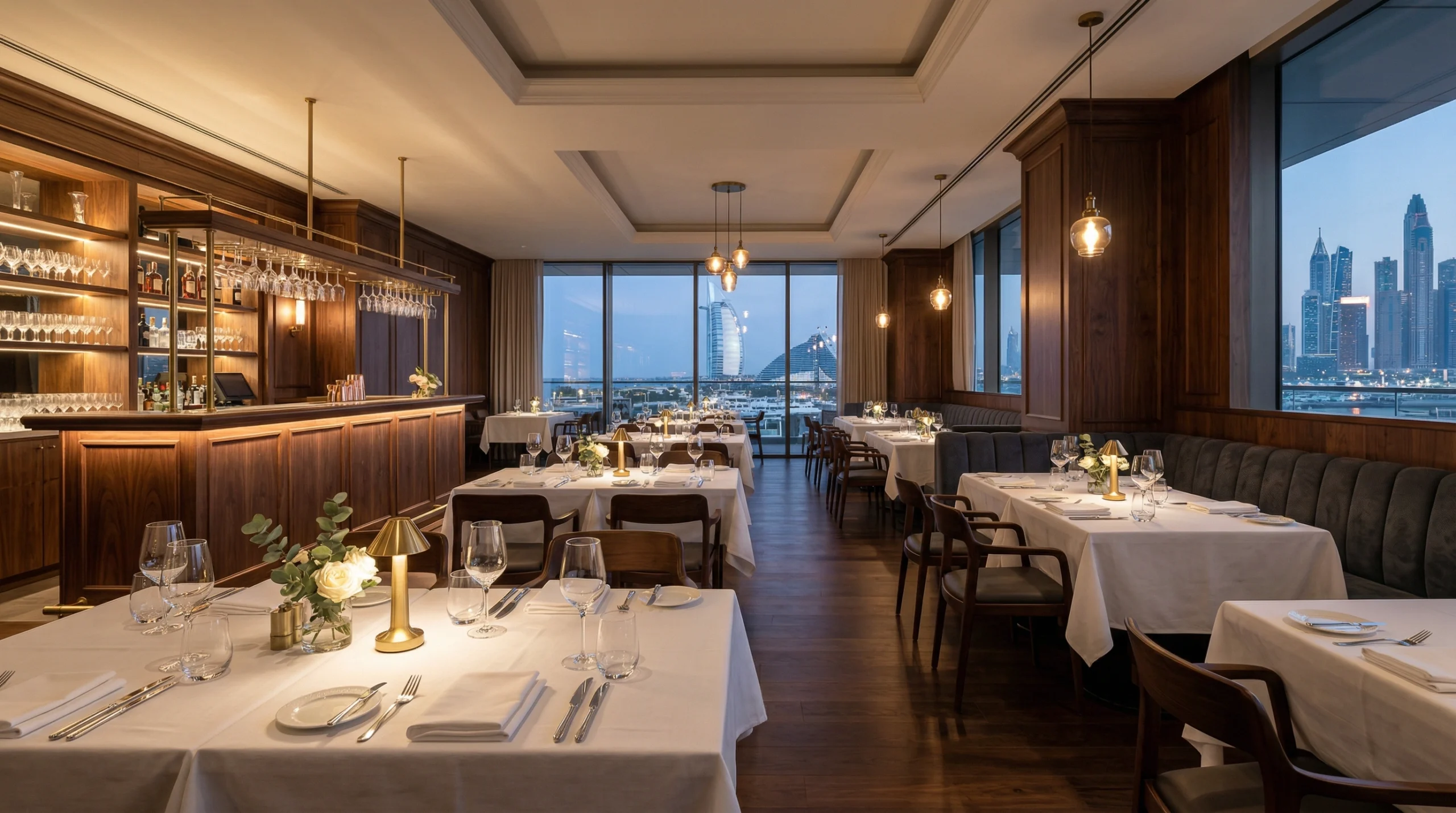
Restaurant & Cafe Carpentry Dubai: Custom Fit-Outs Built to Last
When you’re investing in a restaurant or cafe space, the carpentry either elevates your concept or quietly undermines it. Karnak has been making it elevate since 1988.
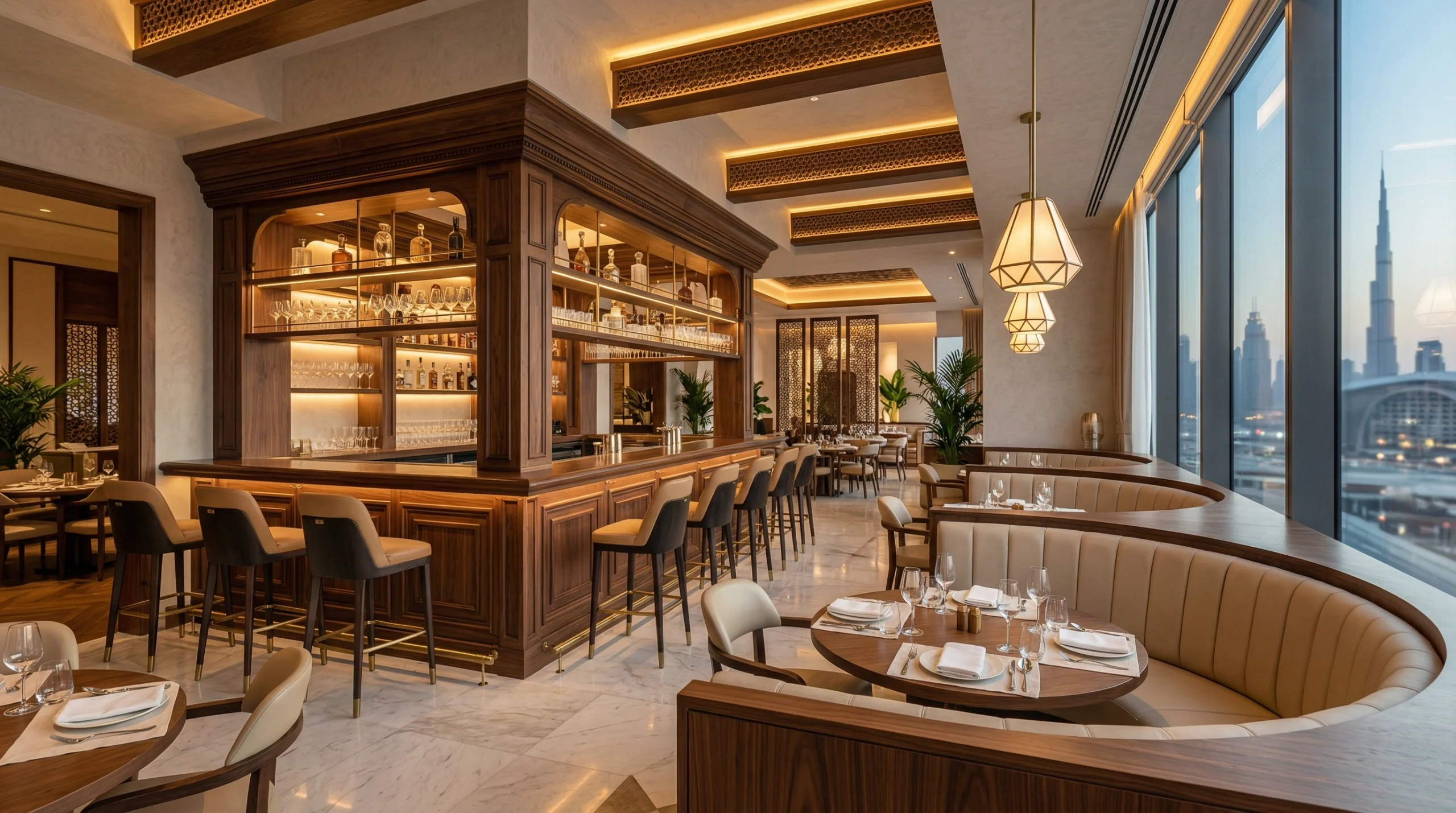
Restaurant carpentry in Dubai is a different discipline from residential joinery. The volumes are larger, the timelines tighter, the operating conditions more demanding, and the stakes — when you’re launching or renovating an F&B concept — considerably higher. Since 1988, Karnak Carpentry has delivered custom woodwork and full joinery fit-outs for restaurants, cafes, lounges, and hotel F&B venues across all seven emirates, completing over 10,000 projects that span everything from intimate 40-seat neighborhood cafes to flagship multi-level dining destinations in Dubai’s most competitive hospitality districts.
The UAE’s hospitality environment creates specific demands that most carpentry contractors simply aren’t equipped for. You’re working in a climate where kitchen areas routinely hit 45°C and humidity in coastal zones can push above 85% during summer. Furniture in a busy Dubai restaurant absorbs far more punishment per square meter than almost anywhere else in the world — continuous service, tight turnaround, aggressive cleaning chemicals, and the kind of daily foot traffic that would be considered exceptional back in Europe. Materials that perform beautifully in a show apartment can degrade in months under those conditions if the specification isn’t exactly right.
What we bring to restaurant carpentry that separates us from general contractors isn’t any single technique — it’s the accumulated judgment from 35 years and several thousand hospitality projects. We know which MDF grades hold up under commercial kitchen steam and which ones delaminate within a season. We know how to engineer banquette frames so they don’t rack under the weight of heavy daily use. We know the Dubai Municipality documentation requirements for commercial fit-outs, and we can work alongside your fit-out contractor or lead the carpentry scope independently. That depth of experience changes outcomes.
What Restaurant Carpentry in UAE Actually Requires
Most restaurant owners come to us with a design concept, a mood board, and a deadline. Translating those into executed woodwork involves navigating a set of requirements that are specific to hospitality environments and specific to operating in the UAE.
Commercial-Grade Material Specification
The word “commercial grade” gets used loosely. For us, it has a precise meaning: materials and construction methods engineered to perform under the conditions your specific venue will face, for a defined operational lifespan.
In restaurant carpentry, that typically means moisture-resistant MDF or marine-grade plywood for any substrate near service areas, steam, or cleaning. Solid timber selections need to account for UAE temperature cycling — a species that’s dimensionally stable in a temperate European workshop can exhibit significant movement in a Dubai environment where air conditioning turns off overnight in empty spaces, and interior temperatures swing 15–20°C between service and non-operating hours. We specify timber with this in mind, selecting species and drying grades that maintain stability under those conditions.
Laminates and veneers for hospitality need to meet abrasion and impact standards significantly above residential requirements. The same applies to hardware — hinges, drawer slides, door closers, and locks in a high-volume restaurant are opened, closed, and handled thousands of times per week. We spec commercial-grade hardware from Blum, Hettich, and Häfele at minimum, and upgrade further depending on volume and environment.
Compliance with Dubai Municipality and Local Authority Requirements
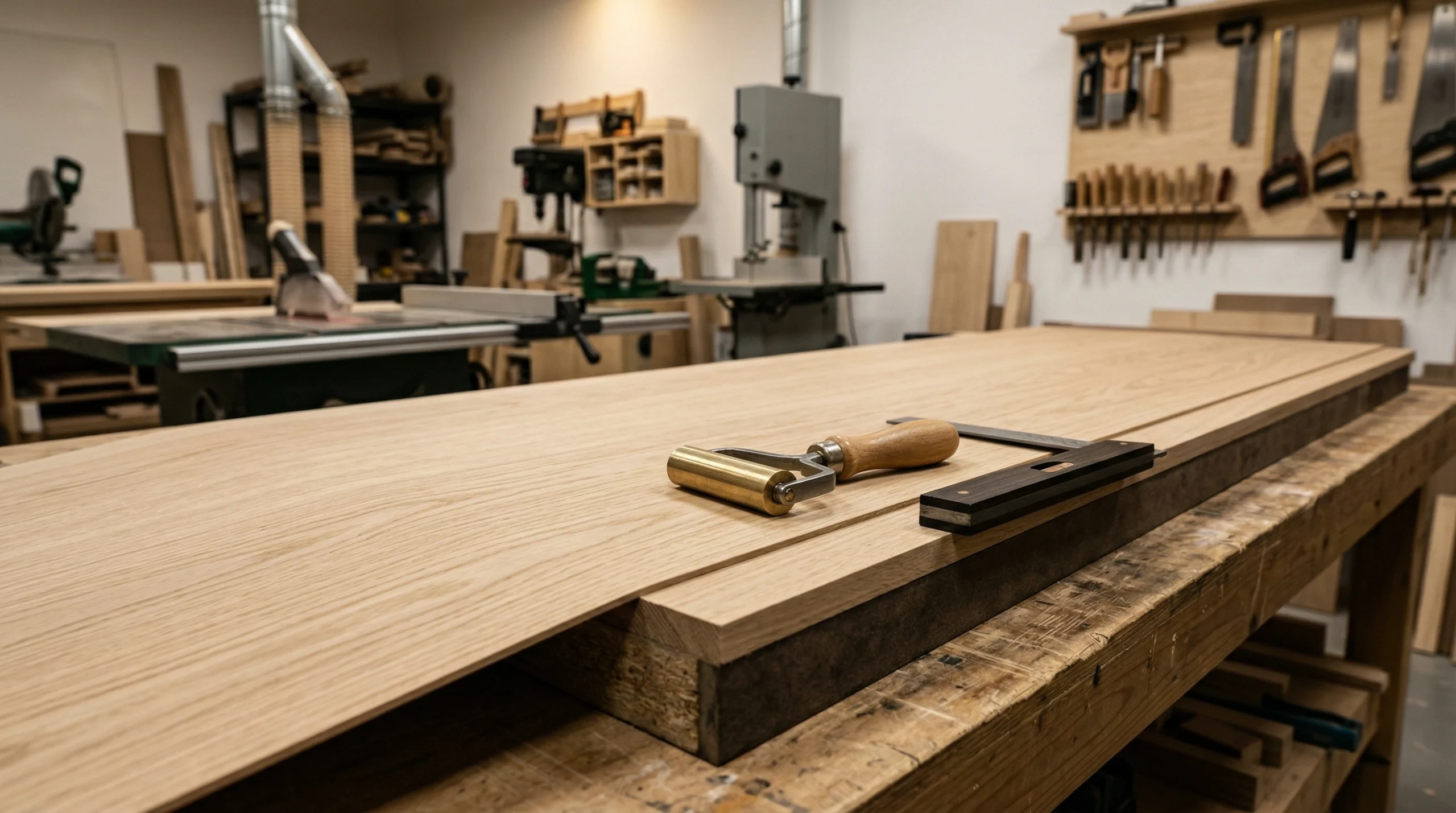
Commercial hospitality fit-outs in the UAE operate within a regulatory framework that affects what you can build, where, and how. Restaurant interiors touching structural elements, fire-rated walls, or emergency egress routes require approved materials and construction methods — and documentation to prove it.
Karnak’s commercial carpentry team has managed Dubai Municipality approvals on over 1,200 restaurant and cafe fit-out projects. We understand what the DM inspectors look for, which materials require fire-rating certification for use in commercial kitchens and dining areas, and how to document our work in a format that supports your NOC process. If you’re working in a free zone — DIFC, Dubai Marina, JLT, DHCC — we know the additional authority requirements those zones impose.
This isn’t an incidental capability. For a restaurant operator trying to hit an opening date, having your carpentry contractor cause a compliance delay is a serious problem. We treat regulatory competence as a core deliverable.
Timeline Engineering for Hospitality Openings
Restaurant openings are among the most deadline-driven construction projects in commercial real estate. Operators have lease commencement dates, PR launch campaigns, staff start dates, and often significant pre-opening marketing commitments. Delays cost real money — not just in contractor time, but in carrying costs, staff wages, and lost revenue.
Our workshop fabrication model is specifically designed to compress installation timelines. Rather than building in-place (which is slow and vulnerable to site conditions), we prefabricate the majority of carpentry elements — cabinetry, bar structures, millwork panels, booth frames — in our controlled Dubai workshop and bring them to site in near-finished form. Installation then becomes assembly and finishing rather than construction, and we can typically complete a full restaurant carpentry fit-out in 60–70% of the time a purely site-built approach would require.
Restaurant & Cafe Carpentry Services We Deliver
This is where the scope of what we do matters. Karnak handles the full woodwork and joinery scope for restaurant and cafe fit-outs, which means one contractor, one warranty, and one point of coordination for everything timber-based in your space.
Bar Counter Fabrication
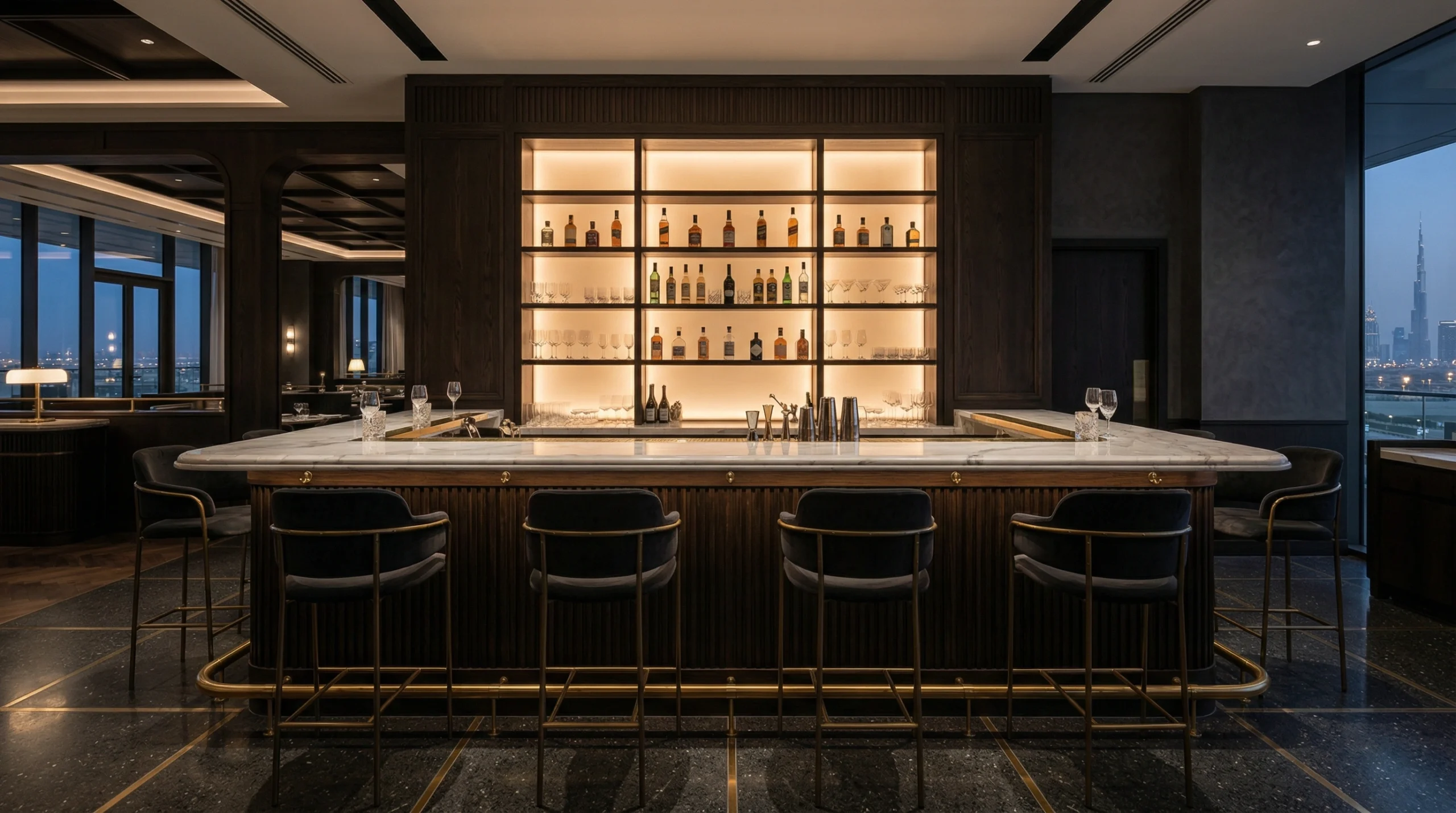
A bar is the most complex carpentry element in most restaurant or cafe environments. It integrates structural requirements, equipment coordination, electrical and plumbing pass-throughs, display and storage functions, and aesthetic impact — all in a unit that takes constant physical abuse from both sides.
Our bar fabrication process begins with detailed coordination with your equipment supplier and MEP contractor before a single board is cut. We need to know the dimensions and weight of your refrigeration units, your glass washers, your ice machines, and any display elements before we finalize the substrate and frame design. Underbuilt bar structures fail not through poor carpentry, but through inadequate engineering at the coordination stage.
For the bar front, back bar, and any overhead structures, we work in solid hardwood, veneered MDF, lacquered cabinetry, or combinations — depending on your design intent and operational requirements. We’ve fabricated bars with integrated marble inlay, backlit onyx panels, custom metal-timber composites, and traditional Arabic carved wood detailing. We can incorporate live-edge timber elements, hand-applied metal leaf finishes, and custom curved forms that require precision steam-bending or laminated-bend techniques.
Banquette Seating and Booth Construction
Fixed seating — banquettes and booths — defines the character of a restaurant floor plan more than almost any other element. Done well, it creates intimacy, maximizes covers per square meter, and delivers better acoustic comfort than loose furniture arrangements. Done poorly, it’s expensive, uncomfortable, and permanent.
Karnak’s banquette and booth fabrication starts from a structural frame — typically engineered timber or steel-reinforced timber depending on scale — that’s designed to handle decades of use without racking, squeaking, or settling. The frame geometry determines seat and back angle, cushion support depth, and table height relationship. We work closely with your upholstery supplier (or handle upholstery coordination ourselves when needed) to ensure the finished profile matches your design intent precisely.
For booth partitions and dividers, we offer solid panel, timber-framed fabric, glass-and-timber composite, and perforated panel options — each serving different acoustic, visual privacy, and design objectives. In larger restaurant spaces, we often design booth configurations with integrated storage beneath the seats and recessed lighting within the upper panel structure, eliminating the need for separate fixtures and creating a cleaner ceiling plane.
The UAE restaurant market has specific seating durability requirements. Fabric selections for commercial banquettes need to meet minimum rub counts of 50,000–100,000 Martindale for high-turnover venues, and the structural joints in booth frames need to be mechanically fastened (not adhesive-only) to survive the movement and weight cycling of continuous commercial use.
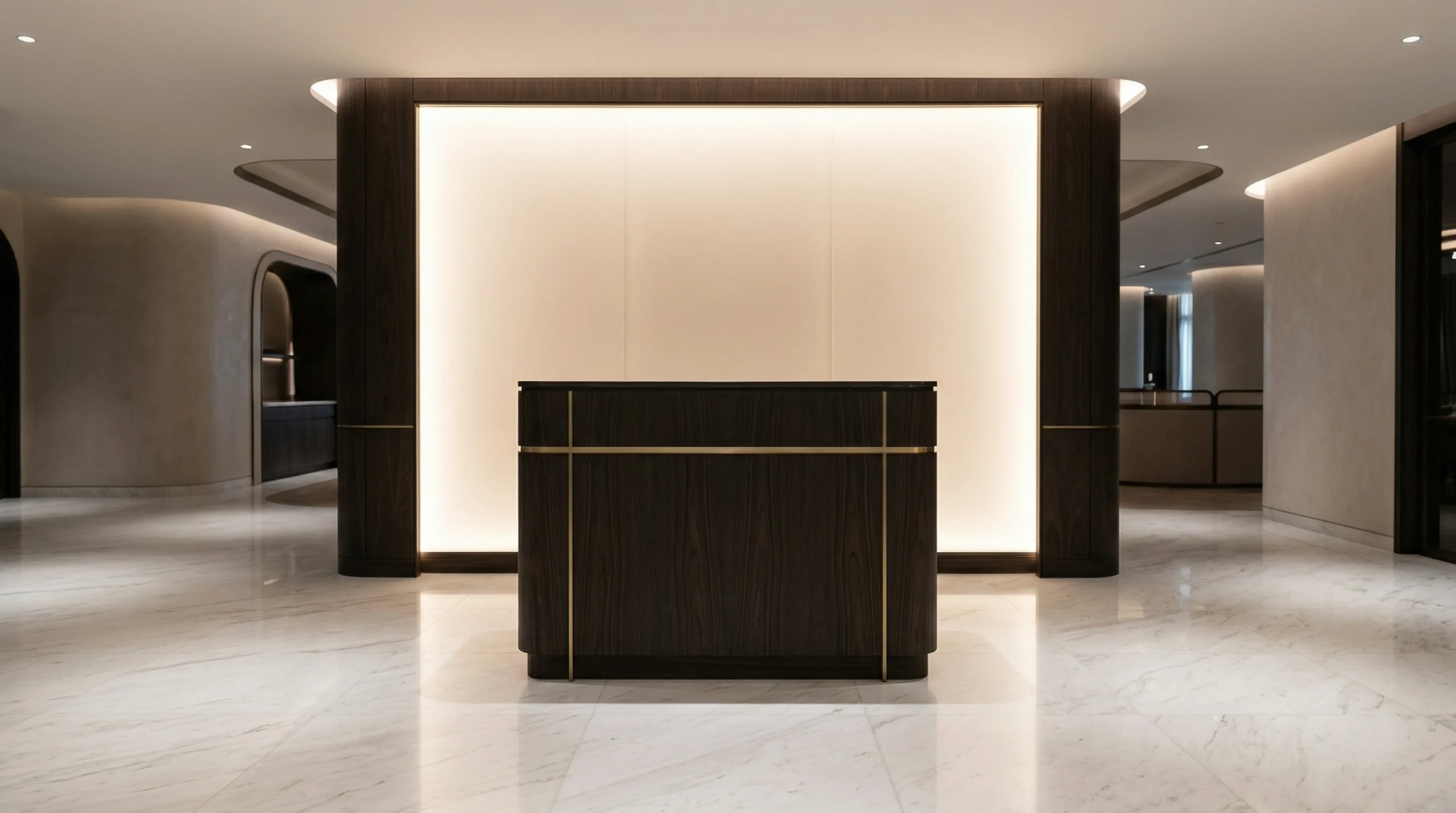
Host Stand and Reception Millwork
The host stand is the first carpentry element a guest physically encounters. In Dubai’s competitive dining scene, it sets an immediate impression of your venue’s quality and design investment. We fabricate custom host stands in any configuration — freestanding, wall-mounted, illuminated, with integrated tablet/POS mounting, guest list storage, and menu display.
For hotel restaurants and fine dining venues, we regularly produce reception millwork that integrates with broader lobby or entrance joinery packages — consistent grain matching, coordinated finish specifications, and detailed molding profiles that read as designed rather than assembled.
Kitchen and Servery Joinery
Commercial kitchen cabinetry and servery carpentry operates at the intersection of food safety compliance, extreme heat and moisture resistance, and operational efficiency. It’s where cheap materials fail fastest and where poor detail design creates daily operational frustrations for your kitchen team.
We fabricate kitchen cabinetry from moisture-resistant MDF or phenolic-faced plywood depending on proximity to water sources and heat. All kitchen joinery is finished with high-pressure laminate (HPL) — typically from Formica, Wilsonart, or Abet Laminati — to the color and finish specified by your kitchen designer. We coordinate closely with your kitchen equipment supplier to ensure joinery infills, pass-throughs, and surround panels integrate accurately with your installed equipment footprint.
Servery counters — the pass, the cold display, the hot holding area — require careful coordination between carpentry, refrigeration, and lighting. We’ve delivered servery packages for everything from fast-casual counters to hotel buffet set-ups spanning 20+ linear meters, always coordinating with the equipment contractor to ensure the finished assembly looks designed rather than bolted together.
Wall Panelling and Ceiling Joinery
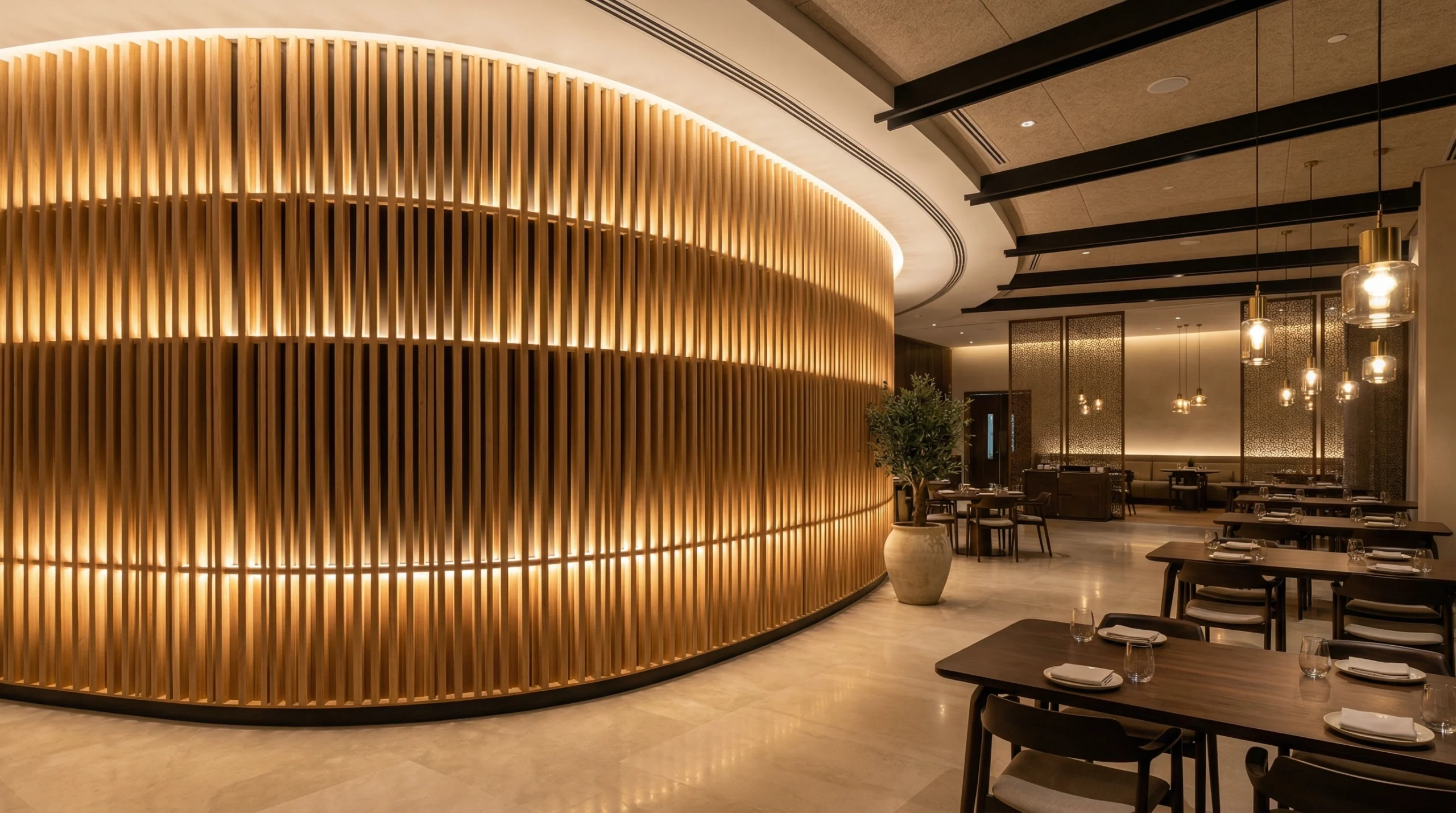
Timber wall panelling transforms the acoustic and visual character of a dining space fundamentally. In Dubai’s restaurant scene, we see demand for everything from American white oak shiplap with a matte natural finish, to intricate carved Arabic mashrabiya screens in walnut, to backlit slatted timber panels creating dramatic lighting effects, to full coffered timber ceiling structures.
Our panel fabrication is entirely workshop-based. We cut, finish, and pre-treat all panels under controlled conditions, then install on-site using concealed fixing systems that allow future access for maintenance or modification. For venues that may refresh their interiors every three to five years (common in the Dubai F&B market), designing for adaptability matters as much as the initial quality.
Acoustic performance is an increasingly important consideration in restaurant design, and timber panelling contributes meaningfully when designed with sound absorption in mind. We can integrate acoustic backing within wall panel assemblies, reducing reverberation in high-ceiling dining spaces without compromising the aesthetic.
Display Shelving, Wine Storage, and Feature Joinery
Display shelving in restaurant and cafe environments is rarely purely functional. A well-designed wine wall, a coffee bean display behind the espresso bar, a spirits display above the back bar — these are designed objects that contribute to the brand story of your venue.
We fabricate display structures in solid timber, veneered MDF, and metal-timber composite depending on the aesthetic direction. For wine storage specifically, we design to maintain appropriate temperature zones and bottle orientation, working with your HVAC consultant where climate-controlled storage is required. Feature wine walls from floor to ceiling have become a signature element in a number of Dubai’s premium dining venues — we’ve built them in loft-ladder-access configurations spanning 4 to 8 meters of height.
Flooring and Timber Floor Finishes
Engineered timber flooring in restaurants requires careful selection and precise installation. We supply and install engineered oak, walnut, and ash flooring from European and American suppliers, specifying wear layer thickness appropriate for hospitality traffic levels. For high-traffic areas, we recommend a minimum 4mm wear layer with aluminum oxide finish for maximum scratch resistance.
Subfloor preparation is critical in UAE commercial spaces — we address moisture vapor emission from concrete slabs before installation, using appropriate primers and moisture barriers to prevent delamination, which is an acute risk in Dubai’s humid coastal areas. Our team handles leveling, preparation, installation, and finishing as a complete service, eliminating the coordination complexity of managing separate flooring and carpentry contractors.
The Karnak Process for Restaurant Fit-Outs
Getting a restaurant interior built to spec, on time, and within budget requires more than good craftsmanship. It requires a project management framework that handles the complexity of hospitality environments specifically.
Step 1: Design Consultation and Brief Development
Every restaurant project begins with a consultation where we understand your concept, your brand aesthetic, your operational requirements, and your constraints — budget, timeline, existing structure. If you’re working with an interior designer or architect, we engage them directly in this stage. If you’re working without a designer, we can assist with carpentry design development and specification, drawing on our database of reference projects from similar venue types.
This isn’t a sales meeting. It’s an information-gathering session where we ask the questions that will affect fabrication decisions — equipment specifications, service flow, cleaning protocol, staff access requirements, timeline from construction to opening, and how long you’re planning to operate before your next refresh.
Step 2: Technical Drawing and Material Specification
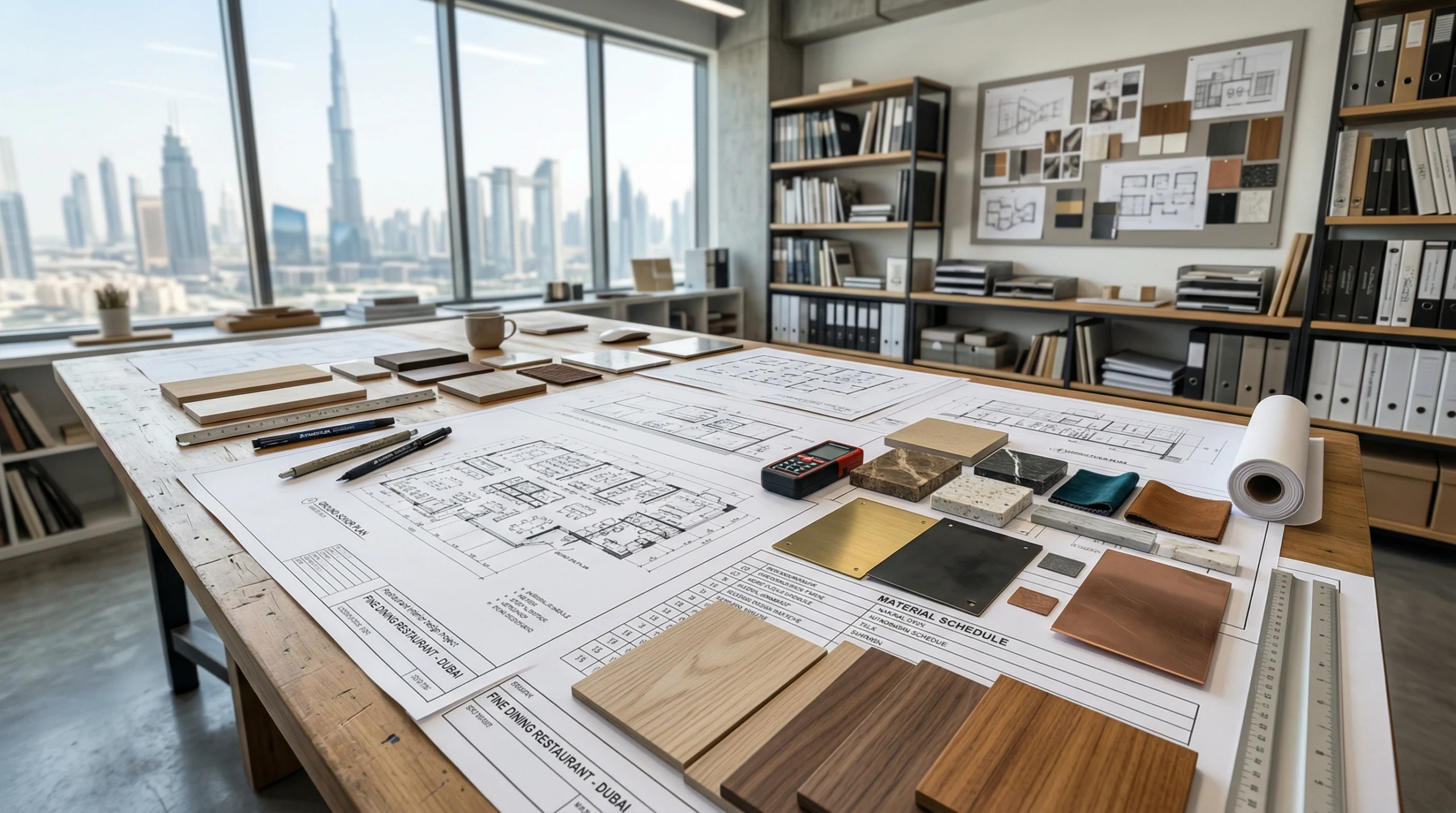
Following consultation, our drafting team produces detailed shop drawings — dimensioned plans, elevations, and sections for every carpentry element. These drawings serve multiple purposes: they allow you to visualize and approve the work before fabrication begins, they give your architect or designer the detail they need to issue approvals, and they become the fabrication reference for our workshop team.
Material specification happens in parallel. We present a detailed schedule of materials — substrate, finish, edge detail, hardware — with samples where required. For significant elements like bar counters and feature walls, we produce physical samples or refer to completed reference projects for client approval before cutting any primary materials.
Step 3: Workshop Fabrication
The majority of fabrication happens in our Dubai workshop under controlled conditions. This is where the quality is actually built — not on-site. Workshop fabrication means better precision (we’re not working around other trades or adapting to dusty, crowded site conditions), better finish quality (spray-applied lacquers and veneers applied in a controlled environment), and dramatically faster on-site installation.
Our workshop operates double shifts during peak fit-out periods to meet hospitality opening timelines. We maintain material inventory for common specifications to avoid supplier lead-time delays, and we track fabrication progress against site-readiness to synchronize delivery with installation windows.
Step 4: Site Coordination and Installation
Installation begins once the site is in a state that allows carpentry work to proceed — flooring base or screed laid, MEP first-fix complete, plastering done. We coordinate directly with your site manager or main contractor to identify the earliest installation window and plan access, sequencing our installation to clear the site for subsequent trades.
Our installation teams are permanent employees — not subcontracted labor — which means consistent quality standards and direct accountability. Each team is led by a senior carpenter with a minimum of eight years commercial hospitality experience. We don’t install and disappear: our project manager remains on-site through practical completion to address any adjustments, snag items, or integration issues with other trades.
Step 5: Finishing, Snagging, and Handover
The final stage of a restaurant carpentry installation involves detailed finishing work — touch-ups, door adjustments, hardware installation, and a formal snag list walkthrough with you or your site representative. We don’t consider a project complete until the snag list is closed and you’ve signed off on the finished work.
At handover, we provide a complete care and maintenance guide specific to the materials used in your installation, along with hardware adjustment guides for any mechanical elements. Our warranty period for restaurant carpentry is two years on workmanship, with manufacturer warranties applying to hardware and finish materials.
Why UAE Restaurant Operators Choose Karnak
35 Years of Hospitality Fit-Out Experience in the UAE
Since 1988, we’ve worked in the UAE F&B sector through every phase of the market’s development — from the early days of Dubai’s hotel restaurant scene to the explosion of standalone dining concepts in the 2000s, through the food hall and casual dining boom of the 2010s, and into today’s ultra-competitive multi-concept hospitality environment. We’ve seen what lasts and what doesn’t. That’s not a claim — it’s a record.
Over 10,000 completed projects means we’ve solved most problems before you encounter them. The moisture delamination issue on high-use bar counters? We revised our specification for that in 2004 after seeing it fail twice and haven’t seen it since. The booth frame racking problem in heavy-volume venues? Solved with a design change we made in 2009 that’s now standard on every booth we build. This kind of iterative learning is only possible through volume and tenure.
Workshop Fabrication Model
Our workshop-first approach is a genuine competitive differentiator. Contractors who build primarily on-site are limited by site conditions, constrained by other trades, and unable to achieve the finish quality that’s possible in a controlled workshop environment. Our fabrication facility in Dubai is equipped for precision CNC cutting, spray-applied finishes, veneer pressing, and bending work that simply can’t be replicated on a construction site.
The practical benefit for restaurant clients is this: your installation happens faster, to a higher finish standard, and with less disruption to surrounding spaces (critical when you’re fitting out within a live hotel or mall environment).
Single-Contractor Scope Management
Managing multiple carpentry subcontractors on a restaurant fit-out — one for kitchen joinery, another for bar work, a third for floor finishes — is a coordination and quality control problem. Inconsistent material specifications, gaps in responsibility between contractors, and competing installation schedules create delays and finish inconsistencies.
Karnak handles the complete carpentry and joinery scope as a single contractor. This isn’t just convenient — it materially improves the finished result. Grain matching between adjacent elements, consistent finish specifications across all joinery, coordinated installation sequencing, and a single warranty for all woodwork — these are real benefits that affect your opening timeline and long-term maintenance experience.
UAE Compliance and Documentation Expertise
We’ve navigated Dubai Municipality commercial carpentry approvals on more than 1,200 restaurant and cafe projects. We know the fire-rating requirements for joinery elements in commercial food service environments, the documentation format DM requires, and the inspection points that commonly create delays for operators who use contractors without this specific experience.
For projects in free zones (DIFC, JLT, Dubai Marina, Abu Dhabi’s Al Maryah Island), we understand the overlay of free zone authority requirements and how to address them without creating project delays.
Transparent Pricing and Budget Management
Restaurant fit-out budgets don’t have much flexibility, particularly when you’re also managing kitchen equipment, furniture, lighting, and branding investment simultaneously. We provide detailed line-item quotations that break down every carpentry element by material, labor, and installation cost. No allowances that balloon, no provisional sums that become surprises.
When a client’s design brief exceeds their budget, we provide a value engineering report identifying where specification changes or design modifications can reduce cost without compromising the elements that matter most to the concept. We’ve helped dozens of operators achieve their design intent within budget through this process.
Recent Restaurant and Cafe Projects Across UAE
The Mezze Collective — JBR Walk, Dubai
A 180-seat Lebanese concept restaurant requiring a complete fit-out including custom walnut millwork throughout the dining room, a 9-meter curved bar counter with integrated back bar display, banquette seating for 80 covers along two walls, and a feature entrance arch with carved Arabic pattern detail. The site was a shell-and-core handover with a 14-week fit-out window. We completed our carpentry scope in 11 weeks, allowing the client two weeks of buffer for FF&E dressing and soft opening preparation.
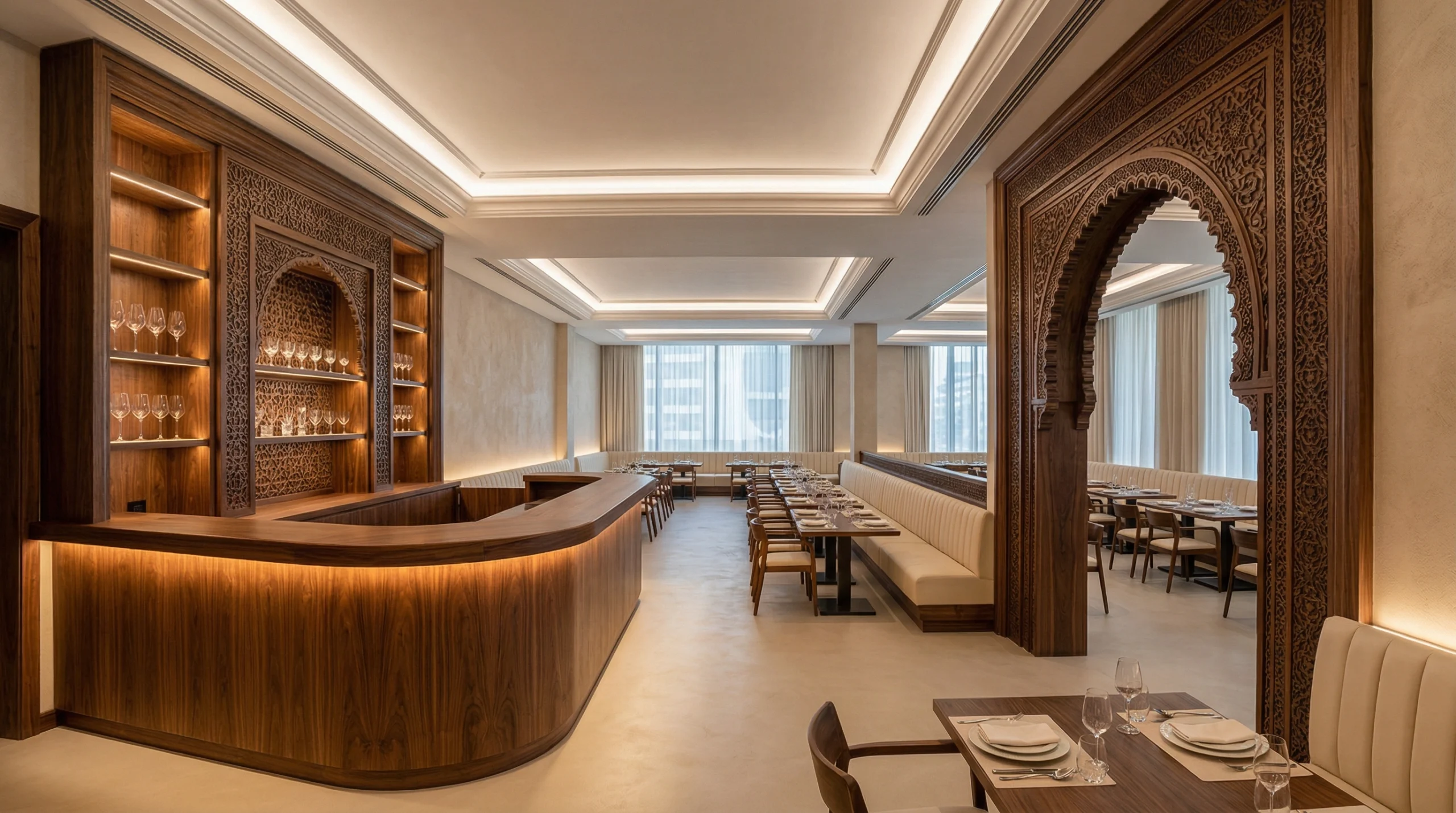
Roast Social House — Business Bay, Dubai
A 90-seat specialty coffee and brunch venue in a Business Bay commercial tower requiring custom espresso bar fabrication in white oak and matte black metal, floor-to-ceiling shelving walls in matching oak, communal table fabrication (four units, each 3.2 meters), and timber-cladded column wraps throughout the space. The project was delivered within a 6-week fit-out window while adjacent office tenancies remained occupied — requiring strict dust and noise management protocols throughout.
Saffron Sky — Abu Dhabi Corniche
A 240-seat hotel restaurant in an Abu Dhabi waterfront hotel requiring complete kitchen servery joinery, a 12-meter buffet counter assembly with refrigerated display integration, custom dining booths for 120 covers, and wall panelling throughout the dining room in figured ash veneer. This project involved coordination with a European hotel design firm and an Abu Dhabi MEP contractor, requiring our team to work within a design documentation framework from international standards.
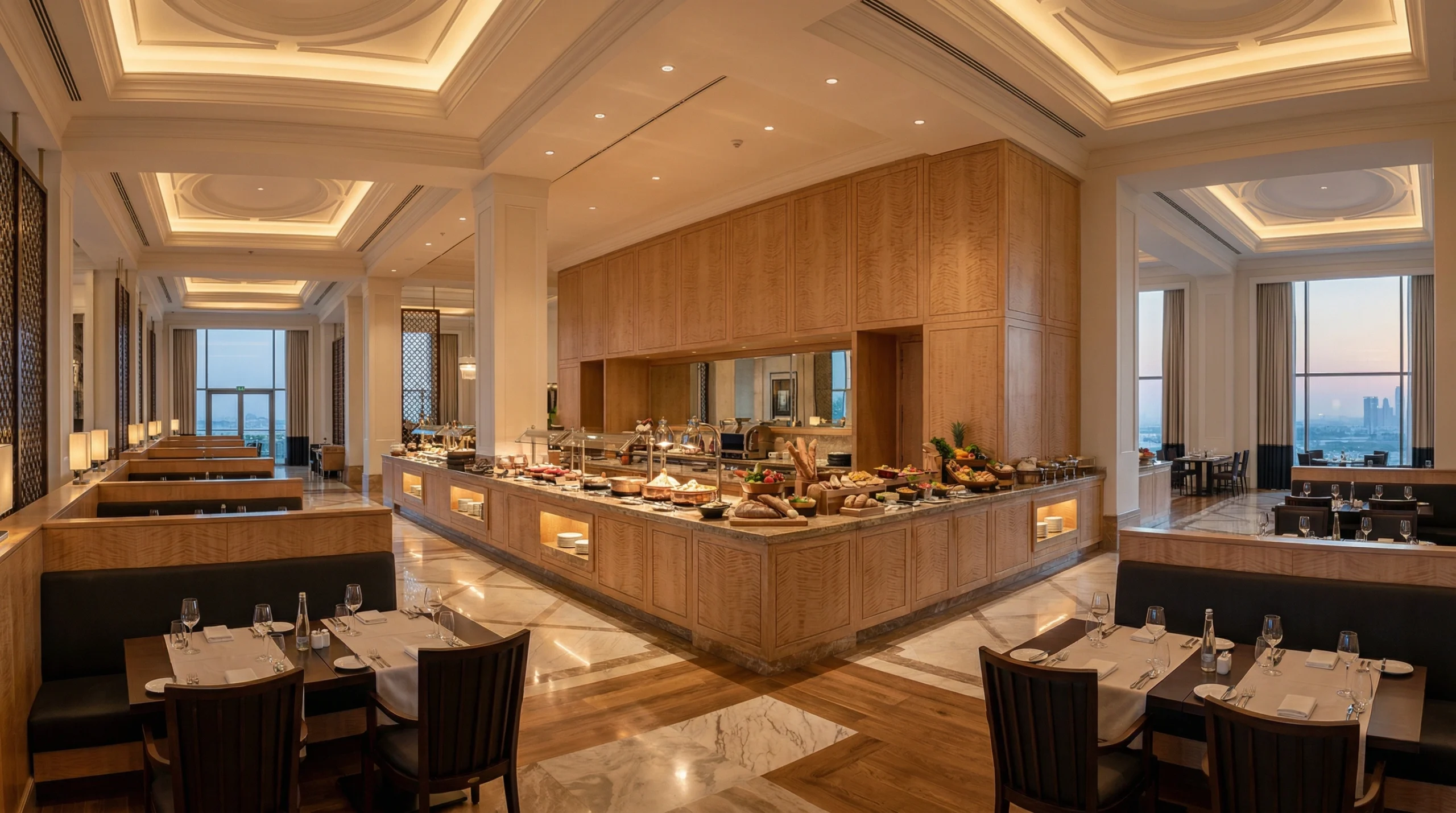
The Rattan Room — Alserkal Avenue, Dubai
An intimate 55-seat concept cafe and retail hybrid in a warehouse space requiring custom counter fabrication for coffee service and retail display, floor-to-ceiling bookcase shelving units, bespoke timber and rattan furniture pieces (12 tables, 24 chairs), and exposed timber ceiling battens across the full warehouse ceiling plane. The design direction called for a specific natural, artisanal aesthetic — our workshop team sourced reclaimed teak from our materials partner and finished all elements with natural oil treatments rather than lacquer.
Nara Japanese Kitchen — DIFC, Dubai
A 130-seat Japanese concept requiring custom timber elements consistent with Japanese joinery aesthetics — shou sugi ban (charred timber) feature wall panels, Hinoki cypress slab counter section in the sushi bar, minimal shoji-inspired booth dividers in white oak with translucent panel inserts, and a custom sake display unit. DIFC fit-out approval requirements added a documentation stage not present in standard DM approvals; we managed this process without creating timeline delays.
Bloom Patisserie — Mall of the Emirates, Dubai
A 45-seat retail patisserie within a major mall environment requiring custom display counter fabrication in high-gloss white lacquered MDF with integrated lighting and refrigerated display units, back-of-house prep room cabinetry, and a feature wall of custom-fabricated hexagonal display niches. Mall fit-out environments impose particularly strict contractor management requirements — timed delivery windows, covered walkways, dust containment. Our mall fit-out experience meant we knew what to expect and prepared accordingly.
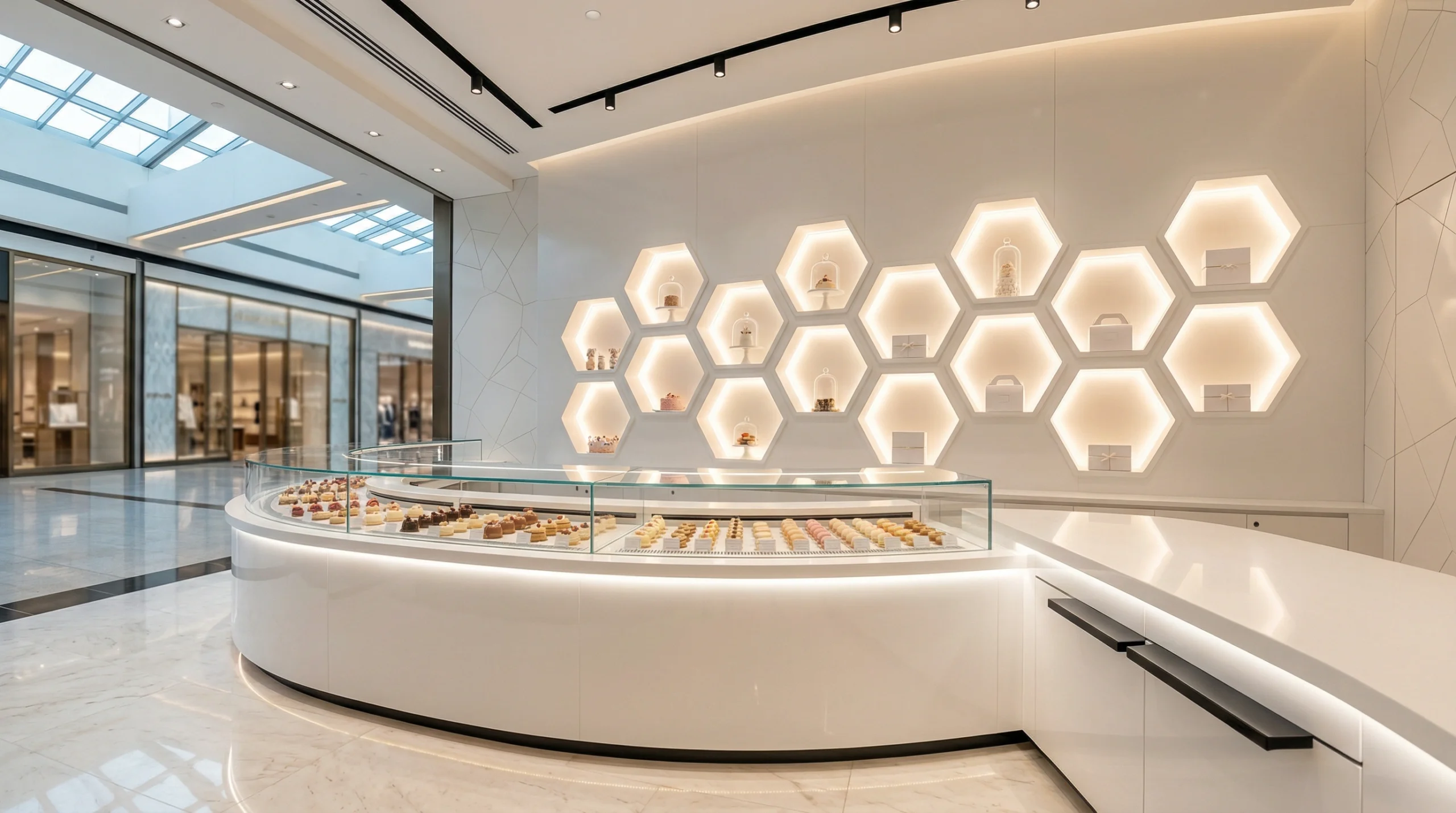
Zahrat Al Khalij — Sharjah
A 200-seat traditional Arabic restaurant in Sharjah requiring an extensive program of carved wood elements — entrance mashrabiya screen (4.2 x 3.6 meters), carved wooden ceiling lanterns, traditional majlis-style seating alcoves with carved panelling, and custom Arabic calligraphy wood panels as feature wall elements. This project drew on our specialist traditional woodcarving capability, which is rarely offered by modern fit-out contractors and represents a significant element of our heritage as a UAE-founded carpentry company.
Restaurant Carpentry Questions — Expert Answers
For a medium-sized restaurant of 100–150 covers, the carpentry scope typically runs 8–14 weeks from signed contract to installation completion. Within that, workshop fabrication runs concurrently with your site preparation — so the actual on-site installation window is usually 2–4 weeks for a project of that scale. The timeline is governed primarily by the complexity of custom elements (a simple laminate bar versus a carved timber bar are different fabrication propositions), the number of carpentry elements in the scope, and your site-readiness when our installation team arrives.
We provide a detailed program at contract stage that maps fabrication milestones against your site program, so you know exactly when we need site access and when you can expect each element to be installed. Pre-opening pressures in restaurant F&B are real, and we build the program around your opening date rather than our convenience.
The range is genuinely wide — from around AED 150,000 for a minimal-scope small cafe fit-out to AED 2.5 million or more for a large format fine dining venue with extensive custom millwork. The primary cost drivers are: the total linear meters of cabinetry and joinery, the material specification (laminate versus solid timber versus veneered MDF), the complexity of custom design elements (curved work, carved elements, bespoke forms), and the hardware specification.
We provide detailed line-item quotations that allow you to understand where cost is being allocated and make informed decisions about where to invest versus where to value-engineer. In our experience, the three elements that deliver the highest perceived value per dirham in a restaurant context are the bar counter, the entrance experience, and the seating configuration — those are the areas we typically recommend clients prioritize when budget decisions need to be made.
Yes — in fact, the majority of our restaurant projects involve working from an interior designer or architect's concept documentation. We receive design drawings, finish schedules, and material specifications from the designer and translate these into shop drawings and fabrication details for approval before cutting any materials.
Where we add value in this relationship isn't substituting for the designer's creative direction — it's applying fabrication knowledge to refine details that may not be fully developed at the design stage. We regularly identify elements that are aesthetically valid but practically difficult or expensive to build as drawn, and propose alternative construction approaches that achieve the same visual result more efficiently. Good designers appreciate this technical input. We've worked with most of Dubai's major hospitality design practices and understand how to integrate into a coordinated design process.
This is one of the most important questions you can ask, and the fact that it doesn't get asked more often explains why a lot of UAE restaurant joinery fails prematurely.
Our material specification for any UAE restaurant project accounts for three climate factors specifically: ambient temperature cycling (particularly in spaces that aren't climate-controlled 24 hours), humidity variation (higher in coastal zones and particularly during the summer months), and the interaction between aggressive commercial cleaning chemicals and surface finishes. Substrates are specified for moisture resistance appropriate to their location — kitchen joinery uses phenolic-faced plywood or moisture-resistant MDF as standard, not standard MDF which absorbs moisture and swells. Timber species for exposed solid wood elements are selected for dimensional stability under UAE temperature and humidity ranges. Surface finishes in wet areas are sealed with additional coats and specified to meet commercial abrasion standards.
Our standard warranty on workmanship is two years from practical completion, covering defects in fabrication and installation. This includes structural failures, finish delamination attributable to our fabrication process, hardware malfunction, and any dimensional or alignment issues. Hardware components carry manufacturer warranties — typically 3–5 years for quality commercial hardware from Blum or Häfele — which we register in your name at project completion.
We do not warranty against damage caused by misuse, unauthorized modification, or the use of incompatible cleaning chemicals. We provide a care guide at handover that specifies approved cleaning products and methods for each surface type to avoid voiding finish warranties.
Yes. Our portfolio spans the full range of design aesthetics present in Dubai's diverse dining scene. Traditional Arabic woodcarving, Japanese joinery techniques, Scandinavian natural timber aesthetics, industrial reclaimed wood, ultra-modern lacquered millwork — we've delivered all of these and more within the past three years.
For specialist aesthetics, we research reference projects extensively and, where relevant, source materials from origin — authentic Hinoki cypress for Japanese concepts, reclaimed European oak for Scandinavian interiors, specialist Arab master carvers for traditional Islamic geometric patterns. The research and sourcing stage adds time to the program, which is why early engagement on these projects matters.
Design changes are common on restaurant fit-outs and we manage them through a formal variation process. When a change is requested — whether from you, your designer, or your operator — we issue a variation notice within 48 hours specifying the scope change, the cost impact (addition or credit), and any timeline implication. Work on the changed element doesn't proceed until you've approved the variation in writing.
This process protects both parties. You know exactly what you're committing to before it's fabricated; we have documented approval for any additional expenditure. We've managed projects with significant mid-stream design changes without disputes because the variation process is clear and consistently applied from the start.
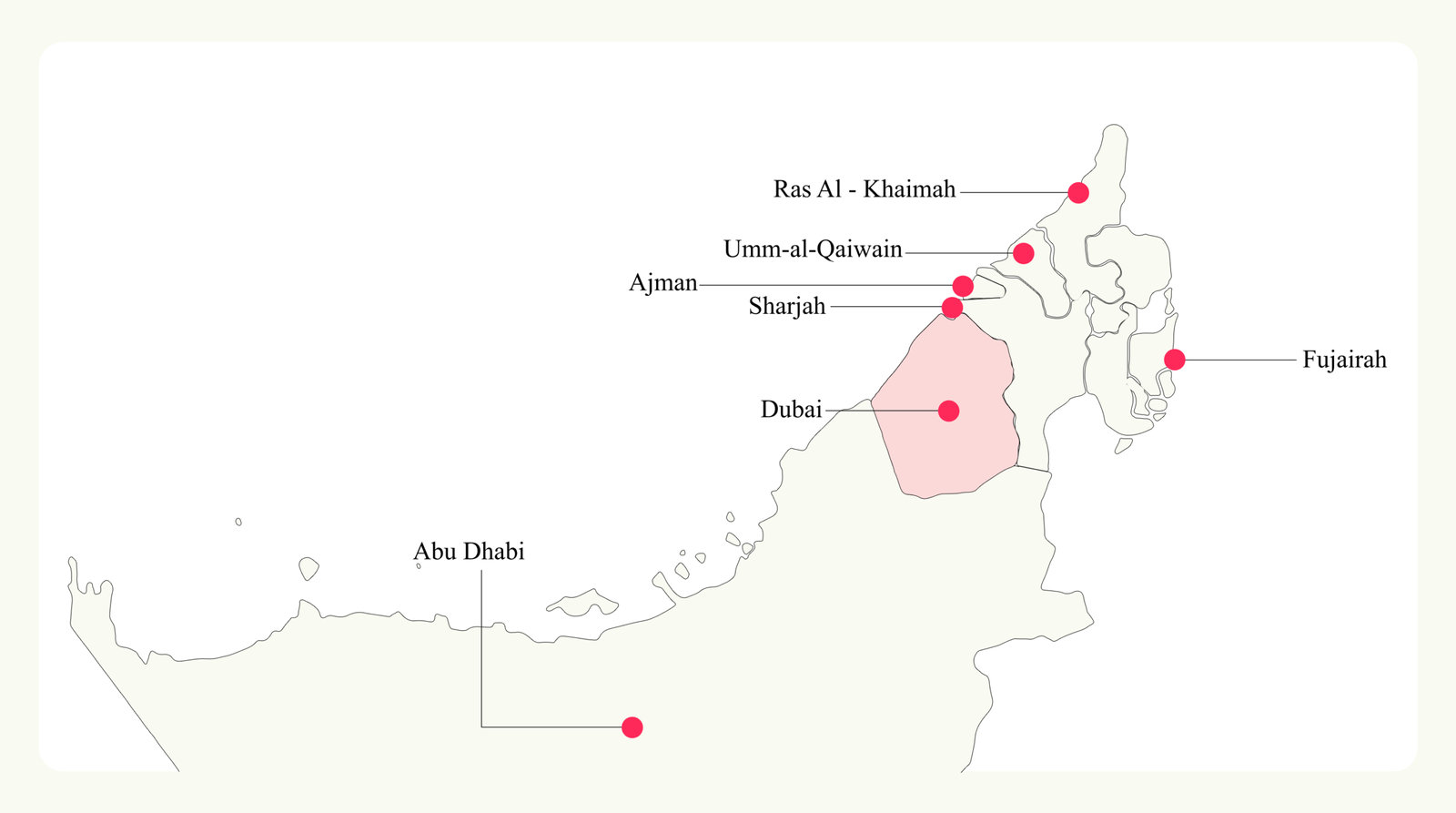
We maintain active teams across all seven emirates and complete regular projects in Abu Dhabi, Sharjah, Ajman, Ras Al Khaimah, Fujairah, and Umm Al Quwain. For projects outside Dubai, our project manager is based on-site during critical installation phases, and workshop fabrication still happens in our Dubai facility — finished elements are transported to site. We work with emirate-specific authority requirements where applicable and have established relationships with local authority consultants in Abu Dhabi and Sharjah.
Response time for consultations is the same regardless of emirate — we travel to you for the initial site visit.
We work on projects from small cafe counter refurbishments (a single bar counter replacement or a display update) through to multi-venue F&B group fit-outs. There's no minimum project value, though our proposal process for smaller projects is lighter than the full documentation approach we apply to major fit-outs. If you have a specific project in mind, contact us and we'll tell you clearly whether it's within our scope and capacity.
We work regularly as a specialist carpentry subcontractor within larger main contractor-managed fit-outs, and equally as the lead contractor on carpentry-only scopes. In main contractor environments, we work within the construction program issued by the main contractor, attend site coordination meetings, and coordinate our installation sequence with adjacent trades — particularly MEP and flooring. Our project manager maintains direct communication with the main contractor's site manager to manage access, sequencing conflicts, and shared services.
In environments where we're coordinating directly with the client without a main contractor, we take a more active coordination role — scheduling access with MEP and other specialist contractors, managing the shared site program, and flagging sequencing risks early.
Matching existing finish is one of the most requested and technically demanding aspects of renovation carpentry. Painted finishes are matchable with color reference — we use spectrophotometric color matching to identify the RAL or NCS reference and source matched paints. Timber finishes are more complex: stain and oil formulations applied to the original specification may no longer be available, and timber grain and patina change over time. We assess the existing finish, source the closest available match, and apply it to a sample for your approval before proceeding.
In some cases, the most practical approach is to refinish a broader element rather than attempting to match a single panel — a decision we'll make transparently with you based on what we see on-site.
We focus on fixed carpentry and joinery — built-in elements that are permanently attached to the structure or significantly custom. For loose furniture, we have trusted procurement partners we can recommend for restaurant and cafe sourcing in Dubai, and we're happy to facilitate introductions. For custom loose furniture — bespoke timber tables, custom chairs, specific statement pieces — we can fabricate these as part of our scope if the design intent requires it.
Our quotation documentation includes a detailed scope of works description, a material schedule specifying substrate, finish, and hardware for each element, dimensioned reference drawings for all major elements, a preliminary program, and payment terms. For projects over AED 500,000, we include a risk register identifying schedule and technical risks we've identified, and our proposed mitigation approach for each. This documentation level is significantly more thorough than what most carpentry contractors in the UAE market provide, and it tends to accelerate the client approval and sign-off process significantly.
Yes. Phased delivery — where a defined set of carpentry elements are completed to allow a soft opening or partial operation while remaining elements are completed — is something we've managed for several restaurant clients. The key is identifying the phasing logic early: which elements must be complete for the space to function at a minimum level, and which can follow in a second phase. We build this into the program and quotation from the outset rather than managing it reactively.
The process starts with a conversation or site visit. Contact us by phone or WhatsApp to arrange a time for us to visit your site, review your drawings if they exist, and understand your project scope and timeline. Initial consultations are at no charge and carry no obligation. Within five working days of the site visit, we provide a preliminary proposal and indication of scope, timeline, and budget range.
Restaurant Carpentry Service Coverage Across UAE
Our restaurant and cafe carpentry teams serve every emirate with the same quality standards, the same documentation capability, and the same project management approach. We don’t treat a Fujairah project as a secondary scope — every job gets a dedicated project manager, proper documentation, and direct client communication throughout.
Dubai: We’ve delivered restaurant carpentry across the full geography of Dubai — Business Bay, DIFC, Downtown Dubai, Dubai Marina, JBR, the Palm Jumeirah, Jumeirah, Mirdif, Dubai Silicon Oasis, Al Quoz, Al Barsha, Deira, Bur Dubai, JLT, Dubai Hills, and every community and district in between. From JBR beachside cafes to DIFC fine dining venues, from Al Quoz warehouse concept restaurants to Palm Jumeirah hotel F&B — Dubai’s diversity is something we’ve navigated in every direction.
Abu Dhabi: We serve the full Abu Dhabi Emirate including Abu Dhabi City (Corniche, Al Maryah Island, Yas Island, Saadiyat Island), Al Ain, and the Western Region. Abu Dhabi’s hotel restaurant and upscale dining market has been a consistent and significant part of our portfolio for over two decades.
Sharjah and the Northern Emirates: We serve Sharjah, Ajman, Umm Al Quwain, Ras Al Khaimah, and Fujairah with the same capacity and quality as our Dubai and Abu Dhabi operations. The northern emirates have seen meaningful growth in the F&B sector over the past decade, and we’ve grown our project volume there proportionately.
Start Your Restaurant or Cafe Carpentry Project
The quality of your carpentry is something your guests register before they’ve read the menu — in the finish of the bar, the comfort of the seating, the warmth of the materials surrounding them. Getting it right the first time, to a standard that holds up through years of continuous commercial use, is what we’ve built our reputation on across 35 years in the UAE.
Whether you’re planning a new opening, a full renovation, or a targeted refresh of specific elements, we’d like to understand your project and show you what Karnak can deliver.
IF YOU HAVE ANY QUESTION? WE ARE GLAD TO
CONSULT YOU AS SOON AS POSSIBLE
Get Started
Immediate assistance from our team regarding your project details.
Form Submitted!
Thank you for contacting us. Our team will get back to you within 24 to 48 hours regarding your query.
Contact us on WhatsApp for Quick Response