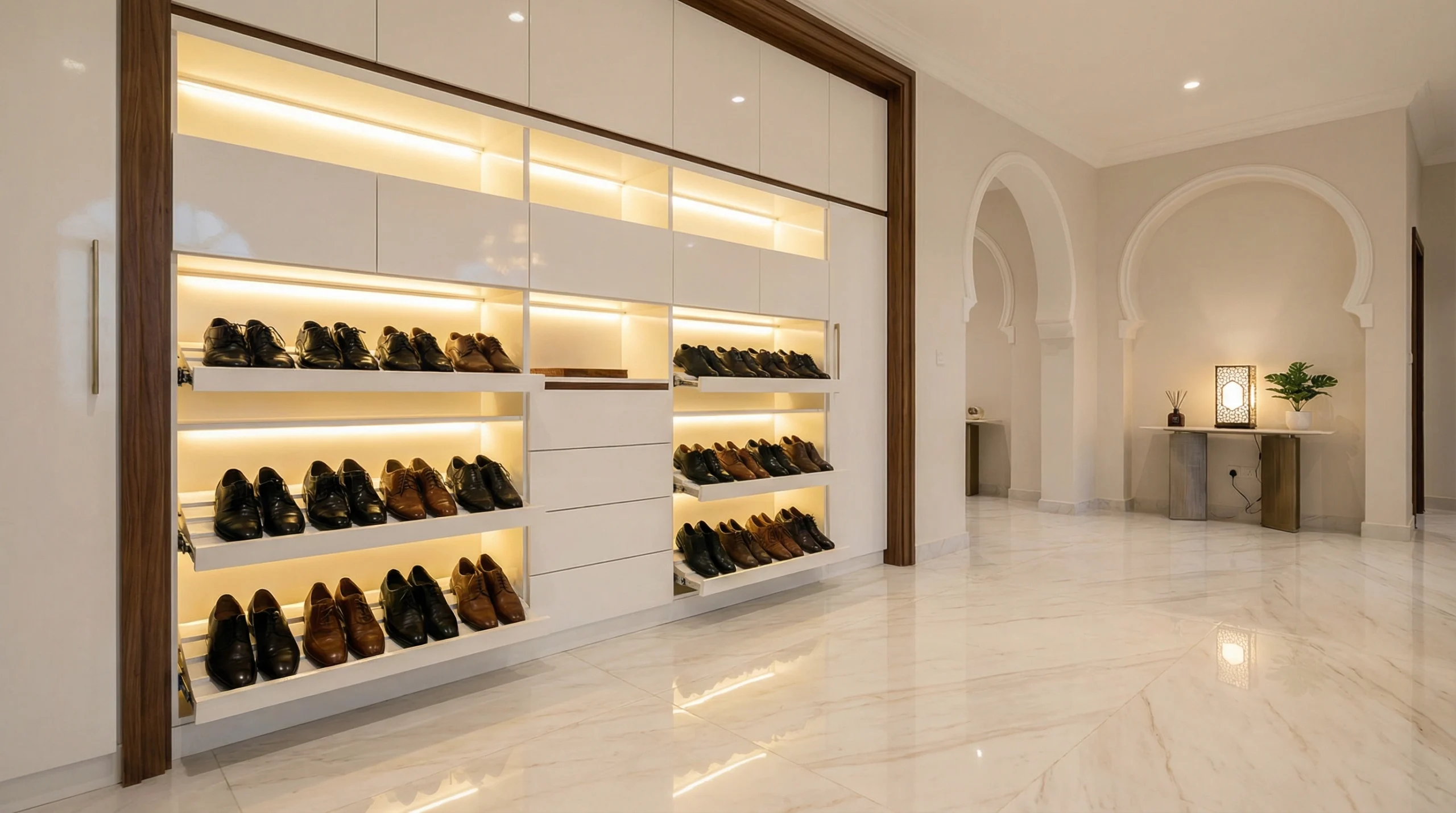
Custom Shoe Racks & Shoe Cabinets Handcrafted for Dubai & UAE
Expert shoe storage solutions designed for UAE lifestyles from compact apartment organizers to luxury walk-in closet systems. Precision-crafted since 1988 across all seven emirates.
Shoe Racks Dubai – UAE
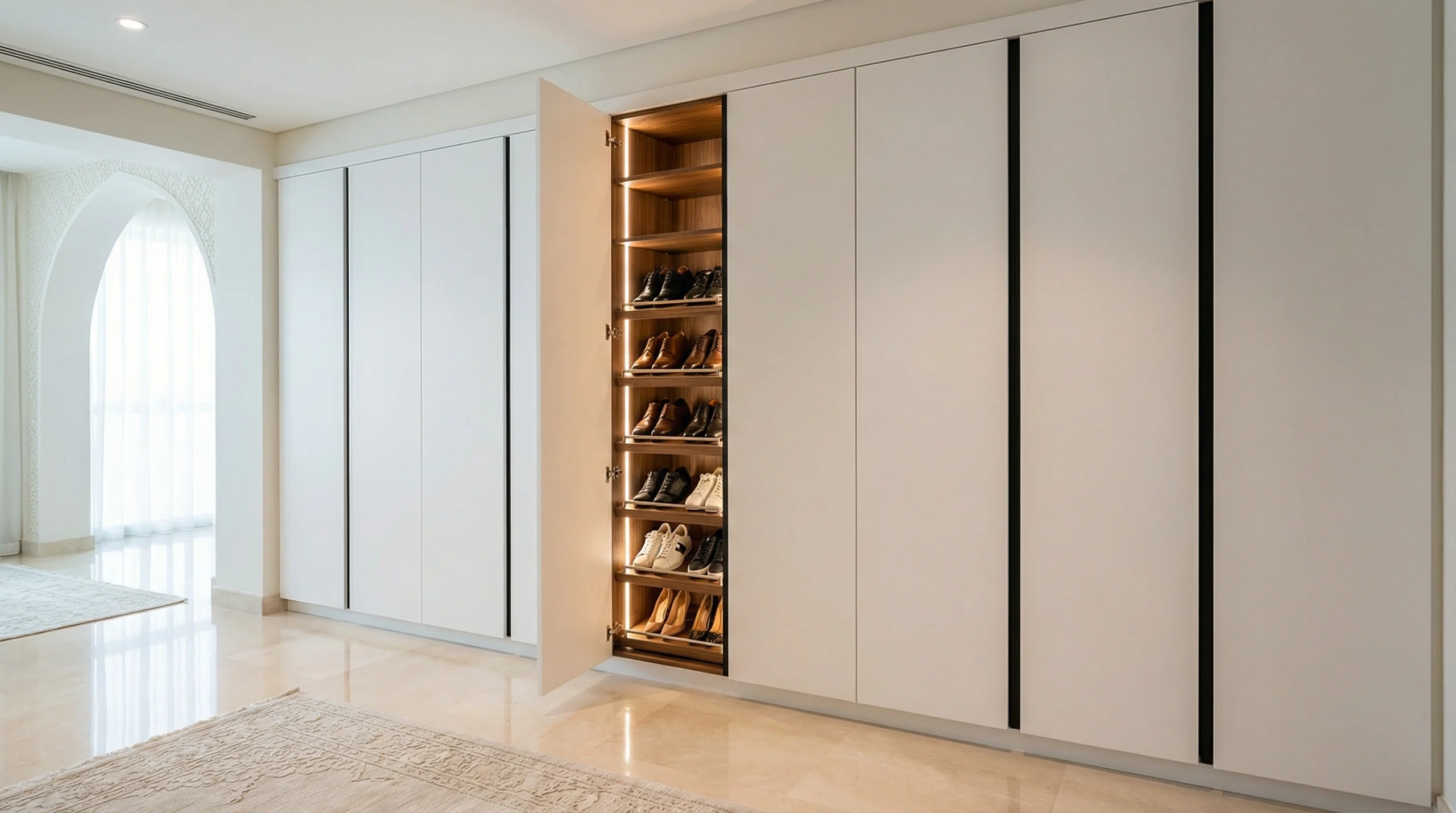
Shoe Racks Dubai – UAE , Walk into any Dubai home and you’ll find the same challenge: dozens of shoes accumulating near the entrance, in bedroom corners, scattered across closets. With our climate requiring different footwear for indoors, outdoors, summer heat, and air-conditioned interiors, UAE residents own significantly more shoes than global averages. Karnak Carpentry has spent 35 years solving this uniquely local storage challenge with shoe racks Dubai that actually work for how people live here.
We’ve designed shoe storage for over 2,400 UAE homes, from studio apartments in JBR where every centimeter counts to villa walk-in closets in Emirates Hills housing 200+ pairs. The difference between generic imported shoe racks dubai and our custom solutions comes down to understanding UAE realities: the dust that coats shoes within hours, the need for ventilation in our humidity, the space constraints in modern Dubai apartments, and the expectation that storage furniture matches your interior investment.
Our workshop in Dubai has fabricated shoe cabinets for every scenario you can imagine. We’ve built pull-out racks for narrow hallways, floor-to-ceiling systems for master bedroom suites, modular units that adapt as collections grow, and concealed cabinets that disappear into wall panels. Each project starts with measuring your actual space and counting your actual shoes, not guessing at standard dimensions.
Understanding Shoe Storage Needs in UAE Homes – Shoe Racks Dubai
Dubai living creates specific footwear storage challenges that don’t exist elsewhere. The cultural practice of removing shoes at the entrance means you need accessible storage right where people enter. Our climate means shoes worn outdoors carry more dust and require ventilation. Apartment living means limited square footage. Luxury expectations mean storage can’t look like utility furniture.
The UAE Shoe Storage Challenge
Most Dubai residents own 15-40 pairs of shoes per person, sometimes significantly more. That’s formal shoes for professional settings, casual shoes for malls and restaurants, athletic shoes for gyms, sandals for poolside, indoor slippers, outdoor slippers, seasonal variations, and specialty footwear. Families multiply this across every member. Even a couple in a one-bedroom apartment easily accumulates 50-80 pairs.
Standard imported shoe racks Dubai fail in Dubai for predictable reasons. Open wire racks collect dust that then transfers back to shoes and floors. Plastic units warp in our temperature fluctuations. Shallow racks designed for Western shoes don’t accommodate the sandals and slip-ons preferred here. Units designed for garage storage look terrible in entrance halls. We’ve replaced hundreds of these inadequate solutions with properly designed shoe cabinets that address actual needs.
The position of shoe storage matters enormously in UAE homes. Shoes come off immediately upon entering, so you need capacity right at the entrance. But entrance areas in modern apartments are compact, often just 1.2-1.8 meters wide. We design vertical solutions that use height rather than floor space, pull-out systems that maximize depth without protruding into walkways, and slim-profile cabinets that provide serious capacity in minimal footprints.
Climate Considerations for Shoe Storage Design – Shoe Racks Dubai
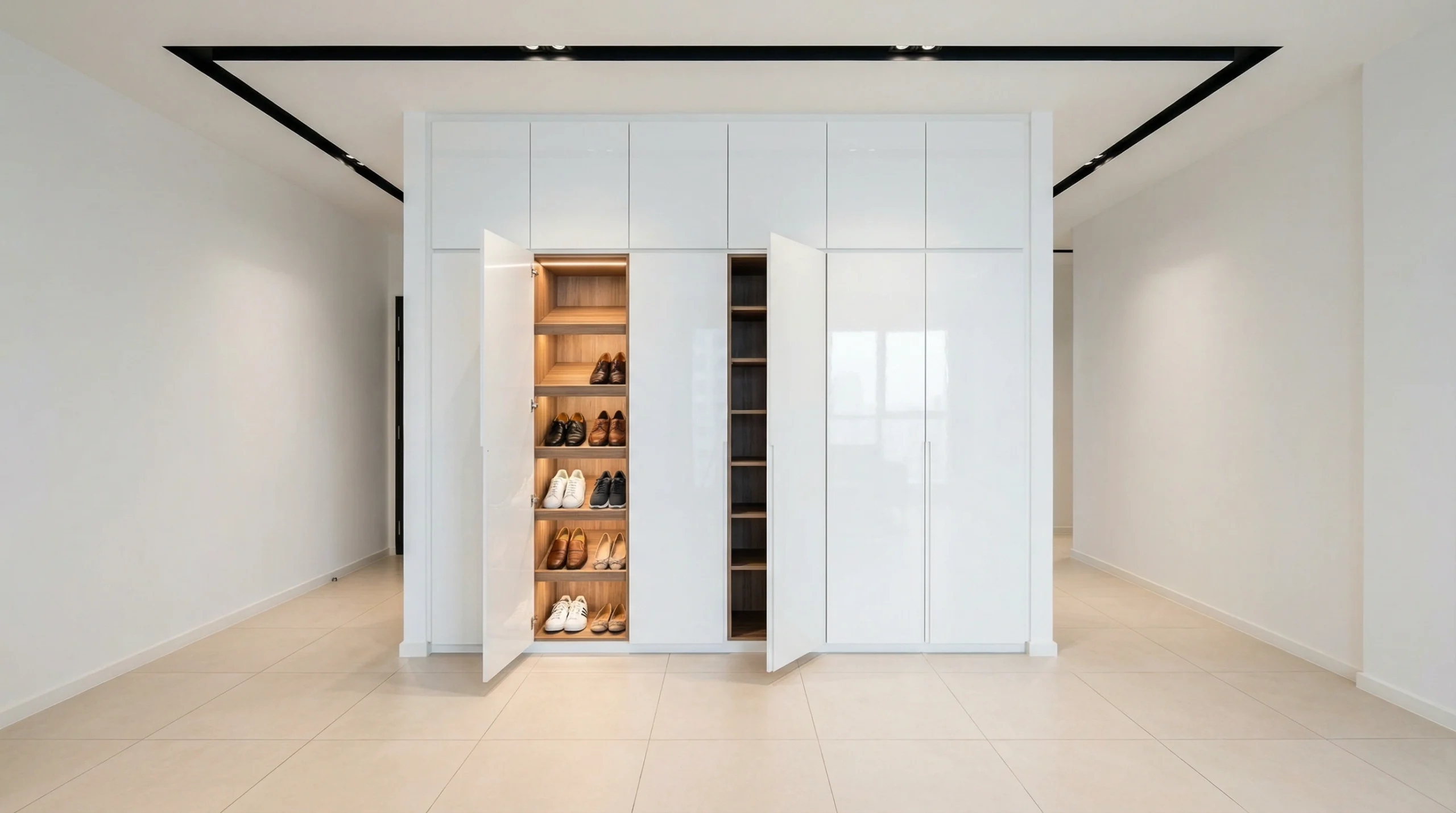
Dubai’s humidity and dust fundamentally change what makes good shoe storage. Shoes worn outside accumulate fine dust particles that, in enclosed storage without ventilation, create musty conditions and accelerate material degradation. We incorporate ventilation into every design—either through perforated backing panels, louvered doors, or deliberate air gaps that allow circulation without compromising the clean appearance.
Wooden shoe racks Dubai require specific material selection. We avoid particleboard and MDF in their basic forms because they absorb humidity and swell. Our shoe cabinets use moisture-resistant MDF with sealed edges, solid hardwoods with proper finishing, or marine-grade plywood in coastal areas. The finishing process includes sealers that prevent moisture penetration. We’ve tracked performance across different Dubai microclimates and know which materials survive in Marina apartments versus desert-edge communities.
Leather shoes and fabric athletic shoes both benefit from air circulation between uses. Our angled shelf designs ensure shoes don’t touch each other, allowing air to reach all surfaces. The angle also prevents dust from settling on uppers. We space shelves based on actual shoe heights—12cm for flat shoes, 15cm for sneakers, 20cm for boots, 35cm for knee-high boots. Adjustable shelving sounds convenient but introduces mechanical failure points, so we design fixed spacing based on your specific collection.
Custom Shoe Racks Dubai Designs We Build
The term “shoe rack” covers everything from simple shelving to sophisticated furniture systems. We categorize our work into distinct types based on spatial constraints, capacity requirements, aesthetic integration, and budget parameters. Each category represents solutions we’ve refined across hundreds of installations.
Freestanding Wooden Shoe Racks Dubai – UAE
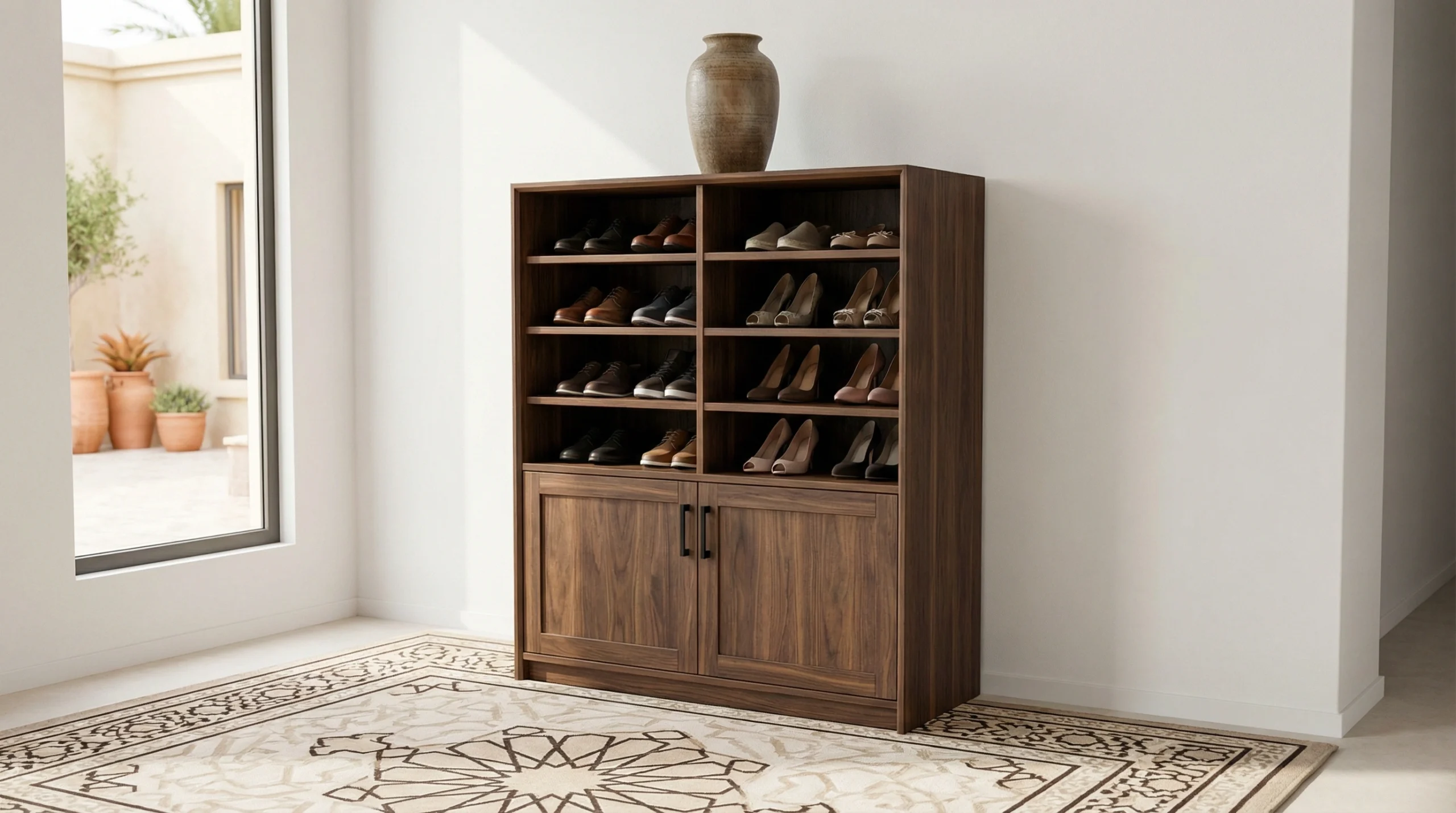
Traditional freestanding units work well in larger spaces—villa mudrooms, spacious apartment entrances, or bedroom areas with adequate floor space. We build these from solid wood or wood composites, typically 80-120cm wide, 30-40cm deep, and 90-180cm tall. The advantage of freestanding designs is flexibility in placement and the ability to relocate if you move or reorganize.
Our freestanding shoe racks dubai – uae use either open shelving or combination designs with enclosed lower cabinets and open upper shelves. The enclosed section hides less-frequently-worn shoes and seasonal items. Open shelves provide quick access to daily footwear. We often add a top surface for keys, mail, or decorative items, transforming the shoe rack into functional entrance furniture. Drawer options accommodate shoe care supplies, small accessories, or household items.
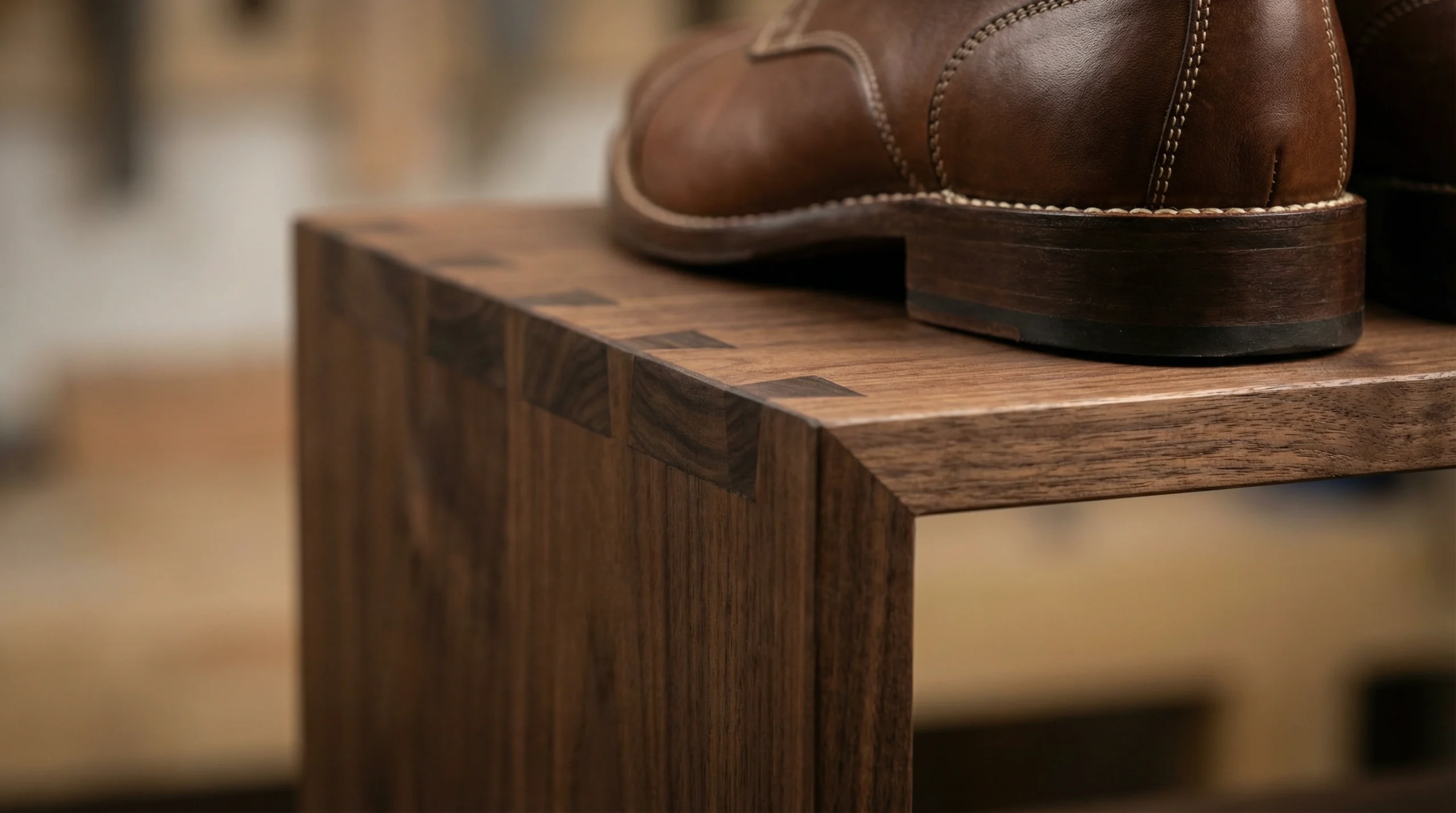
Construction quality separates adequate freestanding units from furniture that lasts decades. We use mortise-and-tenon joinery for frame connections, not just screws and dowels. Shelves receive proper support—either dadoes routed into side panels or commercial-grade shelf pins in reinforced holes. Back panels are set into rabbets and secured with both adhesive and fasteners. The result is a unit that doesn’t rack or wobble, handles weight without sagging, and maintains tight tolerances even after years in UAE conditions.
Built-In Shoe Cabinets and Wall-Mounted Systems Shoe Racks Dubai – UAE
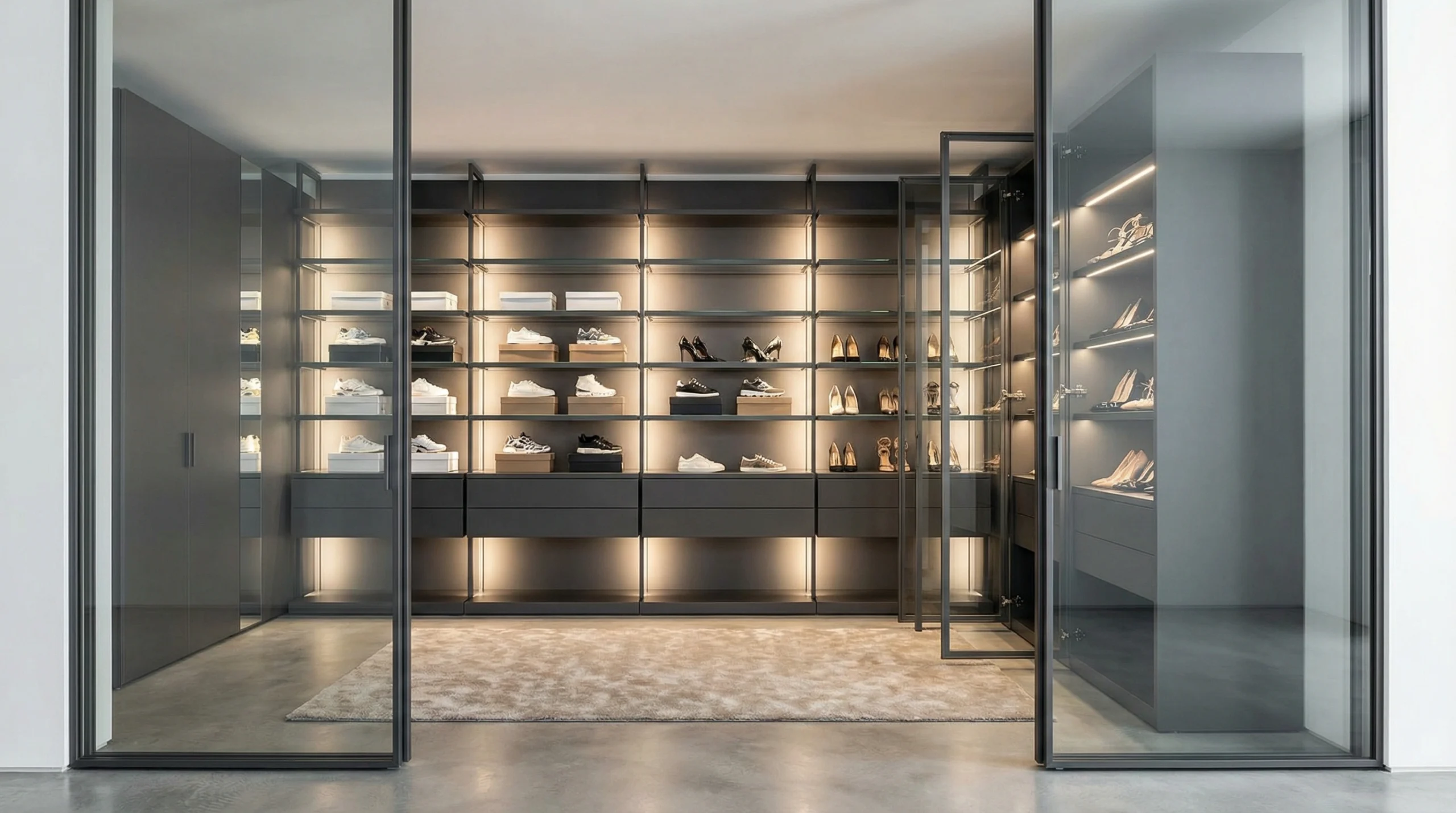
Built-in solutions maximize capacity in limited spaces by utilizing wall depth and vertical height. We recess cabinets into wall cavities where possible, creating flush installations that don’t protrude into walkways. In apartments where walls are concrete or load-bearing, we build slim-profile wall-mounted cabinets—typically 15-20cm deep—that provide surprising capacity while maintaining minimal visual impact.
The construction approach for built-ins differs from freestanding furniture. We anchor to wall studs or use concrete anchors rated for the total loaded weight, typically 80-150kg for a full shoe cabinet. Cabinet boxes are constructed separately in our workshop, then installed as complete units. We scribe to walls and use shadow gaps where perfect alignment isn’t possible, creating deliberate design details rather than attempting impossible precision fits on UAE construction.
Door options for built-in shoe cabinets include hinged, sliding, bifold, or lift-up mechanisms. Hinged doors are most reliable but require clearance space. Sliding doors work well in tight spaces but reduce accessible width by half at any moment. Bifold doors provide nearly full access in minimal clearance. Lift-up doors create a completely open front but require overhead clearance. We recommend based on your specific space constraints and access patterns.
Interior configuration of built-in cabinets often includes pull-out racks, angled shelves, or rotating carousel systems. Pull-out racks bring shoes forward for visibility and access, especially useful in deeper cabinets. We build these on full-extension drawer slides rated for 35-50kg per rack. Angled shelves improve visibility and ventilation. Rotating carousels maximize corner spaces but work best for smaller shoe collections where mechanical complexity is justified.
Closet and Wardrobe Shoe Storage Integration
When we design walk-in closets or wardrobes for Dubai homes, shoe storage integration requires as much planning as hanging space. Dedicated shoe zones keep footwear organized and prevent shoes from cluttering clothing areas. We allocate 1.5-2.5 linear meters of wall space for shoe storage in typical master closets, more for serious collections.
The most efficient closet shoe storage uses floor-to-ceiling vertical space. We install angled shelves from about 20cm above floor level up to 200-220cm height. This provides 12-15 shelf rows in standard ceiling heights, accommodating 48-75 pairs depending on shelf depth. Lower shelves hold everyday shoes, middle sections for seasonal rotation, upper shelves for special occasion or rarely worn pairs. The vertical organization dramatically outperforms horizontal shoe racks Dubai apartments where floor space is precious.
Pull-out shoe racks dubai – UAE integrated into closet systems provide excellent accessibility in deeper wardrobe configurations. These mounted on full-extension slides bring shoes completely forward for easy viewing and selection. We typically install these in lower sections of closets, from 20cm to 120cm height, as bending to low pull-outs is easier than reaching high ones. Each rack holds 8-12 pairs depending on width and shoe types.
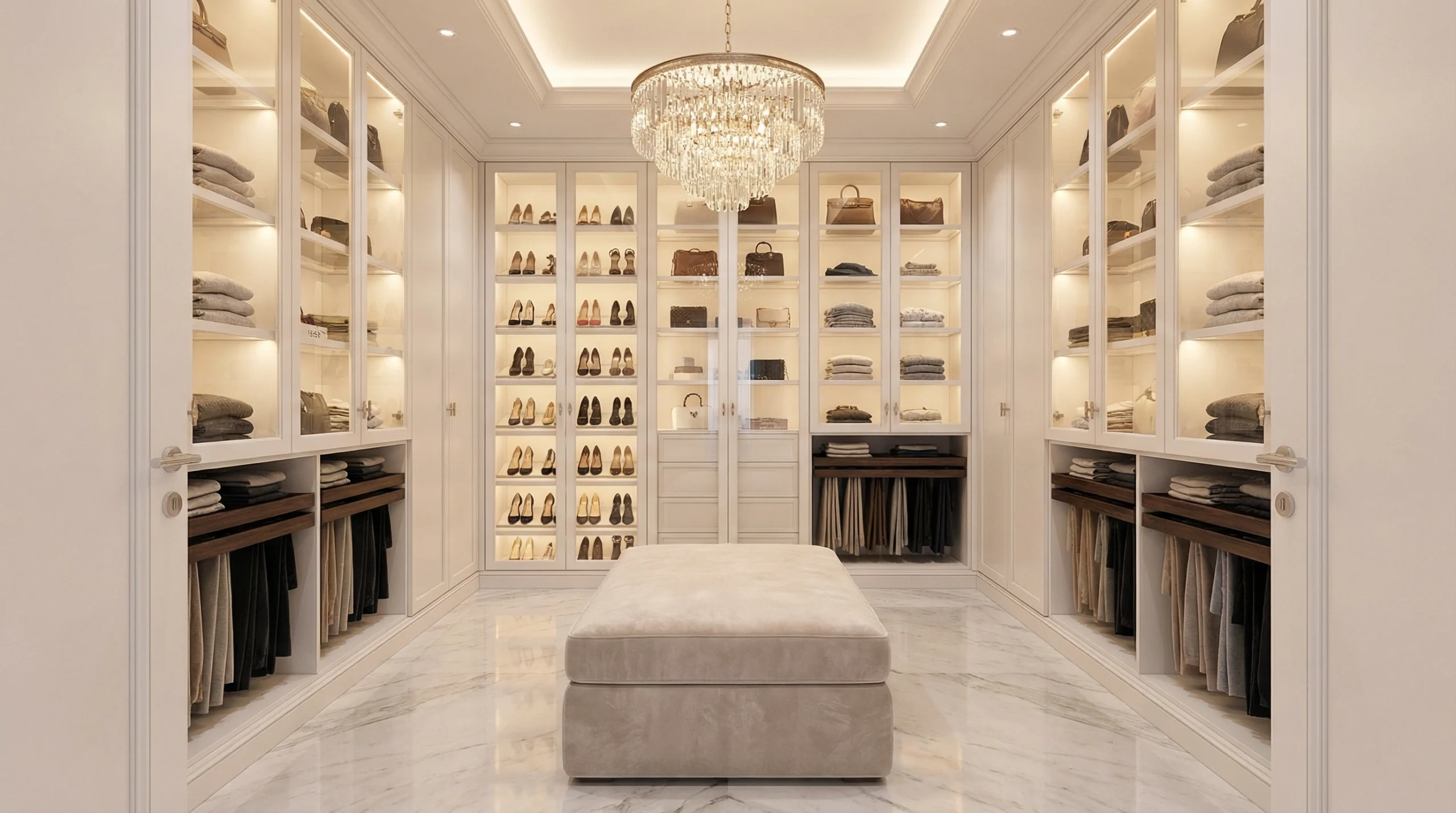
Some walk-in closets incorporate dedicated shoe rooms or alcoves. We’ve built these in larger villas where space allows a separate shoe storage zone, essentially a small room lined with shoe displays. These include seating for trying on shoes, mirrors, and proper lighting. The millwork resembles retail shoe boutiques—individual cubby displays, glass-front cabinets for special shoes, and pull-out drawers for smaller items. It’s an investment in organization for serious shoe collectors.
Entryway and Mudroom Shoe Solutions – Shoe Racks Dubai & UAE
Shoe Racks Dubai – Purpose-built entrance furniture combining shoe storage with other functions suits UAE lifestyles well. We design benches with shoe storage underneath, providing a sitting surface for putting on shoes while hiding storage below. Wall-hung coat and shoe combinations include upper hooks or hanging space for jackets and bags, lower shoe cabinets, and sometimes middle drawers for accessories.
The challenge in Dubai apartment entryways is working within 1.2-1.5 meter widths while providing adequate capacity. We build vertical storage that uses the full ceiling height, typically 2.6-2.8 meters. A slim 35cm deep cabinet spanning 120cm wide and 260cm tall accommodates 40-60 pairs easily. We add a bench section at sitting height (45-50cm) that interrupts the vertical run, creating visual interest while providing function.
Material selection for entryway shoe storage must consider heavy use and visible placement. These pieces function as furniture, not utility storage, so finish quality matters. We typically use painted or laminated surfaces in entryways rather than natural wood, as they resist scuffing and simplify maintenance. Handleless push-to-open doors maintain clean lines. Soft-close mechanisms prevent slamming in spaces where noise carries.
Ventilation remains critical in entryway shoe storage since these cabinets hold shoes worn most recently. We incorporate ventilation grilles disguised as design elements—horizontal reveals that appear decorative but allow air circulation, perforated metal panels finished to match the cabinetry, or louvered door sections. The ventilation isn’t obvious but serves the essential function of preventing odor buildup and allowing moisture dissipation.
Modular and Expandable Shoe Storage Systems
Modular systems appeal to clients who want flexibility as their collections grow or when future space changes are anticipated. We design component-based systems where individual units stack, connect side-by-side, or reconfigure into different arrangements. Each module is a complete freestanding unit that also integrates with others through alignment features and connection mechanisms.
Shoe Racks Dubai – A typical modular shoe storage system includes base units (60-80cm wide, 30-35cm deep, 40cm tall) that provide foundational capacity and can support stacked components. These might include enclosed cabinets or open shelving. Middle units add height without increasing footprint, usually 80-100cm tall segments with open shelves or combination storage. Top units or caps finish the system at 20-30cm height, providing display surfaces or concealing upper storage.
The connection system we use in modular designs ensures stability while allowing reconfiguration. Alignment pins prevent lateral shifting. Stacking units include weight-transfer supports. We avoid complex fastening systems that frustrate customers during reconfiguration. The goal is stability in use with reasonable ease of modification. Most clients configure once and leave it, but having the option provides peace of mind.
Modular systems cost slightly more than equivalent built-in solutions due to the engineering required for each component to function both independently and as part of a system. The value comes from adaptability. If you move from a two-bedroom apartment to a three-bedroom, you can reconfigure or add modules. If room functions change, the system adjusts. For clients who value this flexibility, the premium is worthwhile.
Materials and Finishes for Shoe Storage Cabinets – Shoe Racks Dubai & UAE
Shoe Racks Dubai – The material choice fundamentally determines how shoe storage performs in Dubai’s environment and how it appears in your home. We work with materials ranging from engineered wood products to solid hardwoods, each with distinct characteristics affecting cost, durability, appearance, and maintenance.
Engineered Wood Products for Shoe Cabinets
Moisture-resistant MDF forms the foundation of most shoe cabinets we build. This isn’t standard MDF but specially formulated material with added moisture resistance, often colored green or blue to distinguish it. The edges receive complete sealing—we apply edge banding with proper heat activation and pressure, then seal cut edges with primers before finishing. Properly processed moisture-resistant MDF handles Dubai humidity far better than people expect.
Shoe Racks Dubai – Marine-grade plywood becomes our material of choice in coastal areas—Dubai Marina, JBR, Palm Jumeirah—where humidity levels are consistently higher. This plywood uses waterproof adhesives between veneer layers and often includes tropical hardwood veneers that naturally resist moisture. It costs 60-80% more than moisture-resistant MDF but provides superior long-term durability where moisture exposure is significant. We’ve never had a marine plywood shoe cabinet fail due to humidity issues in fifteen years.
Particleboard and standard MDF don’t appear in our shoe storage work. These materials absorb moisture, swell, and degrade. We’ve removed countless failed imported shoe racks dubai built from these materials. The cost savings disappear within two years when the unit needs replacement. Some clients request the absolute lowest cost option, and we explain that quality materials represent the minimum viable investment, not an upgrade.
The substrate choice affects finish options. MDF accepts paint beautifully, creating smooth furniture-quality surfaces. Plywood works well with wood veneer or laminate finishes. Both materials can be edge-banded to create seamless appearances. We help clients understand that the substrate isn’t what they see—it’s the structural foundation for the finish materials that create the visual result.
Solid Wood for Premium Shoe Racks Dubai – UAE
Solid wood shoe racks dubai – UAE represent our premium tier, chosen for aesthetic reasons and heirloom furniture aspirations more than functional superiority. Woods we commonly use include oak, walnut, and sapele for their grain character and finishing properties. Teak occasionally appears in outdoor or semi-outdoor shoe storage due to its natural weather resistance. We avoid soft woods like pine in structural applications as they dent and mar too easily.
Solid wood construction requires different joinery techniques than engineered products. Wood movement from seasonal humidity changes demands accounting for expansion and contraction. We orient grain directions to minimize visible movement, use floating panel construction in larger surfaces, and apply finishes that allow some vapor transmission. These techniques ensure the wood can respond to environmental changes without creating visible problems.
Shoe Racks Dubai – The cost differential for solid wood shoe storage is substantial—typically 2.5-3.5 times engineered wood equivalents. Clients choose solid wood for the authentic material presence, unique grain patterns, and perception of luxury. From a pure function standpoint, well-built engineered wood storage performs identically. The choice comes down to aesthetic values and budget allocation. Both approaches produce excellent results when executed properly.
Finishing solid wood for shoe storage involves multiple steps—sanding through progressive grits, applying grain filler on open-grain woods, staining if color adjustment is desired, and multiple coats of topcoat finish. We primarily use catalyzed conversion varnish for furniture pieces requiring durability. This finish provides excellent moisture resistance, withstands scuffing, and maintains appearance with minimal maintenance. Natural oil finishes appear occasionally on request but require more maintenance.
Surface Finishes and Color Options – Shoe Racks Dubai & UAE
Paint finishes dominate contemporary Dubai interiors, and our shoe cabinets reflect this preference. We use two-component catalyzed paints that cure to a hard, durable surface. These withstand daily contact better than standard wall paints. Color matching to existing interiors happens through sample testing—we create finish samples on actual material substrates for approval before production. Popular choices include whites, grays, beiges, and occasionally bold colors in modern interiors.
Laminate finishes provide excellent durability and pattern variety. Modern high-pressure laminates replicate wood grains, stone textures, solid colors, and even metallic finishes convincingly. The surface resists scratching, doesn’t fade, and cleans easily. We apply laminate to engineered wood substrates using contact adhesive and pressure, creating permanent bonds. Edge details receive matching edge banding or contrasting reveals depending on design intent.
Wood veneer finishes offer authentic wood appearance at lower cost than solid wood construction. We apply real wood veneers—thin slices of actual hardwoods—to MDF or plywood substrates. This provides the visual character of oak, walnut, or exotic species while maintaining dimensional stability and controlling costs. The veneered surface receives the same finishing process as solid wood. Most people cannot distinguish well-executed veneer from solid wood in finished furniture.
Combination finishes appear frequently in our work—painted cabinet bodies with wood veneer or solid wood door frames, laminate interiors with painted exteriors, contrasting colors between cabinet boxes and doors. These combinations add visual interest while managing costs strategically. We place premium materials where visible and use economical solutions where hidden. The result is sophisticated appearance without unnecessary expense.
The Karnak Process for Custom Shoe Storage
Shoe Racks Dubai – Creating effective shoe storage starts with understanding your specific situation. We’ve developed a systematic process refined across 2,400+ home storage projects that ensures the final installation actually solves your problems rather than creating new ones.
Step 1: Initial Consultation and Space Assessment – Shoe Racks Dubai
Our process begins with visiting your home to see the actual space, count your actual shoes, and understand your actual lifestyle. Phone consultations and photos provide limited information. We need to measure the space precisely, note electrical outlet locations, check wall construction, assess floor levelness, observe traffic patterns, and see how you currently use the area. This visit typically takes 30-45 minutes for straightforward projects.
During this consultation, we count shoes by category—everyday shoes kept by the entrance, seasonal shoes in storage, special occasion shoes, athletic shoes, outdoor shoes, indoor slippers. We note if the collection is stable or growing. We ask about family changes that might affect requirements—expecting children, elderly parents moving in, teenagers approaching shoe-collecting age. The goal is designing capacity for your actual needs plus 20-30% growth buffer.
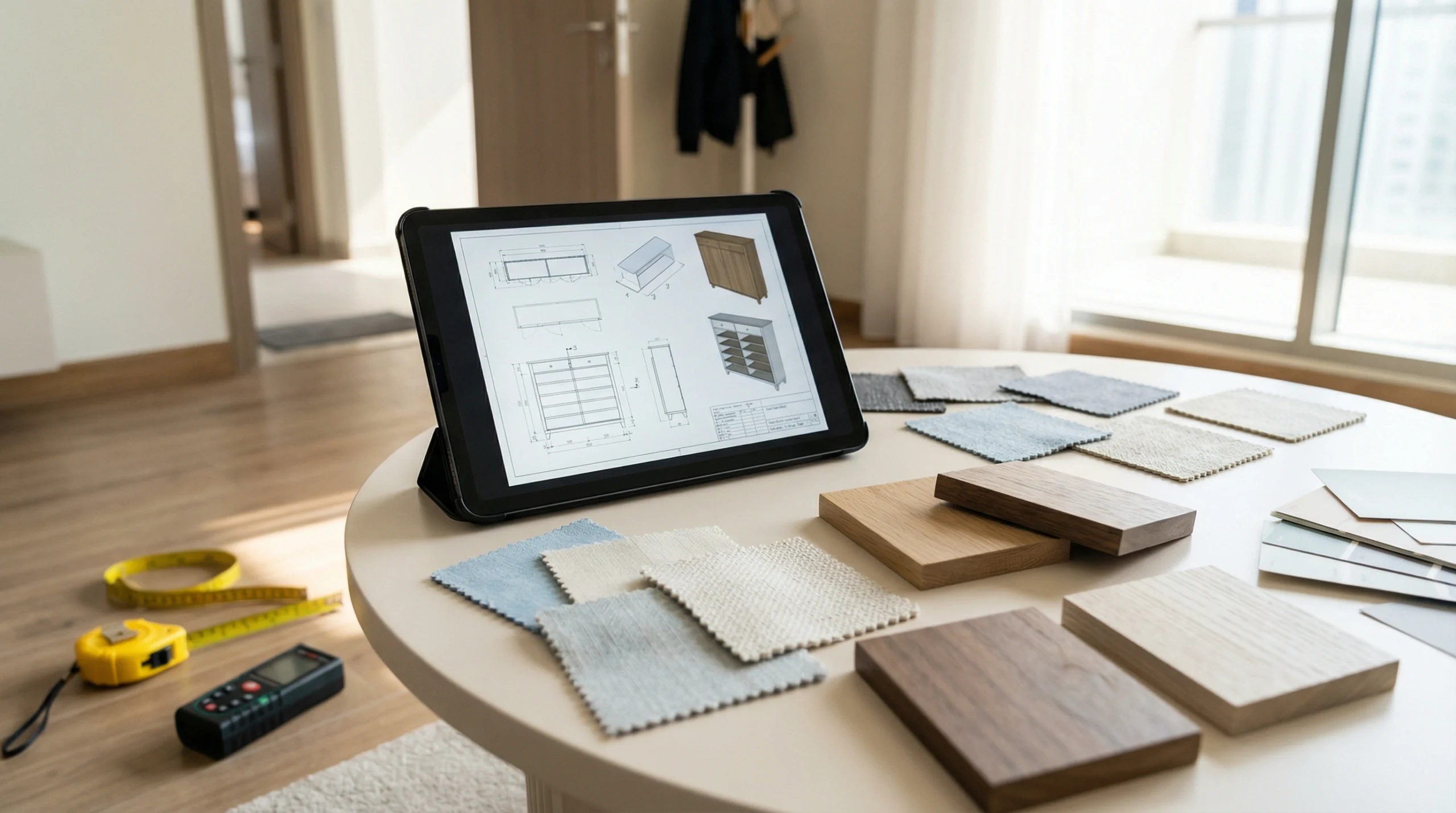
We photograph the space from multiple angles and take detailed measurements. Ceiling heights, wall lengths, depth available, door swing clearances, adjacent furniture positions—everything that affects what we can build and how it will function. We use laser measuring for accuracy and mark critical dimensions on floor plans. In apartments, we verify which walls are suitable for mounting heavy cabinets, as not all walls have adequate structure.
The consultation includes discussing aesthetic preferences. We show examples of previous work on tablets, discuss finish options, explain construction approaches, and help clients articulate their vision. Many people know they need shoe storage but haven’t considered specific design options. We guide this exploration based on what’s appropriate for their space and budget.
Step 2: Design Development and Specification
Back at our office, we create detailed design drawings showing the proposed shoe storage solution. These include front elevations showing what you’ll see, section drawings showing internal configuration, and dimensioned plans showing exact sizes. We specify all materials, finishes, hardware, and installation requirements. The drawings provide clear visualization of the proposal and serve as fabrication documents.
We develop multiple design options when appropriate—perhaps comparing a freestanding unit versus built-in, showing different door configurations, or presenting finish alternatives. Each option includes pricing so clients can make informed decisions about where to invest their budget. We explain tradeoffs clearly. Sliding doors cost less than bifold but reduce access. Higher cabinets maximize capacity but require step stools. Every choice has implications.
The specification process includes selecting exact materials and finishes. We provide physical samples of wood species, paint colors, laminate patterns, and hardware options. Clients make selections from real materials, not just photos. This eliminates surprises when the finished product arrives. We’ve learned that clear material communication prevents 90% of potential dissatisfaction.
Hardware selection matters more than people realize. We specify commercial-grade drawer slides rated for proper weight capacity, soft-close dampers for door systems, and ventilation grilles that balance function with appearance. Clients rarely think about these components, but they determine how the shoe storage functions daily. We make these selections based on 35 years of tracking what performs reliably.
Step 3: Quotation and Project Approval – Shoe Racks Dubai
We provide detailed written quotations itemizing materials, labor, finishing, hardware, delivery, and installation. The breakdown helps clients understand cost components and make value-based decisions. We explain what’s included, what’s excluded, and what optional additions might be considered. Payment terms, project timeline, and warranty coverage are specified clearly.
Quotations remain valid for 30 days, as material costs fluctuate. We include allowances for items not yet selected—if finish choice affects cost, we show a reasonable allowance that can be reconciled once selections are final. The goal is providing accurate pricing while accommodating design decisions still in progress. We revise quotes if scope changes during the approval period.
Once clients approve the design and pricing, we require a 50% deposit to commence work. This covers material procurement and reserves workshop capacity. The remaining 50% is due upon installation completion and client approval. We’ve maintained this payment structure for years—it’s fair to both parties and ensures commitment without creating risk.
Project timelines from approval to installation typically run 3-4 weeks for standard projects, 4-6 weeks for complex built-ins, and 6-8 weeks during peak periods (September through November when many residents return from summer travel). We provide realistic timelines accounting for current workshop load. Rushing projects compromises quality, and we’ve learned that clear timeline communication beats optimistic promises.
Step 4: Workshop Fabrication
All fabrication happens in our Dubai workshop where we control quality and timing. We don’t outsource production to external factories. Materials are cut on precision panel saws and CNC equipment for accuracy. We cut all components at once to ensure consistency—if we’re building six shelves, all six are cut from the same settings to guarantee identical dimensions.
Assembly uses appropriate joinery for each application. Cabinet cases receive corner reinforcement, either mechanical fasteners with structural adhesive or proper joinery where visible. Shelves sit in dadoes or on reinforced supports. Backs are recessed into rabbets. We build like furniture manufacturers, not like people screwing together flat-pack components. The structural integrity shows in how the finished piece feels—solid, precise, permanent.
Finishing happens in controlled spray booths with proper ventilation and dust control. Paint finishes receive primer coats, sanding, and multiple topcoats. Wood finishes involve grain filling, staining, sealing, and topcoating. Catalyzed finishes require specific mixing ratios and application conditions—we maintain proper environment control for optimal curing. The finish quality determines long-term appearance, so we invest heavily in this phase.
Quality control occurs throughout fabrication. We check dimensions against drawings, verify finish quality before assembly, test mechanical components for smooth operation, and inspect completed units before scheduling installation. Problems caught in the workshop are easily corrected. Problems discovered during installation create delays and frustration. Our QC process eliminates most installation-day surprises.
Step 5: Delivery and Professional Installation
We schedule installation when fabrication is complete and client availability aligns. Our installation teams work in two-person crews minimum for efficiency and safety. They arrive with all necessary tools, fasteners, shims, fillers, and touch-up materials. The installation site should be clear of obstructions, and we ask clients to protect valuable items in the work area.
Installation begins with verifying space dimensions match our original measurements. We’ve encountered situations where homeowners made changes after our consultation—painted walls, installed new flooring, added furniture—that affect installation. Catching these issues immediately allows adjustment before proceeding. We level and plumb all components regardless of floor or wall irregularities, using shims and adjustment where needed.
Mounting and anchoring follows engineering specifications. Wall cabinets receive anchors into studs or concrete with appropriate fastener types and spacing. We verify holding strength before loading weight. Freestanding units that exceed 120cm height or might be climbed by children receive tip-over prevention anchoring. We explain this to clients and secure permission before drilling any holes.
Final adjustments ensure everything operates smoothly. Doors are aligned and adjusted for consistent reveals. Drawers operate without binding. Shelves sit level. We clean up completely—removing packaging, vacuuming dust, wiping surfaces. The installation should look like the shoe storage has always been there, with no evidence of the installation process except the new furniture.
Step 6: Client Orientation and Handover
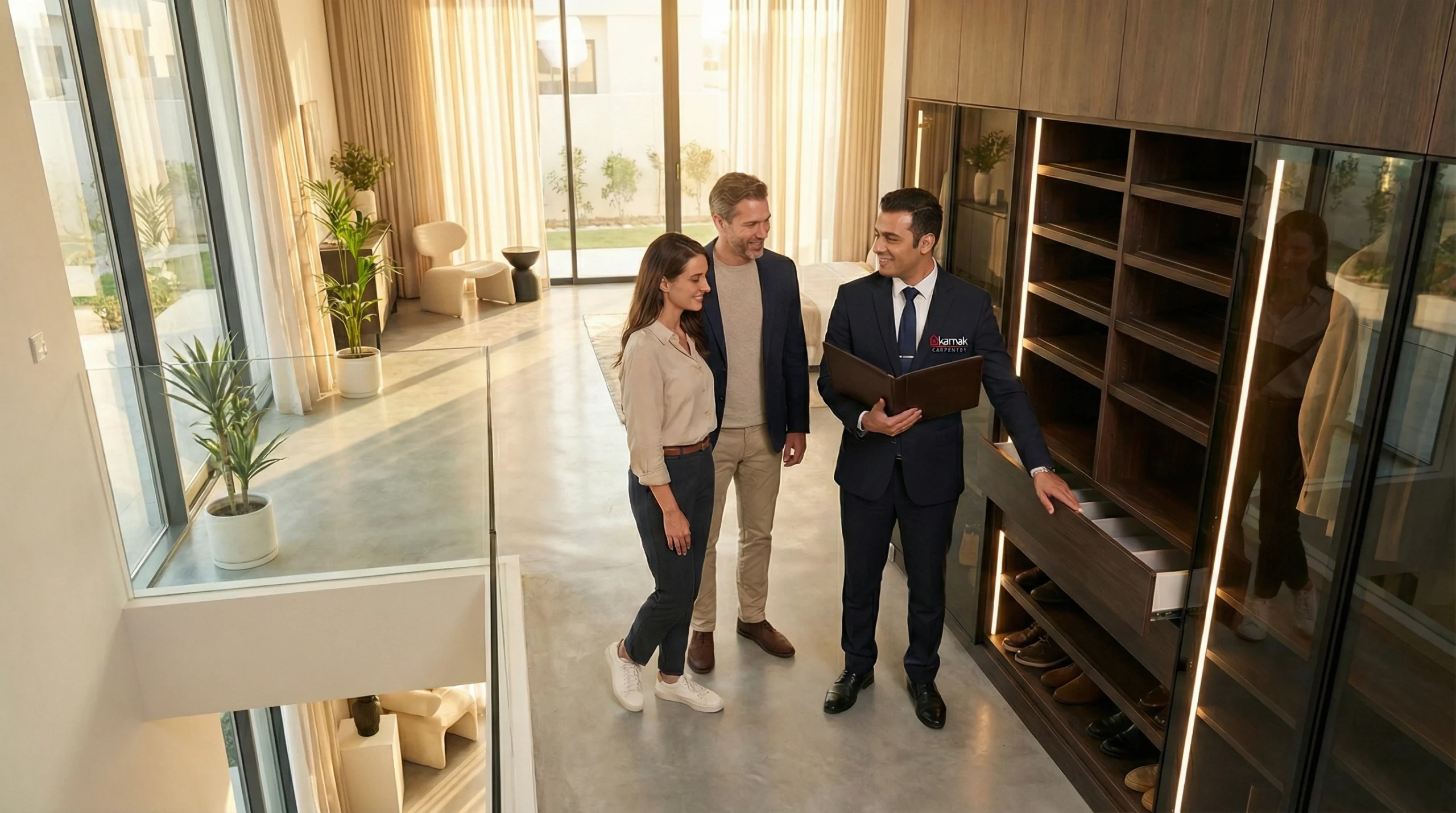
Before leaving, we walk clients through proper use and care. We demonstrate how doors operate, explain any special features like soft-close mechanisms or pull-out racks, show how to clean and maintain finishes, and answer questions about organization strategies. We provide written care instructions covering cleaning methods, what to avoid, and how to contact us if issues arise.
We verify client satisfaction before final payment collection. They should inspect the installation, confirm it matches expectations, and raise any concerns while we’re on site. Most issues are minor adjustments easily handled immediately. We’d rather address concerns during installation than receive calls afterward. The face-to-face handover ensures clear communication.
Documentation provided includes proof of payment receipt, warranty information, care instructions, and contact details for future service needs. We photograph the completed installation for our records and portfolio (with client permission). These photos help future clients visualize possibilities and serve as references if service is needed years later.
The warranty covers manufacturing defects and installation issues for 12 months from installation date. This includes hardware failures, finish defects, structural problems, or installation-related damage. Normal wear, damage from misuse, or environmental issues beyond our control aren’t covered. We explain coverage clearly so expectations are aligned.
Step 7: Follow-Up and Long-Term Service
We contact clients 2-4 weeks after installation to verify everything is functioning well and answer any questions that arose during use. Sometimes people discover operational questions or optimization opportunities once they’ve used the storage for a few weeks. This follow-up catches minor issues before they become problems.
Long-term service availability matters for furniture expected to last decades. Hardware can wear out, finishes might need touching up, or home modifications might require storage adjustments. We maintain client records indefinitely and stock common hardware for our installations. If you need service five years later, we have your project documentation and can provide appropriate support.
Many clients return for additional projects once they experience our work. The shoe storage project leads to requests for closet organization, kitchen renovations, office furniture, or complete home carpentry. These relationships built on successful initial projects have sustained our business for 35 years. We value them and invest in maintaining these connections.
Why UAE Homeowners Choose Karnak for Shoe Storage Solutions
Selecting who builds your shoe storage might seem straightforward, but the choice affects daily life for years. You’ll interact with this furniture multiple times daily. It needs to function flawlessly, maintain appearance, and justify the investment through long-term performance.
Three and a Half Decades of UAE-Specific Expertise
Since 1988, we’ve completed over 10,000 carpentry projects across the UAE. This includes approximately 2,400 residential shoe storage installations, from basic racks to sophisticated closet systems. We’ve worked in every emirate, every community type, and virtually every architectural style present in the UAE. This experience base informs every design decision we make.
We know which materials survive in specific Dubai microclimates because we’ve tracked performance across thousands of installations. Coastal apartments in Marina require different material specifications than desert-edge communities in Arabian Ranches. We’ve documented which finishes hold up to daily use and which fail. We know how Dubai Municipality requirements affect built-in installations in different building types. This knowledge isn’t theoretical—it’s earned through 35 years of learning what works.
Our client relationships span generations in some cases. We built shoe storage for parents in the 1990s, then their children’s homes in the 2010s, now we’re working with grandchildren. These multi-generational relationships exist because our work lasts and our service remains consistent. Families return because they remember the quality and reliability from previous projects.
The UAE market has changed dramatically since 1988. Building standards evolved, material availability expanded, design trends shifted, client expectations increased. We’ve adapted continuously while maintaining core principles of quality craftsmanship and client service. This balance of evolution and consistency defines our approach.
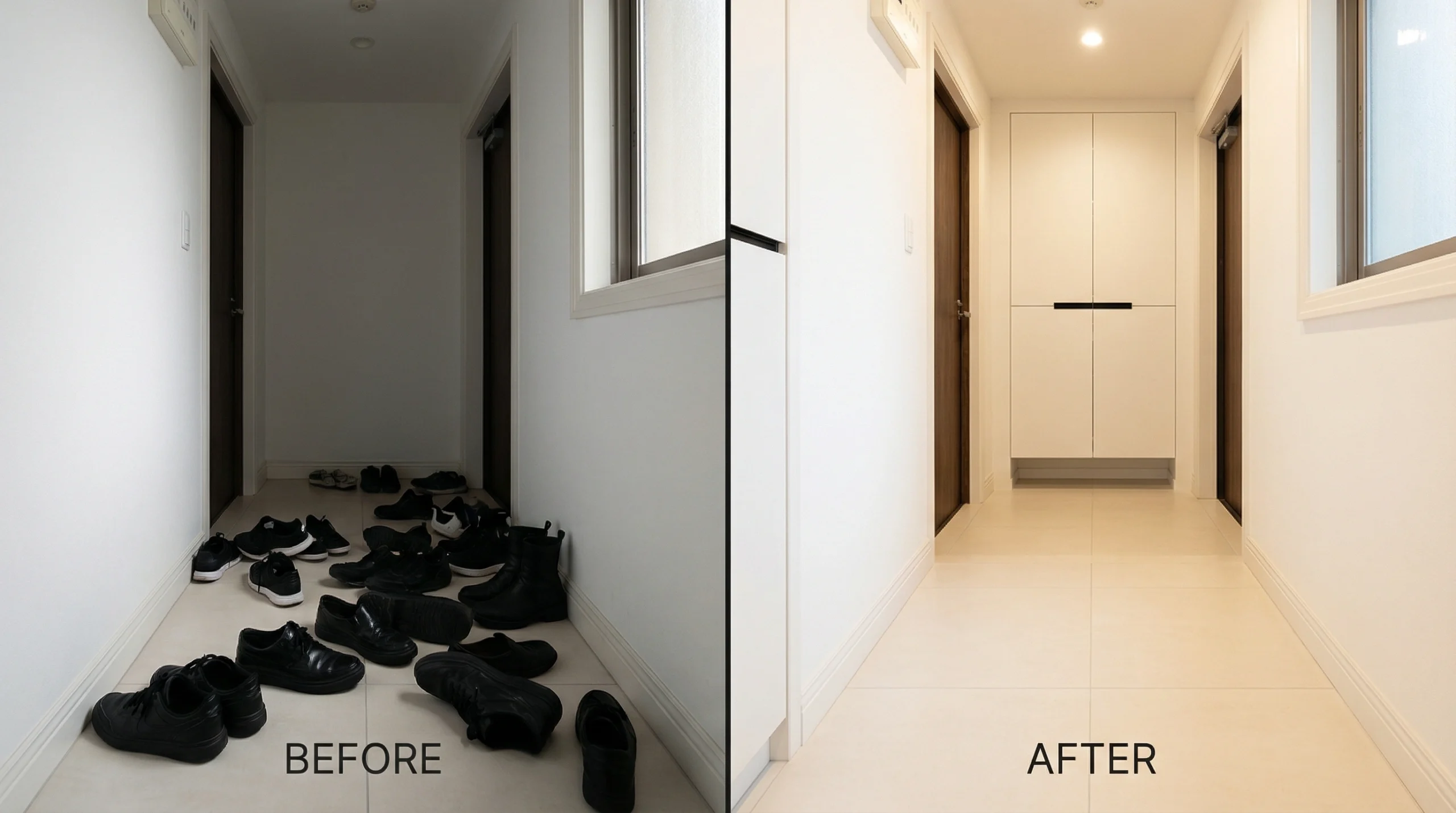
Complete In-House Manufacturing Control – Shoe Racks Dubai & UAE
Shoe Racks Dubai – We fabricate all shoe storage in our Dubai workshop using our equipment and craftsmen. This isn’t a sales operation outsourcing production. When we quote a project, we’re committing our workshop capacity, materials we’ll purchase, and craftsmen we employ. This creates accountability that outsourced models can’t match.
Our workshop equipment includes precision panel saws, CNC routers, edge banders, wide belt sanders, and professional spray booths. These allow us to control quality at every production stage. We’re not assembling imported components—we’re manufacturing custom solutions from raw materials. If specifications require adjustment during fabrication, we make those decisions immediately without external approvals.
The craftsmen in our workshop average 8-15 years with Karnak, with several exceeding 20 years. This stability creates consistent quality and institutional knowledge. When someone has built hundreds of shoe cabinets, they notice problems during fabrication that less experienced workers miss. They know how things should fit, how finishes should look, what tolerances are acceptable. This experience is irreplaceable.
Quality control during fabrication prevents installation problems. We catch dimensional errors, finish defects, or operational issues while correction is straightforward. By installation day, the product has been thoroughly verified. This front-loaded QC process eliminates the delays and frustrations common with outsourced manufacturing where problems aren’t discovered until delivery.
Genuine Custom Design for Your Specific Space
Shoe Racks Dubai – Custom doesn’t mean selecting from pre-designed options—it means creating solutions specific to your space, possessions, and preferences. We measure your actual rooms, count your actual shoes, and design storage that fits perfectly. A 147cm wall space gets a 147cm cabinet, not a 150cm unit with gaps or a forced 140cm compromise.
We accommodate architectural irregularities common in UAE construction. Walls aren’t always plumb, floors aren’t always level, ceiling heights vary within rooms. Our designs account for these realities. We scribe to walls, use adjustable feet for leveling, and create shadow gaps where perfect fits aren’t achievable. The result looks intentional and professional rather than exposing construction limitations.
Lifestyle-specific design considers how you actually live. If you have young children who will be using shoe storage independently, we design lower accessible sections. If you’re a shoe collector who rotates displays seasonally, we include flexible shelving. If you entertain frequently and have guests removing shoes at the entrance, we ensure adequate capacity and elegant appearance. Generic solutions can’t accommodate these individual requirements.
Material and finish customization means your shoe storage integrates with your interior design investment. We match existing cabinetry, complement architectural details, or create contrasting focal points based on design intent. The shoe storage should feel like part of the original space planning, not an afterthought addition. This integration requires careful attention to details like trim profiles, finish sheens, and hardware styles.
Transparent Pricing and Project Management – Shoe Racks Dubai & UAE
We provide detailed written quotations showing exactly what you’re purchasing. Material specifications, labor components, finishing details, hardware selections, delivery and installation—everything is itemized. This transparency helps you understand value and make informed decisions about where to invest or economize.
No surprises or hidden costs emerge during projects. The quoted price is the price you pay unless you request scope changes. We build contingencies into quotes for foreseeable variables rather than low-balling estimates that inevitably increase. This might mean our initial quotes aren’t always the lowest, but the final invoices match expectations.
Project timelines are realistic and generally met. We account for current workshop load, material procurement lead times, and installation logistics when promising completion dates. We communicate proactively if delays occur—material shipment issues, unexpected site conditions, or other complications. Clients deserve honest timeline management, not optimistic promises that create frustration.
Change management during projects follows clear processes. If you want to modify designs after approval, we explain cost and timeline implications before proceeding. If we discover issues requiring changes, we present options and costs for approval. Changes happen on many projects, but transparent handling prevents disputes.
Comprehensive Warranty and After-Installation Support
Our 12-month warranty covers manufacturing defects, installation issues, and hardware failures. If doors misalign, finishes delaminate, or structural problems develop from workmanship issues, we correct them at no cost. This warranty provides peace of mind and demonstrates confidence in our work quality.
Beyond warranty coverage, we provide long-term service availability. If hardware needs replacement five years later, we maintain records and can source appropriate components. If you need modifications due to changing needs, we understand the original installation and can integrate modifications seamlessly. This ongoing relationship benefits clients needing service and provides us valuable long-term performance feedback.
We respond to service calls within 48-72 hours typically. If the issue is urgent—a broken door affecting daily function—we prioritize faster response. Most service needs are minor adjustments or normal wear items, handled quickly. Knowing reliable service is available reduces anxiety about making significant furniture investments.
The warranty and service commitment reflects our long-term business perspective. We’ve operated in Dubai for 35 years and plan to continue indefinitely. This long horizon means we can’t afford poor quality or service failures—our reputation depends on long-term client satisfaction. This alignment of incentives benefits everyone.
Shoe Storage Solutions for Different UAE Property Types – Shoe Racks Dubai
Dubai’s diverse residential architecture creates varied storage challenges. What works in a JBR studio doesn’t suit an Emirates Hills villa. We’ve developed solution sets optimized for common property types across the UAE.
Apartment Solutions: Maximizing Limited Space – Shoe Racks Dubai & UAE
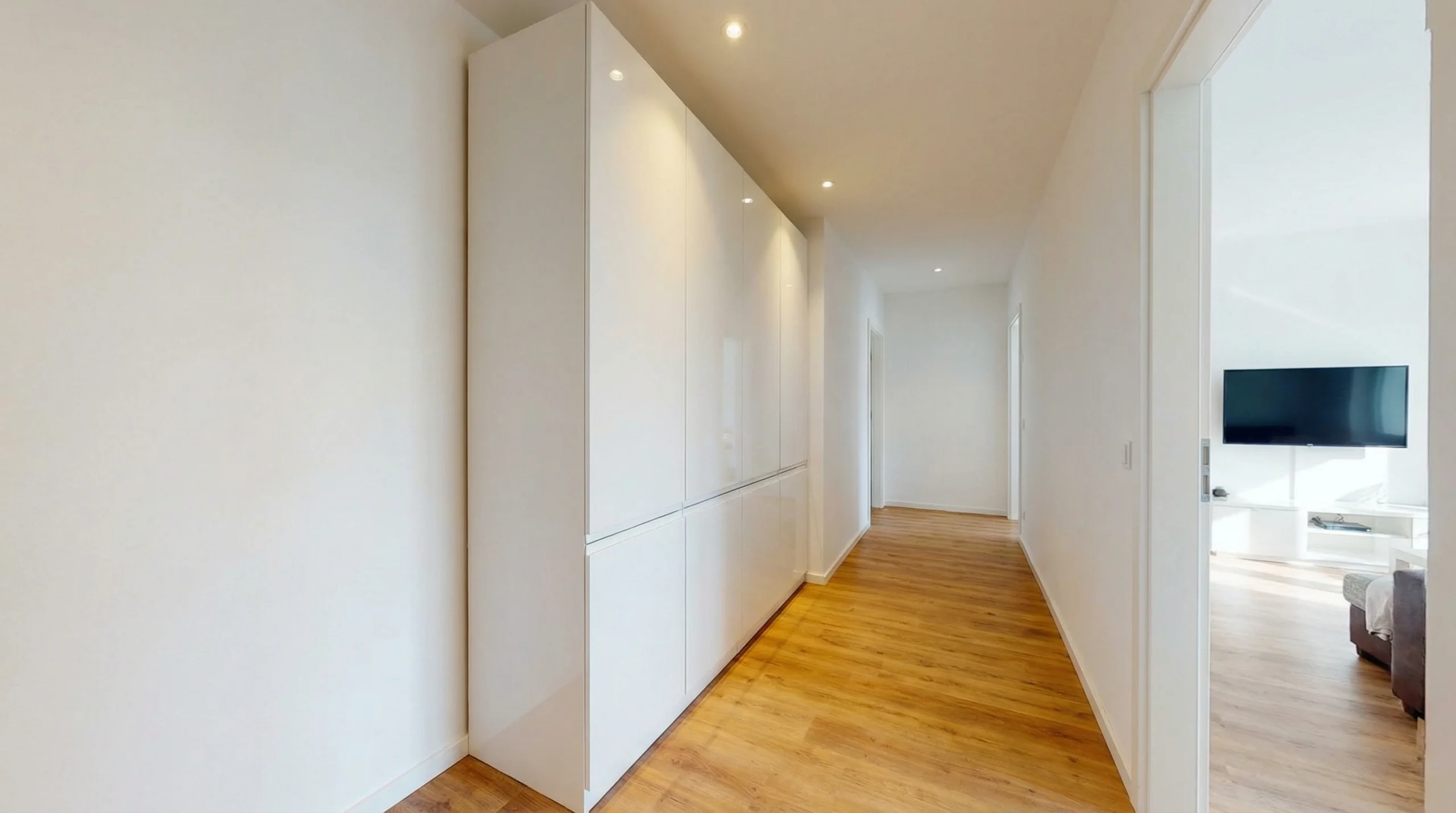
Modern Dubai apartments present the classic storage challenge—significant shoe collections in limited square footage. We focus on vertical solutions using full ceiling height, slim-profile cabinets that minimize floor space consumption, and multi-functional furniture combining shoe storage with other uses.
Studio and one-bedroom apartments typically have 1.2-1.5 meter entrance areas. We design floor-to-ceiling cabinets 35-40cm deep spanning the available width. These accommodate 40-60 pairs while maintaining narrow profiles that don’t obstruct movement. Pull-out racks maximize the depth, bringing shoes forward for visibility and access. The sleek appearance suits modern apartment aesthetics.
Two and three-bedroom apartments often have slightly larger entrance areas or hallways where we can create more substantial shoe storage. We build combination units with bench seating, coat hanging, and shoe cabinets integrated into single furniture pieces. The bench provides sitting while putting on shoes, making the furniture more valuable than just storage. Upper sections hold coats and bags, creating complete entrance organization.
Some apartment configurations include entrance closets or storage rooms where we can install more extensive built-in systems. These dedicated storage spaces allow floor-to-ceiling shelving on multiple walls, dramatically increasing capacity. We treat these like small walk-in closets, using angled shelves, pull-out racks, and organized sections for different family members or shoe categories.
Villa and Townhouse Storage Systems – Shoe Racks Dubai & UAE
Villas and townhouses provide more spatial flexibility but create different organizational challenges—larger families, more shoes, often multiple entrance points. We design comprehensive systems addressing the full scope of shoe storage needs rather than single units.
Main entrance shoe storage in villas needs capacity for family members plus guests who remove shoes when entering. We typically design substantial built-in or freestanding units accommodating 80-120 pairs. These often include seating, coat storage, and sometimes built-in consoles or display areas. The furniture makes a design statement while providing serious functional capacity.
Master bedroom closets receive dedicated shoe zones integrated into overall wardrobe design. We allocate 2-3 meters of wall space for shoe storage, using floor-to-ceiling configurations with angled shelves or pull-out racks. This keeps master bedroom shoes separate from family entrance storage and provides more controlled environment conditions for special or seasonal footwear.
Children’s bedrooms or family areas sometimes need separate shoe storage to prevent kids’ shoes from migrating to main living areas. We design scaled-down versions appropriate for smaller shoe sizes and teaching organization skills. Lower shelves that children can access independently, durable finishes that handle rough use, and simple organization systems work best.
Mudrooms or back entrances common in villas need practical shoe storage for outdoor, athletic, or work footwear that shouldn’t mix with entrance shoes. We design heavy-duty open shelving or ventilated cabinets in these areas, prioritizing function over aesthetics. Materials like marine plywood and easy-clean finishes handle the demanding use these areas receive.
Walk-In Closet Shoe Display Systems
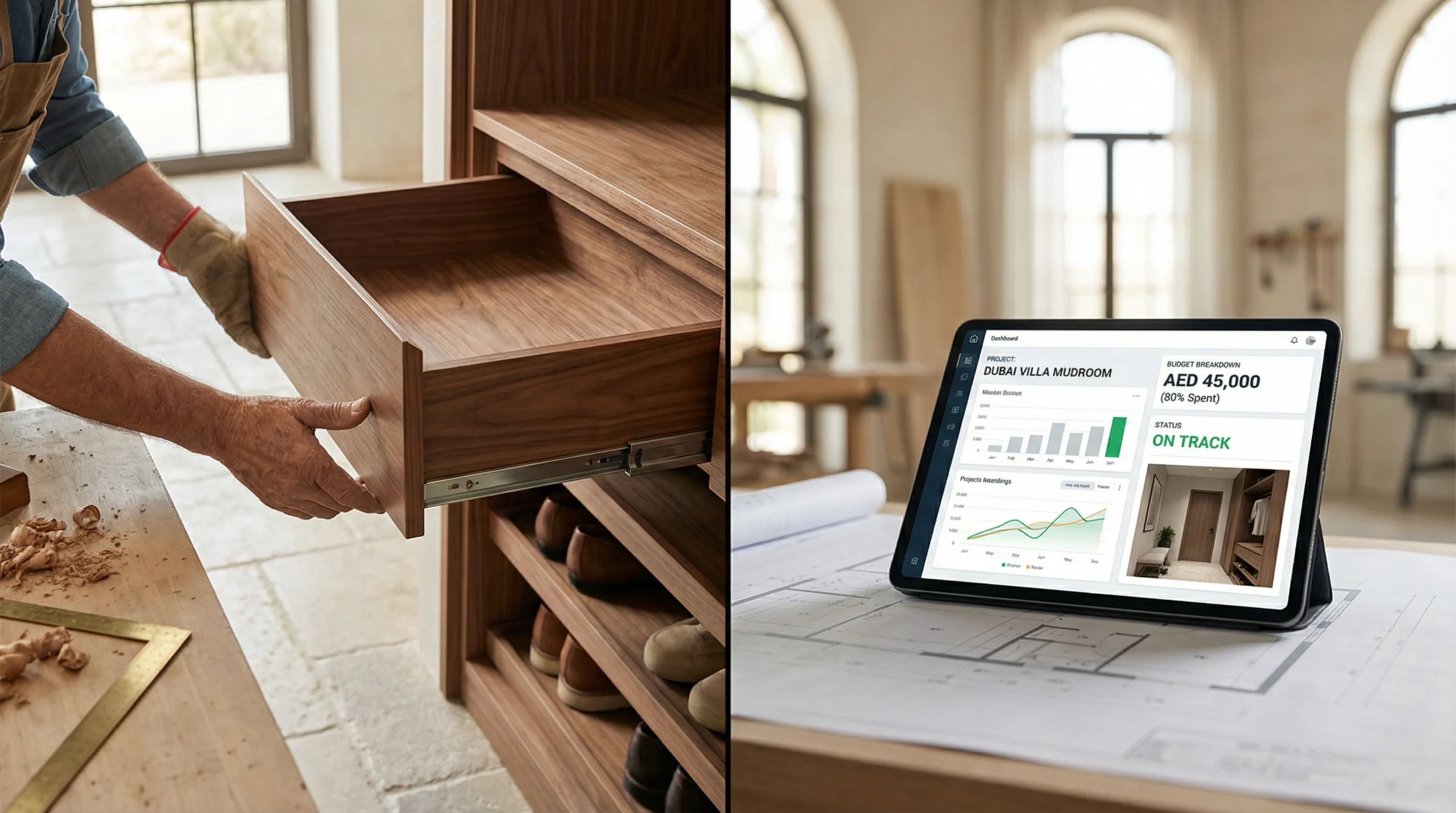
Serious shoe collectors with walk-in closets want display-quality storage that showcases collections while maintaining organization. We approach these projects like retail boutique millwork—every pair visible, accessible, and beautifully presented.
Glass-front cabinets provide dust protection while keeping shoes visible. We install LED lighting inside to create dramatic displays. The glass shelving we specify is tempered safety glass with polished edges, supported on adjustable brackets. This creates the floating appearance popular in luxury retail while handling the weight of multiple shoe pairs per shelf.
Pull-out display racks in walk-in closets bring shoes forward for viewing like retail displays. Each rack holds 8-12 pairs depending on depth, mounted on full-extension soft-close slides. We angle the racks slightly so shoes display attractively when pulled out. The mechanical quality of these systems must be exceptional—they’ll be used daily and need to operate smoothly for years.
Dedicated shoe walls in larger walk-ins feature individual cubbies for each pair, creating dramatic visual impact. We build these as floor-to-ceiling installations with staggered cubby sizes accommodating different shoe types. Lighting can be integrated into each cubby or provided as overall illumination. The effect resembles luxury shoe boutiques.
Some clients request specific zones for shoe categories—separate areas for athletic shoes, formal shoes, sandals, boots, special occasion shoes. We create visual separation through different shelving styles, finishes, or lighting. This category organization makes selection easier and adds visual interest to large installations.
Commercial and Hospitality Shoe Storage – Shoe Racks Dubai & UAE
We occasionally design shoe storage for commercial applications—spas requiring guest shoe storage, medical facilities with staff shoe change areas, or hospitality venues in markets serving customers who remove shoes. These applications demand durability, simplicity, and capacity beyond residential needs.
Spa and wellness facility shoe storage needs to accommodate numerous guests efficiently while maintaining the luxury atmosphere these businesses cultivate. We design numbered cubby systems where guests receive numbers and use corresponding storage cubbies. The construction uses high-pressure laminates in upscale finishes, commercial-grade hardware, and ventilated designs that prevent odor issues.
Medical facility staff areas need practical shoe storage where healthcare workers change from street shoes to professional footwear. Open shelving or ventilated lockers work well, using materials that withstand cleaning and disinfection. We avoid ornate details that collect dust and design for easy maintenance—smooth surfaces, minimal crevices, durable finishes.
Retail or showroom applications might need shoe storage for customer use—furniture stores showcasing room settings with removal shoe policies, or cultural facilities. We design these installations to handle heavy traffic and unskilled use—robust construction, simple operation, materials that hide wear. The aesthetic should complement the commercial space without demanding excessive maintenance.
Recent Shoe Storage Projects Across UAE
Our portfolio includes hundreds of completed shoe storage installations. These representative projects demonstrate our range of capabilities and the diverse solutions we create for different client needs.
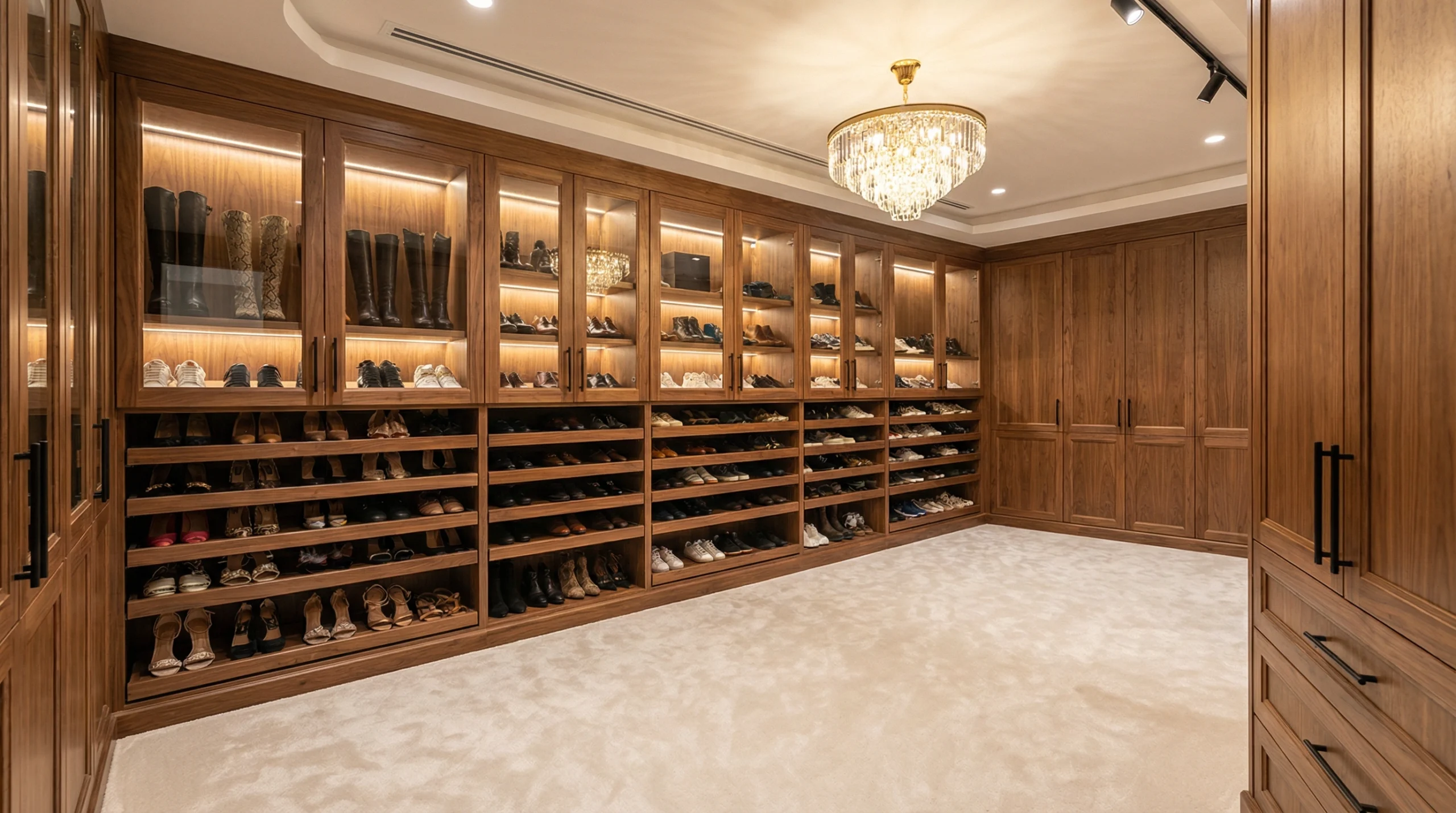
Luxury Villa Walk-In Closet – Emirates Hills
A 12-square-meter master closet renovation included a dedicated 4-meter shoe wall accommodating 180 pairs across floor-to-ceiling angled shelves. Glass-front upper cabinets display special occasion shoes with integrated LED lighting. Pull-out racks in lower sections hold everyday shoes. The installation uses walnut wood with satin lacquer finish matching the existing wardrobes. Project timeline was 7 weeks from design to completion. The client specifically requested seasonal rotation capability and boutique-quality displays.
Marina Apartment Built-In System – Dubai Marina
A 2-bedroom Marina apartment with limited entrance space received a floor-to-ceiling built-in shoe cabinet 120cm wide and 35cm deep. White lacquered finish matches the apartment’s modern aesthetic. Soft-close doors conceal 16 pull-out racks accommodating 64 pairs total. Internal LED lighting activates when doors open. The slim profile leaves adequate hallway width while providing substantial capacity. Installation required coastal-rated materials due to proximity to sea. Timeline was 4 weeks including custom color matching.
Family Villa Mudroom – Arabian Ranches
Complete mudroom renovation in a 4-bedroom villa included dual shoe storage zones—a built-in bench with shoe cabinets underneath for daily use (40 pair capacity) and a walk-in storage closet with floor-to-ceiling shelving for seasonal and special shoes (80 pair capacity). Bench provides cushioned seating and concealed storage. Materials include marine plywood with gray paint finish. Separate zones for adults and children keep organization manageable for the family. 5-week project included electrical work for integrated lighting.
JBR Studio Apartment Solution – Jumeirah Beach Residence
Space-constrained studio apartment with 1-meter entrance area received a custom freestanding shoe cabinet 90cm wide, 30cm deep, and 200cm tall. The unit combines enclosed lower cabinet (24 pairs), open middle shelves (16 pairs), and upper cabinet with display shelf top. White lacquer finish coordinates with the apartment’s minimalist design. The narrow profile maximizes capacity without overwhelming the small entrance. Delivered and installed in 3 weeks, within the client’s budget constraints for quality storage.
Commercial Spa Reception – DIFC
Upscale spa facility needed guest shoe storage for 40 simultaneous visitors. We designed a wall of numbered cubbies using high-gloss laminate in warm gray, integrated into the reception area design. Each cubby includes ventilation and accommodates various shoe sizes. Brushed brass cubby numbers match the spa’s luxury branding. Commercial-grade construction handles daily use by different visitors. The installation complements the sophisticated interior design while serving essential function. 6-week fabrication and installation timeline coordinated with spa construction schedule.
Townhouse Walk-In Closet – The Springs
3-bedroom townhouse master closet received comprehensive wardrobe and shoe storage upgrade. Shoe storage includes angled shelf section (60 pairs) and pull-out rack section (32 pairs) integrated into the overall wardrobe design. Materials are moisture-resistant MDF with wood veneer finish matching bedroom furniture. Design accommodates both daily and seasonal rotation needs. Adjustable sections allow future reconfiguration. 5-week project completed while clients were traveling, coordinating with property access.
Executive Apartment – Business Bay
Modern executive apartment entrance redesign included a sophisticated shoe storage bench spanning 160cm. The bench features cushioned seating upholstered in gray fabric, concealed shoe cabinet underneath (32 pairs), and floating wall-mounted coat hooks above. Internal organization includes removable dividers for flexible configuration. Materials include painted MDF carcass with walnut veneer bench seat. The integrated design creates functional entrance furniture rather than obvious storage. 4-week timeline included custom upholstery coordination.
Villa Secondary Entrance – Jumeirah Park
Family villa’s frequently-used garage entrance needed practical shoe storage for outdoor and children’s shoes. We installed a robust shelving system 240cm wide with open shelves at child-accessible heights and upper cabinets for seasonal storage. Total capacity approximately 100 pairs. Materials include moisture-resistant MDF with easy-clean laminate finish that handles heavy daily use. Ventilated design prevents odor issues. Separate zones for different family members maintain organization. 3-week installation coordinated with garage renovations.
Penthouse Walk-In – Downtown Dubai
Large penthouse master suite with 15-square-meter closet included extensive shoe storage for a collector’s 250+ pairs. Solution combined multiple approaches—glass display cabinets with lighting (80 pairs), floor-to-ceiling angled shelving (120 pairs), and pull-out racks (50+ pairs). High-gloss white lacquer finish creates gallery-like atmosphere. Individual cubby sections organize by color and style. LED lighting throughout creates dramatic presentations. This was an 8-week project with premium finishes and complex installation requirements.
Apartment Renovation – Palm Jumeirah
Complete apartment renovation included custom entrance furniture combining coat storage, shoe cabinets, and bench seating in one integrated unit. The 200cm wide installation provides capacity for 50+ pairs while serving multiple functions. Two-tone finish with white lacquer body and walnut accents matches the apartment’s contemporary aesthetic. Pull-out racks, soft-close doors, and integrated LED lighting enhance usability. 6-week timeline coordinated with broader renovation schedule.
Shoe Storage Questions – Expert Answers
Count your current shoe collection for all household members, then add 30-40% for growth. Most Dubai residents significantly underestimate their shoe count. Walk through your home and count everything—entrance shoes, bedroom shoes, closet shoes, seasonal shoes stored away, children’s shoes including outgrown pairs awaiting hand-down, athletic shoes, formal shoes, sandals, indoor slippers. The total usually surprises people.
A single adult typically owns 15-30 pairs depending on lifestyle. Professionals working in formal environments might own 40+ pairs. Children’s shoe counts vary by age but plan for 8-15 pairs per child. Add these up across all household members for your baseline. Then consider growth—will your collection expand? Are children growing into larger shoe sizes? Plan capacity for where you’ll be in 2-3 years, not just current needs.
Storage capacity also depends on organization goals. If you want everything stored in one location, you need higher capacity than if you’re comfortable with distributed storage—some in entrance, some in bedrooms, some in closets. Many Dubai homes benefit from dual storage zones: high-capacity everyday storage at the main entrance, and secondary storage for seasonal or special occasion shoes elsewhere.
Our design process includes actual shoe counting during consultation. We don’t guess. We measure your collection, understand your acquisition patterns, account for family changes, and design appropriate capacity. Undersized storage means you’ll outgrow it quickly. Oversized storage wastes space and budget. Getting capacity right is foundational to successful shoe storage.
Moisture-resistant MDF and marine-grade plywood are our primary materials for Dubai shoe storage, selected based on specific location and budget. Both handle UAE humidity far better than standard particleboard or basic MDF. The key is proper processing—sealed edges, appropriate finishes, and quality construction prevent moisture-related failures.
Moisture-resistant MDF (often green or blue-colored) includes moisture-resistant additives in the core. We seal all cut edges with edge banding and finishing, preventing moisture penetration. This material accepts paint and laminate finishes beautifully and costs less than plywood. It’s our standard specification for most interior shoe storage applications. We’ve tracked hundreds of installations using this material over 10+ years with excellent performance.
Marine-grade plywood becomes our recommendation in coastal areas—Marina, JBR, Palm Jumeirah—where humidity levels are consistently higher. This plywood uses waterproof adhesives between veneer layers and often includes tropical hardwood veneers that naturally resist moisture. It costs 60-80% more than moisture-resistant MDF but provides superior durability in challenging environments. For clients prioritizing maximum longevity in coastal locations, it’s worth the investment.
Solid wood works well for shoe storage but requires appropriate species selection and finishing. We avoid woods that move significantly with moisture changes. Teak, oak, and walnut handle UAE conditions well when properly finished. The finish is critical—multiple coats of catalyzed varnish that seal the wood and prevent moisture penetration. Solid wood costs substantially more than engineered products but provides premium aesthetics for clients who value authentic wood.
Whatever material we use, the finishing process determines long-term performance. Unsealed edges, inadequate finish coats, or poor surface preparation lead to premature failure. We invest heavily in finishing—proper surface prep, multiple coats, adequate curing time—because the finish protects the substrate from environmental challenges.
Both approaches have merit depending on your priorities around dust protection, aesthetics, ventilation, and access convenience. We often recommend combination solutions that provide both enclosed and open sections, optimizing the benefits of each approach.
Enclosed cabinets protect shoes from Dubai’s significant dust accumulation. Shoes in open shelving collect noticeable dust within days, requiring frequent cleaning. Enclosed storage keeps shoes clean and maintains appearance longer. This particularly matters for special occasion shoes or leather footwear where dust damages materials over time. Enclosed cabinets also create cleaner visual appearance—the shoes are hidden behind doors, maintaining uncluttered aesthetics.
However, enclosed storage requires adequate ventilation to prevent moisture and odor buildup. We incorporate ventilation into enclosed designs through perforated back panels, louvered doors, or deliberate air gaps. Without ventilation, enclosed shoe storage in Dubai’s climate can develop musty conditions. The door design also affects convenience—you need to open doors to access shoes, adding a step versus open shelving’s immediate access.
Open shelving provides immediate visibility and access. You can see your entire collection and grab shoes without opening doors. This works well for daily-use shoes where convenience matters more than dust protection. Open designs inherently provide excellent ventilation. The disadvantage is dust accumulation and visual clutter if the shelving is in prominent locations.
Our typical recommendation combines approaches: enclosed cabinets for special occasion and seasonal shoes, open shelving or pull-out racks for everyday shoes. This provides dust protection where it matters while maintaining convenience for daily use. The specific ratio depends on your collection composition and priorities. We design solutions matching your actual needs rather than defaulting to one approach.
Pull-out racks provide superior accessibility in deeper cabinets but add cost and mechanical complexity. Fixed shelving costs less and offers simplicity but can make shoes in deeper storage difficult to reach. The choice depends on cabinet depth, budget, and how much you value convenience.
Pull-out racks bring shoes completely forward for easy viewing and selection. In cabinets 40cm or deeper, accessing shoes at the back of fixed shelves is difficult—you can’t see them well and reaching requires effort. Pull-out racks solve this by bringing the entire shelf forward. We install these on full-extension soft-close drawer slides rated for 35-50kg capacity. The mechanism operates smoothly and prevents slamming.
The additional cost for pull-out racks versus fixed shelving is approximately 40-60% more per unit. This covers the drawer slides (quality soft-close slides cost AED 60-120 per pair), additional construction complexity, and installation labor. For a typical shoe cabinet with 8 pull-out racks, this adds AED 2,000-3,500 to project cost. Whether this is worthwhile depends on how much you’ll use the storage and what you value in convenience.
We recommend pull-out racks primarily in lower cabinet sections (below 120cm height) where you’ll frequently access shoes. Bending to pull-out racks is easier than reaching to fixed shelves. Upper sections can use fixed shelving for seasonal or less-frequently-worn shoes where the convenience premium doesn’t justify the cost. This selective application provides best value.
The mechanical components in pull-out racks are potential failure points that fixed shelving doesn’t have. Quality slides from manufacturers like Blum or Hettich last many years, but they will eventually wear. We specify commercial-grade slides and maintain availability of replacement components. With proper specification, pull-out racks should provide 10-15 years of smooth operation before requiring service.
Built-in installation requires verifying wall structure, obtaining any necessary approvals, professional mounting, and finishing to integrate with existing architecture. The process is more complex than freestanding furniture but creates custom results that maximize space efficiency.
We start by assessing wall construction. Some Dubai apartments have concrete block walls suitable for heavy mounting, while others have steel stud and drywall construction requiring different anchoring approaches. We probe walls to locate studs or verify concrete, then select appropriate fastener types—expansion anchors for concrete, toggle bolts or mounting rails for drywall applications. The mounting system must safely support the cabinet’s loaded weight, typically 80-150kg.
Dubai Municipality approval requirements depend on whether the installation is considered alteration of common property or affects building systems. Most internal cabinet installations in private apartments don’t require municipality approval. However, building management companies sometimes have their own approval processes for modifications. We guide clients through determining what approvals, if any, are needed for their specific situation. Navigating these requirements is part of our service.
The installation process includes precise measurement, level and plumb verification, mounting, finishing, and cleanup. We verify that space dimensions match our workshop measurements—occasionally homeowners make changes after our consultation that affect installation. We level cabinets regardless of floor irregularities, using shims and adjustment feet. Wall gaps receive scribed fillers or shadow gaps depending on design approach. The goal is professional integration that looks planned, not retrofitted.
Installation timing typically requires 4-6 hours for standard cabinet installations, longer for complex multi-wall systems. We ask clients to clear the work area and protect valuable nearby items. Our teams bring all necessary tools, fasteners, and finishing materials. We complete installation, verify operation of all doors and drawers, adjust as needed, clean thoroughly, and provide care instructions before leaving.
Family shoe storage needs dedicated organization zones, accessible sections for children’s independent use, capacity for growing collections, and durable materials that handle daily use by multiple people. We approach these projects with practical organization strategies rather than just providing generic storage.
Separate zones for different family members prevent mixing and maintain organization. We often design color-coded or labeled sections—dad’s shoes in one area, mom’s in another, each child having designated space. This teaches children organization skills and makes morning routines smoother when everyone can find their shoes quickly. The zoning can be visual (different colors or labels) or spatial (different cabinet sections or shelves).
Children need accessible storage they can use independently. Lower shelves or cabinet sections positioned at heights children can reach without assistance encourage self-sufficiency. We typically place children’s shoe storage at 40-100cm heights depending on ages. This eliminates the morning struggle of parents retrieving shoes from high storage. As children grow, the lower sections can be repurposed or adjusted.
Capacity planning for families requires accounting for growth—both children getting older and shoe collections expanding. Children’s feet grow rapidly, creating accumulation of outgrown shoes awaiting hand-down to younger siblings or donation. We add buffer capacity beyond current needs. A family with three children might currently have 60 pairs total but should plan for 90-100 pairs capacity to handle growth.
Material durability matters significantly in family storage that receives heavy daily use from children. We specify more durable finishes—high-pressure laminates, catalyzed paints, or tough varnishes that resist scuffing and damage. Avoid delicate finishes or materials that show wear easily. Soft-close mechanisms prevent slamming that children might not avoid consciously. The storage should handle real-world family use for years.
Yes, we regularly add shoe storage to existing closet systems or retrofit wardrobes with dedicated shoe zones. The approach depends on available space, current configuration, and how much disruption you’re willing to accept during installation.
Simple additions include installing pull-out shoe racks Dubai in unused lower wardrobe sections or adding angled shelving on available wall space. Many existing closets have wasted lower areas where hanging clothes don’t extend to the floor. We install pull-out racks or fixed shelving in these zones, adding capacity without removing existing components. This minimal-intervention approach works when you want to add shoe storage without complete redesign.
More comprehensive retrofits involve reconfiguring closet layouts to create dedicated shoe zones. This might mean reducing hanging space to allocate wall area for floor-to-ceiling shoe shelving, or removing old shelf systems and installing new configurations optimized for shoes. We measure the existing closet, design new layouts, remove old components, and install new shoe-specific storage. This creates better results but requires more extensive work.
Integration quality depends on matching existing finishes and styles. If your wardrobe is white melamine and we’re adding shoe racks Dubai – UAE, we’ll match the white melamine finish. If it’s wood veneer, we’ll match the species and color as closely as possible. Perfect matching sometimes proves impossible if the original installation is old or uses discontinued materials, but we get very close with careful color matching and finishing.
The disruption level varies with project scope. Simple rack additions might take half a day with minimal mess. Complete closet reconfigurations require emptying the closet, might take 1-2 days, and create construction dust requiring cleanup. We explain the disruption level clearly during planning so clients can prepare appropriately—timing the work when they’re traveling, temporarily relocating closet contents, protecting adjacent areas.
Custom shoe storage fits your specific space exactly, accommodates your exact collection, integrates with your interior design, and provides long-term durability that imported units rarely match. The investment premium over ready-made units—typically 2-3x cost—delivers substantially better results that justify the difference for most clients.
Space efficiency represents the clearest advantage. Ready-made units come in standard sizes that rarely fit your space perfectly. A 150cm wall receives a 140cm unit with gaps, or you force a 160cm unit and create problems. Custom solutions use 100% of available space—147cm walls get 147cm cabinets. In Dubai apartments where space is precious, maximizing every centimeter matters significantly.
Capacity optimization means custom storage holds exactly what you own. We count your shoes and design appropriate capacity with growth buffer. Ready-made units provide arbitrary capacity that’s often insufficient or excessive. Our designs include the right ratio of hanging space, shelving, pull-out racks, and specialized storage based on your collection composition. Generic units can’t optimize for your specific needs.
Quality differences are substantial. We use moisture-resistant materials suitable for Dubai, commercial-grade hardware, proper finishing, and solid construction. Ready-made units typically use basic particleboard, minimal hardware, and finishing appropriate for temperature-controlled warehouses rather than UAE homes. The durability gap is dramatic—our installations last 15-20+ years while imported units often fail within 3-5 years.
Aesthetic integration is only possible with custom work. Ready-made units are designed to appeal broadly, not integrate specifically with your interior design. Custom solutions match your existing cabinetry, complement architectural details, and can incorporate special features like lighting or unusual configurations. The result looks planned and permanent rather than added furniture.
The investment calculation weighs upfront cost against longevity, functionality, and satisfaction. A custom shoe cabinet costing AED 8,000-12,000 that lasts 20 years and perfectly serves your needs costs less annually than replacing AED 2,000-3,000 imported units every 3-4 years while tolerating inadequate function. For clients who value quality and plan to remain in their homes, custom represents better value despite higher initial investment.
From initial consultation to completed installation, most shoe storage projects take 3-6 weeks depending on complexity, current workshop load, and any special requirements. We break this into distinct phases with typical timelines for each.
Initial consultation and site visit happen within 3-5 days of first contact, sometimes sooner if schedule permits. This 30-45 minute visit includes measuring space, counting shoes, discussing requirements, and understanding aesthetic preferences. We take detailed measurements and photos for design development.
Design development requires 3-7 days after consultation. We create detailed drawings, develop specifications, select materials, and prepare quotations. Complex projects with multiple design options take longer than straightforward applications. We present designs with material samples for client review and feedback.
Design approval and revisions add 2-5 days typically. Clients review proposals, request modifications, make material selections, and approve final designs. Some clients decide immediately, others need time to discuss with family or compare options. Once design and pricing are approved and deposit received, we schedule fabrication.
Workshop fabrication takes 2-3 weeks for standard projects, 3-4 weeks for complex built-ins, and 4-5 weeks during peak periods. This includes material procurement, cutting, assembly, finishing, and quality control. We don’t rush fabrication as quality requires appropriate time for processes like finish curing. Material lead times occasionally extend this if special-order items are required.
Installation scheduling happens when fabrication is near completion. We coordinate with client availability, typically finding installation dates within 3-5 days of fabrication completion. Installation takes 4-8 hours depending on project complexity—simple freestanding units install quickly, extensive built-in systems require longer.
Total timeline from first contact to completed installation averages 4-5 weeks for straightforward projects. Complex installations or projects during busy seasons (September-November) might extend to 6-8 weeks. We provide realistic timeline estimates upfront and communicate proactively about any delays. Rushing projects compromises quality, so we encourage clients to plan ahead rather than expecting immediate turnaround.
Properly built shoe storage requires minimal maintenance beyond regular cleaning and occasional hardware adjustment. We design for durability and specify finishes that simplify upkeep, not finishes that need constant attention.
Regular cleaning involves wiping surfaces with slightly damp cloths to remove dust. Avoid excessive water or harsh chemicals that might damage finishes. For painted or laminate surfaces, mild soap solution works well for tougher dirt. Wood finishes benefit from occasional treatment with furniture polish or wood conditioner, though modern catalyzed finishes don’t require this as frequently as traditional finishes did.
Pull-out rack maintenance includes periodic slide cleaning and lubrication if operation becomes less smooth. Quality soft-close slides generally operate smoothly for many years, but Dubai’s dust can accumulate in slide channels. We clean these with compressed air or vacuum, then apply appropriate lubricant if needed. This simple maintenance every 1-2 years keeps mechanisms operating optimally.
Hinge and door adjustments might be needed occasionally as buildings settle or use patterns stress mechanisms. Doors that don’t close properly or reveal gaps can usually be adjusted using the built-in adjustment features of modern hinges. We provide basic adjustment instructions at handover, and offer service calls if clients prefer professional adjustment.
Finish touchup becomes necessary if surfaces are damaged—scratched painted finishes, dinged wood surfaces, or damaged laminate edges. We provide small touchup kits with new installations for painted finishes. Minor damage can often be addressed with these touchup materials. More significant damage might require professional refinishing or component replacement.
The maintenance requirement correlates directly with build quality and material specifications. Our cabinets using quality materials and commercial-grade hardware require far less maintenance than budget alternatives. The additional upfront investment in quality reduces long-term maintenance burden significantly. We track long-term performance and design accordingly—using approaches we know hold up well rather than cutting costs in ways that create maintenance headaches.
Yes, we design and build shoe storage for commercial applications including spas, wellness facilities, medical offices, cultural centers, and hospitality venues. Commercial requirements differ from residential—emphasizing durability, capacity, simple operation, and maintenance efficiency.
Spa and wellness facilities represent our most common commercial shoe storage application. Guests remove shoes upon entering, creating need for organized temporary storage. We design numbered cubby systems where guests receive numbers and use corresponding cubbies. Construction uses commercial-grade materials—high-pressure laminates, heavy-duty hardware, and finishes that withstand daily cleaning with commercial cleaning products. Ventilation is critical to prevent odor buildup from numerous different shoes daily.
Medical facilities sometimes need staff shoe change areas where healthcare workers transition from street shoes to professional footwear. We design practical storage—typically open shelving or ventilated lockers using materials that handle repeated cleaning and disinfection. These installations prioritize function and hygiene over aesthetics, though we maintain professional appearance appropriate for medical environments.
Corporate office prayer rooms occasionally need shoe storage for Muslim employees. These applications require respectful design appropriate to the spiritual function while providing practical storage. We often use closed cabinets rather than open storage to maintain quiet, contemplative atmospheres. Materials and finishes coordinate with overall prayer room design.
Retail or showroom applications might need customer shoe storage—furniture showrooms with no-shoe policies in certain areas, or cultural facilities. We design these for heavy traffic, unskilled use, and materials that hide wear. The construction must be robust enough to handle daily use by many different people who aren’t careful with property they don’t own. The aesthetic should complement the commercial space without demanding excessive maintenance.
Commercial projects require additional considerations—compliance with building codes, accessibility standards in some jurisdictions, and sometimes specific industry requirements. We navigate these successfully having completed numerous commercial carpentry projects across Dubai. The process includes more coordination with architects, contractors, and facility managers than residential work, but we have established workflows for managing commercial projects efficiently.
Yes, matching existing furniture is a core capability we use extensively. Most clients want new shoe storage to integrate seamlessly with existing cabinetry, wardrobes, or entrance furniture. The matching process involves careful color analysis, finish type identification, and sample testing.
We start by examining existing furniture closely, identifying the finish type—paint, laminate, wood veneer, or solid wood with clear finish. Each finish type requires different matching approaches. We take photos in various lighting conditions and sometimes small samples if possible. We note finish characteristics—color obviously, but also sheen level (matte, satin, semi-gloss, gloss), texture, and any special features.
For painted finishes, we create color samples for client approval before production. Modern color matching technology is quite accurate, but we verify through physical samples because lighting conditions affect color perception. We apply sample finishes to actual substrate materials using production processes, then compare to existing furniture in the actual installation environment. This ensures accurate matching.
Laminate matching involves selecting from manufacturer catalogs or custom laminate production if standard patterns don’t match. Major laminate manufacturers offer hundreds of patterns including wood grains, solid colors, and textures. We identify the closest match available, or for exact requirements, work with custom laminate producers who can match virtually any color or pattern.
Wood veneer matching requires identifying the wood species and finish color. We match both the veneer species and the stain/finish applied. If existing furniture uses walnut with medium brown stain and satin finish, we source matching walnut veneer, apply comparable stain, and finish with matching sheen level. The grain pattern will differ slightly—veneer comes from different trees—but the overall appearance matches closely.
Perfect matching sometimes proves impossible if existing furniture is very old, uses discontinued materials, or has aged significantly. We explain matching limitations clearly during planning. In cases where perfect matching isn’t achievable, we discuss alternatives—complementary rather than matching finishes, or creating deliberate contrast that looks intentional. Honest communication about matching possibilities prevents disappointment.
We provide a 12-month comprehensive warranty covering manufacturing defects, installation issues, and hardware failures. This warranty demonstrates confidence in our work quality and provides clients assurance that problems will be addressed without additional cost during the coverage period.
Manufacturing defect coverage includes issues arising from our fabrication—structural failures, joint separation, finish defects like delamination or cracking, or material failures. If cabinet boxes separate, finishes fail, or construction proves inadequate, we repair or replace affected components at no cost. This coverage assumes normal use and reasonable care—we’re covering defects in our work, not damage from misuse or accidents.
Installation issue coverage addresses problems resulting from improper mounting, alignment errors, or installation-related damage. If cabinets aren’t properly anchored and come loose, doors don’t align correctly, or installation process damages adjacent walls or floors, we correct these problems under warranty. Proper installation is fundamental to function and safety, so we stand behind our installation work completely.
Hardware failure coverage includes drawer slides, hinges, soft-close mechanisms, handles, and other mechanical components we install. If hardware fails during normal use within the warranty period, we replace it at no charge. We specify commercial-grade hardware specifically to minimize failure rates, but mechanical components can occasionally fail and we cover this risk.
Warranty exclusions include normal wear, damage from misuse or accidents, environmental issues beyond reasonable expectations (flooding, extreme humidity exposure), unauthorized modifications, and commercial use of residential installations. We explain exclusions clearly at project handover. The warranty protects against defects in our work, not all possible problems that might occur.
Making warranty claims is straightforward—clients contact us describing the issue, we schedule service visits typically within 48-72 hours, and we repair or replace defective components. Most warranty service involves minor adjustments or hardware replacement completed quickly. We maintain excellent client relationships partially through responsive warranty service that demonstrates we stand behind our work.
Our custom shoe storage typically costs 2-3 times more than basic imported units but delivers substantially better results that justify the premium for most clients seeking quality long-term solutions. Direct price comparisons are somewhat misleading because the products differ so fundamentally in quality, suitability, and longevity.
Basic imported shoe racks dubai from furniture retailers cost AED 500-1,500 for freestanding units. These typically use particleboard or basic MDF, minimal hardware, and basic finishes. They’re designed for global markets, not Dubai’s specific climate. Durability averages 2-4 years in UAE conditions before materials degrade, hardware fails, or finishes deteriorate. These work as temporary solutions or extremely budget-conscious choices.
Our custom freestanding shoe racks Dubai start around AED 3,500-5,000 for simple designs and range to AED 8,000-15,000 for more sophisticated units with combination features, premium finishes, or larger capacity. These use moisture-resistant materials suitable for Dubai, commercial-grade hardware, quality finishing, and solid construction. Expected life is 15-20+ years with minimal maintenance. The per-year cost actually becomes quite reasonable when divided across the usable life.
Built-in shoe cabinets range from AED 6,000-12,000 for standard installations to AED 15,000-30,000 for extensive systems with premium materials and complex configurations. Walk-in closet shoe storage as part of complete wardrobe systems might represent AED 20,000-50,000 of a larger project. These represent significant investments but create permanent, custom solutions that dramatically improve daily function and home value.
The value calculation should consider function, longevity, and satisfaction, not just upfront cost. An AED 10,000 custom installation providing perfect fit, optimal capacity, and 20-year durability costs AED 500 annually. Replacing AED 2,000 imported units every 3 years while tolerating inadequate function costs AED 667 annually plus the frustration of repeated purchasing and disposal. Custom solutions cost more initially but provide better value for clients planning to stay in their homes and who value quality.
We work with various budget levels and can design solutions matching different investment parameters. Not everyone needs or wants premium materials and complex features. We explain options clearly—where costs go, what value different approaches provide, and what trade-offs exist between investment levels. The goal is helping clients make informed decisions aligned with their priorities and circumstances.
Yes, we provide detailed design drawings showing proposed solutions before production begins. These drawings help clients visualize the design, verify it meets requirements, and make informed decisions about materials and configurations. The visualization process is integral to our design workflow.
Our design drawings include front elevations showing what you’ll see when looking at the installed shoe storage. These dimensioned drawings show door styles, handle selections, overall proportions, and how the unit relates to adjacent walls, floors, and ceilings. We indicate finishes and materials so you understand the appearance. These elevations provide clear visualization of the front-facing design.
Section drawings show internal configuration—shelf spacing, pull-out rack positions, internal organization, and how the interior space is utilized. These help clients understand capacity and organization strategy. We dimension critical elements so clients can verify shoe accommodation—heel heights that will fit, boot storage adequacy, and overall capacity verification.
Plan drawings show overhead views indicating depth, relationship to adjacent walls, and installation footprint. These help visualize space consumption and ensure adequate clearance for doors, drawers, and walkways. In tight spaces, plan views verify that everything fits and operates without interference.
We present drawings digitally on tablets during design review meetings or send PDFs for remote review. We walk through designs explaining intent, answering questions, and noting any concerns. Clients often request modifications after seeing initial designs—adjustments to dimensions, changes to door configurations, different material selections. We revise drawings based on feedback until the design meets approval.
The drawing detail level balances clarity with production efficiency. We provide enough information for clients to make confident decisions and for our workshop to fabricate accurately. We don’t create photorealistic 3D renderings that require significant time investment—our experience shows dimensioned drawings with material specifications provide adequate visualization for most clients. For clients wanting more visualization, we can provide simple 3D models at additional cost.
Shoe Storage Coverage Throughout UAE
Our shoe storage design and installation services reach all seven emirates with consistent expertise and quality standards. Based in Dubai, we complete projects from Fujairah to Ras Al Khaimah, bringing the same craftsmanship, materials, and service approach regardless of location.
Dubai: We serve all Dubai communities including Downtown Dubai, Business Bay, DIFC, Dubai Marina, JBR, Palm Jumeirah, Emirates Hills, Arabian Ranches, The Springs, The Meadows, The Lakes, Jumeirah, Mirdif, Dubai Silicon Oasis, International City, Dubai Sports City, Motor City, JVC, JVT, Discovery Gardens, and every other residential area. Our Dubai workshop enables fast response and efficient project coordination throughout the emirate. We complete more shoe storage installations in Dubai than all other emirates combined.
Abu Dhabi: We serve Abu Dhabi city including Al Reem Island, Saadiyat Island, Yas Island, Al Reef, Al Raha Beach, Khalifa City, Mohammed Bin Zayed City, Masdar City, and surrounding communities. Projects in Abu Dhabi require slightly longer lead times due to travel but maintain identical quality standards. We’ve completed numerous shoe storage projects in Abu Dhabi over the years and understand the market well.
Sharjah, Ajman, RAK, Fujairah, UAQ: We serve all remaining emirates, completing projects wherever clients need custom shoe storage solutions. Travel to these emirates is incorporated into project planning and pricing. Our commitment to quality and service extends throughout the UAE—location doesn’t affect the craftsmanship or materials we provide.
Coverage includes both supply and installation. We don’t manufacture in Dubai and ship for someone else to install. Our teams handle the complete process ensuring integration quality. The distance doesn’t compromise results—we’ve completed excellent projects throughout the UAE using the same processes that make our Dubai work successful.
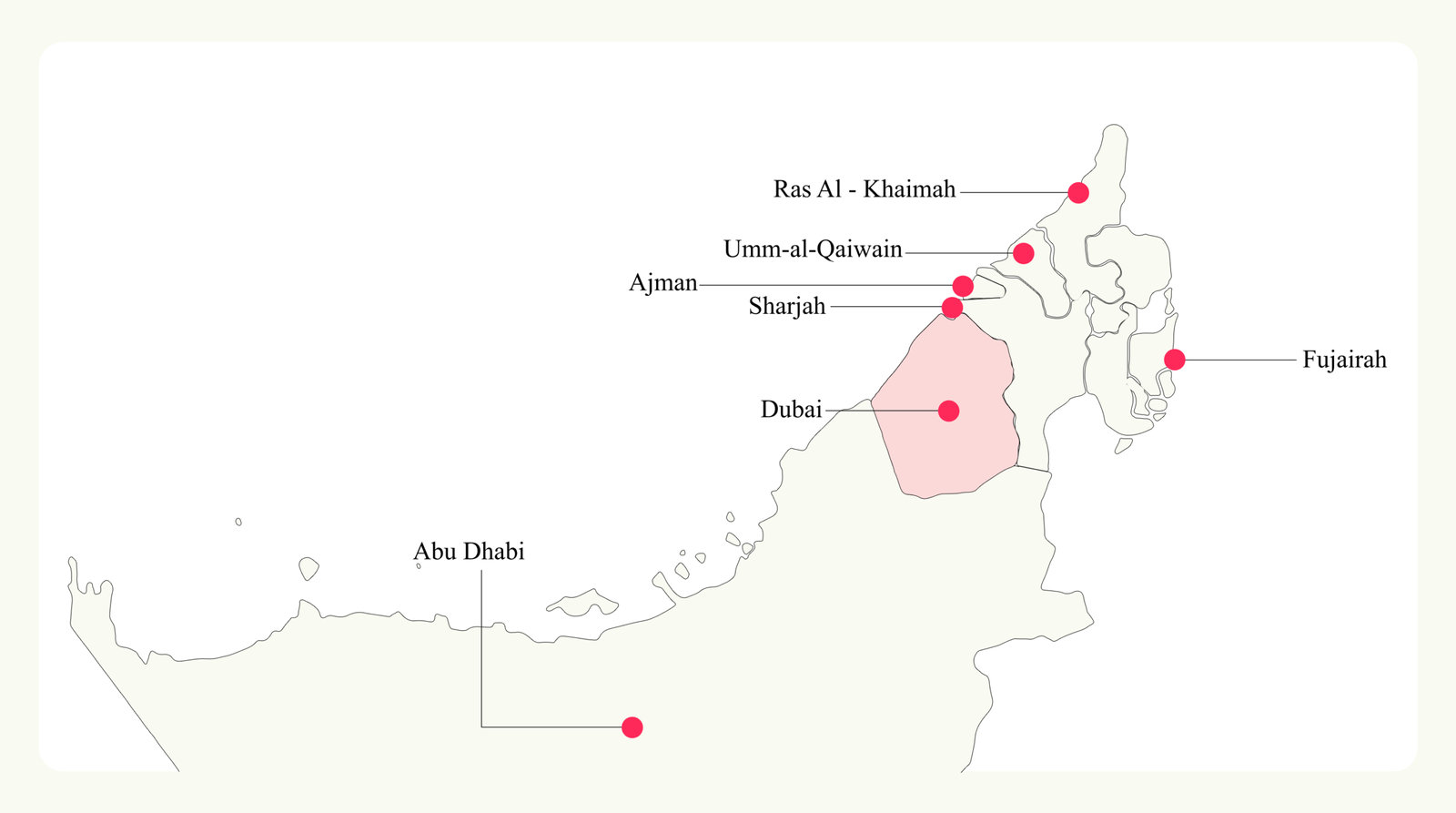
Start Your Custom Shoe Storage Project
Your home deserves storage solutions that actually solve problems rather than creating new frustrations. We’ve been designing and building shoe storage for UAE homes since 1988 and understand exactly what works in our unique environment. Whether you need a simple apartment solution or sophisticated villa storage, we’ll create something that fits your space, suits your style, and serves you reliably for decades.
The first step is a consultation where we visit your home, measure your space, count your shoes, and discuss your requirements. There’s no obligation and no pressure—just professional assessment and honest recommendations. We explain what’s possible, what it costs, and how long it takes. You decide if our approach matches your needs and expectations.
IF YOU HAVE ANY QUESTION? WE ARE GLAD TO
CONSULT YOU AS SOON AS POSSIBLE
Get Started
Immediate assistance from our team regarding your project details.
Form Submitted!
Thank you for contacting us. Our team will get back to you within 24 to 48 hours regarding your query.
Contact us on WhatsApp for Quick Response