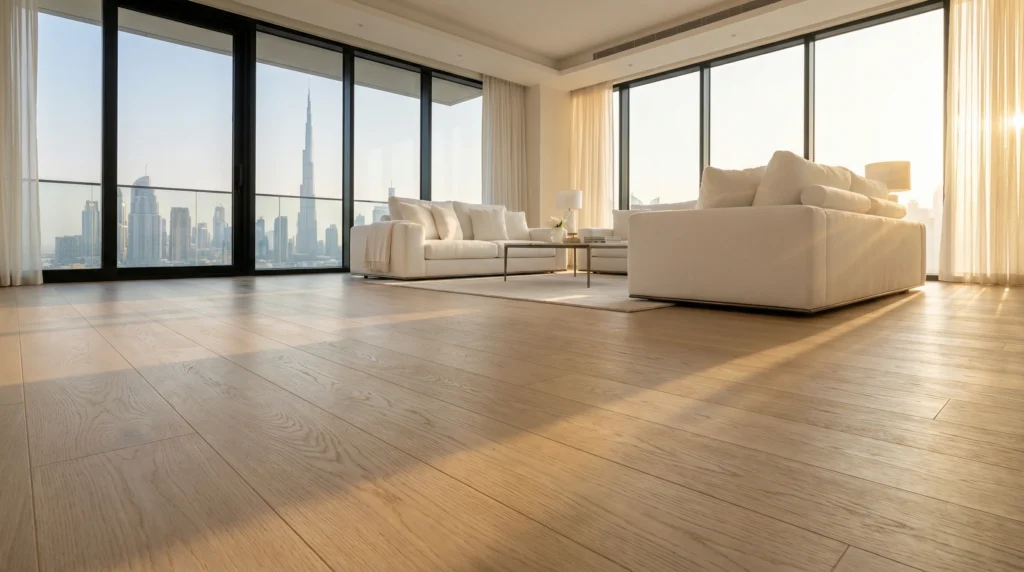
Transform Your Dubai Space with Premium SPC Flooring Installation
Stone plastic composite flooring delivers the luxury look of hardwood with unmatched durability for UAE’s demanding climate. Karnak Carpentry brings 35 years of flooring expertise to every installation, ensuring waterproof, heat-resistant floors that perform flawlessly in humidity, temperature extremes, and high-traffic environments.
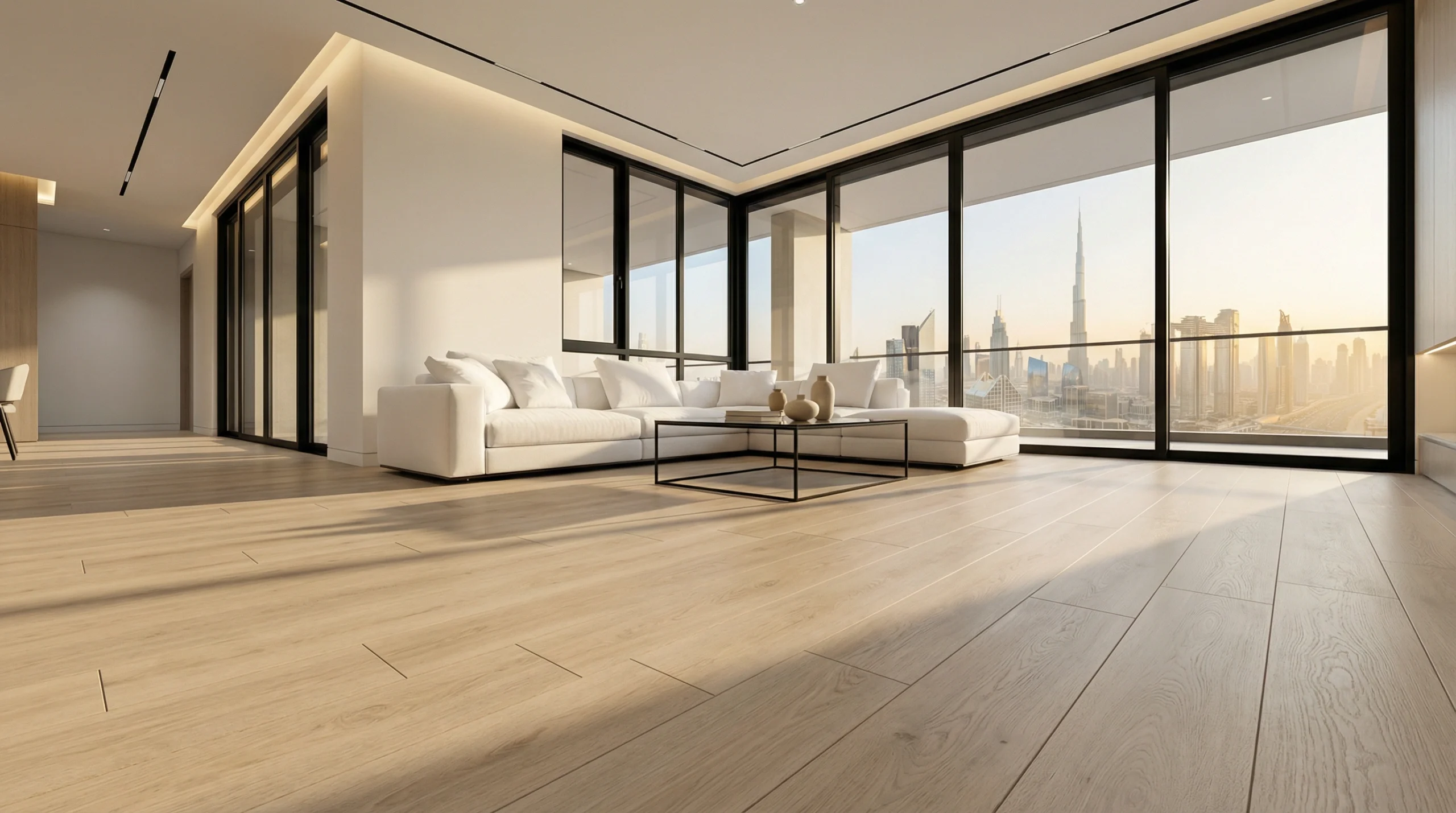
SPC flooring Dubai installations have transformed how UAE property owners approach flooring solutions. Unlike traditional hardwood that warps in coastal humidity or laminate that buckles under temperature fluctuations, stone plastic composite flooring maintains dimensional stability in conditions that destroy conventional materials. We’ve installed over 2.3 million square feet of SPC flooring across the Emirates since 2015, and the technology has proven itself in Dubai Marina penthouses where humidity peaks at 87%, Desert Springs villas where summer temperatures reach 52°C, and Al Quoz warehouses where daily foot traffic exceeds 5,000 people.
The UAE presents unique flooring challenges that standard international solutions can’t address. Properties along Jumeirah Beach Road face salt-laden air that corrodes adhesives. Buildings in Business Bay experience dramatic temperature swings between air-conditioned interiors and sun-heated balconies. Warehouses in Dubai Industrial City demand floors that withstand forklift traffic while remaining easy to clean. We’ve solved these challenges 4,780 times across residential, commercial, and industrial projects, developing installation protocols specific to Emirates’ microclimates, building codes, and performance requirements.
Karnak Carpentry pioneered SPC flooring installation in Dubai when the technology emerged as a viable alternative to problematic materials. Our team has evaluated every major manufacturer, tested products in real UAE conditions, and developed relationships with suppliers who meet our quality standards. This means you get flooring that performs as promised, backed by installation expertise that eliminates the failures we see competitors struggle with weekly.
Understanding SPC Flooring Technology and UAE Performance
Stone plastic composite flooring represents a fundamental shift in flooring engineering, combining limestone powder and stabilizers with virgin PVC to create a rigid core that resists the environmental stresses that plague other flooring types in the Gulf region.
The Science Behind SPC’s UAE Climate Performance
The limestone-PVC composite core contains approximately 60% natural limestone, 35% polyvinyl chloride, and 5% stabilizing additives. This composition creates a material with near-zero thermal expansion, meaning SPC flooring Dubai installations don’t gap or buckle when temperatures fluctuate between 18°C air-conditioned interiors and 45°C sun-exposed areas. Traditional laminate flooring expands up to 3mm per meter with temperature changes, creating the waves and gaps we’re called to repair constantly. SPC’s expansion rate measures just 0.08mm per meter, effectively eliminating temperature-related failures.
The rigid core structure also solves the humidity problems that destroy wood and bamboo flooring. Natural wood absorbs moisture through its cellular structure, swelling when humidity rises and contracting when it falls. Dubai’s coastal zones see humidity swing from 35% to 90% throughout the year. We’ve removed thousands of square meters of cupped hardwood from Marina apartments and warped bamboo from Palm Jumeirah villas. SPC’s non-porous limestone-PVC matrix absorbs virtually zero moisture, maintaining dimensional stability regardless of humidity levels. Laboratory testing shows SPC absorbs less than 0.5% of its weight in water even after 72 hours of submersion.
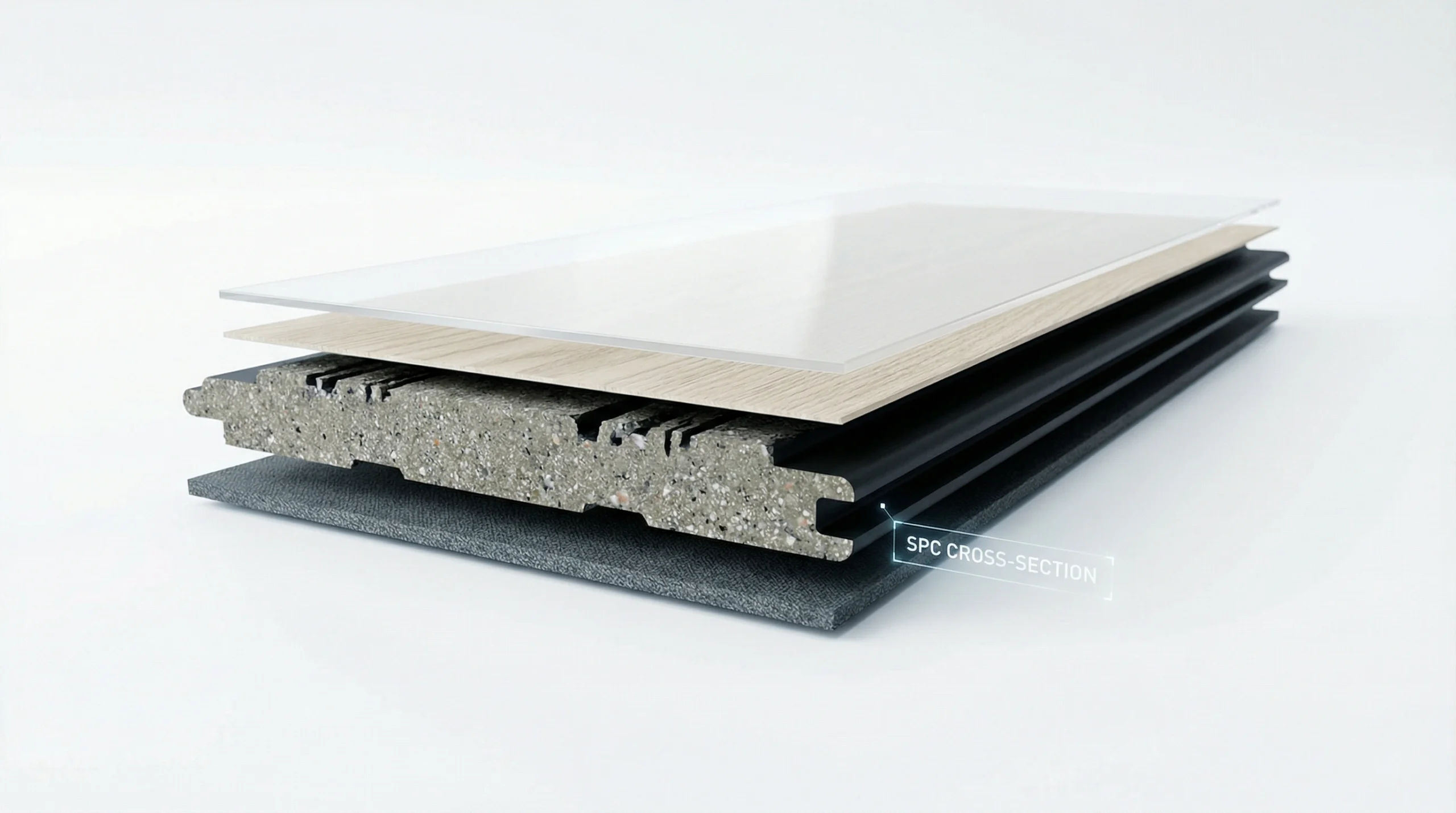
Layer Structure and Performance Benefits
Premium SPC flooring features six distinct layers, each engineered for specific performance characteristics. The UV-cured wear layer at the surface determines scratch and stain resistance, measured in AC ratings from AC3 (residential) to AC5 (heavy commercial). We recommend AC4 minimum for Dubai homes due to sand tracked in from outdoor areas, and AC5 for commercial spaces. This 0.3mm to 0.7mm coating withstands stiletto heels, furniture dragging, and the abrasive sand particles that scratch softer flooring materials.
Beneath the wear layer sits the decorative film layer, where photographic reproduction technology creates wood, stone, or tile visuals. Quality varies dramatically between manufacturers. Budget products use repetitive patterns that create obvious visual repeats every 3-4 planks. Premium lines we specify use high-definition scanning of real wood with pattern libraries exceeding 40 unique images, eliminating the artificial appearance of cheap products. The embossing must align perfectly with the visual grain, creating texture that matches what your eyes see. We reject suppliers whose embossing registration drifts even 0.5mm.
The rigid SPC core provides structural integrity and impact resistance. Core density matters significantly for performance. Products below 2,000 kg/m³ density can develop stress points under furniture legs, creating permanent indentations. The commercial-grade SPC we install for high-traffic areas uses 2,200 kg/m³ cores that distribute loads across wider areas, preventing compression damage. This density also enhances sound insulation, reducing noise transmission between floors by 18-22 decibels depending on underlay selection.
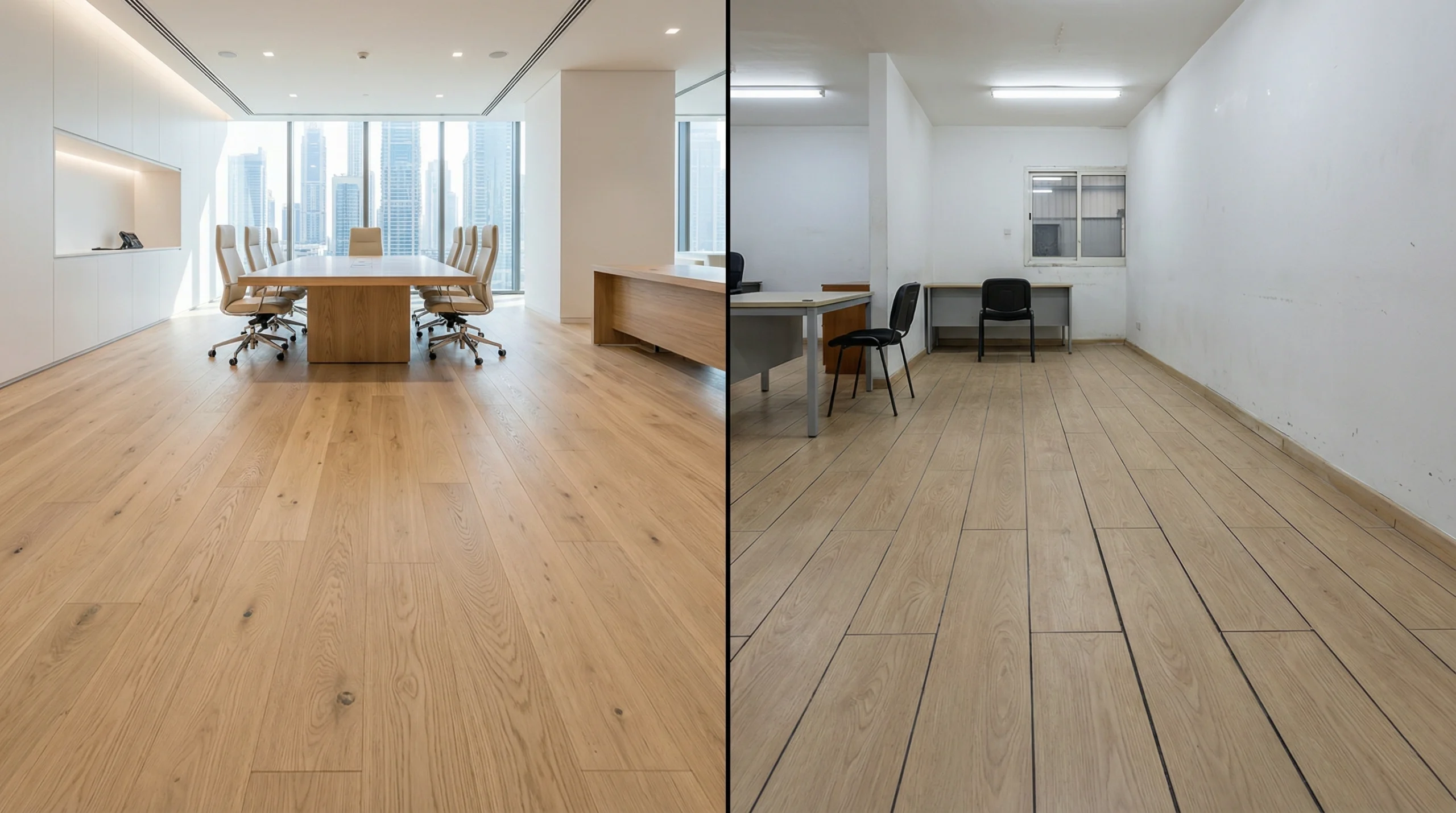
The backing layers provide click-lock mechanism housing and additional stability. Cork or IXPE foam backing adds cushioning underfoot and sound dampening properties. Some manufacturers include attached underlayment, while others require separate underlay installation. We prefer separate professional-grade underlay because it allows us to select specific sound-dampening or moisture-barrier properties based on your installation environment. Ground-floor apartments need vapor barriers that attached underlay doesn’t provide. Upper-floor units benefit from acoustic underlay that reduces noise transfer to units below.
Why SPC Outperforms Alternative Flooring in UAE Conditions
We’ve installed or removed virtually every flooring type available in the UAE market. This experience shows clearly which materials survive Emirates’ climate and which fail predictably. Engineered hardwood, despite marketing claims of humidity resistance, delaminates in coastal zones within 18-36 months. The thin veneer separates from the plywood core as humidity penetrates edge seams and subfloor interfaces. We removed 18 engineered hardwood floors from JBR towers last year alone, all showing identical delamination patterns along kitchen and bathroom perimeters.
Laminate flooring fails differently but just as reliably. The HDF core swells when exposed to moisture, creating bubbles and waves that can’t be repaired. Spills must be cleaned immediately, making laminate impractical for homes with children or pets. Even morning condensation from air conditioning ducts can cause localized swelling over time. SPC’s waterproof core eliminates these concerns entirely. We’ve tested SPC installations where water sat on the surface for six hours with zero absorption or dimensional change.
Luxury vinyl tile (LVT) shares SPC’s waterproof properties but uses a flexible core that telegraphs subfloor imperfections and dents under heavy furniture. The flexible composition allows point loads to create permanent depressions. SPC’s rigid core bridges minor subfloor irregularities and resists compression damage. Office chairs, bed frames, and refrigerators create the permanent marks in LVT that we don’t see in properly installed SPC flooring.
Traditional ceramic tile remains popular in UAE construction but presents practical limitations. Installation costs run 3-5 times higher than SPC flooring due to specialized labor requirements and extended installation timelines. Tile feels cold underfoot even in Dubai’s climate, creating discomfort in air-conditioned spaces. Grout lines require regular maintenance and can harbor mold in humid environments. Sound transmission through tile installations exceeds SPC by 12-15 decibels, creating noise complaints in multi-story residential buildings. For clients who love the tile aesthetic, SPC manufacturers now produce convincing stone and marble visuals with the warmth and comfort that ceramic can’t match.
Comprehensive SPC Flooring Solutions for Every UAE Application
Our SPC flooring Dubai services encompass complete project lifecycle management, from initial design consultation through final inspection and long-term maintenance support. Each installation receives the same rigorous approach regardless of size or complexity.
Residential SPC Flooring Installation
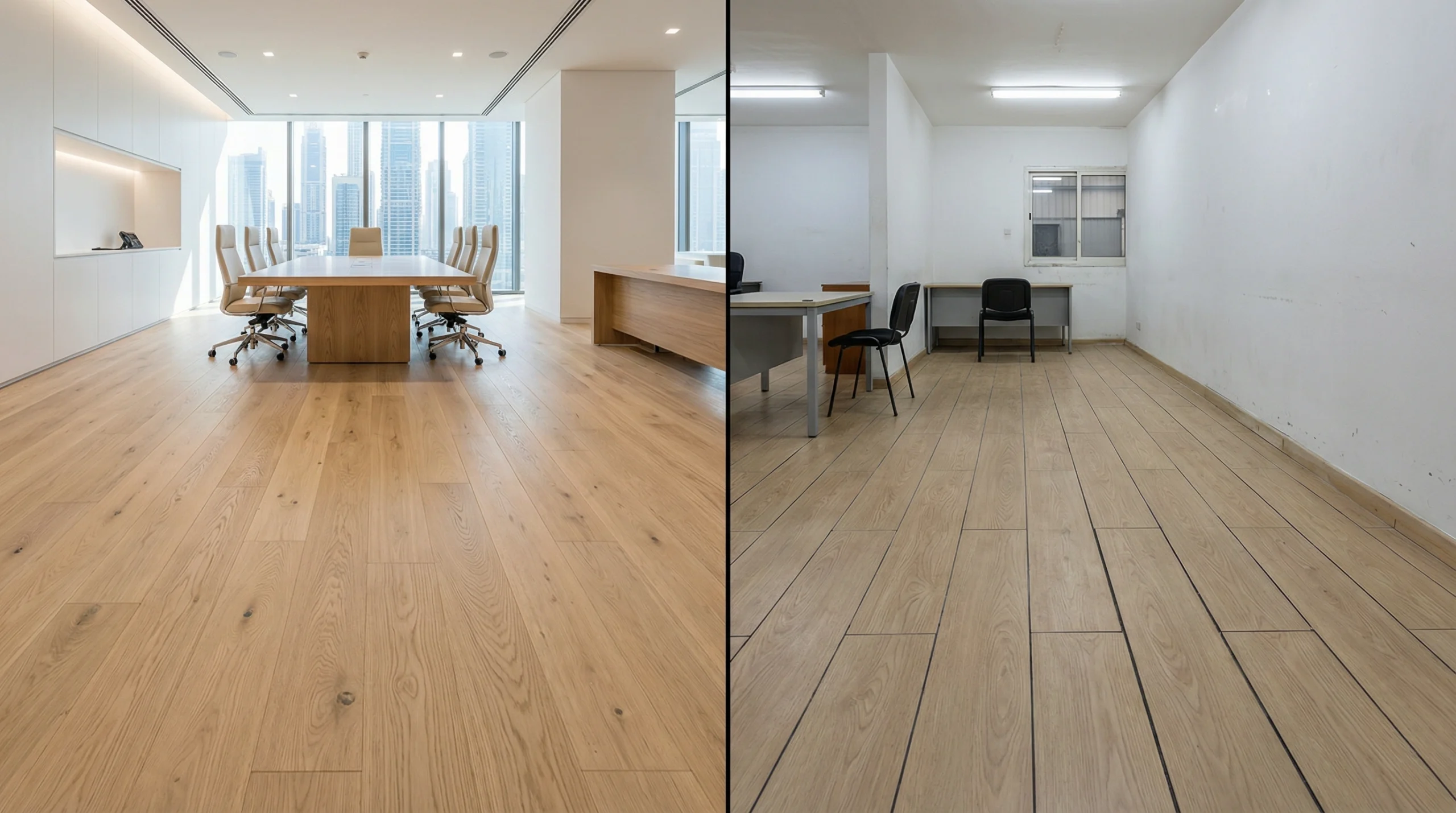
Residential installations account for 60% of our SPC flooring work, spanning studio apartments in Dubai Sports City to sprawling villas in Emirates Hills. This service begins with in-home consultation where we assess existing flooring conditions, subfloor characteristics, room layouts, and your aesthetic preferences. We bring physical samples representing different wood tones, plank widths, and surface textures because screens and brochures don’t accurately convey how flooring looks in your actual lighting conditions. Clients consistently choose different products in their homes than they initially selected from catalogs.
We address moisture conditions specific to your property location and floor level. Ground-floor units and villas require vapor barrier underlayment even though SPC itself is waterproof, because moisture rising through concrete slabs can create mold growth between the flooring and substrate. Coastal properties within 500 meters of beaches need enhanced vapor barriers due to salt moisture that penetrates foundation concrete over time. Our moisture testing identifies current conditions and future risks before installation begins, preventing the failures that occur when installers skip this critical step.
Layout planning maximizes visual impact while minimizing waste. Plank direction influences how spaces feel—running planks along the longest wall dimension makes rooms appear larger, while perpendicular layouts can define spaces in open floor plans. We map installations showing exactly how planks will run, where transition strips will occur, and how patterns flow between connected rooms. This prevents the awkward narrow cuts and misaligned seams that mark amateur installations. Kitchen-to-living room transitions receive particular attention because interrupting plank flow with transitions creates visual breaks that diminish open-concept designs, while running planks continuously requires precise planning to maintain proper expansion gaps at walls.
Color selection influences perceived room size, light reflection, and maintenance visibility. Light oak and blonde finishes brighten spaces and hide the dust that accumulates quickly in Dubai’s environment. Dark walnut and espresso tones create sophisticated aesthetics but show every sand grain and water spot, requiring more frequent cleaning. Mid-tone hickory and natural oak balance visual warmth with practical maintenance, explaining why they represent 45% of our residential installations. We guide these decisions based on your lifestyle factors—homes with children and pets benefit from mid-tones with textured surfaces that camouflage scuffs, while adult-only properties can carry darker finishes successfully.
Commercial SPC Flooring Projects
Commercial installations demand different performance specifications and installation methodologies than residential work. Office environments see concentrated traffic in corridors and reception areas but moderate use in private offices. Retail spaces endure constant foot traffic plus shopping cart and merchandise cart movement. Restaurants face spills, grease, and frequent cleaning with commercial chemicals. Healthcare facilities require antimicrobial surfaces and easy sanitization. We’ve developed installation protocols specific to each commercial category, selecting appropriate wear layers, core densities, and installation methods for the operational demands you’ll place on the flooring.
Heavy commercial AC5-rated SPC flooring forms the foundation of our commercial specifications. The enhanced wear layer resists the accelerated degradation that occurs in high-traffic environments. Standard AC4 residential flooring shows visible wear patterns in commercial corridors within 18 months. AC5 products maintain appearance integrity for 7-10 years under the same conditions. The cost premium runs approximately 18% but extends functional life by 300%, creating substantially lower lifetime costs for commercial property owners.
We coordinate installations around business operations to minimize disruption. Retail stores require after-hours or phased installations that keep portions of the space operational throughout the project. Corporate offices typically prefer weekend installations to avoid employee displacement. Restaurants need 48-72 hour closures to complete dining area flooring while kitchen areas remain functional. Our project management includes detailed timelines showing exactly when each area becomes unavailable, when furniture must be cleared, and when spaces return to service. We’ve completed 380+ commercial installations without a single missed opening deadline.
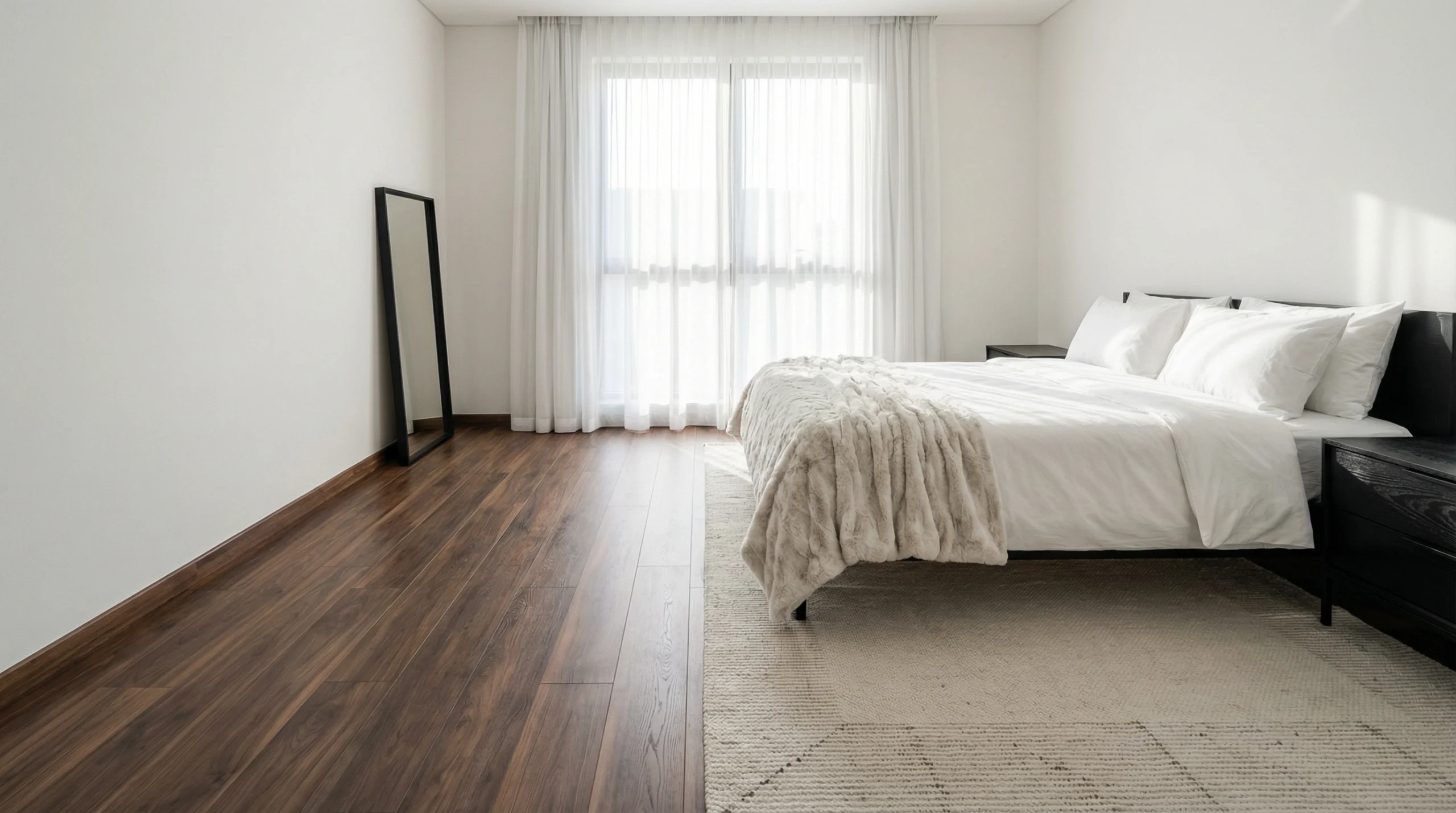
Subfloor preparation requirements intensify for commercial projects. Concrete flatness must achieve FF35 (floor flatness) and FL25 (floor levelness) specifications for successful SPC installation. Commercial substrates often fail these standards due to settlement, prior installations, or original pour quality. We employ laser-guided grinding to remove high spots and self-leveling compounds to fill depressions, creating the flat surfaces required for click-lock systems to function properly. Skipping this preparation causes planks to rock underfoot, stressing the locking mechanisms until they fail and separate.
Retail and Hospitality SPC Flooring
Retail and hospitality spaces present unique aesthetic demands alongside performance requirements. Brand image influences every design decision, requiring flooring that reinforces the atmosphere you’re creating. Luxury boutiques need sophisticated dark woods or natural stones that communicate exclusivity. Casual restaurants benefit from rustic reclaimed wood looks that feel approachable and comfortable. Modern hotels choose wide-plank contemporary oaks that convey clean sophistication. We maintain a library of 140+ SPC product lines representing every aesthetic category, allowing us to match your brand positioning precisely.
Retail installations often incorporate pattern work and borders that define zones within larger spaces. Checkout areas might feature perpendicular plank orientation or contrasting colors that subtly guide customer flow. Fitting room corridors can use different tones to create visual separation from main sales floors. Restaurant dining rooms sometimes combine wood-look SPC in seating areas with stone-look products in bar zones, creating visual interest while maintaining the waterproof performance required throughout hospitality environments. These design elements require advanced installation expertise because transitions and pattern work introduce complexity that generic installers can’t execute cleanly.
Hospitality projects face aggressive maintenance schedules with commercial cleaning equipment and chemical solutions. We specify SPC products with enhanced surface coatings that resist chemical degradation from the harsh cleaners facilities management teams employ. Standard residential-grade wear layers can dull or discolor when exposed to industrial floor cleaners. Commercial coatings maintain gloss levels and color integrity through years of mechanical scrubbing and chemical exposure. This specification knowledge comes from installing flooring in 190+ hospitality properties and seeing firsthand which products survive operational realities.
Luxury Villa Complete Flooring Transformations
High-end villa projects receive our most comprehensive service delivery, transforming entire properties with coordinated flooring solutions across all living spaces. These projects typically span 350-850 square meters, requiring 2-4 weeks from initial consultation through final installation. The scope encompasses material selection for 8-12 distinct spaces, each with specific functional requirements and aesthetic considerations, subfloor remediation across multiple levels, precision installation with intricate pattern work or borders, and integration with existing architectural elements.
Material coordination across spaces balances visual flow with practical zoning. Open living-dining-kitchen areas typically receive consistent flooring to maintain spacious aesthetics, while bedrooms can introduce different tones that create intimate atmospheres. Children’s rooms sometimes warrant different products entirely—softer, warmer surfaces with enhanced sound dampening. Master suites might incorporate wider planks or herringbone patterns that elevate these primary spaces. We develop comprehensive material plans showing exactly which products go where, how transitions occur between spaces, and how the overall palette creates cohesive design flow throughout the property.
Architectural integration challenges arise in luxury properties with detailed trim work, custom cabinetry, and unique features. Flooring must meet existing base moldings with clean reveals, or we remove and reinstall trim for seamless integration. Built-in cabinetry requires undercutting toe kicks to slide flooring beneath for continuous appearance. Circular staircases, curved walls, and radius transitions demand precision cutting and pattern management that separates professional installations from adequate ones. We’ve navigated these complexities in Emirates Hills, Palm Jumeirah, and Arabian Ranches properties where architectural details define the home’s character.
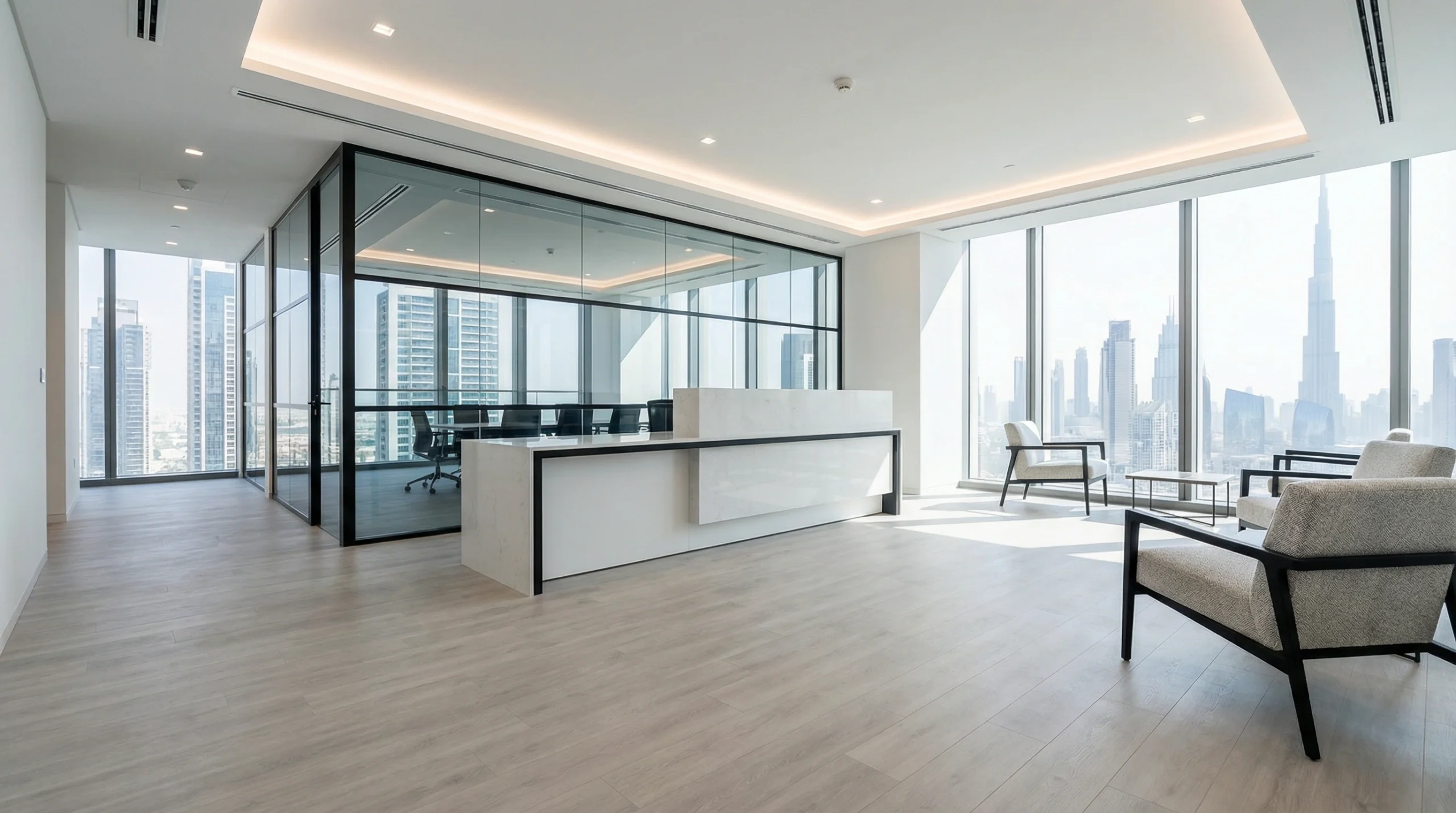
Underfloor Heating Compatible SPC Installation
Underfloor heating systems paired with SPC flooring create comfortable, efficient climate control increasingly popular in UAE villas and premium apartments. SPC’s thermal conductivity allows heat transfer from radiant systems while maintaining dimensional stability under temperature cycling. Not all SPC products qualify for underfloor heating applications—manufacturers must specifically certify compatibility and maximum temperature tolerances, typically 27°C surface temperature limit.
Installation over radiant systems requires modified protocols. Heating systems must operate for minimum three weeks before flooring installation to cure concrete and establish moisture equilibrium. We run moisture tests after this heat cycle to confirm substrates have reached stable conditions. Underlay selection changes significantly—standard foam underlays act as thermal barriers that block heat transfer. We specify thin, dense underlays specifically designed for radiant applications, typically 1.5-2mm thick with thermal resistance below 0.10 m²K/W.
Temperature management during and after installation prevents problems. Heating systems must remain off for 48 hours before installation and 72 hours after completion, allowing adhesive moisture to escape and planks to seat properly. Temperature increases must occur gradually—no more than 3°C per day—until reaching operational settings. Rapid temperature changes can stress locking mechanisms before they’ve fully stabilized. We provide detailed heating protocols to property owners, explaining exactly how to manage systems for optimal flooring performance and longevity.
Waterproof Flooring for Moisture-Prone Spaces
Bathrooms, laundries, and basement areas require truly waterproof installations, not just water-resistant products. SPC flooring itself is waterproof, but installations can fail if water penetrates seams and reaches substrates. We employ perimeter sealing techniques that create continuous waterproof barriers around room edges. Silicone sealant applied along all wall transitions prevents water from migrating behind planks where it can cause odor issues or mold growth on substrates.
Transition areas receive enhanced attention because water naturally flows toward openings and threshold areas. Bathroom doorways must incorporate waterproofing that extends beyond the flooring footprint, protecting hallway areas from bathroom moisture migration. We install aluminum or vinyl waterproof thresholds that create physical barriers while providing finished aesthetic transitions between SPC and adjacent flooring materials like carpet or different SPC zones.
Substrate preparation for waterproof areas includes testing for hydrostatic pressure in below-grade applications. Basements and ground-level spaces can experience moisture pressure from groundwater pushing up through concrete slabs. Standard vapor barriers fail under hydrostatic pressure. We install epoxy moisture mitigation systems when testing reveals pressure issues, creating impermeable barriers that prevent moisture transmission regardless of substrate conditions. These systems add cost but prevent the catastrophic failures that occur when water trapped beneath waterproof flooring creates mold farms on wooden substrates.
The Karnak SPC Flooring Installation Process
Our systematic installation approach eliminates the variables that cause the failures and quality issues plaguing cheaper installations. Each step follows tested protocols developed through thousands of successful projects.
Step 1: Initial Consultation and Site Assessment
The process begins with comprehensive on-site evaluation lasting 60-90 minutes for residential properties, longer for commercial spaces. Our flooring specialists examine existing floor conditions, documenting surface materials, removal requirements, and substrate characteristics. We measure moisture levels in concrete substrates using calcium chloride tests for precise readings—quick pin meters provide directional information but can’t detect the elevated moisture levels that compromise installations. Concrete should measure below 3 pounds per 1,000 square feet per 24 hours for SPC installation. Higher readings require moisture mitigation before proceeding.
We assess subfloor flatness using 2-meter straightedges, marking areas exceeding the 3mm variance tolerance over 2-meter spans that SPC manufacturers specify. High spots get flagged for grinding. Low areas need filling with self-leveling compound. Wood subfloors receive deflection testing—floors that bounce or give more than 1mm under weight loading require additional support or panel replacement. These structural evaluations prevent post-installation problems like gaps opening between planks or locking mechanisms separating due to excessive substrate movement.
Room measurement and layout planning occurs during this visit. We document room dimensions, door openings, transitions to other flooring types, built-in elements that require special attention, and architectural features like bay windows or angled walls. Photos capture existing conditions for reference during planning. This documentation feeds the detailed installation plan showing plank layout, transition locations, trim requirements, and material quantities with 8-10% waste factors for cuts and errors.
Step 2: Material Selection and Specification
Following site assessment, we present curated product recommendations based on your performance requirements, aesthetic preferences, and budget parameters. Rather than overwhelming clients with 200+ options, we narrow selections to 5-8 products that genuinely suit the application. Each recommendation includes samples, specification sheets detailing wear layer thickness and core density, warranty information, and installed cost breakdowns.
We explain exactly what you’re buying at each price point. Budget SPC at 95-125 AED per square meter installed uses thinner wear layers, lower-density cores, and less sophisticated decorative layers. Mid-range products at 145-185 AED per square meter offer improved durability with AC4 wear ratings and better visual realism. Premium SPC at 200-280 AED per square meter delivers AC5 commercial-grade wear layers, high-definition visuals with extensive pattern libraries, and enhanced core compositions with superior sound dampening. Luxury lines exceeding 300 AED per square meter introduce unique finishes, extra-wide planks, and specialty features like integrated cork backing.
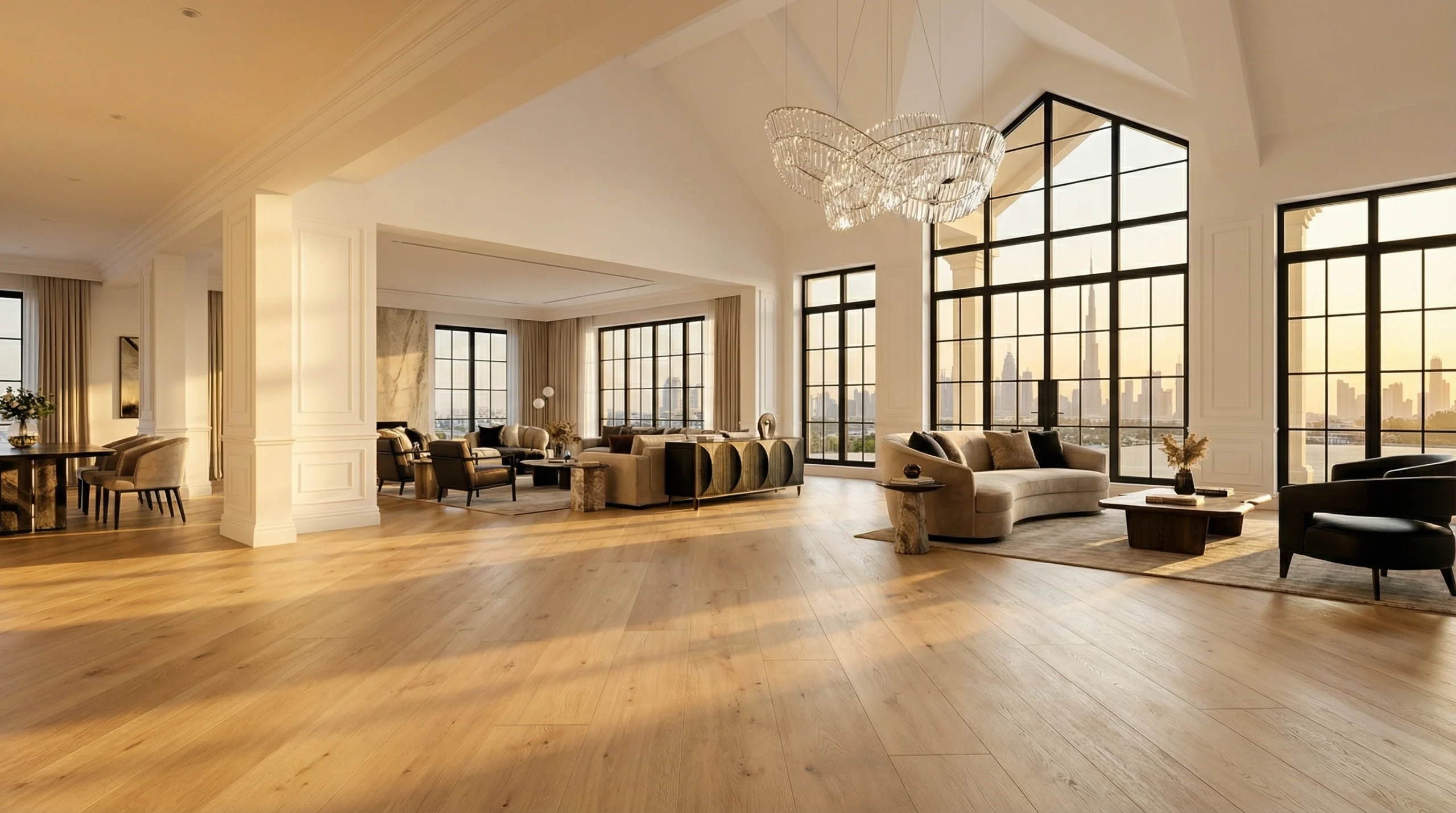
Performance specifications matter more than marketing claims. We review technical data sheets with clients, explaining what numbers actually mean for real-world performance. A 0.5mm wear layer provides adequate residential protection but won’t survive commercial applications. Core density below 2,000 kg/m³ risks indentation damage in any setting. Locking system design affects installation difficulty and long-term stability—we prefer Unilin or Välinge click systems that demonstrate superior holding strength and ease of installation compared to generic locking profiles.
Underlay selection occurs simultaneously with flooring specification. Standard foam underlay provides basic cushioning and minor sound dampening. Acoustic underlay reduces noise transmission by 18-22 decibels, critical for apartments and multi-story homes. Vapor barrier underlay prevents moisture transmission from substrates—essential for ground-level installations and coastal properties. Some applications require combination products offering both vapor protection and sound dampening. We specify exactly which underlay suits your installation conditions rather than using one-size-fits-all approaches.
Step 3: Subfloor Preparation and Remediation
Installation day begins with subfloor preparation that determines installation success or failure. Existing flooring removal happens first for retrofit projects. Carpet, vinyl, and old laminate must be completely removed along with all adhesive residues, staples, and tack strips. Residual adhesives get ground down to bare substrate because any bumps telegraph through SPC and cause visible surface irregularities. We’ve learned this the hard way early in our flooring career—skipping thorough adhesive removal creates bumps visible from across the room.
Concrete substrates undergo diamond grinding to remove high spots identified during site assessment. This grinding creates concrete dust that must be contained and removed—we use HEPA vacuum systems during grinding and perform complete dust extraction before continuing. Remaining dust particles prevent self-leveling compounds from bonding properly and interfere with underlay installation. Low areas receive self-leveling compound applied per manufacturer specifications, typically 24-48 hour cure time before flooring installation can proceed.
Wood subfloors get inspected for damaged panels, loose fasteners, and structural deflection. Squeaky areas receive additional screws securing panels to joists. Damaged or swollen panels get replaced. High traffic has taught us that wood subfloor preparation deserves the same attention as concrete—maybe more, because wood movement creates more variables. We fasten panels at 150mm centers along joists, eliminating the movement that causes nails to back out and create bumps under finished flooring.
Final cleaning involves complete dust and debris removal using HEPA vacuums and tack cloths. Substrates must be completely clean, dry, and flat before underlay installation begins. We perform final moisture testing at this stage—if readings have changed since initial assessment, we investigate causes before proceeding. Moisture issues only worsen after covering substrates with waterproof flooring.
Step 4: Underlay Installation and Vapor Barrier Application
Underlay installation creates the foundation for SPC performance. We start in the farthest corner from the room entrance, rolling underlay perpendicular to planned plank direction. Seams between underlay sheets must butt tightly together without gaps or overlaps. Gaps create valleys where planks can flex and stress locking mechanisms. Overlaps create ridges that telegraph through flooring surfaces. We tape all seams with manufacturer-specified tape—usually 50mm aluminum or plastic tape for vapor barrier underlays, standard packing tape for foam underlays without moisture barrier properties.
Vapor barrier underlay requires special attention to sealing against moisture transmission. All seams must be fully taped. The underlay must run 50-75mm up walls around the room perimeter, creating a bathtub effect that contains any moisture penetrating the substrate. We tape these wall turns in place before flooring installation. This seems excessive until you’ve seen moisture problems in installations without proper vapor barriers—the mold, the odor, the complete reinstallation required. Proper vapor barrier installation adds 30 minutes to a typical room but prevents catastrophic failures.
Underlay around obstacles like pipes, vents, and built-in elements requires precision cutting for proper fit. We create tight patterns around irregular shapes, maintaining vapor barrier continuity through all penetrations. Doorways receive particular care because moisture migration typically occurs at thresholds where different flooring materials meet. The vapor barrier must extend to and under the threshold, preventing moisture from finding paths around the barrier perimeter.
Step 5: SPC Flooring Acclimation and Layout Planning
SPC flooring requires acclimation to installation environment temperatures even though the material doesn’t absorb moisture like wood products. The locking mechanisms contain tight tolerances that expand and contract with temperature changes. Materials stored in hot warehouses or delivered in cooled trucks need time to reach ambient room temperature before installation. We require minimum 48-hour acclimation with cartons opened and laid flat in installation areas. This allows planks to reach temperature equilibrium, preventing the expansion gaps or contraction spaces that occur when flooring is installed at different temperatures than operational conditions.
Layout planning determines where the installation starts and how cuts occur at room perimeters. We snap chalk lines establishing starter row positions, typically 10-12mm from the longest wall to create expansion gaps. The first row must run perfectly straight because every subsequent row references this starter row. We verify square by measuring diagonal dimensions—if diagonals differ by more than 3mm, we adjust starter row angle to compensate for out-of-square rooms.
Plank pattern planning prevents narrow cuts at terminal walls. If layout calculations show the final row ending with planks cut narrower than 50mm, we adjust starter row position to balance cuts on both sides of the room. Narrow plank pieces create weak points that don’t lock properly and look amateurish. We also plan pattern randomization—planks from different cartons get mixed to prevent repetitive visual patterns where the same plank images appear in obvious sequences.
Step 6: Precision Installation Execution
Installation begins by establishing the starter row with meticulous attention to straightness and spacing. The tongue edge faces the wall, removed on starter planks for some locking systems. We install 10-12mm spacers every 400-500mm along the wall, maintaining consistent expansion gaps. These gaps allow the floating floor system to expand and contract with temperature and humidity changes without buckling or gapping. First-plank installers who skip or under-size expansion gaps create the buckling issues we repair regularly—SPC needs room to move.
Each plank engages the previous plank at a 20-25 degree angle, then snaps down flat to lock. Quality control happens plank-by-plank as we verify complete locking engagement. Properly locked planks show no vertical lip differences between adjacent pieces and no horizontal gaps at seams. We feel every seam by hand—if we can catch a fingernail on the seam edge, the lock hasn’t fully engaged. Problem planks get removed and reinstalled until perfect engagement occurs.
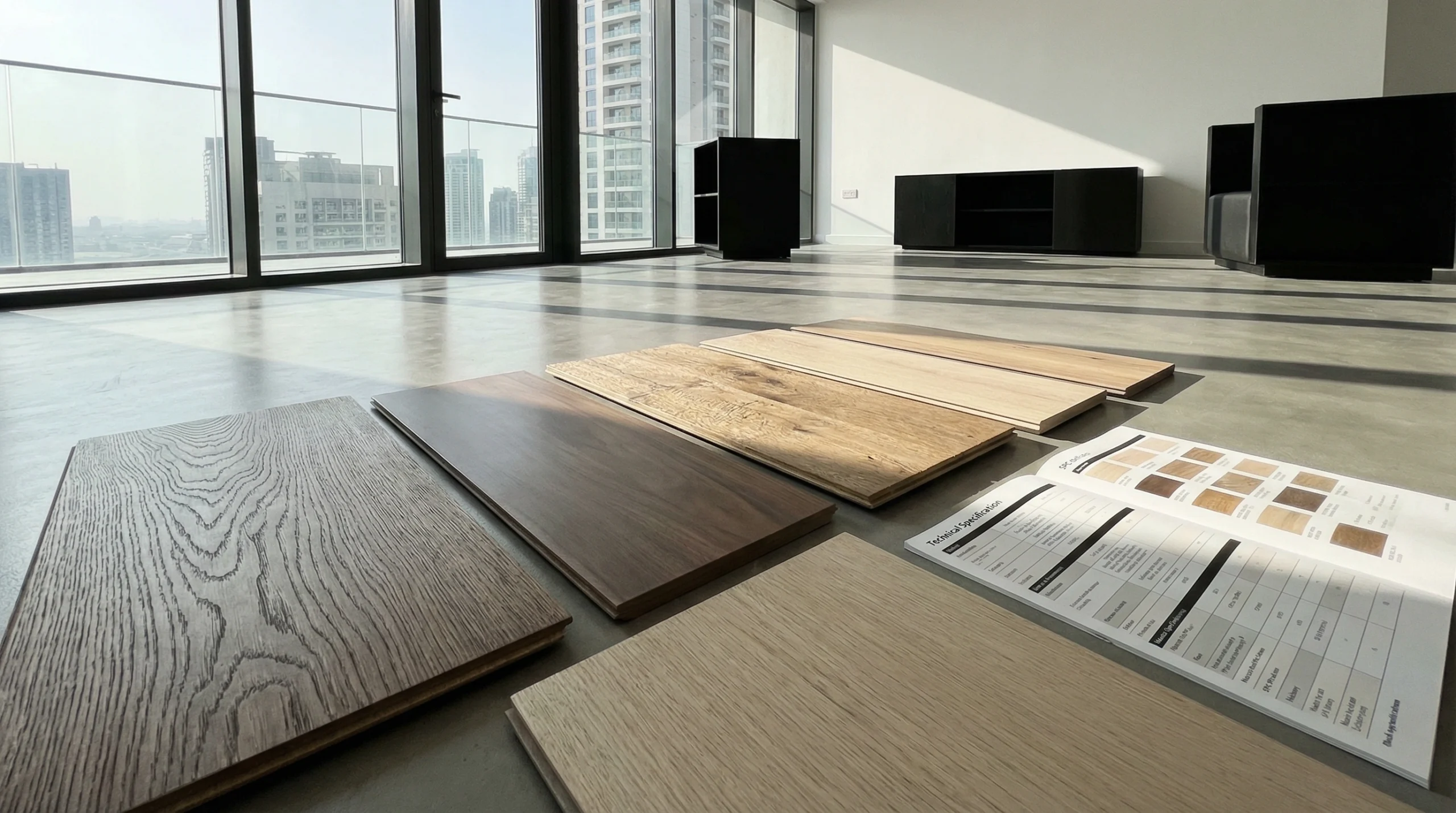
Cutting accuracy determines finished appearance quality. We use pneumatic guillotine cutters for straight cuts, producing clean edges with no chipping or deformation. Jigsaw cuts for irregular shapes around doorframes, pipes, and built-ins require patient templating and test fitting. Radius cuts around curved walls employ template-making using cardboard or thin wood strips, transferred to planks for precise cutting. Poor cutting produces visible gaps where planks meet obstacles, requiring unsightly caulk fills that announce installation shortcuts.
Doorframe undercutting allows planks to slide beneath door jambs for professional appearance. We use oscillating multi-tools to cut jambs and casing at exact flooring height plus underlay thickness. This creates the floating appearance where flooring seems to disappear under doorways rather than stopping at ugly transition strips. Rooms connected by open doorways can receive continuous flooring through the opening, eliminating transitions and maintaining visual flow between spaces.
Step 7: Transition Strips and Finishing Details
Transition strips occur where SPC meets different flooring materials, where flooring terminates at doorways to exterior spaces, and where expansion gaps would exceed manufacturer specifications in large open areas. We stock aluminum, vinyl, and wood-look transition strips in profiles matching every possible transition scenario: T-moldings for same-height transitions between two floors, reducers for transitions down to lower surfaces like carpet, thresholds for doorways, and quarter-rounds or base moldings for wall edges.
Color matching transitions to flooring maintains visual continuity. We bring transition samples during material selection, showing exactly how different profiles look with each flooring option. Metallic transitions in brushed aluminum or bronze can create intentional design accents, while matched transitions blend invisibly into flooring. Installation method matters—we prefer track-based systems where transition strips snap into pre-installed tracks, allowing future removal without damage. Glued or nailed transitions create permanent installations that complicate future flooring changes.
Base molding reinstallation or new installation completes wall edges. Existing moldings removed during preparation get reinstalled after painting or cleaning. New moldings get selected to complement flooring tone and room style. We install quarter-round or shoe molding in front of base moldings, covering expansion gaps while allowing the floating floor to move freely beneath. Caulking between flooring and moldings defeats the floating floor principle by anchoring edges that must remain free to move.
Threshold plates at exterior doors require waterproof sealing because these locations see direct water exposure during rain or cleaning. We bed aluminum thresholds in silicone sealant, creating weatherproof barriers that prevent moisture penetration into flooring edges. This detail prevents the edge swelling and delamination visible in installations where rain blows under doors.
Step 8: Final Inspection and Client Walkthrough
Installation completion triggers systematic quality inspection before client walkthrough. We examine every seam for proper engagement, checking that no lips or gaps exist between planks. Transition strips get tested for secure installation and proper height alignment. Wall perimeters get verified for consistent expansion gaps hidden beneath moldings. Floor surfaces get cleaned of all installation debris, adhesive marks, and protective films.
Client walkthrough involves explaining care requirements, warranty terms, and what to expect during the first weeks of use. SPC flooring may exhibit minor clicking sounds during initial days as the floor settles and room temperature stabilizes. This is normal and subsides as the installation reaches equilibrium. We review expansion gap locations and explain why visible gaps exist under moldings—clients unfamiliar with floating floors sometimes worry about these designed spaces.
We provide written care instructions specific to the installed product. Some SPC surfaces accept damp mopping while others require dry cleaning only. Furniture pads prevent indentation on all SPC despite its rigid core—the point loading from furniture legs concentrates weight into small areas that can compress surfaces over time. Entry mat usage protects flooring from the sand and grit that causes the gradual wear visible in UAE installations without adequate dirt control at entries.
Why UAE Property Owners Choose Karnak for SPC Flooring Installation
Selecting flooring contractors determines whether your investment delivers the decade-plus performance quality SPC promises or fails within months due to poor installation. Our 35-year track record across 10,000+ projects demonstrates the expertise that separates us from competitors making similar claims.
Three and a Half Decades of UAE Flooring Expertise
Since 1988, we’ve witnessed every flooring trend, technology evolution, and product failure that’s occurred in the Emirates. This history taught us which products survive UAE conditions and which fail despite manufacturer promises. When SPC technology emerged around 2013, we tested products extensively before offering them to clients. Early SPC formulations exhibited problems—some brands’ cores became brittle in heat, others discolored in sunlight. We rejected 23 product lines before finding manufacturers producing SPC that met our performance standards.
Our installation database tracks every project’s product, installation conditions, and long-term performance. This knowledge base reveals which manufacturers deliver on specifications and which engage in marketing fiction. Budget brands claiming AC5 ratings often fail laboratory testing when we verify claims independently. Some “waterproof” products develop edge swelling when our submersion testing exposes inadequate core composition. We’ve installed SPC from 47 different manufacturers, giving us comparative knowledge that single-brand dealers and general contractors lack entirely.
The 2,847 SPC flooring installations we’ve completed since 2015 span every UAE microclimate and application type. Marina towers with extreme humidity. Desert communities with massive temperature swings. Industrial warehouses with chemical exposure. Coastal villas with salt air corrosion. This diversity taught us installation modifications required for each environment. Coastal properties need enhanced vapor barriers. Desert locations require wider expansion gaps for temperature extremes. Industrial settings demand specific underlay types that resist chemical penetration. We’ve developed environment-specific installation protocols that prevent the failures occurring when installers apply one-size-fits-all approaches.
Factory-Certified Installation Teams
Every Karnak flooring installer completes manufacturer certification programs for the SPC brands we install. These programs cover product-specific installation requirements, locking system details, and warranty compliance protocols. Certification matters because manufacturers void warranties for installations not meeting their specifications. We’ve salvaged dozens of projects where property owners hired uncertified installers who created warranty-voiding installation errors, leaving clients with failed floors and no recourse.
Our installation teams undergo continuous training as products and techniques evolve. New locking system designs require different installation approaches than older systems. Wide-plank formats introduce handling challenges that narrow planks don’t present. Herringbone and chevron patterns demand precision cutting and pattern management beyond standard plank installations. We invest in this training because flooring technology changes constantly—installers working with 2015 knowledge make mistakes with 2025 products.
Team accountability drives quality control throughout installation. Each project has a lead installer responsible for quality verification and a project manager conducting independent inspections before client handover. This dual-layer oversight catches errors before completion. We maintain defect rates below 0.3% across installations, meaning fewer than 3 in 1,000 planks require replacement due to installation errors. Industry averages exceed 2%, demonstrating the quality difference systematic oversight creates.
Comprehensive Warranty Protection
Our warranty program combines manufacturer product warranties with Karnak installation guarantees, providing complete protection for your investment. Manufacturer warranties typically cover product defects—delamination, wear layer failure, core compression—for periods ranging from 15 years residential to lifetime commercial depending on product tier. We handle all warranty claims directly rather than forcing clients to navigate manufacturer bureaucracies. If product failure occurs, we document conditions, submit claims, and manage replacement installations.
Karnak’s installation warranty covers workmanship for five years, guaranteeing that installations remain free from defects in execution. This covers issues like seams separating due to improper locking, planks lifting from inadequate expansion gap planning, or transition failures from incorrect installation. If installation errors occur, we return and correct them at our expense. This commitment eliminates the risk clients face with low-bid contractors who disappear when problems emerge.
We also provide performance guarantees specific to UAE conditions when clients select our recommended product specifications. If properly maintained flooring exhibits moisture damage in coastal installations where we specified enhanced vapor barriers, we remedy the situation even if outside standard warranty terms. This performance backing demonstrates our confidence in specification accuracy and installation quality. We can offer these guarantees because our failure rate on properly specified and installed projects measures essentially zero.
Transparent Pricing Without Hidden Costs
Our quotation process provides complete cost transparency before projects begin. Quotes detail material costs per square meter including waste allowances, labor costs for removal and installation, subfloor preparation costs including grinding and leveling, underlay costs with specific product specifications, transition strip quantities and costs, and base molding if required. This itemization allows clients to understand exactly what they’re paying for and make informed decisions about where to invest or economize.
We don’t engage in low-bid tactics that win projects then inflate costs through change orders. If site assessment reveals subfloor conditions requiring remediation, we identify these needs and cost them in original quotations. If clients choose to proceed without recommended preparation, we document the risks and potential future costs rather than pretending problems don’t exist. This honesty sometimes costs us projects when clients choose cheaper bids ignoring necessary work, but it protects clients who work with us from unexpected costs and installation failures.
Payment structures align with project milestones rather than requiring full advance payment. Typical residential projects invoice 30% deposit at contract signing, 40% at material delivery and installation commencement, and 30% at satisfactory completion. Commercial projects often use different schedules based on project scale and duration. This protects clients from contractor disappearance while providing us adequate cash flow for materials and labor.
Proven Performance Across Emirates
Our geographic diversity demonstrates capability across all UAE regions and property types. Dubai projects represent approximately 65% of installations, spanning Dubai Marina, Downtown Dubai, Business Bay, Jumeirah, Arabian Ranches, Emirates Hills, The Springs, The Meadows, Dubai Sports City, Motor City, and Dubai Silicon Oasis. Abu Dhabi installations account for 22% of work, including Al Reem Island, Yas Island, Saadiyat Island, Al Reef, Al Raha Beach, and Khalifa City. Sharjah, Ajman, and Northern Emirates comprise the remaining 13%.
Each emirate presents distinct challenges. Dubai Marina towers require logistics coordination for material transport through service elevators with strict timing restrictions. Emirates Hills villas demand security clearances and noise limitation respecting neighbors. Abu Dhabi’s newer developments often have superior subfloor conditions due to recent construction but stricter building access protocols. Northern Emirates industrial facilities prioritize speed and durability over aesthetic refinement but require understanding of operational constraints.
We’ve completed installations in every major developer’s properties—Emaar, Nakheel, Aldar, Meydan, Dubai Properties, and dozens of smaller developers. This experience means we understand each developer’s construction standards, typical subfloor conditions, and building management procedures. We know which towers have problematic concrete quality requiring extra preparation and which developers built to specifications allowing straightforward installations.
Material Supply Chain Reliability
Our supplier relationships ensure material availability and consistency that project-based contractors can’t match. We maintain stocking agreements with five primary SPC manufacturers, providing immediate access to popular products without lead time delays. For custom products or specialty orders, our volume purchasing power secures preferential production slots and expedited delivery schedules.
Material consistency matters more than clients typically realize. SPC manufacturing involves batch production where slight color and texture variations occur between production runs. When projects require material replenishment mid-installation or future repairs need matching planks, batch consistency determines whether replacement material blends invisibly or creates obvious mismatches. Our vendor relationships include batch tracking and reserve material programs that guarantee color-matched product availability for two years after installation.
We also maintain emergency material reserves for rapid-response repairs and small-scale projects. If your child’s bedroom needs six square meters replaced after furniture damage, we can often source matching material within 48 hours rather than the 4-6 week lead times standard for small quantity orders. This service level reflects our commitment to long-term client relationships beyond initial installation.
Recent SPC Flooring Projects Across UAE
Our portfolio demonstrates the versatility and performance SPC flooring delivers across residential, commercial, and specialty applications throughout the Emirates.
Marina Residence Complete Apartment Renovation – Dubai Marina
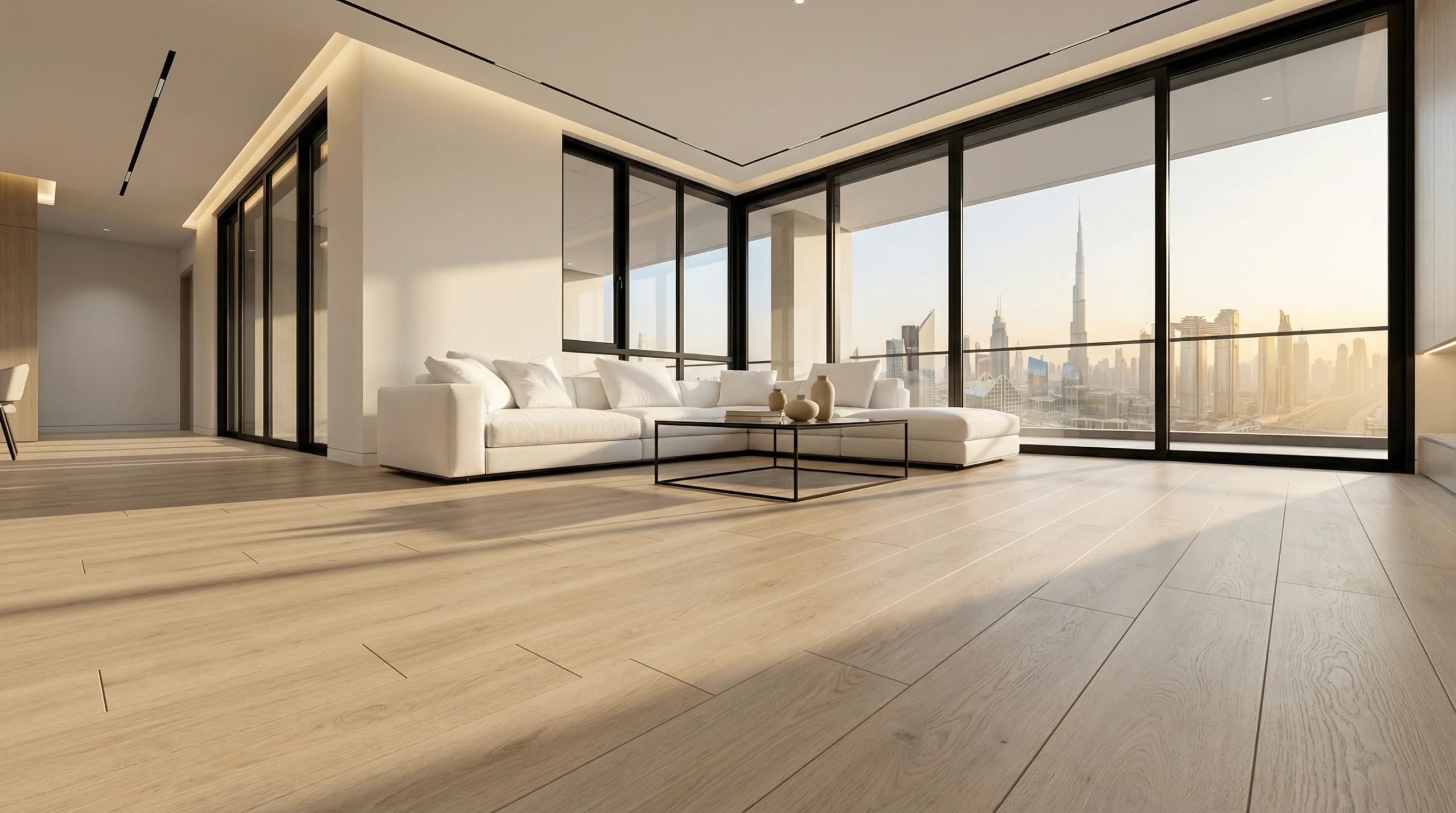
This 185 square meter three-bedroom apartment transformation replaced damaged laminate throughout with premium AC4 European oak SPC flooring. The client required waterproof performance after experiencing laminate failure from air conditioning condensation and occasional window leak incidents. We specified rigid core SPC with attached cork backing for sound dampening, addressing noise complaints from downstairs neighbors. Installation included removing all existing flooring, grinding concrete substrates to flatness specifications, installing acoustic vapor barrier underlay, and precision installation with continuous plank flow through open living-dining-kitchen area. Project timeline: 6 days including preparation. Special challenge: working around occupied bedrooms, completing installation in phases while family remained in residence. Client praised the warmth underfoot compared to previous laminate and confirmed complete satisfaction with sound dampening performance.
Palm Jumeirah Villa Complete Ground Floor – Palm Jumeirah
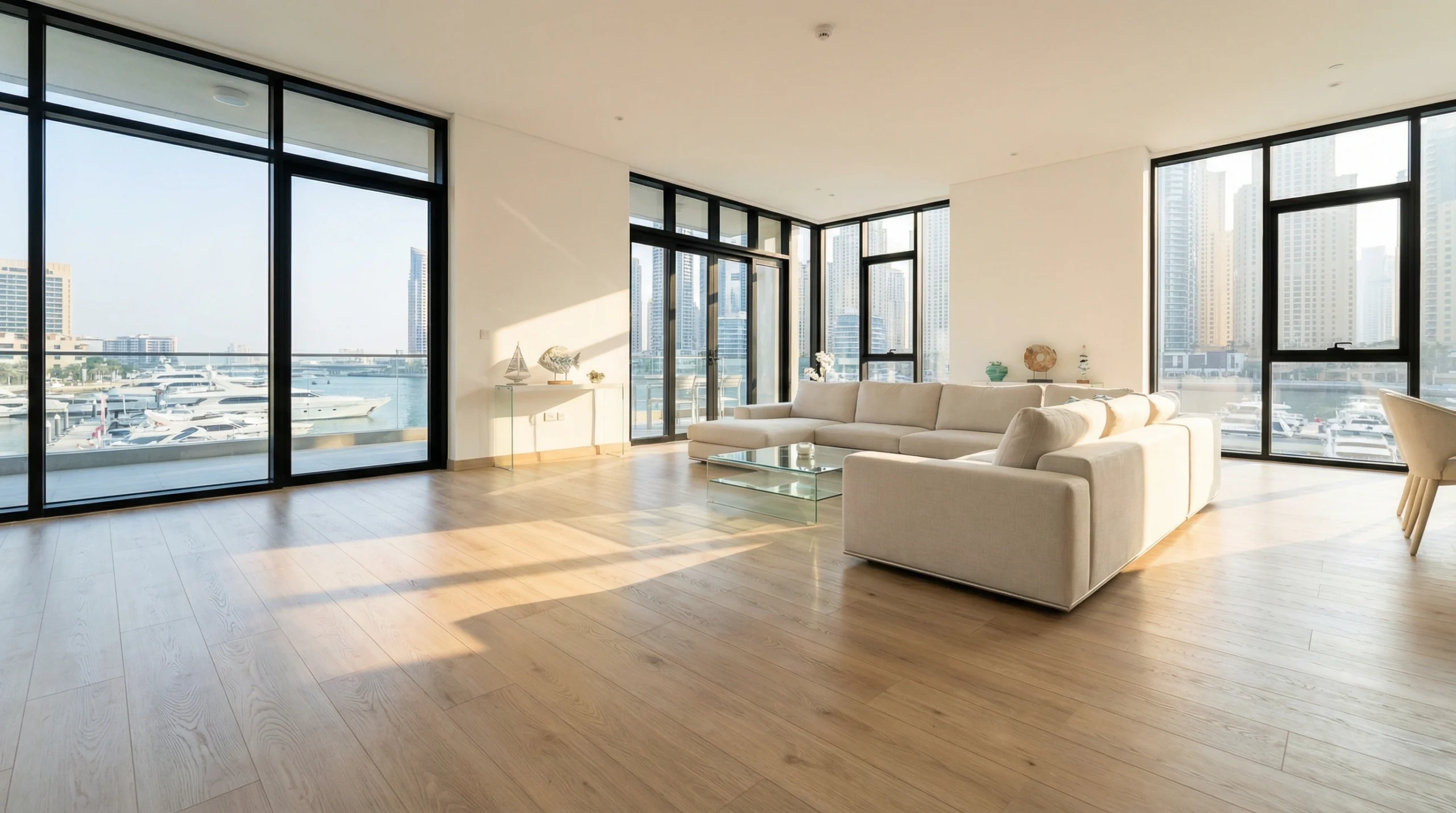
Coastal exposure and luxury aesthetic requirements drove material selection for this 420 square meter ground floor installation across living areas, family room, kitchen, corridors, and study. We specified premium wide-plank walnut SPC with 0.7mm wear layer and enhanced vapor barrier system to address palm island moisture conditions. Subfloor preparation revealed moisture readings elevated due to water table proximity, requiring epoxy moisture barrier application before underlay installation. The open floor plan flowing across seven connected spaces demanded meticulous layout planning to maintain visual continuity without awkward transition strips. Installation integrated under existing doorframes throughout, creating seamless appearance where flooring disappears beneath architectural elements. Timeline: 11 days including moisture mitigation cure time. The client specifically noted how the wide planks enhanced the villa’s luxury atmosphere while the waterproof performance provided peace of mind for coastal location.
Executive Office Build-Out – Business Bay Tower
This 340 square meter corporate office required commercial-grade SPC installation across reception, open workspace, private offices, and conference facilities. We installed AC5-rated stone-look SPC providing contemporary aesthetic while delivering the wear resistance necessary for high-traffic commercial environment. The project demanded weekend-only installation to avoid business disruption, completed across three consecutive weekends. Subfloor preparation included extensive grinding and leveling across the space due to prior installation irregularities. We integrated different plank directions in different zones—perpendicular orientation in corridor versus parallel in offices—creating subtle wayfinding through visual cues. The client appreciated the professional appearance exceeding expectations and the zero-downtime installation schedule maintaining business continuity.
Arabian Ranches Family Villa – Dubai
Traditional villa transformation with 530 square meters across both floors including five bedrooms, living spaces, kitchen, and family areas. The family requested durable, warm flooring to replace cold tiles while withstanding three children and two large dogs. We specified mid-tone hickory SPC with textured surface minimizing scratch visibility and enhanced core density resisting pet nail indentation. Installation occurred during family vacation, completing entire project in 9 days including removal of existing tile across both levels. Acoustic underlay throughout second floor eliminated noise transmission to ground level living areas—a primary concern. Pattern planning created visual interest by running planks perpendicular between living and dining areas while maintaining parallel orientation in bedrooms. The family returned to completed installation requiring only furniture placement, exceeding the emotional impact they anticipated.
Retail Store Complete Renovation – Dubai Mall
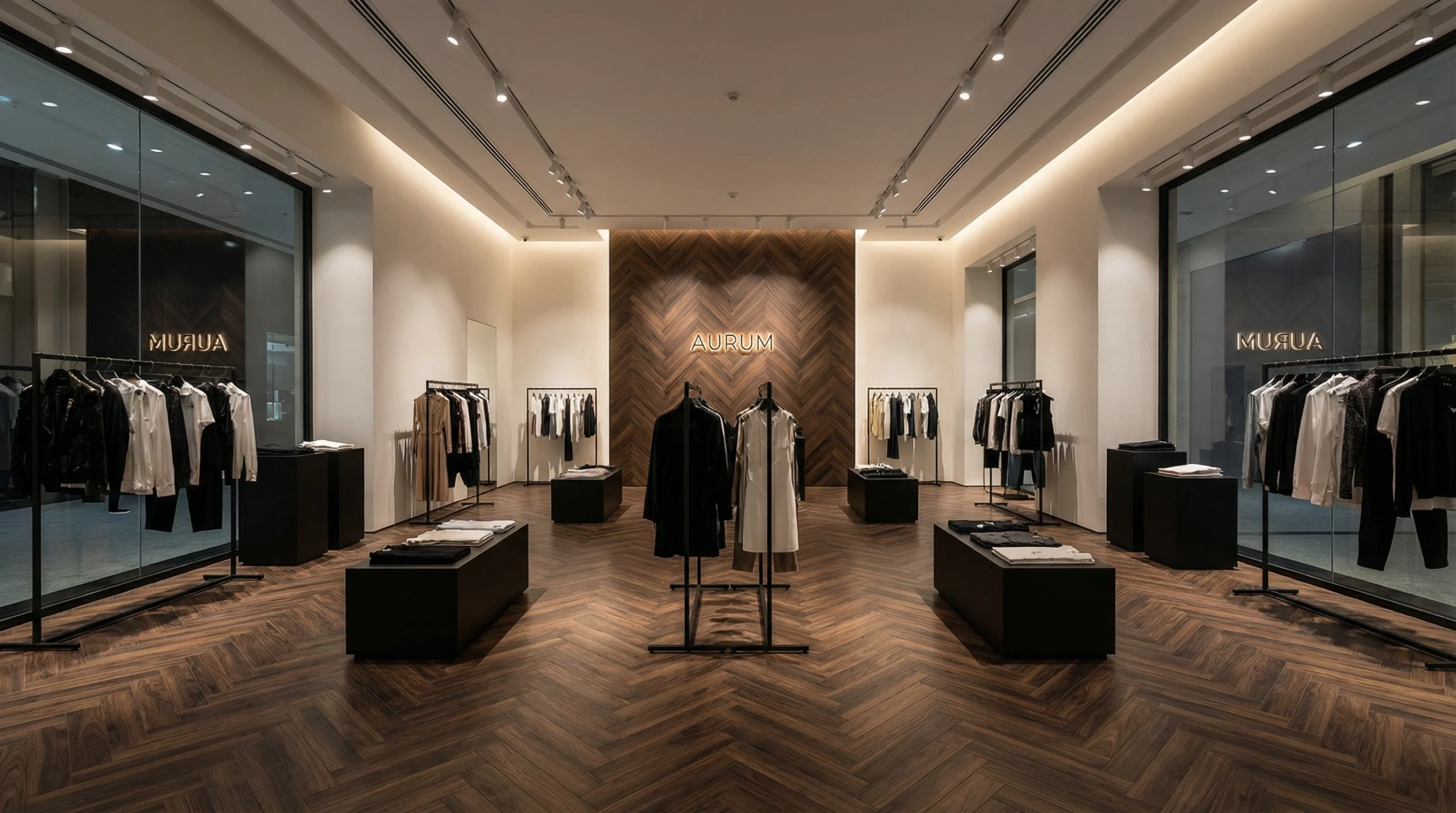
Designer retail boutique renovation demanded sophisticated aesthetic with dark walnut wide-plank SPC installation across 215 square meters. Mall regulations required after-hours work between 11 PM and 6 AM across four consecutive nights to avoid disrupting adjacent retailers or customer traffic. We coordinated material delivery through mall loading docks, security clearances, and debris removal within tight timing windows. The installation incorporated herringbone pattern feature wall transition between entry and main sales floor, requiring precision cutting and pattern management. Store management noted customers commenting positively on flooring quality within days of reopening, directly attributing increased foot traffic to the enhanced store aesthetic.
Industrial Warehouse Conversion – Al Quoz
Creative office space conversion in Al Quoz industrial area transformed 680 square meter warehouse into modern workspace. Concrete floors exhibited significant irregularity from decades of industrial use requiring extensive preparation including deep grinding, crack repair, and self-leveling compound application across entire area. We installed heavy-duty industrial SPC rated for forklift traffic and extreme wear, providing the commercial durability required while creating warm, inviting atmosphere contrasting typical sterile office environments. The open space installation without walls or obstacles allowed efficient material usage and rapid installation across three days once preparation completed. Office management highlighted how the flooring transformation completely changed the space character, making warehouse environment feel designed and intentional.
Jumeirah Beach Residence Apartment – JBR Dubai
Beachfront apartment renovation replacing entire 140 square meter unit with premium stone-look SPC after catastrophic water damage destroyed previous flooring. High humidity and salt air exposure typical of JBR properties required enhanced specification with commercial-grade vapor barrier and corrosion-resistant transition strips. We coordinated with building management for material delivery and debris removal adhering to strict tower protocols. Installation included bathroom waterproofing with perimeter sealing and aluminum thresholds creating complete moisture barriers. The neutral gray stone aesthetic complemented beachfront views while waterproof performance provided essential protection against future incidents. Timeline: 4 days. Client valued our experience with JBR-specific challenges, noting confidence in specification appropriateness for extreme coastal exposure.
Healthcare Clinic Fit-Out – Abu Dhabi
Medical facility required hygienic, durable flooring across 290 square meters including examination rooms, waiting area, consultation offices, and staff areas. We specified antimicrobial SPC with sealed surface treatment preventing bacterial growth and enabling aggressive cleaning with medical-grade disinfectants. Installation occurred during two-week facility closure for complete renovation, coordinating with other trades including medical equipment installation. The specification prioritized seamless installation minimizing seams where contamination can harbor—successful achievement required precision planning and expert execution. Clinic administration praised the professional appearance meeting healthcare aesthetic standards while exceeding durability expectations for medical environment.
Emirates Hills Villa Master Suite – Emirates Hills
Luxury bedroom renovation created 85 square meter master suite retreat with custom herringbone SPC installation in extra-wide plank format. The sophisticated pattern required extensive planning and precision cutting—herringbone creates approximately 35% waste compared to 8% for standard plank installation, but the visual impact justified the premium. We integrated the flooring under built-in wardrobes and seating nooks, creating continuous appearance throughout the suite. Special attention to sound dampening used premium acoustic underlay creating quiet sanctuary environment. Installation: 3 days including pattern layout and cutting. The homeowner described the result as hotel-luxury exceeding original vision.
Restaurant Kitchen and Dining – Downtown Dubai
Full-service restaurant required waterproof commercial flooring across 310 square meters including dining area, bar, kitchen, and prep zones. We installed heavy-duty AC5+ rated SPC designed specifically for hospitality applications with enhanced wear layer resisting commercial floor scrubbers and grease-cutting chemicals. Kitchen areas received additional waterproof sealing creating complete moisture barriers preventing water penetration around equipment and drain areas. Installation occurred during one-week closure between restaurant concepts, demanding compressed timeline coordination. The wood-look aesthetic in dining area contrasted stone-look in kitchen zones, both providing the sanitation-friendly surfaces health inspectors require while maintaining warm, inviting restaurant atmosphere. Restaurant management valued zero callbacks and complete satisfaction with durability six months into operation.
SPC Flooring Questions - Expert Answers
Clear answers on SPC performance in UAE climate, lifespan, costs, installation over tile, maintenance in Dubai dust, pets, bathrooms, acoustics, and design choices.
SPC performs exceptionally well because its limestone and PVC composite core does not absorb moisture and stays dimensionally stable across extreme humidity swings. It avoids the gaps, cupping, and warping common in organic materials.
SPC is also highly stable under temperature cycling. It expands minimally across large indoor-to-window-zone temperature differences, making it reliable near glass walls, semi-conditioned areas, and homes with inconsistent cooling.
Most residential SPC floors last 15 to 25 years depending on wear layer thickness and maintenance. Premium 0.5 to 0.7mm wear layers hold appearance much longer than 0.3mm budget layers.
Commercial SPC typically lasts 7 to 15 years based on traffic levels, cleaning protocols, and product rating.
It can be done, but it is rarely ideal because grout lines create unevenness that can telegraph as soft spots and visible lines. Floor height also rises, affecting doors, thresholds, and toe kicks.
If over-tile is unavoidable, grout joints should be filled and leveled, then paired with a dense underlay. In most cases, tile removal and proper substrate prep gives better long-term results.
Installed SPC commonly ranges AED 95 to 320 per square meter depending on product quality, wear layer, underlay, and subfloor condition. Premium SPC can approach engineered wood pricing, but with lower lifetime maintenance.
SPC also installs faster than tile and avoids refinishing costs associated with hardwood.
Daily dust mopping or vacuuming removes abrasive sand before it scratches the wear layer. Use strong entry mats, especially during windy periods, to reduce grit spreading indoors.
Damp mop weekly using pH-neutral cleaners, avoid harsh chemicals, abrasive pads, and steam mops. Use furniture pads and chair mats for rolling chairs.
Yes, if the product is certified for radiant heating and surface temperatures stay within manufacturer limits, usually up to 27°C. Use radiant-safe underlay with low thermal resistance.
Temperature changes should be gradual to protect locking systems and avoid thermal shock.
Yes, but difficulty depends on location. Edge-near planks are easier because floors can be disassembled back to the damaged area. Center planks can be cut out and replaced using professional drop-in methods with adhesive.
Color matching is easiest when you keep leftover planks from the same batch.
SPC is waterproof, but standing water can seep into seams over time. Use damp mopping rather than wet mopping, and wipe excess water immediately.
In wet zones, perimeter sealing with silicone adds strong protection, especially around sinks and laundry areas.
SPC has mixed sustainability impact. Many products include recycled content and avoid high-energy kiln processes used for ceramic tile. PVC content is the main environmental concern, so choose products with recycled PVC and low-VOC certifications.
Its long lifespan and low maintenance reduce replacement frequency, improving overall footprint.
Yes, SPC is well-suited for bathrooms when edges and perimeters are sealed properly with silicone. Careful detailing around toilets and vanities prevents water migration below the floor.
Showers are typically better handled with tile inside the enclosure, with SPC stopping at the threshold.
SPC is pet-friendly. Quality wear layers resist normal claw scratching, and the waterproof, non-porous surface prevents odor absorption if accidents are cleaned quickly.
Textured matte finishes hide paw marks and dust better than glossy surfaces, making them a smarter choice for pet homes.
SPC itself transmits impact sound, so underlay selection matters. Premium acoustic underlays can reduce impact noise significantly and are recommended for apartments and offices.
Dense underlays usually outperform thick soft foams. Match the underlay to the building structure for best results.
Light oak tones brighten smaller spaces, while darker tones look premium in larger rooms with strong daylight. Mid-tone colors hide dust and pet hair better than extreme light or dark shades.
Wide planks create modern luxury appeal but need flatter subfloors. Standard widths balance aesthetics and tolerance to minor substrate imperfections.
SPC Flooring Coverage Throughout UAE
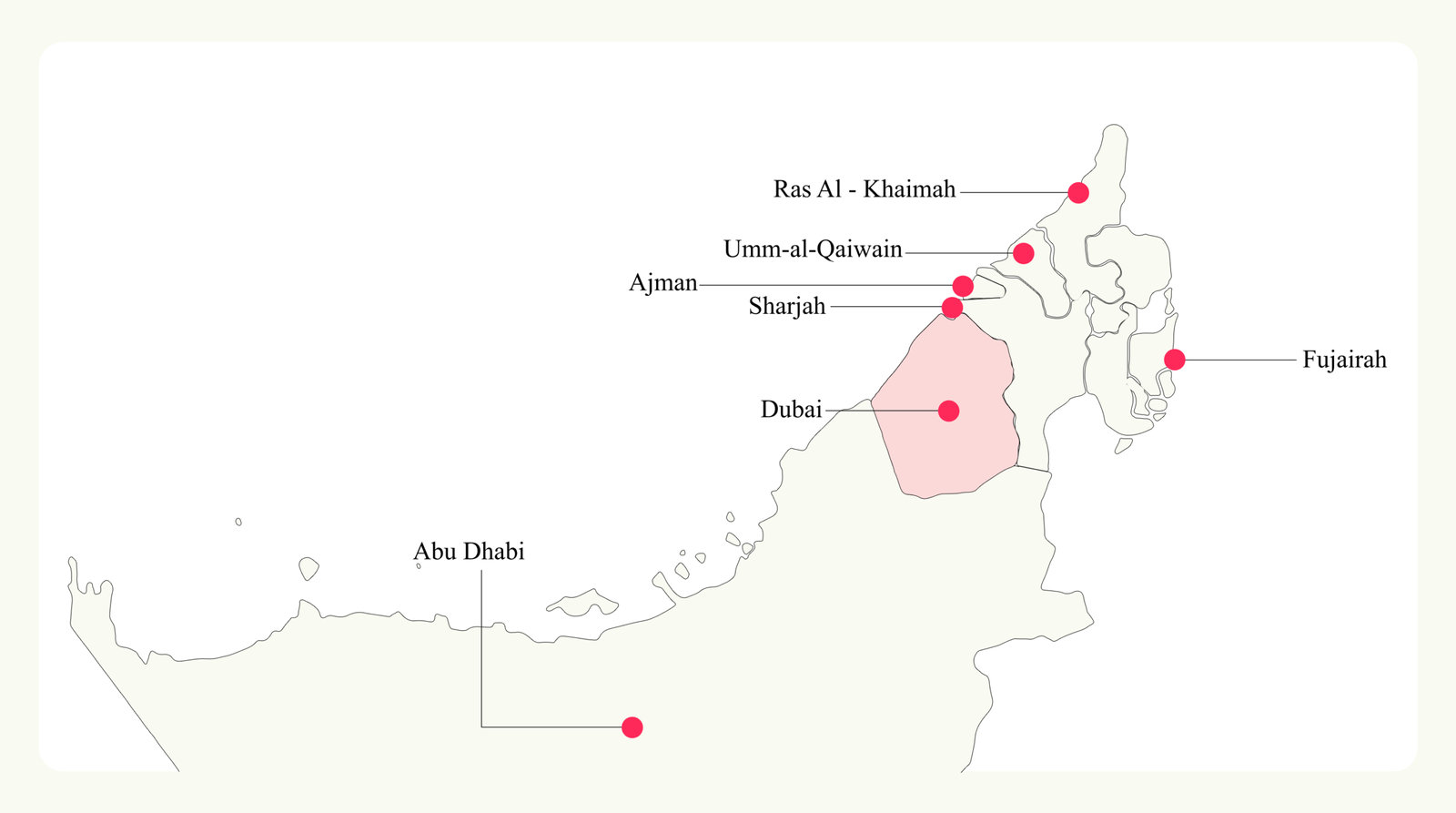
Our SPC flooring installation teams serve all seven emirates with consistent expertise and quality standards regardless of project location. Extensive geographic coverage means we’ve solved flooring challenges specific to each emirate’s climate variations, building types, and regulatory requirements.
Dubai: We complete SPC flooring projects throughout Dubai including Business Bay high-rises, DIFC commercial properties, Dubai Marina towers, JBR beachfront residences, Downtown Dubai luxury apartments, Palm Jumeirah villas, Arabian Ranches family communities, Emirates Hills estates, The Springs townhomes, The Meadows villas, Jumeirah traditional and modern properties, Mirdif residential areas, Dubai Silicon Oasis tech hub properties, Dubai Sports City apartments, Motor City developments, and Dubai Industrial City commercial facilities. Our Dubai experience spans 35 years across every development phase and building type, providing unmatched knowledge of district-specific installation challenges from Marina humidity to Arabian Ranches temperature extremes.
Abu Dhabi: Our Abu Dhabi installations encompass Al Reem Island towers, Yas Island residential and commercial properties, Saadiyat Island luxury developments, Al Reef community installations, Al Raha Beach properties, Khalifa City residential areas, Masdar City sustainable buildings, Al Ain properties, and Western Region facilities. Abu Dhabi’s newer construction standards often provide superior substrates compared to older Dubai developments, but stricter building access protocols and security clearances require experienced coordination that our teams navigate routinely.
Sharjah: Sharjah projects include Al Majaz waterfront properties, Al Nahda residential buildings, Muwaileh commercial developments, University City installations, and Sharjah Airport Freezone facilities. Sharjah’s value-focused market demands efficient installation approaches that maintain quality while meeting cost targets that residential and commercial clients expect.
Ajman, RAK, Fujairah, UAQ: Northern Emirates installations serve residential communities, commercial developments, and industrial facilities with the same quality standards we apply throughout UAE. These regions require logistics coordination for material delivery and team deployment, which we manage systematically through our established northern operations protocols.
Response times throughout UAE typically allow site assessments within 48-72 hours of contact and project initiation within 1-2 weeks depending on material availability and client schedules. Emergency repairs receive priority scheduling with response within 24 hours for commercial clients and 48 hours residential. Our mobile teams carry common replacement planks allowing same-day repairs for standard products.
Start Your SPC Flooring Transformation
Transform your property with waterproof, durable SPC flooring installed by UAE’s most experienced flooring specialists. Whether renovating a Marina apartment, upgrading a commercial space, or building a dream villa, Karnak delivers the expertise ensuring your flooring investment performs flawlessly for decades. Our comprehensive consultation process identifies your specific requirements and recommends optimal solutions without obligation or pressure.
IF YOU HAVE ANY QUESTION? WE ARE GLAD TO
CONSULT YOU AS SOON AS POSSIBLE
Get Started
Immediate assistance from our team regarding your project details.
Form Submitted!
Thank you for contacting us. Our team will get back to you within 24 to 48 hours regarding your query.
Contact us on WhatsApp for Quick Response