
Blog
How Humidity and Heat Destroy Wooden Furniture in the UAE (And How to Stop It)

In 35 years and over 10,000 projects across the UAE, we have seen beautiful, expensive furniture destroyed by something most homeowners never think about: the air inside their own homes. Not scratches. Not accidents. The invisible combination of heat and humidity that makes the UAE one of the harshest environments on earth for wooden furniture.
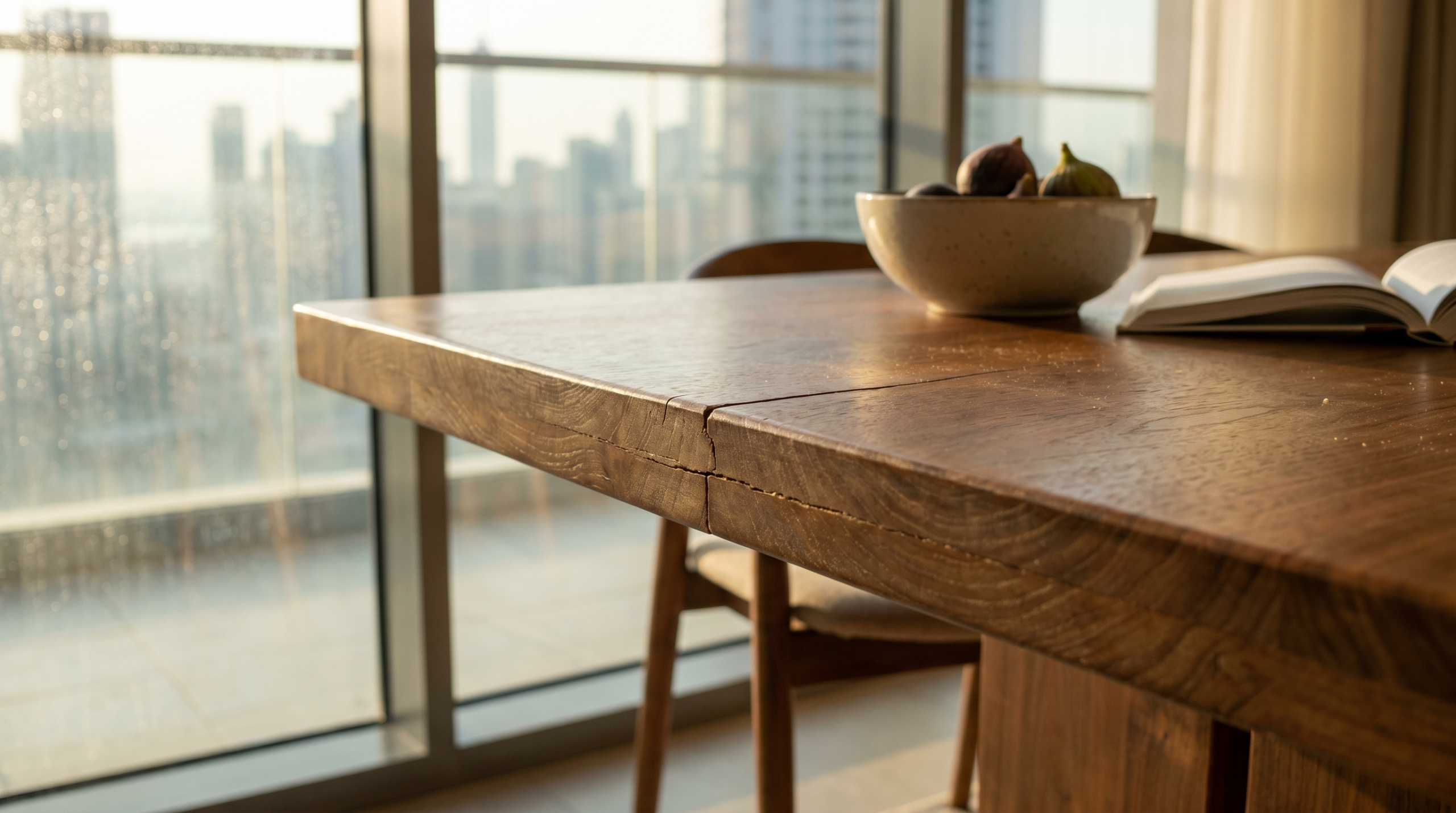
A client in Emirates Hills called us in 2024 about a custom solid oak dining table we had built for them three years earlier. The joints had opened up by almost 4mm. The tabletop had developed a distinct bow. Nothing had been dropped on it, nobody had abused it. The air had done this. We have had this same conversation, in different forms, in Marina apartments, Palm Jumeirah villas, and Jumeirah townhouses more times than we can count. We have had this same conversation, in different forms, regarding premium Dining Room Carpentry and bespoke Home Office Carpentry in Marina apartments, Palm Jumeirah villas, and Jumeirah townhouses more times than we can count.
This post explains exactly what is happening to your wooden furniture, why the UAE makes it worse than almost anywhere else, and what actually works to slow or stop it. No generic advice. No product endorsements. Just what 35 years of carpentry in this climate has taught us.
Why Wood Is Essentially a Living Material, Even After It’s Cut
This is the foundation of everything. Most people treat wood like stone or metal, as though it reaches a finished state and stays there. It does not. Wood is hygroscopic, which means it continuously absorbs and releases moisture from the surrounding air for its entire lifespan. Every board in your dining table, your wardrobe, your kitchen cabinets, is silently responding to the air around it every single day.
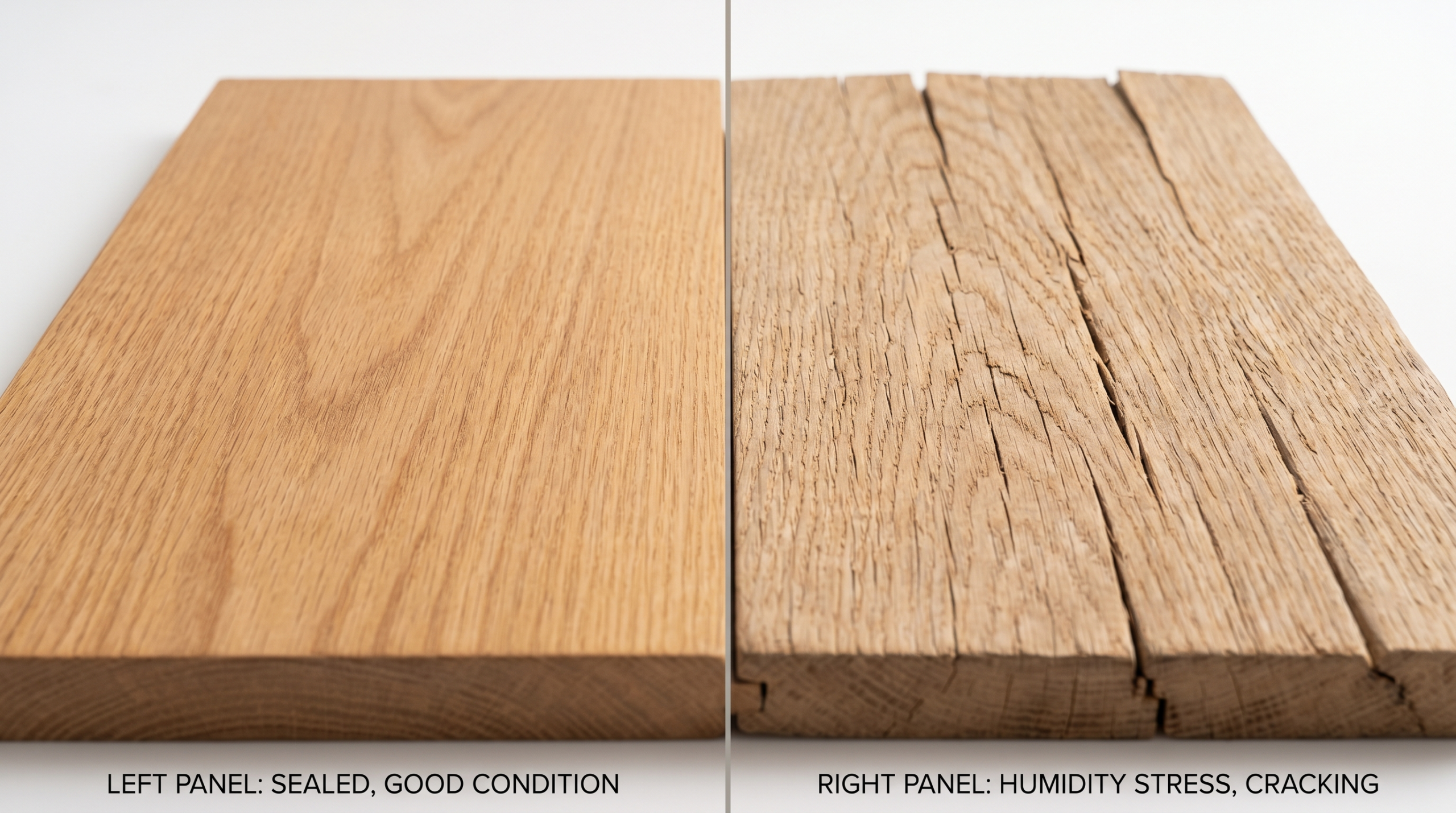
When wood absorbs moisture, it expands. When it releases moisture, it contracts. This movement is not uniform across the board. Wood expands and contracts far more across its width than along its length, which is why you see tabletops cup or bow rather than stretch lengthwise. A solid timber plank that is 300mm wide can move 3 to 5mm seasonally in a UAE home. That does not sound like much until you have eight planks edge-glued together in a tabletop, and the cumulative stress tears the joints apart.
The specific number that matters here is called the Equilibrium Moisture Content, or EMC. This is the moisture level wood naturally reaches when it stabilizes with the surrounding air. In temperate climates, indoor EMC typically sits around 8 to 10 percent. In Dubai, it swings between 4 percent during the dry winter months and up to 14 percent in peak summer humidity, particularly in coastal areas like JBR, Dubai Marina, and the Palm. That 10-point swing is catastrophic for solid wood that was not properly prepared for this climate.
The Two Seasons That Damage Wood Most in the UAE
Homeowners here tend to worry about summer, and summer does cause problems. But the transition periods between seasons are actually when most damage occurs, and this surprises people when we tell them.
From May through September, outdoor humidity in coastal Dubai regularly exceeds 85 to 90 percent. Your air conditioning works hard, pulling that moisture out of the indoor air and keeping your home comfortable. The effect on wood: it dries out more aggressively than it would in a naturally moderate climate, because the AC is running almost continuously. Wood shrinks, joints open slightly, and finishes can begin to micro-crack along the grain.
Then October arrives. The AC usage drops. Windows start opening. Outdoor air, still carrying significant moisture from the Gulf, floods into homes that have been kept artificially dry for five months. The wood, which has contracted during summer, now absorbs moisture rapidly and expands. This rapid rehydration after prolonged drying is when you see the most dramatic cracking, joint failures, and warping. We respond to more furniture damage calls in October and November than any other time of year.
The secondary damage season is the late winter dust period, February through March, when Shamal winds reduce humidity sharply and the fine desert dust that infiltrates everything accelerates surface finish degradation. Furniture in villas with poor sealing, particularly in areas like Arabian Ranches and The Springs, takes a visible beating during Shamal season.
How Temperature Amplifies the Problem
Heat alone does not damage wood the way humidity does. But heat and humidity together create a compounding effect that is far more destructive than either alone.
At 45 degrees Celsius, which is not uncommon on a Dubai rooftop terrace or in a car, wood surface temperatures can reach 60 to 70 degrees. At these temperatures, the oils and resins that give wood its natural flexibility begin to break down. Finishes soften. Adhesives in joints lose their grip. And when the temperature drops again, everything contracts at slightly different rates. After enough cycles, the cumulative fatigue is visible as fine surface checking, that network of tiny cracks you sometimes see on older wooden furniture that has lived through many UAE summers.
For outdoor furniture specifically, this thermal cycling is the primary killer, not rot, not insects. A teak sun lounger on an unshaded Palm Jumeirah terrace is cycling through temperature swings of 30 to 40 degrees between night and peak afternoon. Teak handles this better than almost any other species, which is why we recommend it for outdoor applications without hesitation. But even teak shows the effects within three to four years without proper maintenance.
The Most Vulnerable Wood Types in UAE Homes
Not all wood responds to UAE humidity equally. After fitting furniture in thousands of homes across Dubai, Abu Dhabi, and Sharjah, we have developed a clear picture of which species and wood products perform well and which struggle.
Solid Hardwoods: High Risk, High Reward
Solid hardwoods, oak, walnut, ash, cherry, are the most beautiful and the most vulnerable. Their visual appeal comes from the same characteristic that creates problems in the UAE: they are real, dense, natural wood with a full cross-section of cells that absorb and release moisture actively.
American white oak is probably the most commonly specified solid wood in UAE high-end residential projects. It is genuinely beautiful and durable. It is also one of the more reactive species to humidity changes. In a well-climate-controlled Emirates Hills villa where the indoor humidity is managed year-round, a luxury Living Room Carpentry setup or a solid oak kitchen is entirely achievable.
However, in a JBR apartment where the owner travels frequently and the AC gets turned off for weeks at a time, solid oak features or highly exposed central surfaces, like Custom Kitchen Islands, will warp noticeably within two or three such cycles. We have seen it many times.
Walnut is slightly more stable than oak and significantly more expensive. It is our recommendation when a client absolutely wants solid hardwood and is serious about maintaining their home environment. Teak, as mentioned, is exceptional for outdoor and semi-outdoor applications. For interior furniture, teak is often considered too oily for certain finishes, but its natural durability more than compensates.
Engineered Wood Products: Better Stability, Different Risks
MDF, plywood, and engineered timber boards are far more dimensionally stable than solid wood because the manufacturing process disrupts the directional grain structure that causes movement. A high-quality 18mm MDF panel will expand and contract far less than a solid timber panel of the same thickness in response to humidity changes.
This stability is why we use engineered substrates for most UAE cabinet carcasses, even when the visible surface is a solid wood veneer or natural timber door. The stability of the base material protects the appearance of the finish.
However, engineered wood products have a critical vulnerability: their edges and any exposed cores. Standard MDF that gets wet, whether from a plumbing leak under a sink or persistent condensation in a coastal apartment bathroom, will swell irreversibly. The face may look fine while the interior core absorbs moisture and begins to deteriorate. By the time visible swelling appears at the edges, the panel is often structurally compromised.
Moisture-resistant MDF, which we specify for all kitchen and bathroom applications, performs significantly better but is not waterproof. It resists incidental moisture, not sustained exposure.
Veneer: The Delamination Risk Nobody Mentions
Veneered furniture represents a large portion of mid-range and high-end furniture sold in the UAE. A beautiful walnut veneer over an MDF or plywood substrate gives the visual richness of solid wood with better dimensional stability. In a controlled environment, it is an excellent choice.
The risk specific to the UAE is delamination. When humidity swings are large and the adhesive layer between veneer and substrate is exposed to repeated stress from differential movement (the veneer responding slightly differently from the substrate), the bond can fail. You see it initially as bubbling or rippling in the veneer surface. In advanced cases, sections of veneer lift entirely.
We have inspected European-imported installations where custom Bedroom Carpentry sets, including high-end Sliding Wardrobes or beautifully paneled Walk-in Closets; began to show delamination within 18 months of installation., not because the furniture was poor quality, but because it was manufactured for a temperate European climate and arrived in Dubai without any acclimatization period. The client paid AED 45,000 for a bedroom set that needed remediation less than two years after delivery.
What Actually Works to Protect Wood in the UAE
This is the section most articles get wrong because they give generic advice that ignores the specific conditions here. Let us be direct about what works and what does not.
Humidity Control: The Single Most Important Factor
Maintaining consistent indoor humidity is, without question, the most effective thing you can do for wooden furniture in the UAE. Nothing else comes close.
The target range is 45 to 55 percent relative humidity, year-round. Below 40 percent (common in heavily air-conditioned Dubai homes during summer), wood dries and contracts. Above 60 percent (common when AC is reduced or windows are opened during transitional months), wood absorbs moisture and expands.
Most UAE homes have no active humidity management. The air conditioning unit removes some moisture as a byproduct of cooling, but it is not calibrated to maintain a specific humidity level. Investing in a whole-home dehumidifier or humidifier system, depending on season, is the most cost-effective protection for a home with significant solid wood investment.
A basic hygrometer costs AED 30 to 60 at any hardware store. Place one near your most important wooden furniture and start reading it. Most homeowners are genuinely surprised by how much their indoor humidity fluctuates.
For homes with high-value furniture, a standalone dehumidifier for a living or dining room (AED 400 to 1,200 for a quality unit) can maintain the humidity range wood needs. We recommend this to every client who invests AED 30,000 or more in solid wood furniture.
Wood Finishing: What the Finish Actually Does
A good finish is not decoration. It is a moisture barrier. But it is important to be honest about the limits of what any finish can do.
No finish completely stops moisture movement in wood. What a good finish does is slow it down, reducing the rate of absorption and release, and thereby reducing the amplitude and speed of movement. This matters because it is the rapid, extreme swings that cause cracking and joint failure, not gradual, modest movement.
Oil-based finishes (Danish oil, Tung oil, linseed oil) penetrate the wood fibers and provide good protection from moderate humidity. They are relatively easy to maintain and repair, which is why we use them for much of our furniture work. They need reapplication every one to two years in the UAE climate.
Hard lacquers and polyurethane topcoats create a surface film that is more impermeable than oil finishes. They offer stronger moisture resistance but are more brittle. In extreme UAE heat on outdoor or south-facing surfaces, lacquer topcoats can check and peel. When that happens, moisture enters through the cracks and is then trapped between the wood and the film, accelerating damage rather than preventing it.
For outdoor furniture, penetrating oils are almost always the correct choice in the UAE. For indoor furniture in a climate-controlled environment, a high-quality lacquer finish applied correctly can last many years without issue.
Wax finishes offer the least moisture protection and are not appropriate for UAE conditions on anything that will see real use. We see imported European furniture finished only in wax fail within the first summer fairly regularly.
Proper Acclimatization Before Installation
This is something the furniture industry does not communicate clearly enough. Before any solid wood furniture is installed in a UAE home, it needs to spend time in the actual environment where it will live.
We hold custom pieces in our workshop for a minimum of two weeks before delivery and installation. During this time, the piece is exposed to similar conditions to the installation environment, allowing the wood to reach its natural EMC for Dubai’s indoor climate. Any movement that is going to happen early in the piece’s life happens in the workshop, where we can address it. Pieces that go straight from a controlled workshop or a shipping container into a home will almost always move after installation.
For imported furniture, we strongly recommend buyers ask dealers about their acclimatization process. Reputable high-end retailers in Dubai do acclimatize stock properly. Furniture shipped directly from overseas and delivered without any acclimatization period is taking a significant risk, particularly with solid wood pieces.
Joinery Design That Accommodates Movement
This is the craft dimension of the problem, and it is where 35 years of experience in this climate shows most clearly in our work.
The Consequences of Ignoring Wood Movement
Furniture built without accommodating wood movement will fail in the UAE. This sounds obvious, but it requires specific design decisions that less experienced makers do not always make.
Tabletop Fastening Techniques
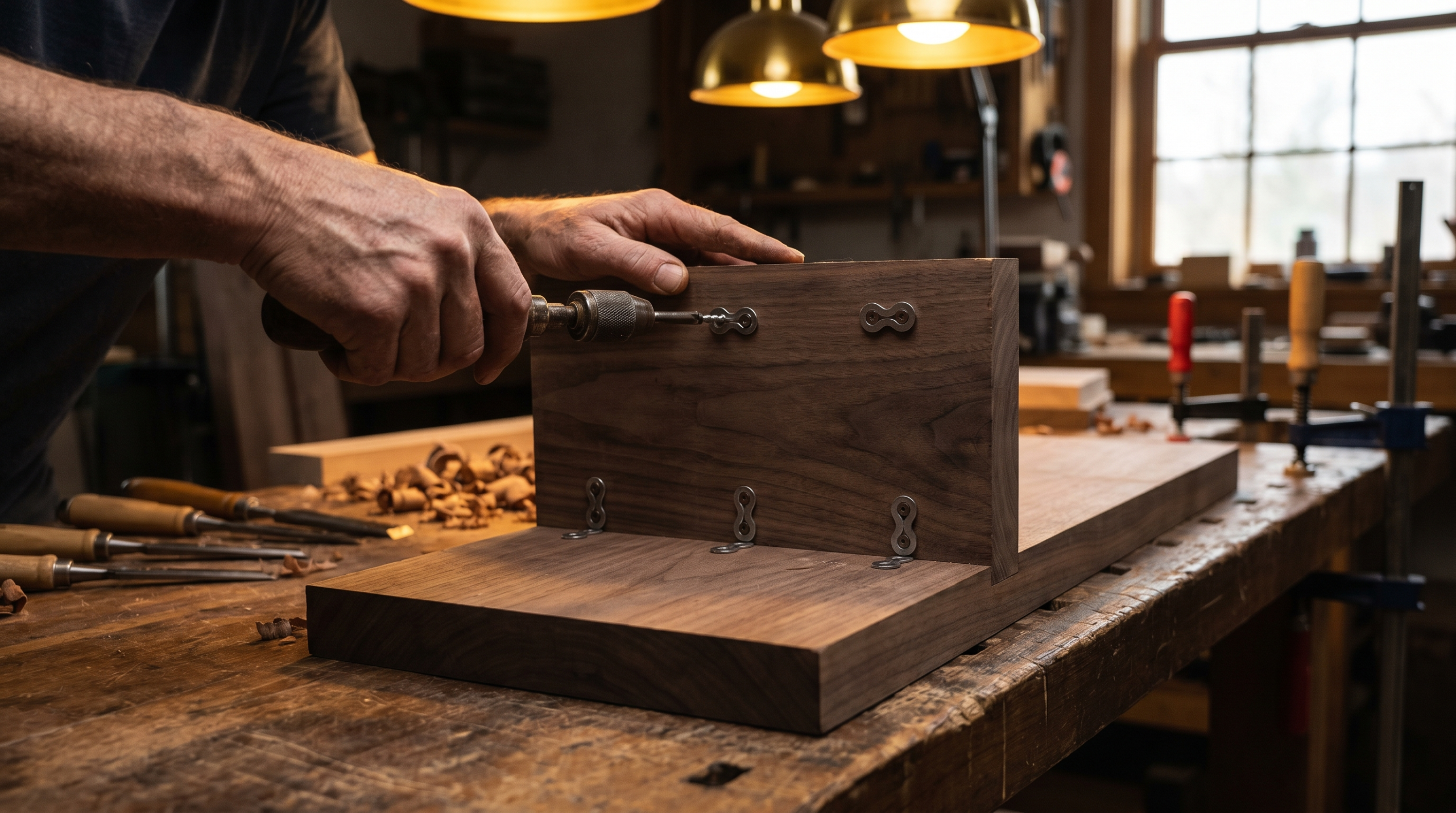
A solid wood tabletop should never be rigidly glued or screwed directly to a fixed base. The top will move seasonally, and if it cannot move, it will crack instead. We use figure-eight fasteners or slotted metal clips that allow the top to expand and contract across its width while holding it securely to the base. This is standard practice but frequently skipped in mass-produced furniture.
Drawer Tolerances for Coastal Climates
Drawer construction in solid wood cabinets needs slightly more tolerance in the UAE than in temperate climates. A drawer that fits perfectly in February when the wood is at its driest will bind and refuse to close in October if no movement allowance was built in. We add 1.5 to 2mm additional tolerance per side on solid wood drawers in coastal areas like Marina and the Palm.
Floating Panels in Traditional Joinery
Panel frames need floating panels. A solid wood panel rigidly captured in a frame will either crack the panel or distort the frame during humidity swings. The panel floats in a routed groove, free to move within the frame. This is traditional joinery practice, but it is non-negotiable in the UAE.
Common Mistakes That Accelerate Wood Damage in UAE Homes
Mistake 1: Turning Off the AC When Travelling
This is the single most damaging thing UAE homeowners do to their furniture, and it is entirely understandable. Electricity is not cheap, nobody wants to cool an empty villa for two weeks while they are in Europe, and so the AC gets turned off or set to 30 degrees before the flight.
What happens in those two weeks: the indoor humidity rises to match the outdoor level, which during summer can exceed 85 percent. The wood absorbs moisture aggressively. Then the family returns, cranks the AC back to 20 degrees, and the humidity drops sharply over 24 to 48 hours. The wood, which just spent two weeks expanding, now contracts rapidly. This single cycle can open joints, crack panels, and warp doors noticeably.
The solution is simple and costs less than people think. Set the AC to 27 to 28 degrees and leave it running when you travel. The unit barely runs at that setpoint in the evening but maintains enough dehumidification to keep humidity in a safe range. The electricity cost for a month is genuinely modest compared to the cost of repairing or replacing damaged furniture.
Mistake 2: Placing Wood Furniture Near AC Vents
We see this constantly in Marina and JBR apartments where the floor plan leaves limited furniture placement options. A solid wood sideboard positioned directly beneath a ceiling AC vent is receiving a concentrated stream of cold, dry air for six months a year. The wood surface directly under the vent dries faster than the rest of the piece, creating localized stress that results in surface checking and, over time, visible cracking.
The minimum safe distance between a wood surface and a direct AC vent is about 600mm. Where this is not possible, redirecting the vent airflow with a deflector (AED 30 to 80 at any hardware store) away from the furniture surface makes a meaningful difference.
Mistake 3: Using Water-Based Cleaning Products Regularly
Many popular household cleaning sprays contain water, alcohol, or both. Used occasionally on a well-finished wood surface, they are generally fine. Used as a daily or weekly cleaning routine on a dining table or kitchen cabinets, they progressively degrade the finish, particularly oil-based finishes.
For regular cleaning, a barely damp microfiber cloth followed immediately by a dry cloth is ideal. Purpose-made wood cleaning products that are pH-neutral and do not contain bleach or high alcohol concentrations are appropriate for more thorough cleaning. Never use all-purpose kitchen spray cleaners, bleach-containing products, or abrasive cloths on wood surfaces.
Mistake 4: Neglecting Outdoor Furniture Maintenance
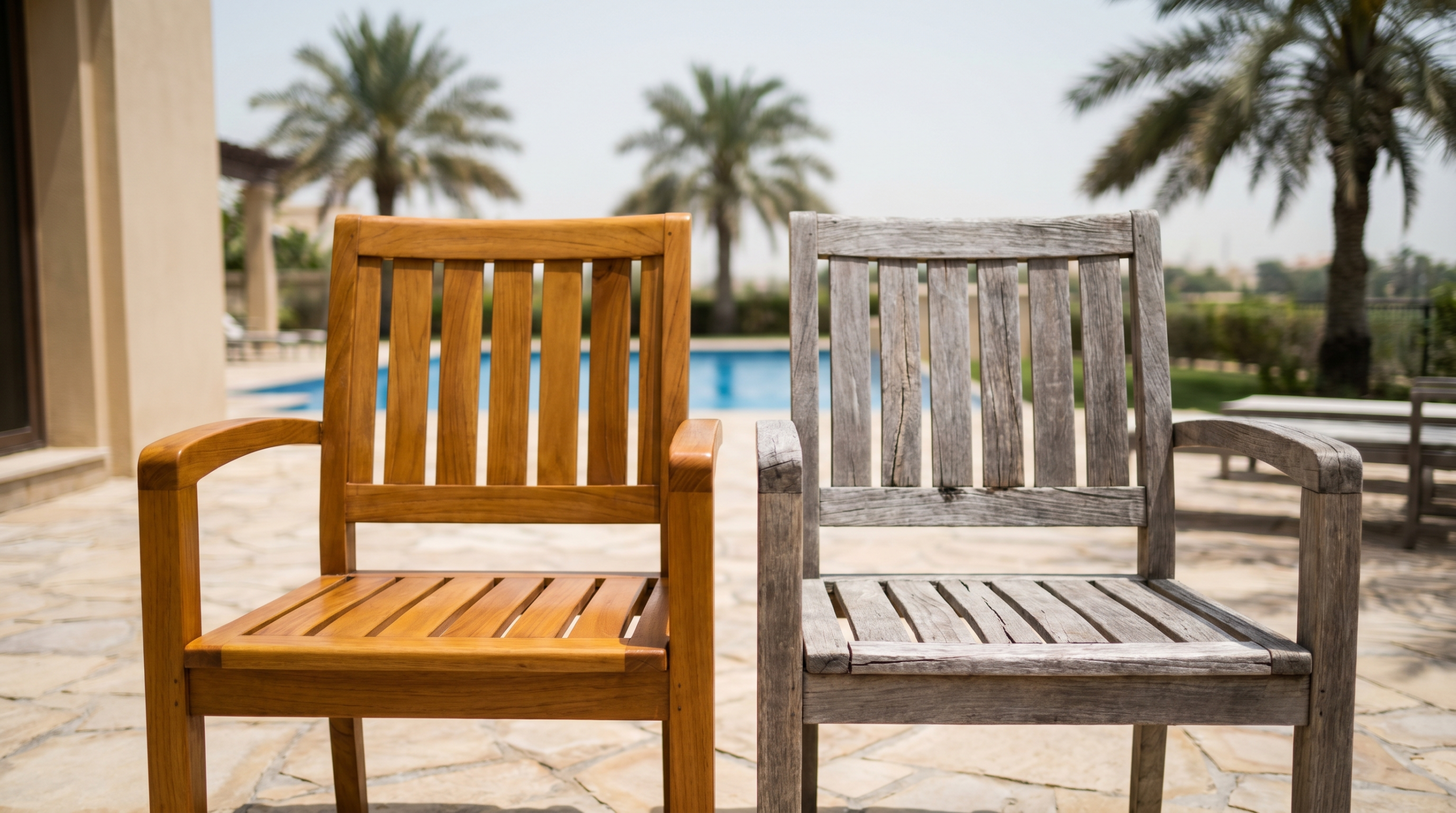
Teak is remarkably durable. It is not indestructible. Teak outdoor furniture in the UAE that receives no maintenance will be grey, surface-checked, and structurally weakened within four to five years. The teak itself rarely fails completely, but the hardware and any structural joints can deteriorate significantly.
The maintenance requirement for teak in UAE conditions is an annual clean and oil application at minimum, ideally twice yearly. A proper teak cleaner removes the surface grey and opens the grain, and a teak-specific oil application protects it through the following season. The cost for a standard set of outdoor furniture is AED 200 to 400 in materials and a half-day of effort, or AED 800 to 1,500 if you hire it done. Against the replacement cost of quality outdoor teak furniture, which starts at AED 8,000 to 10,000 for a modest set, this is not a difficult calculation.
Mistake 5: Assuming Expensive Furniture Is Immune
We have seen damaged furniture from brands selling dining tables for AED 80,000 and bedroom sets for AED 120,000. Price is not protection. What matters is the wood species, the finish type, the joinery method, and how the piece was treated before and after it arrived in the UAE. Some very expensive European furniture brands produce pieces designed specifically for the stable indoor climates of Germany or Scandinavia. Those pieces can struggle in Dubai regardless of what they cost.
Conversely, a well-made piece from a local UAE workshop, built by craftsmen who understand this climate, specifying the right species and construction methods, can outlast imported furniture costing three times as much. This is not self-promotion. It is simply what we have observed over 35 years.
Mistake 6: Refinishing Without Addressing the Underlying Cause
When furniture shows surface damage, cracking, or finish deterioration, the natural response is to refinish it. This is often the right thing to do, but refinishing without understanding and addressing why the damage occurred is a short-term fix.
We have been called to refinish pieces that were refinished by someone else 18 months previously, and the same damage has returned. If the cause is humidity cycling because the AC is turned off when the family travels, refinishing will not solve the problem. Additionally, if the cause is direct AC vent exposure, moving the furniture or redirecting the vent must happen alongside refinishing. Moreover, if the cause is an outdoor piece placed in conditions beyond its specification, no finish will last without reducing that exposure.
What UAE Humidity Protection Costs: Realistic Numbers
Clients often ask us how much it costs to properly protect wooden furniture in the UAE. The honest answer is that it depends significantly on how much solid wood you have in your home and what condition it is currently in.
Prevention Costs
A basic hygrometer to monitor humidity: AED 30 to 60. Worth buying regardless of anything else on this list.
A standalone dehumidifier for a living or dining room: AED 400 to 1,200 for a quality unit from brands like Dimplex or Hitachi. Running cost is approximately AED 50 to 100 per month in electricity.
Whole-home humidity management integrated into a ducted AC system: AED 3,000 to 8,000 installed, depending on home size. For a home with AED 100,000 or more in solid wood furniture and joinery, this is highly cost-effective.
Annual furniture maintenance (oil application, hardware check, joint inspection): AED 800 to 2,500 for a typical villa, depending on scope, if professionally done. Materials only for DIY: AED 150 to 400.
Repair Costs
Joint repair on a solid wood dining table (opening joints, re-gluing, clamping, refinishing the affected area): AED 600 to 1,500 depending on severity.
Warped solid wood door replacement versus repair: Minor warp (under 4mm): sometimes correctable with moisture treatment and clamping, AED 300 to 600. Severe warp: replacement is usually more economical, AED 800 to 2,500 per door depending on species and finish.
Veneer delamination repair on a cabinet panel: AED 400 to 900 per panel for professional re-bonding and refinishing. If multiple panels are affected, replacement of the cabinet carcass becomes the better option economically.
Full furniture restoration (stripping, repair, refinishing): AED 1,500 to 6,000 for a dining table, AED 3,000 to 12,000 for a full bedroom set, depending on size, condition, and species.
These numbers assume professional work in Dubai. Material costs alone for confident DIY refinishing of a dining table run AED 300 to 600.
Expert Tips From 35 Years of UAE Carpentry
1. Buy a hygrometer before you buy expensive wood furniture
Spend two weeks measuring your home’s humidity range across different rooms and seasons before committing to solid hardwood. If your home humidity regularly drops below 35 percent or rises above 65 percent without intervention, budget for humidity control alongside the furniture purchase.
2. In coastal Dubai, specify teak or iroko for outdoor applications without exception.
We have tried many species over the years. Nothing performs comparably in the combination of sun intensity, salt air, and humidity that characterizes Palm Jumeirah, JBR, or Dubai Marina outdoor living.
3. Ask your furniture supplier specifically about UAE acclimatization.
Not European acclimatization, not “we store it in Dubai.” Ask whether the piece spent time in conditions representative of a Dubai interior. If they look puzzled, that tells you something.
4. For kitchen cabinets in any area within 5km of the Gulf coastline, always specify moisture-resistant (MR) board for carcasses.
The premium over standard board is modest. The performance difference in coastal humidity is significant.
5. Never place large solid wood furniture directly against an exterior wall in a villa without a vapor barrier behind it.
External walls in UAE buildings can transmit both heat and moisture to anything in direct contact. A 50mm air gap or appropriate vapor barrier makes a meaningful difference.
6. Oil your interior solid wood furniture every 12 to 18 months in the UAE.
Most people think finishing is done once, at the factory or workshop. In this climate, oil finishes need periodic renewal to maintain their moisture-slowing properties. The process on a dining table takes about two hours and costs AED 80 to 150 in materials.
7. If you are renovating a bathroom or kitchen, do not compromise on the wood specification to save cost on cabinets.
These are the highest-humidity rooms in any UAE home. Cheap particleboard or standard MDF in a poorly ventilated bathroom will need replacement within three to five years. Moisture-resistant board costs perhaps 15 to 20 percent more and lasts two to three times as long.
8. Before any major wood purchase, check the grain direction on tabletops.
Quartersawn timber, where the growth rings run roughly perpendicular to the face, moves significantly less across its width than flat-sawn timber. It is harder to source and costs more, but in the UAE climate, the reduced movement is worth the premium for large solid wood surfaces.
Conclusion: The UAE Is Hard on Wood, But It Does Not Have to Destroy It
Wood and the UAE climate can coexist. We have built furniture that has lasted 20 and 30 years in Dubai homes, looking as good today as when it was installed. The clients who have that experience share something in common: they understood what the climate requires, they invested in the right species and construction methods, and they maintained their furniture.
The clients who have called us about destroyed furniture also share something in common: they treated wood like an inert material that would take care of itself. It will not, in this climate.
The core principles are not complicated. Manage your indoor humidity consistently. Use the right species and finishes for your specific application. Allow wood to acclimatize before installation. Build in movement allowances where solid timber is used. Maintain finishes before they fail rather than after. And when travelling, leave the AC running at a modest setpoint. These are not expensive or difficult commitments. They are the difference between furniture that lasts a decade and furniture that lasts a generation.
Key Takeaways:
- Wood continuously absorbs and releases moisture, and UAE humidity swings between 4 and 14 percent EMC seasonally, which is extreme by global standards.
- The most damage occurs during transitional periods, particularly when AC is turned back on after travel or windows are opened in October.
- Maintaining indoor humidity between 45 and 55 percent year-round is more protective than any finish or wood species choice.
- Joinery design must accommodate wood movement. Figure-eight fasteners, floating panels, and adequate drawer tolerances are non-negotiable in this climate.
- Annual maintenance of oil finishes and outdoor teak is far cheaper than repair or replacement, and the cost calculation is not close.
Need Expert Help?
If you have noticed your wooden furniture starting to show signs of humidity or heat damage, or if you are planning a new furniture installation and want to get it right from the start, Karnak Carpentry has been solving exactly these problems in UAE homes since 1988. We offer free consultations for residential projects across Dubai, Abu Dhabi, and Sharjah, and we will give you honest advice about what your specific situation requires rather than what will maximize our invoice.
Contact: WhatsApp Us or Call Us at +971-52-5554207 | info@karnakcarpentry.com
Frequently Asked Questions About Heat and Humidity Damage to Wooden Furniture in the UAE
Why does wooden furniture crack in the UAE?
High temperatures and constant indoor cooling cause wood to expand and shrink throughout the year. These repeated changes create stress inside the timber, which eventually leads to cracks, loose joints, and surface damage. Choosing stable wood species and maintaining consistent indoor humidity helps prevent these problems.
Can humidity damage wooden furniture in Dubai?
Yes. Excess humidity allows wood to absorb moisture, which causes swelling, warped panels, sticky drawers, and misaligned doors. Quality finishes, proper ventilation, and moisture-resistant materials reduce humidity-related damage.
How can I protect wooden furniture from Dubai’s heat?
Keep furniture away from direct sunlight, use curtains or UV-filtering window films, maintain indoor temperatures, and apply protective wood polish regularly. These simple steps reduce heat stress and preserve the wood’s finish.
Which wood handles the UAE climate the best?
Teak, oak, marine plywood, and high-quality engineered wood perform exceptionally well in the UAE. These materials resist moisture, maintain structural stability, and last longer than untreated softwoods.
Why do wooden doors and drawers become difficult to open during summer?
Wood absorbs moisture from humid air and expands slightly. This natural expansion increases friction between moving parts, making doors, cabinets, and drawers harder to open and close.
Does air conditioning help protect wooden furniture?
Yes. Air conditioning lowers indoor humidity and creates a more stable environment for wood. However, avoid placing furniture directly under AC vents because excessive airflow can dry the wood too quickly and increase the risk of cracking.
Can sunlight fade wooden furniture?
Yes. Strong UV rays gradually fade natural wood color, weaken protective finishes, and dry the surface. Place furniture away from large windows or install blinds and UV-protective films to reduce sun damage.
How often should I polish wooden furniture in the UAE?
Apply a quality wood polish every three to six months, depending on daily use and indoor conditions. Regular polishing nourishes the surface, restores shine, and adds an extra layer of protection against heat and moisture.
Can heat loosen furniture joints?
Yes. Constant expansion and contraction weaken glue lines, screws, and wooden joints over time. Regular maintenance and professional repairs keep furniture strong and prevent further structural damage.
Should I use solid wood or engineered wood in the UAE?
Choose engineered wood for better dimensional stability and choose solid hardwood for premium furniture with proper maintenance. Both materials perform well when manufacturers use high-quality construction techniques and protective finishes.
Can humidity cause mold on wooden furniture?
Yes. High moisture levels encourage mold and mildew growth, especially inside wardrobes, cabinets, and poorly ventilated rooms. Improve airflow, reduce humidity, and clean affected surfaces quickly to stop mold from spreading.
How can I prevent wooden furniture from warping?
Maintain stable indoor humidity, keep furniture away from direct sunlight, avoid standing water, and choose kiln-dried wood or marine plywood. These practices minimize movement inside the wood and help furniture retain its original shape.
What signs indicate heat or humidity damage?
Look for swollen panels, cracked surfaces, faded finishes, loose joints, sticky drawers, peeling veneers, and unusual gaps between wooden components. Early repairs prevent more expensive structural damage.
Which rooms expose wooden furniture to the highest moisture levels?
Kitchens, bathrooms, laundry rooms, and rooms with poor ventilation experience the highest moisture levels. Choose marine plywood or moisture-resistant engineered wood for furniture in these spaces.
What is the best way to make wooden furniture last longer in the UAE?
Choose climate-appropriate wood, control indoor humidity, clean furniture regularly, polish protective finishes, avoid direct sunlight, and fix minor problems before they become major repairs. Consistent care significantly extends the life of wooden furniture in the UAE.
Related Articles
- How to Prepare Your Dubai Home for a Carpentry Installation (The Complete Homeowner Guide)
- Engineered vs Solid Wood Flooring in UAE: The Climate Verdict After 35 Years
- How Long Do Carpentry Materials Actually Last in Dubai Homes?
- Wood Finishing Options Explained: Paint, Stain, Lacquer, and Oil in the UAE