
Blog
Solid Wood vs. MDF vs. Plywood: Which Material Is Right for Your Dubai Home?

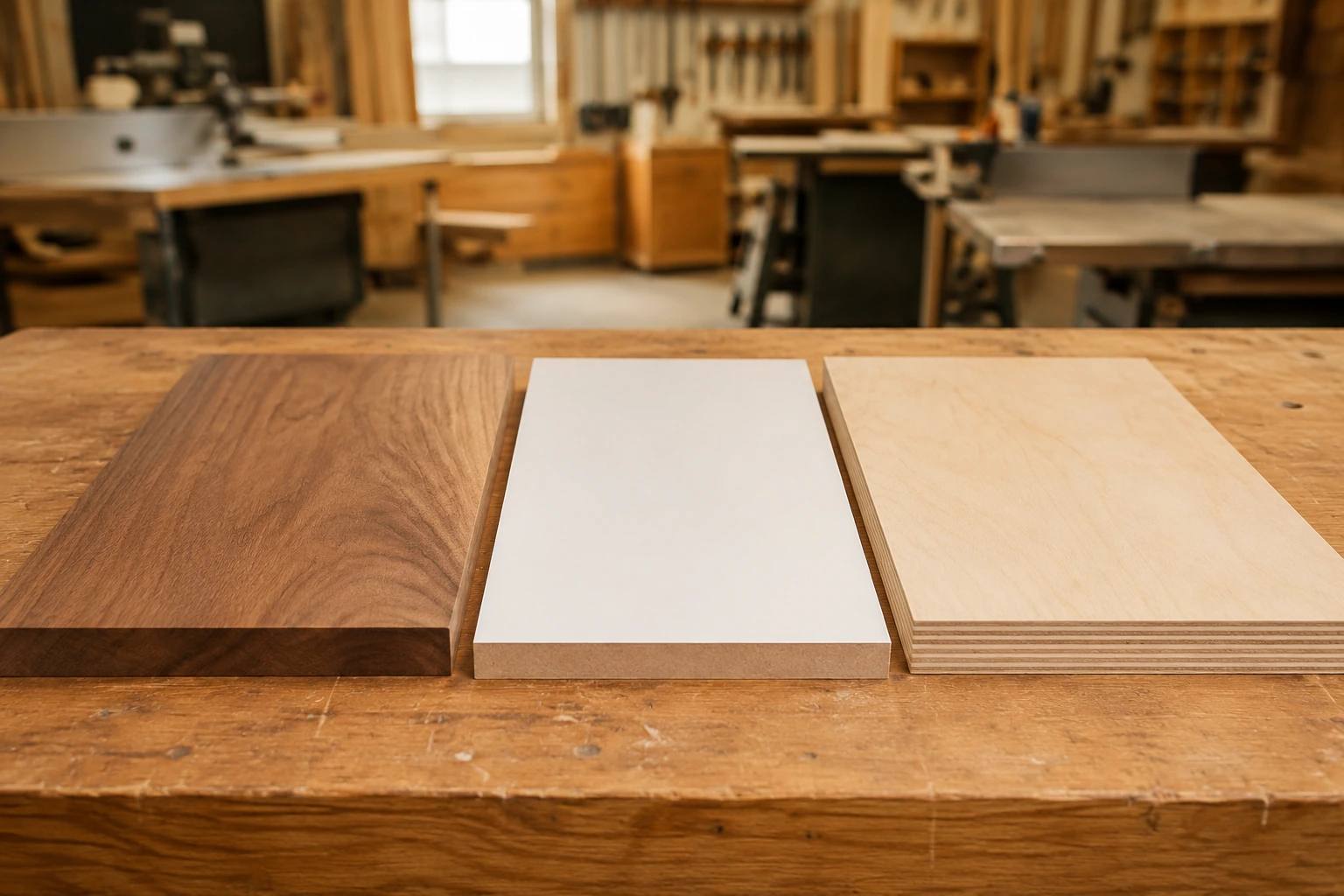
In 35 years of working on homes across the UAE, the question we hear most often is not “what style do you recommend?” It is “what material should I use?” Homeowners in Dubai Marina ask us this. Villa owners in Emirates Hills ask us this. Apartment residents in JBR, families fitting out new builds in Arabian Ranches, landlords renovating rental units in Deira. Everyone wants to know the same thing: solid wood vs MDF Dubai, or plywood?
The honest answer is that there is no single correct material. There is only the right material for your specific situation, your budget, your location in the building, Dubai’s climate, and what you are actually building. We have completed over 10,000 projects across the UAE since 1988, and we have seen every combination succeed brilliantly and fail badly. What separates a successful fit-out from a disappointing one is almost always this decision, made early, made correctly. This is especially true for the many expats settling into life in Dubai, where understanding local conditions makes all the difference.
This guide gives you what 35 years of real-world UAE experience looks like on paper. Not theory. Not general carpentry advice from a website in London. Specific, honest information about how these three materials behave in Dubai’s heat, humidity, and lifestyle conditions. By the end, you will know exactly what to specify for every room in your home.
Understanding Why Dubai Changes Everything About Wood
Before we compare materials, you need to understand why Dubai’s environment is fundamentally different from almost any other market where carpentry advice is written. Most online guides about wood materials are produced in Europe or North America, where winters are cold and summers are mild. The material behavior they describe simply does not apply here.
Dubai sits in one of the most demanding environments on earth for wood products. Summers bring temperatures regularly above 45 degrees Celsius. Coastal areas like JBR, Dubai Marina, and Palm Jumeirah carry ambient humidity that fluctuates dramatically between the cooled interior of your home and anything near an exterior wall, a kitchen, or a bathroom. Then you have the air conditioning factor. Dubai homes run air conditioning 8 to 10 months of the year at temperatures between 18 and 22 degrees. The cycling between cool dry interior air and the humid hot exterior creates what carpenters call “movement pressure” on wood products. Materials expand and contract constantly.
In 2019 we were called to a villa in Jumeirah to assess a kitchen that was only 18 months old. The solid wood cabinet doors had warped so severely that three of them could not close properly. The homeowner had spent over AED 95,000 on that kitchen. The material choice was not wrong in principle. Solid wood is beautiful and durable. But the wrong species was specified, without adequate moisture sealing, installed against an exterior-facing wall with inadequate insulation. The result was predictable to anyone with UAE experience. It was heartbreaking nonetheless.
That story is not an argument against solid wood. It is an argument for understanding how your material choice interacts with Dubai’s specific conditions. Let us work through each material properly. For expert guidance tailored to Dubai’s unique climate, visit the Karnak Carpentry homepage.
Solid Wood in Dubai: Honest Assessment After 10,000 Projects
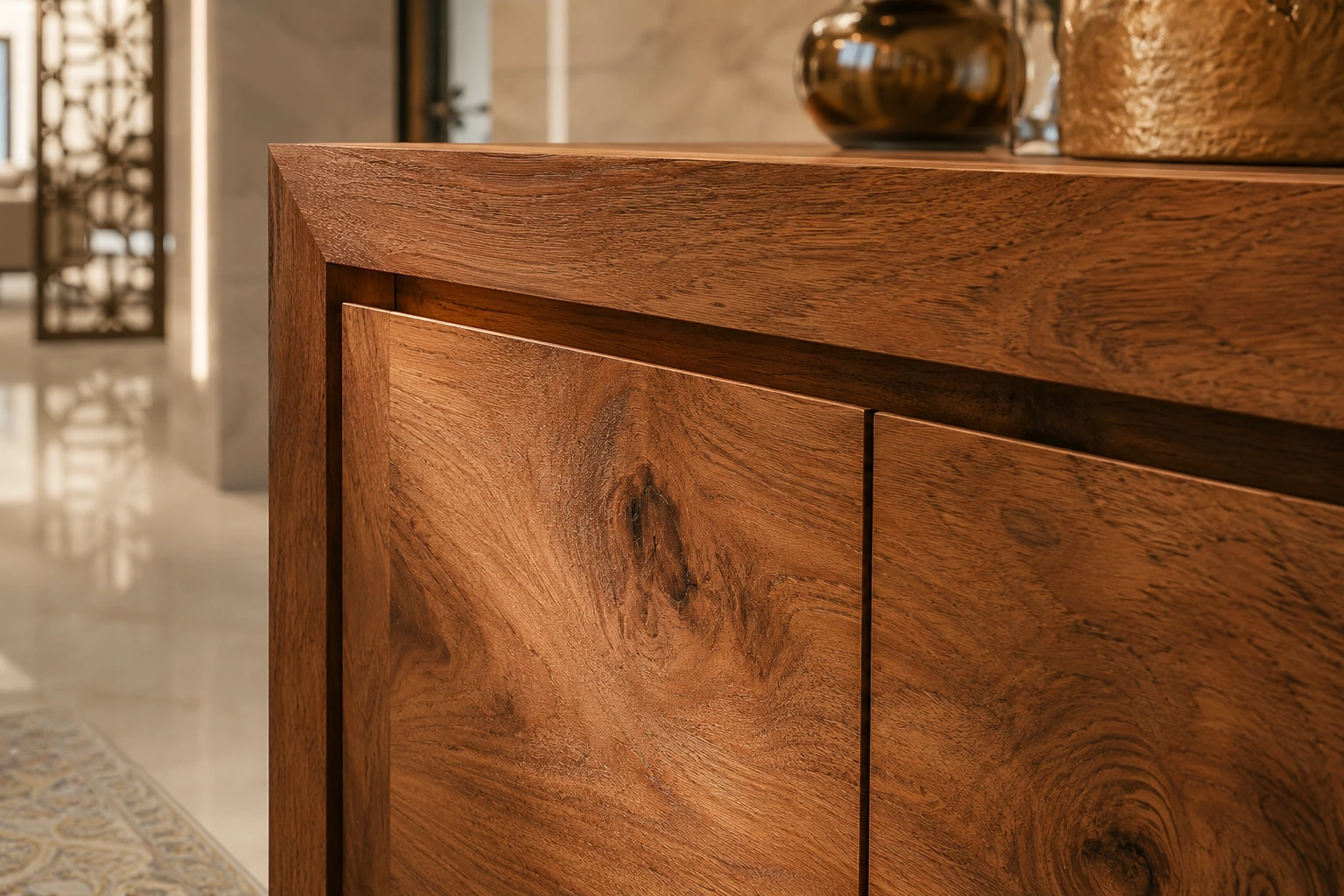
Solid wood is what most homeowners want when they imagine high-quality carpentry. There is a reason for that. Real wood has warmth, character, and a sense of permanence that no engineered material fully replicates. The grain is natural and unique. Done right, solid wood furniture and joinery in a Dubai home is extraordinary. Done wrong, it is very expensive firewood.
The critical factor with solid wood in the UAE is species selection. Not all solid wood behaves the same way in humid, thermally extreme conditions. After decades of work here, we have a clear picture of what performs and what struggles.
The Wood Species that Work in Dubai are :
1. Teak: The Gold Standard
Teak remains the gold standard for UAE conditions. It has a natural oil content that resists moisture absorption. It moves less with humidity changes than almost any other hardwood. We have teak installations across Dubai that are now 20 and 25 years old, looking magnificent. The cost is significant. Expect to pay between AED 850 and AED 1,400 per square metre for teak joinery, depending on thickness and finish. But if you are building something to last in a coastal Dubai property, teak earns its price.
2. Iroko: The Smart Alternative
Iroko is a West African hardwood that performs nearly as well as teak at roughly 30 to 40 percent lower cost. We use it extensively for window frames, external-adjacent joinery, and bedroom furniture. It does not have teak’s visual prestige, but structurally it handles UAE conditions very well.
3. Oak: Popular but Demanding
Oak is popular in Dubai homes because it is widely available and homeowners recognize it. Be careful here. Oak performs reasonably well indoors with consistent climate control, but it is more vulnerable to movement than teak. We have seen oak doors develop gaps in the frame during the transition between summer and winter when air conditioning settings change. For interior doors, paneling, and furniture in climate-controlled rooms away from kitchens and bathrooms, oak works well. Do not specify it for kitchen cabinet doors or anywhere near moisture.
4. Walnut: Premium Interior Luxury
Walnut is increasingly requested in premium Dubai villas. It is a beautiful, stable hardwood that behaves well in interior UAE conditions. The price is high, often between AED 1,100 and AED 1,600 per square meter for quality walnut joinery. In an Emirates Hills or Jumeirah living room with consistent climate control, walnut is a legitimate choice.
Woods to avoid in the UAE include pine and untreated softwoods generally. They absorb moisture readily, stain unevenly, and move considerably. We occasionally see pine joinery in older UAE properties and it almost always shows visible stress within a few years.
The Real Cost of Solid Wood Joinery in Dubai
Solid wood joinery is not cheap, and the UAE’s import dependence makes it more expensive here than in European markets. For budgeting purposes, here are honest 2026 cost ranges based on what we are currently seeing in the market.
A fully solid wood kitchen in a medium-sized Dubai apartment, using hardwood carcasses and doors, runs between AED 55,000 and AED 130,000 depending on species, hardware, and complexity. A built-in wardrobe system in solid teak for a master bedroom typically costs between AED 18,000 and AED 45,000. Solid wood interior doors, custom made to UAE standard heights, run between AED 2,800 and AED 6,500 per door installed.
Those numbers are not inflated. They reflect the cost of quality imported hardwood, skilled craftsmen, proper finishing, and the time required to work with natural materials correctly. Anyone quoting you significantly less for “solid wood” joinery in Dubai is either using lower grade timber, substituting MDF in areas you cannot see, or cutting corners on finishing and sealing. We have re-done dozens of jobs where homeowners went with a cheaper quote and regretted it.
When Solid Wood Is the Right Answer
Use solid wood when permanence and appearance are the priority, the budget allows proper specification, the installation is in a stable climate-controlled environment, you want pieces that age beautifully and can be refinished, and the application is furniture, feature joinery, doors, or decorative elements. Solid wood in the right context delivers something no other material matches.
This makes it an excellent choice for custom furniture, high-end wardrobes, feature doors, and decorative joinery throughout your home. For expert Dubai-specific guidance on solid wood applications, explore our Custom Furniture services or Residential Carpentry offerings.
MDF in Dubai: The Material That Built Modern UAE Interiors
MDF, medium density fiberboard, is the most widely used joinery material in the UAE today. Walk into almost any apartment fit-out across Dubai Marina, Downtown, or Business Bay and the majority of what you are looking at, painted units, lacquered kitchen cabinets, built-in wardrobes, TV units, is MDF. There are very good reasons for this.
MDF is manufactured wood. It is made from fine wood fibers compressed with resin under high pressure and heat. The result is a dense, smooth, completely uniform panel with no grain, no knots, and no natural movement. It takes paint and lacquer finishes better than any other material. A high-gloss lacquered MDF kitchen looks stunning and costs a fraction of the equivalent in solid wood.
Where MDF Excels in UAE Projects
Painted and lacquered joinery is MDF’s strongest application. If you want a crisp, modern kitchen with high-gloss or matte lacquer finish, MDF is the correct material. The smooth surface holds paint perfectly and the painted finish also provides a moisture barrier. In a properly sealed and lacquered state, MDF performs reliably in Dubai kitchens and bedrooms.
MDF is also excellent for decorative paneling, wall cladding, and ornamental features. We regularly use MDF for decorative ceiling coffers, wall panel detailing, and feature elements in Dubai villas. It routes beautifully, allowing intricate profiles and shapes that would be prohibitively expensive in solid wood.
Built-in wardrobes in bedrooms are another strong MDF application. The interior panels are typically painted or vinyl-wrapped. Combined with quality hinges and hardware, an MDF wardrobe system in a Dubai bedroom looks premium and performs well for 10 to 15 years with normal use.
The cost advantage is significant. A painted MDF kitchen in a Dubai apartment typically runs between AED 22,000 and AED 55,000, depending on size, finish, and hardware. For the same spatial footprint, solid wood would cost two to three times more. For many homeowners, that price difference is decisive, and rightfully so.
The Honest Weaknesses of MDF in Dubai
Here is what suppliers and some carpenters will not tell you: MDF and water are a dangerous combination in the UAE context. MDF swells when it absorbs moisture. It does not recover. The swelling is permanent and visible. The edges are especially vulnerable because raw MDF edges absorb moisture like a sponge.
We have seen MDF kitchen bases beneath sinks fail within two years because a slow leak was not noticed. We have seen MDF bathroom vanity units show swelling within 18 months in apartments without proper ventilation. In areas with any realistic moisture exposure, unprotected MDF edges are a liability.
The solution is not to avoid MDF
It is to seal it properly. Every exposed MDF edge in a kitchen, bathroom, or laundry should be sealed with edge tape, a solid wood lipping, or a paint system that fully encapsulates the panel. The bottom of every MDF cabinet should be sealed. When we specify MDF in moisture-adjacent areas, we use moisture-resistant MDF grade, which has a green core and significantly better water resistance. It costs roughly 25 to 35 percent more than standard MDF but the performance difference is substantial.
The second weakness is impact resistance
MDF dents and chips at corners under impact. In a family home with children, or in a high-traffic area, corners and edges of MDF units will show wear over time.
This is exactly why we use premium plywood carcasses in our Kitchen Carpentry, Bedroom Carpentry , Bathroom Carpentry, and other residential projects across Dubai. For more examples, explore our full range of Residential Carpentry services.
Solid wood lippings on edges dramatically improve this, which is why quality MDF joinery includes solid wood edging rather than just PVC tape. MDF is also heavier than plywood of equivalent thickness. This matters for overhead cabinet installations and for anything requiring frequent movement.
MDF Longevity Expectations in Dubai Conditions
With proper specification, moisture-resistant MDF in sealed applications, quality lacquer finishing, and solid wood lipping’s on edges, an MDF kitchen or wardrobe system in Dubai should perform well for 12 to 18 years. Without proper specification, you may start seeing problems in 3 to 5 years. The difference is not the material. It is the quality of specification and installation.
Plywood in Dubai: The Underrated Professional’s Choice
Plywood is the material that professional contractors use constantly and homeowners understand least. If you have had a high-quality fit-out done in Dubai by experienced tradespeople, there is plywood in it, even if you cannot see it.
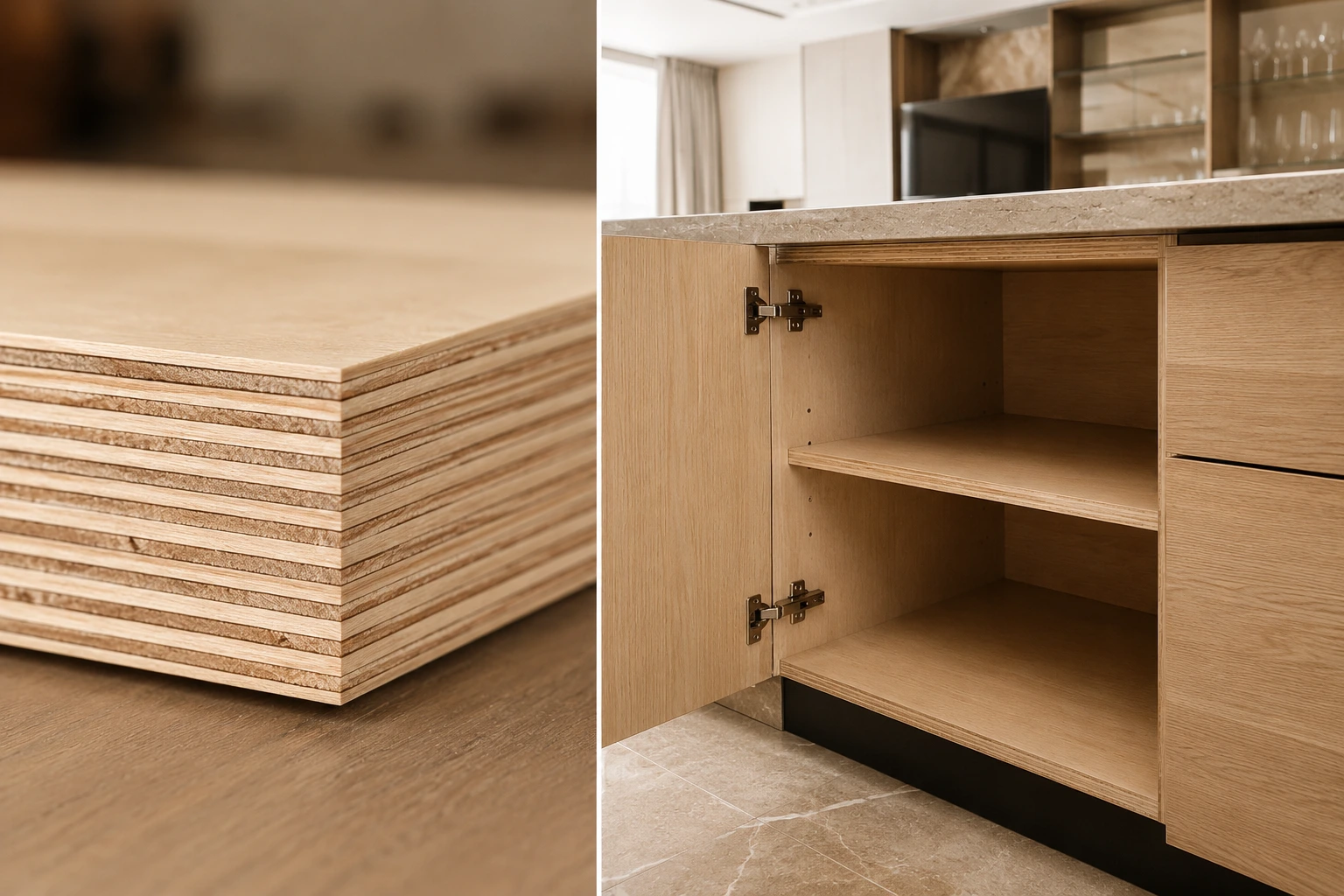
Plywood is manufactured from thin wood veneers, called plies, glued together with the grain of each layer running perpendicular to the one above and below. This cross-grain construction is the key to plywood’s unique properties. It creates a panel with exceptional strength in all directions, dimensional stability, and the ability to hold screws and fixings firmly without splitting.
Why Plywood Outperforms MDF Structurally
The structural comparison between plywood and MDF is not close. Plywood is significantly stronger for its weight. It resists bending under load. Additionally, it holds screws along edges without the “screw pullout” problem that affects MDF when fixings are placed near edges. Moreover, it does not shatter under impact the way MDF can.
For carcass construction, meaning the box structure that forms the body of a cabinet or wardrobe, plywood is technically superior to MDF in almost every measurable way. A plywood carcass is lighter, stronger, and more moisture-tolerant than an MDF carcass. This is why commercial fit-outs, high-end retail spaces, and quality kitchen manufacturers in Europe and Australia predominantly use plywood for carcasses even when they use other materials for doors and visible surfaces.
The UAE market has been slower to adopt plywood carcasses than some other markets, partly because MDF is very well established here, and partly because plywood is more challenging to work with for less experienced carpenters. Cutting plywood cleanly, finishing edges, and working with the natural variation in plywood requires skill and proper tooling. Many workshops default to MDF because it is easier to process.
At Karnak, we use birch plywood carcasses for kitchen installations where the budget allows it. The result is a kitchen that is meaningfully more durable and better able to handle the stresses of UAE conditions. Birch plywood kitchen carcasses in 18mm thickness, properly finished, are what you find in the best European kitchens. The carcass cost is higher than MDF, roughly 40 to 60 percent more for the structural components, but for a kitchen that will be in your home for 20 years, that uplift is worth serious consideration.
Moisture Performance of Plywood vs. MDF
Marine-grade and WBP (weather and boil proof) plywood offers moisture resistance that MDF simply cannot match. In areas with genuine moisture exposure, such as laundry rooms, near bathroom vanities, or in coastal properties with humidity challenges, plywood is the more robust choice.
Standard construction plywood is not waterproof. The glue systems in lower-grade plywood will delaminate if subjected to prolonged moisture. Specifying the right grade matters enormously. For UAE applications near moisture, we specify WBP exterior-grade plywood at minimum, and marine plywood for any application with direct water exposure.
The face veneer on plywood is also important in the UAE context. Birch face plywood has a clean, light appearance suitable for painted or clear-finish applications. Hardwood-faced plywood’s accept veneer or paint finishes well. Always confirm the face veneer specification before approving a material order.
Plywood for Visible Surfaces: When It Works
Plywood with a quality face veneer can be a beautiful visible material. Exposed birch plywood edges, with their characteristic banded appearance showing the alternating layers, have become a popular aesthetic choice in contemporary interiors. We have completed several projects in Dubai where exposed plywood was specified intentionally as a design feature, and the result is striking and modern.
For shelving in libraries, home offices, and display units, plywood on visible surfaces is entirely legitimate. The natural variation in the veneer gives it a character that MDF painted surfaces lack.
Head-to-Head Comparison: Which Material for Which Room
Now that you understand each material properly, here is how we actually specify them in real Dubai projects. This is not a generic comparison. This is what 35 years of UAE projects has taught us about material placement.
Kitchens
The kitchen is the most demanding environment in the home. Heat from cooking, steam, splashing water, heavy use, and the UAE climate pressure all converge here. This is where material decisions matter most and mistakes cost most to correct.
For kitchen doors and visible surfaces, we recommend moisture-resistant MDF with a high-quality lacquer or thermofoil finish, or solid hardwood (teak or iroko) for premium budgets. The painted surface on MDF provides excellent moisture resistance when applied correctly. High-gloss lacquer on MDF doors in a Dubai kitchen looks genuinely beautiful and performs reliably.
For kitchen carcasses, we recommend birch plywood at 18mm for clients with budget flexibility, or moisture-resistant MDF for standard budgets. Standard MDF carcasses are acceptable but must be fully sealed at all edges and the bottom panels. The under-sink cabinet deserves particular attention. Specify moisture-resistant MDF or plywood here without exception.
Solid wood for entire kitchen carcasses is generally not recommended in Dubai. The moisture and temperature cycling in a kitchen exceeds what even quality hardwoods handle well without very high maintenance. Reserve solid wood for selected door fronts, open shelving, and feature elements where it can be appreciated without bearing the functional stress of carcass work.
Bedrooms and Built-In Wardrobes
Bedrooms are the most forgiving room in a Dubai home for material selection. Climate control is consistent, moisture exposure is minimal, and the primary demands are aesthetic rather than functional.
For wardrobe carcasses, standard MDF performs well and offers the best value. Interior panels are typically laminated or vinyl-wrapped, providing both finish and moisture protection. For wardrobe doors, painted MDF, lacquered MDF, or veneered MDF all work well. Solid wood doors in hardwood are a genuine upgrade for master bedroom wardrobes where quality and longevity are the priority.
For bedroom furniture, solid wood is the most satisfying choice where budget allows. A solid walnut or oak bed frame and matching furniture in a climate-controlled Dubai bedroom will outlast the home’s ownership cycle and appreciates aesthetically with age. MDF painted furniture is a legitimate budget alternative but does not have the same longevity or refinishing potential.
Bathrooms and Wet Areas
Bathrooms require the most conservative material specification of any room. Standard MDF has no place in a bathroom without exceptional sealing. In our experience, even sealed MDF in bathrooms shows stress over time in UAE conditions. Moisture gets into seams and edges regardless of initial sealing, and once it starts, swelling follows.
For bathroom vanity units, specify either marine-grade plywood, moisture-resistant MDF (green core) with complete edge sealing and paint finishing, or solid teak. Teak vanities in bathrooms are genuinely excellent. The natural oil content handles moisture well and teak looks beautiful in bathroom settings.
Avoid standard plywood in bathrooms. The delamination risk from steam and splashing is significant without WBP grade specification. Confirm the grade before accepting material delivery.
Living Areas and TV Units
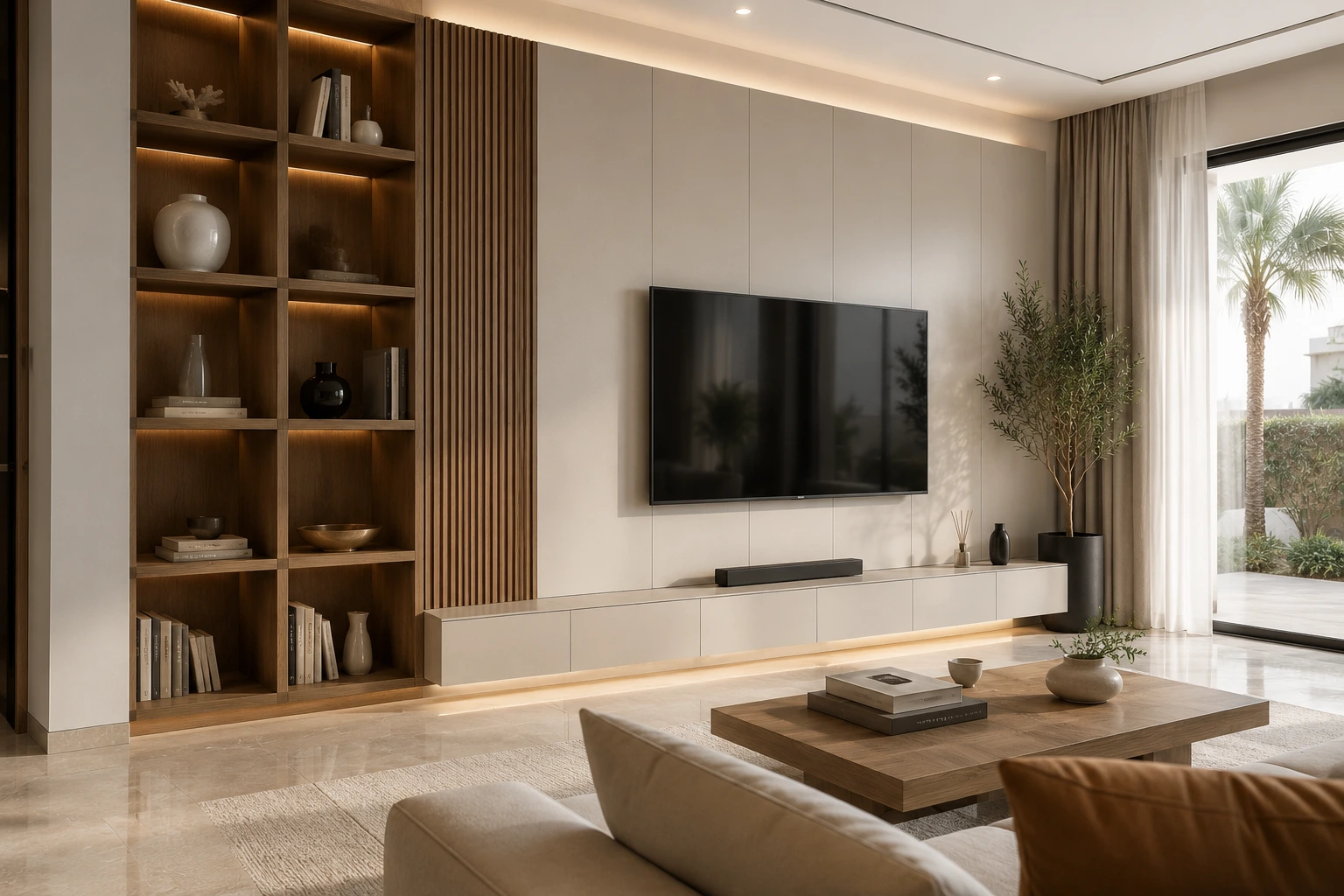
Living areas in Dubai are typically well climate-controlled and away from moisture sources. This allows the widest material flexibility. MDF for painted or lacquered TV units and shelving works well and looks excellent. Veneered MDF or plywood for a warmer, wood-grained aesthetic is a step up. Solid wood for feature elements, shelving, and furniture brings the quality and character that a main living space deserves.
One observation from countless projects: the living area is where clients most frequently want solid wood, and it is genuinely the most forgiving room for it. The consistent temperature, low moisture, and visual centrality of the space make it an ideal environment for quality hardwood furniture and joinery.
Common Mistakes Dubai Homeowners Make With Wood Materials
After 10,000 projects, the mistakes are familiar. They are rarely unique to one client. They repeat across years and budgets and building types. Knowing them before you start is worth a great deal.
Mistake 1: Specifying Solid Wood Based on European Advice
We regularly meet homeowners who have done extensive research online and arrived at a material specification that makes perfect sense in the UK or Germany but is problematic in Dubai. European guides discuss oak, pine, and spruce for applications that Dubai’s climate makes challenging. A beautiful pine bedroom wardrobe that performs perfectly in Amsterdam will show humidity stress within two years in a Dubai apartment.
The solution is to take general principles from online research but verify specific material choices with someone who has worked in the UAE for years. Not a salesperson. A craftsman or technical consultant with actual UAE project experience.
Mistake 2: Using Standard MDF Near Any Water Source
The number of kitchens and bathrooms we have been called to repair because of MDF swelling from water exposure is significant. The damage is always worse than it looks. What appears to be a swollen corner on a base cabinet often involves water that has tracked along the base panel for months. By the time it is visible, the panel may need complete replacement.
The fix is straightforward: specify moisture-resistant MDF (green-core) for any installation within two metres of a water source. Seal all cut edges before installation. Seal the base of every floor-standing cabinet. Treat MDF as the moisture-sensitive material it is, rather than hoping the paint finish will protect it indefinitely.
Mistake 3: Choosing Material Before Deciding on Finish
The finish and the material need to be decided together. MDF is the correct base for a smooth, high-gloss lacquer kitchen. Solid wood is the correct base for an oiled or waxed natural finish. Plywood is the correct base for a raw-edge contemporary aesthetic. Choosing solid wood and then wanting it painted high-gloss, or choosing MDF and then wanting a natural wood grain appearance, creates mismatches that are expensive to resolve.
Decide the finish first. The material choice often follows logically from that decision.
Mistake 4: Treating All MDF as Equal Quality
There is significant variation in MDF quality available in the UAE market. Low-density MDF used by budget workshops is softer, less stable, and more vulnerable to moisture than high-density MDF used by quality suppliers. Moisture-resistant MDF and standard MDF look identical until one gets wet.
Always ask your carpenter or fit-out company to specify the MDF grade and density in writing. A reputable company will do this without hesitation. One that resists specifying materials in writing is worth questioning.
Mistake 5: Ignoring the Substrate When Buying Furniture
Many homeowners buying furniture, rather than commissioning custom joinery, assume that “wood furniture” means solid wood. In the UAE furniture retail market, much of what is sold as “wood furniture” uses MDF or particleboard cores with a thin wood veneer or printed paper surface. This is not necessarily wrong at the price point, but you should know what you are buying.
Before purchasing furniture in Dubai, ask directly: is this solid wood throughout, or does it have an engineered core? Request material specifications in writing for significant purchases. A AED 15,000 bed frame should be specifiable. If the sales staff cannot tell you the construction method, that tells you something important.
Mistake 6: Not Accounting for Movement in Solid Wood
Solid wood moves. It expands and contracts as humidity changes. Professional joinery accounts for this movement in the design. Solid wood panels in frames are not glued at the edges, they float. Additionally, solid wood table tops have breadboard ends attached with elongated slots, not fixed screws. Moreover, solid wood cabinet doors have specific clearances that allow movement without binding.
Joinery that does not account for wood movement will crack, warp, or bind as UAE conditions cycle through the year. If you are commissioning solid wood joinery, ask the craftsman specifically how they are handling wood movement. An experienced carpenter will have a clear answer. Someone without UAE experience may not understand why you are asking.
What Things Actually Cost: 2026 Material and Labor Pricing in Dubai
Pricing in the UAE carpentry market has moved significantly over the past three years. Supply chain changes, material costs, and skilled labor demand have all shifted. Here are honest, current ranges based on our active project pricing as of early 2026.
These are installed costs including materials, labor, and finishing. They are not supply-only prices.
Kitchen installations, painted MDF carcasses and doors in a medium apartment kitchen of 8 to 12 running metres, range from AED 22,000 to AED 48,000. High-gloss lacquer finishes add 15 to 25 percent. Plywood carcasses with MDF lacquered doors add 20 to 35 percent over standard MDF. Solid wood kitchen joinery starts at AED 65,000 for a medium kitchen and can reach AED 180,000 and beyond for premium hardwoods with bespoke detailing.
Built-in wardrobes in standard bedrooms, MDF construction with paint or laminate finish, run from AED 8,500 to AED 18,000 for a full wall-to-wall system. Sliding door systems add to this. Solid wood wardrobe systems start around AED 22,000 and are more common in master bedrooms of larger villas.
Custom furniture, such as a solid wood dining table or a hardwood media console, is harder to generalize but a quality solid teak dining table custom-made in our workshop typically costs between AED 12,000 and AED 28,000 depending on size and complexity.
Interior doors in MDF with paint finish run from AED 1,400 to AED 2,800 installed. Solid hardwood interior doors start at AED 3,200 and can reach AED 7,500 for premium species with detailed design.
One important note: the cheapest quote you receive in Dubai for carpentry work is rarely representative of what the finished product will be made from. Material substitution after contract signing is an industry-wide problem. Always specify materials contractually and visit workshops before committing to major projects.
Expert Tips From 35 Years of UAE Carpentry Work
These are not general tips. They are things we have learned specifically from working in the UAE, lessons that come from real projects, real problems, and real solutions developed over three and a half decades.
Tip 1: Always specify moisture-resistant grades in writing.
For any MDF or plywood near water, put the grade in the contract. “Moisture-resistant MDF, green core, minimum 700 kg per cubic meter density” is a specific, verifiable specification. “MDF” is not. The difference in performance is enormous and the difference in material cost is modest.
Tip 2: Seal solid wood before installation, not after.
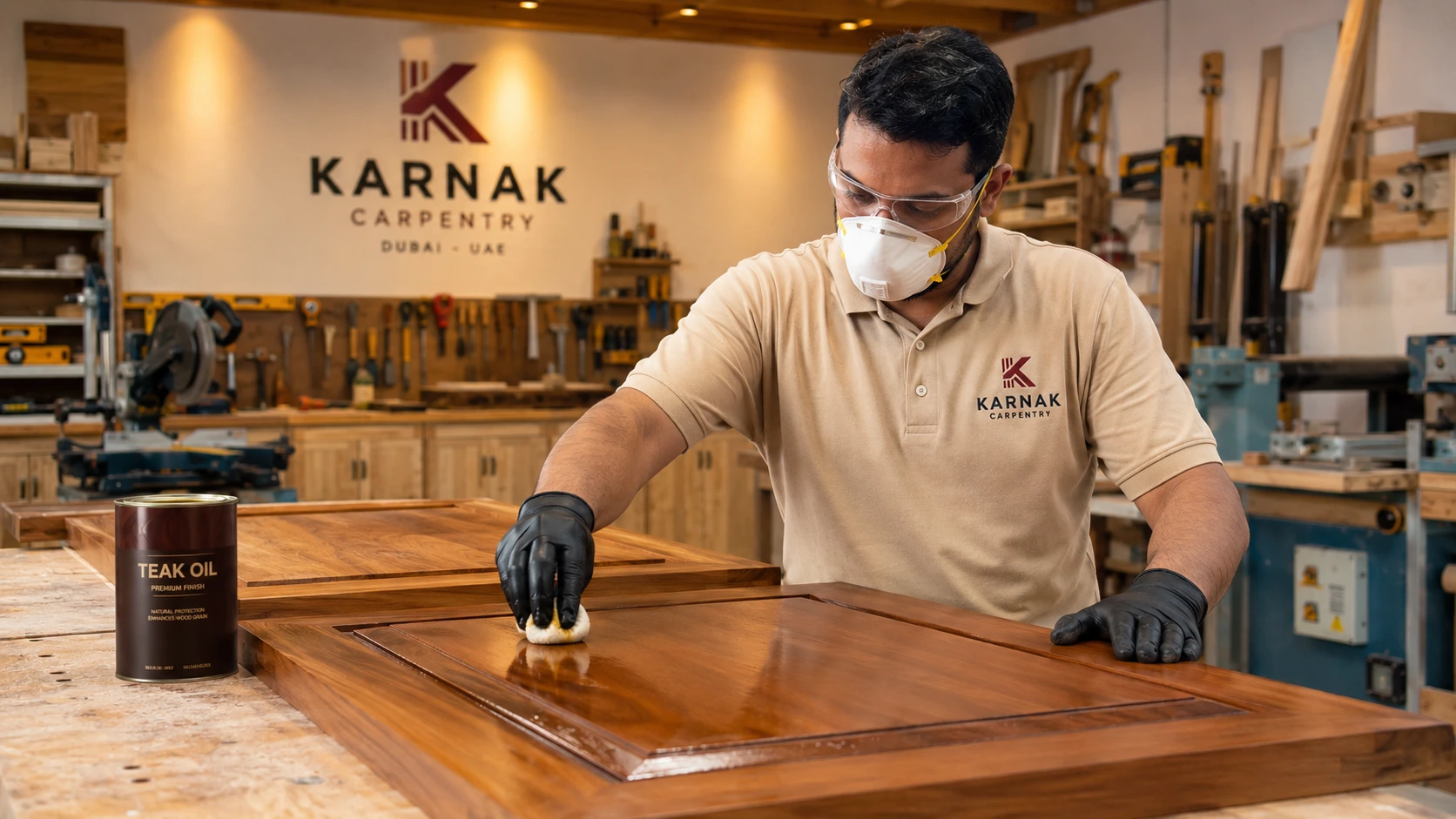
Pre-finishing wood components in controlled workshop conditions produces better results than site-finishing in a Dubai apartment. The oil or lacquer penetrates more evenly, coverage is complete including edges and back faces, and the result is superior moisture protection from day one.
Tip 3: Acclimatize timber before installation.
Solid wood brought to a project site should sit in the space for at least 5 to 7 days before cutting and installation. This allows the timber to adjust to the specific humidity and temperature of that room. Timber installed without acclimatization may move significantly after installation as it adjusts to conditions. We have seen doors installed on a Monday that would not close properly by Friday because this step was skipped.
Tip 4: Specify solid wood lipping’s on all MDF edges in visible locations.
PVC edge tape on MDF looks acceptable in the short term but it chips, peels, and cannot be repaired cleanly. A 2mm solid wood lipping in a matching species is more expensive and more difficult to apply but it is vastly more durable and looks genuinely refined. For quality joinery, it is the correct specification.
Tip 5: Consider the replacement cycle in your decision.
If you are a tenant fitting out a rental property, an MDF solution designed for 8 to 10 years at a moderate cost may be entirely correct. If you own a villa you intend to live in for 15 to 20 years, the additional cost of quality solid wood or plywood carcasses pays for itself in durability and avoided replacement. Match the material quality to the intended longevity.
Tip 6: Visit the workshop, not just the showroom.
The showroom shows you the best work and the most appealing samples. The workshop shows you how they actually work. Ask to visit the production facility before commissioning a major project. A workshop with proper humidity control, quality tooling, and organized production processes will deliver better results than one operating in a basic shed regardless of how attractive the showroom looks.
Tip 7: Budget 10 to 15 percent extra for access complications in Dubai high-rises.
Delivering and installing large joinery items in Dubai’s high-rise apartments adds cost and time that ground-level villa projects do not incur. Lifts have size restrictions. Higher floors require more logistics. A realistic project budget in Dubai Marina or Downtown will account for this, and a carpenter quoting you the same as a villa installation without adjusting for access is either not aware of the complications or choosing not to mention them.
Conclusion: Making the Right Choice for Your Dubai Home
After all of this, the decision framework is actually straightforward if you have the right information. And now you do.
When to Choose Solid Wood
Use solid wood when appearance and longevity are the priority, the room is climate-controlled and away from moisture, the budget allows proper species selection and finishing, and you want joinery that ages beautifully and can be refinished decades from now. Teak and iroko for moisture-adjacent applications. Walnut and oak for dry interior rooms with stable climate control.
When to Choose MDF
Use MDF when the aesthetic is painted or lacquered, the budget is the primary constraint, you are working in a moisture-managed environment and specifying properly sealed moisture-resistant grades in wet-adjacent areas, and you need precision for detailed profiling and routed decorative work. MDF dominates Dubai’s apartment fit-out market for very good reasons. It delivers a high-quality painted finish at a cost that makes ambitious designs financially viable.
When to Choose Plywood
Use plywood when structural performance matters, particularly for kitchen and wardrobe carcasses where load-bearing and screw retention are important, when moisture resistance needs to exceed what MDF can reliably provide, and when an exposed plywood aesthetic suits the design direction. Birch plywood carcasses with lacquered MDF doors represent, in our view, the best performing combination for Dubai kitchens at a realistic price point.
The Smart Approach: A Hybrid Strategy
The most common correct answer for a Dubai home fit-out is not one material. It is a combination. Plywood or moisture-resistant MDF for carcasses in kitchens and bathrooms. Painted MDF for doors and visible surfaces in living areas and bedrooms. Solid hardwood for furniture, feature elements, and any application where natural wood character is the point.
Dubai’s climate demands respect. Materials that work beautifully in temperate climates can fail here without proper specification. Conversely, materials that are dismissed as “cheap” in other markets, like MDF, can deliver outstanding results in Dubai when specified and installed correctly.
Key Takeaways:
- Species selection is everything for solid wood in Dubai. Teak and iroko for moisture-adjacent work. Oak and walnut for dry interior rooms with climate control.
- MDF performs excellently in painted applications when you specify moisture-resistant grades for wet-adjacent areas and use solid wood edge lipping’s in visible locations.
- Plywood is structurally superior to MDF for carcass work and moisture resistance. It is underused in the UAE residential market relative to its merits.
- The correct choice is usually a combination of materials, matched to the function and conditions of each specific location in the home.
- Material specification should be contractual and specific. Grades, densities, and species should be written into any significant carpentry contract.
Need Expert Help?
Karnak Carpentry has been working in UAE homes since 1988. Our team has completed over 10,000 projects across Dubai, Abu Dhabi, and Sharjah, and we have seen how every material performs in real UAE conditions over real decades. When you consult with us, you are not getting a sales pitch for the material with the highest margin. You are getting honest advice from people who have watched these materials perform, fail, and succeed in this specific climate and context.
We offer free consultations for kitchen, wardrobe, and full fit-out projects. Bring your plans, your budget range, and your questions. We will tell you exactly what we would specify and why.
Contact: WhatsApp Us or Call Us at +971-52-5554207 | info@karnakcarpentry.com
Frequently Asked Questions About Solid Wood, MDF, and Plywood in Dubai
Which material works best for furniture in Dubai’s climate?
Plywood offers the best balance of strength, moisture resistance, and durability for most Dubai homes. Solid wood delivers premium quality and a natural appearance, while moisture-resistant MDF creates smooth painted finishes for wardrobes, TV units, and decorative furniture.
Should I choose solid wood, MDF, or plywood for my home?
Choose solid wood if you want luxury furniture that lasts for decades. Additionally, Choose plywood if you want strong, long-lasting cabinets and wardrobes. Choose moisture-resistant MDF if you prefer modern painted furniture at a lower price.
What is the biggest difference between solid wood, MDF, and plywood?
Solid wood comes directly from natural timber, plywood combines multiple layers of wood veneer, and MDF uses compressed wood fibers. Solid wood offers natural beauty, plywood provides structural strength, and MDF delivers perfectly smooth painted surfaces.
Which material lasts the longest?
Solid hardwood lasts the longest with proper maintenance. High-quality plywood also provides excellent durability for decades, while MDF performs well in dry indoor spaces when you protect it from excessive moisture.
Which material handles humidity better?
Marine plywood and solid teak handle humidity better than MDF. Moisture-resistant MDF performs well indoors, but marine plywood remains the better choice for kitchens, bathrooms, and other humid areas.
Which material costs the least?
MDF usually costs the least, plywood falls into the middle price range, and solid hardwood costs the most. Your final cost also depends on the finish, hardware, and furniture design.
Which material should I choose for kitchen cabinets?
Choose marine plywood for kitchen cabinets because it offers excellent strength, moisture resistance, and long-term durability. Add laminate, acrylic, veneer, or PU paint to improve appearance and protection.
Is MDF durable enough for wardrobes?
Yes. Moisture-resistant MDF works very well for wardrobe doors, shelving, and painted finishes. Pair MDF with quality hardware and proper installation to maximize its lifespan.
Which material holds screws better?
Solid wood and plywood hold screws much better than MDF. These materials create stronger joints and support heavy doors, shelves, and furniture hardware more effectively.
Can MDF replace solid wood?
MDF replaces solid wood in many modern furniture designs, especially painted cabinets and decorative panels. However, solid wood still offers greater strength, repairability, and natural character.
Which material creates the best luxury furniture?
Solid hardwood such as teak, oak, walnut, and ash creates premium furniture with exceptional durability and timeless appeal. These woods also increase the long-term value of custom furniture.
Which material resists warping the most?
High-quality plywood resists warping better than most solid woods because its layered construction improves stability. Marine plywood performs especially well in Dubai’s changing humidity levels.
Which material works best for custom furniture?
Choose plywood for cabinets, wardrobes, and storage furniture. Additionally, Choose solid wood for dining tables, beds, and statement pieces. Choose MDF for painted furniture with intricate decorative details.
How can I identify high-quality MDF or plywood?
Inspect the board density, panel thickness, edge quality, and finish. High-quality plywood features uniform veneer layers without gaps, while premium MDF offers a dense, smooth surface with clean edges.
Which material gives the best value for money in Dubai?
Plywood delivers the best overall value because it combines durability, strength, moisture resistance, and reasonable cost. Many professional carpenters recommend plywood for homeowners who want furniture that lasts for years without exceeding their budget.
Related Articles
- The Complete Guide to Choosing Wooden Flooring for Dubai Homes in 2026
- How to Measure Your Space for Built-In Wardrobes (The Right Way)
- How Long Do Carpentry Materials Actually Last in Dubai Homes?
- Engineered vs Solid Wood Flooring in UAE: The Climate Verdict After 35 Years