
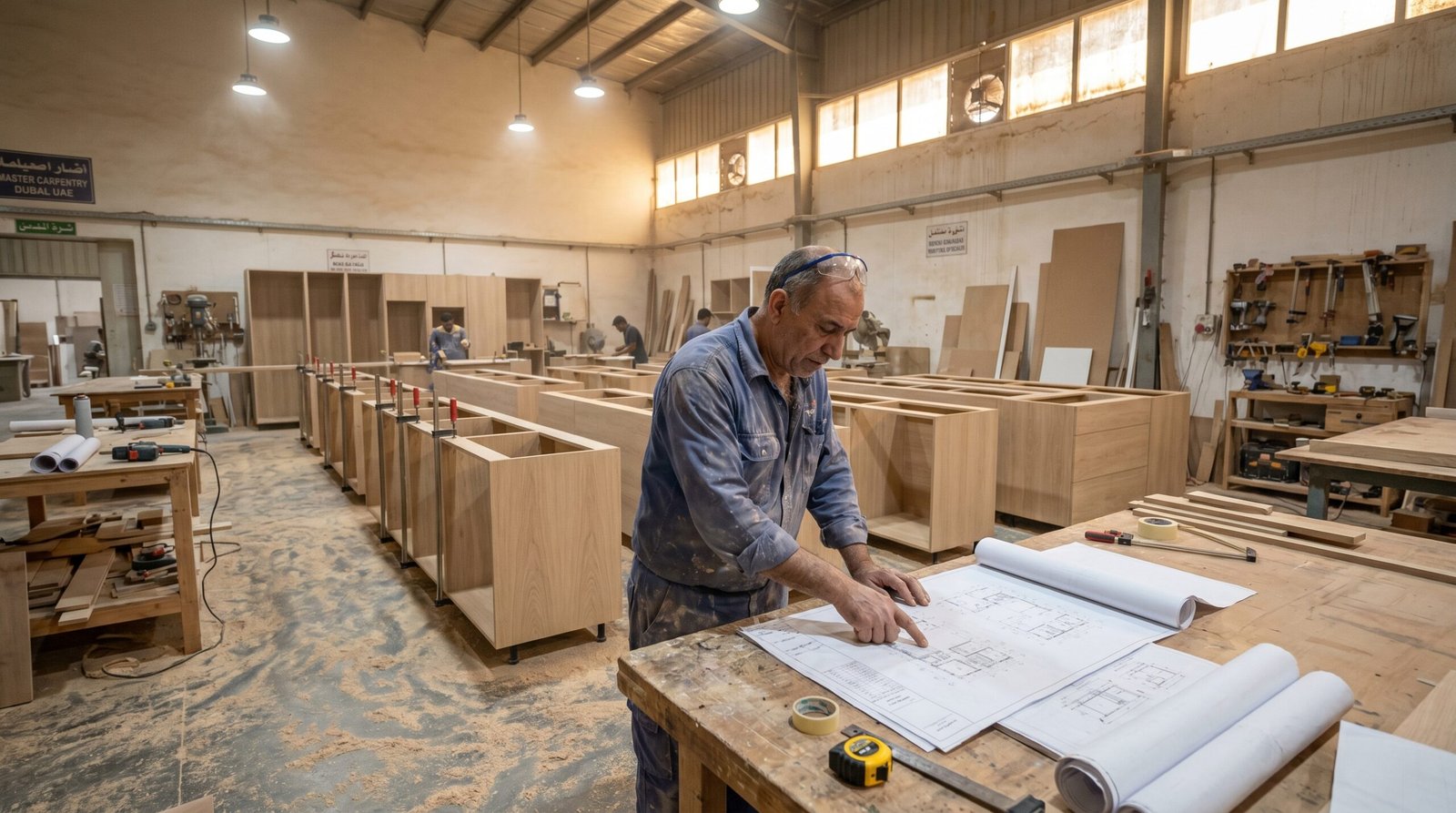
Most homeowners ask us the same question when they visit our workshop for the first time. They look around at the machinery, the stacks of sheet material, the spray booths, and they say: “I had no idea this much went into a kitchen.” After 35 years and over 10,000 projects across the UAE, we still love that moment. Because understanding the custom kitchen cabinets process Dubai homeowners invest in is what separates a homeowner who gets a kitchen they love from one who gets a kitchen they tolerate.
This post walks you through the complete custom kitchen cabinets process Dubai process we follow here in Dubai, from the first measurement to the final handle installation. We are going to share things most carpentry companies keep behind closed doors, including where things can go wrong, what adds real cost, and why certain steps that seem unnecessary are actually critical in the UAE climate.
Why Dubai Kitchens Have Unique Manufacturing Requirements
Before we get into the process itself, you need to understand something important. Building custom kitchen cabinets for a home in Emirates Hills or a high-rise apartment in Dubai Marina is not the same as building cabinets in London or Frankfurt. The UAE environment creates specific engineering challenges that every step of our process is designed around.
Dubai’s humidity swings between 20% in January and over 85% during the summer months. That level of variation causes wood-based materials to expand and contract. Poorly built cabinets crack at the joints, doors warp, and drawer faces go out of alignment within two or three years. We have been called in to replace cabinets from suppliers who did not account for this, and the failure patterns are always the same.
Then there is the heat. Kitchen areas face direct sun exposure for much of the year in UAE villas. Materials that handle temperature well in European showrooms can delaminate, fade, or develop surface bubbles in Abu Dhabi or Sharjah conditions. Every material we specify gets tested against UAE climate data before it goes near a client’s home.
Finally, the sheer scale of UAE kitchen projects tends to be larger than European equivalents. The average kitchen we build in a Dubai villa runs between 18 and 35 linear meters of cabinetry. An apartment project in JBR or Business Bay typically sits between 8 and 14 linear meters. The logistics of building, transporting, and installing that volume requires a very different operation than a small local joinery shop.
Step One: The Site Survey and Measurement Process
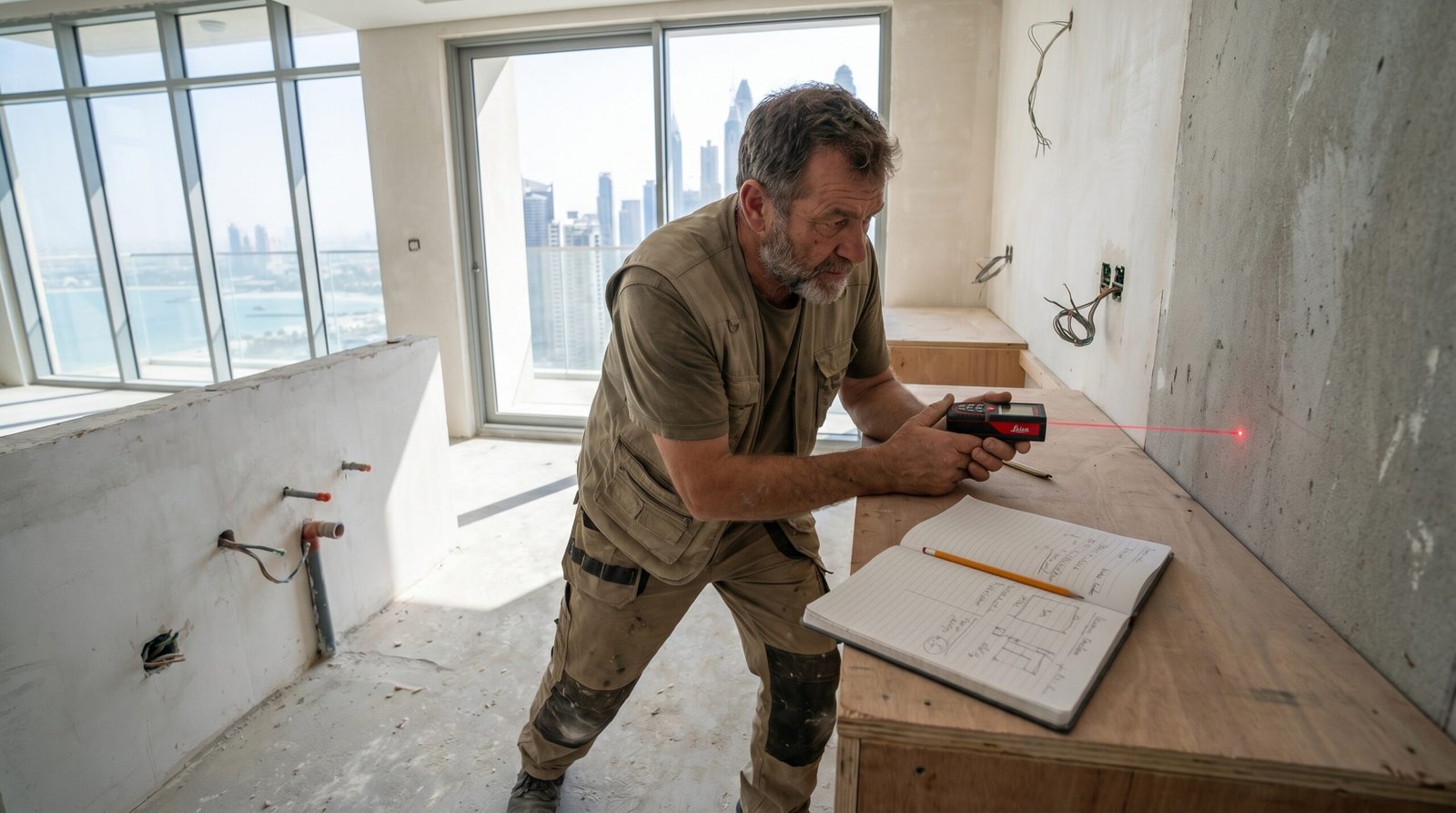
Everything starts with measurements, and this is where more projects go wrong than any other stage. We use laser measuring tools that are accurate to within 1mm. But the measurement itself is only half the job. The other half is understanding what those measurements are telling you.
Reading the Room Before Drawing a Line
UAE construction has specific quirks. Walls in Dubai apartments and villas are rarely perfectly plumb. Floors in high-rise buildings often have a gradient of 3 to 8mm across a standard kitchen run because of concrete settling and screed variation. Ceilings in older buildings in areas like Deira or Bur Dubai can vary in height by up to 15mm from one end of a kitchen to the other.
Our surveyors document all of this on the first visit. We measure floor level changes with a digital level across every 500mm of the base cabinet run. Additionally, we check wall plumb at the top, middle, and bottom of every wall that will carry cabinetry. Moreover, we locate every hidden service, including water pipes, electrical conduit, and drainage runs, using a combination of developer drawings and physical checking.
This takes between one and three hours for a standard kitchen survey. Homeowners sometimes ask why it takes so long. The answer is that every millimeter we get wrong at this stage costs far more to fix once cabinet manufacturing has started.
Working with the Developer’s Tolerances
Dubai’s major developers, including Emaar, Nakheel, and Damac, each have slightly different construction tolerances in their units. After 35 years of working across the city, our team knows these differences from experience. A villa in Mira Reem will have different structural characteristics to an apartment in Downtown Dubai, and our survey approach adapts accordingly.
Once measurements are complete, the survey data goes into our CAD design system the same day. We do not work from sketches or hand measurements. Every project gets a fully dimensioned digital model within 48 hours of the site visit.
Step Two: Design and Client Approval
The design stage is where the kitchen takes its first real shape, and it is also where clients make decisions that will affect their satisfaction for the next 10 to 15 years. We spend more time here than most people expect, and deliberately so.
Creating the 3D Kitchen Design
Our designers work in specialized cabinet CAD software that models every component at full scale. This is not a general-purpose 3D tool. It is purpose-built for cabinetry, which means every hinge position, every drawer runner path, and every panel thickness is accurately represented in the model.
We generate photorealistic renders for every client. These are not illustration-style images. They are rendered views that show the actual specified materials, door profiles, and hardware in the actual lighting conditions of the client’s space. A homeowner in Palm Jumeirah looking at a render of their kitchen should be seeing something that looks like a photograph, not a diagram.
We typically present two or three layout options at the initial design meeting. These cover different approaches to the workflow triangle, storage configuration, and island or peninsula options where the space allows.
The Details Most Clients Do Not Think to Ask About
Internal storage is where a custom kitchen earns its cost. Anyone can build a box with a door. What separates a genuinely functional kitchen is what happens inside the carcass. We design every cabinet interior specifically for the items it will store.
Pull-out spice racks are sized to the client’s actual spice containers. Drawer dividers are specified based on the cutlery set the client already owns. Waste bin pull-outs are sized for the exact bin dimensions available in UAE supermarkets, because we have seen too many beautiful waste bin drawers installed with bins that do not actually fit.
This level of detail requires a longer design conversation. We typically hold two to three client meetings before design sign-off on a full kitchen project. Clients who rush this stage almost always wish they had not.
What Happens After You Sign Off
Once design is approved and the deposit is received, two things happen simultaneously. The materials are ordered from our suppliers, and the workshop team receives the cut files. In Dubai, the lead time from design approval to workshop start is typically three to five working days for materials sourcing.
Step Three: Material Selection and Sourcing
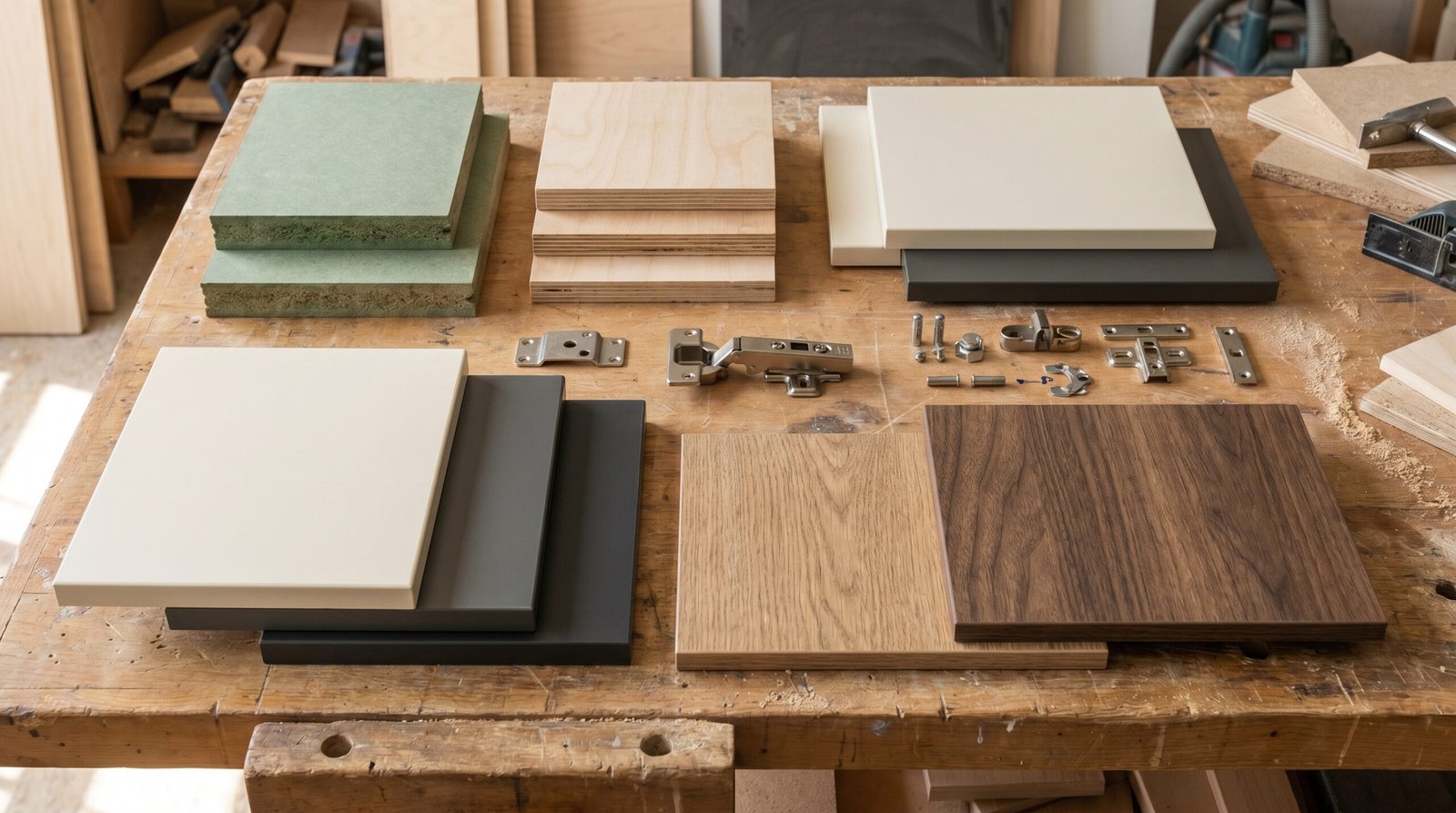
Material selection affects everything: cost, longevity, finish quality, and long-term performance in the UAE environment. We are going to give you the honest version of this conversation, not the sales version.
Carcass Materials: What We Actually Use and Why
The carcass is the structural box of the cabinet. For UAE kitchens, we use one of two materials depending on the project scope and budget.
Moisture-resistant (MR) MDF
It is the entry-level carcass material for interior areas. It is dimensionally stable, takes edge banding cleanly, and machines well for consistent results. In a UAE kitchen environment, it needs to be genuine MR-rated board, not standard MDF with a moisture-resistant label slapped on it. We source from verified European mills with testing documentation. The cost difference between genuine MR MDF and substandard material is around AED 15 to 25 per sheet. Over a full kitchen project, that is a meaningful number. But we do not compromise on it.
18mm birch plywood
what we specify for high-load applications including base cabinet floors, pull-out frames, and larder units. Birch ply has superior screw-holding compared to MDF and performs better under repeated loading. It is heavier and more expensive to machine, but for anything that carries weight regularly, it is the right choice.
We do not use chipboard for any structural element in UAE kitchens. Full stop. We have seen what happens to chipboard base cabinets in a kitchen where there has been any water ingress from an appliance leak, and it is not something we want our name associated with.
Door and Front Materials
Cabinet doors are what the homeowner sees and touches every day. The material and finish here is a significant part of both cost and longevity.
Painted MDF doors
It uses moisture-resistant MDF with a primer coat, filler, sanding, and then a two-pack polyurethane or acrylic lacquer finish. This gives a hard, smooth surface that is resistant to kitchen grease and easy to wipe clean. The color range is unlimited since we mix to any RAL or BS reference. These account for approximately 55% of the doors we produce.
Veneer doors
Use a real wood veneer laminated to an MDF substrate. Popular choices for UAE clients include American walnut, oak, and teak. Veneer gives a natural look that paint cannot replicate, but it requires more careful cleaning and will show wear over time in a way that paint does not. Approximately 25% of our projects specify veneer on some or all doors.
Acrylic high-gloss doors
They are a consistently popular choice in Dubai Marina, JLT, and modern apartment projects. The ultra-reflective surface photographs well and feels premium to the touch. It does show fingerprints more than other finishes, and it can scratch if cleaned with abrasive cloths. We always have this conversation with clients before they commit.
Hardware: Where False Economy Hurts You Most
Cabinet hardware is where we see the biggest quality gap between suppliers in the UAE market. Inexpensive hinges and drawer runners feel fine when new. By year two or three, the soft-close mechanism starts to fail, the drawers begin to drop, and the hinges develop lateral play.
We specify Blum hardware on all projects as standard. Blum is Austrian-engineered, carries a 10-year warranty, and we have seen their products in UAE kitchens we installed 15 years ago that still operate perfectly. The cost premium over generic hardware is typically AED 800 to 2,500 per kitchen depending on the number of units. Over a 15-year lifespan, the cost per year difference is negligible.
Step Four: Workshop Manufacturing
This is the stage most clients never see, and it is where the quality of a custom kitchen is genuinely determined. Our workshop in Dubai has been running since 1988, and the combination of German CNC machinery and experienced craftsmen is what makes consistent, precise cabinetry possible.
CNC Cutting: Precision at Scale
Once our designers export the cut files from the CAD system, they go directly to our CNC panel saw and nesting machines. CNC cutting means every panel is cut to tolerances of plus or minus 0.2mm. That level of precision is not achievable by hand, and it is what allows large kitchens to assemble squarely and cleanly.
A standard kitchen of 20 linear meters will typically require between 60 and 90 individual cut panels for the carcasses alone. Each panel is labeled automatically during cutting with its position code, so assembly is unambiguous.
Edge Banding: The Detail That Defines Quality
Every exposed panel edge receives a PVC edge band applied by a hot-melt edge banding machine. This is one of those steps that looks simple but has enormous quality implications. A well-applied edge band is invisible. A poorly applied one is immediately obvious and will begin to peel in the UAE heat within 12 to 18 months.
Our edge banding machine uses a pre-melt glue system that applies at the correct temperature for the ambient workshop conditions. In the UAE summer, workshop temperature management matters. We run climate control in our finishing and edge banding areas specifically to maintain consistent adhesion temperatures year-round.
Drilling and Cam Fitting
Cabinet assembly uses a combination of dowels, cam locks, and structural screws depending on the joint type. All dowel and cam lock positions are drilled on a dedicated multi-spindle boring machine. This ensures that every panel hole position is precise and that assembled carcasses are perfectly square without manual adjustment.
Getting the bore positions wrong by even 0.5mm means the cabinet will not close square, the back panel will not sit flush, and the doors will require adjustment at installation. CNC-drilled bore positions are one of the quality investments that is invisible to the client but entirely determines whether the installation team has an easy day or a very difficult one.
Carcass Assembly
Our assembly team puts each carcass together on flat assembly jigs that guarantee 90-degree angles. Carcasses are assembled with glue at the joints in addition to mechanical fixings. The glue is a structural PVA that sets to a stronger bond than the surrounding material within 24 hours.
Once assembled, each carcass is checked for square and flat before being moved. Any carcass that is out of square by more than 0.5mm goes back to the assembly team before it leaves the assembly area. This sounds exacting. It is. But a slightly out-of-square carcass is impossible to make look good at installation, regardless of how skilled the installation team is.
Door Manufacturing and Finishing
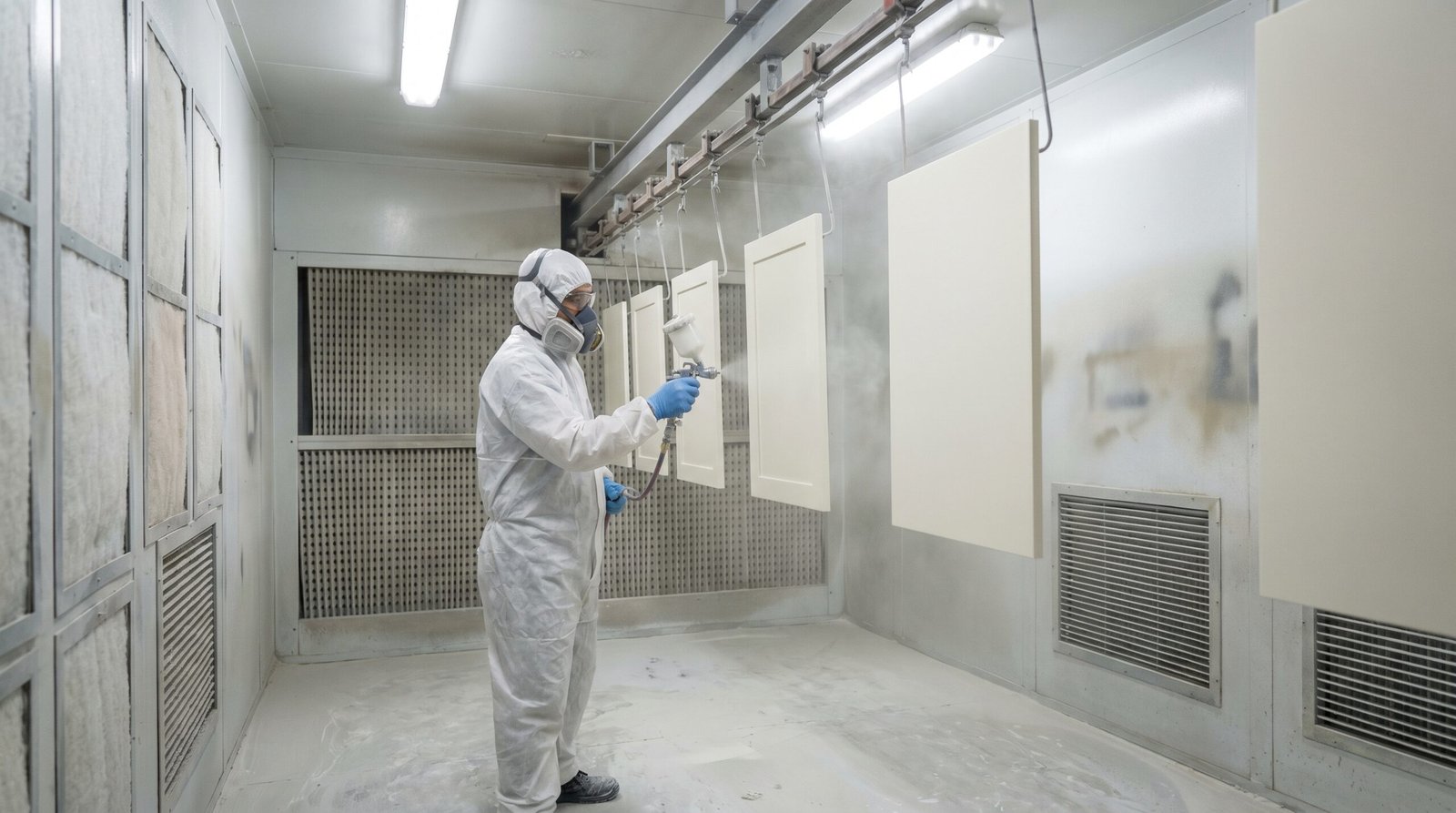
Doors go through a separate manufacturing process to carcasses. Cut door blanks are profiled on CNC routing machines, which creates the frame-and-panel shapes, routed edges, and shaker-style details that clients specify in design.
Painted doors go through a five-stage finishing process. First coat of primer after sanding. Full surface filler application. Second sand to 180 grit. First finish coat of lacquer. Final sand to 240 grit. Second finish coat. Each stage requires full cure time before the next begins. Rushing this process is the single biggest cause of orange-peel texture and paint adhesion failures in kitchen doors.
We cure doors at controlled temperatures. In the UAE summer, lacquer that is applied in an uncooled environment will not flatten properly and will show texture in certain lighting conditions. Our spray booth is climate-controlled and our team adjusts thinner ratios to match ambient humidity on each production day.
Step Five: Quality Control Before Delivery
Before any cabinetry leaves our workshop, it goes through a formal quality check. Each carcass and door is inspected against the project specification. Hardware is fitted and tested. Drawer runners are adjusted to the correct tension. Hinge positions are verified against the door dimensions.
This stage catches problems while the solution is still easy. A door with a finish defect caught in the workshop takes two hours to rectify. The same defect caught at installation takes half a day and can delay the rest of the installation team.
We photograph every piece before loading. This creates a documented record of condition at dispatch that protects both the client and our team if any transit damage occurs.
Step Six: Delivery and Site Installation
The Delivery Logistics in Dubai
Moving finished kitchen cabinetry in Dubai requires specific planning. Our delivery team coordinates building access with the client and building management in advance, because loading dock bookings in Dubai Marina towers, for example, can have waiting times of one to three days without prior arrangement.
Cabinets are wrapped in moving blankets and stretch film for transport. Doors and panels are separated from carcasses in the vehicle. We do not stack carcasses directly on their finished surfaces.
For villa deliveries in areas like Arabian Ranches, Meadows, or Jumeirah Golf Estates, site access and material staging areas are confirmed before the delivery date. Having nowhere to store materials on site on delivery day is a solvable problem before it happens and a costly one after.
The Installation Process
Base cabinets are always installed first. Our installation team sets out the full base cabinet run using the laser level before a single cabinet is fixed. This takes time. Clients sometimes ask why the team is spending 40 minutes measuring before any cabinets go up. The answer is that those 40 minutes determine whether the entire run is level or whether the worktop fabricator arrives to find a cabinet run that dips 8mm in the middle.
We use wall battens fixed to verified structural points for wall-hung upper cabinets. Wall anchoring in UAE construction uses specific fixings appropriate to the wall type, whether that is solid concrete block, lightweight concrete, or the gypsum partition walls common in many Dubai apartments. The wrong fixing in the wrong wall type is a safety issue, not just a cosmetic one.
Cabinet legs are adjusted individually so that every base unit sits at the correct height before fixing. The standard UAE kitchen worktop height is 90cm, which means base cabinets need to sit at a very specific height to account for the worktop thickness. We use 36mm worktops as the default, so base cabinet upper edges need to sit at 864mm finished floor level.
Worktop Templates and Final Fitting
Once base cabinets are installed, worktop templates are made. For stone or engineered stone worktops, which account for the majority of UAE kitchen projects, templates go to the stone fabricator for cutting. The typical stone fabrication lead time in Dubai is three to five working days.
Final installation includes fitting the worktop, connecting doors and drawer fronts, fitting all hardware, and completing appliance cutouts. Plumbing and electrical connections are completed by the respective trades. We coordinate this sequencing with the client’s project manager or directly with the other contractors on site.
Common Mistakes Homeowners Make When Ordering Custom Kitchen Cabinets
Mistake 1: Choosing the Finish Before the Function
We see this regularly. A client has fallen in love with a glossy white kitchen they saw in a magazine, and they want that exact look without thinking about how they actually use their kitchen. High-gloss finishes show every fingerprint in a family kitchen with young children. Dark-stained veneers show water marks near the sink area. Matte painted finishes are forgiving and beautiful but require more careful cleaning around cooking zones.
The right finish is the one that works for your family’s habits. We always ask clients to describe a typical week of cooking before we discuss finishes.
Mistake 2: Under-specifying Storage
The most common feedback we receive from clients who did not work through storage in detail is that they run out of a specific type of storage within the first year. Typically this is pot and pan storage or food pantry space. Once the kitchen is built, reconfiguring this is a significant and expensive job.
We use a storage audit process with every client before design is finalized. This involves reviewing what the client currently stores, what they wish they had more room for, and what they want to access most frequently. It takes about 30 minutes and prevents years of frustration.
Mistake 3: Ignoring the Extraction Position
Kitchen extraction hood positioning affects the entire upper cabinet layout. The extraction duct path determines where certain upper cabinets can and cannot go. In Dubai apartments, the duct route to the external building facade is fixed by the building structure. Any kitchen design that ignores this will create problems at installation that are expensive to solve.
Mistake 4: Choosing Hardware on Budget Alone
We covered the hardware quality question in the materials section, but it is worth repeating here because we see it often. A client who accepts every quality recommendation but saves money on hinges and drawer runners is making a false economy. The hardware is the most physically active component in the kitchen. It is used dozens of times per day and is the first thing to show quality degradation.
Mistake 5: Not Allowing Realistic Time
UAE clients understandably want their kitchens completed quickly, especially during a renovation that has displaced the family. The realistic timeline for a custom kitchen in Dubai is six to ten weeks from design sign-off to installation completion for a standard project. Rushes are sometimes possible but they cost more, and they increase the risk of quality compromises.
If a supplier is quoting you two to three weeks from order to installation, ask very specific questions about what steps they are skipping or where the process shortcuts are.
Mistake 6: Assuming All Suppliers Are Comparable
The Dubai market for kitchen cabinetry ranges from excellent to genuinely poor, and price alone does not distinguish them reliably. There are inexpensive suppliers producing good work and expensive suppliers producing mediocre work. The distinguishing questions are: Can I visit your workshop? Can you show me projects you completed three years ago? Do you have a warranty with specific terms in writing?
What Does a Custom Kitchen Cost in Dubai in 2026?
This is the question every homeowner wants answered, and we are going to give you the honest version.
Entry-Level Custom Kitchen: AED 35,000 to AED 65,000
This range covers a standard apartment kitchen of 8 to 12 linear meters using MR MDF carcasses, painted MDF doors in a straightforward design, quality hardware, and laminate or engineered stone worktops. Appliances are not included.
This is not a cheap kitchen. It is a well-made, functional kitchen that will perform reliably for 10 to 15 years with normal care.
Mid-Range Custom Kitchen: AED 65,000 to AED 130,000
This range covers larger apartment kitchens and smaller villa kitchens. It includes more complex storage solutions, higher-specification hardware, better door finishes, and typically stone worktops. Custom kitchen islands usually fall in this range.
Premium Custom Kitchen: AED 130,000 and Above
Villa kitchens in Emirates Hills, Palm Jumeirah, or Jumeirah Golf Estates typically fall in this range. These projects involve larger floor areas, premium materials including solid wood or high-end veneers, integrated appliances with customized front panels, and complex design features. Our largest villa kitchen project completed in 2025 involved 42 linear meters of cabinetry and reached AED 380,000 for the joinery alone.
What Drives Cost Up
The factors that move a project from mid-range toward premium are usually: island size and complexity, the choice of veneer or solid wood doors over painted MDF, the number of internal fittings and pull-out mechanisms, and the specification of integrated appliance panels that require precise coordination with appliance manufacturers.
Expert Tips From 35 Years of Kitchen Projects in the UAE
1. Plan the lighting in the design stage, not after.
Under-cabinet LED lighting needs a power supply route that is determined by the upper cabinet layout. Adding it after installation is messy and compromises the finish. You can discover more about structural integrations in our specialized guides for living room carpentry and organized home office carpentry.
2. Specify your appliances before design begins.
The exact cutout dimensions for your oven, hob, and dishwasher need to be known before the design is finalized. Brand equivalents are not always interchangeable.
3. Ask for a full-size trial assembly of any complex corner solution.
Corner cabinets are the most problematic area in any kitchen. If your design has a complex corner, ask the workshop to assemble and test it before the rest of the kitchen is delivered.
4. Leave a gap behind base cabinets for future pipe access.
We build a 50mm service void behind base cabinet runs in all our projects. This costs nothing but saves enormous disruption if a plumber ever needs access to supply pipes behind the cabinets.
5. Request a written handover document.
This should include the paint codes and finish specifications for every surface, the hardware model numbers, and instructions for replacement parts. You will need this eventually, probably around year seven.
6. Seal the kick plate connections to the floor.
In UAE humidity, the gap between kick plates and the floor is where insects enter kitchen cabinetry. A simple flexible silicone seal at installation takes 20 minutes and prevents a persistent problem.
7. Consider the refrigerator circulation space before finishing the surround panels.
Integrated refrigerator surrounds look beautiful but restrict the refrigerator’s condenser airflow if the vent gaps are not correctly sized. Incorrect refrigerator ventilation in the UAE heat shortens appliance lifespan significantly. For seamlessly matching cabinetry setups in other functional spaces, check our dedicated workflows for dining room carpentry as well as welcoming entryway / corridor carpentry.
Conclusion: Why the Process Is the Product
A custom kitchen is not a product you order. It is a process you go through. The survey, the design conversations, the material decisions, the manufacturing steps, and the installation details are not preamble to the kitchen. They are how the kitchen is created.
After 35 years and over 10,000 projects across Dubai, Abu Dhabi, and Sharjah, the consistent finding is that clients who engage with this process get kitchens they love. Clients who treat it as a transaction to be completed as quickly as possible get kitchens they live with.
The UAE climate, the scale of the typical project, and the density of the Dubai market all mean that the quality gap between a carefully made custom kitchen and a quickly produced one becomes visible within three to five years. The difference is in steps that are invisible at handover: the board specification, the edge banding adhesion temperature, the bore position tolerances, the hardware brand.
Those are the things Karnak Carpentry has been paying attention to since 1988. If you want to expand this tailored approach to your private rooms, review our options for premium bedroom carpentry, featuring bespoke built-in wardrobes & walk-in closets, modern sliding wardrobes Dubai, and luxury walk-in closets Dubai.
Key Takeaways:
- The UAE climate requires specific material and construction standards that directly affect cabinet longevity. Standard European specifications are not automatically sufficient.
- The survey and design stages are where the most important decisions are made. Rushing either stage creates problems that are expensive to fix.
- Hardware quality is the most underestimated factor in long-term kitchen satisfaction. Specify quality hardware from the start.
- A realistic custom kitchen timeline in Dubai is six to ten weeks from design sign-off. Suppliers quoting faster should be asked specific questions about their process.
- Budget honestly. A well-made entry-level custom kitchen starts at AED 35,000 for an apartment-scale project. Below that range, ask very specific questions about what they are compromising. If you plan to extend your high-quality upgrades outside, we also build durable features via our outdoor & garden carpentry.
Need Expert Help?
Karnak Carpentry has been designing and building custom kitchen cabinets in Dubai and across the UAE since 1988. Our team handles every stage of the process in-house, from the initial site survey through workshop manufacturing to final installation. We offer a free consultation at your property where we will assess your space, discuss your requirements, and give you honest guidance on what is achievable within your budget and timeline. There is no obligation and no sales pressure. Just the knowledge of a team that has completed over 10,000 UAE projects.
Contact: WhatsApp Us or Call Us at +971-52-5554207 | info@karnakcarpentry.com
Frequently Asked Questions About Custom Kitchen Cabinet Manufacturing in Dubai
How do custom kitchen cabinets differ from ready-made cabinets?
Custom kitchen cabinets match your exact room dimensions, storage needs, and design preferences. Ready-made cabinets come in fixed sizes, which often leave unused spaces or require fillers to complete the layout.
What is the first step in making custom kitchen cabinets?
Every project starts with an on-site measurement and design consultation. A cabinet designer records precise dimensions, discusses your storage requirements, and prepares a layout before production begins.
Which materials do cabinet makers use in Dubai?
Most professional manufacturers choose marine plywood, moisture-resistant MDF, and premium laminates because these materials handle Dubai’s heat and humidity while delivering long-lasting performance.
How long does it take to build custom kitchen cabinets?
A standard custom kitchen usually takes two to six weeks from design approval to installation. Project size, material availability, and finish selection influence the overall production schedule.
How do cabinet makers ensure accurate measurements?
Professional installers measure walls, ceiling height, plumbing points, electrical outlets, windows, and appliance locations before creating production drawings. Accurate measurements prevent installation issues and improve the final fit.
Why do manufacturers use CNC machines for cabinet production?
CNC machines cut every panel with exceptional precision and consistency. Computer-controlled production reduces material waste, improves accuracy, and speeds up manufacturing without compromising quality.
Which cabinet finish lasts the longest in Dubai?
High-pressure laminate, acrylic, and polyurethane finishes offer excellent durability for Dubai kitchens. Each finish resists scratches, moisture, and daily wear while maintaining an attractive appearance.
What hardware should I choose for custom kitchen cabinets?
Soft-close hinges, heavy-duty drawer runners, pull-out storage systems, and quality handles improve both durability and convenience. Premium hardware also extends the life of your cabinets.
Can I customize every cabinet inside my kitchen?
Yes. Designers can add spice racks, corner storage solutions, cutlery organizers, pull-out pantry units, appliance garages, recycling bins, and custom shelving based on your cooking habits.
How do professionals install custom kitchen cabinets?
Installation teams level every cabinet, secure each unit to the wall, align doors and drawers, adjust hardware, and inspect every component before completing the project. Careful installation ensures smooth operation for years.
What quality checks take place before installation?
Factory technicians inspect dimensions, panel finishes, edge banding, hardware alignment, and structural strength before packing the cabinets. Final inspections reduce installation delays and maintain consistent quality.
Do custom kitchen cabinets increase home value?
Well-designed custom cabinets improve functionality, maximize storage, and create a premium appearance. Buyers often view a professionally designed kitchen as a valuable feature that enhances the overall property.
Which mistakes should homeowners avoid during cabinet planning?
Avoid overlooking storage requirements, selecting low-quality hardware, ignoring ventilation, or choosing materials that cannot handle Dubai’s climate. Smart planning creates a kitchen that performs well for many years.
How can I choose the right custom kitchen cabinet company in Dubai?
Review completed projects, compare material specifications, ask about manufacturing methods, inspect hardware quality, and confirm warranty coverage before making a decision. A reputable company explains every stage of production and provides transparent pricing.
Why do homeowners prefer custom kitchen cabinets over modular options?
Custom cabinets maximize every inch of available space, match your preferred style, accommodate unique appliances, and deliver a seamless appearance. Personalized designs also provide better storage efficiency than standard modular layouts.
Related Articles
- Wardrobe Installation Process Dubai: What Actually Happens From Measurement to Handover
- How to Prepare Your Dubai Home for a Carpentry Installation (The Complete Homeowner Guide)
- Engineered vs Solid Wood Flooring in UAE: The Climate Verdict After 35 Years
- Wood Finishing Options Explained: Paint, Stain, Lacquer, and Oil in the UAE