Blog
Wood Finishing Options Explained: Paint, Stain, Lacquer, and Oil in the UAE

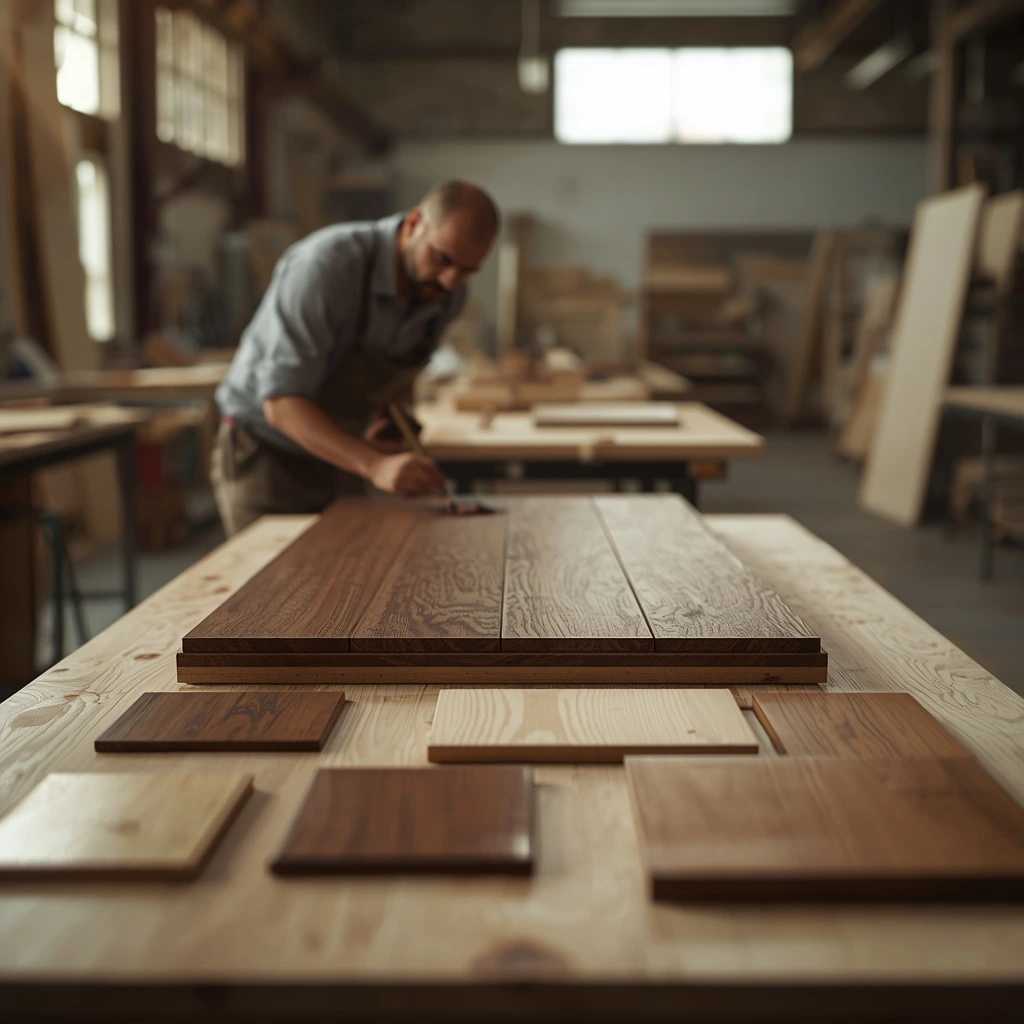
Every week, someone asks us a version of the same question. A homeowner in Arabian Ranches has just had custom wardrobes fitted. A developer in Business Bay is specifying joinery for thirty apartments. A villa owner in Emirates Hills wants to refinish fifteen-year-old teak outdoor furniture. The question is always some variation of: “Which finish should I use?” After 35 years and more than 10,000 projects across the UAE, we have learned that this question deserves a real answer, not a sales pitch. The wrong finish in a Dubai home does not just look bad. It fails within months, costs double to fix, and sometimes damages the wood underneath. This guide, featuring insights and updates relevant to UAE property owners as reported across top regional publications like The National, gives you the honest, complete picture we share with every client before a single brush touches their timber.
What makes this topic genuinely complicated in the UAE is the climate. Dubai’s humidity swings from single digits in January to above 90 percent during August. Temperatures push past 48 degrees Celsius on site, and air conditioning units run almost continuously indoors, creating rapid temperature cycling on wood surfaces. A finish that performs beautifully in a European kitchen will crack, peel, or cloud in a Marina apartment within one summer. This is not theory. We have seen it happen to expensive European-imported joinery brought over without any climate adaptation in the finish specification. Understanding why certain finishes work here, and why others fail, starts with understanding what each category actually does.
What Wood Finishing Actually Does (And Why UAE Conditions Change Everything)
Before comparing specific options, it helps to understand that all wood finishes do two jobs. They protect the wood from its environment, and they affect how the wood looks. In most climates, the protection job is mostly about moisture. In the UAE, you are dealing with a more complex set of stresses: intense UV radiation, extreme heat, high humidity in coastal areas like JBR and Dubai Marina, and dramatic temperature swings caused by the contrast between outdoor heat and heavily air-conditioned interiors.
Wood is hygroscopic, meaning it absorbs and releases moisture constantly. In a country where outdoor humidity can drop to 15 percent in winter and rise to 90 percent in summer, untreated or poorly finished wood moves a lot. It expands in humid months and contracts in dry months. A finish that cannot flex with this movement will crack. a finish that is not UV-stable will fade and chalk outdoors within a season. A finish applied without proper surface preparation will fail early because the wood beneath it has not been stabilized.
We finished joinery in a Palm Jumeirah villa in 2019 using a water-based lacquer that the client specified based on a recommendation from an overseas designer. By the following summer, the kitchen cabinet doors were showing fine crazing cracks across the entire surface. The lacquer had been formulated for Northern European conditions. It simply could not handle the coefficient of thermal expansion at UAE temperatures. We stripped and re-finished everything using a two-component polyurethane system designed for hot climates. That finish is still performing well today, six years later. The lesson was not that water-based lacquers are bad. The lesson is that product selection has to be matched to UAE conditions specifically.
The Four Categories You Need to Understand
For practical purposes, wood finishing in UAE residential and commercial joinery falls into four categories. Paint. Stain. Lacquer. Oil. Each behaves differently, suits different applications, and requires different maintenance. Some overlap exists. You can apply stain then lacquer over the top, for example. But understanding each category on its own terms is the right starting point.
Paint: Full Coverage, Maximum Protection, Specific Use Cases
Paint is the most misunderstood finish in joinery work. Many people assume it is a budget option or a way to cover low-quality timber. Neither is accurate. Paint is a specific tool with real advantages, and the decision to paint or not paint should be based on the application, not on price assumptions.
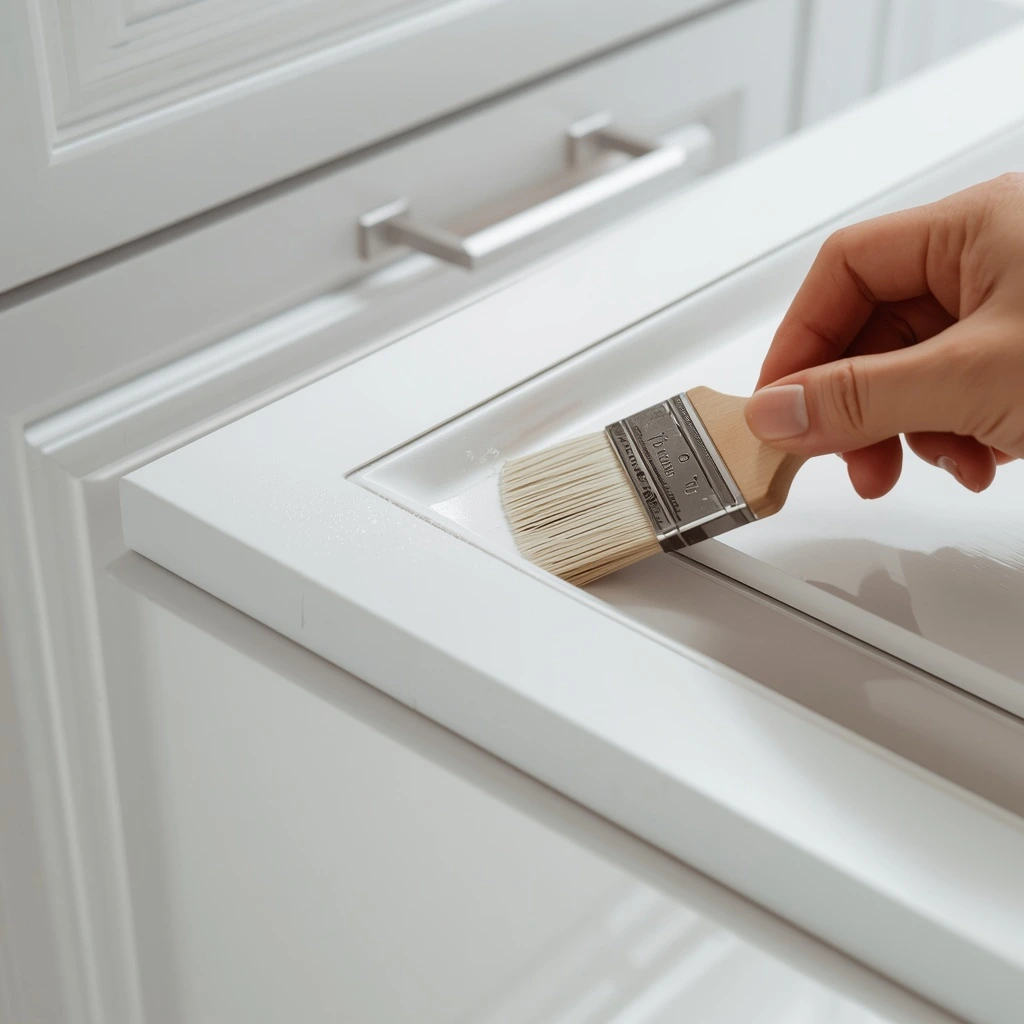
When we say paint on wood, we mean an opaque coating that fully conceals the wood grain underneath. This creates a uniform color surface, which is either what you want or what you absolutely do not want depending on the brief. For a contemporary Dubai apartment with handleless cabinetry in matte white, paint is the correct and premium choice. For a client who has paid for solid American white oak and wants to show that grain, paint is the wrong tool entirely.
Oil-Based vs Water-Based Paint on Wood
In the UAE, the choice between oil-based and water-based paint for wood is more consequential than it sounds. Oil-based paints penetrate deeper, level out better when applied by brush, and historically offered better adhesion on oily hardwoods like teak. Their disadvantage is drying time. In a humid August in Dubai, oil-based paint on joinery can take 24 to 48 hours to cure properly between coats. On a commercial project with tight handover timelines, that matters.
Water-based paints have improved enormously over the past decade. Modern acrylic and waterborne alkyd paints dry faster, emit fewer VOCs, and have caught up on durability. In air-conditioned workshops and climate-controlled installation environments, they perform excellently. We shifted most of our spray paint work to water-based systems around 2018 and have not looked back. The critical variable is application environment temperature and humidity. If those are controlled, water-based paint delivers outstanding results.
For doors, trims, skirting boards, and cabinetry in UAE homes, paint durability depends heavily on surface preparation. We always sand to at least 150 grit, apply a specialist wood primer, sand again with 220 grit, and apply a minimum of two finish coats. On high-traffic areas like kitchen cabinet fronts, three finish coats is standard. Clients sometimes ask us to skip primer to save time. We decline every time. Primer adhesion on wood is not optional. A finish coat without primer will fail faster in UAE humidity regardless of how good the topcoat is.
Where Paint Works Best in UAE Projects
In our experience, paint is the right finish choice in several specific situations. Contemporary joinery where a clean uniform color is the design intent. Children’s bedroom furniture where scrubbability matters. Environments with intense cleaning regimens, such as kitchens. Any application where the timber itself is a structural and functional species rather than a decorative one. MDF joinery almost always gets painted rather than stained or oiled, since MDF has no natural grain to show.
For outdoor applications in the UAE, exterior-grade paint designed for wood requires UV stabilizers to hold color. Standard interior paint outside in Dubai will fade to a chalky, degraded state within one to two years. We use specific exterior wood paint systems with built-in UV inhibitors on gates, pergolas, and timber screens. Even then, a repaint cycle of three to five years is realistic in UAE coastal environments. Anyone who tells you otherwise is not being honest.
Cost for paint finishing at Karnak runs from approximately AED 45 to AED 95 per square meter for standard residential work, depending on the number of coats and the complexity of the profile. Spray application is more efficient and produces a better surface than brush and roller on large flat panels, so we spray prime and finish in our workshop where possible.
Stain: Enhancing Grain While Changing Color
Stain is probably the most misunderstood finish category among homeowners. The common assumption is that stain changes the color of wood. That is partially true, but it misses the more important point. Stain works with the natural grain of the wood rather than against it. A good stain application enhances what is already in the timber, adds depth, and shifts the tone without looking like a coating sitting on top.
Stain penetrates into the wood fibers rather than forming a film on the surface. This means it cannot be sanded off or peeled the way a paint or lacquer layer can. What you are doing with stain is permanently altering the color of the wood cells near the surface. This is both a strength and a constraint. If the client changes their mind after staining, the options are limited: sand down significantly, apply a darker stain over the top, or paint over it.
Stain Types We Use in UAE Projects
We work primarily with three categories of stain for UAE residential and commercial projects. Oil-based stains, water-based stains, and gel stains. Each has a specific application area.
Oil-based stains penetrate deeper and tend to produce richer, more consistent color on open-grain hardwoods like oak, ash, and walnut. They take longer to dry and require solvent cleanup, but the results on furniture and cabinetry are difficult to match with water-based alternatives. We use oil-based stains on bespoke furniture pieces where color depth is critical.
Water-based stains dry faster and have improved significantly in color range and consistency. For production joinery work, they allow shorter turnaround times between stain application and topcoat. They work well on even-textured woods but can raise the grain slightly, which means an intermediate sanding step is required before the topcoat goes on. We factor this into our schedules as standard.
Gel stains are particularly useful on tight-grain woods like pine and birch, which can absorb liquid stains unevenly and produce a blotchy result. The gel consistency slows penetration and allows more controlled application. For clients in Jumeirah who want a walnut tone on pine shelving, gel stain is usually the solution that produces even color without the blotching risk.
Stain Always Needs a Topcoat in UAE Conditions
This is a point we make emphatically to every client considering stain. Stain alone is not a complete finish in any climate, and it is certainly not in the UAE. Stain penetrates and colors but does not provide meaningful surface protection. Without a topcoat, a stained surface will absorb grease, water marks, and wear scratches directly into the wood. In a Dubai kitchen or a living room with heavy use, a stain-only surface would degrade quickly.
The topcoat choice over stain depends on the application and the desired look. Lacquer is the most common topcoat over stained interior joinery. Oil can work as a topcoat in certain applications. Some clients want wax, though we counsel against it for high-traffic surfaces in UAE conditions. The topcoat determines the sheen level, durability, and maintenance requirements. We treat stain plus topcoat as a complete system and specify both together when quoting.
Lacquer: The UAE Workhorse Finish
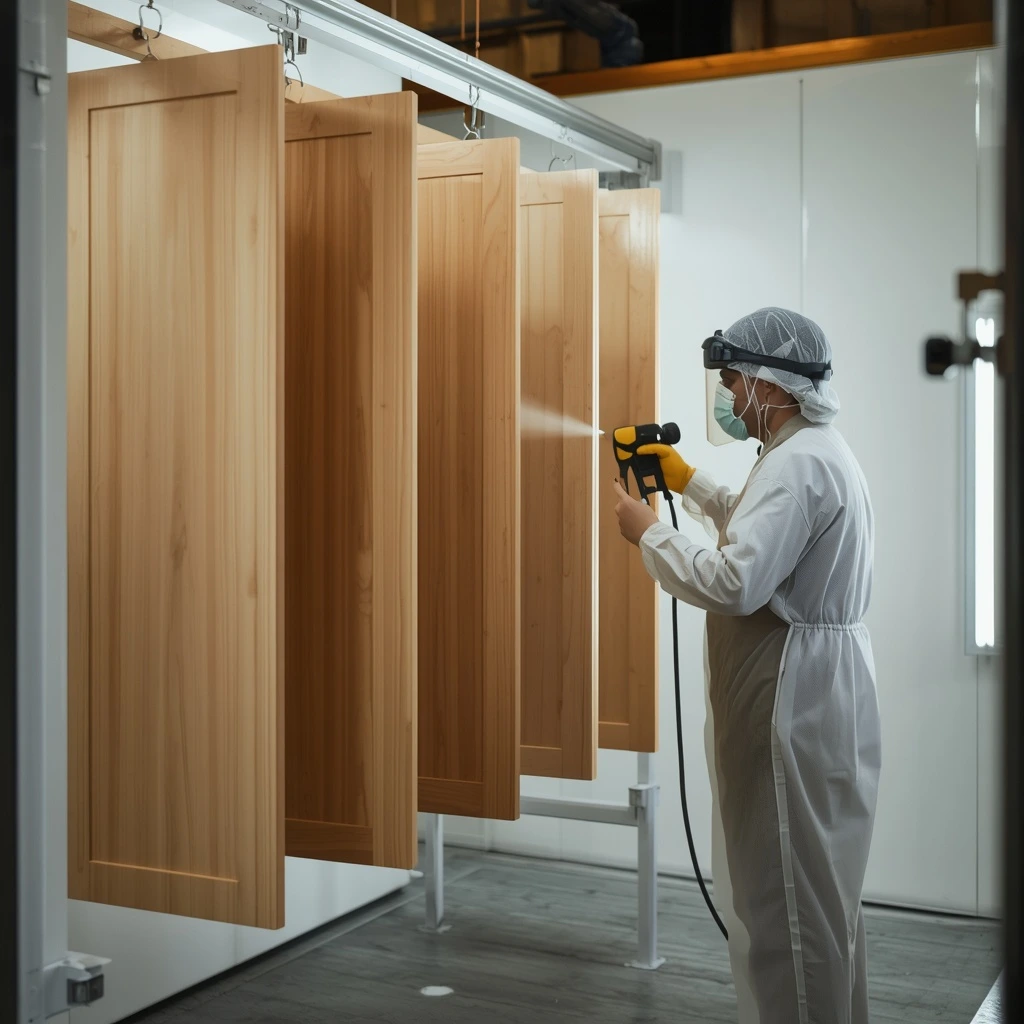
If you ask us which finish we apply most often in UAE residential and commercial joinery, the answer is lacquer. Specifically, two-component polyurethane lacquer for demanding applications and single-component nitrocellulose or acrylic lacquer for lighter-duty work. Lacquer is the practical backbone of professional joinery finishing in this region for good reasons.
Lacquer forms a hard, continuous film over the wood surface. Unlike oil, which soaks in, or stain, which penetrates the fibers, lacquer sits on top and creates a sealed layer. This layer can be formulated to any sheen level, from dead matte to high gloss. It provides strong resistance to moisture, cleaning chemicals, mild impacts, and UV radiation when properly formulated. And critically for UAE conditions, it can be specified for the temperature and humidity ranges found here.
Two-Component vs Single-Component Lacquer
The distinction between two-component and single-component lacquer matters significantly in UAE conditions. Two-component systems, sometimes written as 2K, mix a base with a hardener just before application. The hardener triggers a chemical crosslinking reaction as the lacquer cures. The resulting film is significantly harder, more chemical-resistant, and more thermally stable than single-component systems that simply dry by solvent evaporation.
For kitchen cabinets, bathroom vanities, high-use furniture, and any application near UAE coastal humidity, we specify 2K polyurethane lacquer as standard. The added cost over single-component lacquer is real. Expect to pay roughly 25 to 35 percent more for a 2K system. But we have seen 2K lacquered kitchen fronts in Dubai Marina apartments hold up for twelve to fifteen years without refinishing, against single-component lacquer fronts in similar conditions that needed work after five to seven years. The maths usually favors the premium system.
Single-component lacquers still have a place. For furniture pieces that will not face hard use, display cabinetry, interior room dividers, and accent pieces in air-conditioned interiors, a good quality single-component acrylic lacquer performs well and costs less. The key is matching the lacquer grade to the application demand, not automatically specifying the most expensive option everywhere.
Sheen Levels in Lacquer: What the Numbers Mean
Lacquer sheen is specified as a gloss reading on a scale of zero to 100 measured at a 60-degree angle. Matte is typically 10 to 20. Satin is 30 to 45. Semi-gloss runs from 50 to 65. High gloss is 80 and above. These numbers matter because the sheen level affects both appearance and practical performance.
Higher gloss lacquers show surface imperfections more clearly. A fingerprint, a minor scratch, or an uneven substrate reads more visibly at 80 gloss than at 20 gloss. In UAE family homes with children, clients often choose satin or matte finishes for this practical reason rather than any aesthetic preference. High gloss has its place on display cabinetry, feature panels, and formal reception areas where the reflective depth is a deliberate design statement.
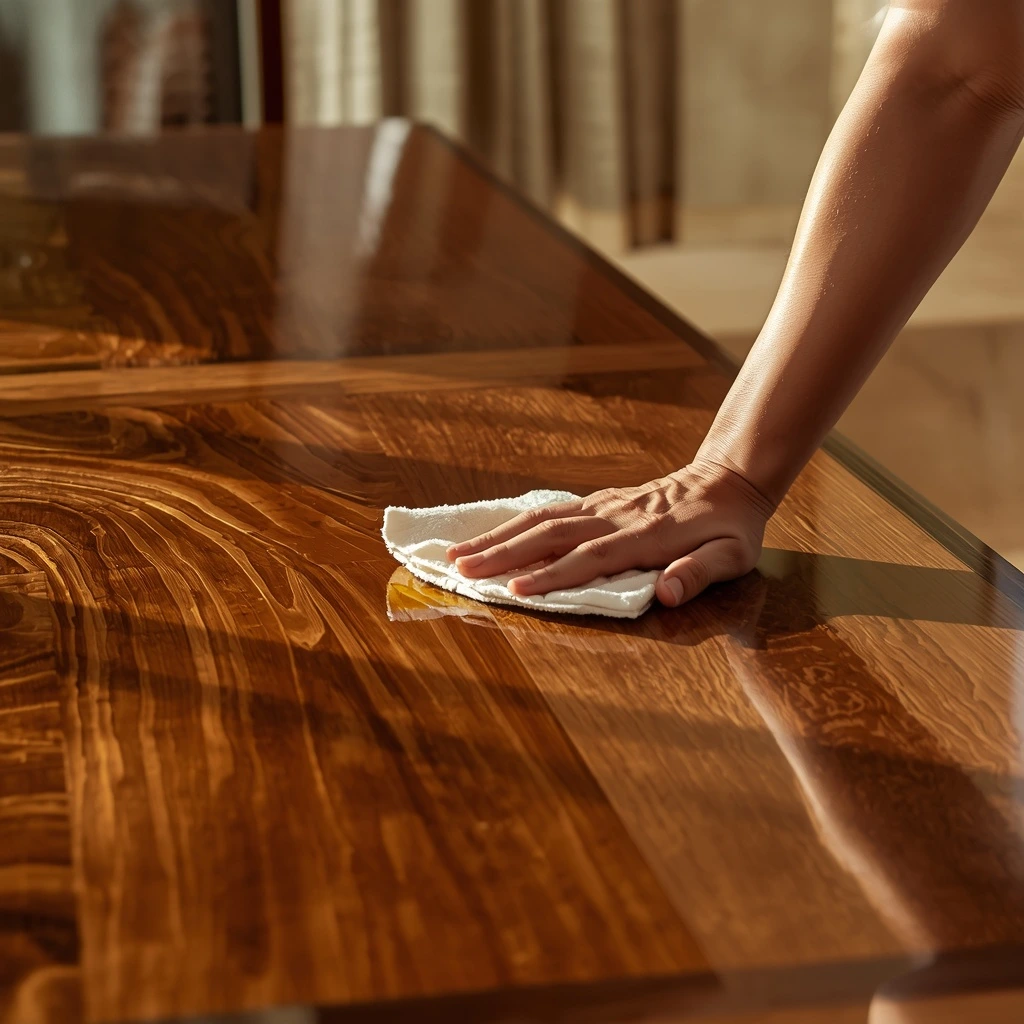
Matte lacquers require slightly more careful cleaning. Because the flattening agents in matte formulations create a micro-textured surface to reduce reflectivity, they can accumulate grease in kitchen environments. We always advise clients with matte kitchen cabinets to use a damp microfiber cloth for regular cleaning and to avoid any abrasive cleaners that would gradually polish the surface unevenly.
Lacquer in UAE Outdoor Applications
Lacquer is primarily an interior finish. Using standard lacquer outdoors in the UAE is one of the most common mistakes we see on projects that were finished by others before coming to us for remediation work. Exterior UV in Dubai is intense. Standard lacquer, even high-quality interior grade, will yellow, chalk, and crack within one to two seasons outdoors. It is simply not designed for that level of solar radiation.
For outdoor timber applications that require a film-forming finish, we use specific exterior-grade two-component systems with UV absorbers built into the formulation, or we switch to oil-based exterior systems which handle UV better by design. The product type label, interior or exterior, is not a marketing distinction. It reflects genuinely different chemistry. Check it before specifying.
Oil Finishes: The Natural Choice With Real Limitations
Oil finishing has been part of woodworking for centuries, and it remains a relevant option in UAE projects for specific applications. The appeal is immediate: oil soaks into the wood rather than sitting on top, it feeds the fibers rather than sealing them, and the result has a warmth and naturalness that film-forming finishes cannot fully replicate. On a beautiful piece of solid walnut furniture in an Emirates Hills living room, a well-applied hard wax oil finish looks genuinely different from lacquer. It has tactile warmth. It feels like wood rather than like a coated surface.
The limitation is durability in demanding conditions. Oil finishes do not provide the same barrier protection as lacquer or paint. They are more susceptible to water rings, alcohol marks, and general wear in high-use applications. A dining table in a family home in Mirdif that sees daily use from children needs a harder finish than oil typically provides, unless the client is committed to periodic maintenance applications. Some clients are. Many are not.
Hard Wax Oil vs Pure Oil vs Tung Oil
The oil finish category includes several distinct product types that perform differently. Understanding the differences is important for correct specification.
Pure penetrating oils such as linseed oil and Tung oil are traditional finishes that offer limited surface protection. They feed the wood and enhance color but build minimal surface film. They are appropriate for surfaces that see light use and where the natural appearance is paramount. Outdoor teak garden furniture in UAE can be maintained with teak oil or linseed oil applied seasonally. It is low effort, and the timber weathers gracefully with this approach.
Hard wax oils are a more modern development that blends natural oils with wax components to build a thin but more protective surface layer. Products like Osmo Polyx and Rubio Monocoat fall into this category. They provide better stain and moisture resistance than pure oil while retaining much of the natural warmth. We use hard wax oils on solid hardwood flooring and on statement furniture pieces where the client wants a natural look with reasonable practical protection.
Danish oil is a blended penetrating finish, typically linseed oil combined with varnish and mineral spirits. It builds a slightly harder surface than pure oil but is not in the same durability category as lacquer. It is a solid choice for workshop interiors, utility furniture, and mid-tier residential applications in the UAE where budget and aesthetics need to be balanced.
Maintenance Reality of Oil Finishes in UAE Homes
We are transparent with every client who asks about oil finishes on high-use surfaces. Oil finishes require maintenance. In a Dubai climate with low winter humidity and air conditioning cycling year round, oiled wood will benefit from re-oiling every one to two years on tabletops and every two to three years on shelving and lower-use surfaces. The process is straightforward. Clean the surface, lightly sand with fine paper, apply a thin coat of oil with a cloth, let it penetrate, wipe off the excess, and allow to cure. A client who does this maintenance will have furniture that looks better at fifteen years than it did at five. A client who does not will see the wood dry out, fade, and lose its resilience.
This is not a disadvantage of oil finishes. It is an honest description of how they work. The same maintenance reality applies to painted and lacquered surfaces, just on different timescales. The question is always whether the client’s lifestyle and expectations match the maintenance profile of the finish specified.
Comparing All Four: A Practical UAE Guide
Choosing between paint, stain, lacquer, and oil is not about which finish is best overall. It is about which finish is right for the specific wood species, application, use conditions, and client expectations in play. Here is how we approach the comparison across the variables that matter most in UAE projects.
Durability in UAE Conditions
For high-use kitchen and bathroom joinery in UAE conditions, 2K polyurethane lacquer leads the durability comparison. A properly applied 2K system on kitchen cabinet fronts in a Dubai apartment will handle humidity cycling, cleaning, and daily contact for twelve to fifteen years before any significant refinishing is needed. Paint in a comparable 2K or high-quality single-component system comes second, particularly on primed surfaces with three coats. It provides strong protection on the right substrates.
Oil finishes sit at the lower end of the durability scale for UAE conditions in terms of barrier protection, but they are not fragile. On properly prepared hardwood floors and statement furniture maintained correctly, they perform admirably. The key distinction is that oil finishes handle abuse differently from lacquer. They absorb minor damage into the wood surface and can be spot-repaired more easily than lacquer. A deep scratch in a lacquered surface requires professional refinishing. A deep scratch in an oiled surface can often be sanded and re-oiled locally.
Stain alone is not a protective finish at all. Stain plus a lacquer or oil topcoat performs at the level of the topcoat system applied over it.
Appearance Options
Paint offers the widest color range but conceals grain. Stain shifts color while keeping grain visible. Lacquer can be clear or tinted, matte to high gloss, over any base preparation. Oil provides the most natural appearance with the least surface modification.
For clients who want to show off the beauty of the actual timber they have paid for, oil or clear lacquer over stain are the correct directions. For clients who want a specific RAL color or a consistent contemporary palette across their joinery, paint or pigmented lacquer is the right answer.
Cost Comparison in AED
These are realistic ranges for residential quality work in UAE conditions as of 2026. They include materials and labor for a professional finish.
Paint finishing on primed joinery: AED 45 to AED 95 per square meter. Stain application with lacquer topcoat: AED 65 to AED 120 per square meter. Single-component lacquer clear finish: AED 55 to AED 95 per square meter. Two-component polyurethane lacquer: AED 85 to AED 150 per square meter. Hard wax oil finish on solid hardwood: AED 60 to AED 110 per square meter.
These figures cover standard flat panel work. Profiled moldings, intricate carvings, turned elements, and complex geometries add to cost because they require more time in preparation and application. Site refinishing also costs more than workshop finishing because environmental control is harder to achieve on a construction site in Dubai.
Common Mistakes That Cost UAE Homeowners Money
After 35 years and thousands of finishing projects across Dubai and the wider UAE, we have seen the same mistakes repeatedly. They are worth detailing honestly because they account for a significant portion of the remediation work we take on every year.
Mistake 1: Using Interior Finishes Outdoors
This is the most expensive mistake, because it fails completely. We have re-finished more pergolas, garden gates, timber screens, and outdoor furniture than we can count after a client or a less experienced contractor applied interior lacquer or standard paint outdoors. Interior finishes are not formulated for UV resistance at UAE solar intensity. They chalk, crack, peel, or go yellow within one to two seasons. The cost to strip and re-finish is always more than the cost to specify correctly the first time.
If it is outdoors in the UAE, it needs a finish that says exterior on the product data sheet. No exceptions.
Mistake 2: Skipping or Rushing Surface Preparation
Surface preparation is not optional finishing. It is the foundation of everything that follows. We spend more time preparing surfaces than we spend applying finish. Sanding, filling, priming, intermediate sanding, and cleaning at each stage all contribute directly to how well the finish adheres and how long it lasts. A beautiful lacquer applied over poorly prepared wood will fail prematurely regardless of product quality. We see this on joinery that has been fast-tracked on commercial projects in Business Bay and Downtown Dubai. Tight handover schedules pressure teams to compress preparation time. The result is often joinery that starts failing within two to three years.
Mistake 3: Applying Too Many Coats
More coats of finish does not mean better protection beyond a certain point. An over-built lacquer system, too many coats applied too quickly, creates a brittle film that is more prone to cracking as the wood moves with UAE climate cycles. Each additional coat also adds to the overall film thickness, which can obscure fine detail in profiles and moldings. The right number of coats is specified in the product technical data sheet and based on the application requirement. Three coats of finish with correct intercoat sanding is almost always better than five coats rushed without it.
Mistake 4: Ignoring Wood Moisture Content Before Finishing
Wood must be at the correct moisture content before finishing. In the UAE, this means timber should be acclimatized to the installation environment before any finish is applied. We typically require timber to acclimatize in the installation space for a minimum of five to seven days before our finishing teams begin work on site. Finishing wood that is still adjusting to local conditions creates a moving substrate under the finish. The finish cannot accommodate that movement and will crack or separate from the surface.
We check moisture content with a calibrated digital meter on every project. Target moisture content for indoor UAE joinery is typically 8 to 12 percent depending on the area and the building’s humidity control. Coastal projects near JBR or Palm Jumeirah may see equilibrium moisture content settle at the higher end of that range.
Mistake 5: Choosing Finish by Appearance Sample Alone
Showroom finish samples look perfect in controlled conditions. They are photographed under ideal lighting on pristine timber. The decision about which finish to specify should never be made on appearance alone. You need to know the finish system, the product grade, how it handles the specific wood species you are using, and whether it is appropriate for the application and environment. We always provide clients with product technical data sheets alongside physical samples. The sample shows what it looks like. The data sheet tells you whether it will last.
Mistake 6: Neglecting Maintenance After Installation
Every finish has a maintenance requirement and a service life before refinishing is needed. Ignoring maintenance does not pause that clock. It accelerates it. A lacquered surface that is regularly cleaned with appropriate products will last significantly longer than one that is cleaned with abrasive or solvent-based household cleaners. An oiled surface that receives a maintenance oil application every two years will look better at year ten than one that has been left to dry out completely. We provide every client with a written maintenance guide specific to the finish system we have applied. Clients who follow it consistently get significantly longer intervals between refinishing.
Expert Tips From 35 Years of UAE Finishing Work
These are the things we know from experience that do not appear in product brochures.
Always test on a sample board using the actual wood species going into the project
Different species absorb finish differently. What looks right on oak does not automatically look right on mahogany or merbau. We test every new species and every new color specification on a sample before touching the project timber.
UV exposure in UAE is severe and fast
Any finish used near floor-to-ceiling glazing common in Dubai high-rise apartments and villas needs UV inhibitors, even for interior applications. Clear lacquer without UV stabilizers will yellow noticeably on wood near large south or west-facing windows within twelve to eighteen months.
Air conditioning affects finish selection
Rooms with very aggressive air conditioning that creates rapid temperature drops can stress rigid film-forming finishes more than rooms with gentler HVAC systems. In server rooms, commercial kitchens, and heavily air-conditioned retail environments, we factor this into finish selection and may recommend more flexible finish systems.
Two-pack finishes require correct pot life management
Once you mix a 2K lacquer, you have a working window, typically two to four hours depending on temperature. In a hot UAE workshop or on a summer site, that window shortens. Applying material past its pot life produces a weaker finish even if it looks fine on application. We train our team on this and track mixed material times as standard.
Grain filling on open-grain species is worth the time
Woods like oak and ash have a pronounced open grain that, without grain filling, will create a slightly textured surface even under multiple lacquer coats. Grain filling before the finish coats produces a dramatically smoother result. On high-gloss applications especially, grain filling is not optional if you want a professional outcome.
Color consistency across joinery batches requires care
Stain colors can vary between timber batches of the same species. We always stain all timber for a project from the same production mix to avoid tonal variation visible at installation. For large projects where production runs in multiple batches, we document the exact stain formula and mixing ratios precisely.
Do not apply oil or wax over lacquer or paint
This seems obvious but we have seen it. Some clients, trying to restore a lacquered surface that has dulled over time, apply furniture oil or wax polish over the top. Oil does not bond to cured lacquer. It sits on the surface, attracts dust, and creates a tacky, uneven appearance. If a lacquered surface needs refreshing, it needs correct cleaning, light sanding, and a compatible maintenance coat, not a different finish category applied on top.
Conclusion: Getting Wood Finishing Right in the UAE
The wood finishing decision is one of the most consequential choices in any joinery project. The right finish on the right wood in the right application, properly prepared and correctly maintained, will perform for a decade or more in UAE conditions and will look better with age. The wrong choice costs money, time, and sometimes damages timber that cannot be easily replaced.
From 35 years working across Dubai, Abu Dhabi, Sharjah, and the wider UAE, our core advice is this: resist the temptation to decide on finish type by looking at photos online or choosing whatever is cheapest. Think about the wood species, the application, the traffic the surface will see, the client’s maintenance commitment, and whether it is indoor or outdoor. Then match the finish system to those realities.
Paint when you want color uniformity and a durable opaque surface. Stain when you want to shift the tone of the wood while keeping the grain visible. Lacquer when you need a hard-wearing film-forming finish that handles the demands of UAE residential and commercial use. Oil when you want natural warmth and are committed to periodic maintenance. In practice, many of our best finishing work combines categories: stain plus 2K lacquer topcoat, for example, gives you the color enhancement of stain with the protection of lacquer.
Key Takeaways:
- UAE climate conditions require finish selection specific to local temperature, humidity, and UV intensity, not generic recommendations from overseas sources
- Two-component polyurethane lacquer is the highest durability option for UAE interior joinery in high-use applications
- Stain alone is never a complete finish and always requires a protective topcoat
- All outdoor UAE timber applications require exterior-grade finishes with UV inhibitors without exception
- Surface preparation quality directly determines finish longevity, regardless of how good the finish product is
- Oil finishes offer natural warmth and beauty but require periodic maintenance and are not suited to all applications
Need Expert Help With Your Wood Finishing Project?
Karnak Carpentry has been specifying, applying, and maintaining wood finishes across the UAE since 1988. Whether you are planning a new joinery installation in a Dubai villa, refinishing existing furniture, or specifying finishes for a commercial development, we bring 35 years of direct UAE experience to the conversation. Our team has finished more than 10,000 projects in this climate and we know which systems hold up and which do not. Contact us for a free consultation and we will give you an honest recommendation based on your specific timber, application, and environment.
Contact: WhatsApp Us or Call Us at +971-52-5554207 | info@karnakcarpentry.com
Frequently Asked Questions About Wood Finishing Options in the UAE
Which wood finish works best for furniture in the UAE?
The best finish depends on the furniture, wood species, and room conditions. Polyurethane lacquer, PU paint, natural wood stain, and hardwax oil all perform exceptionally well when professionals apply them correctly in UAE homes.
What is the difference between paint, stain, lacquer, and oil?
Paint completely covers the wood surface with color, stain enhances the natural grain, lacquer creates a durable protective coating, and oil penetrates the timber to nourish and protect it while preserving its natural appearance.
Should I choose paint or wood stain?
Choose paint if you want a modern solid-color finish that hides the grain. Select wood stain if you prefer to showcase the natural beauty, texture, and character of real timber.
Why do carpenters recommend lacquer for furniture?
Lacquer dries quickly, creates a smooth finish, resists scratches, and protects wood from everyday wear. High-quality lacquer also delivers excellent clarity and enhances the natural richness of the timber.
Does oil provide enough protection for wooden furniture?
Natural oils protect wood by penetrating deep into the fibers and highlighting the grain. Regular reapplication keeps the surface looking fresh and maintains long-term protection.
Which finish lasts the longest?
Polyurethane lacquer and high-quality PU paint usually provide the longest-lasting protection against scratches, stains, moisture, and daily household use. Proper preparation and professional application further improve durability.
Can wood finishes protect furniture from Dubai’s climate?
Yes. Quality finishes reduce moisture absorption, minimize UV damage, and help wood handle indoor temperature changes more effectively. Suitable finishes also preserve color and extend furniture lifespan.
Which finish works best for kitchen cabinets?
PU paint, polyurethane lacquer, acrylic finishes, and high-quality laminates offer outstanding durability for kitchen cabinets. These finishes resist moisture, grease, stains, and frequent cleaning.
How often should I refinish wooden furniture?
Most lacquered and painted furniture remains in excellent condition for many years before requiring refinishing. Oiled furniture benefits from periodic maintenance because fresh oil restores protection and enhances the wood’s appearance.
Can I apply stain and lacquer together?
Yes. Many craftsmen apply wood stain first to enhance the grain and then seal the surface with clear lacquer for additional protection and durability.
Which finish creates a matte or natural appearance?
Hardwax oils, matte lacquers, and low-sheen polyurethane finishes produce a natural-looking surface while allowing the wood grain to remain the visual focus.
Can I change the color of wood without hiding the grain?
Wood stain changes the timber’s color while preserving its natural grain and texture. Different stain shades allow homeowners to match furniture with modern or traditional interiors.
How do I clean finished wooden furniture?
Dust surfaces with a soft microfiber cloth, clean spills immediately, and use wood-safe cleaning products whenever deeper cleaning becomes necessary. Gentle care helps preserve every type of finish.
Which finish adds the most value to custom furniture?
Premium lacquer, expertly applied wood stain, and professionally sprayed PU finishes create a luxurious appearance that enhances custom furniture and improves its long-term durability.
How should I choose the right wood finish for my Dubai home?
Consider the furniture’s purpose, the room’s humidity, your preferred appearance, maintenance expectations, and the wood species before making a decision. Experienced carpenters can recommend a finish that balances beauty, protection, and longevity.