
Blog
DIY vs Professional Carpenter in Dubai: When Each Makes Sense

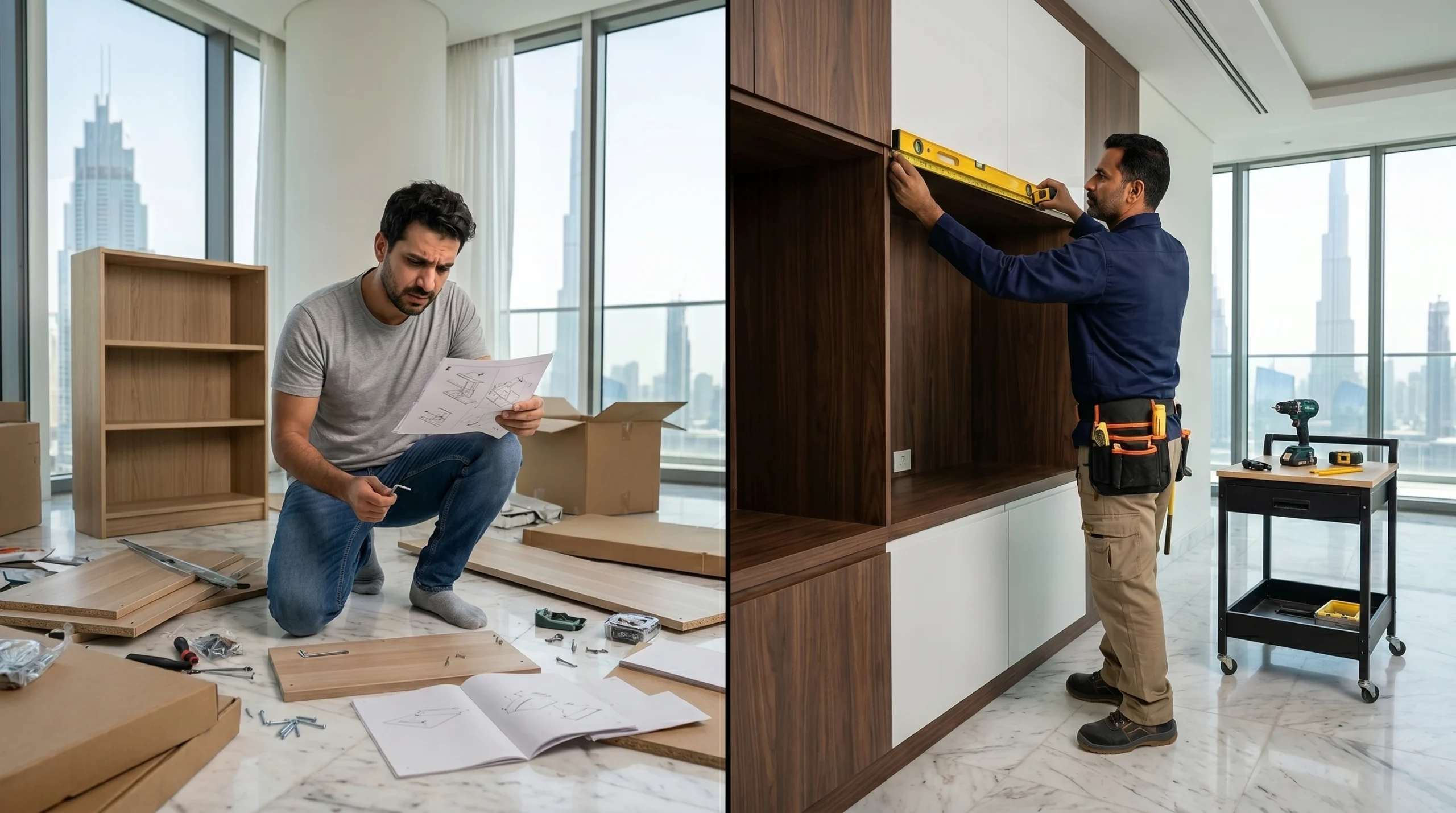
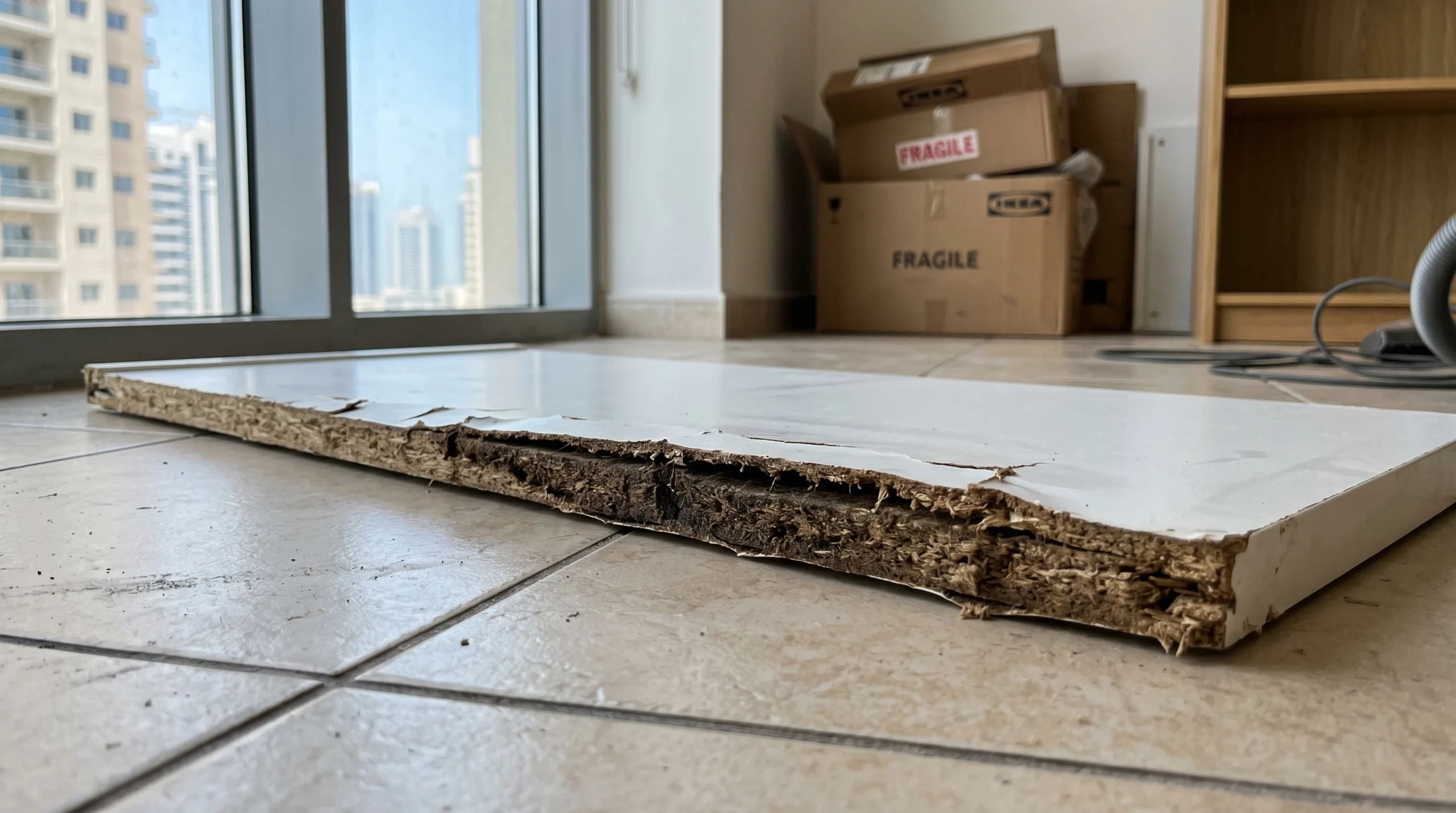
Here is the question we hear constantly at Karnak, and we have been hearing it for 35 years. A homeowner in Dubai Marina calls us after spending a weekend trying to build a wardrobe from a flat-pack kit. The doors hang crooked, two panels split, and the whole unit wobbles. By the time they call, they have already lost a weekend, damaged AED 1,400 worth of furniture, and they still have no wardrobe. Whether you are moving into a newly registered property found via the Dubai Land Department or simply upgrading your current space, DIY assembly can quickly turn into a headache. We have completed over 10,000 projects across the UAE since 1988, and this particular story has dozens of variations. Sometimes the ending is a simple fix. Sometimes it means starting over completely.
This guide is not a sales pitch for hiring us. Genuinely. Some carpentry tasks in a Dubai home are perfectly suited for a confident DIY approach, and we will tell you exactly which ones. Others will cost you significantly more money if you attempt them without professional help. Knowing the difference is what this post is about.
Understanding the Dubai Context First
Before you decide anything, you need to understand something about doing carpentry work in the UAE that most generic home improvement guides miss entirely. Dubai is not London or Toronto. The environment here is actively hostile to wood, and it changes the rules of the game.
The humidity in Dubai swings between roughly 30% in the dry winter months and above 90% during the summer. That range causes wood to expand and contract more dramatically than in almost any temperate climate. Solid wood that fits perfectly in February can be visibly warped or binding by July. MDF, which is the material inside most flat-pack furniture sold here, absorbs moisture and swells. Kitchens and bathrooms face the worst of it. We have seen brand-new kitchen cabinet doors installed by homeowners in March that were bowing outward by September, not because of poor materials, but because the gaps and tolerances needed for Dubai were not accounted for during installation.
Factor of dust
Fine desert dust infiltrates everything here, including hinges, drawer slides, and any mechanical component you install. Hardware that works perfectly on installation day can start sticking within months if it is not the right grade or is not properly sealed during fitting.
Most Dubai homes are in apartment buildings or gated communities with specific fit-out regulations
RERA guidelines, building management rules, and developer specifications govern what you can drill into, what you can fix to walls, and how noise-producing work must be scheduled. These are not suggestions. Getting this wrong can result in fines, forced removal of work, or problems when you eventually sell or hand back the property.
None of this means you should not touch a hammer in your Dubai home. It means you need to factor in the climate and the regulatory environment before you decide what to take on yourself.
What DIY Carpentry Actually Makes Sense in Dubai
Let us be specific, because vague advice helps no one. There is a real category of carpentry work that a reasonably practical person can handle well in a Dubai home, and it does not require professional help.
Flat-Pack Assembly for Simple Items
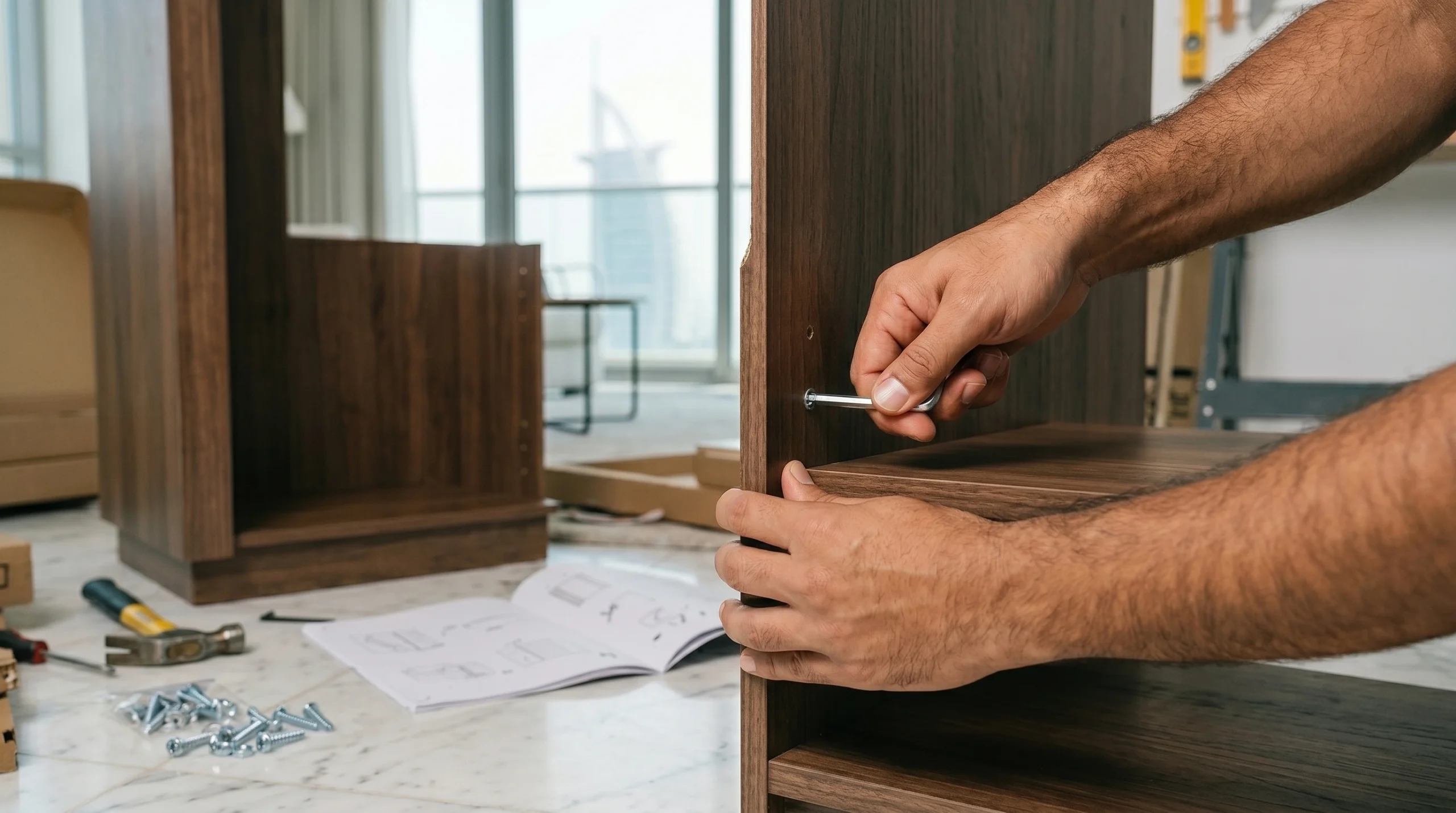
Assembling flat-pack furniture from IKEA, HOMES R US, or similar retailers is genuinely DIY territory for most pieces. Shelving units, simple bed frames, basic office desks, side tables, and small storage units are designed for self-assembly, and the tolerances built into them account for a range of environments. If you can follow diagrams, have two hours, and a basic toolkit including a rubber mallet, a screwdriver set, and a level, you can assemble these items competently.
Where this stops working is with larger, heavier flat-pack items. IKEA PAX wardrobes, for example, are manageable but genuinely need two people and a careful approach to wall fixings. In Dubai apartments, most walls are either reinforced concrete or hollow partition walls, and the difference matters enormously for which rawl plugs you need and how much weight your fixings will safely hold. If you are not confident identifying wall types and selecting appropriate fixings, that PAX wardrobe may come off the wall the first time someone leans on it. We have re-fixed a considerable number of them.
Replacing Simple Hardware
Swapping out door handles, drawer pulls, cabinet knobs, or basic hinges is well within DIY territory. This is low-risk, low-cost work. If you strip a screw hole or pick the wrong size, the fix is easy and inexpensive. Buy quality hardware, match the existing hole spacing, and you are fine. Hettich, Blum, and Grass are the brands we use professionally and they are available at hardware suppliers in Al Quoz industrial area for less than you pay at retail.
Basic Wall Shelving
Installing a small floating shelf or a simple bracket shelf in a concrete wall is a reasonable DIY project if you own or can borrow a good hammer drill. The key requirement is using the correct masonry bits and proper concrete rawl plugs, not the plastic ones that come in cheap hardware sets. Dubai concrete is hard, often reinforced, and it needs the right equipment. Rent a decent SDS drill if you do not own one. The AED 50 per day rental cost is worth it compared to damaged walls or insecure fixings.
Touch-Up Repairs and Minor Fixes
Re-tightening loose hinges, adjusting cabinet doors that have drifted out of alignment, filling small holes before repainting, or re-gluing a loose joint on a piece of furniture. These are all sensible DIY tasks. They require patience more than skill, and the cost of getting them slightly wrong is low.
When Professional Carpentry Is Not Optional
This is where we need to be direct with you, and where 35 years of seeing projects go wrong gives us a clear picture of what costs homeowners the most money.
Custom Fitted Furniture
Wardrobes, kitchen cabinets, TV units, and storage solutions that are built to fit a specific space are not flat-pack projects. A custom wardrobe running floor to ceiling in an Emirates Hills villa or a kitchen fit-out in a JBR apartment requires precise measurements, proper material selection for the UAE climate, and installation techniques that account for walls that are rarely perfectly plumb or square.
We have measured thousands of supposedly identical apartments in the same building and found variations of up to 15mm in room dimensions between floors. A wardrobe designed at home on paper without proper survey measurements will not fit. And unlike a flat-pack unit you can return, custom-built furniture cut to wrong dimensions is a loss.
Beyond measurement, there is the question of material specification. For Dubai’s climate, internal wardrobe carcasses need to be built from moisture-resistant board with the correct core density. The backs need proper ventilation gaps. Door hardware needs to be a minimum grade to handle the temperature swings in rooms that are air-conditioned and then left for holidays. Getting these specifications wrong does not cause immediate failure, but it causes failure within two to four years, which we have seen repeatedly on jobs where we were called in to replace work done by others.
Kitchen Carpentry and Cabinet Installation
A kitchen is probably the highest-stakes carpentry environment in any home. You have water, heat, steam, and heavy daily use all happening in one space. Kitchen cabinet installation requires precise levelling across uneven floors, proper scribing to uneven walls, correct clearances around appliances, and integration with plumbing and electrical that must meet UAE codes. If you under-cut a cabinet panel to fit over uneven tiling and leave a gap, that gap becomes a moisture and cockroach entry point. If your upper cabinets are not properly fixed into structural walls, they can fail with serious consequences.
The cost of professional kitchen carpentry in Dubai currently ranges from AED 15,000 for a modest apartment kitchen to AED 80,000 and above for a large villa kitchen in solid wood or premium lacquered finishes. Yes, that is a significant investment. But a failed DIY kitchen refit that needs professional remediation costs more than doing it right the first time, because you pay for the failed attempt and then pay again for the correct installation.
Structural and Load-Bearing Work
Any carpentry that involves your home’s structural elements requires a professional, and in many cases requires a permit. This includes building new internal partitions, modifying door or window frames, installing mezzanine platforms, or any work that touches the building fabric. In Dubai, unauthorized structural modifications are a serious compliance issue. If you sell your property and the buyer’s inspection finds unauthorized work, you face forced remediation at your cost. We have been called to correct exactly this situation for clients in Arabian Ranches and Business Bay.
Staircase Modification or Installation
Staircases involve precise calculations for riser height, tread depth, and handrail height that are governed by UAE building standards. Get these wrong and you have a safety issue, not just an aesthetic one. This is professional work without question.
Anything Involving Wood Veneers or Solid Hardwood
Working with solid hardwood or real wood veneer requires joinery skills that take years to develop. Cutting, joining, and finishing these materials correctly in Dubai’s climate requires knowledge of how specific species move with humidity change, what adhesives hold in high-temperature environments, and how to finish surfaces to protect against the UV levels here. If you try to work with iroko, teak, or walnut without this knowledge, you will waste expensive material and likely end up with a result that looks poor within one season.
The Real Cost Comparison: DIY vs Professional in Dubai
Money is always part of this decision, and we want to give you honest numbers rather than vague ranges.
What DIY Truly Costs
Most people calculate DIY cost as materials only. The actual calculation includes materials, tools you need to buy or rent, the value of your time, and the cost of mistakes. In Dubai, add delivery costs if you are buying timber or board materials, because you are not loading sheets of MDF into a regular car.
A simple floating shelf with hidden brackets, for example, costs roughly AED 150 to 250 in materials if you buy decent board and proper fixings. Professional installation of the same shelf would cost AED 300 to 500 depending on the carpenter. The DIY saving is real here, AED 150 to 300, and the risk is low. This is a case where DIY makes financial sense.
A fitted wardrobe is a different calculation entirely. Professional supply and installation of a quality two-meter, floor-to-ceiling wardrobe in Dubai currently runs between AED 3,500 and AED 8,000 depending on material and finish. If you try to source and build this yourself, competent materials will cost AED 1,800 to 3,000, plus tools if you do not own them, plus the time investment of a full weekend or more. The financial gap narrows significantly, and that gap disappears entirely if you make even one significant measurement or cutting error.
Professional Carpentry Rates in Dubai, 2026
For context, here are current approximate day rates and project costs you should expect from reputable carpenters in Dubai:
Skilled finish carpenter: AED 400 to 600 per day Basic carpentry and assembly work: AED 250 to 400 per day Kitchen cabinet supply and fit (mid-range): AED 20,000 to 45,000 Bedroom fitted wardrobes per linear meter: AED 1,200 to 2,500 Custom TV unit, mid-size: AED 3,500 to 7,000 Door installation, including frame: AED 800 to 1,500
Be cautious of rates significantly below these figures. Dubai has a large informal carpentry market where workers without proper trade credentials or insurance offer very low prices. We regularly see the results. Some of the work is fine. Much of it is not, and when it fails, you have no recourse.
The Hidden Cost of Remediation
The job category that costs the most is remediation, fixing someone else’s failed attempt. This is true whether that someone is an unqualified low-cost worker or a homeowner who attempted something beyond their skill level. Remediation almost always costs more than the original professional job would have, because we are working around existing mistakes, removing failed materials, and often repairing damage caused by the failed attempt. The average remediation project we take on costs the client 40 to 60 percent more than the original job would have cost done correctly.
Common Mistakes We See Every Year
After 10,000 plus projects, patterns emerge. These are the mistakes we see most consistently.
Mistake 1: Underestimating UAE Wood Movement
A client in Jumeirah installed solid wood floating shelves himself in November. They looked excellent. By the following August, the shelves had cupped noticeably and two of the wall fixings had partially pulled because the wood expansion had put stress on them. He had used timber without allowing it to acclimatize to the interior humidity level first, and had not left the expansion gaps needed at fixing points. The fix required new fixings, some wall repair, and re-finishing the shelves. Acclimatizing timber indoors for at least five to seven days before installation and leaving proper expansion gaps at fixing points is standard practice here, but it is not mentioned in any generic DIY guide.
Mistake 2: Using the Wrong Wall Fixings
Dubai apartment walls are not consistent. One wall in your apartment might be 200mm reinforced concrete. The next might be a 75mm metal stud partition with plasterboard facing. The fixing required for each is completely different. We have seen heavy shelves fall, cabinets pull away from walls, and curtain poles collapse because someone used a plastic cavity anchor in what they thought was a solid wall or, equally common, drilled too shallow into concrete and got fixing pull-out. Before you fix anything significant to a Dubai wall, identify the wall type. Knock and listen, use a stud finder, or ask someone who knows.
Mistake 3: Buying Cheap Hardware
Dubai has a range of hardware suppliers from budget markets in Deira to quality trade suppliers in Al Quoz. The price difference between a budget cabinet hinge and a Blum or Hettich equivalent is perhaps AED 8 per hinge. Over the lifespan of a kitchen or wardrobe, the difference in performance is enormous. Budget hinges in Dubai’s climate lose their adjustment within two to three years. Quality European hardware lasts decades. We have serviced Blum hinges on kitchens we installed in the 1990s that still work perfectly. Buy good hardware once.
Mistake 4: Skipping the Survey
For any fitted or custom carpentry, the single most important step is accurate measurement of the actual space, not the architectural drawing. Drawings are often not updated to reflect as-built conditions. Floor-to-ceiling heights vary across a room. Walls bow. Floors are not level. A client in Al Barsha asked us to quote based on his own measurements for a home office fit-out. When our carpenter surveyed the space, the actual dimensions differed from his measurements in ways that would have made his planned layout impossible. Spending 30 minutes doing a thorough survey with the right tools saves significant cost and rework.
Mistake 5: Ignoring Ventilation Behind Furniture
This applies particularly to wardrobes built into alcoves or against exterior walls in Dubai. Without adequate ventilation gaps, moisture condenses behind the furniture and causes mould on both the wall and the back of the unit. We specify minimum 25mm gaps behind all floor-to-ceiling furniture against external walls, and solid backs on wardrobes are always better than open backs in Dubai. If you are building fitted furniture yourself, this is a detail to incorporate from the start.
Mistake 6: Attempting Complex Joinery Without Experience
Dovetail joints, mortise and tenon, complex miters on architraves and skirting. These are skills. They look simple in YouTube videos filmed in temperature-controlled workshops in Northern Europe or North America. In Dubai, you are often working in a space that is not yet air-conditioned, in summer heat, with materials that are responding to humidity. Getting clean joints requires practiced hand skills or good machinery, not enthusiasm. If you want joined furniture that looks professional, either develop the skills over time on low-stakes projects or commission the work.
How to Evaluate Your Own DIY Readiness Honestly
The question is not just whether a task is technically DIY-appropriate. It is whether you specifically are ready to do it. Here is a practical framework we would apply if we were advising a friend.
Ask These Four Questions Before You Start
First, have you done something similar before and been satisfied with the result? Experience is the most honest predictor of outcome. If you have never used a hammer drill before, a major wall fixing project is not the place to start in a Dubai apartment where drilling errors can be expensive to repair.
Second, do you have the right tools, not just tools? A cheap drill from a supermarket, a set of basic screwdrivers, and a tape measure are not the right tools for most meaningful carpentry tasks. You need quality measuring tools, the right drill for the surface, appropriate bits, and proper safety equipment. If you are going to buy significant tooling for a one-off project, the cost may exceed professional labor.
Third, what is the cost of failure? A cosmetic shelf in a spare bedroom is low stakes. A fitted wardrobe in a master bedroom, or any kitchen work, is high stakes. Scale your risk tolerance accordingly.
Fourth, is this permitted work? In Dubai, certain modifications require NOC from your building management or developer. Some require municipality permits. If you do not know whether your project requires permission, find out before you start. We can advise you on this for projects we handle, and any competent carpenter or fit-out contractor in Dubai can guide you through the process.
Expert Tips From 35 Years of UAE Carpentry
These are the things we tell people who ask us directly for advice. Not sales points. Practical knowledge from decades in the trade here.
Acclimatize your materials.
Any timber or board product you bring into a Dubai interior should sit in that environment for at least five days before you work with it. This applies to professionals too. We acclimatize materials on every project we do. It is not optional here.
Buy hardware from trade suppliers, not supermarkets.
Al Quoz has multiple quality trade hardware suppliers. The products are the same grades we use on professional projects. You pay less than retail, and the quality is significantly better than what is on the shelf at general hardware stores.
Never skip the level.
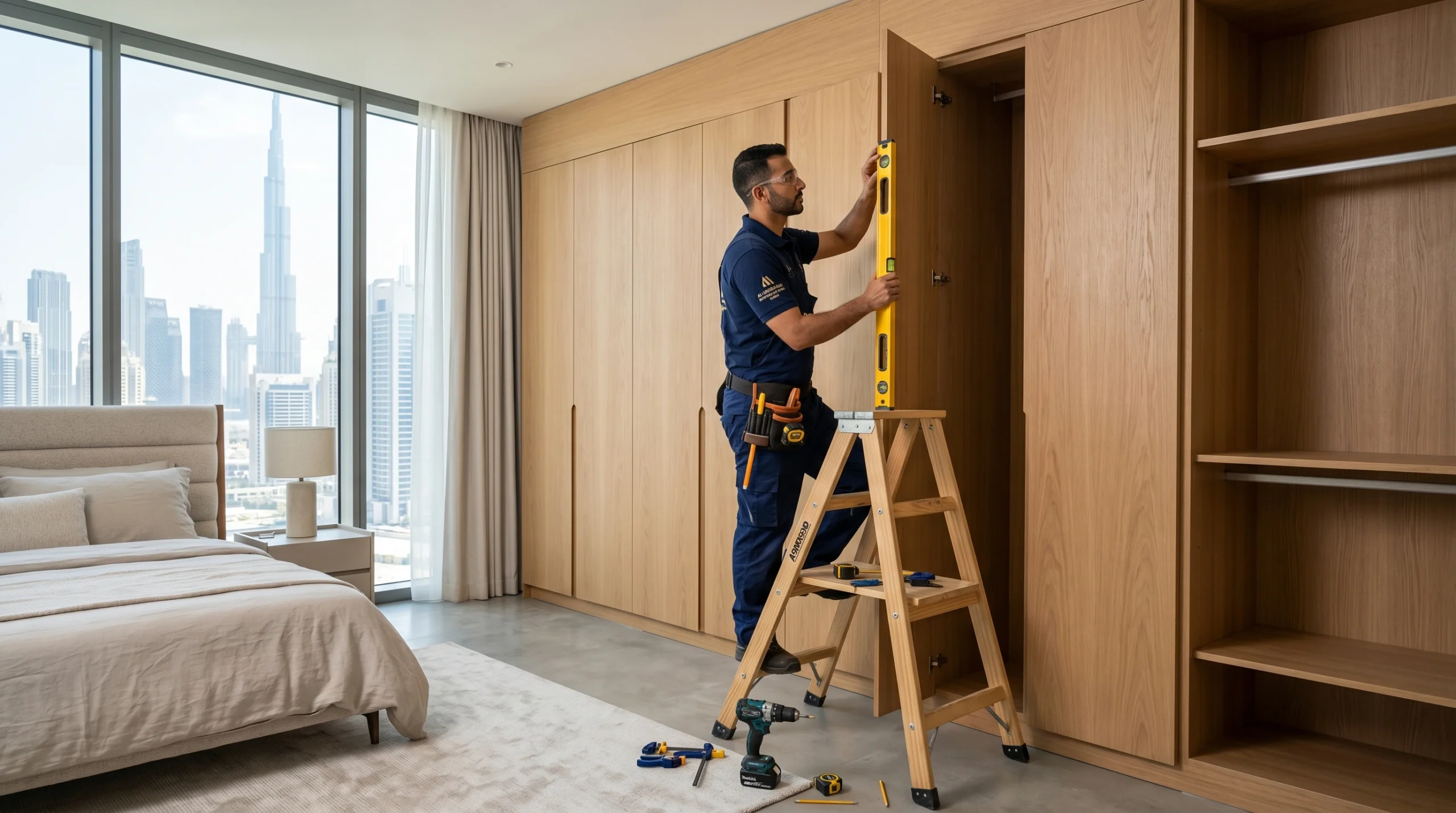
In Dubai, nothing is truly level or plumb. Buildings settle, floors have screed laid over them at varying thicknesses, walls are plastered to differing tolerances. If you assume anything is level or square without checking, you will build errors into your work from the start.
Seal cut edges of any MDF immediately.
If you are cutting or trimming MDF panels, seal the exposed edges with PVA or dedicated edge sealer before they are exposed to Dubai air. Unsealed MDF edges in a humid environment absorb moisture visibly within weeks.
Match your wood species to your use.
Teak and iroko handle UAE humidity change well. Pine does not, and it is sold widely in Dubai. For exterior or semi-exterior applications, material selection is critical. For indoor furniture that stays in air-conditioning, more species are suitable. Ask before you buy.
Get two professional quotes and one honest reference.
If you are hiring a carpenter for significant work, get at least two detailed written quotes and ask each contractor to show you a completed project you can visit. Dubai has excellent carpenters and carpenters who produce poor work at similar price points. Seeing finished work is the only reliable quality indicator.
Document everything before your fit-out.
Before any carpenter starts work in your Dubai home, photograph every wall surface, floor area, and ceiling junction involved in the project. This protects both you and the contractor if disputes arise about pre-existing damage. We ask for this on every project.
Choosing the Right Carpenter in Dubai: What to Look For
If your project falls into the professional category, here is what distinguishes carpenters worth hiring from those who will cost you more in the long run.
Established presence matters. A carpenter or joinery company that has been operating in the UAE for years has skin in the game. They rely on reputation. They know the building regulations, the climate conditions, and the specific challenges of working in Dubai’s various property types, from 1980s villas in Jumeirah to modern tower apartments in Downtown Dubai.
Ask specifically about material sourcing. Good carpenters in Dubai can tell you exactly where their materials come from, what core density their board products are, and what hardware brands they use. Vague answers or “whatever is available” responses are a warning sign.
Written quotes with specifications matter enormously. A quote that says “supply and fit wardrobe, AED 5,000” tells you almost nothing. A professional quote specifies the materials, dimensions, hardware brands, installation method, and inclusions or exclusions. The detail in a quote reflects the professionalism of the operation.
Ask how they handle UAE climate in their work. A seasoned professional will be able to speak specifically about acclimatization, expansion gaps, moisture-resistant materials, and ventilation. A carpenter who gives you a blank look at these questions has not been doing quality work in this climate long enough.
Finally, warranty terms. Karnak provides a written warranty on all projects. Any professional carpentry operation in Dubai should be able to offer at least a one-year workmanship warranty. Ask for it in writing before you sign.
Conclusion: Making the Right Call for Your Project
The honest answer to DIY vs professional carpenter in Dubai is not a single answer. It is a project-by-project decision based on the task complexity, your actual skills and tools, the stakes of failure, and the climate realities of the UAE.
Simple assembly, minor hardware replacement, basic shelf installation, these are reasonable DIY territory for a capable homeowner with the right tools and a realistic sense of their own ability. Custom fitted furniture, kitchen carpentry, any structural work, anything involving solid hardwood or veneer finish, these are professional work in Dubai, not because homeowners lack the intelligence to attempt them, but because the margin for error is low and the cost of mistakes is high.
What we have learned in 35 years here is that the most expensive projects we take on are rarely the complex ones. They are the ones where someone started down the wrong path and had to call us to fix it.
Key Takeaways:
- DIY is appropriate for flat-pack assembly, basic hardware replacement, and simple shelf installation with the right tools and fixings.
- Professional carpentry is necessary for all custom fitted furniture, kitchen work, structural modifications, and hardwood or veneer projects.
- Dubai’s climate creates specific challenges for wood, including expansion, moisture absorption, and hardware wear, that require professional knowledge to address correctly.
- The cost difference between DIY and professional narrows significantly on medium-complexity projects once materials, tools, time, and risk of failure are factored in.
- Choosing a professional carpenter in Dubai means checking established track record, material specifications, detailed written quotes, and warranty terms.
Need Expert Help?
Karnak Carpentry has been working in homes and commercial spaces across Dubai and the UAE since 1988. Our team has completed over 10,000 projects, from simple cabinet repairs to complete villa fit-outs. If your project is beyond comfortable DIY territory, or if you are simply not sure, we offer a free consultation at your property. We will tell you honestly what the project requires, whether that means you hiring us or handling it yourself.
Contact: +971-52-5554207 | info@karnakcarpentry.com
Frequently Asked Questions About DIY vs. Professional Carpentry in Dubai
Should I choose DIY carpentry or hire a professional carpenter?
Choose DIY for simple repairs, basic shelving, or small decorative projects if you have the right tools and experience. Hire a professional carpenter for custom furniture, built-in wardrobes, kitchens, flooring, doors, and structural woodworking that requires precision.
Which carpentry projects are suitable for DIY?
Simple floating shelves, furniture assembly, picture frames, minor wood repairs, sanding, painting, and basic storage units work well as DIY projects. These tasks require fewer specialized tools and lower technical expertise.
When should I hire a professional carpenter?
Professional carpenters deliver the best results for custom kitchens, built-in wardrobes, TV units, wall paneling, staircases, wooden flooring, office furniture, pergolas, and large renovation projects where accuracy matters.
Can DIY carpentry save money?
DIY projects can reduce labor costs for straightforward jobs. Material waste, incorrect measurements, and purchasing specialized tools can quickly eliminate those savings on more complex work.
Why do professional carpenters achieve better results?
Experienced carpenters combine technical knowledge, precision tools, quality materials, and years of practical experience to deliver accurate measurements, strong construction, and high-quality finishes.
Which tools do professional carpenters use?
Professionals rely on CNC machines, table saws, laser measuring devices, routers, planers, edge banding machines, nail guns, and precision cutting equipment to produce consistent results.
Can I build a custom wardrobe as a DIY project?
Building a custom wardrobe requires accurate measurements, specialized tools, and advanced woodworking skills. Most homeowners achieve better long-term results by hiring an experienced carpenter for this type of project.
Does professional carpentry increase property value?
Custom-built furniture, premium kitchens, fitted wardrobes, and quality woodwork enhance interior appeal and improve the overall value of many Dubai properties.
Which option takes less time?
Professional carpenters usually complete projects much faster because they work with experienced teams, efficient production methods, and specialized equipment. DIY projects often require additional time for learning, adjustments, and corrections.
What risks should I consider before starting a DIY carpentry project?
Incorrect measurements, poor material selection, unsafe tool handling, weak joints, and costly mistakes can affect both appearance and durability. Proper planning reduces these risks but cannot replace professional expertise on complex projects.
Can professional carpenters customize furniture for my home?
Yes. Skilled carpenters design furniture around your room dimensions, storage needs, preferred materials, finishes, and lifestyle to create solutions that standard furniture cannot match.
Which option offers better long-term durability?
Professionally built furniture generally lasts longer because experts use premium materials, strong joinery techniques, accurate installation methods, and high-quality hardware.
Should beginners attempt furniture-making projects?
Beginners should start with simple woodworking projects before attempting custom furniture. Basic experience builds confidence and develops essential skills for more advanced work.
How do I choose the right carpenter in Dubai?
Review completed projects, compare material specifications, verify experience, inspect workmanship, request transparent quotations, and confirm warranty coverage before hiring a carpenter.
Which choice provides the best value for most homeowners?
DIY works well for small projects with limited complexity, while professional carpentry delivers better value for custom furniture, permanent installations, and projects that demand precision, durability, and premium craftsmanship.