
Blog
Built-In vs. Freestanding Wardrobe in Dubai: Which One Actually Works for Your Home?

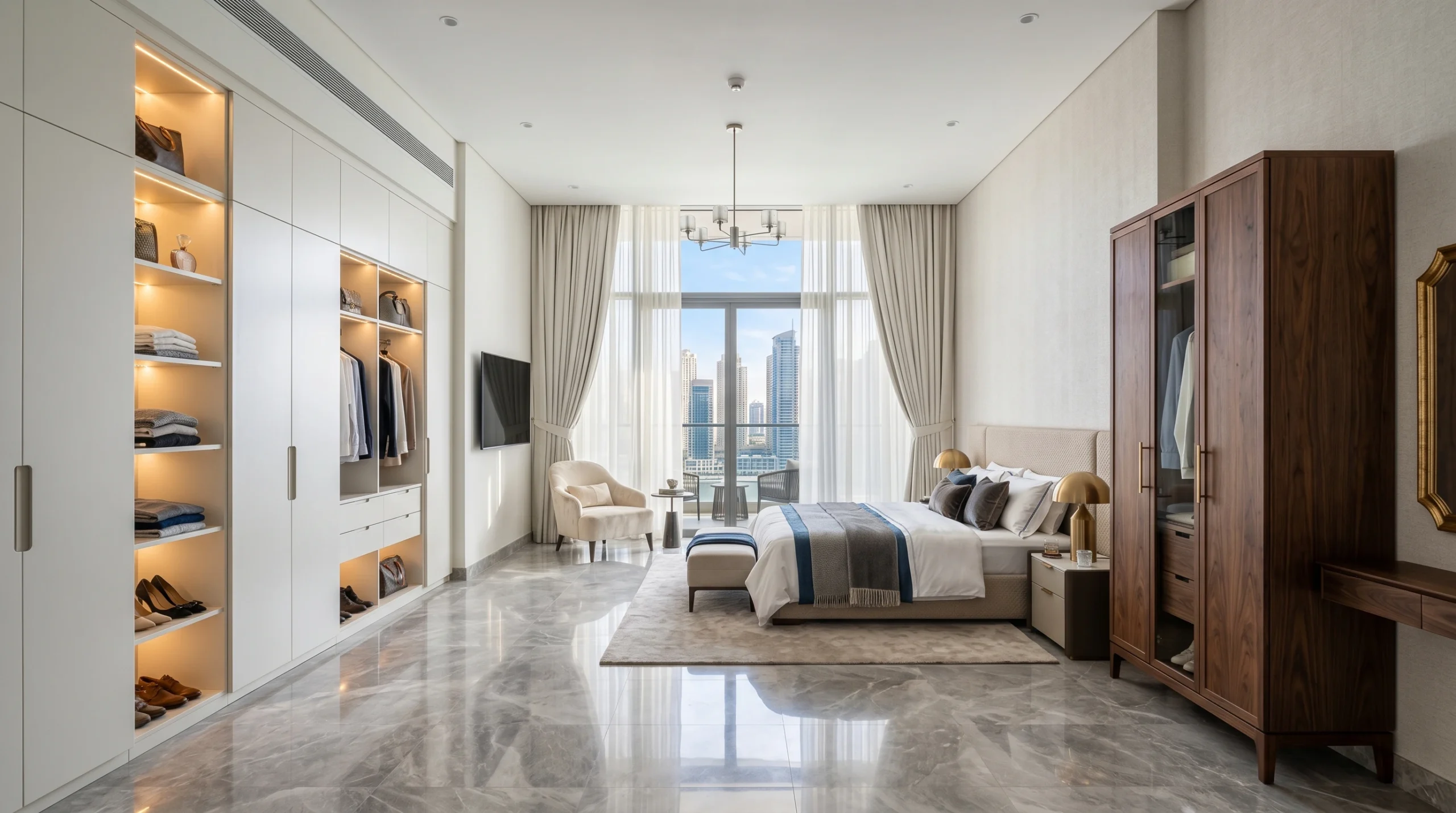
Every week, someone calls our workshop with a version of the same question. They have just moved into a new apartment in Dubai Marina, or they are renovating their villa in Emirates Hills, and they want to know: should they go built-in or freestanding? It sounds like a simple question. After 35 years and more than 10,000 wardrobe projects across the UAE, we can tell you it is anything but simple.
The right answer depends on your building type, your lease situation, Dubai’s humidity, the room’s dimensions, your budget, and whether you plan to stay long-term. Get it wrong and you either spend money on a beautiful fitted wardrobe you cannot take with you when you leave, or you buy a freestanding unit that warps, wobbles, and fails within two summers because it was never designed for Gulf conditions. This guide gives you the honest, experience-based breakdown so you can make the right call for your specific situation.
Understanding What You Are Actually Choosing Between
Before you compare costs or aesthetics, it helps to understand what each option genuinely is, because the marketing language around wardrobes in Dubai can be misleading.
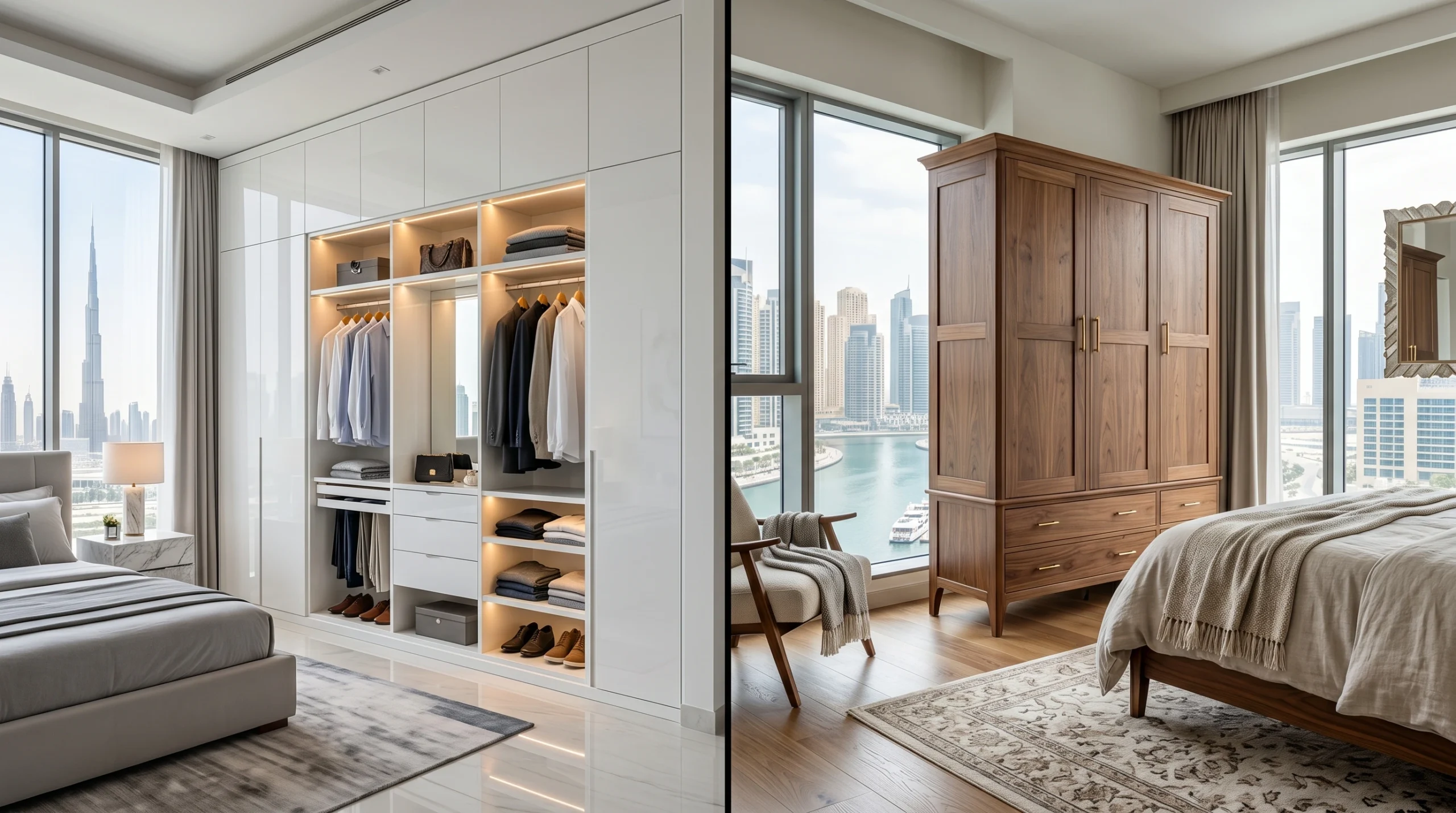
A built-in wardrobe, also called a fitted wardrobe, is constructed in place. It is fixed to the walls, ceiling, and sometimes the floor. The carpenter works inside your room, takes measurements to the millimeter, and builds a unit that becomes part of the architecture. It uses the full height of your room, fills awkward corners, and when done well, looks like the room was always designed with it. Built-ins are permanent. They add to the property’s value. They also require skilled craftsmen, proper materials, and more time to complete.
A freestanding wardrobe is furniture. It arrives as a finished piece, you place it in the room, and it stands on its own. Simple wardrobes are flat-pack. Better ones come fully assembled. Premium freestanding wardrobes are solid wood, handcrafted pieces that are genuinely beautiful. The key distinction is this: a freestanding wardrobe is movable. You can take it with you.Add You can sell it. You can rearrange your bedroom.
Neither is universally better. Both have served thousands of Dubai families very well. The question is which one serves your situation.
Why Dubai’s Conditions Change Everything
Most wardrobe guides online are written for European or American homes. They talk about humidity and climate in passing. In Dubai, these factors are not a footnote. They are a deciding factor, and ignoring them is how you end up with a wardrobe that has swollen shut by August or developed mold along the base by the following spring.
The Humidity Factor Is Not Subtle
Dubai’s humidity regularly hits 80 to 95 percent during summer months. Between June and September, the air inside apartments that are not perfectly climate-controlled carries enough moisture to affect wood movement significantly. Poorly sealed MDF will swell. Particleboard, which is used in many budget freestanding wardrobes, absorbs moisture and deteriorates from the inside. You will not notice it immediately. You will notice it in year two or three when the drawers stop closing properly or the base starts to discolor.
This is not a problem unique to cheap furniture. We have seen expensive European freestanding wardrobes, units that cost 25,000 AED or more, develop issues in Dubai apartments that were not consistently air-conditioned. The material specification matters enormously here.
For built-in wardrobes, the advantage is that we seal every join, prime every surface, and specify materials based on what actually performs in Gulf conditions. Marine-grade MDF, moisture-resistant melamine, and proper lacquer finishes are standard in any built-in we construct. With freestanding units, you are at the mercy of what the manufacturer chose to use, often decided for a temperate European climate.
Floor-to-Ceiling Height Is a Real Opportunity
Dubai apartments and villas tend to have generous ceiling heights. Three meters is common. Some Discovery Gardens and Business Bay apartments have lower ceilings at 2.6 meters, while villas in Jumeirah and Arabian Ranches regularly hit 3.2 meters or more. In a standard European home, a 2.1-meter wardrobe reaches close to the ceiling. In a Dubai bedroom, it leaves 60 to 90 centimeters of dead space above the unit that collects dust and is impossible to use productively.
A built-in wardrobe eliminates that gap entirely. We build to your exact ceiling height, give you storage all the way up, and either fit sliding access panels for the upper zone or design that area for seasonal or infrequently accessed items. Over a three-meter run of wardrobe, this difference translates to roughly 30 to 35 percent more usable storage. For families in Dubai who often have large wardrobes but limited bedroom square footage, that gain is significant.
Air Conditioning Placement Affects Your Decision
This one surprises a lot of clients. In many Dubai apartments and villas, AC units are positioned on walls or near ceilings in ways that direct airflow across specific parts of a room. If a freestanding wardrobe blocks an AC vent, you create warm pockets in the room and uneven cooling. If it stands directly under a ceiling duct, you get moisture condensation on the top surface.
When we design a built-in wardrobe, we always map the room’s HVAC layout first. We route around vents, incorporate them into the design when necessary, and ensure the finished installation does not compromise your cooling system. A freestanding unit is placed where it fits visually. This sometimes means it ends up in exactly the wrong spot thermally.
The Built-In Wardrobe Case for Dubai
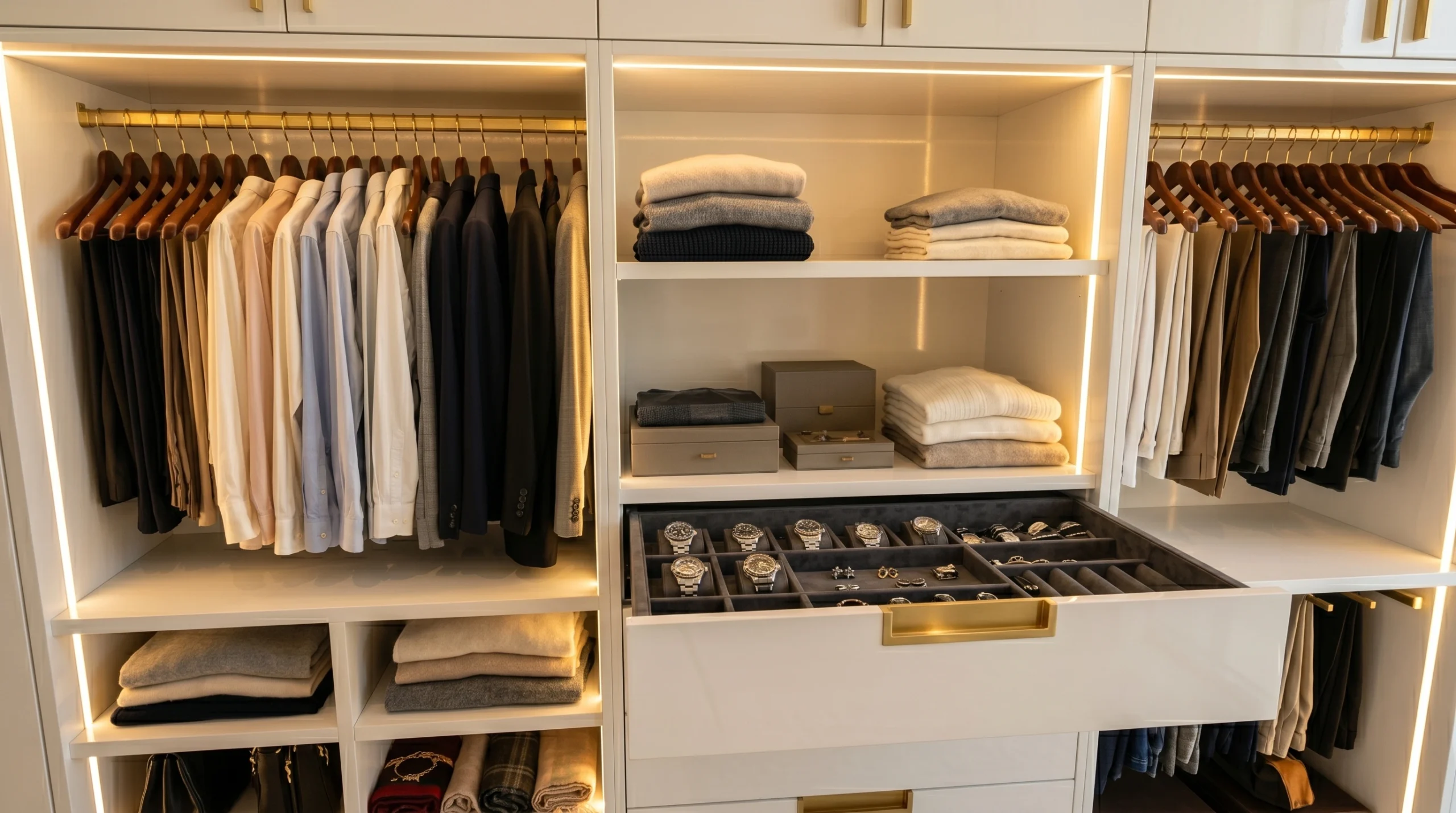
We have installed built-in wardrobes in studio apartments in JLT and master suites in Palm Jumeirah villas. The scale changes. The fundamental advantages do not.
Maximizing Every Centimeter of Space
A built-in wardrobe fits your room precisely. That sounds obvious. The implications are not. In a bedroom with an awkward alcove, a column, a beam, or a sloped ceiling near a window, a freestanding unit simply cannot work. You end up with gaps, wasted corners, and a visual awkwardness that makes a good-sized room feel poorly organized.
We worked on a project in a Mirdif villa last year where the master bedroom had a structural column interrupting what should have been a clean wardrobe wall. The homeowner had tried two different freestanding wardrobes over five years. Both left awkward gaps around the column. We built a fitted unit that incorporated the column as a design feature, running the wardrobe around it seamlessly. The result used space that had been wasted for years.
For families with children, built-ins work particularly well. We can divide the unit clearly between parents and children, adjust rail heights for kids, incorporate a homework nook into a built-in design, and add shelving exactly where it is needed without compromise. None of that is possible with a freestanding piece.
The Resale and Rental Value Argument
Landlords in Dubai know the data. Properties with quality fitted wardrobes rent faster and at higher rates. In areas like Dubai Hills, Arabian Ranches, and The Lakes, a well-designed fitted wardrobe in the master bedroom is increasingly an expectation rather than a luxury. Tenants, particularly families and professionals relocating from Europe or North America, arrive expecting built-in storage.
We have had property investors come to us specifically to fit wardrobes before listing a property. The numbers work. A built-in wardrobe installation that costs 12,000 to 18,000 AED in a mid-range bedroom can add disproportionate perceived value and reduce vacancy periods. If your property sits empty for even one extra month because a tenant chose a competing unit with better storage, you have already lost more than the wardrobe cost.
Customization That Reflects How You Actually Live
This is where built-ins genuinely earn their cost. A freestanding wardrobe comes with fixed shelves, fixed rails, and fixed dimensions. You adapt your storage habits to the furniture. A built-in wardrobe is designed around your habits, your wardrobe, your specific needs.
We ask clients a series of questions before designing anything. How many formal suits or dresses do you own? Do you fold or hang? How many shoes? Do you want a mirror integrated?. Additionally, do you want a dressing table incorporated?. Moreover, do you travel frequently and need a specific area for luggage access? Every answer changes the internal layout. The result is a wardrobe that works the way you work, not the way a product designer in Sweden imagined you might.
For clients with large clothing collections, which is genuinely common in Dubai given the social lifestyle and corporate dress expectations, this matters enormously. A standard two-door freestanding wardrobe simply cannot accommodate a Dubai professional’s wardrobe without spilling into multiple units across the room.
What Built-Ins Cost in Dubai Today
Pricing varies based on materials, size, internal fittings, and finish. To give you honest numbers based on current 2026 rates:
Basic built-in wardrobe with standard melamine finish, simple internal layout, no integrated lighting: 850 to 1,200 AED per linear meter.
Mid-range built-in with moisture-resistant MDF, soft-close mechanisms, integrated LED lighting, pull-out drawers, better hardware: 1,400 to 2,200 AED per linear meter.
Premium built-in with lacquer finish, custom veneer, German hardware (Hettich or Blum), full LED integration, mirror panels, and complex internal fittings: 2,500 to 4,500 AED per linear meter.
A typical master bedroom wardrobe runs three to four meters wide. At mid-range specification, expect to invest 15,000 to 30,000 AED for a quality fitted unit. That is real money. It is also a permanent upgrade to your property that a freestanding unit simply cannot match.
Installation time for a standard built-in wardrobe is typically five to seven working days from measurement to completion. Complex projects with lacquer finishes or extensive joinery can run ten to fourteen days.
The Freestanding Wardrobe Case for Dubai
Built-ins are not right for every situation. If someone tells you otherwise, they are selling you something. There are scenarios where a quality freestanding wardrobe is genuinely the better choice, and we have recommended exactly that to clients over the years when it made sense.
When You Are Renting and Cannot Make Permanent Changes
This is the most common and most valid reason to choose freestanding. Dubai has a substantial renting population, including many professionals on two to three-year assignments who want good storage but cannot or will not invest in permanent fixtures they must leave behind.
Some landlords in Dubai explicitly prohibit built-in installations without written permission. Many standard tenancy agreements require the property to be returned in its original condition, meaning built-ins would need to be removed at your own expense. Even if you negotiate permission to install, you are creating value for your landlord at your own cost.
For renters in this situation, a high-quality freestanding wardrobe, not a flat-pack unit but a proper solid wood or moisture-resistant engineered wood piece, is a practical choice. You invest once, take it with you, and use it in your next home. Karnak builds freestanding wardrobes for exactly this client, using the same material standards we apply to built-ins because the Dubai climate shows no mercy to cheap furniture.
Short to Medium Stay Horizons
If you know you are likely to relocate within two to three years, the calculus changes. A built-in that adds value to a property you do not own returns nothing to you personally. A quality freestanding unit that you can sell or move retains value and gives you flexibility.
This matters particularly for Dubai’s large expat community. Many professionals arrive with a genuine intention to stay long-term and end up leaving within a few years due to career changes or family reasons. If there is meaningful uncertainty about your timeline, freestanding gives you an exit option.
Properties With Awkward Situations
Occasionally we encounter properties where built-ins genuinely do not make sense architecturally. Older apartments in Deira or parts of Bur Dubai sometimes have wall surfaces that make proper installation difficult. Buildings with certain types of concrete construction create challenges for secure mounting. Properties currently undergoing phased renovation, where you know walls will change, are another case where a temporary freestanding solution makes more sense than committing to a built-in now.
What Quality Freestanding Wardrobes Cost
This is where most buyers get the comparison wrong. They compare a 3,000 AED flat-pack wardrobe to a 20,000 AED built-in and conclude built-ins are overpriced. That comparison is not valid.
A quality freestanding wardrobe that will actually perform in Dubai’s climate, made with moisture-resistant materials, proper joinery, and solid construction, starts at around 4,000 to 6,000 AED for a basic two-door unit and runs to 15,000 to 25,000 AED for a large, premium solid wood piece.
Flat-pack and budget freestanding wardrobes from mass-market furniture retailers are generally not suitable for Dubai as a long-term solution. The particleboard components absorb moisture, the cam-lock fittings loosen over time, and the finish deteriorates in air-conditioned rooms where temperature cycling causes material expansion and contraction repeatedly. You may get two or three years from a budget unit before it needs replacing.
Comparing Them Side by Side Across What Actually Matters
Space Efficiency
Built-in wins clearly. A built-in wardrobe in a 3.2-meter ceiling room uses every centimeter from floor to ceiling, wall to wall, and around every obstacle. A freestanding unit leaves gaps above, beside, and occasionally below that accumulate dust and reduce effective storage. In a Dubai bedroom where square footage is expensive and often limited, this matters.
Verdict: Built-in.
Climate Performance
Both can perform well if specified correctly. The edge goes to built-in because every material decision is made with UAE conditions specifically in mind, every join is sealed properly, and the unit is not relying on factory construction methods designed for temperate climates. High-quality freestanding wardrobes with correct material specification can match this, but you need to verify carefully before purchasing.
Verdict: Built-in, if both are quality products.
Flexibility and Portability
No contest. Freestanding wins entirely. You can take it with you, rearrange it, sell it, or adapt it. A built-in is there when you buy it or rent the property, and it goes with the property when you leave.
Verdict: Freestanding.
Initial Investment Required
For equivalent quality and storage capacity, built-ins typically cost more upfront. You are paying for skilled labor, site work, custom fabrication, and a permanent installation. Freestanding is lower upfront cost for equivalent volume, though not necessarily for equivalent quality.
Verdict: Freestanding for lower upfront cost.
Long-Term Value
If you own the property, a quality built-in wardrobe adds real value. Dubai property buyers notice good joinery. A master bedroom with a well-designed fitted wardrobe photographs better, shows better, and appeals to tenants and buyers. A freestanding wardrobe adds no structural or resale value to the property.
Verdict: Built-in for property owners.
Installation Disruption
A built-in wardrobe means several days of carpentry work in your home. Dust, noise, workers on-site, and a bedroom potentially out of use. A quality freestanding unit can be delivered and placed in a day, sometimes a few hours.
Verdict: Freestanding for convenience.
Aesthetic Integration
A well-designed built-in looks like it belongs. It can match your flooring, match adjacent joinery, incorporate lighting and architectural details. Even a beautiful freestanding wardrobe reads as furniture placed in a room. Both have their aesthetic merits, but for seamless integration, built-in is unmatched.
Verdict: Built-in.
Common Mistakes Dubai Homeowners Make With Wardrobes
After 10,000-plus projects, we have seen every mistake possible. Here are the ones that cost people the most money and frustration.
Mistake 1: Choosing Based on Online Photos Rather Than Your Actual Room
Instagram and Pinterest are full of beautiful wardrobe photographs taken in rooms that share nothing with your actual bedroom. A walk-in wardrobe that looks perfect in a 45-square-meter master suite in a Jumeirah villa is completely wrong for a 14-square-meter bedroom in a Business Bay apartment. Before you commit to any wardrobe style, measure your room properly, map out where the door swings, note where the AC is positioned, and understand what your actual ceiling height is. We always start here, and it changes the recommended solution nearly every time.
Mistake 2: Buying Flat-Pack Furniture for Dubai’s Climate
The largest furniture retailers in Dubai sell enormous volumes of flat-pack wardrobes. Many of these products are designed and manufactured for European conditions. The particleboard and basic MDF used in budget flat-pack units performs poorly in UAE humidity cycles. We see the results frequently when clients call us to install a built-in to replace a flat-pack unit that has deteriorated. The money spent on the flat-pack unit is gone. If a freestanding wardrobe is your choice, invest properly in moisture-resistant materials. It will cost more initially and perform for years longer.
Mistake 3: Not Considering Internal Layout Before Committing
The outside of a wardrobe is what gets photographed. The inside is what you live with daily. We have seen beautiful built-in wardrobes with poor internal layouts, just long hanging rails with no drawers, no shoe storage, no accessories organization, and unusable shelving heights. Before approving any wardrobe design, sketch your actual clothing and accessory needs. Count your suits, your folded items, your shoes, your bags. The internal layout should be derived from that inventory, not from a default template.
Mistake 4: Ignoring the Door Type Question
Sliding doors or hinged doors. This is not a style preference. It is a practical space planning decision. In a tight bedroom where the wardrobe faces the bed with limited clearance, hinged doors may be impossible to open fully. Sliding doors solve that problem but reduce access to the full wardrobe width at any one time and add mechanical components that can fail. Bi-fold doors offer a middle position. Each has appropriate use cases. Make this decision based on your room’s geometry, not based on what looks nice in a showroom.
Mistake 5: Overlooking Lighting Completely
Dubai bedrooms are often darker than equivalent bedrooms in Europe because of solar shading requirements and window placement. A wardrobe without internal lighting becomes a dark cave. You cannot see colors accurately, you miss items stored in corners, and the whole storage experience is frustrating. Integrated LED lighting in a wardrobe is not a luxury finish. It is a functional necessity, particularly in Dubai apartments where bedroom windows face interior courtyards or are covered by external screens. Budget for it from the start.
Mistake 6: Fitting a Wardrobe Before Confirming Your Tenancy Plans
This applies specifically to built-ins and specifically to renters. We occasionally receive calls from tenants who want built-in wardrobes installed without having spoken to their landlord. In some cases this leads to disputes at tenancy end, with landlords claiming restoration costs. Always get written landlord permission before any built-in installation. Always clarify in that agreement what happens to the unit at lease end. The question of whether the wardrobe remains with the property or is removed should be decided before the first nail goes in.
How to Actually Make the Decision for Your Situation
Rather than giving you a checklist, let us walk through the real decision in plain terms.
If you own your property in Dubai
A quality built-in wardrobe is almost always the better investment. You gain space efficiency, property value, climate performance, and the ability to design exactly what you need. The higher upfront cost is justified. The question becomes specification, which material, which finish, which internal layout. That is where the value is defined.
If you are renting on a short-term lease of one to two years
Invest in a quality freestanding wardrobe. Specify moisture-resistant materials, solid construction, and proper hardware. Accept that you will spend more than flat-pack prices and get something that performs and can be moved. Built-in is not your answer.
If you are renting long-term with a landlord who permits modifications in writing
A built-in becomes a reasonable option again. Many long-term tenants in Dubai have contributed to permanent improvements in a property and negotiated rental reductions or lease extensions in return. Discuss it with your landlord clearly and get everything documented.
If your property has unusual architecture
Columns, beams, sloped ceilings, irregular room shapes, built-in is almost always the answer because only a custom installation can handle those conditions properly. Freestanding furniture will always leave you with gaps and compromises.
If you are renovating a property for rental or resale
Built-in wardrobes in bedrooms are among the highest-return investments you can make. A well-fitted master bedroom wardrobe increases perceived value beyond its actual cost in most Dubai submarkets.
Expert Tips From 35 Years of UAE Wardrobe Projects
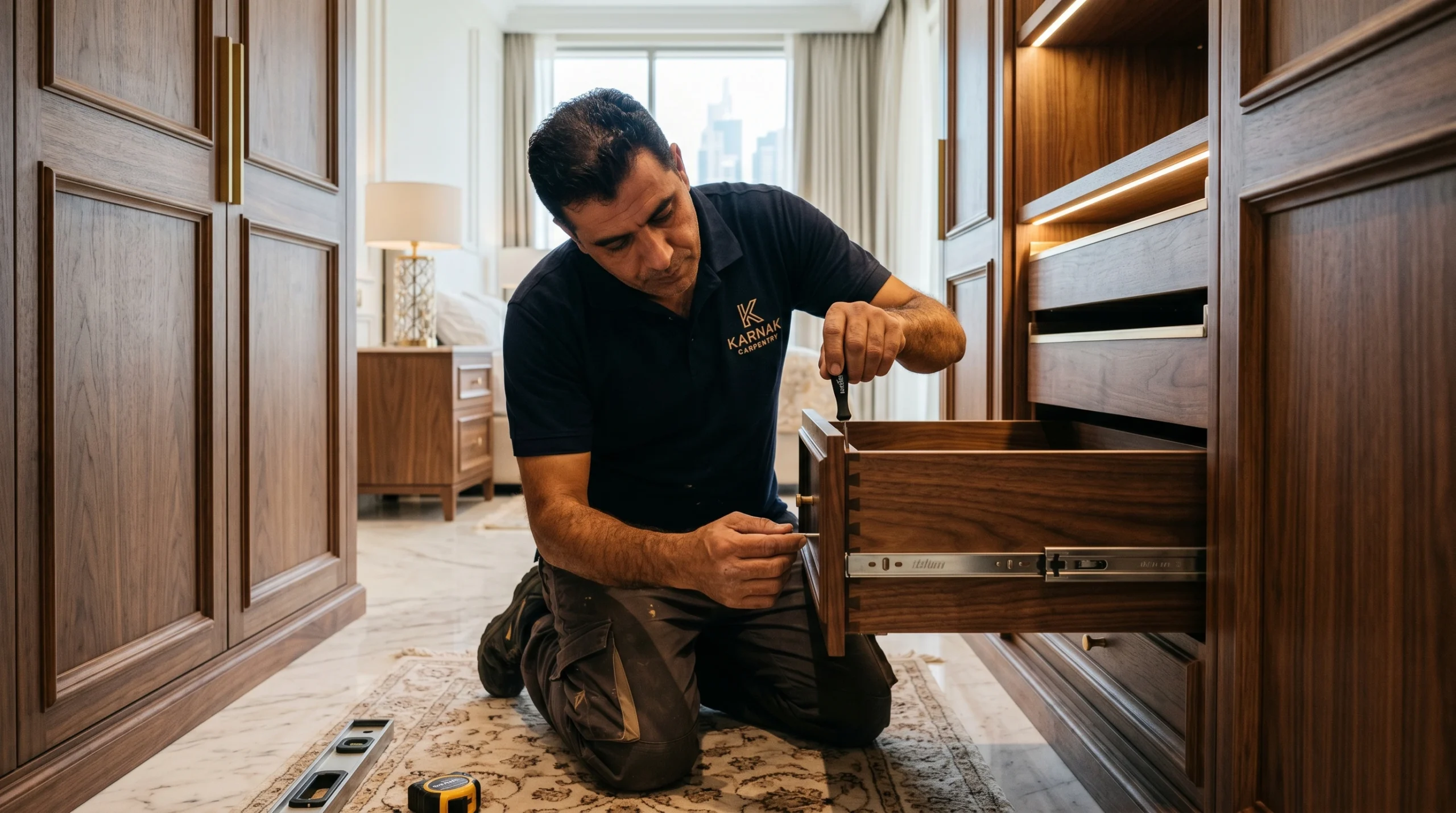
These are the things we tell clients that most guides leave out.
Specify moisture-resistant materials explicitly, not just “good quality.”
Ask your carpenter or supplier for the moisture resistance rating of every material being used. Marine-grade MDF has a specific density and treatment standard. Moisture-resistant melamine has a measurable specification. Vague claims about quality are not enough in a Gulf climate. Get specifics.
Build ten percent more storage than you think you need.
Dubai living frequently involves more clothing, accessories, and household items than people arrive expecting to need. Wardrobes that seem generous at installation often feel cramped within a year. If your budget allows any flexibility, add the extra meter of wardrobe width or the extra shelf zone. You will use it.
Address lighting in the initial design, not as an afterthought
Retrofitting LED strips into a completed wardrobe is possible but more expensive and less clean than integrating them during construction. Include lighting in your initial brief and your initial budget. Recessed LED strips along the top of the wardrobe interior and motion-sensor lights inside drawers are both practical and relatively inexpensive additions at the design stage.
Consider your floor type when specifying a freestanding wardrobe
Dubai villas often feature large-format marble or porcelain tiles, which adjustable feet on heavy furniture can easily scratch or crack. If your floor has tiles, confirm that your freestanding wardrobe has proper felt or rubber feet and sits securely on the hard, smooth surface. Some designs that work well on carpet are unstable on tile.
Plan for seasonal storage separately
In Dubai, you have winter and summer wardrobes. Thick jackets, scarves, and warm weather clothing for winter visits abroad need storage space but are not in daily rotation. Designing a dedicated seasonal zone in the upper portion of your wardrobe, behind a panel or in a clearly designated upper section, keeps your daily-use area organized and accessible.
Agree on every finish detail before work starts.
Changes to lacquer color, hardware style, or internal layout once construction has begun are expensive and time-consuming. Take the time before starting to confirm every detail in writing. Look at physical samples of all finishes in your actual room light, not in a showroom. Dubai’s light is different from showroom light, and colors can shift noticeably between contexts.
Get a dust and damage protection plan agreed before installation.
Good carpenters bring protection for floors and adjacent surfaces. This should be standard, but ask about it explicitly. Installing a built-in wardrobe generates significant dust, especially if the job requires wall preparation or cutting. You must protect the room, particularly bedrooms with carpeted floors or adjacent finishes that dust and debris can easily mark.
Conclusion: Make the Right Call for Your Situation
The built-in versus freestanding decision comes down to four things: how long you are staying, whether you own or rent, what your room demands, and what your budget allows. Neither option is universally superior. Both, done well with the right specifications for Dubai conditions, will serve you properly for years.
Built-in wardrobes deliver unmatched space efficiency, property value, and design integration. They are the right choice for homeowners, long-term renters with landlord permission, and any room with architectural complexity. Freestanding wardrobes deliver flexibility, portability, and lower disruption. They are the right choice for renters who will move, for simpler rooms, and for situations where permanence is a liability rather than an asset.
What neither option forgives is poor material specification in Dubai’s climate. Cheap materials fail. Humidity, temperature cycling, and Gulf air conditions expose every weakness in a wardrobe’s construction within a few seasons. Whether you choose built-in or freestanding, invest in materials that are specified for your actual environment.
Key Takeaways:
- Built-in wardrobes are best for property owners and long-term residents. They maximize space, add property value, and handle Dubai’s ceiling heights and architectural variations properly.
- Freestanding wardrobes suit renters and short-term residents. Choose quality materials designed for humidity resistance, not budget flat-pack options.
- Dubai’s climate is not negotiable. Moisture-resistant material specifications are essential for any wardrobe, regardless of type.
- Internal layout matters more than external appearance. Design your storage around your actual needs before committing to any configuration.
- Lighting, door type, and ceiling height utilization are practical decisions, not aesthetic ones. Make them based on your room and your lifestyle.
Need Expert Help?
Karnak Carpentry has been designing and installing wardrobes across Dubai and the UAE since 1988. With more than 10,000 completed projects in properties from compact Marina apartments to sprawling Emirates Hills villas, we have encountered every room shape, every material challenge, and every client need this market presents. We do not sell you what is easiest to build. We help you figure out what actually works for your space, your lease situation, and your budget, then we build it to a standard that performs in Gulf conditions. Our consultations are free, our measurements are precise, and our work is guaranteed.
Contact us to arrange a free in-home consultation anywhere in Dubai or the wider UAE.
Contact: +971-52-5554207 | info@karnakcarpentry.com
Frequently Asked Questions
Which wardrobe is better for Dubai apartments?
Built-in wardrobes are usually the better choice for Dubai apartments because they maximize limited space by fitting wall-to-wall and floor-to-ceiling. However, if you are renting or expect to move frequently, a freestanding wardrobe offers greater flexibility since it can be relocated easily.
Are built-in wardrobes more expensive than freestanding wardrobes?
Generally, yes. Built-in wardrobes involve custom manufacturing and professional installation, making them more expensive than standard freestanding models. However, they often provide better long-term value through increased storage capacity, improved aesthetics, and a tailored fit.
Can a built-in wardrobe be removed later?
Yes, but removing a built-in wardrobe usually requires professional dismantling and may leave behind holes, paint damage, or flooring gaps that need repair. Freestanding wardrobes can simply be moved without affecting the room.
Do built-in wardrobes increase property value in Dubai?
Quality built-in wardrobes are often viewed as a desirable feature by buyers and tenants because they improve storage and create a premium appearance. While they may not dramatically increase the property’s value, they can make a home more attractive in the competitive Dubai market.
How long does it take to install a built-in wardrobe?
A standard custom built-in wardrobe typically takes two to four weeks from design approval to installation. The installation itself usually takes one to three days, depending on the size and complexity of the project.
Can built-in wardrobes be customized to fit awkward spaces?
Yes. Built-in wardrobes are ideal for sloped ceilings, alcoves, corner spaces, and rooms with unusual layouts. They are manufactured to your exact measurements, allowing every available centimetre to be used efficiently.
Are freestanding wardrobes suitable for rental properties?
Absolutely. Freestanding wardrobes are often the preferred choice for tenants because they require no permanent installation and can be moved when relocating. They are also available in a wide range of sizes and styles to suit different budgets.
Which wardrobe type offers more storage space?
Built-in wardrobes generally provide significantly more usable storage because they eliminate wasted space above, below, and beside the unit. They can also be fitted with custom shelves, drawers, pull-out accessories, and hanging sections designed specifically for your storage needs.
What materials are best for wardrobes in Dubai’s climate?
Moisture-resistant MDF, high-quality plywood, and engineered wood with durable laminate or veneer finishes perform well in Dubai’s climate. Quality edge banding and proper installation also help protect the wardrobe from humidity and everyday wear.
How do I choose between sliding and hinged wardrobe doors?
Sliding doors work well in smaller bedrooms because they require no clearance to open. Hinged doors provide full access to the wardrobe interior and are often easier to maintain. The best choice depends on your room size, furniture layout, and personal preference.
Can internal wardrobe layouts be customized?
Yes. Most custom wardrobes allow you to personalize the interior with adjustable shelves, drawers, shoe racks, pull-out baskets, tie and belt organizers, jewelry trays, and integrated LED lighting to suit your lifestyle.
What should I consider before ordering a custom built-in wardrobe?
Measure the available space carefully, think about your current and future storage needs, choose durable materials suitable for Dubai’s climate, and work with an experienced wardrobe manufacturer who provides professional design consultation, installation, and after-sales support.
Related Articles
- How Much Does a Custom Kitchen Cost in Dubai? A Complete 2026 Pricing Guide
- Wood Finishing Options Explained: Paint, Stain, Lacquer, and Oil in the UAE
- How Long Do Carpentry Materials Actually Last in Dubai Homes?
- How to Prepare Your Dubai Home for a Carpentry Installation (The Complete Homeowner Guide)