
Blog
7 Questions to Ask Any Carpentry Company in Dubai Before Signing a Contract


Every week, someone calls us at Karnak Carpentry after a nightmare experience with another contractor. The story almost always starts the same way. They found a company online, the price looked reasonable, and they signed a contract without 7 questions to ask carpentry company in Dubai or verifying if the company follows official property and construction guidelines, such as those outlined by the Dubai Land Department. Six weeks later, the wardrobe doors were warping, the carpenter had gone quiet, and the deposit was gone.
In 35 years and more than 50,000 projects across Dubai and the UAE, Karnak Home have seen what separates a successful carpentry project from a costly disaster. It almost never comes down to bad luck. It comes down to what you asked, or did not ask, before work began.
This guide gives you exactly the right questions to ask any carpentry company in Dubai. These are the same questions we would ask if we were the client. Some of the answers you get will make you walk away. Others will confirm you have found the right partner. Either outcome is a win.
Why Hiring a Carpentry Contractor in Dubai Requires More Scrutiny Than Anywhere Else
Dubai is not a forgiving environment for carpentry. Humidity in summer months routinely hits 85 to 95 percent along the coast, and temperatures inside vehicles and during transportation can push above 60 degrees Celsius. Solid wood that was perfectly stable in a European workshop can develop hairline cracks within weeks of arriving in Dubai if it was not properly acclimatized and treated. For design inspiration on selecting robust, weather-appropriate materials, international architecture platforms like ArchDaily offer deep dives into regional design strategies that mitigate intense thermal conditions.
Add to that the pace of construction here. Dubai has thousands of active fit-out projects at any given moment, which means carpentry companies are in high demand, subcontracting is common, and quality control varies dramatically from one firm to the next. Property owners looking for trusted local contractors and custom furniture experts often browse verified portfolios on Houzz to avoid unreliable services.
Then there is the regulation side. Dubai Municipality has specific requirements around materials used in residential and commercial spaces, particularly regarding fire ratings, formaldehyde emissions from MDF and particleboard, and weight tolerances for wall-mounted joinery. A carpentry company that does not know these requirements is not just cutting corners. They could be putting you in a position where your fit-out fails a building inspection or creates a liability issue down the line.
Knowing which questions to ask cuts through all of this. It separates the professionals from the opportunists fast. This is especially important for summer home renovation carpentry Dubai, where extreme conditions test every joint and finish.

Question 1: Do You Have Your Own Workshop, or Do You Subcontract?
This is the single most important question you can ask, and most homeowners never think to ask it.
In Dubai, it is entirely legal and surprisingly common for a carpentry company to take on a project, then hand the actual manufacturing to a separate workshop in Al Quoz, Ras Al Khor, or even Ajman. The company you hired becomes a middleman. They earn a margin, and the actual craftspeople building your furniture have never met you, never seen your space, and have no relationship with you if something goes wrong.
Why It Matters for Your Project
When a company has its own workshop, your project manager can walk the floor, check tolerances mid-production, and make adjustments before a piece ever leaves the factory. Karnak Carpentry has operated its own dedicated workshop since 1988. When a client in Emirates Hills wanted their kitchen island adjusted by 40mm after initial cutting began, we made that change in-house within a day. If we had been subcontracting, that change would have cost more, taken longer, and required negotiating with a third party who had no stake in the client relationship.
What a Good Answer Sounds Like
A reputable company will either confirm they own and operate their own facility, or they will be transparent about their subcontracting relationships and explain exactly how quality control works in that model. They should be able to tell you the name and location of the workshop, describe how their supervisor oversees production, and explain what happens if a piece does not meet specifications.
A red flag is any version of the answer that gets vague or defensive. If the salesperson has to “check with the team” to answer where the furniture gets made, walk away.
The Follow-Up Question Worth Asking
Ask if you can visit the workshop before signing. This single request eliminates most low-quality operators immediately. Companies with legitimate, well-run workshops welcome this. It gives them a chance to show you their equipment, their timber storage, their finishing area. Companies that subcontract or operate from a rented space sharing a unit with four other businesses will find reasons why a visit is difficult or unnecessary.
Question 2: What Materials Do You Recommend for Dubai’s Climate, and Why?
Any experienced carpentry company in Dubai should be able to answer this question in detail without hesitation. If they give you a generic answer about using “quality materials,” push harder.
Dubai’s climate creates specific, predictable challenges for wood and wood-based products. The right answer to this question tells you immediately whether the person in front of you has genuine technical knowledge or is simply selling you whatever their supplier has in stock.
The Humidity Problem and What Solves It
Solid wood breathes. It expands when humidity rises and contracts when air conditioning drops the moisture level. In Dubai’s extreme humidity cycles, solid wood used in large unbroken surfaces, such as full-height wardrobe panels, can move 3 to 8mm across its width over a single season. A company with UAE experience will design around this, particularly for air conditioned room joinery UAE where temperature fluctuations are constant. They use solid wood for structural elements and feature details, while using moisture-resistant MDF or high-density particleboard for large panel surfaces where stability matters more than aesthetic grain.
For kitchens and bathrooms, marine-grade or moisture-resistant MDF is standard in well-executed Dubai fit-outs. Any company recommending standard MDF for a kitchen near a sink either does not know the climate or is cutting costs. Push them on this specifically, especially in kitchen remodeling Dubai summer projects.
Finishes and Coatings in UAE Conditions
The finish applied to your joinery matters as much as the substrate underneath it. In coastal Dubai areas like JBR, Dubai Marina, and Palm Jumeirah, salt in the air accelerates paint and lacquer degradation. A quality company will use UV-resistant lacquers with at least two to three coats, properly sanded between applications.
Ask specifically: what finish system do you use, what is its humidity resistance rating, and how long should it look good before requiring maintenance? If they cannot answer with specific product names or technical properties, their knowledge of materials is superficial.
Honest Numbers on Material Costs
Good timber and proper hardware cost money. In Dubai right now, marine-grade moisture-resistant MDF runs approximately AED 180 to AED 250 per sheet depending on thickness, compared to AED 80 to AED 120 for standard MDF. Quality soft-close hinges from Blum or Hettich run AED 25 to AED 45 per pair. Budget alternatives can be as low as AED 6 to AED 8 per pair and will feel like it within 18 months.
A company giving you a price dramatically lower than competitors is using cheaper materials somewhere. The question is where, and whether you will notice before or after you have paid in full. This applies equally to heat resistant wood flooring UAE selections that must withstand intense summer heat.
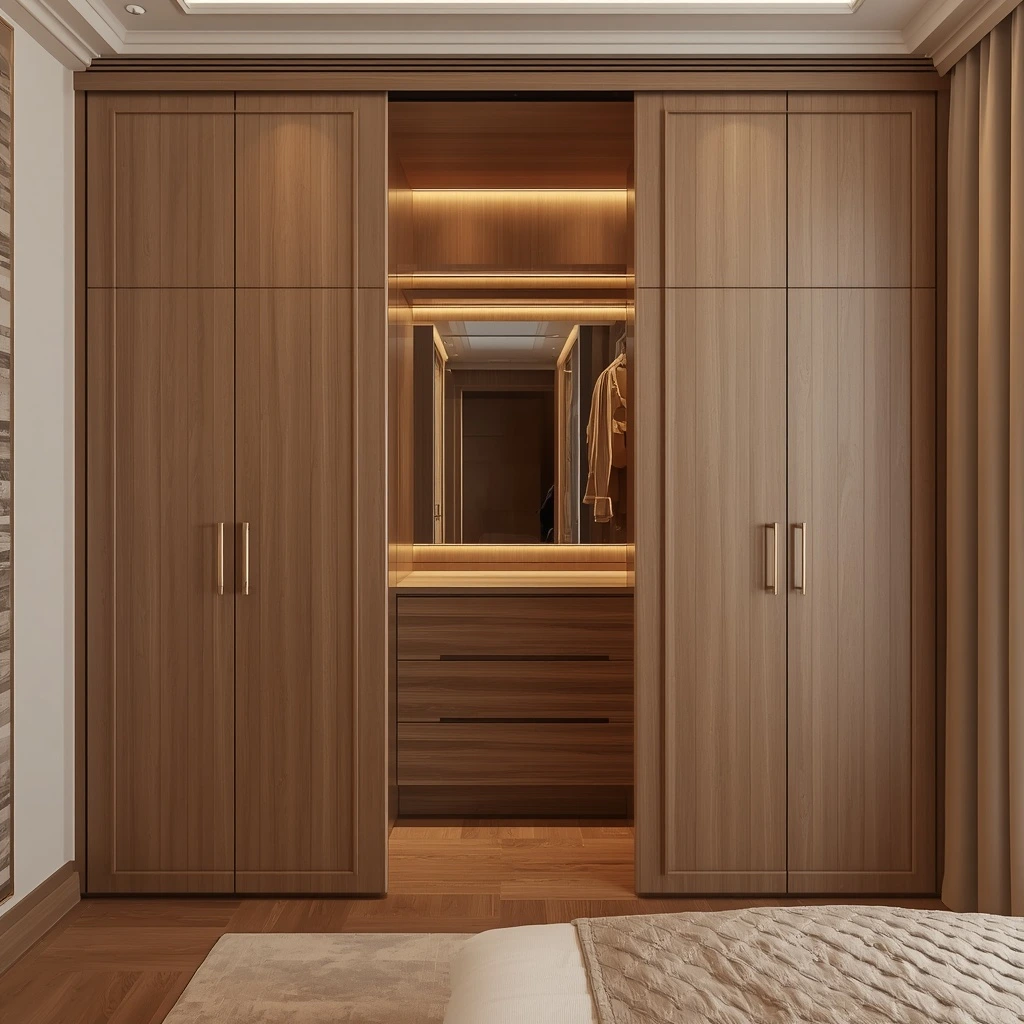
Question 3: Can You Show Me Completed Projects Similar to Mine?
References and portfolio evidence are standard in most industries. In Dubai carpentry, they are absolutely essential, and how a company responds to this request tells you a great deal.
What You Are Actually Looking For
You are not just checking whether the work looks nice in photos. You are looking for evidence that this company has completed projects of similar scope, in similar settings, with comparable materials. A company that primarily does commercial fit-outs for retail stores has different strengths than one that specializes in high-end residential villas in Arabian Ranches or Al Barari. Both may produce excellent work in their lane. Neither automatically transfers that expertise to your project type.
This is vital when seeking custom furniture for villas Dubai or majlis furniture custom UAE that fits traditional and modern aesthetics perfectly. Ask for photos, yes. But also ask for client references you can actually contact. A reputable company with 35 years in the UAE will have dozens of clients willing to speak on their behalf. Karnak Carpentry regularly connects prospective clients with past customers from similar project types because we know those conversations build confidence faster than any brochure.
The Questions to Ask Past Clients
When you do speak with a reference, ask these three things. First, did the project finish on time and on budget? Second, were there any quality issues after installation, and how did the company handle them? Third, would they hire the same company again?
Those three questions reveal more than ten hours of meetings with the sales team ever will.
Red Flags in Portfolios
Be wary of portfolio images that are heavily styled, shot by professional photographers with elaborate staging, and show only extreme close-ups of joinery details. Beautiful photography does not confirm clean installation, accurate measurements, or good site management. Ask for on-site photos taken during or immediately after installation, before professional photography. Real work looks good even in smartphone photos.
Also ask how old the portfolio images are. A company proudly showing work from 2017 and 2018 may not have completed anything worth photographing recently.
Question 4: What Does Your Contract Actually Cover, and What Is Excluded?
In our experience, more disputes in Dubai carpentry projects come from contract ambiguity than from genuine bad workmanship. Both parties thought they had agreed on something. The contract said something slightly different, or simply did not address the situation at all.
The Key Items Every Carpentry Contract Must Include
Before you sign anything, confirm the contract clearly states the project scope in writing, including exact dimensions, materials, finishes, and hardware specifications. It should state the total price with a clear breakdown, the payment schedule tied to project milestones rather than calendar dates, the delivery and installation date, and what happens if either party misses that date.
The warranty terms need to be spelled out specifically. A statement that the company “guarantees their work” means nothing legally. The contract should specify what is covered, for how long, and what the process is for making a warranty claim. Karnak Carpentry offers a written 2-year warranty on workmanship and materials on all residential projects, with clear terms on what constitutes a valid claim and the response time committed.
What Should Be in the Exclusions Section
A good contract will also clearly state what is not included. Site preparation, wall repairs after installation, electrical work for LED lighting inside cabinets, plumbing modifications for kitchen projects. These are commonly excluded, and that is reasonable, but they should be listed so you know to budget for them separately and hire the right contractors.
Be cautious of contracts with very short exclusion lists. Either the company is including everything, which would be reflected in the price, or they are planning to charge for extras later as variation orders.
Payment Structure Tells You About Risk
The standard payment structure for a carpentry project in Dubai is roughly 40 percent deposit to confirm the order and begin material procurement, 40 percent at delivery or start of installation, and 20 percent upon final completion and client sign-off. Any company asking for more than 50 percent upfront without a strong justification is a risk. Any company asking for the full amount before work begins should not receive your business.
The final payment milestone is your only real leverage. A company that collects almost everything before completing the job has no financial incentive to resolve the last few snags efficiently.
Question 5: Who Will Actually Be Working in My Home, and Are They Trained and Insured?
This question makes some salespeople uncomfortable, which is exactly why you should ask it.
The Subcontracted Labor Problem
The foreman or project manager you meet during the sales process and site survey may not be the same person who shows up on installation day. In a well-run company, there is a defined team with consistent supervisors who follow projects from production through installation. In a poorly run operation, installation is handed off to whoever is available, including day laborers who may not have worked on the manufacturing side and may not fully understand the design intent.
Ask specifically: who will be the lead carpenter on my installation, how long have they worked for your company, and can I meet them before installation begins? The answer will be telling.
Insurance and Liability in Dubai
Any carpentry contractor working in a residential or commercial space in Dubai should carry public liability insurance. This covers damage to your property caused by their team during the project. Ask for evidence of this coverage before work begins. This is crucial for commercial carpentry contractors Dubai handling larger scale work.
In a villa in Jumeirah, a subcontracted carpentry team working for a company we later spoke with managed to damage a marble floor worth AED 45,000 when a heavy cabinet was dropped during installation. The contractor had no liability insurance. The homeowner had no recourse except a costly legal process. The carpentry company quietly closed six months later.
This is not a rare scenario. Always ask for proof of insurance and check that it is current.
Worker Welfare and Professionalism
This is less about risk and more about the kind of company you are dealing with. A company that treats its workers well, pays them reliably, and invests in their training produces better work. Ask how long the average employee has been with the company. At Karnak Carpentry, several of our senior carpenters and site supervisors have been with us for over 15 years. That consistency of team is not accidental, and it shows in the work.
Question 6: What Is Your Realistic Timeline, and How Do You Handle Delays?
Every carpentry company in Dubai will tell you they can hit your deadline. Ask them to put the timeline in writing, then ask what happens contractually if they do not.
Why Dubai Carpentry Projects Run Late
Material delivery delays are common. Specialty timber, imported hardware, and custom fittings often come from Europe, and shipping timelines to Dubai can stretch unexpectedly. A company ordering everything locally from Al Quoz suppliers will have more timeline control than one relying on imported items for every project.
Permitting and building management approval adds time in many developments. Communities like The Greens, Downtown Dubai, and Palm Jumeirah have building management offices with their own approval processes for fit-out work. A company familiar with your development will have factored this in. A company that has never worked there may not have.
Site readiness on your end matters too. If handover of the space to the carpenter is delayed by other trades, the timeline shifts. Good contracts address this clearly so neither party is penalized for delays caused by the other. This holds true for office fit out carpentry abu dhabi projects as well.
What Reasonable Timelines Actually Look Like
For a standard 3-bedroom apartment wardrobe and kitchen project, expect 4 to 6 weeks from signed contract to installation complete. This includes design finalization, material procurement, production, and a 2-day installation window. Rush jobs can be done faster but usually at a premium, and the quality risk increases when production is compressed.
For a full villa fit-out covering multiple rooms, custom kitchen, media unit, and study, allow 10 to 14 weeks. Projects we have managed in Arabian Ranches, Meadows, and Lakes typically run in this range when properly planned.
Ask the company to give you a written milestone schedule. Design sign-off by a specific date. Materials ordered by a specific date. Production complete by a specific date. Installation start and end dates. Each milestone creates accountability and gives you early warning if the project is drifting.
The Penalty Clause Conversation
You can ask whether the contract includes a penalty clause for late delivery. Some companies will include a modest daily penalty for delays beyond the agreed installation date. Others will not, but the conversation itself signals to the company that you are serious about the timeline and are paying attention to the contract terms. A company that refuses to discuss any form of delay accountability is telling you something important.
Question 7: What Does Your After-Sales Process Look Like?
Most problems with carpentry in Dubai do not appear on installation day. They appear three months later when the humidity drops sharply in October and November, when drawers that slid smoothly in summer suddenly feel tight, when a door that hung perfectly begins to catch on the frame.
The First Year Is When You Learn the Most
Good joinery settles. Hinges sometimes need adjustment after the first few months of use. This is normal, expected, and not a sign of bad workmanship if the company addresses it quickly. The question is whether they will.
Ask specifically: if I notice a defect or need an adjustment six months after installation, what is the process? Do you charge for adjustment visits? What is your response time for warranty claims?
A company offering a real warranty will have a straightforward answer. Call us, describe the issue, we will schedule a visit within a stated number of days. Karnak Carpentry offers complimentary adjustment visits within the first year for all residential projects because we know the climate creates movement that needs managing, and we would rather visit once to adjust a hinge than lose a client who becomes frustrated by a stiff drawer.
The Companies That Disappear After Final Payment
In our 35 years in Dubai, we have seen the cycle repeat many times. A company does strong work, builds a reputation, takes on too many projects, overextends, and then customer service collapses under the weight of their workload. The after-sales team stops responding. Warranty claims go unanswered. The company does not close, they simply stop prioritizing clients who have already paid.
Ask whether the company has a dedicated after-sales or service team, separate from the project management team. Ask how many service calls they completed in the last month. If they track this number, they take it seriously.
Reviews Over Time Tell the Real Story
Before signing, search for Google reviews for the company, specifically filtering for reviews from one to two years ago, not just recent ones. Recent reviews reflect current sales enthusiasm. Older reviews reflect how the company behaves once you are no longer a prospect.
A company with 4.8 stars in recent reviews and 3.1 stars two years ago has changed something, and not necessarily for the better in terms of long-term client relationship management. Look for patterns in the complaints, not just the ratings.
Common Mistakes Dubai Homeowners Make When Hiring Carpentry Contractors
Mistake 1: Choosing Based on Price Alone
The cheapest quote in Dubai carpentry is almost never the best value. We have audited failed projects for clients who came to us after signing with low-price bidders, and the pattern is consistent. The low quote wins the contract, then variation orders for “items not included” begin appearing. By the end, the total paid exceeds the mid-range quotes they declined. And the quality is still inferior.
Get three quotes. If one is dramatically lower than the others, ask specifically what is different in the scope, materials, or hardware. The answer will explain the gap, or reveal that the company cannot explain it.
Mistake 2: Not Getting the Design Agreed in Writing Before Production Starts
Verbal agreements about finishes, colors, dimensions, and hardware do not protect you. Once timber is cut, changes cost money. Once a paint finish has been applied and you decide you preferred a different shade, you are paying for the repaint.
Every detail you care about needs to be in writing before you approve production to begin. This includes the exact RAL or NCS color code for painted finishes, the specific hardware models by supplier and part number, the exact dimensions of every major piece, and the material specifications. If a company rushes you past this stage or tells you “we will sort out the details as we go,” that is a process problem that will cost you money later.
Mistake 3: Assuming All Wood Is the Same
Clients sometimes arrive with a Pinterest image and say they want “wood like that.” The image might show American white oak. The company might quote using Chinese oak veneer over MDF. Both are technically wood, and the visual result in a photo can look similar. The tactile quality, durability, and price are entirely different.
Ask the company to be specific about every material. Not just the species of wood but the grade, the origin, whether it is solid or veneer, the core material beneath any veneer, and the surface treatment. A company that can give you this information clearly has technical depth. One that waves it off does not. This is key for home office desk carpentry Dubai and tv unit custom dubai pieces.
Mistake 4: Skipping the Site Survey
Some carpentry companies in Dubai will quote from a floor plan without visiting the site. This produces problems. Walls in Dubai apartments are rarely perfectly square. Ceilings in older buildings often have unexpected pipes or ducts running below the slab. A wardrobe quoted to fit flush to the ceiling may encounter a beam that does not appear on any drawing.
A mandatory site survey before finalizing the design is not extra service. It is the minimum standard for professional carpentry work. If a company is willing to go to production without physically measuring your space, something important is being skipped.
Mistake 5: Not Understanding What Warranty Covers
We spoke about warranty terms earlier, but it deserves its own mention here as a mistake because of how often it happens. Clients assume the warranty covers everything. Then the painted finish on a kitchen door begins to chip at the edge after 14 months, and the company cites “normal wear and tear” as an exclusion.
Before signing, read the warranty section of the contract carefully. Ask the company to give you an example of something that would be covered and something that would not. That conversation will teach you more than reading the document alone.
Mistake 6: Ignoring the Communication Style During the Sales Process
How a company communicates with you when they want your business is the best available predictor of how they will communicate with you when there is a problem. If emails go unanswered for days during the quoting stage, do not expect faster responses once your money is in their account.
Pay attention to how quickly they respond, how clearly they explain things, whether they proactively share information you did not know to ask for, and whether the person you deal with has real technical knowledge or is reading from a brochure. These signals are available before you sign and are absolutely worth weighing.
What Carpentry Projects in Dubai Actually Cost: Honest Numbers for 2026
Cost conversations make many carpentry companies evasive. We prefer transparency because clients who understand pricing make better decisions and have more realistic expectations.
Wardrobes and Bedroom Storage
A standard built-in wardrobe in a Dubai apartment, 2.4 meters wide by floor-to-ceiling, with soft-close hinges, quality laminate finish, and basic internal fitting, typically runs AED 3,500 to AED 5,500. Add solid timber doors, premium internal LED lighting, custom paint finish, or premium hardware and the range moves to AED 7,000 to AED 14,000 or more for the same footprint.
Quotes below AED 2,500 for a full-height wardrobe are using entry-grade materials. That is fine if you understand what you are getting and plan to replace it in five years. It is a poor choice if you are expecting a 15-year installation.
Kitchen Cabinetry
A full kitchen fit-out in a standard 2-bedroom Dubai apartment, covering upper and lower cabinets with moisture-resistant MDF carcasses, quality soft-close hardware, and a laminate or paint finish, runs AED 18,000 to AED 35,000 depending on the layout and finish level. High-end kitchens with lacquer finish, solid timber detail, and premium European hardware in larger spaces can reach AED 60,000 to AED 120,000 or more.
Any quote below AED 15,000 for a full kitchen in a 2-bedroom apartment should be examined carefully. Ask exactly what material is being used for the carcasses, what hardware brand is specified, and whether a moisture-resistant board is included throughout.
Custom Furniture and Feature Pieces
A custom TV unit for a living room in a standard Dubai apartment, MDF construction with veneer or laminate finish, built-in cable management, and basic LED lighting, typically runs AED 4,500 to AED 9,000. A custom study desk and shelving unit for a home office runs AED 3,000 to AED 7,000 in most configurations. These align well with home office desk carpentry Dubai and tv unit custom dubai needs, as well as majlis furniture custom UAE requests.
These ranges reflect current material and labor costs in Dubai as of early 2026 and will vary based on complexity, size, and finish choice.
8 Expert Tips From 35 Years of Carpentry Projects in the UAE
- Always request a production sample before full manufacturing begins. For painted or lacquered finishes, ask the company to produce a small sample panel in the exact material, color, and sheen level specified. Approve this in writing before they proceed. Colors look different on a sample chip than on a full panel under your home’s lighting.
- Plan for acclimatization time. Any solid timber elements should spend at least 5 to 7 days in the installation space, with the air conditioning running at normal settings, before installation begins. A company that rushes this step because of scheduling pressure is setting up a movement problem you will discover three months later.
- Think about maintenance before you specify materials. High-gloss lacquer looks stunning on day one but shows every fingerprint and requires careful cleaning. Open-grain timber veneer is beautiful but cannot tolerate moisture near a sink. Ask the company not just what looks good but what will look good in three years with normal use in your household.
- Specify hardware by brand and model number. “Soft-close hinges” is not a specification. Blum Clip Top 110-degree hinges are a specification. Hettich InnoTech Atira drawers are a specification. Generic soft-close alternatives exist at every price point and quality level. Locking down the exact products protects you.
- Visit the workshop mid-production if the project is significant. For projects over AED 30,000, ask to visit once the carcasses are built but before doors and finishes are applied. You can verify dimensions, check material quality, and raise any concerns before the point where changes become expensive.
- Document the site condition before installation begins. Take dated photographs of your floors, walls, and ceilings before any work starts. If a damage claim arises later, this documentation establishes what was pre-existing and what the installation team caused.
- Get the building management approval before the installation date. Many Dubai communities require written approval from the building management or homeowners association before any fit-out work can begin. Confirm this requirement for your development and factor the approval timeline into the project schedule. Discovering this requirement the day before installation is scheduled to start is an expensive mistake.
- Read the contract once more the day before signing. Not the day you receive it, when you are still excited about the project. The day before you sign. A 24-hour gap often reveals terms you glossed over during the initial review, especially around payment schedules, exclusions, and warranty limitations.
Conclusion: Walk Into Every Carpentry Conversation Armed With These Questions
Choosing the right carpentry company in Dubai is not complicated if you know what to ask. The seven questions in this guide cut through polished sales presentations and get to the information that actually predicts whether your project will succeed.
Ask about the workshop. Ask about materials and why they are recommending them for your specific space. Demand to see completed work and speak with real clients. Read every line of the contract before you sign it. Verify who will actually be doing the work and confirm they are insured. Get the timeline in writing with accountability built in. And find out exactly what happens after the final invoice is paid.
Companies that answer these questions openly and confidently are worth your time. Companies that get evasive, vague, or defensive are telling you something important about how they operate.
Key Takeaways:
- A carpentry company with its own workshop has far greater quality control than one that subcontracts manufacturing.
- Material recommendations should be specific and climate-aware, not generic. UAE humidity requires proper moisture-resistant specifications.
- Never approve production without every design detail confirmed in writing, including exact colors, dimensions, and hardware models.
- Payment structure matters. Final payment on completion is your only real leverage.
- After-sales responsiveness predicts long-term satisfaction better than the installation itself.
Need Expert Help With Your Dubai Carpentry Project?
Karnak Carpentry has been designing and installing custom joinery across Dubai and the UAE since 1988, with more than 50,000 completed residential and commercial projects. We operate our own workshop, employ our own trained teams, and stand behind every project with a written 2-year workmanship warranty. If you would like a no-obligation consultation and site survey, contact us below. We will answer every question in this guide before you sign anything, because that is the standard we hold ourselves to.
Contact: +971-52-5554207 | info@karnakcarpentry.com
Frequently Asked Questions About Carpentry Contracts and Selection
Why should I ask questions before I sign a carpentry contract?
Your questions help you evaluate the company’s experience, pricing, materials, timelines, and warranty. Clear answers reduce misunderstandings and help you choose the right carpentry company for your project.
What documents should a professional carpentry company provide?
A professional company should provide a detailed quotation, project timeline, written contract, material specifications, payment schedule, and warranty information before the project begins.
How can I confirm a carpentry company’s experience?
Review the company’s portfolio, ask for recent project photos, request client references, and discuss projects similar to yours. Experienced carpenters explain their process with confidence and provide practical recommendations.
How can I compare quotations from different carpentry companies?
Compare material quality, hardware brands, project scope, workmanship, warranty, installation, and delivery timelines. Focus on value instead of selecting the lowest price.
Why should I ask about the materials before I approve the project?
Material quality directly affects durability, appearance, and maintenance. Ask the company to explain the wood type, board material, finish, and hardware so you understand exactly what you will receive.
How should a carpentry company explain its payment terms?
The company should explain every payment milestone, the deposit amount, the balance schedule, and any additional charges before work starts. Clear payment terms help both parties avoid disputes.
Why should I ask about the project timeline?
A realistic timeline helps you plan your schedule and allows the company to complete every stage without rushing. Experienced carpenters estimate the timeline according to the project size and material availability.
How does a warranty protect my investment?
A warranty demonstrates the company’s confidence in its workmanship and materials. It also gives you support if you discover installation or hardware issues after completion.
What warning signs should I notice during my first meeting with a carpentry company?
Watch for vague answers, incomplete quotations, unrealistic promises, poor communication, missing project examples, and reluctance to discuss materials or warranties. These signs often indicate unreliable service.
How can I choose the right carpentry company in Dubai?
Choose a company that communicates clearly, provides written documentation, showcases quality work, explains every detail, offers a workmanship warranty, and answers your questions honestly before you sign the contract.