
Blog
How to Budget for a Full Villa Carpentry Fit-Out in Dubai: A Real Cost Guide for 2026

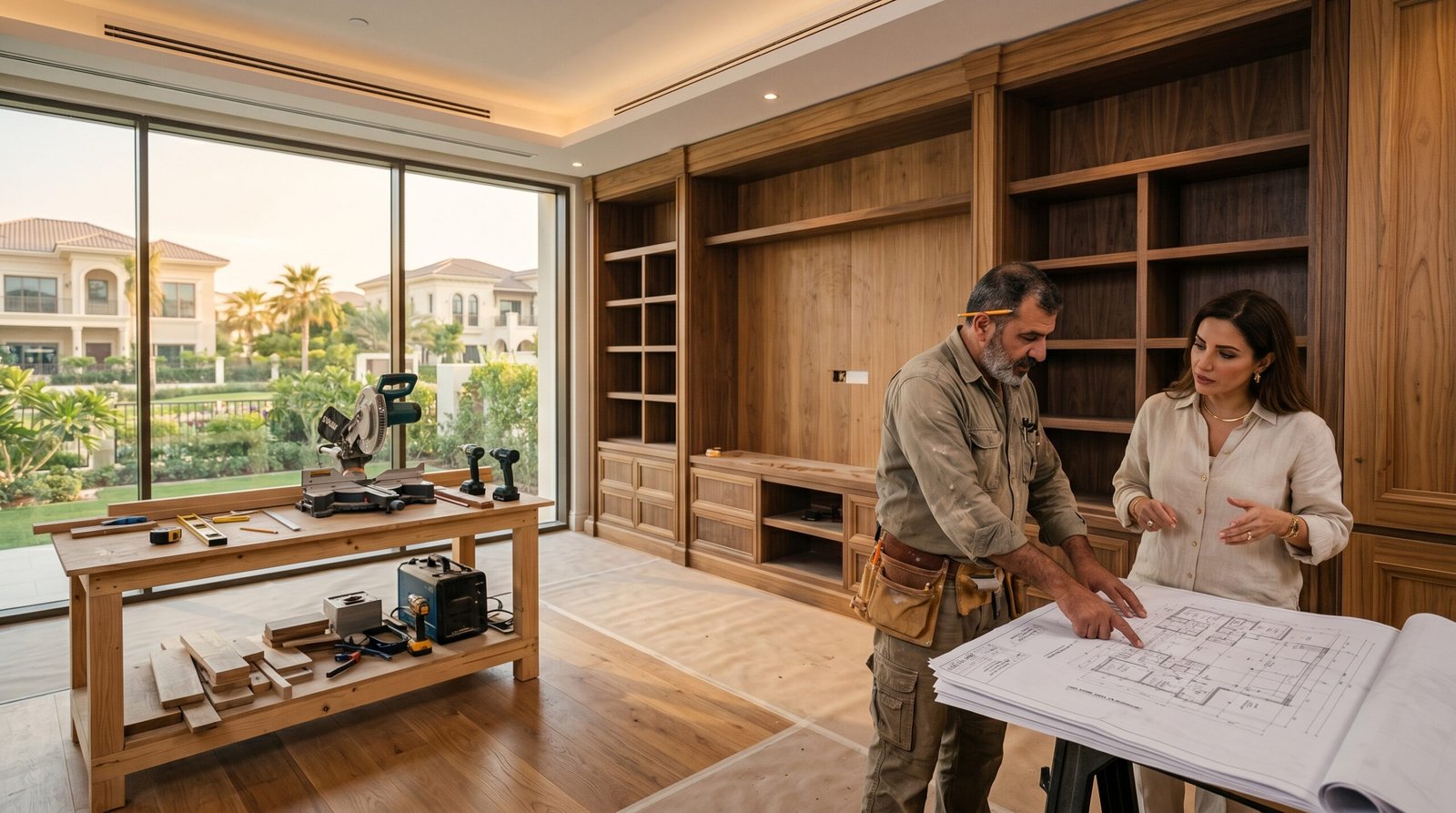
Every week, someone calls our workshop with the same story. They bought a villa in Mirdif or Arabian Ranches, they have a vision in their head, and they need a number. One number. How much will all the carpentry cost?
After 35 years and more than 10,000 projects across the UAE, we understand why people ask it that way. A villa fit-out is one of the largest investments a homeowner makes after the property itself. Getting the budget wrong by 30 or 40 percent is not a minor inconvenience. It can stop a project cold halfway through, force compromises that undermine the entire design, or worse, attract contractors who will fill that budget gap with shortcuts you will not discover until two monsoon seasons have warped your cabinetry doors.
This guide exists to give you a realistic, honest picture of what a full villa carpentry fit-out costs in Dubai in 2026. We will break down every major scope of work, explain what drives costs up or down, share real examples from projects we have completed, and give you the framework to evaluate any quote you receive. By the end, you will know enough to have an intelligent conversation with any carpentry contractor in the UAE.
Why Dubai’s Villa Market Demands a Different Approach
Dubai’s villa market is unlike anywhere else. The climate, the build standards, the expectations of finishes, and the sheer scale of properties here create a carpentry environment that simply does not compare to Europe or Asia. A four-bedroom villa in Jumeirah Park can have 800 to 1,200 square meters of built-up area. The carpentry scope in a home that size is not a line item. It is a full construction phase.
What “Full Fit-Out” Actually Means in a Dubai Villa
Before any number makes sense, you need to agree on what you are counting.
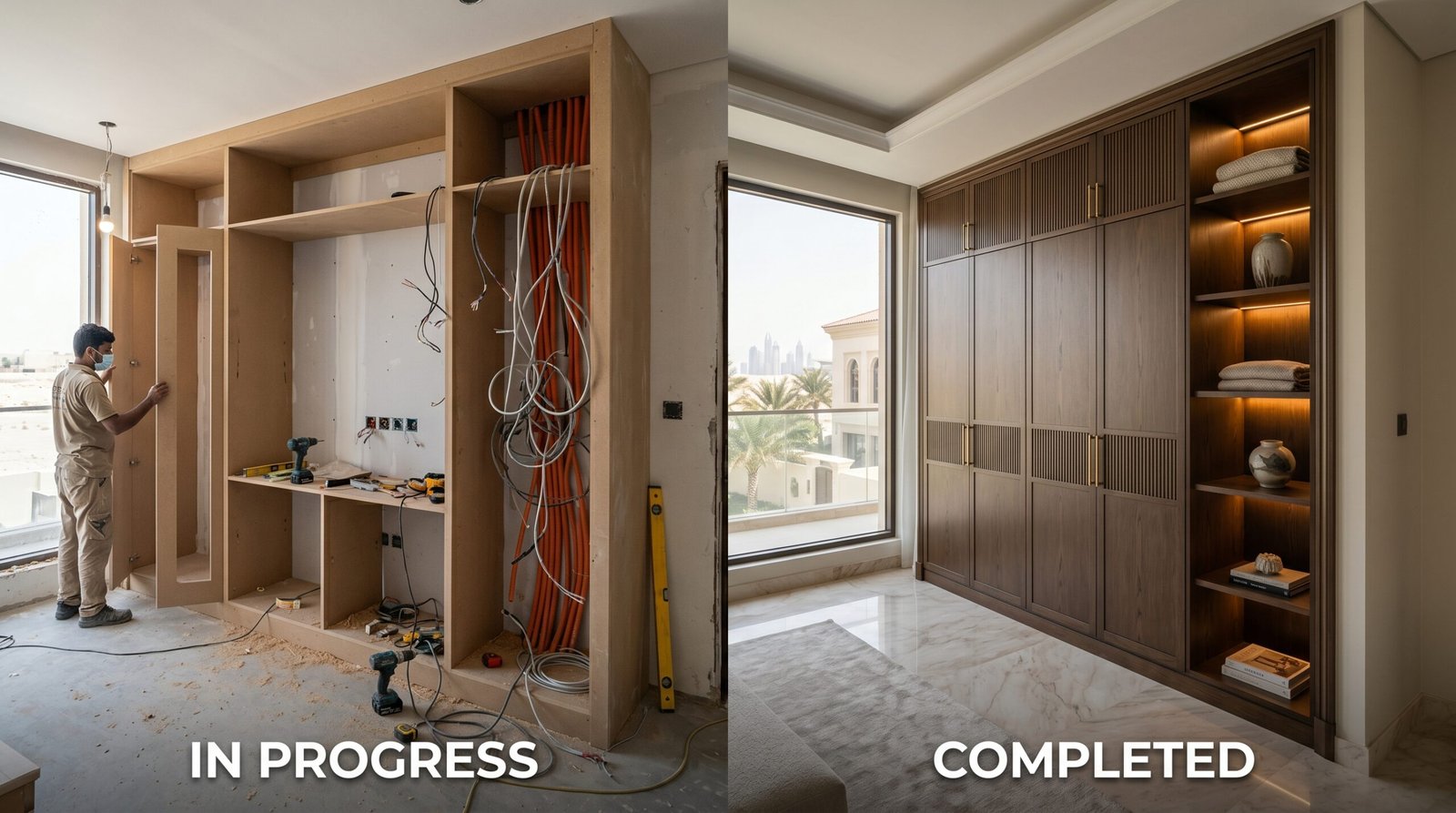
When a client says “full carpentry fit-out,” we always ask them to walk us through the property room by room, because the scope varies enormously from one homeowner to the next. For some, full fit-out means built-in wardrobes, a kitchen, and bathroom vanities. For others, it means all of that plus a paneled study, a custom staircase cladding, a majlis with floor-to-ceiling joinery, decorative ceiling work, and a custom home theater unit. These are not the same project, and they are not the same budget.
Here is how we define the standard scope categories for a full Dubai villa fit-out:
Primary Carpentry Scope:
Kitchens, all bedroom wardrobes, bathroom vanities, utility room storage, and laundry cabinetry. This is the non-negotiable core of any fit-out. Every villa needs these functional elements to be livable.
Secondary Carpentry Scope:
TV units, display units, home office built-ins, dining room sideboards, entryway storage, and mudroom furniture. These are high-impact visual spaces that most villa owners include in their fit-out.
Feature Carpentry Scope:
Wall paneling, ceiling treatments, staircase joinery, majlis-specific built-ins, decorative library walls, and bespoke statement pieces. This is where a villa moves from comfortable to remarkable, and where budgets expand most significantly.
Most villas we work on in Emirates Hills, Jumeirah Golf Estates, and Al Barsha fall into a combination of all three categories. Understanding which scope you want before you speak to any contractor will save you weeks of misaligned quoting and frustrating back-and-forth.
The Size Factor: Why Square Meters Are Not the Whole Story
People often ask us whether we price by square meter, and the honest answer is that square meters tell only part of the story. A 600-square-meter villa with a simple, clean design and standard-height ceilings will cost considerably less than a 500-square-meter villa with 4-meter-high ceilings, curved joinery, mixed materials, and complex hardware specifications.
What actually drives cost is the number of linear meters of cabinetry, the complexity of the design details, the materials specified, and the degree of site-specific customization required. A standard wardrobe runs roughly 1.8 to 2.4 meters wide. A master bedroom in a Dubai villa typically holds two to three of them, plus a dressing room with floor-to-ceiling hanging sections, drawers, shoe racks, and integrated lighting. That one room alone can represent 40 to 60 linear meters of built-in joinery.
When you multiply that level of density across a four or five-bedroom villa, including a kitchen with an island, two family bathrooms, a master bath, a guest powder room, and all the living area units, you are looking at 200 to 400 linear meters of finished joinery in a mid-range villa. That is the number that drives your budget more than the villa’s total floor area.
How Dubai Villas Differ from Apartments
Fit-out contractors who work primarily on apartments sometimes underestimate villa projects. The differences are structural, not cosmetic.
First, villa ceilings are higher. Standard apartment ceiling heights in Dubai run 2.8 to 3 meters. Villa ceilings commonly range from 3.2 to 4.5 meters, and some of the properties in Mohammed Bin Rashid City or Palm Jumeirah fringe villas go higher. Every extra meter of height adds fabrication complexity, installation time, and material cost.
Second, villa humidity zones are more varied. Ground-floor storage areas in some communities sit close to irrigation systems or landscaping zones with higher ambient moisture. We have seen MDF swell in basement storage areas of villas where the waterproofing on the external wall was inadequate. This matters for material selection in a way it simply does not in a fifth-floor apartment.
Third, villas often have multiple staircases, utility rooms, and service entrances that require carpentry in spaces that apartments do not have. These are easy to forget in early budget planning and surprisingly expensive to fit out properly.
Room-by-Room Cost Breakdown for a Dubai Villa
Let’s go through the real numbers. These are 2026 figures based on our actual project costs in Dubai. They represent quality craftsmanship using appropriate materials for the UAE climate. hey are not bargain-basement prices, and they are not ultra-luxury outliers. They are what good work costs in this market.
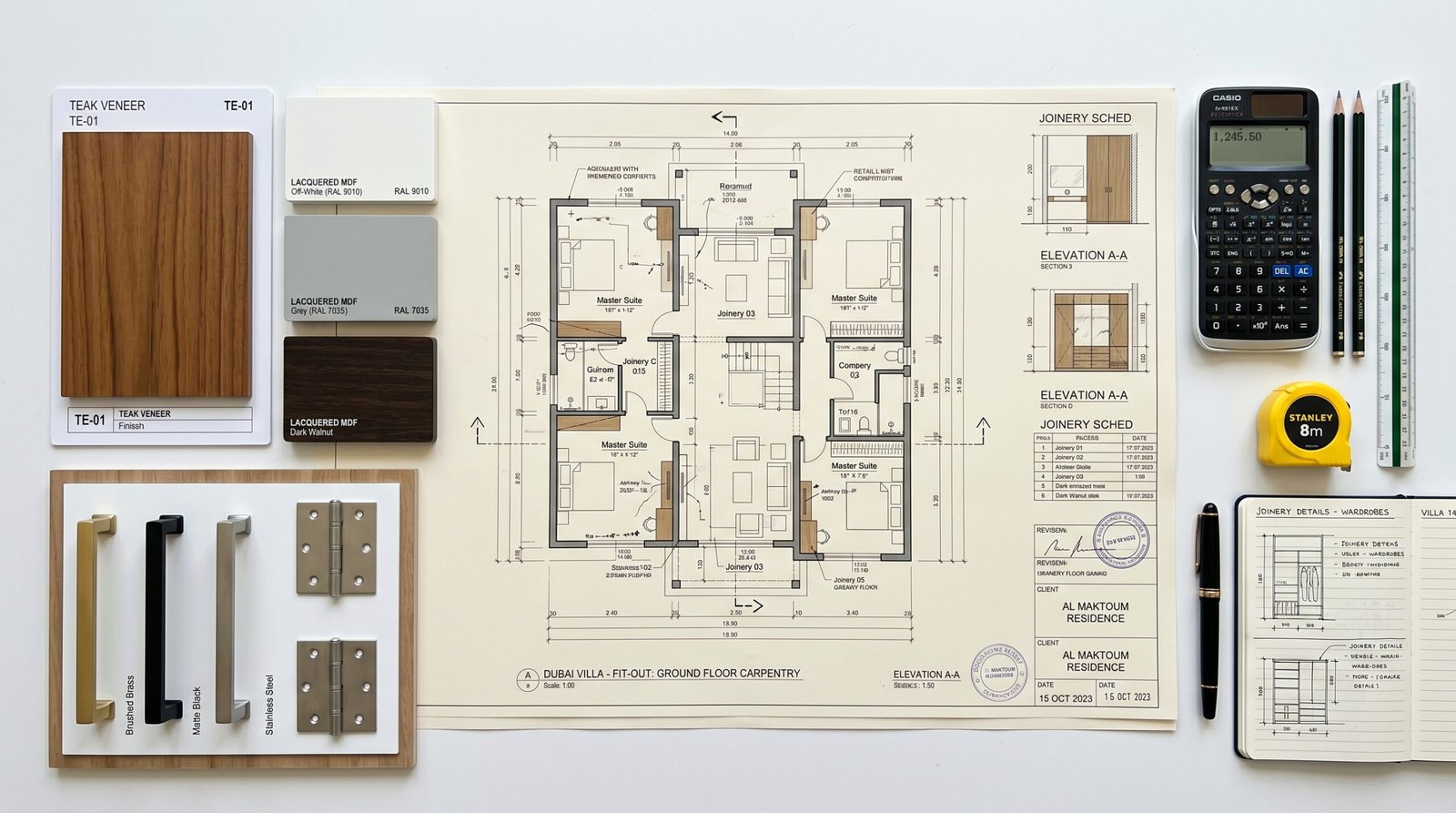
Kitchen Cabinetry
The kitchen is almost always the single most expensive carpentry element in a Dubai villa. It combines the highest material volumes, the most complex hardware, and the most demanding functional requirements of any room in the home.
For a standard villa kitchen in the 15 to 20 square meter range, you can expect to spend between AED 45,000 and AED 95,000 for quality custom carpentry. This range reflects real choices in material specification. A kitchen using 18mm moisture-resistant MDF with lacquer finish, soft-close hinges, and standard organization hardware sits toward the lower end. A kitchen using solid wood doors, dovetail-jointed drawers, Blum Legrabox pull-out systems, and integrated appliance panels sits toward the upper end.
For larger villa kitchens, particularly the open-plan kitchen and family room combinations common in Emirates Living communities, scope can extend to 25 to 35 square meters including the island. At that scale, AED 120,000 to AED 180,000 is a realistic range for premium custom work.
What inflates kitchen costs beyond these ranges is usually one of four things: stone or fluted glass door inserts requiring specialized fabrication, custom hood canopy cladding in wood or veneer, integrated pantry units with pull-out carousel systems, or an island that doubles as a bar with integrated wine storage, undermount sinks, and complex edge profiling.
One project we completed in a Meadows villa two years ago had a kitchen where the owner wanted the full run of overhead cabinets replaced with open shelving and leaded glass display units. Beautiful result. But the custom glass unit fabrication alone added AED 28,000 to the scope. These choices are always available, but they need to be in your budget before you fall in love with the design.
Bedroom Wardrobes
After the kitchen, wardrobes represent the second-largest carpentry investment in a villa fit-out. A four-bedroom villa typically includes one master wardrobe suite and three secondary bedroom wardrobes, plus often a separate dressing room or walk-in wardrobe if the master suite layout permits.
For secondary bedrooms, a standard built-in wardrobe running 2 to 3 meters wide, floor to ceiling, with sliding doors, mixed hanging and shelving, and basic drawer configuration costs between AED 3,500 and AED 7,500 per unit depending on door finish and internal fittings.
Master bedroom wardrobe suites are a different conversation. In Dubai villas, the master wardrobe is often as important to the homeowners as the kitchen. We regularly complete master suite wardrobes running 5 to 8 linear meters of built-in storage, often on two or three walls, with separate his-and-hers sections, full-height mirror panels, integrated sensor lighting, pull-out shoe racks, tie and belt drawers, and jewelry trays. A scope like that runs AED 25,000 to AED 55,000 depending on finish level.
Dressing rooms, which are common in larger villas in communities like Jumeirah Islands or Al Furjan, add AED 18,000 to AED 40,000 on top of the bedroom wardrobe scope if they require their own full built-in island and perimeter storage.
The single biggest value decision in wardrobe design is the door system. Sliding doors cost more than hinged in most cases because the track systems used for floor-to-ceiling sliding panels in a 3-meter wardrobe are precision German or Italian hardware. Frameless hinged doors on a smaller wardrobe can be executed beautifully for less. We always show clients both options because the cost difference can be AED 3,000 to AED 8,000 on a single unit.
Bathroom Vanities and Cabinetry
Bathroom carpentry in a Dubai villa typically covers the vanity unit, any wall-hung storage, mirror cabinets, and occasionally a built-in linen closet within the bathroom.
For a standard family bathroom vanity with two sinks, floating design, and simple lacquered MDF carcass with soft-close doors, budget between AED 4,500 and AED 9,000. Master bathroom vanities, which frequently involve longer runs (1.5 to 2.5 meters), vessel sink cutouts, integrated electrical access, and more refined door profiles, typically run AED 9,000 to AED 22,000.
The material choice in bathrooms is non-negotiable from a quality standpoint. Any carpentry within 1.5 meters of a shower enclosure or bath must use marine-grade or moisture-resistant board as its carcass substrate. We have seen projects where contractors used standard MDF in bathroom vanities to save cost, and within 18 months the carcass has begun to delaminate at the base. In Dubai’s climate, where AC systems create significant condensation cycles in bathrooms, this is not a minor risk. It is a certainty. Specify the right material or accept the consequence.
For a four-bathroom villa (master, two family, one guest powder), total bathroom carpentry typically runs AED 30,000 to AED 65,000 depending on finish selections and fixture integration requirements.
Living Areas, TV Units, and Display Cabinetry
Living room and family room carpentry is where individual taste varies most and where budgets can range most dramatically. A simple floating TV unit in MDF with a painted finish might cost AED 4,500. A full feature wall with integrated fireplace surround, floating shelves, display niches, concealed wire management, and push-to-open media cabinet might cost AED 35,000 to AED 60,000.
For budget planning, if your villa has a main living room, a family room, and a formal dining area, and you want quality custom built-ins for each, allocate AED 35,000 to AED 90,000 for this combined scope. The spread is wide because the design intent varies enormously.
One thing Dubai homeowners consistently underestimate is the cable management requirement in modern living spaces. A properly done TV unit today must account for streaming boxes, gaming consoles, soundbar equipment, and often a whole-home AV system. Doing this well requires planning cable routes into the carpentry during fabrication, not retrofitting afterward. We include this in every living room scope we handle, but contractors who do not plan for it create problems that are expensive and ugly to correct.
Majlis and Formal Rooms
In UAE villas, the majlis is a cultural centerpiece and often the most elaborately finished carpentry space in the home. Traditional Arabic majlis designs using geometric wood screen panels, layered ceiling detailing, and built-in seating platforms can represent some of the most skilled joinery work we produce.
A well-executed majlis carpentry scope, including seating platforms with storage, wall paneling, ceiling feature work, and display niches, runs AED 45,000 to AED 120,000 for a dedicated room of 20 to 35 square meters. This is specialist work and the cost reflects that. We have completed majlis fit-outs in Nad Al Sheba and Al Warqa that represent three to four weeks of workshop fabrication time alone before a single piece arrives on site.
Home Office Built-Ins
Home offices in Dubai villas became a priority scope item after 2020, and they remain one of the most requested elements we see in 2026. A proper built-in home office includes a desk surface, overhead cabinetry, filing drawers, shelving, and ideally a study wall with integrated bookcase.
For a dedicated study room of 10 to 15 square meters with comprehensive built-in joinery, budget AED 18,000 to AED 45,000. The spread depends on whether the desk is a simple floating surface or a wraparound configuration, whether bookshelves run full height to the ceiling, and whether the room includes any acoustic paneling or concealed door solutions.
Material Choices That Determine Your Budget (and Your Quality)
Material selection is where most budget mistakes happen in Dubai villa fit-outs. Homeowners either over-specify materials they do not need or, more dangerously, under-specify materials that will fail in the UAE climate.
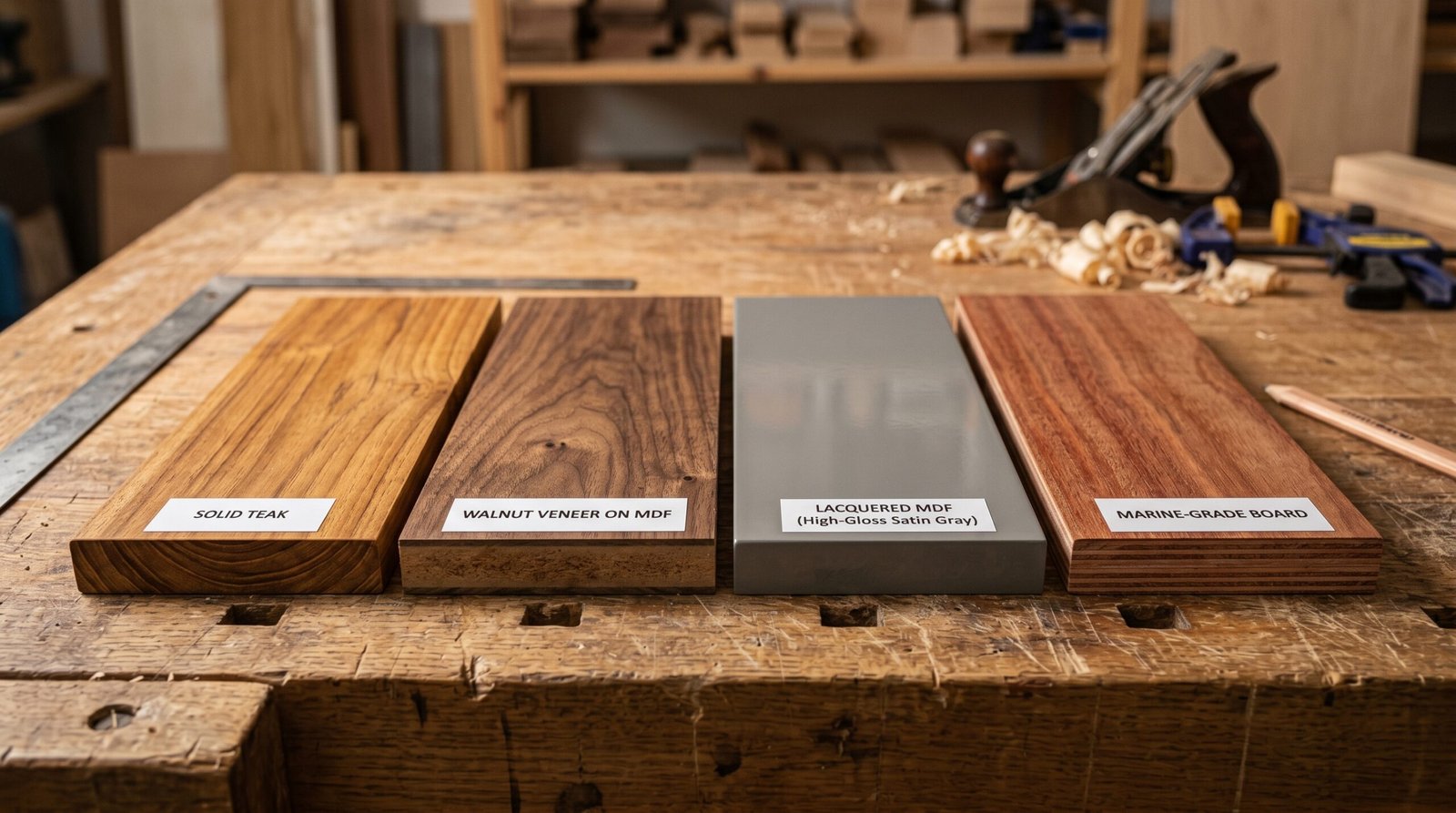
MDF: The Workhorse of Dubai Fit-Outs
Moisture-resistant MDF is the foundation of most quality carpentry in the UAE. It machines well, accepts lacquer and veneer finishes with excellent results, is dimensionally stable in air-conditioned environments, and is more cost-effective than solid wood for large-volume applications like wardrobe carcasses and kitchen units.
What matters is the grade. Standard MDF is not suitable for kitchens or bathrooms in Dubai. Moisture-resistant (MR) or ultra-moisture-resistant (UMR) grades must be specified for any cabinetry that will be near water sources or in rooms with variable humidity. The cost difference between standard and MR-grade MDF is roughly 15 to 25 percent per sheet, which is a small price to pay for significantly better performance over a decade of use.
We use 18mm MR-MDF as our standard carcass material for kitchens and bathrooms across every project, regardless of the overall budget level. This is not a premium upcharge. It is a minimum quality standard.
Solid Wood: When It Adds Value and When It Does Not
Solid wood is beautiful, and there is genuine craftsmanship in solid wood joinery. But in Dubai’s climate, solid wood requires thoughtful application. Solid timber expands and contracts with humidity changes. In a villa where the AC runs continuously for eight months and outdoor humidity swings significantly in summer, poorly designed solid wood joinery will move. Doors will stick. Panels will gap.
The answer is not to avoid solid wood. The answer is to use it where it performs well and is most visible. Solid wood works beautifully for drawer fronts, door panels, decorative moldings, furniture legs, and feature elements. Using solid wood for internal carcasses of a wardrobe is often unnecessary expense that adds vulnerability without visible benefit.
For door profiles in a kitchen or wardrobe using solid wood frames with veneer or lacquer panels, budget a 30 to 50 percent premium over equivalent MDF designs. For fully solid hardwood furniture pieces, custom dining tables, or feature shelving in walnut or oak, costs are highly project-specific but a solid wood custom dining table for a villa dining room typically runs AED 12,000 to AED 35,000.
Veneer: The Premium Visual at Mid-Range Cost
High-quality wood veneer applied over MDF gives the natural appearance of solid timber at significantly lower cost and with better dimensional stability in humid conditions. For clients who want the warmth and character of real wood grain in their kitchen or wardrobe doors, veneer over MDF is often the most intelligent choice.
Natural walnut veneer kitchen doors, for example, might cost 20 to 35 percent more than equivalent lacquered MDF doors, but will look dramatically more sophisticated and perform better over time than a painted finish in a busy kitchen. We specify veneer finishes on many of our Emirates Hills and Jumeirah Golf Estates projects where the design brief calls for a warm, natural aesthetic.
The key quality indicator with veneer is the thickness and the matching. Book-matched veneer panels where the grain mirrors across adjacent doors is a hallmark of high-quality work. Random veneer matching, where adjacent doors have different grain patterns, is a sign of a lower-tier supplier cutting corners on material cost.
Hardware: Where You Should Never Cut Corners
Hardware is the most tactile part of any cabinetry. Every time someone opens a drawer or closes a wardrobe door, they are feeling the hardware. In a villa that will be used daily for ten or twenty years, hardware quality has an outsized impact on how the fit-out feels over time.
We specify Blum, Grass, or Hettich hardware on all our projects. These are Austrian and German manufacturers whose soft-close hinges and drawer runners carry 10-year warranties and are engineered for 100,000 open-close cycles. The cost premium over generic hardware is approximately AED 200 to AED 600 per cabinet unit depending on the drawer systems specified. Across an entire villa fit-out, this might represent AED 8,000 to AED 20,000 in hardware cost. That is real money, and it is absolutely worth paying.
We have been called to repair fit-outs done with cheap Chinese hardware that failed within three years. The cost of replacing all hardware in a fitted kitchen, including labor, is often more than the original hardware saving.
Understanding the Full Cost Structure of a Dubai Villa Fit-Out
Beyond materials and room costs, there are additional elements of a fit-out budget that homeowners routinely miss in their early planning.
Site Preparation and Access
Villa fit-out carpentry work involves moving substantial volumes of material in and out of a property. Floor protection, staircase protection, and work zone isolation are genuine costs. For a typical four-bedroom villa fit-out, site setup and protection materials represent AED 3,500 to AED 8,000. This is not an optional cost if you want to hand over a home with undamaged floors and walls.
Finishing Work: Paint Touch-Ups and Gap Sealing
Every carpentry installation creates some interface with existing walls, ceilings, and floors. Scribing, caulking, silicone sealing, and touch-up painting at all junction points is skilled work that takes time. Some contractors exclude this from their quotes and add it back as a variation. Ask specifically whether finishing work is included before you sign anything.
Delivery and Installation Logistics
Workshop fabrication is one cost. Transporting fully fabricated units from a workshop to a villa site in Dubai involves logistics that are priced into any serious quote. For a full villa scope, delivery and installation labor typically represents 15 to 22 percent of the total project cost.
If a quote looks unusually low, often this is where the gap appears. Cheap quotes sometimes reflect fabrication-only pricing, with installation quoted separately or not at all. Ask your contractor to confirm that their price is fully inclusive of fabrication, delivery, installation, and finishing.
Total Villa Fit-Out Cost Ranges
Pulling all of this together, here are realistic total budget ranges for a full villa carpentry fit-out in Dubai in 2026:
Three-Bedroom Villa (approx. 300 to 450 sqm), Standard Finish: AED 150,000 to AED 250,000
Four-Bedroom Villa (approx. 450 to 650 sqm), Quality Mid-Range Finish: AED 220,000 to AED 380,000
Five or Six-Bedroom Villa (approx. 650 to 1,000 sqm), Premium Finish: AED 380,000 to AED 650,000
Ultra-Luxury Villa with Feature Joinery, Majlis, and Full Secondary Scope: AED 600,000 to AED 1,200,000 and above
These are honest ranges based on real projects. Anyone quoting you a full four-bedroom villa fit-out for AED 80,000 is either misunderstanding the scope or planning to use materials and execution that will not last. Anyone quoting AED 800,000 for a standard mid-range villa is charging a premium that requires a very clear justification in the design brief.
Common Budgeting Mistakes Dubai Villa Owners Make
Mistake 1: Getting One Quote and Treating It as a Market Price
We see this constantly. A homeowner receives one quote, it seems reasonable or it seems high, and they either accept it without context or reject it and go hunting for something cheaper. Neither response is informed.
A fit-out quote reflects assumptions about materials, hardware, labor rates, and scope interpretation. Two contractors can quote the same villa and land 40 percent apart simply because of different material specifications, not because one is dishonest. Get three detailed quotes, ask each contractor to specify materials by brand and grade, and compare them on that basis. The cheapest is rarely the best value. The most expensive is not automatically the best quality.
Mistake 2: Designing Without a Budget Ceiling
Many homeowners engage an interior designer, fall in love with a design, and only then ask for a carpentry cost. By that point, they are emotionally committed to materials and details that may push their budget well past what they can spend.
Start with a budget ceiling before you engage any designer or contractor. Tell them what you have available and ask them to design within that constraint. Good designers and contractors work this way comfortably. The alternative is spending months designing something you cannot afford and then having to compromise the design anyway, but with less time and more disappointment.
Mistake 3: Ignoring the Climate Compatibility of Material Specs
Designs drawn in London or downloaded from Pinterest were not created with Dubai’s climate in mind. Solid wood open shelving in a kitchen that faces a window receiving direct morning sun, exposed raw timber in an outdoor-facing storage zone, or standard MDF in a basement utility room are all examples of material specifications that work elsewhere but create problems in the UAE.
Always ask your contractor explicitly: “Is this material specification appropriate for this location in a Dubai climate?” If they cannot give you a confident answer with a reason, that is a warning sign.
Mistake 4: Underestimating the Cost of Changes During Production
Once fabrication begins, changes are expensive. If a kitchen carcass has been cut and you decide to change the door profile, you may be paying for new doors on top of the original ones. If you change a wardrobe configuration after the unit is built, the internal fittings may need complete replacement.
Design changes during production typically cost 2 to 4 times what they would have cost if made during the design stage. Spend time and attention in the design and approval phase. It is the cheapest time to make changes by far.
Mistake 5: Leaving Electrical and Lighting Integration to the End
Integrated lighting in wardrobes, kitchens, and display units is a standard expectation in quality Dubai villa fit-outs. But lighting integration requires coordination with the electrical contractor before carpentry installation begins, not after.
We have arrived at sites where the electrician has not run circuits to the wardrobe zone because the electrical plan was done before the carpentry layout was finalized. Correcting this after installation means opening walls, which means repainting, which adds cost and time that is entirely avoidable with proper sequencing.
Mistake 6: Not Clarifying the Warranty Terms
Quality carpentry comes with a workmanship warranty. At Karnak, we provide a two-year warranty on all installed work, covering any defects in fabrication or installation. Some contractors offer none. Others offer vague terms that exclude the most common failure modes.
Before you sign any contract, ask: What is the warranty period? What does it cover? What does it exclude? How quickly will you respond to a warranty claim? These questions reveal a lot about a contractor’s confidence in their own work.
Expert Tips for Managing Your Fit-Out Budget
These are lessons from 35 years and over 10,000 projects. Not theory. Actual hard-won experience.
Tip 1: Prioritize the Kitchen and Master Wardrobe First
These two elements have the most daily impact on how you experience your home and the most significant effect on resale value. If your budget is under pressure, maintain quality in these areas and simplify elsewhere.
Tip 2: Phase Your Fit-Out If Needed
A full villa fit-out does not have to happen at once. We regularly work with clients who complete primary scope (kitchen, wardrobes, bathrooms) at handover and add secondary scope (TV walls, study built-ins, majlis joinery) in a second phase six to twelve months later. This is intelligent budget management, not a compromise.
Tip 3: Specify Materials in the Contract, Not Just Finishes
A contract stating only “white lacquer kitchen” is unenforceable. It must specify the exact materials and brands. Ensure your contract requires an 18mm MR-MDF carcass and a specific door profile. It should also name the hardware brand, like Blum, and include the exact lacquer system and color code.
Tip 4: Visit the Workshop Before You Sign
Any reputable carpentry contractor in Dubai will invite you to visit their workshop. If they are reluctant or their workshop is not a real fabrication facility, that tells you something. A visit lets you see material quality, fabrication standards, and the kind of work they actually produce.
Tip 5: Understand the Payment Schedule
Typical payment structure for a villa fit-out in Dubai is 30 percent deposit at contract signing, 30 to 40 percent at start of fabrication, and the balance on satisfactory completion. Any contractor asking for 70 to 80 percent upfront before work begins is creating a risk for you. Payment milestones should align with delivery milestones.
Tip 6: Build a 10 to 15 Percent Contingency Into Your Budget
Even the best-planned projects encounter site conditions that create costs. A wall that is not plumb. A floor level that varies. A design detail that requires a solution not in the original scope. Ten to fifteen percent contingency is not pessimism. It is professional planning.
Tip 7: Ask About Lead Times Early
Quality workshop fabrication for a full villa fit-out takes six to ten weeks from approved drawings. If you are working toward a move-in date, you need to place your order at least ten to twelve weeks before that date to allow for fabrication, delivery, installation, and finishing. Rushing fabrication to meet a deadline is how quality gets compromised.
The Karnak Process: How We Help Clients Budget Accurately

We built our process over 35 years based on what villa owners actually need when they are planning a fit-out. It starts before a single measurement is taken.
The first conversation is about your vision, your timeline, and your budget.
We listen first. Then, we conduct a detailed, room-by-room site survey. We note ceiling heights, wall conditions, window positions, existing MEP points, and any villa-specific structural constraints.
From the survey, we produce a scope document that lists every element of carpentry work with preliminary cost ranges. This is not a final quote. It is a budget framework that lets you make informed decisions about scope before you commit to a design. If the preliminary scope comes back higher than your budget, we have that conversation openly and help you prioritize. If it comes in where you expected, we proceed to full design development.
Design development includes 3D renders of every major space so you can visualize the result before anything is built. We present material options at every price point and explain the genuine trade-offs between them. When you approve the design and materials, we produce a detailed production specification that becomes part of your contract.
This process typically takes two to four weeks from first consultation to contract signing for a standard villa scope. For larger or more complex projects, it may take slightly longer. Rushing this phase always costs more in the end.
Conclusion: Plan Carefully, Build Once
A full villa carpentry fit-out in Dubai is one of the most significant investments you will make in your home. Done well, it transforms a property, functions beautifully for decades, and adds genuine value to your asset. Done poorly, it creates problems that are expensive and disruptive to correct.
A long-lasting fit-out depends on how money is allocated, not just how much is spent. Quick deterioration usually stems from poor planning and bad choices. Success relies on accurate specifications, the right contractors, complete designs before production, and materials suited for the UAE climate.
Plan your budget from a position of knowledge, not from the lowest quote you receive. Spend time in the design phase. Specify materials in your contract. Build in contingency. And choose a contractor whose workshop you have visited and whose previous work you have seen.
Key Takeaways:
- A quality full fit-out for a four-bedroom Dubai villa realistically costs AED 220,000 to AED 380,000 in 2026
- Kitchen and master wardrobe are the highest-value investments to protect in your budget
- Always specify moisture-resistant MDF and premium hardware brands in your contract, not just finish colors
- Get three fully itemized quotes comparing materials, not just total figures
- Build 10 to 15 percent contingency into every fit-out budget and start the process 12 weeks before your move-in date
Need Expert Help Planning Your Villa Fit-Out Budget?
Since 1988, Karnak Carpentry has completed over 10,000 projects across Dubai and the UAE. We bring genuine craftsmanship, honest budgeting, and deep knowledge of UAE climate requirements to every villa we work on. Our consultation process starts with your budget and works toward the best possible result within it. Reach out and we will arrange a complimentary site visit and budget framework for your villa.
Contact: +971-52-5554207 | info@karnakcarpentry.com
Frequently Asked Questions About Budgeting for a Full Villa Carpentry Fit-Out in Dubai (2026)
How much should I budget for a full villa carpentry fit-out in Dubai?
Most homeowners budget between AED 120,000 and AED 600,000 or more, depending on the villa size, number of custom furniture pieces, material quality, and design complexity. Luxury villas with premium joinery, designer finishes, and bespoke interiors can exceed this range.
What does a complete villa carpentry fit-out include?
A full fit-out typically includes custom wardrobes, kitchen cabinets, TV units, wall paneling, walk-in closets, bathroom vanities, bedroom furniture, office cabinetry, bookshelves, decorative woodwork, doors, and built-in storage throughout the villa.
Which factors affect the total cost of a villa carpentry project?
Villa size, room count, material selection, hardware quality, wood finishes, design complexity, installation requirements, and the level of customization all influence the final project budget.
Which carpentry materials provide the best long-term value?
Marine plywood offers outstanding durability for kitchens and wardrobes. Moisture-resistant MDF works well for painted furniture, while natural veneer and solid hardwood create premium finishes for luxury interiors.
How much of the budget should I allocate to wardrobes?
Built-in wardrobes often represent one of the largest portions of a villa carpentry budget because every bedroom may require custom storage. Interior accessories, premium hardware, and specialized organizers also increase the overall investment.
Should I reserve extra money for unexpected expenses?
Yes. Setting aside 10% to 15% of your planned budget helps cover design revisions, material upgrades, additional storage features, or unforeseen site conditions during installation.
How can I reduce the cost of a villa carpentry fit-out?
Choose durable local materials, standardize cabinet sizes where practical, finalize the design before production, and invest in premium hardware instead of unnecessary decorative upgrades. Smart planning reduces waste and keeps the project within budget.
Does premium hardware justify the additional investment?
Yes. Soft-close hinges, heavy-duty drawer runners, premium sliding systems, and quality pull-out organizers improve durability, daily convenience, and the long-term performance of custom furniture.
How long does a complete villa carpentry fit-out take?
Most villa carpentry projects take between six and twelve weeks from design approval to final installation. Project size, manufacturing schedules, and customization requirements determine the overall timeline.
Which hidden costs should homeowners include in their budget?
Delivery, installation, lighting integration, electrical adjustments, premium finishes, design revisions, transportation, site modifications, and specialty accessories can increase the total project cost.
Should I complete the entire carpentry fit-out in one phase?
Completing the project in one phase creates a consistent design, shortens the overall installation period, and often reduces repeated labor costs. Homeowners with limited budgets may prefer to complete the work in carefully planned stages.
Can custom carpentry increase the value of my villa?
Professionally designed wardrobes, luxury kitchens, custom wall paneling, and built-in furniture improve storage, enhance aesthetics, and increase the overall appeal of a villa for future buyers.
What should every carpentry quotation include?
A detailed quotation should specify materials, board thickness, hardware brands, wood finishes, dimensions, manufacturing costs, installation charges, warranty coverage, project timeline, and payment terms.
How should I compare quotations from different carpentry companies?
Compare identical specifications, including material quality, hardware brands, finishes, installation services, warranty coverage, and project scope. A detailed quotation provides a much better comparison than price alone.
What is the smartest way to budget for a villa carpentry fit-out in 2026?
Establish your maximum budget first, prioritize permanent built-in furniture, invest in durable materials and premium hardware, reserve funds for unexpected changes, and approve every design detail before manufacturing begins. Careful planning delivers better long-term value while helping you avoid costly surprises.
Related Articles:
- Wardrobe Interior Fittings: What to Choose for Maximum Storage in Dubai Apartments
- How to Spot Poor Quality Carpentry Work Before You Pay: A Master Craftsman’s Guide for UAE Homeowners
- DIY vs Professional Carpenter in Dubai: When Each Makes Sense
- Built-In vs. Freestanding Wardrobe in Dubai: Which One Actually Works for Your Home?