
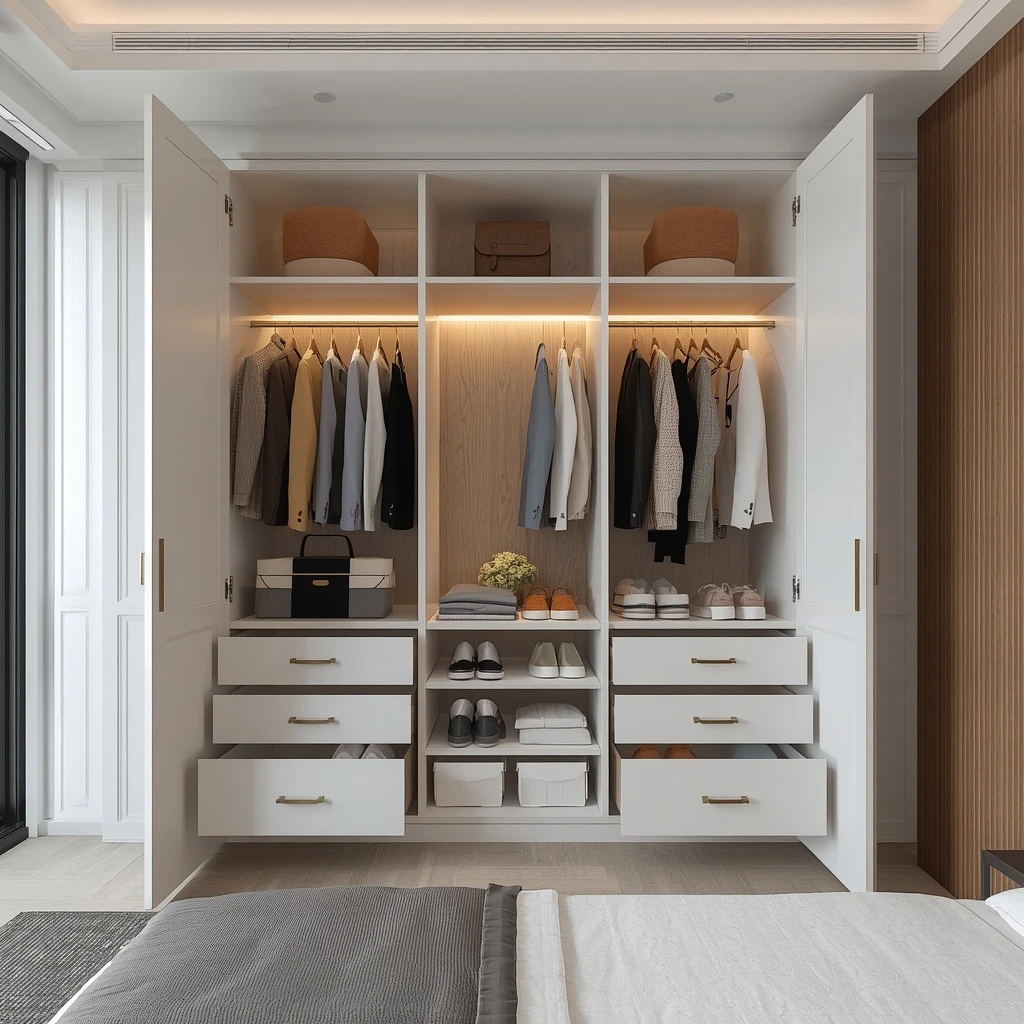
Walk into almost any Dubai apartment and open the built-in wardrobe. What do you find? Usually a single hanging rail, one fixed shelf above it, and a gaping empty column that stores nothing efficiently. We have seen this thousands of times across Marina, JVC, Business Bay, and every other residential community in the UAE. The wardrobe box is there. The interior fittings are not. If you are looking to remodel this space yourself, you can find excellent DIY carpentry tips and layout ideas on finehomebuilding to help turn that empty void into functional storage.
In 35 years and across more than 10,000 projects, Karnak Carpentry has helped Dubai homeowners transform those empty boxes into storage systems that genuinely work. This guide covers everything we have learned about choosing wardrobe interior fittings that maximize space, survive the UAE climate, and actually match how people live here. No generic advice. Just what works in Dubai apartments specifically.
Why Dubai Apartments Demand a Different Approach to Wardrobe Fittings
Most wardrobe advice you find online is written for European or American homes. Those environments have different wardrobes, different clothing needs, and critically, a completely different climate. Dubai apartments present a unique set of challenges that change what fittings you should choose and how they should be installed.
First, consider the humidity. Even with air conditioning running year-round, Dubai apartments experience significant humidity swings, particularly during summer and during the transitional months of April and October. That humidity gets trapped inside closed wardrobes. We have seen timber shelves warp, MDF panels delaminate, and metal fittings rust inside wardrobes that were installed without proper material selection or ventilation planning. The wrong fittings in a Dubai wardrobe do not just underperform. They deteriorate.
Second, Dubai residents typically have larger, more varied wardrobes than many cities would expect. Families maintain both modest and formal clothing, traditional and western wear, plus a seasonal shift between heavy fabrics for winter travel and the lightweight materials worn locally. That range demands a more sophisticated interior layout than a single rail provides.
Third, apartment sizes vary enormously. A studio in International City has fundamentally different wardrobe constraints than a four-bedroom in Emirates Hills. Getting the fitting selection right means understanding your specific space, not following a one-size formula.
The Climate Problem Nobody Talks About Enough
Humidity is the silent killer of wardrobe interiors in Dubai. We replaced a set of wardrobe fittings in a Jumeirah Beach Residence apartment three years ago where the original timber shelves had swollen so badly the drawers could not open. The apartment was always air-conditioned. The problem was not overall humidity. It was trapped humid air inside a sealed wardrobe with no ventilation gap and materials that absorbed moisture instead of resisting it.
For Dubai wardrobes, we recommend moisture-resistant MDF with melamine facing for shelves and drawer boxes, powder-coated or chrome-finished metal for rails and supports, and at minimum a 10mm ventilation gap at the back panel if the wardrobe is against an external wall. These are not premium upgrades. They are baseline requirements for a fitting that lasts.
Apartment Wardrobe Dimensions in Dubai: What You Are Actually Working With
Before choosing any fittings, you need to know your real dimensions. Not the nominal size on your floor plan, the actual interior measurements after the carcass is accounted for.
Most Dubai apartments have built-in wardrobe alcoves ranging from 180cm to 240cm wide and 55cm to 65cm deep. Ceiling heights vary between 260cm and 300cm in most developments, though older properties in Deira or Bur Dubai occasionally go lower. Those dimensions determine everything: whether you can run a double hanging zone, how many shelf tiers fit vertically, and whether a pull-out trouser rack is viable or will jam against the door.
We measure every wardrobe to the millimeter before specifying fittings. In one project in Downtown Dubai, what the developer called a 200cm wardrobe measured 193cm internally after panels. That 7cm difference meant reconfiguring the entire internal layout to keep the drawer units balanced.
The Core Wardrobe Interior Fittings and What Each Actually Does
Let us go through every category of wardrobe fitting with honest assessments of what works, what does not, and what makes sense specifically for Dubai apartment living.
Hanging Rails: Single, Double, and Why It Matters
The most common waste in Dubai apartment wardrobes is a single full-height hanging rail used for all clothing. That arrangement uses less than half the available vertical space for folded or shorter items.
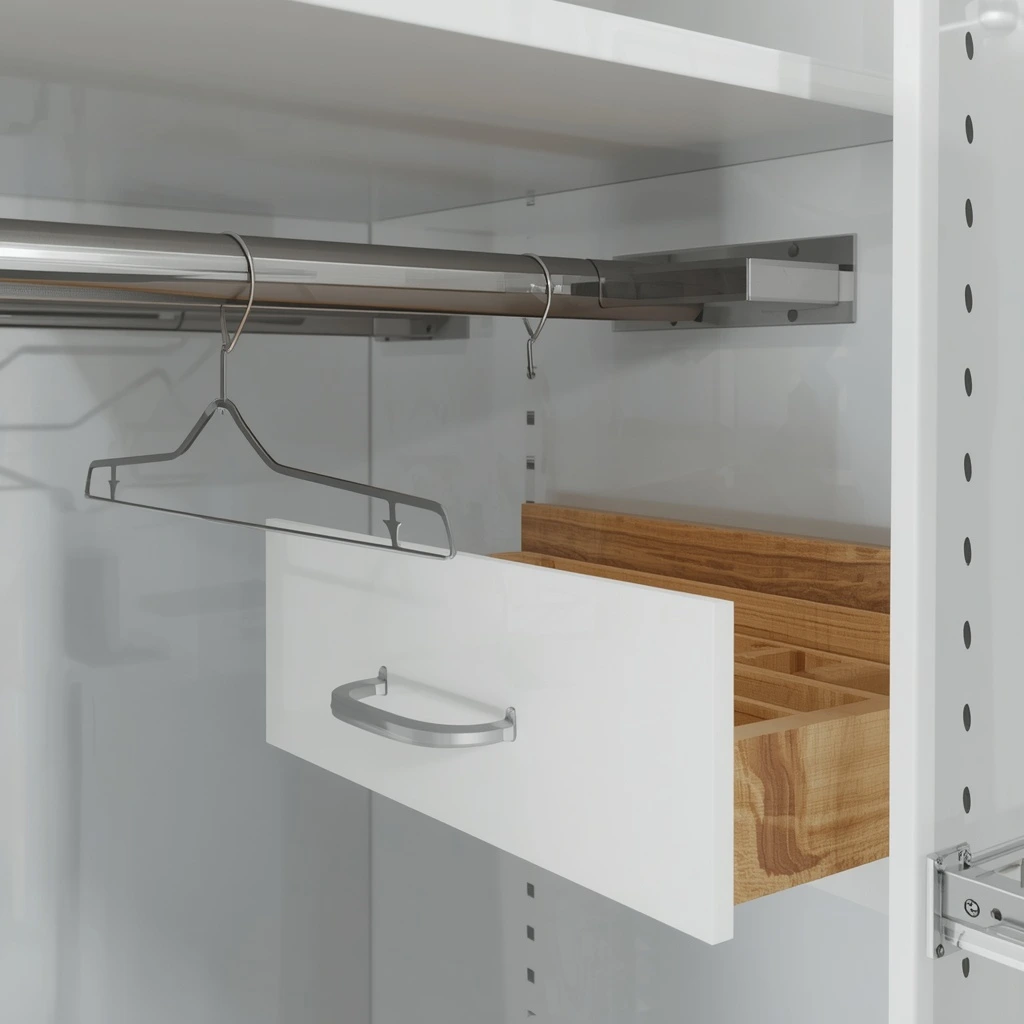
A double hanging configuration, two shorter rails stacked vertically, one for jackets and shirts, one for folded trousers or shorter dresses, effectively doubles the hanging capacity in any given width. For a 180cm wide wardrobe section, a double hanging zone can comfortably hold 60 to 80 garments compared to 30 to 35 on a single rail of the same width.
The rail itself matters. We use 25mm oval chrome rails in most projects because the oval cross-section allows hangers to slide smoothly and the chrome finish resists humidity far better than painted steel. For longer spans above 90cm, a center bracket is non-negotiable. We have seen rails sag and bow in wardrobes where the center support was skipped to save costs. That bowing creates permanent hanger marks on shoulders and eventually the rail fails.
For those who store heavy kandura or abaya collections, round rails at 25mm minimum diameter and spans no longer than 80cm between supports are our standard recommendation. Traditional dress in particular is heavy fabric that loads rails seriously.
Shelving Systems: Fixed, Adjustable, and When to Use Each
Fixed shelves are more stable and cheaper. Adjustable shelves are more flexible and slightly more expensive. For Dubai apartments where families grow, wardrobes get repurposed, and storage needs genuinely change, adjustable shelving using 5mm pin systems in side panels is almost always the better choice.
Shelf thickness matters more than most people realize. For spans above 60cm, use minimum 18mm thick shelving board. Below that, particularly in full-width wardrobe interiors where shelves run 180cm or more without a center support, you need either a 25mm shelf or a metal support rail underneath. We have corrected sagging shelves in probably 200 apartments where the original builder used 16mm board across a 120cm span. Over time, folded clothing, shoes, and bags create enough weight to bow the shelf permanently.
Shelf depth should match the zone. Full-depth shelves at 55cm are right for folded sweaters and bags. Shoe shelves work better at 35cm to 40cm, which also lets you see the shoes rather than push them to the back. Upper shelves above eye level can be 45cm and still hold suitcases and seasonal storage perfectly.
Drawer Units: The Most Used and Most Underspecified Fitting
After hanging rails, drawers are the highest-frequency contact point in any wardrobe. They are also the fitting that fails most often in Dubai apartments because of cheap runner hardware that cannot handle humid air expansion.
The runner mechanism is the most important specification decision you make when choosing drawers. There are three practical options for UAE conditions.
Epoxy-coated steel ball-bearing runners are the entry level. They work adequately in air-conditioned apartments but can corrode in high-humidity conditions over five to seven years. Acceptable for short-term rentals or secondary bedrooms.
Full-extension soft-close steel runners with a zinc coating are our standard residential specification. The full-extension feature means the entire drawer depth is accessible, which matters in a 55cm deep wardrobe. Soft-close prevents slamming, which over years of use damages the drawer box joints. These run around AED 85 to 140 per pair depending on load rating.
Undermount runners, where the mechanism is completely hidden beneath the drawer box, are the premium option. They allow a cleaner look, handle more weight, and are significantly more resistant to corrosion. Appropriate for master bedroom wardrobes and walk-in configurations where aesthetics and longevity both matter. Budget AED 180 to 280 per pair.
Drawer box construction also matters. Solid timber or high-density MDF with dovetail or Hettich Boxside profiles outperform the thin white melamine drawer boxes that developers install as standard. If someone tells you drawer boxes are all the same, they have never replaced a delaminated one in a five-year-old Jumeirah apartment.
Shoe Storage: A Genuine Problem in UAE Households
Dubai households typically own more shoes per person than the European average. This is not an assumption. It is something we observe in virtually every master bedroom project we complete. Factor in formal shoes, casual sandals, sports shoes, occasion footwear, and traditional styles, and a family of four can easily own 80 to 120 pairs that need organized storage.
Dedicated shoe fittings transform this situation. The options are:
Fixed tilted shoe shelves, angled between 15 and 20 degrees forward, display shoes visually and keep pairs together. Each shelf holds a row of 6 to 7 pairs depending on shoe size. These work well in defined shoe zones of 40cm depth.
Pull-out shoe racks on full-extension runners are more expensive but more accessible. Particularly useful in deeper wardrobes where fixed shelves at the back become difficult to reach. Each pull-out unit holds 8 to 12 pairs and reveals everything when extended.
Vertical shoe cubbies, individual compartments sized roughly 30 x 35cm, work well for boots, heels in boxes, or when members of the family want completely separate storage. Less efficient per cubic centimeter but excellent for organization.
For a family master wardrobe in the UAE, we typically plan a minimum of 90cm width dedicated to shoe storage, often more.
Specialty Fittings Worth Knowing About for Dubai Apartments
Beyond the core components, several specialty fittings consistently improve wardrobe function in Dubai apartment contexts. These are not luxury items. They are practical tools that solve specific problems.
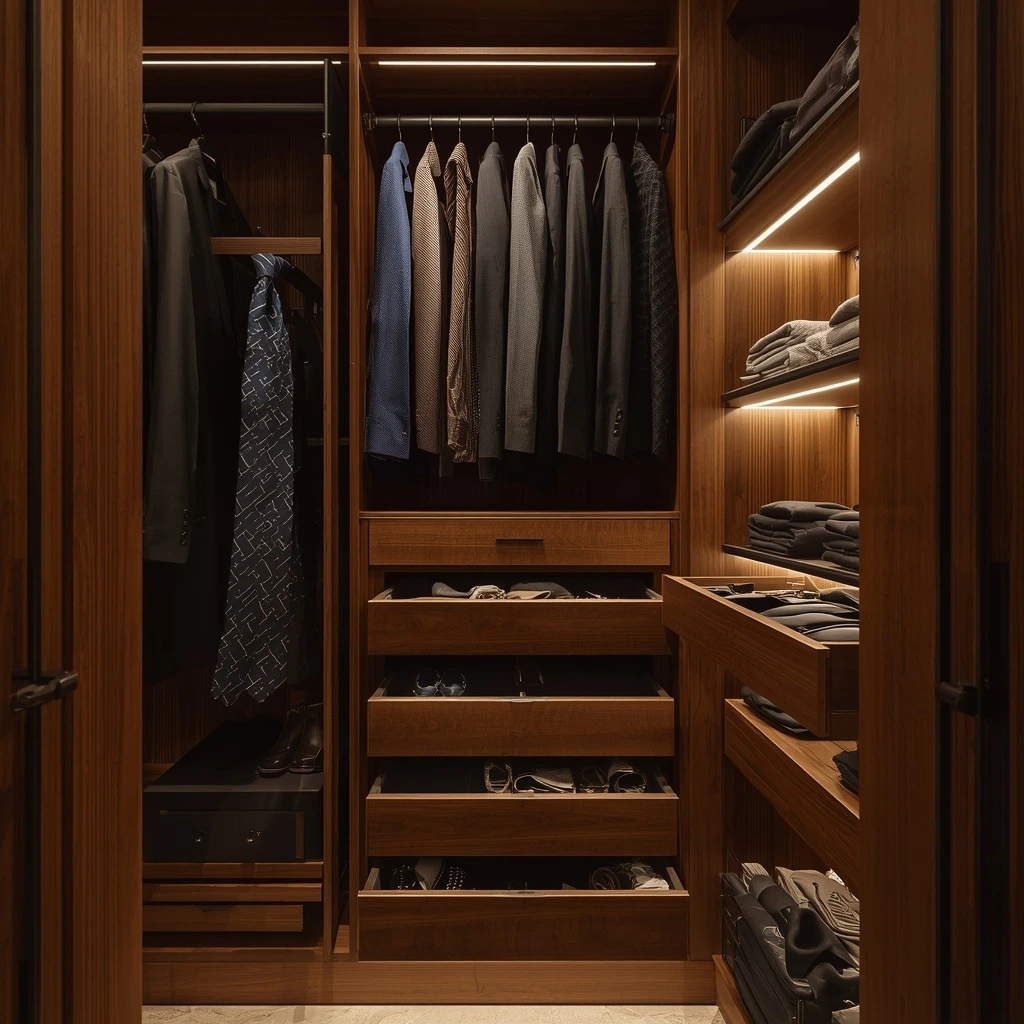
A pull-out trouser rack holds trousers flat over individual bars, preventing the creasing that stacking causes. For professionals in Dubai who maintain multiple suits and formal trousers, this fitting is genuinely useful. A 60cm wide pull-out rack holds 14 to 18 pairs of trousers and extends fully for access. Cost is approximately AED 350 to 600 depending on the manufacturer and the runner system. We use these in roughly 40% of master wardrobe projects we complete.
Belt, Tie, and Accessory Organizers
These small fittings make a real difference to daily routines. A pull-out tie rack in a 20cm wide drawer insert holds 20 to 30 ties and keeps them visible. Belt hooks mounted to a pull-out panel keep belts organized without tangling. Velvet-lined divider inserts in a standard drawer size separate watches, cufflinks, and small accessories far more effectively than any organizer box from a retail store.
These are typically integrated into existing drawer widths and cost between AED 150 and 400 per fitting depending on complexity.
Wardrobe Lighting
This comes up in almost every Dubai apartment project we do, and the answer is consistent. LED strip lighting inside the wardrobe is not a luxury. It is a practical necessity in any wardrobe that closes. A dark wardrobe in a Dubai apartment where the main bedroom lighting is warm and low means every morning starts with difficulty finding what you need.
PIR sensor-triggered LED strips that activate when doors open are the standard we recommend. They run on 12V DC, draw minimal electricity, produce almost no heat, and have a lifespan of 50,000 hours or more. Install cost including the transformer and sensor is typically AED 400 to 700 for a standard wardrobe, more for walk-in configurations.
The color temperature matters. We use 3000K strips for a warm, flattering light that shows clothing colors accurately. Cooler temperatures above 5000K make everything look slightly different from daylight conditions and can be tiring in a bedroom context.
Valet Rods and Pull-Out Hooks
A valet rod is a short horizontal rail that pulls out from the wardrobe side panel and extends into the room, allowing you to lay out the next day’s outfit or stage items before ironing. It folds back flush when not in use. In a Dubai apartment bedroom where space is limited, this small fitting replaces the need for a freestanding valet stand. Cost is around AED 120 to 250 per unit. We add these to nearly every master wardrobe now because once a client has one, they always want it in subsequent projects.
Wardrobe Interior Layouts That Work for Dubai Apartment Types
The right combination of fittings depends entirely on who uses the wardrobe, how the apartment is configured, and how much space you are working with. Here are the layouts that actually work across the most common Dubai apartment types.
Studio and One-Bedroom Apartments
Space is the primary constraint. In a JVC studio or a one-bedroom in Silicon Oasis, you typically have one wardrobe of 120 to 180cm width and you need it to do everything.
The layout we recommend: one third of the width as a double hanging zone for shirts, jackets, and folded trousers; one third as a combination of four to five drawers floor to upper mid-height with an adjustable shelf zone above; one third as shoe storage with tilted shelves and a hanging zone above for longer dresses or suits.
This layout fits within a 180cm wardrobe and handles the storage needs of a single person or couple without requiring additional furniture.
Two and Three-Bedroom Family Apartments
These apartments in areas like Arabian Ranches, Mirdif, or Springs villas sometimes offer more wardrobe depth, typically separate wardrobes per bedroom. In master bedrooms, the wardrobe is often 240cm to 300cm wide, which allows a more generous internal layout.
For families, we separate adult clothing zones clearly and often build a dedicated children’s section with lower rails, more drawers at reachable height, and toy or accessory storage at the bottom. Children’s wardrobes in Dubai apartments are frequently under designed because the original developer spec is generic. A properly fitted children’s wardrobe saves significant daily time.
Walk-In Wardrobe Conversions
Some Dubai apartment plans include a dressing room or a spare bedroom that can be converted to a walk-in wardrobe. This is increasingly common in the larger units in Palm Jumeirah, Dubai Hills, and DIFC area buildings.
Walk-in wardrobes have different fitting logic. You work in the space, so access, lighting, and a central island unit or seating become realistic additions. We plan walk-in wardrobes with island units containing deep drawers for folded items, perimeter hanging and shelving, a dedicated full-length mirror, and lighting that renders clothing color accurately. Budget for a full walk-in wardrobe fitting in a Dubai apartment conversion starts at AED 18,000 and scales based on size and specification.
Common Mistakes We See in Dubai Apartment Wardrobe Fittings
After 10,000 projects, the mistakes repeat themselves. These are the ones we encounter most often and what to do instead.
Mistake 1: Copying a Layout From a Pinterest Image Without Measuring
We see this constantly. A homeowner finds a beautiful wardrobe interior online, sends us the image, and asks us to replicate it. The problem is that image was designed for a wardrobe of different dimensions, different depth, and often a different climate context entirely. Blindly copying a layout without starting from your actual measurements and actual storage needs produces a wardrobe that looks similar but functions poorly.
Always start with an inventory of what you own and what you need to store, then design around that. Not the other way around.
Mistake 2: Underspecifying Rails for Kandura and Abaya Storage
Traditional dress is heavier than most rails are specified to handle at full load. A standard 25mm round chrome rail rated to 40kg per meter sounds adequate until you factor in that heavy kandura and thick abaya fabric, hung densely, can load a 90cm rail section to 30 to 35kg. That is fine if the rail is properly supported at both ends and at center. It is a problem if center brackets were skipped and the rail was specified as a lighter economy product.
We increased the rail specification on a project in Jumeirah after the client explained their clothing collection. The original spec would have failed within two years.
Mistake 3: Installing No Ventilation and Using the Wrong Materials
Already mentioned in the climate section but worth repeating as a common mistake category. Sealing a wardrobe with a back panel against an external wall, using untreated timber or standard MDF without moisture-resistant treatment, and not leaving air circulation gaps is a formula for deterioration. The wardrobe might look fine for two years. By year four in a Dubai climate, the problems become obvious.
Material specification for Dubai: always moisture-resistant MDF or CARB2-compliant particle board with full melamine coverage. Any timber components should be kiln-dried and sealed. No exceptions.
Mistake 4: Buying Fittings Retail and Installing DIY
Dubai has several furniture and storage retail stores where you can buy pull-out basket systems, rail kits, and shelf brackets. These are designed for general use and self-installation. They are not designed for the specific dimensions of your wardrobe, the specific load you will put on them, or the UAE climate.
We regularly receive calls to fix DIY fitting installations that have come loose, sagged, or failed after 12 to 18 months. The savings at purchase often disappear entirely in the repair or replacement cost. For a fitting that will be used every single day, a professional specification and installation is not a luxury. It is the rational choice.
Mistake 5: Ignoring Lighting Until After Installation
Lighting is far easier and cheaper to install during the initial fitting than retroactively. Adding LED strips to a completed wardrobe requires either surface-mounted channels that compromise the clean interior look or reopening sections to route cables properly. Budget for lighting at the design stage, not as an afterthought.
Mistake 6: Treating All Family Members’ Clothing as Identical in Planning
A wardrobe designed for one person’s habits does not work well for two. We always ask about both users when designing a master wardrobe. Who prefers hanging, who prefers folding, how many shoes per person, who needs more drawer space for accessories, whether both or only one use the wardrobe at the same time in the morning. That last question alone often determines whether a single access point works or whether a walk-in configuration with two sides becomes necessary.
What Wardrobe Interior Fittings Cost in Dubai: Honest Numbers for 2026
Pricing for wardrobe interior fittings in Dubai varies significantly based on materials, hardware quality, and installation complexity. Here are honest ranges based on current market conditions.
Entry Level: AED 1,800 to 3,500 per wardrobe
This covers a standard 180 to 200cm wardrobe with moisture-resistant shelving, a double hanging rail configuration, three to four drawers with standard ball-bearing runners, and adjustable shelf pins. No specialty fittings, no lighting. Appropriate for secondary bedrooms, rental properties, or budget renovations where longevity expectations are 5 to 8 years.
Mid-Range: AED 3,500 to 7,000 per wardrobe
This is where the majority of Dubai apartment master bedroom projects land. Includes full-extension soft-close drawers, dedicated shoe shelving, one or two specialty fittings such as a trouser rack or tie organizer, LED lighting with PIR sensor, and properly specified rails with center brackets. Material quality is good enough to last 10 to 15 years with normal use in an air-conditioned environment.
Premium: AED 7,000 to 15,000 per wardrobe
Premium projects use solid timber or high-grade MDF with veneer or painted lacquer finishes, undermount runners on all drawers, specialty fittings throughout, integrated lighting with dimming capability, a valet rod, pull-out mirror, and full custom specification. These are wardrobe systems designed to last 20 years or more and are typically found in Dubai Hills, Downtown, and Palm Jumeirah projects.
Walk-In Wardrobe Full Fit-Out: AED 18,000 to 55,000
Walk-in wardrobe projects vary enormously. A modest 3 x 3m conversion in a spare bedroom at entry to mid spec runs AED 18,000 to 28,000. A fully specified dressing room with island unit, custom lighting, mirror details, and premium hardware in a Palm Jumeirah or Jumeirah Golf Estates apartment can reach AED 45,000 to 55,000. These are fit-out figures including all fittings, carcass work, and installation.
What Drives Cost Up
Drawer quantity is one of the biggest cost variables. Each properly specified drawer adds AED 350 to 650 to the project. Specialty fittings such as pull-out shoe racks and trouser units each add AED 350 to 700. Lighting adds AED 400 to 1,200 depending on extent. Hardware brand matters significantly. European hardware from Hettich, Blum, or Grass costs two to four times the equivalent from unbranded Asian supply chains, but the performance and longevity difference is substantial in a UAE climate.
Karnak’s Expert Tips for Dubai Apartment Wardrobe Fittings
After 35 years fitting wardrobes across the UAE, these are the principles that consistently produce the best outcomes.
Tip 1: Audit your current clothing before designing anything.
Most people do not know exactly what they own until they take everything out. We ask clients to do this before the design consultation. Knowing you own 40 dress shirts, 15 suits, and 8 pairs of formal shoes changes the entire layout calculation. Design to what you actually have, plus 20% growth allowance.
Tip 2: Specify fittings by load, not by look.
A rail that looks identical to a proper rail but is rated to 20kg per meter instead of 40kg will fail eventually. Ask for load ratings on rails and drawer runners. Any supplier who cannot provide them is selling you a specification you cannot verify.
Tip 3: Choose full-extension on every drawer.
In a 55cm deep wardrobe drawer, the back 15cm is completely inaccessible without full extension. We have clients who discovered items they thought were lost when we replaced standard runners with full-extension hardware. That inaccessible space in a shallow-extension drawer is wasted storage.
Tip 4: Plan the lighting circuit during design, always.
Even if you decide not to install lighting immediately, have the cable routed during installation. A 30-minute addition during installation saves hours and complications later.
Tip 5: Do not match your rail finish to your handles without checking the humidity rating.
Some brushed gold and matte black finishes that look beautiful in a showroom are more susceptible to humidity dulling in Dubai conditions. Chrome, powder coat, and anodized aluminum are the most durable finish choices for UAE wardrobe hardware.
Tip 6: Build in a seasonal storage zone.
Dubai residents typically pack away heavier winter clothing for 8 to 9 months per year. An upper shelf zone or dedicated top section for suitcases and seasonal storage keeps that clothing protected and out of the daily-use area without taking premium accessible space.
Tip 7: Consider your daily routine, not your ideal routine.
The best wardrobe design fits how you actually use the space in a normal morning, not how you imagine you might. If you never hang shirts and always fold them, specifying more drawer space and less hanging makes more sense regardless of what looks balanced on a layout drawing.
Tip 8: Ventilation matters as much as fittings.
Leave a 50mm gap at the back panel if the wardrobe is on an external or wet wall. Install a passive ventilation channel at top and bottom if the wardrobe is fully enclosed. We have never seen a ventilated wardrobe develop the humidity-related damage that unventilated ones do.
Conclusion: Getting Your Dubai Apartment Wardrobe Right the First Time
The wardrobe interior fittings in a Dubai apartment determine how well that space functions every single day. Getting them right means starting from the real dimensions of your space, understanding the specific demands of UAE climate, specifying hardware that performs under those conditions, and designing the layout around what you actually own and how you actually live.
The core decisions are not complicated. Choose moisture-resistant materials. Specify rails with proper load ratings and center supports. Use full-extension soft-close runners on every drawer. Dedicate space for shoe storage that is genuinely proportional to your collection. Add lighting at the design stage, not later. Build in seasonal storage. And work with someone who has done this in Dubai specifically, not someone applying generic advice to a UAE context.
The difference between a wardrobe that works and one that frustrates you daily often comes down to decisions that add AED 1,500 to 3,000 to the project. Over ten years of daily use, that investment is straightforward to justify.
Key Takeaways:
- Moisture-resistant materials are not optional in Dubai wardrobes. They are the baseline specification for fittings that last.
- A double hanging configuration can double usable hanging capacity within the same wardrobe width.
- Full-extension soft-close runners make accessible every centimeter of drawer depth.
- Shoe storage in UAE households consistently needs more space than the original developer wardrobe provides.
- LED lighting with a PIR sensor is a practical daily-use fitting, not a luxury addition.
Need Expert Help With Your Dubai Apartment Wardrobe?
Karnak Carpentry has been designing and fitting wardrobe interiors across the UAE since 1988. Our team has completed more than 10,000 projects in Dubai, Abu Dhabi, and Sharjah, across every apartment type from studios in JVC to penthouses in Downtown and Palm Jumeirah. We provide free site consultations where we measure your actual space, audit your storage needs, and propose a layout and specification that works for your budget and your life. No generic showroom spec. Just a fitted wardrobe designed around your apartment and how you use it.
Contact: +971-52-5554207 | info@karnakcarpentry.com
Frequently Asked Questions About Wardrobe Interior Fittings for Dubai Apartments
Which wardrobe interior fittings maximize storage space?
Pull-out drawers, adjustable shelves, double hanging rails, shoe racks, pull-out baskets, corner storage units, and overhead compartments help you use every inch of available space efficiently.
How should I organize a built-in wardrobe for maximum storage?
Divide the wardrobe into dedicated zones for hanging clothes, folded garments, shoes, accessories, luggage, and seasonal items. A structured layout improves accessibility and reduces clutter.
Are adjustable shelves better than fixed shelves?
Adjustable shelves provide greater flexibility because you can change their height as your storage needs evolve. Fixed shelves work well for storing items with consistent dimensions.
Should I install double hanging rails?
Double hanging rails allow you to store shirts, jackets, trousers, and shorter garments on two levels. This arrangement significantly increases hanging capacity in compact wardrobes.
Which drawer fittings improve wardrobe organization?
Soft-close drawers with dividers, jewelry trays, watch organizers, and accessory compartments keep smaller items neatly arranged while making them easy to access every day.
Do pull-out shoe racks save space?
Yes. Pull-out shoe racks organize footwear vertically, improve visibility, and free valuable floor space inside the wardrobe. They also make it easier to reach shoes stored at the back.
Which wardrobe accessories add the most convenience?
Tie racks, belt holders, pull-out mirrors, trouser racks, laundry baskets, valet rods, and LED lighting improve daily usability while keeping clothing and accessories organized.
Can LED lighting improve a wardrobe interior?
Integrated LED lighting brightens dark corners, improves visibility, and creates a premium appearance. Motion-sensor lighting also increases convenience while reducing energy consumption.
How should I use the upper section of a wardrobe?
Reserve overhead storage for luggage, blankets, travel bags, seasonal clothing, and rarely used household items. This approach keeps everyday essentials within comfortable reach.
Which wardrobe fittings work best in small Dubai apartments?
Sliding doors, pull-out storage systems, adjustable shelves, corner organizers, and floor-to-ceiling cabinets maximize storage without occupying additional floor space.
Should I include drawers or shelves in my wardrobe?
Combine both whenever possible because drawers protect smaller items while shelves accommodate folded clothing, handbags, storage boxes, and larger accessories. A balanced layout provides greater flexibility.
Which hardware should I choose for wardrobe interiors?
Soft-close hinges, premium drawer runners, heavy-duty hanging rails, and durable pull-out mechanisms provide smoother operation and longer service life than budget hardware.
Can custom wardrobe fittings increase property value?
Well-designed wardrobe interiors improve storage efficiency, enhance daily convenience, and create a premium appearance that many buyers appreciate when evaluating a home.
How do I choose the right wardrobe interior layout?
Consider the type of clothing you own, your storage habits, available room dimensions, and future needs before selecting interior fittings. A personalized layout delivers better organization than a standard configuration.
Which wardrobe interior design offers the best long-term value?
A custom layout with adjustable shelves, premium hardware, pull-out storage, dedicated accessory organizers, double hanging rails, and overhead compartments provides outstanding functionality while adapting easily to changing storage requirements over time.
Related Articles
- Wardrobe Interior Fittings: What to Choose for Maximum Storage in Dubai Apartments
- How to Spot Poor Quality Carpentry Work Before You Pay: A Master Craftsman’s Guide for UAE Homeowners
- DIY vs Professional Carpenter in Dubai: When Each Makes Sense
- Built-In vs. Freestanding Wardrobe in Dubai: Which One Actually Works for Your Home?