
Blog
The Complete Guide to Hardwood Flooring Installation in Dubai Apartments

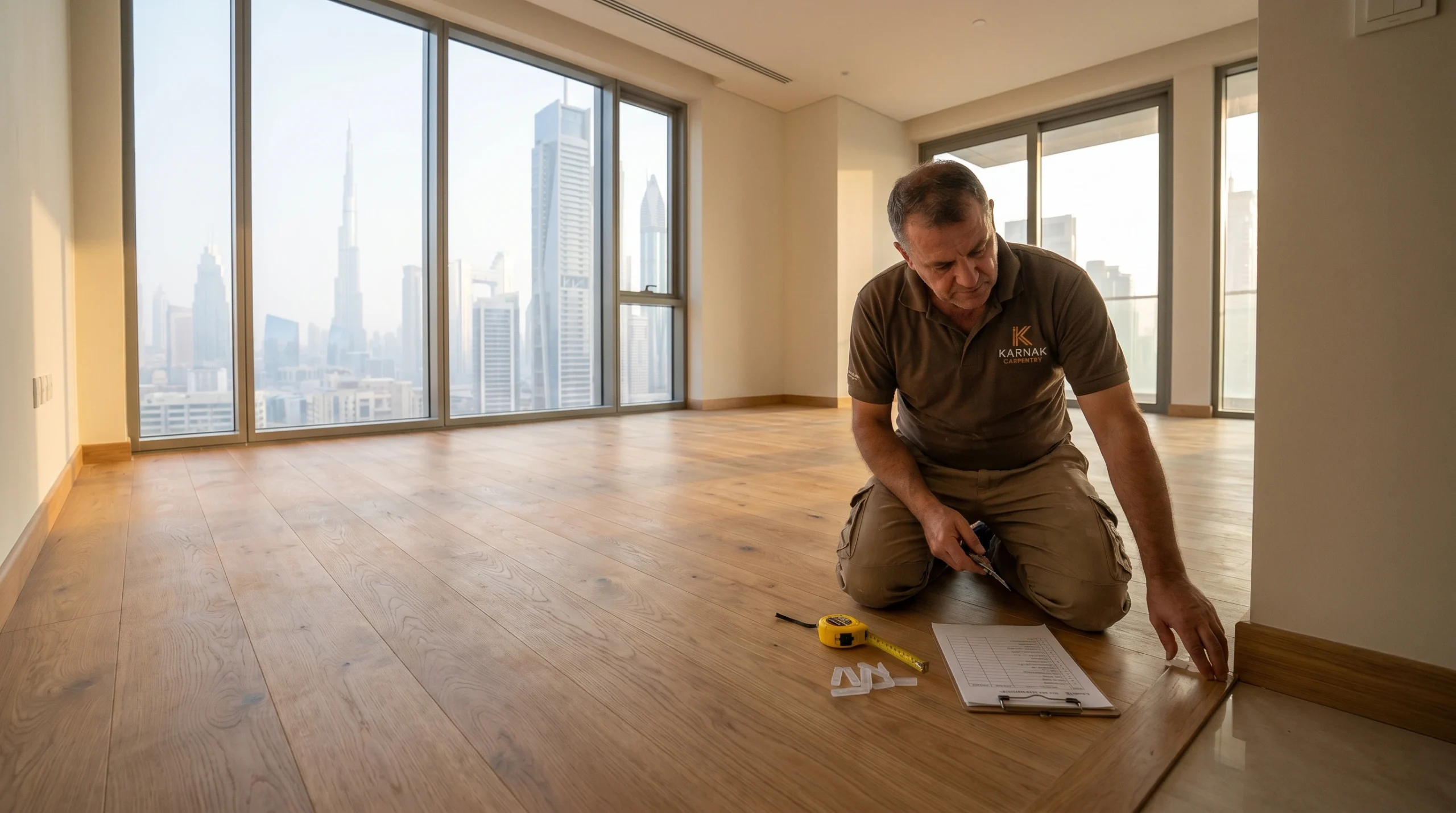
In 35 years of fitting floors across Dubai, we have pulled up more failed hardwood flooring installation Dubai than we care to count. Swollen planks in Marina apartments. Cupped boards in Jumeirah villas. Gaps so wide you could lose a 50-fils coin between them. Every single one of those failures had the same root cause: someone installed a European or American product in a Dubai climate without understanding what that actually means. This guide exists so that does not happen to you.
Karnak Carpentry has completed over 10,000 projects across the UAE since 1988. A significant portion of those projects involve wood flooring, from the grand entrance halls of Emirates Hills mansions to compact one-bedroom apartments in JLT.
We have seen every mistake, solved every problem, and developed approaches that work specifically here, not in London or New York, but in a city where summer humidity swings from 30% to 95% and air conditioning runs nine months a year conditions well documented by local sources such as Khaleej Times. What follows is the honest, complete picture.
Why Hardwood Flooring in Dubai Requires a Completely Different Approach
Most flooring guides you will find online were written for temperate climates. The advice is not wrong exactly. It is just irrelevant to the UAE. Applying it here is like following driving directions for Manchester when you are trying to navigate Abu Dhabi. The destination looks the same on paper. The reality is entirely different.
Dubai’s climate creates two problems that do not really exist together anywhere else in the world. First, extreme outdoor humidity during summer, particularly from June through September when relative humidity regularly sits above 85% and spikes to near 100% during shamal periods. Second, extreme indoor dryness from aggressive air conditioning that drops interior humidity to 30% or below in many apartments. The wood in your floor lives through both of these environments constantly, and it responds to moisture the way wood always has: it expands when wet and contracts when dry.
Solid hardwood flooring moves roughly 1mm per meter of board width for every 4% change in relative humidity. In a Dubai apartment cycling between 30% and 75% humidity across a year, that movement across a 4-meter room adds up to roughly 11mm of total expansion and contraction. If your installation does not account for that, the floor will tell you about it, loudly and expensively.
The Humidity Problem in Real Numbers
Let us make this concrete. In 2019, we were called to assess a Marina apartment where the owner had commissioned a direct-fix solid oak installation the previous year. The installer was experienced and the timber was quality European white oak, 18mm solid boards. The installation looked beautiful in January when the AC was running steadily. By August, the owner had visible ridging across multiple rows, a condition called cupping, where board edges push upward because the underside is absorbing more moisture than the top surface.
The repair cost more than the original installation. We replaced the full floor with engineered oak using a floating installation method, with a specified gap protocol and a humidity management plan. Four years on, that floor still looks perfect.
The numbers that matter for Dubai installations: indoor relative humidity should ideally stay between 40% and 60% for hardwood flooring to remain stable. Most Dubai apartments without humidity control systems sit at 35% to 42% in winter and 55% to 70% in unconditioned periods. If your AC system runs continuously and your apartment is well sealed, you are closer to the manageable range. If you leave windows open during humid periods or if your AC cannot keep up with a top-floor apartment in August, you need to plan your floor choice accordingly.
Solid Wood vs. Engineered: The Dubai Verdict
We get this question on almost every project. Clients see solid hardwood and want it because it feels authentic, it can be sanded multiple times, and there is a perception of it being superior. Engineered hardwood looks identical once installed. On most Dubai apartment projects, engineered is the honest recommendation.
Engineered hardwood is a real wood product. The top layer, called the wear layer or lamel, is genuine hardwood, typically 3mm to 6mm thick on quality products. Beneath that are multiple layers of plywood or HDF core, oriented in alternating grain directions. This cross-ply construction dramatically reduces the wood’s tendency to move with humidity changes. A quality engineered board might move 30% as much as a comparable solid board under the same conditions.
Solid hardwood is not wrong for Dubai, but it requires specific conditions: a stable humidity environment maintained consistently, a floating or semi-floating installation method with correctly engineered expansion gaps, and acclimatization done properly before installation. We have installed solid hardwood successfully across hundreds of Dubai projects, including a 600 sqm solid teak floor in a Jumeirah villa that has performed flawlessly for eight years. The conditions there were right. The methodology was right. We knew what we were doing.
The honest guide does not tell you one is always better. It tells you to match the product to the specific conditions of your space.
Choosing the Right Wood Species for Dubai Conditions
Not all hardwoods perform the same in humid climates. Species have different density ratings, different stability profiles, and different moisture resistance characteristics. Getting this wrong is expensive.
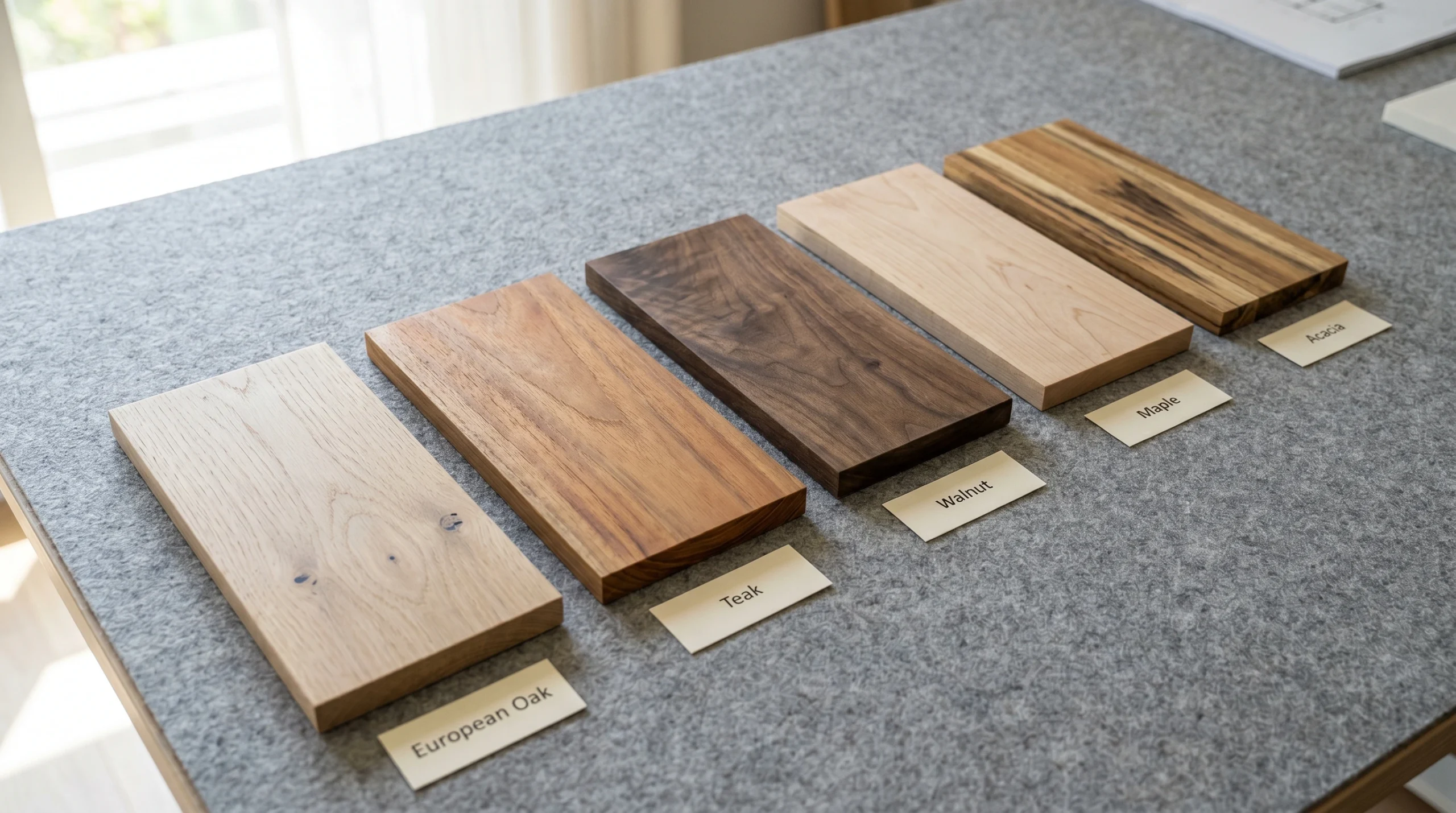
European Oak: The Workhorse of Dubai Installations
European white oak is the species we specify most often for Dubai projects, and for good reasons. It sits at a Janka hardness rating of around 1,360, which means it handles furniture movement and daily traffic well without denting easily. More importantly, oak has a relatively low shrinkage coefficient for a hardwood, meaning it moves less per unit of humidity change compared to species like maple or beech.
Oak also takes finishing exceptionally well. Dubai clients tend to favor either natural/light oil finishes that show the wood’s character, or hardwax oil finishes that offer better moisture resistance at the surface level. We typically specify a UV-cured factory finish for Dubai installations because it provides more consistent protection than site-applied finishes in a construction environment.
Expect to pay between AED 180 and AED 380 per square meter for quality European oak engineered boards, supply only. The wide price range reflects wear layer thickness (3mm vs 6mm matters enormously for longevity), grade (rustic, character, or prime/select), and plank format.
Teak: The Traditional UAE Choice
Teak has been used in this region for centuries, and there is a reason for that. Its natural oil content makes it inherently more moisture-resistant than most other hardwoods. Teak is a practical choice for areas with higher humidity exposure, such as a bathroom-adjacent bedroom or a covered balcony area where some moisture ingress is possible.
The drawbacks of teak for interior flooring are real. It is genuinely difficult to glue because those same natural oils resist adhesives. Any installation using teak requires specific adhesive formulations and sometimes surface preparation of the wood itself. It is also harder to source in consistent grades and widths, and prices have risen considerably over the past decade. Budget AED 280 to AED 500 per sqm for quality teak boards, and ensure your contractor has specific experience with teak installation.
Walnut, Maple, and Other Species
American black walnut has gained popularity in Dubai’s premium residential market over the past five years, driven by its distinctive chocolate-brown tones and the general trend toward darker, richer interiors. It is softer than oak (Janka 1,010), which concerns us slightly in high-traffic areas, but in a master bedroom or study it performs beautifully. The color also shifts noticeably with UV exposure, lightening over time. In a Dubai apartment with significant natural light, expect visible color change within the first two years.
Maple is exceptionally hard and takes a beautiful finish, but it is one of the more dimensionally unstable species and we rarely recommend it for Dubai’s climate without very careful humidity management in place. Acacia and mango wood, popular in budget flooring segments, are typically sold as engineered products and can perform adequately, but quality control is inconsistent across suppliers and we have seen significant variation in the actual wear layer thickness claimed versus delivered.
The Installation Process: What Actually Happens in Your Apartment
Understanding the process helps you manage your project better, make smarter decisions, and spot problems early. Here is what a proper hardwood flooring installation in a Dubai apartment looks like, step by step.
Stage 1: Site Assessment and Acclimatization (7 to 14 Days Before Installation)
Every proper installation begins with assessment, not purchasing. Before you commit to a specific product, the subfloor condition needs to be evaluated. In Dubai apartments, the subfloor is almost always concrete screed. We test for moisture using a carbide bomb test or a calibrated electronic moisture meter, and the reading must come in below 75% relative humidity (equivalent to roughly 3.5% moisture content in the screed) before any wood product goes down.
We have walked away from projects where the client wanted to start immediately but the screed was reading 85%+. That situation is common in newly completed buildings or after any water leak or pipe work. Rushing past it means a failed floor. Full stop.
Once materials are on-site, they need to acclimatize to the apartment’s actual conditions. This means the boxes of flooring, opened and ideally with boards stacked with spacers for airflow, sitting in the apartment with the HVAC running at its normal operating settings for a minimum of 7 days, ideally 14. We have had clients push back on this timeline because their fit-out contractor wants everything done in ten days total. Our answer is always the same: the acclimatization period is non-negotiable, and any contractor who skips it is setting up a future problem.
Stage 2: Subfloor Preparation
This is the stage that separates excellent installations from average ones, and it is almost entirely invisible once the floor is down. The concrete subfloor needs to be flat to within 3mm over a 1.8-meter span for a floating installation, and 2mm over the same span for a glue-down installation. Those are real tolerances with real consequences.
High spots in the screed create pressure points where boards will creak and eventually crack. Low spots mean boards are unsupported and will flex underfoot, eventually failing at the joints. We grind high spots and fill low spots using a quality levelling compound, typically Mapei or Ardex products. This stage alone can add AED 15 to AED 35 per sqm to a project cost, but cutting it is one of the top causes of installation failure we see when we are brought in to fix other contractors’ work.
A moisture barrier, typically a polyethylene sheet at minimum 200 microns for floating installations, goes down before any underlay or boards. In ground-floor apartments or those above car parks, we specify a more robust barrier, often an epoxy-based moisture membrane applied directly to the screed.
Stage 3: The Installation Itself
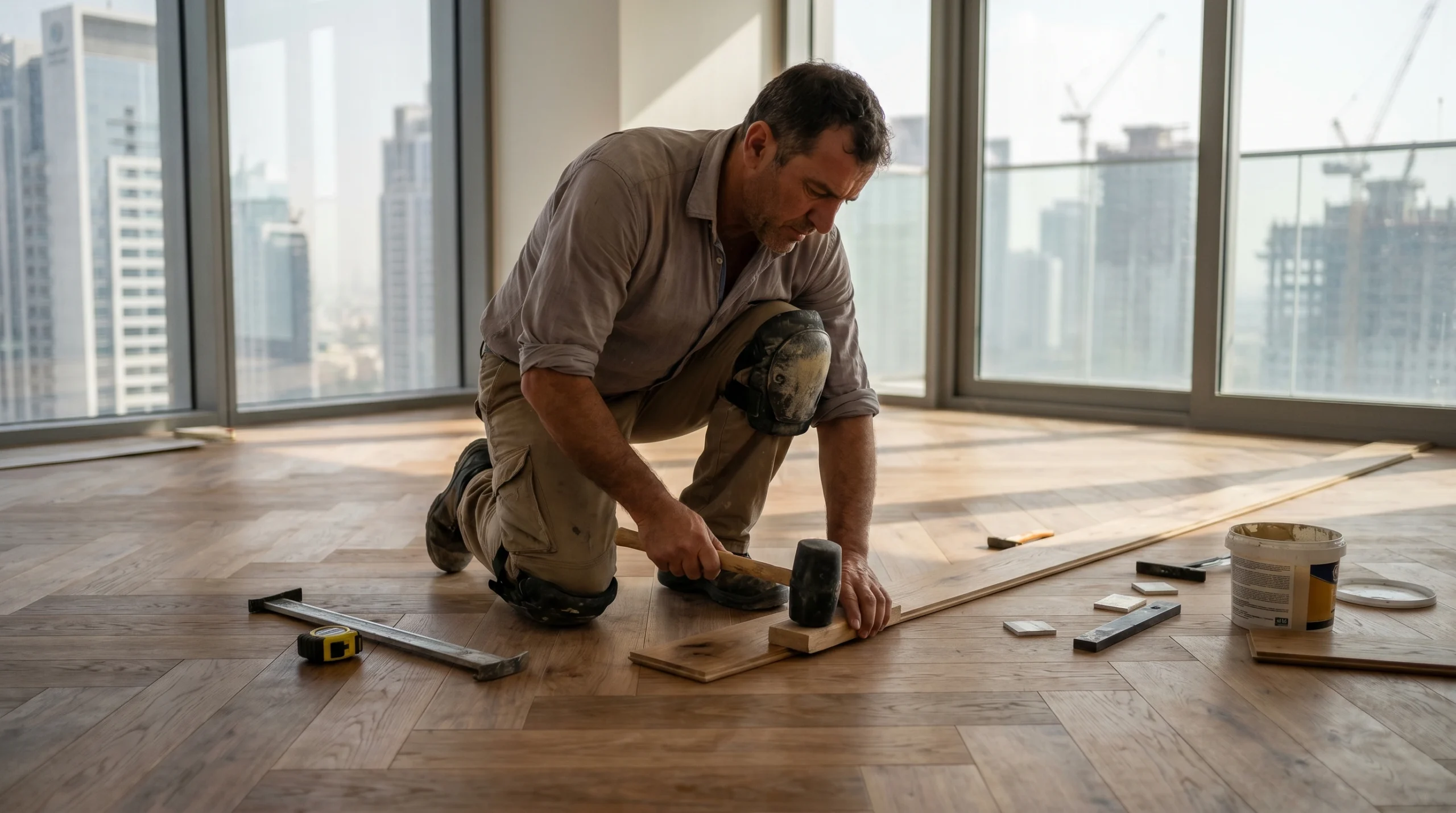
Depending on the chosen method, installation day proceeds differently. For floating installations, boards click together and the entire floor essentially floats on top of the underlay, with a perimeter expansion gap of 10mm to 15mm around all fixed edges including walls, door frames, columns, and any fixed cabinetry. That gap gets covered by skirting boards or beading. Do not let anyone convince you the gap can be smaller to save on beading. The floor needs that space.
For glue-down installations, which we use for herringbone and other complex patterns as well as for solid wood over radiant heating systems, a notched trowel applies adhesive in consistent ridges, and each board is pressed firmly into position. This method is slower, more skill-dependent, and more expensive in labor, but it produces a more solid, quieter floor with no flex.
Herringbone and chevron patterns, both very popular in Dubai premium residential projects currently, require glue-down installation because the diagonal orientation of the boards means there is no continuous locking direction for a floating system. They also require significantly more material (allow 10% to 15% waste versus 7% for straight-lay patterns) and substantially more labor time. A herringbone floor costs roughly 35% to 50% more in total installed cost compared to the same timber in straight planks.
Stage 4: Finishing, Sanding, and Handover
If you have chosen pre-finished boards, the floor is essentially complete after installation and expansion gaps are addressed. A light cleaning and inspection, and the space is ready for light foot traffic within 24 hours.
Site-finished floors, where sanding and finishing happen after installation, require significantly more time. Sanding typically takes one to two days for a standard apartment. First finish coat, light denib, second coat, cure time. You are looking at a minimum of four to five days from end of board installation to a fully cured, furniture-ready floor. The advantage is a completely seamless finish because the entire surface is finished as one continuous plane. For herringbone and complex patterns, this seamless finish makes a visible quality difference.
Dubai Building Regulations and Building Management Rules
This is a section most flooring guides skip entirely, and it catches people off guard.
RERA and Developer Guidelines
Dubai’s Real Estate Regulatory Authority does not specifically regulate flooring materials in apartments, but individual master developers and building management companies often do. In many buildings, particularly those managed by Emaar, DAMAC, and Nakheel, there are specific rules about flooring in apartments above ground floor. The most common restriction involves impact sound transmission, and hardwood flooring directly on concrete can fail impact sound tests.
Before committing to any flooring project in a managed building, request the fit-out guidelines from your building management. This is a free document that specifies approved installation methods, required underlay specifications, permitted working hours for contractors (almost always 8am to 5pm Saturday through Thursday in residential buildings, with no work on Fridays or public holidays), and what building approvals are needed before work starts.
We have seen projects stopped mid-installation by building security because the owner did not obtain the required NOC (No Objection Certificate) from building management before work started. The contractor must typically provide proof of insurance, trade license, and sometimes a damage deposit. Factor this into your timeline. Getting the NOC in Dubai residential buildings typically takes three to seven working days.
Impact Sound Requirements
The UAE building code references acoustic performance standards, and many buildings have specific requirements for flooring systems in terms of impact sound reduction. A quality acoustic underlay, rated at a minimum 19dB impact noise reduction, addresses this for floating installations. For glue-down systems, a thin acoustic membrane is used instead.
This matters not just for compliance but for your relationship with your downstairs neighbor. A floating hardwood floor on a minimal underlay creates impact noise that transmits clearly through concrete slabs. The extra AED 8 to AED 15 per sqm for a proper acoustic underlay is worth every dirham.
Common Mistakes We See on Dubai Hardwood Flooring Projects
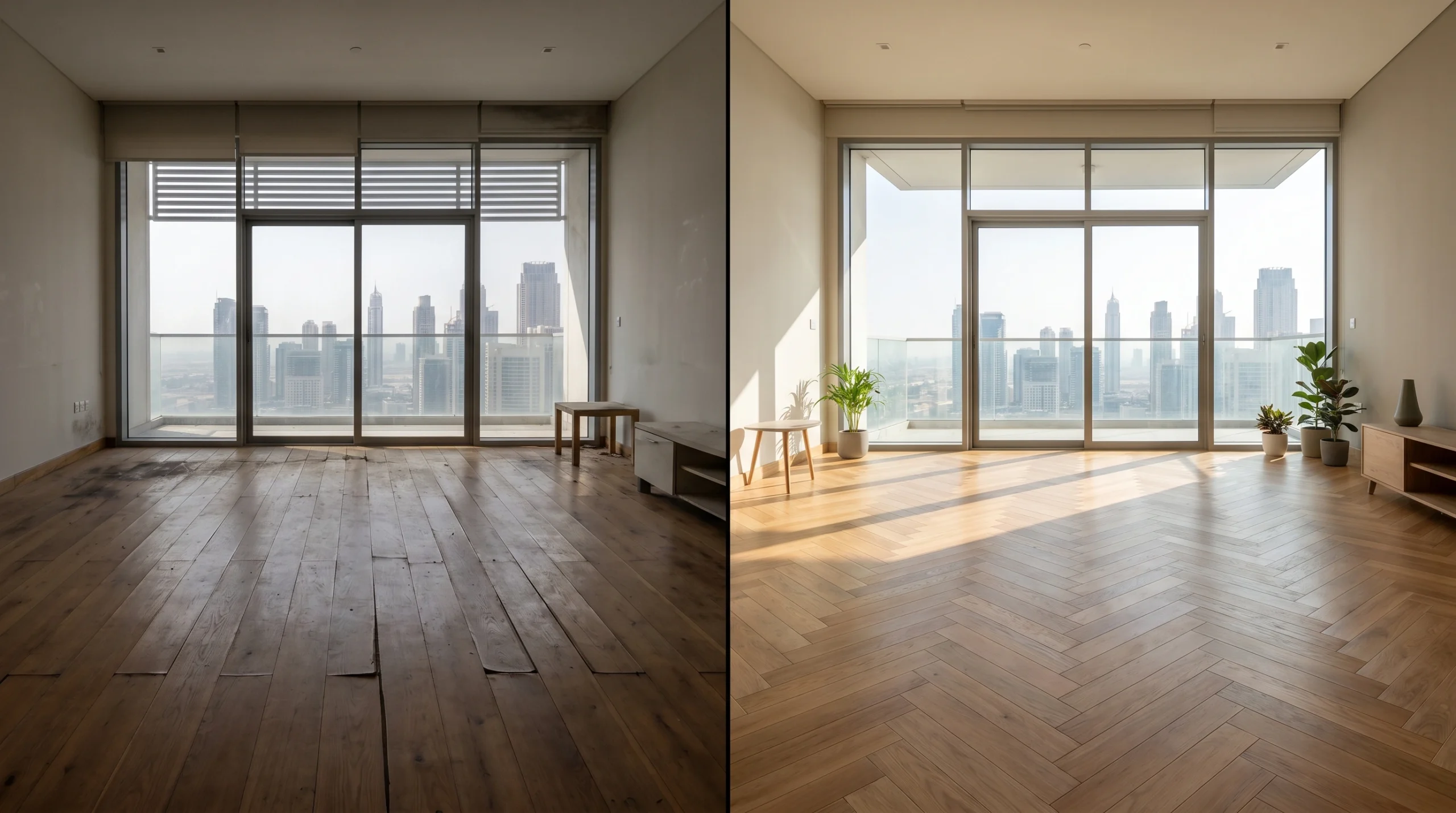
After 35 years and over 10,000 projects, the failures follow patterns. These are the ones we encounter repeatedly.
Mistake 1: Skipping or Rushing Acclimatization
This is the most common cause of failure we see. A contractor wants to start Monday, materials arrive Thursday, installation begins Friday morning. Four days of partial acclimatization in a space that may not even have been running AC consistently. The wood is installed in a state that does not reflect its equilibrium moisture content for the apartment’s actual conditions.
What happens next depends on whether the installed moisture content is above or below equilibrium. If the wood is wetter than the environment (common when materials are stored in a warehouse with poor climate control), it will shrink after installation, creating gaps. If it is drier (less common but possible with imported materials from cold climates arriving in summer), it will expand and potentially buckle.
The fix is the same as the prevention: proper acclimatization in the actual installation environment with HVAC running normally for at least seven days.
Mistake 2: Ignoring Subfloor Moisture
Dubai concrete screeds hold moisture. New builds are notorious for this. A screed that was poured eight weeks ago and has been sealed in a closed, un-air-conditioned apartment can read moisture levels that will destroy a wood floor in six months.
The fix: test with a calibrated meter or carbide bomb test, not a cheap pin meter. If readings are above acceptable levels, either delay installation, improve ventilation and run AC to dry the screed, or apply an epoxy moisture barrier rated for the specific reading you have measured. Quick solutions using standard DPM products do not work above certain moisture levels and give false confidence.
Mistake 3: Insufficient Expansion Gaps
We see this constantly, particularly with floating installations. The fitter runs the floor tight to the wall because it looks neater before skirting goes on, or leaves a 5mm gap when 12mm is needed. The skirting goes on, covering the gap, everything looks fine, and then summer arrives.
A solid oak floor in a 6-meter wide room needs approximately 18mm of total expansion accommodation across the width. If the gap is only 5mm, the floor has nowhere to go. It buckles upward in the middle of the room, which is both visually dramatic and expensive to repair.
Every doorway, every fixed cabinet, every column, every island base needs a gap. We use a rubber spacer system during installation to maintain consistent gaps throughout.
Mistake 4: Using the Wrong Adhesive for Glue-Down Installations
Standard tile adhesives, construction adhesives, and even some products marketed as flooring adhesives are not appropriate for hardwood glue-down installations. The adhesive must be specifically formulated for wood flooring, with sufficient elasticity to accommodate the wood’s seasonal movement while maintaining bond strength.
We specify silage or MS polymer-based adhesives for virtually all our glue-down work. Products like Bostik’s Ultraset or Mapei’s Ultrabond ECO range are appropriate. Cheap alternatives set too rigid and either cause the boards to crack, cause the adhesive to fail and boards to lift, or in some cases actually prevent the natural movement and cause the boards themselves to split along the grain.
Mistake 5: Wrong Underlay Specification
Not all underlays are equal and the spec matters for both performance and compliance. For floating installations in Dubai apartments above ground floor, you need an underlay that addresses three things: moisture protection from below, acoustic performance for impact sound, and sufficient compression resistance to support the floor without excessive flex.
Cheap foam underlays sold in hardware stores address none of these adequately. A 2mm foam underlay will compress to almost nothing under furniture legs, creating low spots that stress the locking joints of floating floors. Specify a combination underlay with a foil moisture barrier bonded to a dense foam or cork layer, minimum 3mm, with a compression strength specification appropriate to your floor traffic.
Mistake 6: Not Managing Post-Installation Humidity
The floor is installed. It looks perfect. You move in, put the AC on full blast in summer, and never think about the humidity in your apartment. By year two, gaps have appeared between boards during the dry winter months. The floor has not failed exactly, it is doing what wood does, but the movement is larger than it should be because the indoor environment is consistently too dry.
A whole-apartment humidifier, or even a room-specific humidifier in the main flooring area, maintaining 45% to 55% relative humidity year-round will significantly reduce the seasonal movement of any wood floor. This is standard advice in cold climates where central heating dries the air. It is less discussed in Dubai but equally relevant given the dehumidifying effect of continuous air conditioning.
Hardwood Flooring Cost Guide for Dubai Apartments, 2026
Pricing in the Dubai flooring market is genuinely confusing because there is enormous variance in material quality at every price point. Here is an honest breakdown.
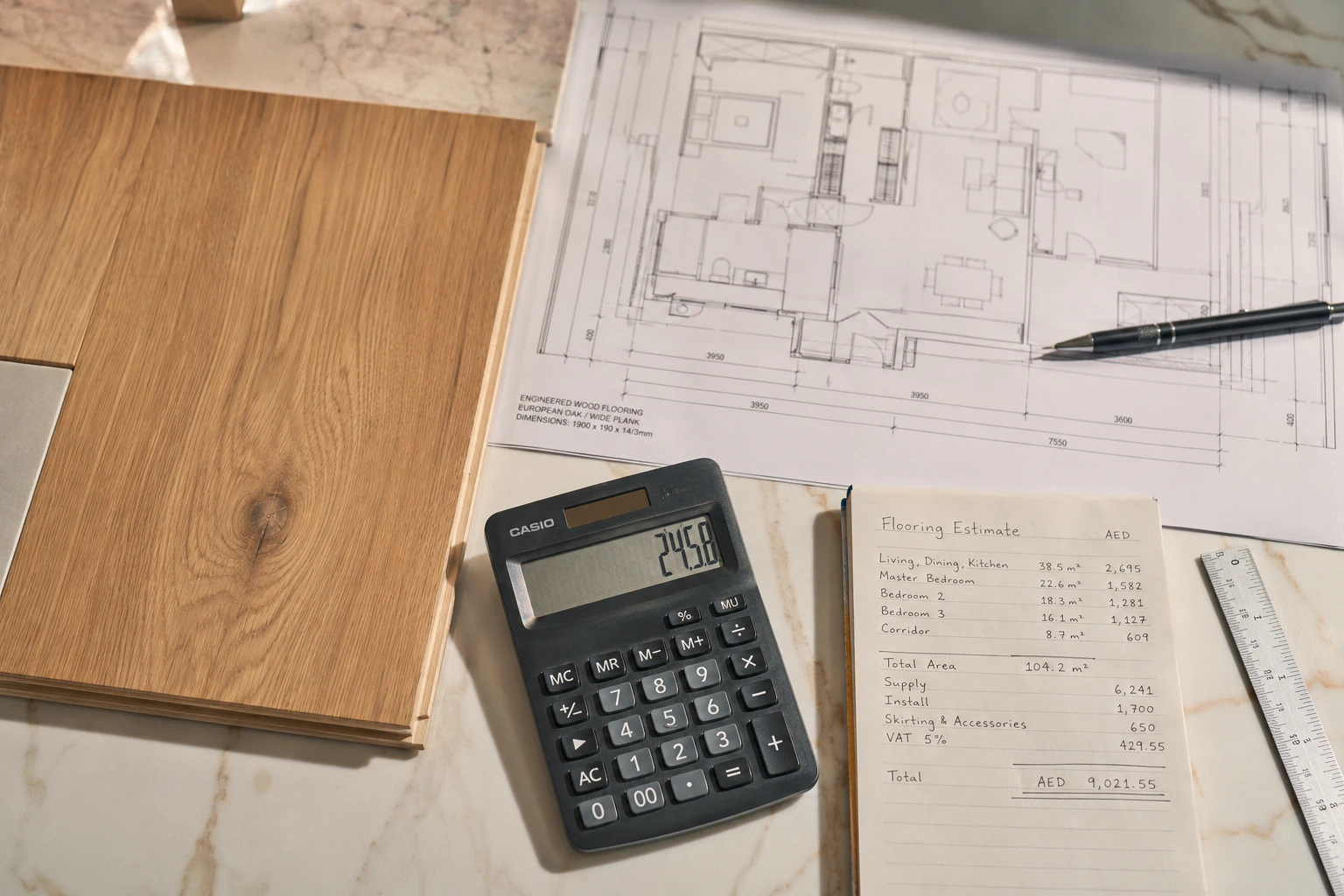
Material Costs (Supply Only, Per Square Meter)
Entry-level engineered wood
(3mm wear layer, HDF core, standard widths): AED 120 to AED 180 per sqm. These products can perform adequately in stable conditions but offer limited sanding potential and inconsistent quality control. We supply and install these for clients with strict budget constraints, but we explain the trade-offs clearly.
Mid-range engineered hardwood
(4mm wear layer, quality plywood core, wider planks): AED 180 to AED 320 per sqm. This is the sweet spot for most Dubai apartment projects. Products from established European manufacturers including Boen, Haro, and Quick-Step’s upper ranges, as well as quality regional distributors, fall here.
Premium engineered hardwood
(5mm to 6mm wear layer, premium species, wide plank or herringbone format): AED 320 to AED 600 per sqm. These are products that you sand and refinish two or three times over a twenty-year period and they look better each time. Justified for long-term ownership, high-quality finishing, or prestige projects.
Solid hardwood
(18mm to 20mm thickness): AED 220 to AED 500 per sqm depending on species and grade. Remember the installation constraints discussed above before choosing solid over engineered.
Installation Costs (Labor and Materials, Per Square Meter)
- Floating installation (including underlay, moisture barrier, basic gap management): AED 45 to AED 75 per sqm.
- Glue-down installation (including adhesive, acoustic membrane): AED 65 to AED 95 per sqm.
- Herringbone or chevron pattern (glue-down, including pattern setup): AED 90 to AED 130 per sqm labor.
- Subfloor levelling (if required, using levelling compound): AED 15 to AED 35 per sqm additional.
- Skirting boards and beading: AED 25 to AED 60 per linear meter depending on profile and material.
Total Installed Cost Examples
A 100 sqm Dubai apartment (typical two-bedroom) with mid-range engineered oak in straight-lay floating installation: total installed cost of AED 28,000 to AED 42,000, including materials, installation, subfloor prep, and finishing elements.
The same apartment with premium herringbone engineered oak, glue-down installation, with subfloor levelling and site-applied finish: AED 65,000 to AED 95,000 total installed.
These numbers assume normal access conditions. High-floor apartments requiring material hoisting, or projects with significant existing floor removal and disposal, add to these figures. We provide detailed written quotes for every project before any work begins.
Expert Tips From 35 Years of Dubai Installations
These are the things we know from experience that you will not find in a product brochure.
Tip 1: Order 10% to 12% Extra Material and Keep Some Back
Flooring gets damaged. Not during installation necessarily, though waste during cutting accounts for part of this. Over years of occupancy, boards get damaged by furniture, water incidents, or simply accident. Being able to replace individual boards from the same batch, with the same finish lot number, is invaluable. A floor replaced from a different batch four years later will never match exactly. Order extra, keep it in a cool, dry storage space.
Tip 2: Specify Your AC Settings Before Choosing Your Floor
This sounds backwards but it makes sense. Your floor choice should reflect your actual living conditions, not ideal conditions. If you run AC aggressively and your apartment sits at 30% humidity for most of the year, choose a product specifically specified for low-humidity environments. Some engineered products are designed for this. If you are often away and the AC goes off for days at a time, choose a product with lower moisture sensitivity.
Tip 3: Ask For the Technical Data Sheet, Not Just the Product Sheet
Every quality flooring product has a technical data sheet (TDS) that specifies acceptable installation conditions, moisture content requirements, temperature ranges, and performance characteristics. A supplier who cannot provide this on request is a supplier to be cautious about. The TDS tells you what the manufacturer actually guarantees. The product brochure tells you what they want to sell.
Tip 4: Herringbone in Main Living Areas, Straight Plank in Bedrooms
This is not a rule, it is a common sense observation from years of projects. Herringbone and chevron patterns are visually striking and worth the extra cost in spaces where they are seen. In bedrooms, which are largely covered by beds and wardrobes, the pattern is mostly hidden and the cost premium is hard to justify unless the entire apartment is being done in herringbone for design consistency.
Tip 5: Dark Floors Show Everything
Clients who choose very dark flooring finishes, including wedge, dark walnut, or heavily stained oak, invariably mention the same thing after a year of living on it: dust, pet hair, and fine scratches are all extremely visible. In Dubai where dust is a genuine environmental condition rather than an occasional nuisance. Hence, laminate floors are best solution noticeably requires less cleaning frequency to look their best.
Tip 6: Consider the Transition Points Carefully
Where your hardwood floor meets a different flooring material, at bathroom doorways, kitchen thresholds, or changes to tile or carpet, the transition detail matters both aesthetically and technically. A proper T-profile or reducer profile accommodates the height difference and allows for independent movement of each flooring zone. Transitions are small details that become very visible if they are done poorly. Specify them before installation begins, not as an afterthought.
Tip 7: Get Your Building NOC Before Buying Materials
As discussed in the regulations section, many Dubai residential buildings require management approval before flooring work begins. We have seen clients purchase AED 40,000 worth of flooring before discovering their building has a three-week approval process or requires a specific acoustic underlay specification that differs from what they bought. The NOC process first, materials second.
Conclusion: Getting Your Dubai Hardwood Floor Right
Hardwood flooring is one of the most rewarding investments you can make in a Dubai apartment. When it is done correctly, it transforms the space, adds genuine value, and lasts for decades. When it is done incorrectly, it becomes one of the most expensive and disruptive renovation problems you will deal with.
The difference between those two outcomes is almost entirely in the decisions made before installation begins: the right product for your specific conditions, proper acclimatization, subfloor preparation done to actual tolerances, and an installation team with genuine experience in the UAE climate.
We have been doing this in Dubai since 1988. We have made our mistakes early on and learned from them. The advice in this guide reflects what we actually know works here, not theory imported from international flooring textbooks.
Key Takeaways:
- Engineered hardwood is the right choice for most Dubai apartments due to climate stability advantages over solid wood.
- Acclimatization for a minimum of seven to fourteen days in the actual installation environment is non-negotiable.
- Subfloor moisture testing and preparation to proper flatness tolerances are the foundation of any successful installation.
- Budget AED 28,000 to AED 42,000 installed for a standard two-bedroom apartment with mid-range materials, and significantly more for premium finishes or complex patterns.
- Get your building management NOC before purchasing materials.
- Maintain indoor humidity between 40% and 60% year-round to protect any hardwood floor investment.
Need Expert Help With Your Dubai Flooring Project?
Karnak Carpentry has completed flooring projects across every area of Dubai and the wider UAE, from compact Marina apartments to sprawling Emirates Hills villas. We bring 35 years of UAE-specific knowledge to every consultation, and we will tell you honestly what will work in your space and what will not. Our consultation process includes subfloor assessment, product recommendations matched to your actual conditions, and a detailed written quote with no hidden costs. Reach out and let us look at your project properly before you commit to anything.
Contact: +971-52-5554207 | info@karnakcarpentry.com
Frequently Asked Questions About Hardwood Flooring Installation in Dubai Apartments
Is hardwood flooring suitable for Dubai apartments?
Yes. Hardwood flooring performs exceptionally well in Dubai apartments when installers choose the right wood species and follow proper installation techniques. Stable indoor temperatures and quality finishes help hardwood maintain its beauty for many years.
Which hardwood works best for apartments in Dubai?
Oak, teak, walnut, and engineered hardwood rank among the best choices for Dubai apartments. These materials provide excellent durability, resist everyday wear, and adapt well to indoor climate conditions.
Should I choose solid hardwood or engineered hardwood flooring?
Choose engineered hardwood if you want greater dimensional stability and easier installation in apartments. Select solid hardwood if you prefer a premium floor that allows multiple refinishing cycles over its lifetime.
How long does hardwood flooring installation take?
Most apartment installations take two to five days, depending on the floor area, subfloor condition, and installation method. Larger apartments or complex layouts may require additional time.
Do installers need to prepare the subfloor before installation?
Yes. Installers clean, level, and inspect the subfloor before laying hardwood planks. A smooth and dry surface improves stability, prevents movement, and extends the life of the flooring.
Can hardwood flooring handle Dubai’s climate?
Hardwood flooring handles Dubai’s climate very well when homeowners maintain stable indoor humidity and avoid excessive moisture. Quality finishes also protect the wood from daily wear and seasonal changes.
Which installation method works best for apartment flooring?
Glue-down and click-lock installation methods work exceptionally well in apartments. Your flooring specialist will recommend the most suitable option based on the subfloor, building requirements, and flooring material.
Does hardwood flooring reduce property value or increase it?
High-quality hardwood flooring increases the appeal and market value of many Dubai apartments. Buyers often appreciate its premium appearance, durability, and timeless design.
How do I maintain hardwood flooring after installation?
Sweep or vacuum regularly, wipe spills immediately, use furniture pads, and clean the surface with products designed for hardwood floors. Simple maintenance keeps the flooring attractive and extends its lifespan.
Can hardwood flooring resist scratches from pets and furniture?
Hardwood flooring resists everyday scratches when you choose durable wood species and protective finishes. Trim pet nails regularly and place protective pads under heavy furniture to minimize surface damage.
Should I install hardwood flooring in kitchens and bathrooms?
Hardwood flooring works well in kitchens if you clean spills quickly and maintain proper ventilation. Bathrooms require more caution because frequent moisture can shorten the life of natural wood flooring.
How thick should hardwood flooring be for an apartment?
Most apartment owners choose hardwood flooring between 12 mm and 20 mm thick. The ideal thickness depends on the subfloor, installation method, and long-term durability requirements.
Can installers lay hardwood flooring over existing tiles?
Yes. Installers can place engineered hardwood over existing tiles when the surface remains level, stable, and free from loose sections. A professional inspection confirms whether the existing floor meets installation standards.
Which hardwood flooring finish lasts the longest?
Aluminum oxide and polyurethane finishes provide outstanding protection against daily wear, scratches, and stains. These finishes also reduce maintenance while preserving the natural appearance of the wood.
How can I choose the right hardwood flooring installer in Dubai?
Compare previous projects, review installation experience, inspect material quality, verify warranty coverage, and request detailed quotations before making your decision. An experienced installer delivers accurate fitting, clean finishing, and long-lasting performance.
Related Articles
- How Custom Kitchen Cabinets Are Made: A Complete Behind-the-Scenes Look at the Dubai Process
- Solid Wood vs. MDF vs. Plywood: Which Material Is Right for Your Dubai Home?
- How Humidity and Heat Destroy Wooden Furniture in the UAE (And How to Stop It)
- Wood Types in Dubai: A Carpenter’s Complete Guide to What Actually Works in the UAE