
Blog
How to Spot Poor Quality Carpentry Work Before You Pay: A Master Craftsman’s Guide for UAE Homeowners

You’ve just watched a carpenter pack up his tools, sweep the floor, and hand you a final invoice. The work looks finished. But does “finished” mean “done properly”? After completing more than 10,000 carpentry projects across Dubai, Abu Dhabi, and Sharjah since 1988, we can tell you honestly: a lot of poor quality carpentry looks perfectly fine on the day of handover. The problems surface three months later, or six months later, right after the warranty argument becomes difficult. You can find inspiration and professional ideas on Houzz to ensure your projects stand the test of time.
This guide is not about scaring you. It is about giving you the same checklist our senior craftsmen use before we sign off any job. If you can run through these checks yourself, you will either confirm the work is genuinely good, or you will catch problems while the contractor is still reachable and still legally obligated to fix them. In the UAE, that window matters enormously.
Why Carpentry Quality Is Harder to Judge in the UAE
Dubai’s climate is not kind to wood. Temperatures swing from 15 degrees Celsius in January nights to 48 degrees in July afternoons. Humidity in coastal areas like JBR, Dubai Marina, and Palm Jumeirah can sit above 85 percent for weeks at a time, then drop to near zero during shamal wind periods. That cycle of expansion and contraction punishes any weakness in joinery, finishing, or material selection.
When we started Karnak in 1988, most residential carpentry in Dubai used solid timber because that was the norm. Over the decades, the market shifted heavily toward MDF, moisture-resistant MDF, plywood cores, and various laminates. These materials can be excellent when used correctly and terrible when used as a way to cut costs while looking premium. The challenge for homeowners is that a beautifully painted MDF cabinet and a beautifully painted moisture-resistant MDF cabinet look identical on day one. By month eight, in a Marina apartment with inconsistent air conditioning, they behave very differently.
This is the core reason you need to inspect carpentry work systematically, not casually. What you see on the surface tells only part of the story.
The First 10 Minutes: What to Check Before the Carpenter Leaves
Most homeowners walk into a completed room, take a general look around, say “looks good,” and sign. Do not do that. Give yourself ten focused minutes before any payment conversation happens.
Check Every Door and Drawer With Your Eyes Closed
Open and close every cabinet door, every drawer, every hinged panel. Do not look at it. Feel it. A properly fitted door glides to a close with light resistance and lands flush against its frame with a clean, quiet click. A poorly fitted door requires a slight lift or push to align, snags at one corner, or closes with a hollow slap rather than a firm contact.
Drawers should pull out in a perfectly straight line with no side wobble. Push them in firmly and listen. A quality drawer with soft-close runners decelerates smoothly over the final 50 to 60 millimeters. If the drawer slams, skips, or catches at one side, the runners are either cheap, incorrectly installed, or both.
In our experience across thousands of kitchen and wardrobe installations in Dubai villas, roughly 30 percent of snagging items from other contractors come back to doors and drawers that were never properly adjusted before handover. It takes twenty minutes to adjust an entire kitchen correctly. Many carpenters skip it because the client has not specifically asked.
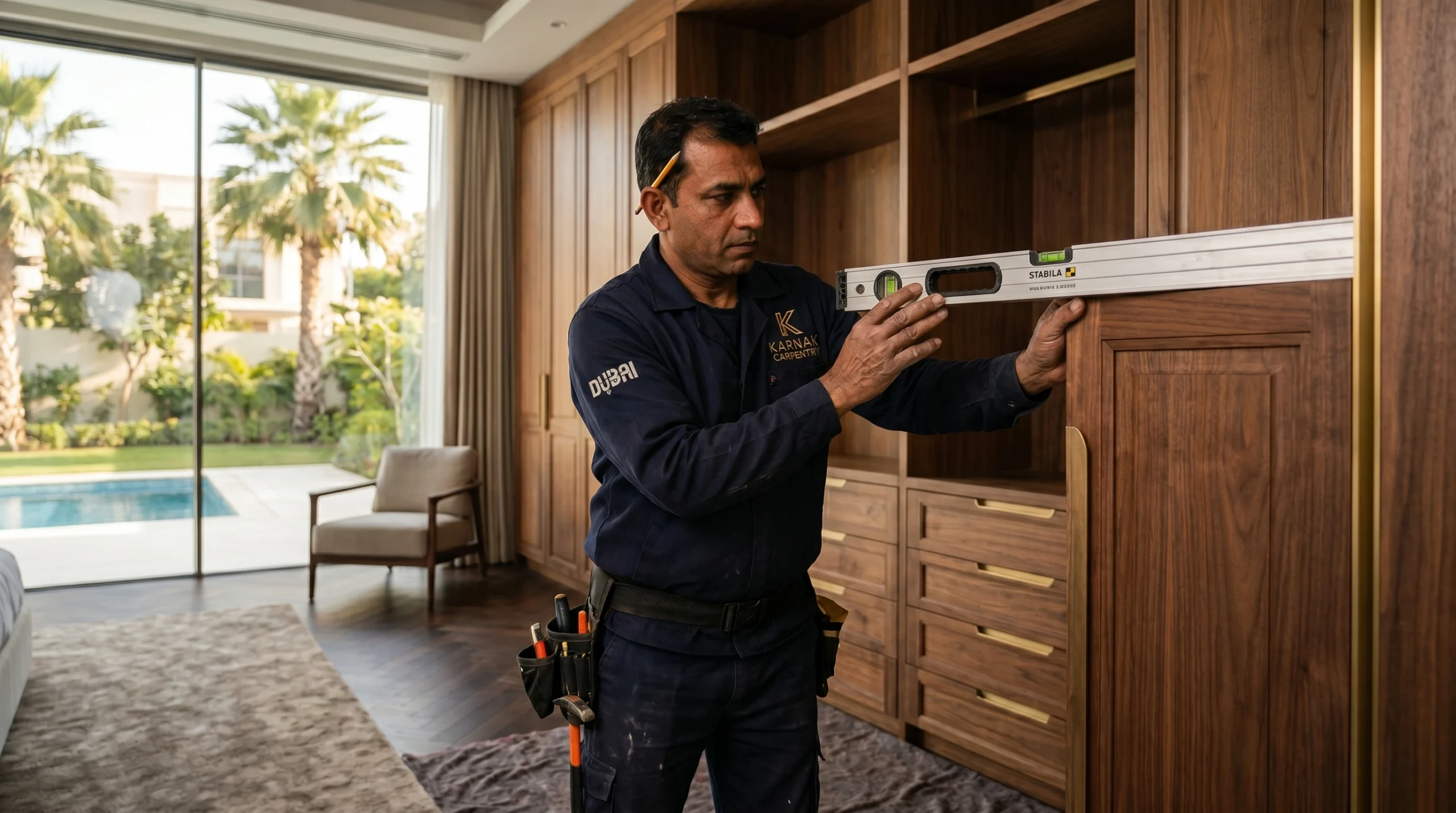
Stand Back and Look Along Every Horizontal Line
Put your eye level with any horizontal surface: a countertop, a shelf, the top of a cabinet run, the bottom rail of a wardrobe. Look along the length of it from one end. In good carpentry, that line should be perfectly straight, or perfectly following the contour of the wall if the wall itself has a bow. What you should not see is a surface that dips or rises in the middle, or panels that sit at slightly different heights where they meet.
This check takes thirty seconds and exposes a surprising number of problems. In UAE construction, walls are rarely perfectly plumb and floors are rarely perfectly level. Good carpenters scribe, pack, and adjust to compensate. Poor carpenters install to the material and let the wall’s imperfections telegraph through the finished work.
Check Every Visible Joint at Close Range
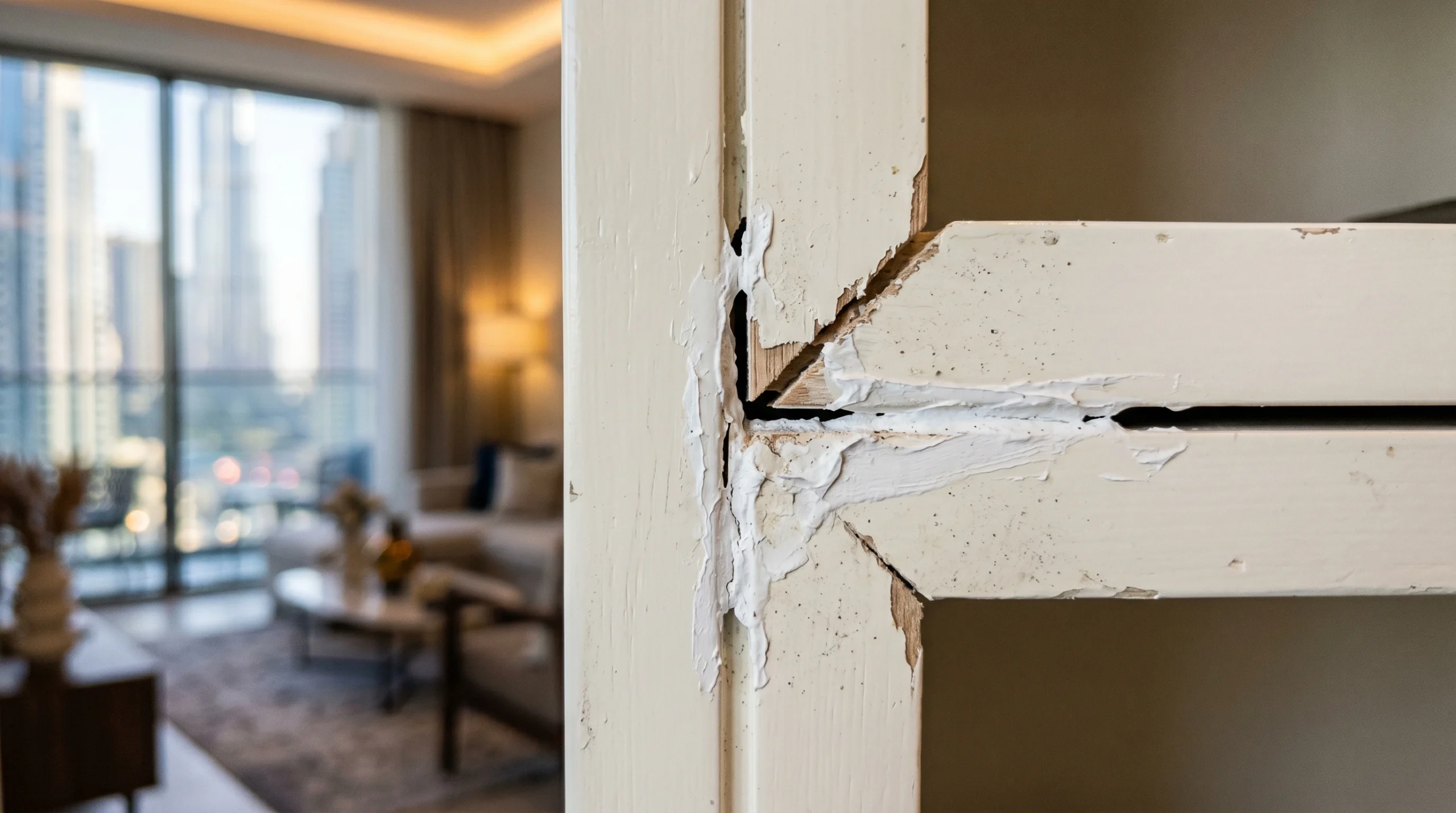
Walk to within 30 centimeters of every corner join, every miter, every butt joint where two pieces of material meet. You are looking for three things: gaps, filler, and alignment.
A clean carpentry joint has no visible gap. If there is a gap that has been filled with caulk or putty and painted over, that is a sign the joint was cut poorly. Filler is acceptable as a fine finishing step on timber, where seasonal movement is expected. It is not acceptable as a structural fix for joints that are simply cut wrong.
Mitered corners at 45 degrees are the most revealing test. A correctly cut miter on a painted MDF profile should be invisible from a standing distance. Run your fingernail along the miter line. If your nail catches a step, even a fraction of a millimeter, the miter was either cut inaccurately or the pieces were not pulled tight before fixing.
The Material Tests Most Homeowners Never Do
The single most common way contractors reduce their margins on UAE carpentry jobs is through material substitution. They quote for one specification and install something cheaper. Unless you know what to look for, you will never notice.
The Edge Test for MDF and Board Materials
Standard MDF and moisture-resistant MDF look identical from the face. Turn your attention to any exposed edge, inside a cabinet carcass, the underside of a shelf, the back of a door. Moisture-resistant MDF has a green-tinted core. Standard MDF has a grey-brown core. In a kitchen, a bathroom vanity, or any joinery near water in UAE buildings, only moisture-resistant materials are acceptable. Standard MDF in a humid Dubai kitchen will begin to swell within twelve to eighteen months.
While you are looking at edges, check the thickness. Proper wardrobe carcasses should use 18mm board as a minimum. Some contractors use 16mm or even 12mm to save cost. Grab the side panel of a tall wardrobe and push it gently. 12mm board has a noticeable flex. 18mm does not.
The Backing Panel Problem
Pull open the wardrobe doors and look at the back panel. Is it the same material as the sides and shelves, or is it a thin hardboard or cheap ply? A 3mm hardboard back on a wardrobe will bow, crack, or delaminate within a few years in UAE conditions. Backing panels should be a minimum of 6mm moisture-resistant material, ideally 9mm.
We have seen wardrobe projects in Emirates Hills villas where the front-facing joinery was genuinely beautiful, solid timber with hand-applied lacquer finish, while the carcass behind was assembled from the cheapest possible materials. When you are paying for premium carpentry, every component should reflect that standard, not just the parts you see immediately.
Hardware Quality: The Difference Between Five Years and Twenty-Five Years
Open every cabinet door and look at the hinges. In UAE residential carpentry, the standard bearer for quality hinges is Blum, a European manufacturer. Grass and Hettich are also reputable. Look for the manufacturer’s name stamped on the hinge body. Unbranded hinges or hinges without markings are almost always cheap Chinese-manufactured products that will lose their adjustment within one to two years in UAE conditions.
The same principle applies to drawer runners. Blum Tandem runners with Brumation soft-close are the industry benchmark. They carry a 10-year guarantee and genuinely last for decades. Generic runners look similar when new. They feel different. Pull a drawer with Blum runners and then pull one with generic runners. The Blum drawer moves on a silky, perfectly controlled glide. The generic drawer has slight side play and a stiffer action.
Ask your contractor specifically what hardware brand is being used before work begins. Get it in writing. If they cannot or will not tell you, that is your answer.
Finishing Quality: Where Cheap Work Always Shows Its Age
In UAE carpentry, finishing is where shortcuts are most common and most damaging long-term. The region’s climate makes finishing quality even more critical than in temperate climates.
Paint and Lacquer Inspection
Walk to each painted carpentry surface and view it in raking light. Either use your phone torch held at a low angle, or position yourself so natural light hits the surface obliquely. This reveals texture, brush marks, roller stipple, and thin spots that are invisible under normal lighting.
A properly spray-applied lacquer finish on cabinetry is completely smooth with no visible texture. A brush or roller applied finish will always show some texture, which is acceptable for site-painted carpentry if applied correctly but should be consistent and deliberate, not patchy. What is never acceptable is visible drip marks, thin areas where the underlying material shows through, or areas where the finish has been applied over dust or debris and shows a sandpaper-like roughness.
Specifically in UAE projects, look carefully at the junction between painted carpentry and walls. This line should be clean, straight, and sealed properly. A ragged caulk line that has been roughly wiped and painted over is a sign of rushed finishing. On a Dubai Marina apartment project we inspected last year for a client who had hired an independent contractor, we found 23 meters of poorly finished caulk lines across a single bedroom built-in wardrobe. The contractor had spent time on the visible door fronts and rushed everything else.
Veneer and Laminate Inspection
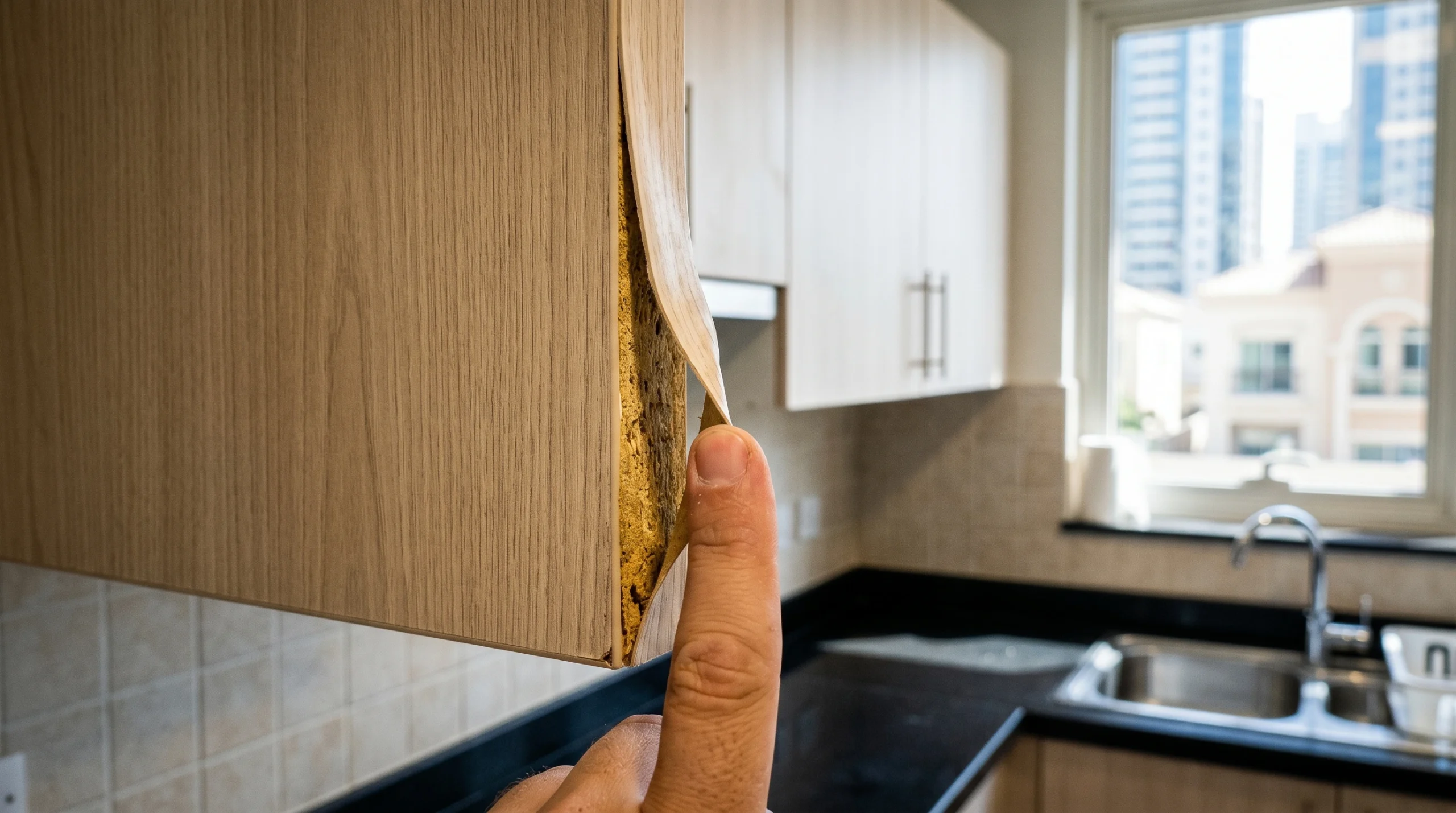
For veneered or laminated surfaces, press firmly in the center of each panel and along each edge. You are feeling for any hollow sound or flex that indicates the laminate has delaminated from its substrate. Pay particular attention to corners and edges, which are the first areas to lift in UAE humidity cycles.
Run your fingernail firmly across any edge banding, the thin strip of matching material applied to exposed board edges. It should not lift. It should not have visible gaps between the band and the face of the board. Edge banding applied with proper PUR adhesive rather than standard hotmelt adhesive has significantly better resistance to UAE temperature extremes. You cannot easily distinguish these adhesives by looking, but you can ask your contractor to specify which adhesive system they use.
Structural Integrity: The Tests That Reveal Hidden Problems
Surface finishing problems are annoying and costly to fix. Structural problems are genuinely dangerous and very expensive to rectify.
The Wobble Test for All Freestanding and Fixed Joinery
Any built-in unit, a wardrobe, a bookcase, a TV unit, should have zero wobble. Place both hands on the unit and push gently from side to side, then front to back. A properly fixed and constructed unit should not move at all. Any movement indicates either that the unit is inadequately fixed to the wall, that the carcass joinery is weak, or both.
In UAE construction, walls are typically block and plaster or drylining. Fixing into block requires appropriate masonry anchors. Fixing into drylining requires either cavity anchors rated for the load or fixings into the metal stud frame behind the board. A carpenter who uses standard wood screws directly into drylining without proper anchors has created a unit that appears solid on day one and is genuinely unsafe by year two, especially in a child’s bedroom where climbing is a possibility.
Ceiling and Cornice Work
For any carpentry that reaches the ceiling, look at the junction from directly below. Cornices, pelmet boxes, and ceiling-height wardrobes should maintain a consistent and even gap with the ceiling, or sit flush against it with sealed joints. Gaps that vary by more than 3 to 4 millimeters across a run indicate either poor measurement or poor fitting.
UAE buildings flex subtly over time as concrete cures and settles. A small, consistently sealed gap in ceiling cornices is actually better than a forced-flush fit, because it accommodates movement without cracking. What is not acceptable is a ragged, irregular gap that has been stuffed with caulk and painted over.
Under-Surface and Internal Inspection
Open every cabinet, pull out every shelf, and look inside. Check the interior corners where carcass panels meet. These should have fixing blocks, wooden corner joints, or mechanical connectors. A carcass held together only by screws through the face is significantly weaker than one with internal corner supports. Look for exposed screw heads inside carcasses that were meant to be concealed. Check whether shelves are adjustable on proper shelf pins or fixed permanently with no flexibility for future use.
Pull out every drawer to its full extension and look at the runner mechanism. Check that the runner is fixed with screws at multiple points, not just at one end. Look at the drawer box itself. A quality drawer box uses dovetail or box joints at the corners. A cheap drawer box uses butt joints held with glue and a single staple. Press the corners of every drawer box firmly. They should feel completely solid.
Common Mistakes UAE Homeowners Make During Inspection
Mistake 1: Inspecting Only What Is Visible From the Door
Most people stand at the doorway, look at the general impression of a room, and form their assessment from there. This is exactly what a contractor relying on surface presentation is counting on. Everything should be inspected at close range and from multiple angles.
Walk inside every wardrobe. Open every internal drawer within the wardrobe. Check the shelf that is at head height where you cannot easily see without a step. Look at the back panel at floor level. These are the areas where shortcuts happen most often because they require active effort to inspect.
Mistake 2: Accepting “It Needs to Settle” as an Explanation
One of the most common deflections we hear reported by homeowners who have had problems with other contractors is the phrase “the wood needs to settle.” There is a grain of truth in this for solid timber, which does undergo minor movement as it acclimatizes. But this explanation is used far too broadly to excuse poor fitting that will never improve on its own.
A door that needs to settle does not exist. Doors are fitted, not left to find their own alignment. If a door closes poorly on day one, it closes poorly permanently unless someone adjusts it. When a contractor uses this phrase in response to specific fitting problems, ask them to return in three weeks and re-inspect with you. If they resist this, you have your answer.
Mistake 3: Not Testing Functionality Under Load
An empty shelf looks fine. A shelf loaded with books, folded clothes, or crockery tells a different story. Before final payment, load test your shelving. Put weight on it. A properly dimensioned shelf of 18mm MDF should span no more than 600 to 700 millimeters unsupported before requiring a center support. Longer spans need either thicker material, a front nosing to add rigidity, or intermediate supports. Shelves that deflect visibly under a reasonable load will worsen over time, not improve.
Mistake 4: Relying on a Verbal Warranty
In the UAE, verbal warranties are essentially unenforceable. If a contractor tells you they offer a one-year or two-year warranty on their work, ask them to put this in writing before you make any final payment. A confident contractor with quality workmanship will have no hesitation providing written warranty terms. A contractor who deflects, says “of course, I will send it later,” or becomes uncomfortable with this request is telling you something important about their confidence in what they have delivered.
Mistake 5: Paying in Full Before Snagging Is Resolved
Standard practice for any project above AED 5,000 in UAE should be to retain a percentage of the final payment until snagging items are resolved. Ten percent retention held for thirty days after completion is entirely reasonable. This is not an insult to the contractor. It is professional project management. Any contractor who makes you feel guilty or difficult for requesting this arrangement should be viewed with caution.
Mistake 6: Not Photographing Everything Before Acceptance
Before you sign off on any carpentry project, photograph every unit, every door, every joint, every detail. Date the photographs. This takes twenty minutes and has saved numerous clients we know from very difficult warranty disputes. If a contractor knows you have detailed dated photographs taken at handover, the conversation about responsibility for problems that emerge later becomes much simpler.

What Good Carpentry Actually Costs in UAE: Realistic Benchmarks for 2026
Part of protecting yourself from poor quality work is understanding what quality work actually costs. When a price is significantly below market, something is being compromised. This is not cynicism. It is thirty-five years of watching the same patterns repeat.
Kitchen Carpentry
A full kitchen fit-out for a standard two-bedroom Dubai apartment, including all cabinetry, drawer boxes, hardware, and installation but excluding appliances and countertops, ranges from AED 18,000 to AED 45,000 depending on materials, layout complexity, and hardware specification. Quotes significantly below AED 15,000 for a full kitchen almost always indicate standard MDF instead of moisture-resistant, generic hardware, and compromised finishing processes.
Countertops are separate. Quartz countertops for the same kitchen add AED 4,000 to AED 12,000 depending on material and edge profile. Marble adds more. Do not let a contractor bundle vague countertop specifications into a total figure without breaking out what you are actually getting.
Bedroom Wardrobes
A built-in wardrobe for a standard master bedroom in Dubai, roughly 3 meters wide and ceiling height, with internal organization, soft-close doors, and a proper finish, costs between AED 7,000 and AED 18,000 for quality work. Sliding door systems at quality specification add AED 2,500 to AED 5,000 depending on system and finish.
Any quote below AED 5,000 for a ceiling-height built-in wardrobe with a finished interior should be interrogated carefully. The material alone for a properly specified wardrobe of that size costs more than AED 2,500 wholesale. Margins exist, but not infinite margins.
Carpentry for Villas
Full villa carpentry in areas like Arabian Ranches, Damac Hills, or Jumeirah Park typically encompasses kitchens, wardrobes across multiple bedrooms, study joinery, and sometimes feature wall paneling or TV units. Total budgets for quality villa carpentry range from AED 90,000 for a three-bedroom villa with standard specification to AED 350,000 or more for premium Emirates Hills or Palm Jumeirah projects with solid timber, custom profiles, and luxury hardware.
When budgeting for villa carpentry, a realistic working figure for mid-market quality is AED 800 to AED 1,400 per square meter of joinery, installed and finished. Premium specification starts at AED 1,500 per square meter and moves upward depending on material and complexity.
Expert Tips From 35 Years of UAE Carpentry
These are the things we tell our own clients, drawn from thousands of projects across the emirate.
1. Visit the contractor’s workshop before you commit.
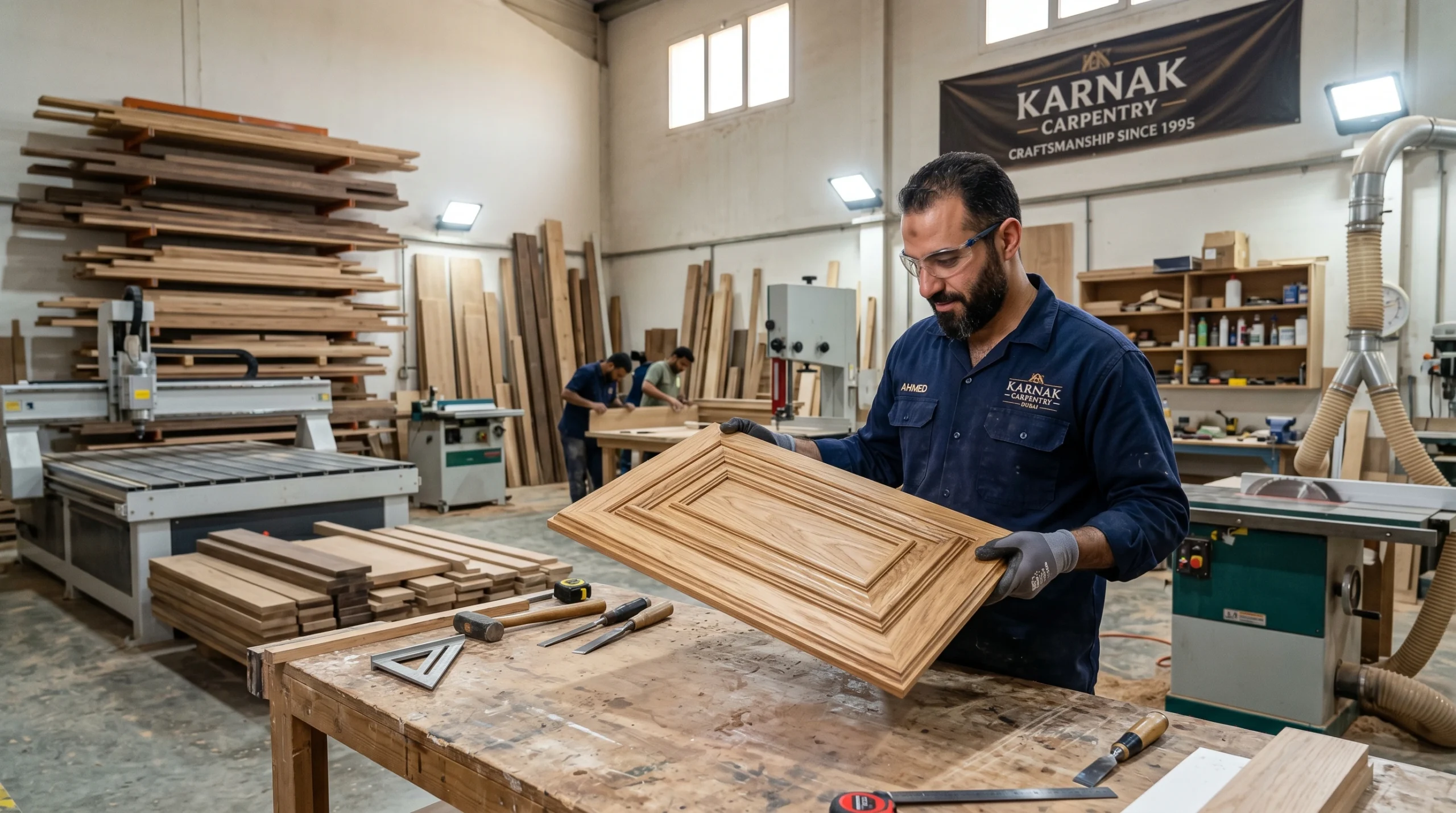
A carpentry contractor with their own workshop, their own machinery, and their own team is a fundamentally different proposition from a contractor who subcontracts everything. Ask to visit. A serious operation will be proud to show you.
2. Ask for references from projects in similar building types.
A contractor who has done excellent work in Jumeirah villas may not have experience with the specific challenges of high-rise Marina apartments, where humidity management, floor levelness, and building movement behave differently. References should be from comparable projects.
3. Specify everything in writing before work begins.
Board specifications, hardware brands, finish types, number of coats, edge banding adhesive type, shelf pin spacing, all of this should be in your written contract. “Standard quality materials” is not a specification. It is a blank cheque.
4. Request a sample board before full production begins.
For any substantial project, a responsible contractor will produce a sample section of the specified materials, finish, and hardware before manufacturing the full job. This adds a few days to the timeline and eliminates expensive surprises at installation.
5. Inspect during installation, not only at completion.
Visit the site when carcasses are being installed but before doors are hung and finishing begins. This is when you can see material quality, fixing methods, and internal construction that will be invisible once the job is complete.
6. Understand your contractor’s warranty terms in writing.
Know specifically what is covered, for how long, and what process to follow to make a claim. A warranty that requires you to contact a number that no longer answers in twelve months is not a warranty.
7. For UAE specifically: confirm moisture-resistant materials are specified for all wet areas.
Any carpentry within 1.5 meters of a water source in a UAE property should be moisture-resistant MDF or marine-grade plywood as a minimum. This is not optional. It is the difference between a bathroom vanity that lasts a decade and one that swells and deforms in three years.
Conclusion: Protect Your Investment Before You Pay
Poor quality carpentry rarely announces itself. It hides behind fresh paint, good presentation, and the general relief you feel that a disruptive project is finally done. The checks in this guide take forty-five minutes on a completed job. Against the cost of a full kitchen or villa carpentry project in Dubai, forty-five minutes of structured inspection is possibly the highest-value use of your time on any home project.
Run the door and drawer test. Check the joints at close range. Look at material edges. Test for wobble. Ask about hardware brands. Photograph everything. Retain a percentage of payment until snagging is resolved. These are not unreasonable demands. They are what any professional contractor should expect from an engaged client.
If you find problems during inspection, document them specifically and request written commitment to resolution with a timeline before making any further payment. A quality contractor will appreciate the clarity. A poor contractor will reveal themselves through their response.
Key Takeaways:
- Check every door, drawer, and moving component before the contractor leaves. Adjustments take minutes when the carpenter is present and become disputes when they are not.
- Look at material edges and internal construction, not just surface finish. The most common cost-cutting happens where clients do not look.
- In UAE conditions, moisture-resistant materials in wet areas, quality hardware, and proper surface finishing are not optional upgrades. They are the baseline for work that will last.
- Get hardware brand specifications in writing. Blum and comparable European hardware is genuinely different from generic alternatives, and you are entitled to receive what you pay for.
- Retain payment until snagging is complete and get any warranty terms in writing with clear claim procedures.
Need Expert Help?
Karnak Carpentry has been delivering quality joinery across Dubai, Abu Dhabi, and Sharjah since 1988. With more than 10,000 completed projects, we have built the kind of track record that comes from doing the work correctly the first time. If you are planning a kitchen, wardrobe, villa fit-out, or any custom joinery project and want to understand exactly what quality specification looks like for your budget, we offer a free no-obligation consultation at your property. We will walk through your requirements, give you honest material and specification recommendations, and provide a fully itemized quotation with all specifications in writing.
Contact: +971-52-5554207 | info@karnakcarpentry.com
Frequently Asked Questions About Identifying Poor Quality Carpentry Work in UAE Homes
How can I identify poor quality carpentry before making the final payment?
Inspect every cabinet, drawer, shelf, door, and finish carefully before approving the project. Smooth operation, accurate alignment, clean edges, and consistent workmanship indicate high-quality carpentry.
What are the most obvious signs of poor carpentry workmanship?
Uneven gaps, crooked doors, rough edges, chipped finishes, exposed screws, loose joints, and misaligned panels often reveal poor craftsmanship. Visible defects usually indicate rushed installation or inadequate quality control.
How should cabinet doors and drawers operate?
Cabinet doors should open and close smoothly without rubbing against adjacent panels. Drawers should slide quietly, close completely, and remain properly aligned throughout their movement.
Why do panel gaps matter in custom furniture?
Consistent gaps create a professional appearance and demonstrate precise manufacturing. Uneven spacing often points to inaccurate measurements, poor installation, or improper adjustments.
How can I check the quality of wood finishes?
Run your hand gently across the surface and examine it under natural light. A premium finish feels smooth, displays an even color, and remains free from bubbles, drips, sanding marks, or visible scratches.
Should I inspect the hardware before accepting the project?
Yes. Test every hinge, drawer runner, handle, soft-close mechanism, and pull-out accessory several times. Reliable hardware should operate quietly and without resistance.
How can I recognize low-quality materials?
Inspect board thickness, edge banding, veneer quality, laminate finishes, and hardware brands carefully. Premium materials show consistent color, clean edges, and strong structural stability.
Why should I examine the edge banding?
Well-applied edge banding sits flush against the board without lifting or visible glue marks. Poorly finished edges can peel over time and reduce the furniture’s durability.
How do I know if the furniture feels structurally strong?
Apply gentle pressure to shelves, doors, and cabinet sides while checking for movement or unusual sounds. Strong furniture remains stable without wobbling, flexing, or creaking.
Should every custom furniture piece match the approved design?
Yes. Compare the completed work with the approved drawings, dimensions, material specifications, hardware selections, and finish samples before signing the handover documents.
What questions should I ask during the final inspection?
Ask about material specifications, hardware brands, warranty coverage, maintenance recommendations, adjustment procedures, and after-sales support. Clear answers demonstrate professionalism and accountability.
Can poor installation damage high-quality furniture?
Yes. Incorrect installation can create alignment issues, weaken structural support, shorten hardware life, and reduce overall performance even when premium materials are used.
Why should I inspect hidden areas inside cabinets?
Interior panels, shelf supports, screw fixings, and concealed joints reveal the true quality of workmanship. Skilled carpenters maintain the same standard inside the furniture as they do on visible surfaces.
What should I do if I find defects before making the final payment?
Document every issue with photographs, prepare a written list of corrections, and request repairs before releasing the remaining balance. Resolving problems before project completion protects your investment.
What separates exceptional carpentry from average workmanship?
Exceptional carpentry combines precise measurements, premium materials, flawless finishes, smooth hardware operation, accurate installation, and meticulous attention to detail. Every component should function perfectly while maintaining a clean, seamless appearance.