
Blog
Teak Wood Outdoor UAE: Why 35 Years of Projects Keep Pointing to the Same Timber

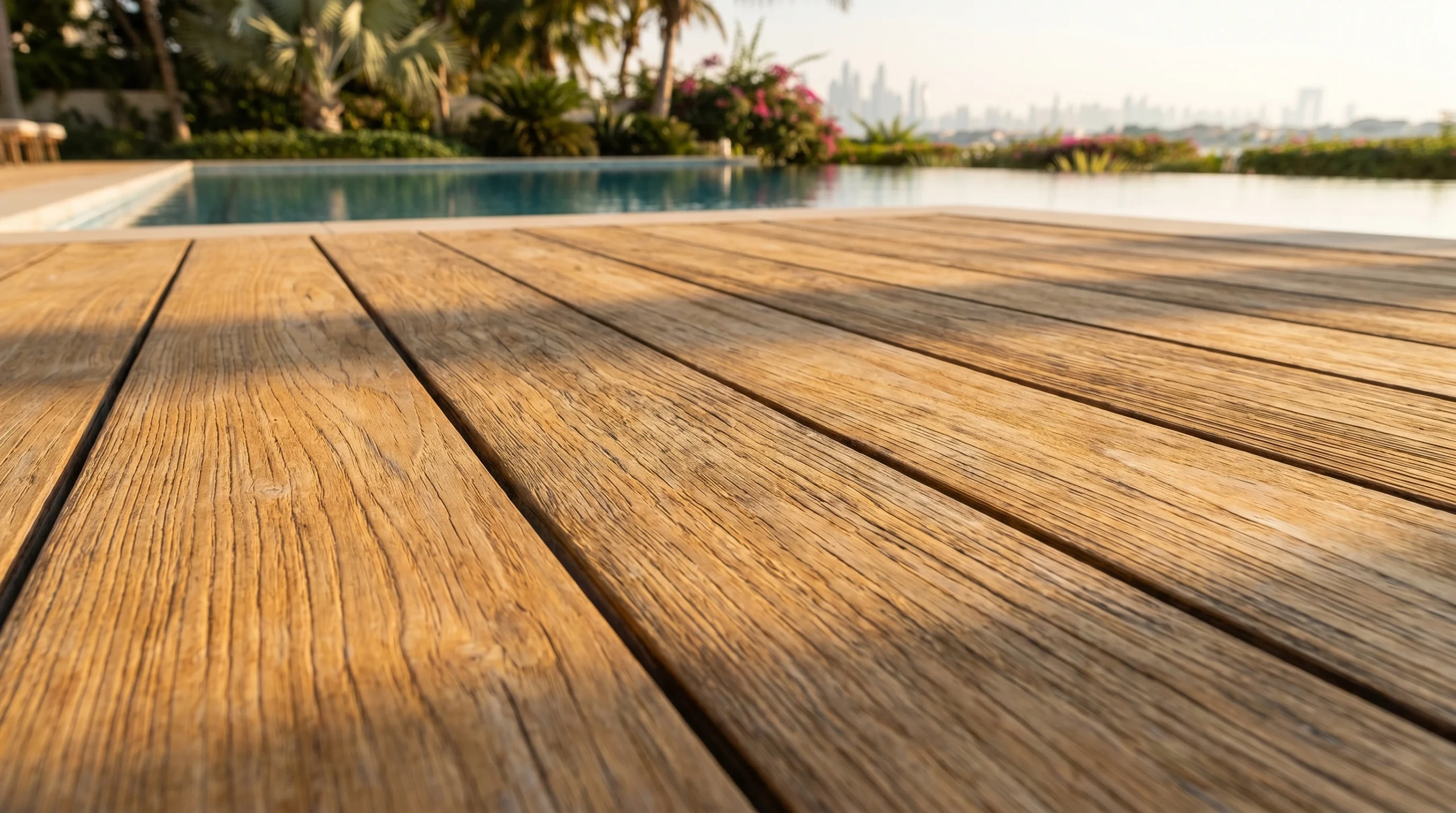
In 1988, when Karnak Carpentry completed its first teak pergola in Jumeirah, the homeowner asked a reasonable question. Why spend more on teak when cheaper options were available? Thirty-five years and more than 10,000 projects later, we still get that question. And we still give the same answer: because in the UAE, teak is not a luxury choice. It is the practical one. Teak remains a top performer for outdoor applications in the UAE. For luxury outdoor living inspiration from around the globe, Khaleej Times features beautiful examples worth referencing
We have worked with virtually every outdoor timber available in this market. Iroko, meranti, pine, ipe, accoya, composite alternatives. Some of them have done well in specific applications. Most of them have taught us, and our clients, expensive lessons. Teak keeps showing up on every premium outdoor project we handle because the UAE climate does not forgive the wrong material choices. By the end of this guide, you will understand exactly why, and you will be able to make a genuinely informed decision for your own project.
What Makes Teak Different From Every Other Outdoor Wood
Most people have heard that teak is “good for outdoors.” What very few people understand is the specific biology behind that reputation, and why those biological traits matter so much in the Gulf specifically.
Teak (Tectona grandis) produces natural oils and silica within its own cellular structure. These are not added during processing. They are grown into the timber. That silica content, roughly 1.4% by weight in quality teak, is what makes the wood naturally resistant to moisture penetration, insect attack, and the expansion-contraction cycle that destroys lesser timbers in extreme heat. The oils act as an internal preservative, essentially self-coating the wood from inside the grain.
Now consider what those properties mean in a climate where ground temperatures hit 65 degrees Celsius in August, where a shaded terrace still sees 45-degree air, and where humidity swings from 15% in February to over 90% during the brief coastal summer rains. Most timbers experience significant dimensional movement under those conditions. They split, cup, and check. Fixings work loose. Finishes fail. We have seen iroko decking in Abu Dhabi literally pull itself off its subframe within three summers of installation due to cumulative movement stress.
The Natural Oil Advantage in UAE Heat
The natural oil content in Grade A teak serves a function that no surface treatment can fully replicate. When the timber heats in direct sun, those internal oils migrate toward the surface, maintaining a degree of lubrication at the cellular level. This is why, when you sand an old teak deck that has been left untreated for years, you often find the wood in surprisingly good condition just a few millimeters below the surface oxidation layer.
We performed a controlled comparison on a project in Emirates Hills back in 2019. Two sections of outdoor decking: one teak, one high-grade iroko, both left without any surface treatment for three years. The iroko showed significant surface checking and two split boards by the end of year two. The teak showed surface greying, as expected, but zero structural checking and no movement at the board joints. Same subframe, same exposure, same fixings.
That is not a selling point. That is just what teak does.
Silica and Dimensional Stability
The silica content that makes teak hard on saw blades (and it absolutely is, which is why you should use a qualified workshop rather than a general contractor for teak work) is the same content that holds the wood together under thermal stress. Silica deposits within the grain create a reinforcing matrix that resists the micro-fractures that begin checking in softer or less dense timbers.
In practical terms, a well-installed teak deck in Jumeirah Beach Residence will show less than 0.3mm movement across a 150mm wide board between the coldest winter night and the peak of August. We measure this on our projects. That tolerance is what allows us to fit boards tightly without leaving expansion gaps that become dirt traps, and without creating stress that splits boards when expansion is blocked.
How Teak Ages in the UAE Specifically
This is where client expectations sometimes need adjusting, and we would rather address it directly than have you discover it after installation.
Teak left without regular oiling in the UAE will grey. Not slowly. Within six to eight months of installation in full sun exposure, untreated teak shifts from its warm honey-gold tone to a silver-grey. Some clients love this. The silvered look has its own elegance, and structurally the timber is completely fine. Others want to maintain that golden warmth. Both outcomes are entirely valid choices, but they require different maintenance approaches and should be decided before installation.
If you want to maintain the warm color, plan for oiling every four to six months in UAE conditions. In Europe, teak owners oil annually. In Dubai, the UV intensity shortens that cycle considerably. We recommend a high-penetration Danish oil or a specifically formulated teak oil with UV inhibitors. Apply it in the cooler months if possible, early morning before the deck heats up. The oil absorbs better into timber that is not surface-hot.
If you prefer the silver patina, your maintenance commitment drops significantly. An annual clean with a teak cleaner and a light sand every two to three years is sufficient to keep the surface looking intentional rather than neglected.
Grade A vs Grade B Teak: The Difference That Matters Most
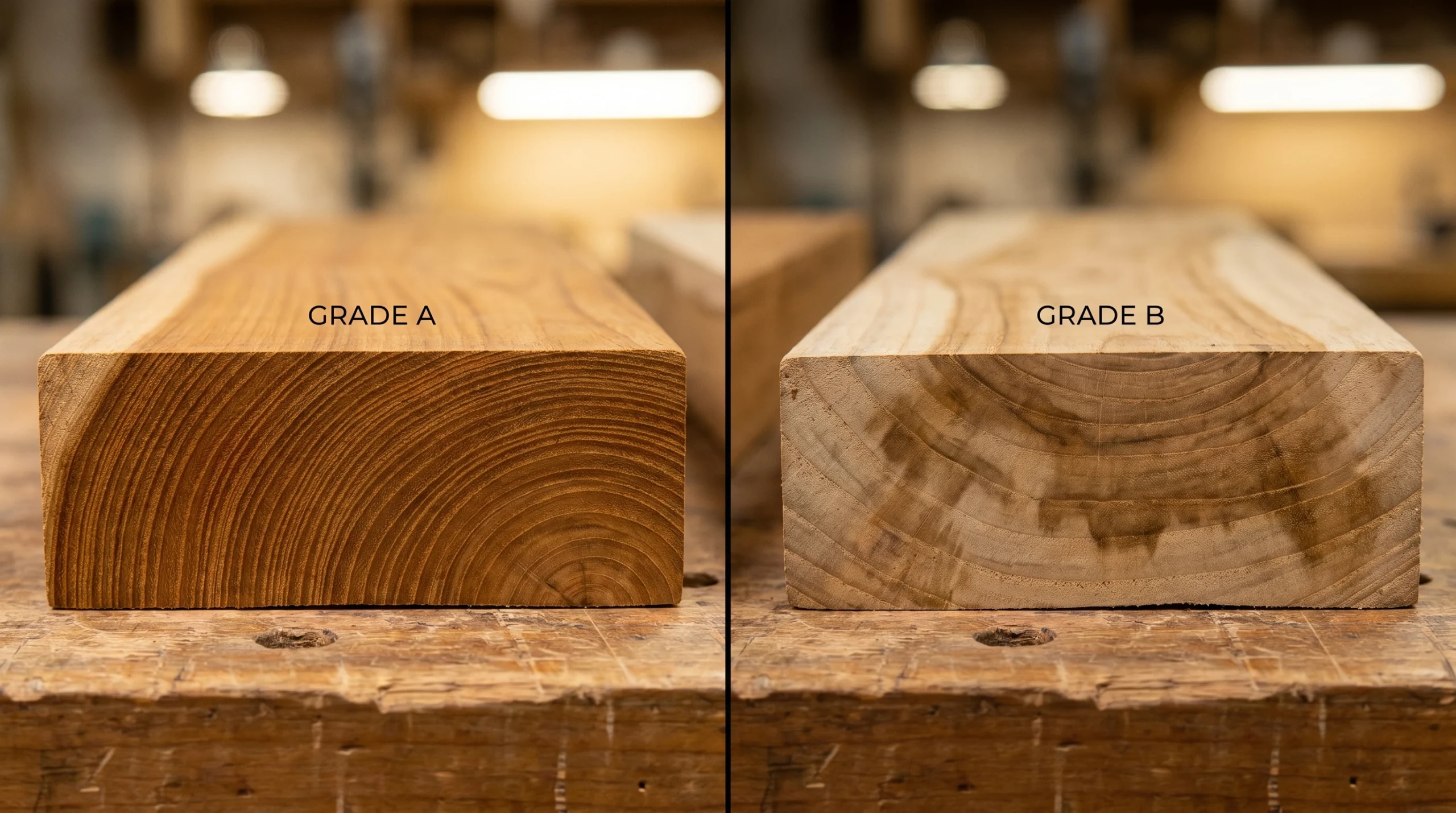
This is the conversation that separates informed buyers from those who get burned. Not all teak is equal. The grade system matters enormously in UAE conditions, and suppliers do not always volunteer this information.
Grade A teak comes from the heartwood of mature trees, typically 40 to 80 years old. It has tight, consistent grain, minimal knots, and the highest concentration of natural oils and silica. The color is even. The density is consistent. This is the teak that earns the reputation.
Grade B teak comes from the outer heartwood, closer to the sapwood. The grain is less consistent, oil content is lower, and you will find more variation in color and density. It is cheaper, and in low-stress indoor applications it can perform reasonably. For UAE outdoor use, it is a compromise that often costs more in the long run.
Grade C teak includes sapwood, which has almost no natural oil content and performs comparably to a generic hardwood. We do not use Grade C in outdoor applications. We mention it because some suppliers do, without being explicit about grading.
How to Identify Grade A in a Supplier’s Yard
The grain on Grade A should be tight and straight. A rule of thumb: count the grain lines per inch. Fifteen or more lines per inch indicates good quality. Fewer than ten is a warning sign. The color should be warm golden-brown with minimal contrast between adjacent boards.
Lift a board and smell it. Quality teak has a faint, characteristic scent from its natural oils. Boards that smell of nothing, or worse smell of fresh preservative treatment, may be lower grade timber that has been treated to compensate for lower natural oil content.
Ask your supplier for the origin certificate. Plantation teak from certified Indonesian, Indian, or Central American sources is entirely acceptable and more sustainable than old-growth. What you want to avoid is unverified teak from unclear supply chains, which may be lower grade dressed up as premium.
Plantation Teak vs Old-Growth Teak
Old-growth teak from Myanmar (Burmese teak) was historically considered the gold standard, with exceptional density and oil content from centuries of slow growth. Legal trade in old-growth Burmese teak has been severely restricted under international sanctions and forestry regulations, which means most teak in today’s market is plantation grown.
The practical reality: well-managed plantation teak at 40-plus years old performs excellently for outdoor use in the UAE. We have been using certified plantation teak for the last decade across projects from Palm Jumeirah to Saadiyat Island and the performance has been consistent. Do not let anyone sell you “genuine Burmese teak” without proper documentation. In today’s market, that claim deserves scrutiny.
Teak in UAE Outdoor Applications: Where It Excels
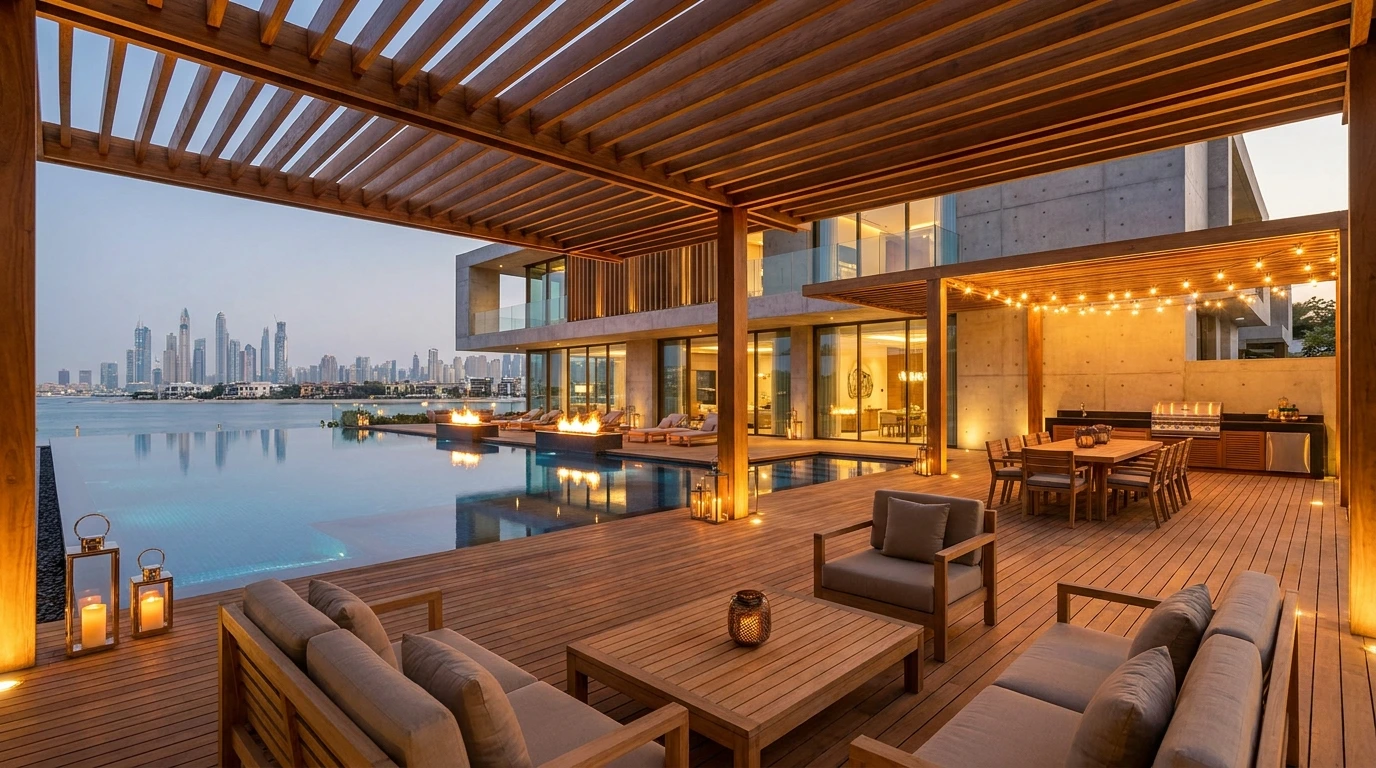
Over 10,000 projects, we have put teak into almost every outdoor application imaginable in the UAE. Here is an honest assessment of where it performs best, and where alternatives deserve consideration.
Teak Decking
This is teak’s strongest application in UAE conditions. Pool decks, terrace decks, rooftop decks. The non-slip surface texture of quality teak is superior to most alternatives when wet, which matters enormously around pools. The heat conductivity is relatively low for a dense wood, meaning teak decking is far more comfortable underfoot in summer than stone, tile, or metal alternatives. We have measured surface temperatures of 52 degrees Celsius on a teak deck at 2pm in August in Dubai, compared to 71 degrees on adjacent stone tile. That 19-degree difference is the difference between walkable and not.
Board width and thickness for UAE outdoor decking: we specify 90mm to 120mm wide boards at 21mm thickness for residential decks, 25mm for commercial applications. Narrower boards show less movement. Thicker boards last longer before requiring resurfacing. Fixings should be stainless steel grade 316 minimum, hidden wherever possible using clip systems.
Cost reference for 2026: Grade A teak decking installed in Dubai ranges from AED 650 to AED 950 per square meter depending on board specification, subframe complexity, and site access. This includes materials and installation. Do not compare this to composite at AED 280 per square meter without accounting for the 15 to 25 year lifespan difference.
Teak Pergolas and Shade Structures
Pergolas are where we see the most variation in quality of construction in the UAE market, and where specification choices have the longest-term consequences. A teak pergola built properly will outlast almost everything else on a property. We have clients in Jumeirah with pergolas we installed in the late 1990s that are structurally sound with surface maintenance only.
The structural specifications for UAE conditions: main posts minimum 100mm by 100mm section, beams at 75mm by 150mm for spans up to 3.5 meters. All mortise and tenon joints where possible, with stainless steel bolts as secondary fixings. Exposed end grain should be sealed on installation day, not after, to prevent moisture entry at the most vulnerable point.
One thing we are direct about with clients: a teak pergola is a significant investment. For a standard 4 meter by 5 meter freestanding pergola in Dubai, expect AED 18,000 to AED 28,000 for Grade A teak, fully installed. That is a real number, not a teaser. Budget structures using lower-grade timber will come in at AED 8,000 to AED 12,000 and will require replacement or significant intervention within ten years. The math’s over a 25-year period typically favors the Grade A investment.
Teak Outdoor Furniture
Tables, chairs, sun loungers, storage benches. Teak furniture holds up in UAE conditions better than any natural material alternative. The primary maintenance issue in the UAE specifically is not weathering but rather the accumulation of dust and sand in the grain during shamal winds. A stiff brush and water resolves this. Avoid high-pressure washing, which can raise the grain and open checking.
For fixed built-in outdoor furniture, daybed platforms, banquette seating around pools, storage built into pergola structures: teak is our default specification. It can be designed flush with surrounding hardscape, holds cushion fixings without pull-out issues, and can be refinished in place to restore appearance without replacement.
Marine and Pool Perimeter Applications
Teak has a 400-year history in marine applications. Its resistance to the salt, moisture, and UV combination that destroys most materials is well documented. For UAE pool perimeters specifically, where timber is in contact with chlorinated water splash, direct sun, and potentially pool chemical exposure, teak’s performance advantage over alternatives is most dramatic.
We have seen iroko and even some treated hardwoods fail within two to three years at pool edges in the UAE. Teak correctly specified and installed should give 20-plus years at pool perimeters with standard maintenance. The key word is correctly: the subframe beneath must have adequate drainage and ventilation. Trapped moisture at the underside of pool deck boards is the one condition that can accelerate teak deterioration.
Common Mistakes We See on Teak Projects in the UAE
These are not theoretical errors. These are situations we have been called in to assess and, in some cases, to remediate. Learning from them before your project is considerably less expensive than learning from them after.
Mistake 1: Using the Wrong Grade for the Application
The most common and most expensive mistake. A client in Al Barsha contacted us in 2023 to assess a two-year-old teak deck installed by a different contractor. The boards were splitting, the color was wildly uneven, and the surface had developed a rough, fibrous texture inconsistent with quality teak. On inspection, the timber was Grade B with sapwood inclusions, purchased based on price. Remediation cost exceeded the original installation price.
If you are receiving a quote that seems significantly below market rate for teak work in the UAE, ask specifically about the grade of timber being supplied. Request to see samples and documentation before signing anything.
Mistake 2: Inadequate Subframe Ventilation
Teak boards themselves are highly durable. The subframe beneath them is where outdoor deck failures most often originate in the UAE. We see this particularly on rooftop decks where the subframe sits on a waterproof membrane with no drainage gaps.
The rule we follow: minimum 25mm air gap beneath deck boards, drainage channels every 1.5 meters to prevent water pooling, and subframe timber treated or, better, specified as teak or stainless steel in pool-adjacent areas. The deck surface looks perfect while the subframe rots beneath it. By the time the problem is visible, replacement is the only option.
Mistake 3: Applying the Wrong Finish
Clients sometimes apply varnish or polyurethane topcoats to teak, wanting to lock in the color. This works for approximately one UAE summer. The thermal expansion of the timber, combined with UV degradation of the coating, causes the finish to crack and peel. Once a film-forming finish fails on teak, you have a maintenance nightmare: stripping the failing coat before re-oiling requires significant labor.
Teak should be finished with penetrating oils, not surface-forming films. The oil feeds the wood. The wood breathes. When the oil weathers out, you apply more oil. Simple, effective, repairable.
Mistake 4: Skipping the Initial Oil Treatment on Installation Day
This one seems small but is not. Freshly machined teak has open pores that will absorb the first oil treatment more deeply than any subsequent application. That initial penetration establishes the baseline protection layer. We apply the first coat of oil on installation day, before the client even sees the finished product, because waiting even a week in UAE sun means the surface layer has already begun to close under UV exposure.
Some contractors leave this step to the client or skip it to reduce cost. The first coat is the most important coat. Make sure it is in your contract.
Mistake 5: Ignoring Fixings Specification
Stainless steel grade 316 is the minimum for UAE outdoor teak work. Grade 304 stainless will begin to show rust staining within two to three years in coastal areas like JBR, Dubai Marina, or Palm Jumeirah. Black iron fixings will rust within a single season and stain the teak around them permanently.
We use hidden clip systems wherever aesthetics allow, not only for appearance but because exposed fixings in UAE conditions are always a potential corrosion point. Where screws must be exposed, they are countersunk and plugged with matching teak grain.
Mistake 6: Buying Teak at the Lumber Souk Without Verification
Dubai has a thriving timber market, and not all of it is what it claims to be. We have seen timber labelled as teak that, on closer inspection, was a treated tropical hardwood with a passing visual resemblance. The weight was wrong, the grain was wrong, and the cut surface had no oil. A simple test: fresh-cut teak has a faint oily sheen on the saw face and a characteristic warm, slightly sweet smell. Neither of these is easily faked.
If you are sourcing independently, buy from suppliers who can provide species verification documentation. If they cannot, you are buying on faith.
Teak Maintenance in UAE Conditions: The Real Schedule
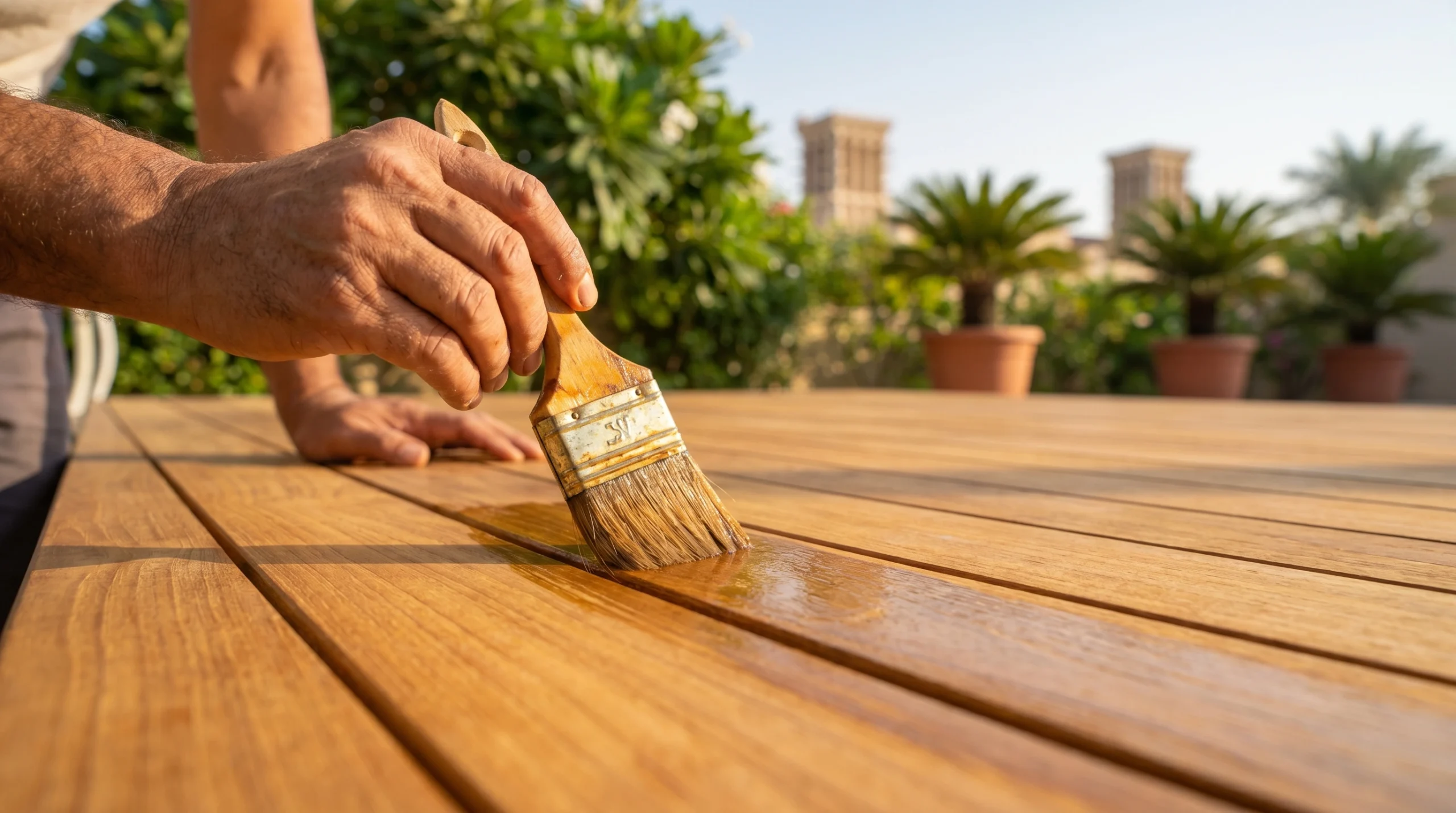
Every timber has a maintenance reality. Teak’s is honest and manageable, but it is not zero. Here is what we actually tell clients, rather than the minimal-maintenance sales pitch.
The Annual Maintenance Cycle for UAE Teak
October to November (post-summer assessment): This is the best time to assess your teak surfaces after the stress of summer. Look for any checking, joint movement, or fixings that have worked loose. Clean the surface with a dedicated teak cleaner and light sanding if needed. Apply oil if maintaining warm color.
February to March (pre-summer preparation): A second oil application before the intense UV of April to August. This is the coat that carries the timber through the most damaging season.
June to August (avoid if possible): Do not oil teak in peak summer. The surface heats too quickly for good penetration, and the oil can become sticky on the surface rather than absorbing properly. Clean only if needed.
The two-coat annual cycle in UAE conditions keeps teak looking its best. For grey-patina preference, the annual clean plus biennial light sand is sufficient.
Cleaning Products That Work and Those That Damage
Use pH-neutral teak cleaners. Bleach-based cleaners will strip natural oils along with the surface contamination and accelerate greying. We have seen clients apply household bleach to teak to remove algae growth and turn the surface fibrous and rough in the process.
For algae growth (more common in Abu Dhabi coastal areas and Ras Al Khaimah mountain properties where humidity is higher), a dedicated deck cleaner with oxalic acid component handles the contamination without damaging the wood structure.
Power washing: maximum 100 bar, fan nozzle only, minimum 30cm distance from the surface. We prefer hand cleaning for maintenance work on quality teak. High pressure inevitably raises grain and creates micro-grooves that collect dirt faster over subsequent months.
Teak vs Alternative Materials: The Honest Comparison
Clients regularly ask us to compare teak against other options. Here is the unvarnished assessment.
Teak vs Iroko
Iroko is a West African hardwood that is frequently positioned as a teak alternative at lower cost. In moderate climates, it is a perfectly adequate choice. In UAE conditions, it performs noticeably worse. Lower oil content means greater moisture movement, more checking in heat, and faster surface degradation. It is lighter than teak, which affects its feel underfoot. For a Jumeirah or Emirates Hills project where longevity matters, we do not recommend iroko as a teak replacement.
If budget is the primary constraint, iroko can work for pergola structures (not decking) with consistent maintenance. Budget for replacement or major maintenance at the eight to twelve year mark rather than the twenty-plus year horizon teak offers.
Teak vs Composite Decking
This is the comparison that comes up most in 2026, as composite products have improved significantly over the last decade. Good composite decking has real advantages: consistent color, lower initial maintenance commitment, and lower entry price. The disadvantages in UAE conditions are also real.
Composite surface temperatures in direct sun are significantly higher than teak. We have recorded composite deck surface temperatures of 78 to 82 degrees Celsius in July, compared to teak at 50 to 55 degrees. That difference matters enormously for a pool deck or a space where children play barefoot.
Composite products also have a defined lifespan and cannot be refinished. When they reach end of life, they are replaced entirely. Teak can be sanded, re-oiled, and restored almost indefinitely. The aesthetics of natural teak are also, in our experience, what most premium UAE clients actually want. Composite is a compromise material. It is not wrong to choose it, but call it what it is.
Teak vs Ipe
Ipe (Brazilian hardwood) is the most serious performance alternative to teak for outdoor use. It is extremely dense, highly durable, and performs well in harsh conditions. The legitimate reasons we still default to teak over ipe for UAE projects: ipe is significantly harder to work, making precise joinery more labor-intensive and expensive. It has less natural oil content than Grade A teak, requiring more consistent maintenance in high-UV environments. And ipe greys aggressively in UAE conditions, faster than teak, with less attractive silver tone.
For clients who specifically want maximum hardness and do not mind the maintenance and working costs, ipe is worth discussing. For most projects, teak is the more practical choice.
Expert Tips From 35 Years of Teak Projects in the UAE
These are not generic advice. These are the specific things we have learned from thousands of UAE teak installations.
Tip 1: Specify board orientation on installation drawings.
On decks with a dominant sun exposure direction, orienting boards perpendicular to the sun angle rather than parallel reduces uneven weathering. It sounds minor. Over five years it makes a visible difference to color consistency.
Tip 2: Seal end grain on every cut, on the day of the cut.
End grain is teak’s vulnerable point. Any time a board is cut during installation or modification, that cut face needs a sealer application the same day. A 500ml tin of end grain sealer on site costs almost nothing. The alternative is a checking crack that begins at that unsealed face within one UAE summer.
Tip 3: Allow for a settling period before fine adjustment.
New teak installed in UAE conditions will undergo minor movement in the first two to three months as it acclimatizes. Do not do fine trimming or final surface finishing immediately after installation. Let the timber settle, then assess. This is why we schedule our final surface inspection at the three-month mark rather than the handover date.
Tip 4: Store teak properly if there is a delay before installation.
Teak waiting on site in UAE summer should be stored in shade, stickered (separated by spacers for air circulation), and covered with breathable material. Not wrapped in plastic. Not stored flat in direct sun. We have seen a week of improper on-site storage cause surface checking that required additional machining before installation.
Tip 5: Match batch numbers when ordering.
Teak from different logging batches or different trees can vary subtly in color tone. For a large deck where boards from multiple batches are mixed, color variation can be noticeable initially. Request batch-matched timber for large areas and, where batches must be mixed, alternate boards from different batches rather than laying them in blocks.
Tip 6: On pool decks, specify hidden fixings without exception.
The exposed fixing clip systems that work fine on terrace decks create small pooling points around the fixing hardware on pool decks. Chlorinated water sitting at fixing points, even stainless ones, eventually causes localized staining. Hidden fixings from beneath, where the deck structure allows, are always the better specification for pool applications.
Tip 7: Budget for the maintenance cycle in your project planning.
A properly maintained teak deck or pergola in the UAE will require meaningful investment over its life. For a 50 square meter deck, budget approximately AED 800 to AED 1,200 per maintenance cycle for professional cleaning and oiling. Two cycles per year means AED 1,600 to AED 2,400 annually. Factor this into your total cost of ownership calculation when comparing materials, not just the installation price.
What a Teak Project With Karnak Actually Looks Like
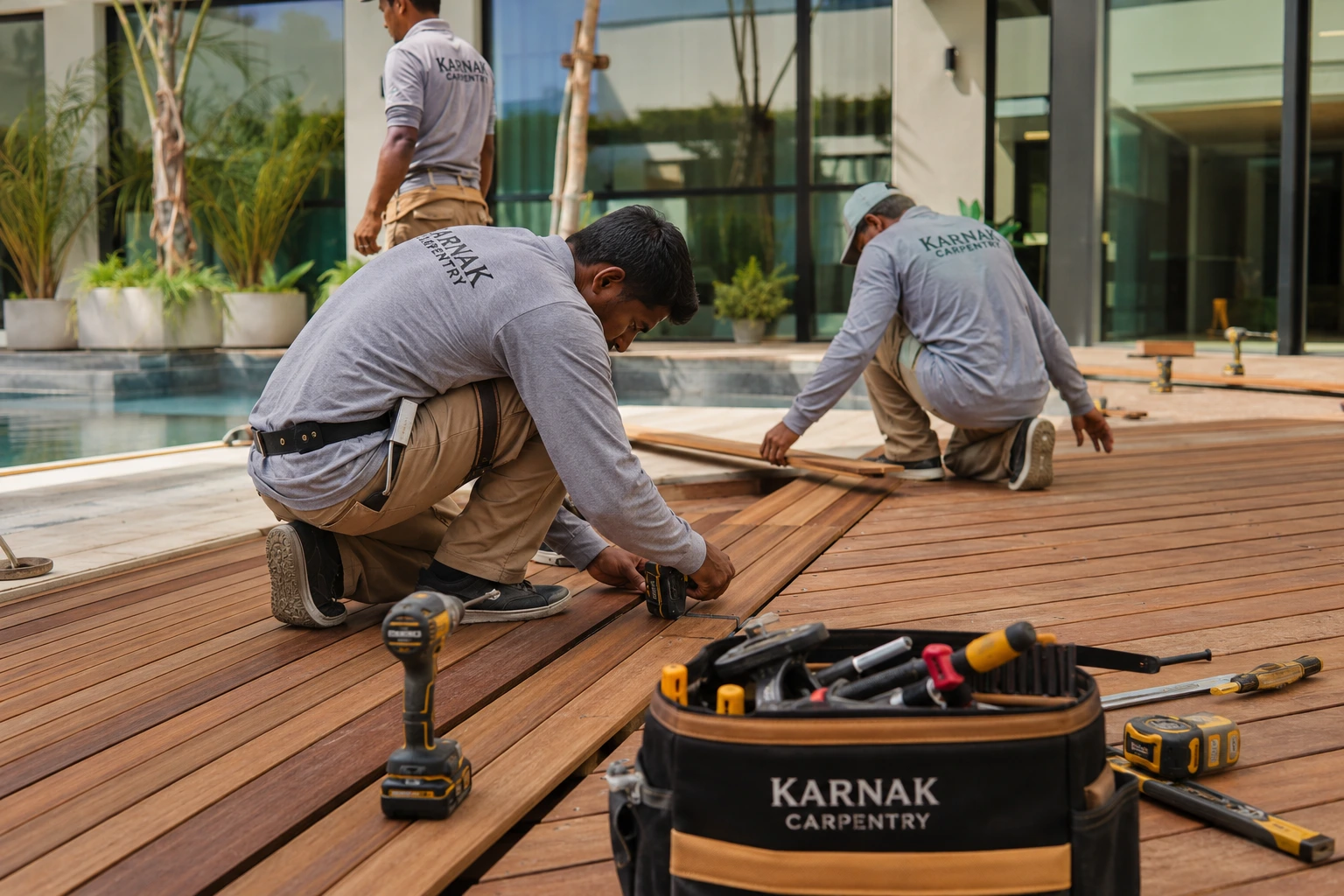
We get asked frequently about our process, and we think transparency here is useful.
Initial consultation is free
We visit the site, assess the existing conditions (drainage, access, adjacent materials, sun exposure), understand the brief, and provide a written specification before any pricing conversation. We do not quote from photographs or floor plans alone for teak work. The site conditions matter too much.
Timber sourcing is part of our service
We do not ask clients to source their own teak and deliver it. We specify the grade, verify the supply, and take responsibility for the material quality. We have worked with our primary teak suppliers for over fifteen years. That relationship matters for consistency.
Our installations are warranted for workmanship for five years
Timber is a natural material and we are straightforward with clients about what that means: we cannot warrant against the natural greying process or against maintenance being skipped. We can warrant that the joinery will not fail, the fixings will not corrode, and the installation will perform as specified.
Timeline for typical projects
A 50 to 80 square meter deck typically runs eight to twelve working days from timber arrival on site to completion. Pergolas run six to ten days. We do not rush teak work. The joinery details that make a teak pergola beautiful are the same details that make it structurally sound for 25 years.
Conclusion: Making the Right Decision for Your Outdoor Space
Teak’s dominance in UAE outdoor carpentry is not marketing. It is three decades of projects, material comparisons, and honest conversations with clients who have seen both good choices and costly mistakes. The combination of natural oils, silica density, and workability that teak offers is not replicated by any other naturally available timber, and not yet genuinely replicated by any engineered alternative either, certainly not at the aesthetic level that premium UAE outdoor spaces demand.
The decision to cut corners on grade, on fixings, or on installation quality with teak is, in our experience, always a false economy. Teak done properly is a 25 to 40 year asset. Teak done cheaply is a ten-year replacement cycle dressed in premium timber’s reputation.
Key Takeaways:
- Grade A teak outperforms all alternatives in UAE outdoor conditions due to natural oils and silica content that no treatment can replicate.
- Correct installation details, particularly subframe ventilation and stainless steel fixings, determine long-term performance as much as timber grade does.
- Maintenance in the UAE requires a two-cycle annual oiling schedule for color retention, or annual cleaning for silver-grey patina acceptance.
- True cost comparison with alternatives must account for lifespan and refinishing capability, not installation price alone.
- UAE-specific risks including incorrect grade supply, inadequate ventilation, and wrong finishes are avoidable with the right specification and the right contractor.
Need Expert Help with Your Teak Project?
Karnak Carpentry has specified, sourced, and installed teak across the UAE since 1988. More than 10,000 projects have refined our understanding of what works in this climate. If you are planning an outdoor deck, pergola, or furniture installation and want an honest assessment of what your project requires, we offer free on-site consultations with no obligation. We will tell you what you need, what grade is appropriate, and what it will realistically cost. No sales pressure. Just 35 years of experience working for you.
Contact:
WhatsApp Us or Call Us at +971-52-5554207 | info@karnakcarpentry.com
Frequently Asked Questions About Teak Wood for Outdoor Use in the UAE
Why do experts recommend teak wood for outdoor furniture in the UAE?
Teak contains natural oils that resist moisture, insects, and decay. These qualities help outdoor furniture withstand Dubai’s intense heat, coastal humidity, and changing weather while maintaining excellent structural strength.
Does teak wood perform well in Dubai’s climate?
Yes. Teak tolerates high temperatures, strong sunlight, and humid conditions better than many other hardwoods. Proper maintenance allows teak furniture to remain attractive and durable for decades.
How long does outdoor teak furniture last?
High-quality teak furniture often lasts 30 to 50 years or longer with regular care. Strong grain structure and natural weather resistance make teak one of the longest-lasting outdoor hardwoods.
Can teak wood stay outdoors all year?
Yes. Teak handles year-round outdoor exposure without losing its structural integrity. Protective covers and occasional cleaning help preserve its appearance during extreme weather conditions.
Why does teak change from golden brown to silver gray?
Sunlight naturally changes the surface color over time. The silver-gray patina affects only the appearance and does not reduce the wood’s strength or durability.
Should I apply teak oil to outdoor furniture?
Teak oil helps maintain the original golden color, but the wood does not require oil for protection. Many homeowners allow teak to develop its natural gray finish because it still performs exceptionally well outdoors.
How do I clean teak outdoor furniture?
Wash the surface with mild soap, water, and a soft brush to remove dust and dirt. Rinse thoroughly and allow the furniture to dry naturally before placing cushions or covers back on it.
Does teak resist termites and insects?
Natural oils inside teak discourage termites, wood-boring insects, and fungal growth. This built-in protection makes teak an excellent choice for outdoor applications across the UAE.
How does teak compare with other outdoor woods?
Teak offers better weather resistance, lower maintenance, and a longer lifespan than many hardwoods and softwoods. Cedar, acacia, eucalyptus, and pine perform well in certain conditions, but teak consistently delivers superior long-term value.
Is teak worth the higher price?
Yes. Teak costs more initially, but its exceptional durability, minimal maintenance, and decades of reliable performance often reduce long-term replacement costs.
Which outdoor projects benefit the most from teak wood?
Teak works exceptionally well for garden furniture, outdoor dining sets, poolside loungers, pergolas, benches, decking accents, balconies, and luxury terrace furniture throughout the UAE.
Can rain and humidity damage teak wood?
Teak naturally handles rain, humidity, and moisture because its dense grain and natural oils slow water absorption. Regular cleaning prevents dirt buildup and helps the surface remain attractive.
How can I identify genuine teak wood?
Look for a straight grain, rich golden-brown color, high natural oil content, substantial weight, and consistent texture. Reputable suppliers also provide information about the wood’s origin and grade.
Does teak require regular maintenance?
Routine cleaning removes dust, sand, and outdoor debris. Occasional sanding or teak protector products restore the original appearance if you prefer the golden finish instead of the natural gray patina.
Why does teak remain the preferred outdoor timber after decades of use in the UAE?
Teak combines natural beauty, exceptional durability, weather resistance, insect protection, and low maintenance in one material. These qualities continue to make it the benchmark for premium outdoor furniture and landscaping projects across the UAE.